

How to Increase Sales Volume - A Framework, Not a Tip List
Your VP of Sales just presented the quarterly plan: "We need to increase sales volume by 20%." The team nods. Nobody asks which of the four levers they're pulling. Three months later, quota is missed - just like the 84% of reps who fell short last year.
You don't need 21 random tactics. You need a framework that tells you exactly where to focus.
Quick version: Sales volume is governed by four variables - opportunities, deal size, win rate, and cycle length. Diagnose which lever is weakest, fix that one first. If you're unsure, start with data quality. Many teams lose 30-40% of outbound email sends to bounces when contact data goes stale.
What Is Sales Volume?
Sales volume is the number of units sold in a reporting period. Not dollars - units. Most teams track revenue and ignore volume entirely, which is why they can't tell whether they have a pricing problem or a pipeline problem.
Total Sales Revenue = Sales Volume x Unit Price. You can increase revenue by raising prices, but sales volume only grows when you sell more units.
Here's a quick example: you projected 500 deals this quarter at $4,000 each. You closed 420. Your variance is (420 - 500) x $4,000 = -$320,000. That number tells you exactly how much pipeline gap to close - and whether the fix is more deals or bigger deals.
The Pipeline Velocity Formula
This is the organizing principle that makes everything else click.
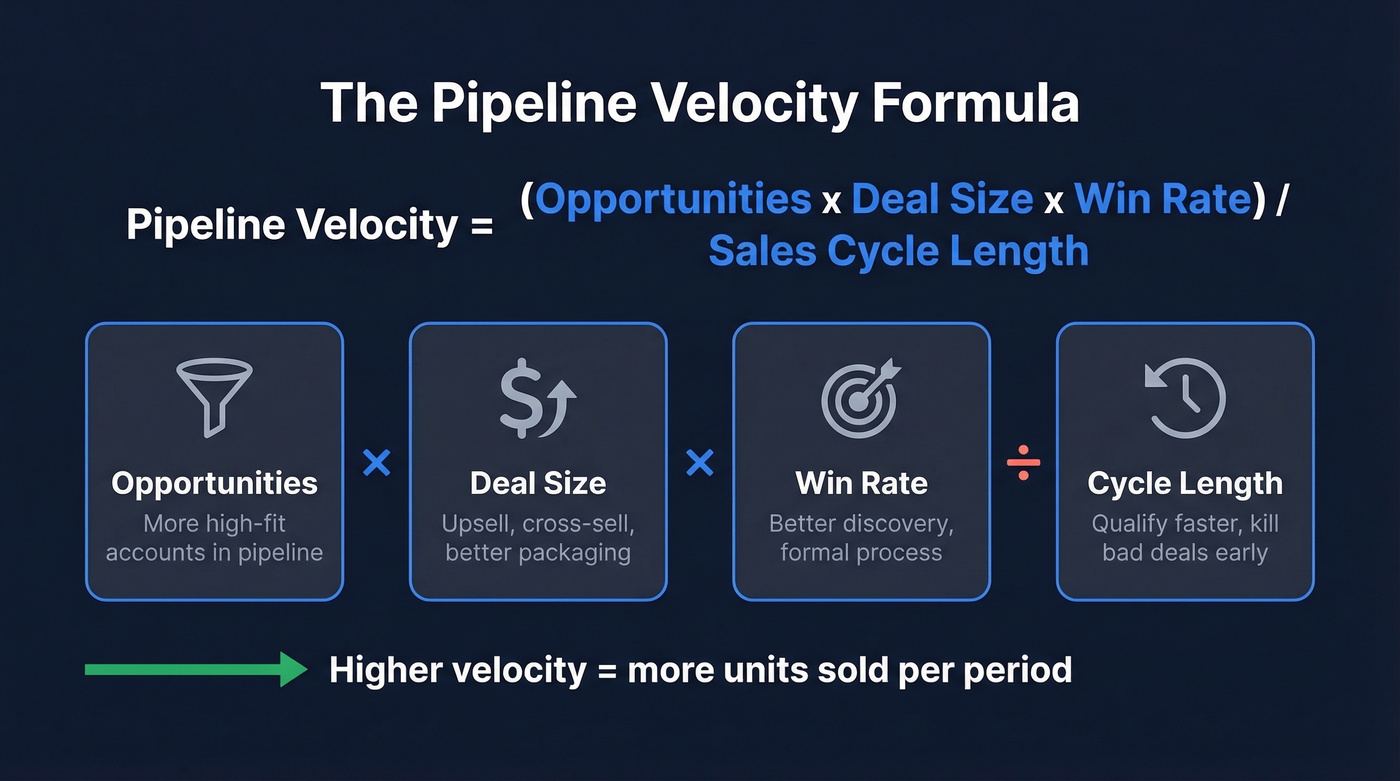
Pipeline Velocity = (Opportunities x Deal Size x Win Rate) / Sales Cycle Length
Every tactic for growing unit volume maps to one of these four levers. In our experience, most teams default to "more activity" when the real problem is one broken lever dragging the whole formula down. As Nancy Kapoor at Grazitti Interactive put it on Databox: you increase opportunities with best-fit prospects, connect price to value to lift deal size, optimize win rate through better discovery, and shorten the cycle by not treating every deal the same.

Snyk's 50 AEs went from a 35-40% bounce rate to under 5% - and AE-sourced pipeline jumped 180%. The lever they pulled? Data quality. Prospeo delivers 98% email accuracy on a 7-day refresh cycle at ~$0.01 per lead, so every rep touch actually reaches a real buyer.
Stop losing pipeline to bad data. Start your free account now.
Four Levers to Boost Sales Volume
1. Generate More Opportunities
More pipeline doesn't mean more random pipeline. High-velocity teams should target 100-300 active accounts per rep. Box cut rep books from thousands down to 200-250 high-potential accounts and saw better coverage immediately. Another Gradient Works customer trimmed books to 300-400 and watched win rates climb from 13% to 20%+ in under a year.
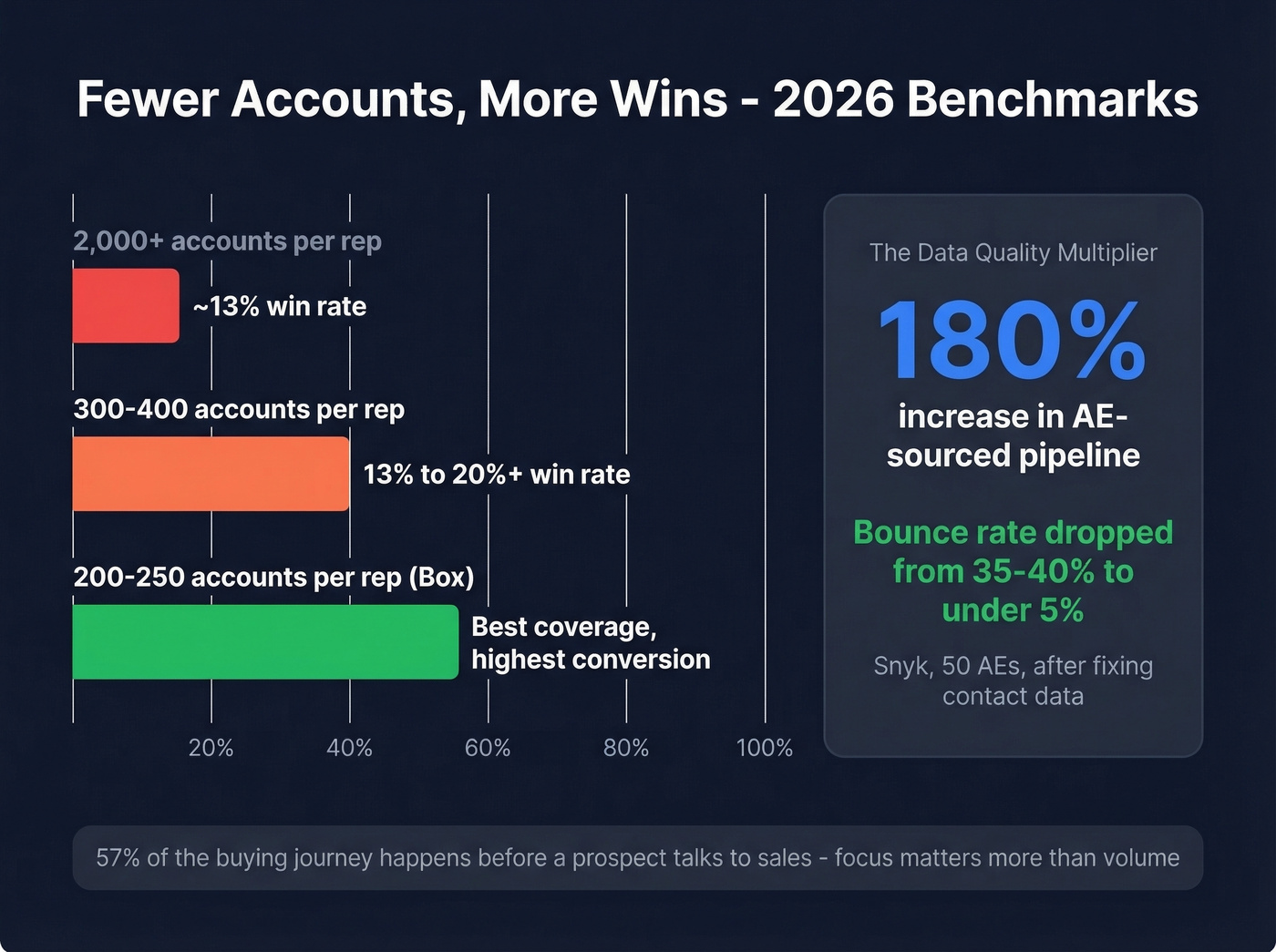
The math is counterintuitive - fewer accounts, more deals. That's because 57% of the buying journey happens before a prospect talks to sales. Spread reps across 2,000 accounts and they simply can't do the research that matters. They end up sending generic emails to stale contacts, and the bounce rates prove it.
There's a constraint most teams ignore: data quality. Snyk's 50 AEs were prospecting 4-6 hours per week with a 35-40% email bounce rate. After switching to Prospeo's verified contact data, AE-sourced pipeline jumped 180% and they generated 200+ new opportunities per month. At roughly $0.01 per lead with 98% email accuracy on a 7-day refresh cycle, it was the cheapest pipeline fix available to them.

2. Increase Average Deal Size
Upselling and cross-selling contribute roughly 21% of company revenue on average. The opportunity isn't adoption - 91% of reps already upsell, and 87% cross-sell. It's execution.
| Tactic | Typical Impact | Why It Works |
|---|---|---|
| Dynamic pricing optimization | +18% margin | Improves price realization without relying on discounting |
| Cross-sell at renewal | +15-25% ACV | Buyer trust is highest post-implementation |
| Tiered packaging | +10-20% deal size | Anchoring effect drives mid-tier selection |
Dynamic pricing matters more than most teams realize. One case study showed an 18% margin improvement without hurting volume. When buyers see ROI clearly, deal size expands without discounting. Let's be honest: if your reps are leading with discounts instead of value, you're training buyers to wait for the end-of-quarter fire sale.
3. Improve Your Win Rate
43% - that's how much top-performing reps talk on calls. Average reps hit 65%. That Gong data tells you everything about why discovery beats pitching.
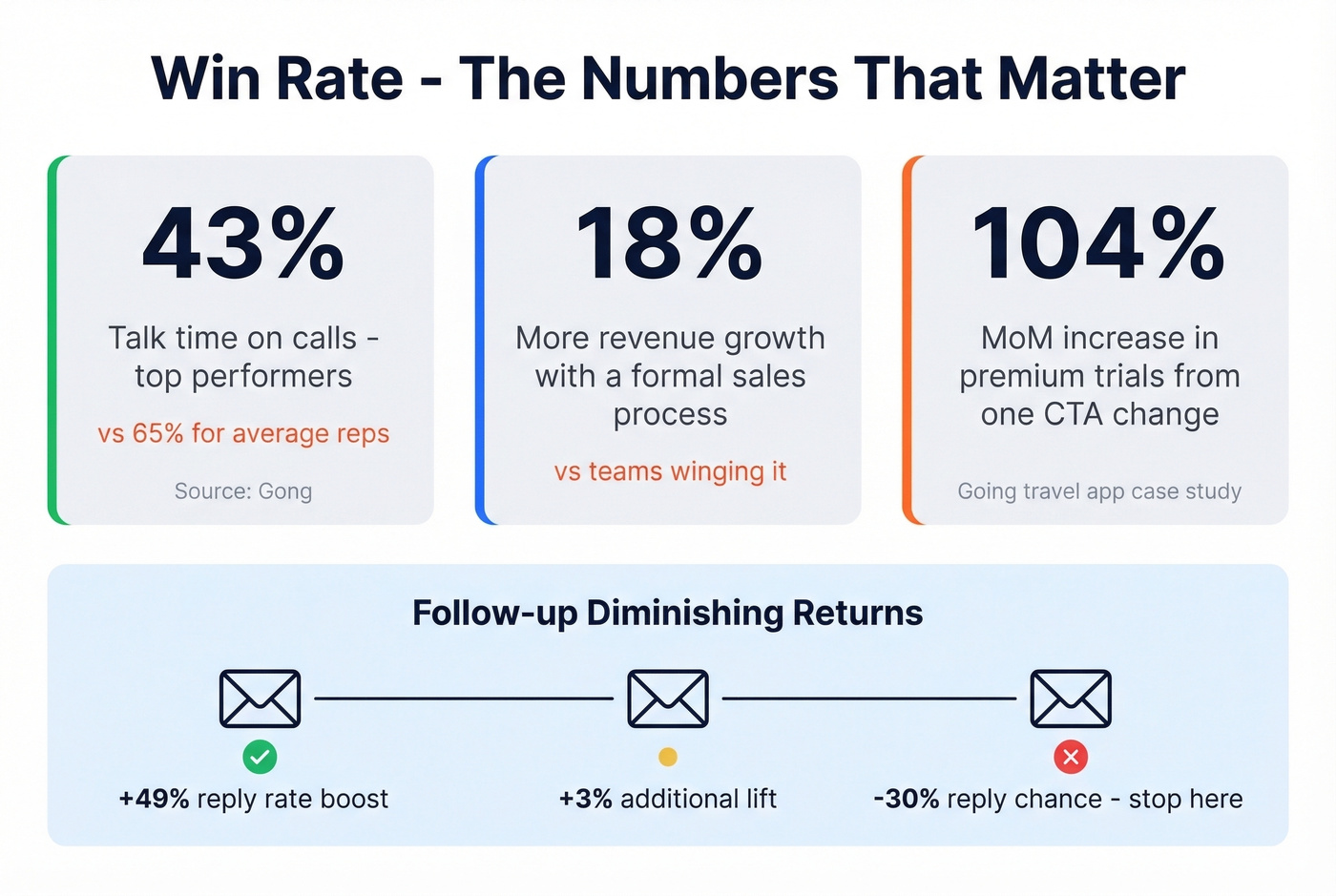
Companies with a formal sales process see 18% more revenue growth than those winging it. And the impact of small changes can be dramatic: Going, a travel deals app, tested a single CTA change and saw a 104% month-over-month increase in premium trial starts.
A simple shift that often helps: move language from "we offer" to customer-first phrasing like "you could..." Small language shifts compound. Your first follow-up email boosts reply rates by 49%. The second adds just 3%. The third actually decreases your chance of a reply by 30%. More isn't better - timing is. (If you need copy you can deploy fast, use these follow-up email patterns.)
4. Shorten the Sales Cycle
Opportunities closed within 50 days show a 47% win rate. After 50 days, that drops to about 20%.
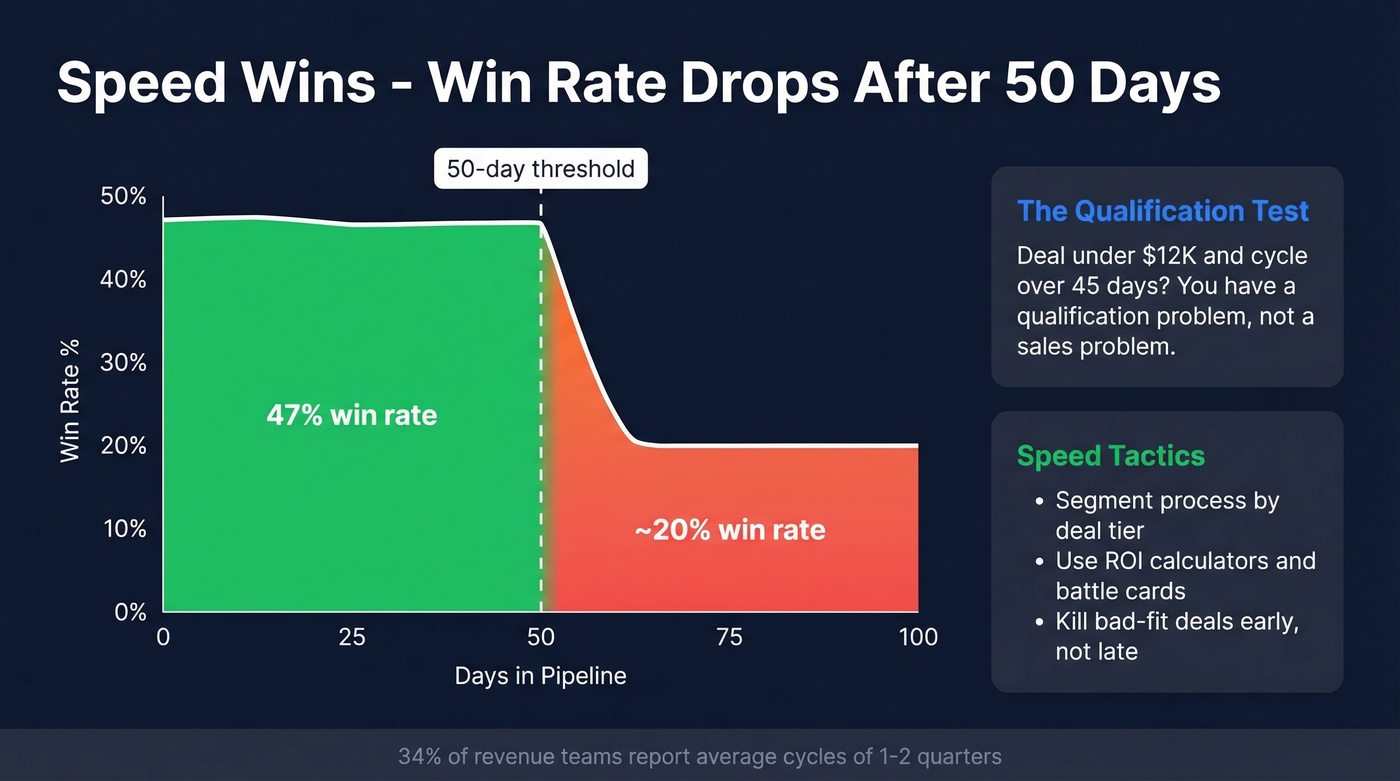
Speed isn't just efficiency - it's a leading indicator of whether the deal is real.
We've seen this pattern repeatedly: 34% of revenue teams report average cycles of 1-2 quarters, and the ones who break out of that bracket do it by segmenting their process. An $8K deal shouldn't follow the same 90-day gauntlet as a $50K enterprise contract. Sales enablement content - case studies, ROI calculators, competitive battle cards - removes the "let me check with my team" delays that kill momentum. (If you’re standardizing this, start with sales process optimization.)
Here's the thing: if your average deal is under $12K and your cycle exceeds 45 days, you don't have a sales problem. You have a qualification problem. You're letting bad-fit deals linger instead of killing them early.
Mistakes That Kill Sales Volume
Spreading reps across too many accounts. 2,000-account territories produce worse results than 300-account books with real coverage. Every time.
Over-following-up. That third email doesn't just fail - it actively hurts you by 30%. Two touches, then move on or change the angle entirely.
Ignoring data quality. If a third of your emails bounce, you don't have a volume problem. You have a data problem. 68% of sales teams report lead quality improved year-over-year - if yours hasn't, you're falling behind the curve fast. (Run a quick audit with these email bounce rate benchmarks.)
Tracking the wrong KPIs. Teams tracking 5-7 core KPIs achieve 91% average quota attainment. Teams tracking fewer than three? Just 73%. That gap is enormous.
No formal sales process. Winging it costs you 18% revenue growth. That's not a rounding error.

Metrics That Drive Sales Volume
Teams that focus on pipeline velocity see 23% faster revenue growth than those tracking only pipeline value. Velocity tells you which lever is dragging - and that's what makes it actionable rather than just informative. (For a tighter dashboard, use this pipeline health checklist.)
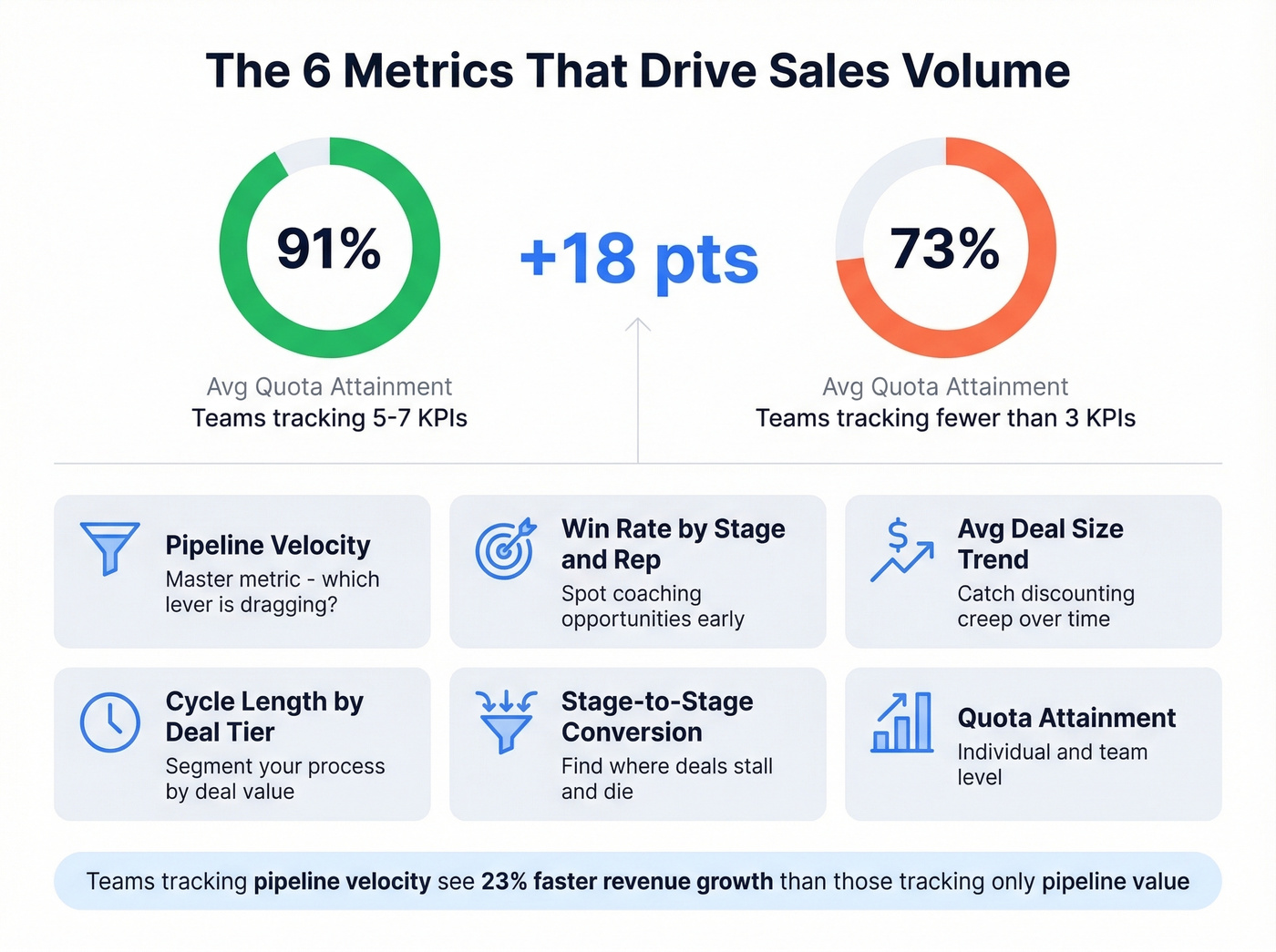
Your dashboard should include pipeline velocity as the master metric, win rate by stage and by rep, average deal size trending over time, sales cycle length by deal tier, conversion rate between each pipeline stage, and quota attainment at individual and team level. That's six metrics. Not twenty. Not three.
The 91% vs. 73% quota attainment gap between teams with disciplined KPI tracking and those without is the clearest signal in the data. If you're only watching revenue and activity volume, you're flying blind.
Fewer accounts with better data beats more accounts with stale contacts - every time. Prospeo gives your reps 300M+ verified profiles with 30+ filters for buyer intent, technographics, and headcount growth so they work focused books that actually convert.
Pull all four levers with data your reps can trust.
FAQ
What's the difference between sales volume and revenue?
Sales volume is units sold; revenue is dollars (volume x unit price). You can grow revenue by raising prices, but volume only increases when you close more deals. Track both - that's how you diagnose whether you have a pricing problem or a pipeline problem.
How do you calculate sales volume variance?
Subtract projected units from actual units sold, then multiply by price per unit. If you projected 500 deals and closed 420 at $4,000 each: (420 - 500) x $4,000 = -$320,000. Track this monthly to catch trends before they become quarterly misses.
What's the fastest way to increase sales volume?
Fix your weakest pipeline lever. For most teams, that's data quality - if 30-40% of outbound emails bounce, cleaning your contact database delivers the fastest lift with zero process change required. Snyk cut their bounce rate from 35-40% to under 5% and added 200+ opportunities per month just by fixing this one thing.
Which KPIs should I track to grow unit sales?
Track 5-7 core metrics: pipeline velocity, win rate by rep, average deal size, cycle length by tier, stage-to-stage conversion, and quota attainment. Teams monitoring this range hit 91% average quota attainment versus 73% for teams tracking fewer than three KPIs. Skip vanity metrics like total emails sent - they tell you nothing about what's actually working.