

How to Know Who Visited My Website in 2026
Ten thousand visitors hit your site last month. Forty-seven filled out a form. The other 9,953 browsed your pricing page, read two case studies, and vanished - taking their intent signals with them. That's not unusual: roughly 98% of website visitors never convert on a form, which means your analytics dashboard shows behavior without identity.
Let's fix that.
The Quick Version
Free baseline: GA4 tracks pages viewed, session duration, and traffic sources - but it won't tell you who visited. Start here, but understand its ceiling.
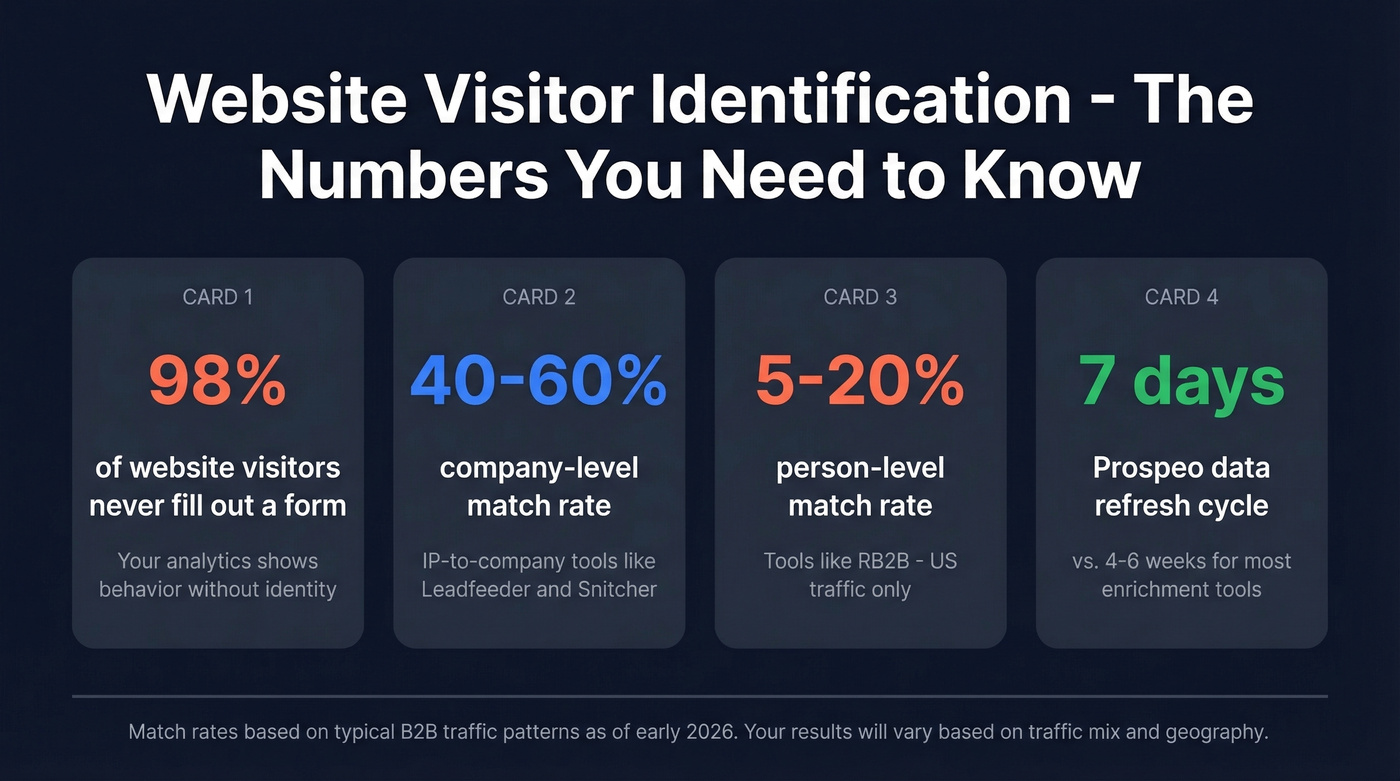
Company-level identification ($39-$149/mo): Tools like Leadfeeder or Snitcher match visitor IPs to company names. Expect 40-60% match rates for B2B traffic. You'll know someone from Datadog visited your pricing page, but not which person.
Person-level identification ($149-$399/mo): RB2B identifies some individual visitors by name and email - contact-level identification is US-only, with 5-20% match rates. Powerful when it hits, but it won't hit often.
Verify before outreach: Visitor ID tools surface contacts, but emails go stale fast. Run every address through Prospeo's email finder before sending - the free tier covers 75 emails/month.
What Google Analytics Actually Tells You
GA4 is genuinely useful for understanding what happens on your site. Which pages get traffic, how long visitors stay, where they came from, what conversion paths look like. In our experience, it's the right starting point for every team.
Here's what it can't do: identify anyone. Google's Terms of Service explicitly forbid sending PII into GA. GA4 doesn't expose IP addresses, doesn't show company names, and doesn't connect sessions to real people. The "Service Provider" and "Network Domain" dimensions that used to offer a rough company signal have shown "(not set)" since February 2020.
Under the hood, GA4 assigns each browser a client ID stored in a first-party _ga cookie that defaults to a roughly two-year expiration, but iOS Safari and privacy-focused browsers often cap it at 7 days, sometimes 24 hours. When consent is denied, GA4 models user counts instead of measuring them, which inflates the numbers.
| GA4 can | GA4 can't |
|---|---|
| Track page views and sessions | Identify visitors by name or company |
| Show traffic sources and referrals | Expose IP addresses |
| Measure conversion paths | Connect sessions to CRM contacts |
| Report device and geo data | Distinguish individual users across devices |
GA4 is your behavioral foundation. If you want to identify the actual people and companies behind those sessions, you need a different layer.
Three Ways Websites Identify Visitors
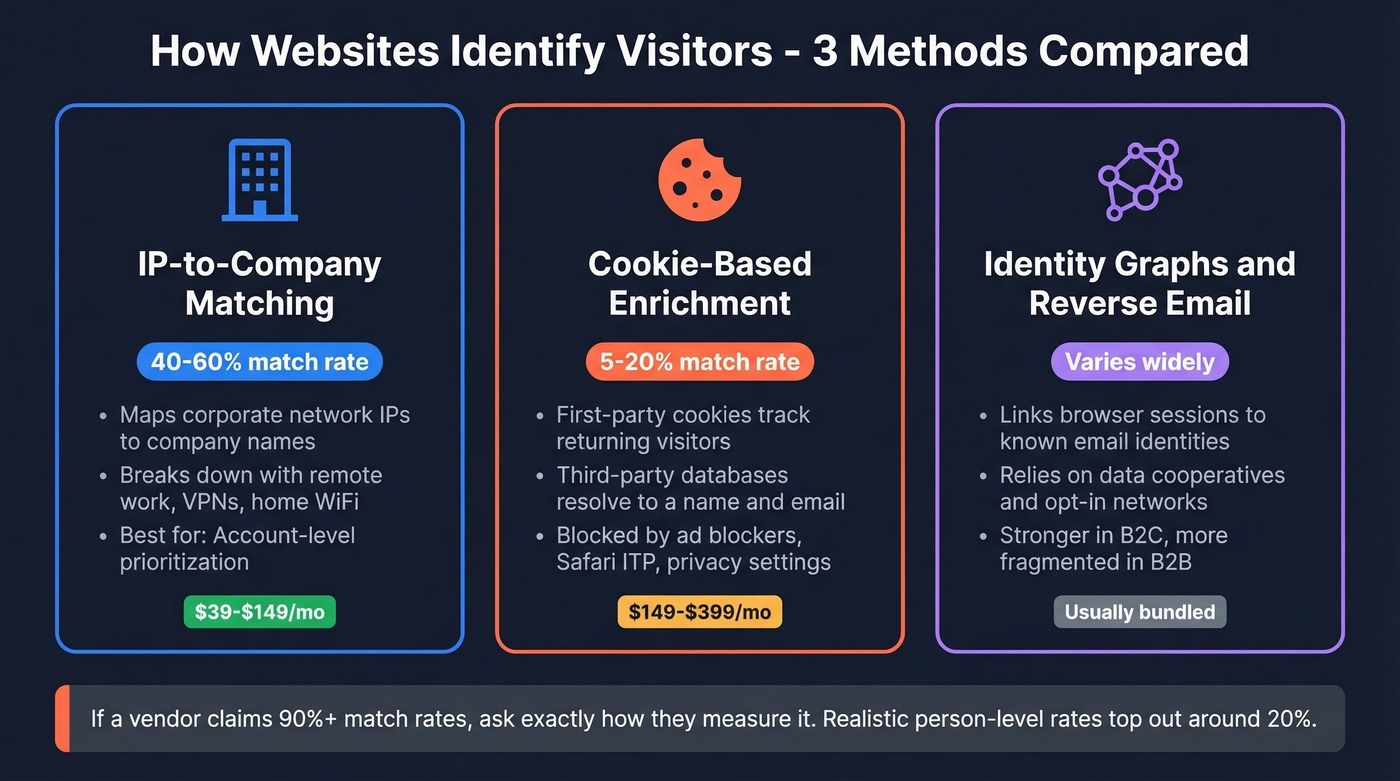
Every visitor identification tool uses one of three methods - or a combination. Understanding the mechanics helps you set realistic expectations and avoid vendors who oversell their match rates.
IP-to-Company Matching
The most common approach. When someone visits from a corporate network, their IP maps to a company through commercial IP databases. Tools like Leadfeeder and Snitcher use this to tell you "someone from Salesforce visited your pricing page."
The catch: over 60% of knowledge workers now browse from home ISPs, coffee shops, and VPNs - none of which map cleanly to a corporate IP. Remote work and shared workspaces have made IP-based identification less reliable year over year. Realistic company-level match rates sit around 40-60% for B2B traffic.
Cookie-Based Enrichment
First-party cookies track returning visitors across sessions, and some tools enrich that cookie data with third-party identity databases to resolve individual people - matching a browser fingerprint to a name and email.
Match rates are much lower: 5-20% at best. Privacy regulations, browser restrictions, and ad blockers all chip away at reliability. If a vendor claims 90%+ match rates, ask exactly how they measure it. The highest realistic company-level match rate is 60-70%; person-level claims above 20% deserve serious scrutiny.
Identity Graphs and Reverse Email
This method links visitors to known identities through email-based identity graphs - matching a browser session to someone who's already in a data cooperative or has opted in elsewhere. More common in B2C, where large consumer identity networks exist. For B2B, identity graphs are smaller and more fragmented, with higher-quality data but narrower coverage.
Best Tools to Identify Website Visitors
Here's the thing: most B2B teams should start with a company-level tool at $39-$149/mo, not a person-level tool. Company identification has 3-10x higher match rates, costs less, and gives you enough signal to prioritize accounts. Person-level tools are a layer you add later, once you've proven the workflow.
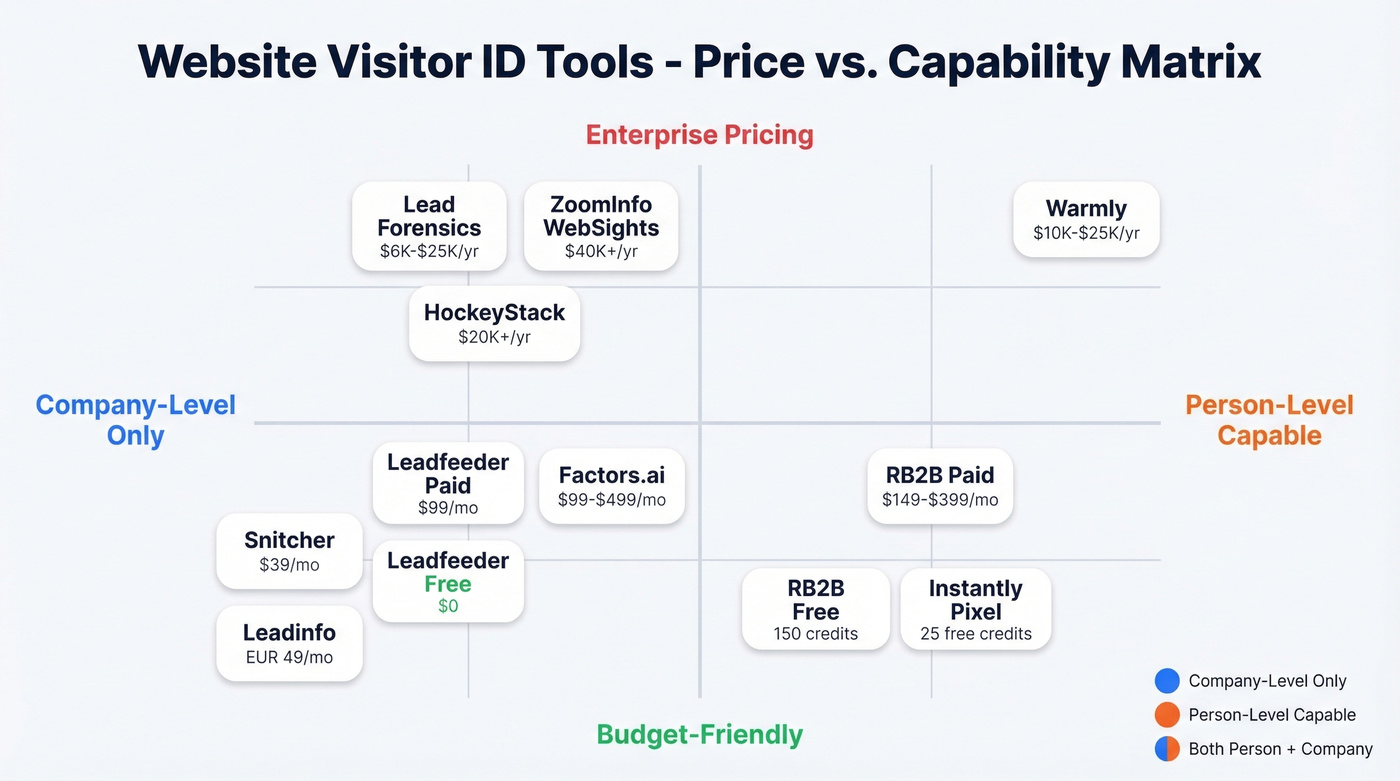
Pricing below reflects published rates as of early 2026.
| Tool | Type | Starting Price | Best For |
|---|---|---|---|
| Leadfeeder (Dealfront) | Company | Free / $99/mo | Most B2B teams |
| RB2B | Person | Free (150 credits) / $149/mo | US mid-market sales |
| Factors.ai | Company | $99/mo | Analytics + ID combo |
| Lead Forensics | Company | ~$6,000-$25,000/yr | Enterprise, high traffic |
| Warmly | Company + Person | Free / $10,000/yr | AI-driven orchestration |
| Instantly Pixel | Person | Credit-based (25 free) | Cold email teams on Instantly |
| Snitcher | Company | $39/mo | Budget SMBs |
| Leadinfo | Company | EUR 49/mo | European B2B teams |
| ZoomInfo WebSights | Company | ~$40,000+/yr | Enterprise ABM stacks |
| HockeyStack | Company | ~$20,000+/yr | Revenue attribution + ID |

Leadfeeder (Dealfront)
We recommend testing Leadfeeder's free plan first. You get 100 identified companies per month with 7 days of historical data - enough to validate whether your traffic mix supports IP-based identification before you spend anything.
Paid plans start at $99/mo billed annually for up to 50 identified companies, scaling to $215/mo for 201-400 companies and $509/mo for 3,001-5,000. Monthly billing runs higher. Pricing is per website, and ISP/low-quality traffic gets filtered so you're not paying for junk matches. CRM integrations are solid across Salesforce, HubSpot, and Pipedrive. Dealfront is a strong option for teams selling into Europe as well as the US.
Skip it if you need person-level identification - that's not what it does.
RB2B
RB2B is US-only for contact-level data. That's the first thing to know. If your traffic is primarily international, stop here and look at company-level tools instead.
For US mid-market and enterprise traffic, RB2B delivers something fundamentally different: a name, email, and job title attached to a website visit. The free plan includes 150 monthly credits. Person-level requires the $149/mo plan with 600 resolutions or $399/mo for 2,500. Third-party reviewers and the consensus on r/sales consistently note that RB2B generates noise from junior employees and irrelevant roles - you'll need to filter aggressively by seniority and department, or you'll waste credits on interns who stumbled onto your site.
Factors.ai
Skip this if you already have an analytics stack you're happy with. Factors.ai makes sense specifically when you're shopping for marketing analytics and visitor ID at the same time, because it bundles both. Their deanonymization claims up to 64% of visiting companies identified, which sits at the high end of realistic ranges.
Pricing runs $99/mo for Starter, $149/mo for Professional, and $499/mo for Growth.
Lead Forensics
Lead Forensics is overpriced for most mid-market teams. You're paying enterprise rates for the same IP-matching technology Snitcher offers at $39/mo. Based on contract analysis of 47 real deals, the Essential plan runs $6,000-$25,000/yr and the Automate plan $25,000-$95,000/yr, with an average contract around $35,000/yr. Add-ons for contact data and advanced integrations push costs higher. Only worth it if you're processing thousands of daily visitors and need enterprise-grade support.
Warmly
Combines company and person-level identification with AI-driven orchestration - automated chat, meeting scheduling, and signal-based workflows. Paid tiers run $10,000-$25,000/yr. Uses a waterfall approach across 20+ data providers, which improves match rates but makes it hard to audit sourcing.
Instantly Pixel
If you're already running cold email through Instantly, their pixel is the path of least resistance. 25 free person-level identifications, with additional credits on a usage-based model. Data flows directly into Instantly campaigns, and visitors push to a Slack channel for real-time follow-up.
Snitcher, Leadinfo, ZoomInfo WebSights, HockeyStack
Snitcher ($39/mo for 100 identifications) is the budget entry point for company-level ID. Clean interface, basic CRM integrations. Good for small teams testing the concept.
Leadinfo (EUR 49/mo for 100 visitors, scaling to EUR 499/mo for 10,000) is the strong choice for EU-based B2B teams who want GDPR-compliant identification with local support.
ZoomInfo WebSights - skip this unless you're already locked into a ZoomInfo contract. Enterprise ABM play bundled into ZoomInfo's broader platform, typically $40,000+/yr as part of a larger deal.
HockeyStack is a revenue attribution platform with visitor identification as a feature, not the core product. Their tracking script runs under 10KB and uses SHA256-based fingerprinting - a cookieless approach that reduces reliance on cookies. Expect enterprise-level contracts starting around $20,000+/yr.

Website visitor tools tell you who visited. Prospeo tells you how to reach them. Run any identified contact through 300M+ profiles with 98% email accuracy - verified on a 7-day refresh cycle so you're not emailing someone who left that company last quarter.
Stop identifying visitors you can't actually contact.
The Step Most Teams Skip
We see this pattern constantly. A team sets up RB2B or Leadfeeder, exports identified visitors with emails, loads them into a sequence tool, and launches outreach. Three days later, their bounce rate is 18% and their domain reputation is tanking.
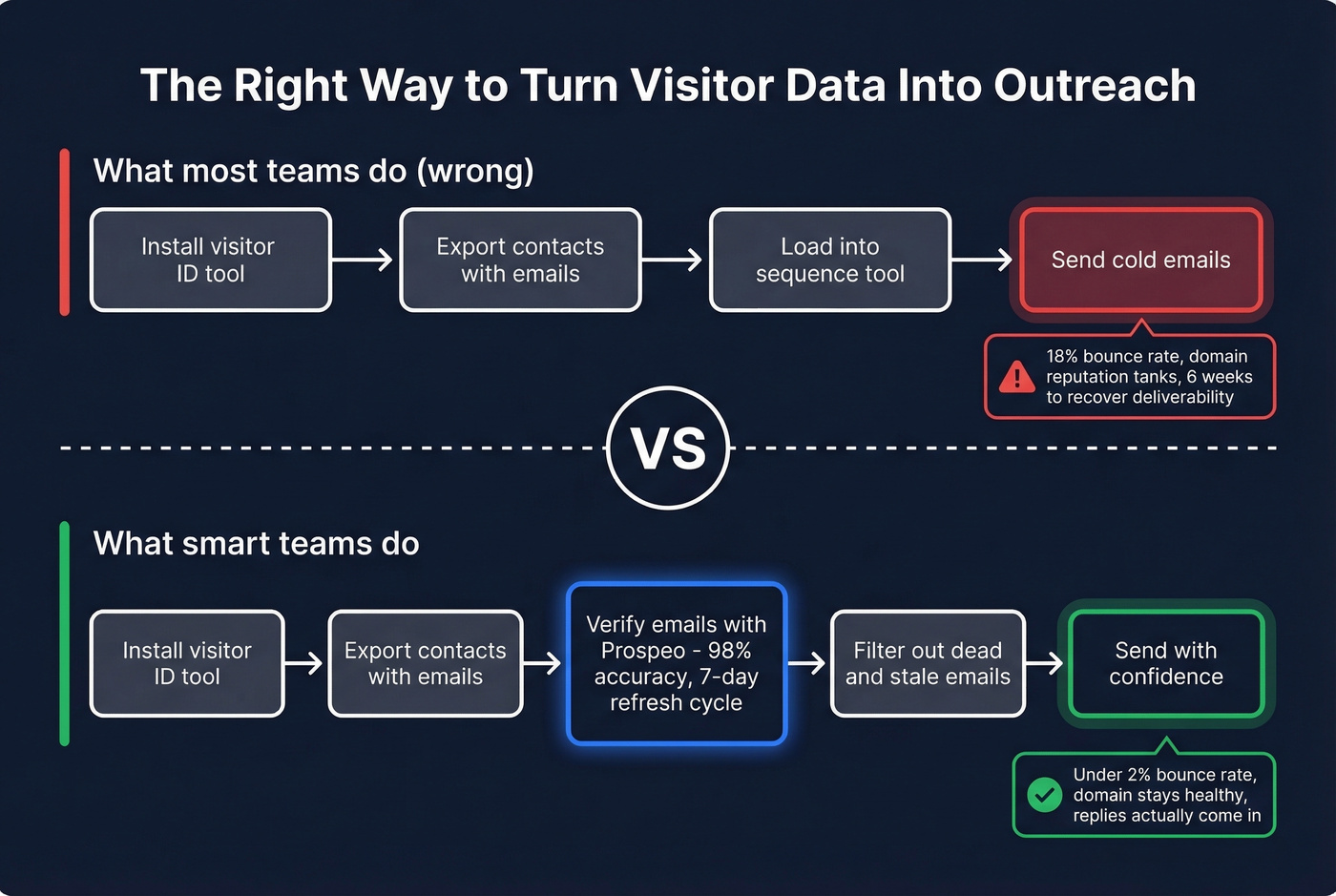
Visitor ID tools surface the company or person. They don't guarantee the email is still valid.
People change jobs, companies rotate domains, and enrichment databases go stale. One bounced campaign to a dead email can trigger spam filters that affect your entire sending domain for weeks. I've watched a 12-person sales team lose their primary sending domain over a single unverified batch of 400 contacts - it took them six weeks to recover deliverability.
The fix is simple: verify before you send. Prospeo checks emails in real time with 98% accuracy on a 7-day data refresh cycle - not the 4-6 week refresh most enrichment tools run on. Export the CSV from your visitor ID tool, upload it to Prospeo's enrichment engine, and you'll know which emails are live before you hit send.
Privacy and Compliance
Visitor identification sits in a legal gray area that gets grayer the closer you get to individual-level data. Company-level identification is generally safer - you're matching an IP to an organization, not a person. Person-level identification is where compliance risk increases, especially under GDPR.
There's also an ethical dimension worth acknowledging. The line between helpful intent tracking and surveillance is thinner than most vendors admit. Just because you can identify someone doesn't mean you should blast them with a cold email 30 seconds after they leave your site. Use the data to be relevant, not creepy.
| GDPR | CCPA/CPRA | |
|---|---|---|
| Consent model | Opt-in | Opt-out |
| Max penalty | EUR 20M or 4% revenue | $7,500/violation |
| IP = personal data? | Yes | Yes |
Meta's EUR 1.2B GDPR fine in 2023 made the stakes concrete. GDPR treats IP addresses as personal data, and CCPA includes them in personal information, which means even company-level identification tools need proper consent infrastructure.
Your cookie consent banner needs to meet these requirements:
- Granular cookie categories - Functional, Analytics, and Marketing as separate choices
- No pre-ticked boxes - consent must be affirmative
- A "Reject All" button alongside "Accept All" - regulators are targeting dark patterns
- A visible "Cookie Preferences" link on every page
- Backend tracking that matches banner promises - if someone rejects marketing cookies, your pixel can't fire
One practical tip: filter out companies with fewer than 5 employees from your identification results. When a "company" has 3 people, identifying the company is effectively identifying the person - and that's where regulators get uncomfortable.
What to Do After Identifying Visitors
Identification without action is just expensive analytics.
Move fast. Contact within 5 minutes of a visit makes you 21x more likely to qualify the lead. Within an hour, that drops to 7x. If you can't respond in real time, set up automated Slack alerts for high-intent pages at minimum.
Segment by intent signal. A visitor who hit your pricing page twice is a fundamentally different lead than someone who read a blog post once. Route pricing-page visitors to sales immediately. Nurture blog readers with content. Most tools let you filter by visit frequency - use it to surface your hottest leads.
Personalize the outreach. "I noticed your team was evaluating our API documentation - here's a technical walkthrough" is infinitely better than a generic cold email. Reference specific pages or you're wasting the data. "I saw you visited our website" without context is creepy and unhelpful.
Verify emails before launching any sequence. Run every address through a verification tool first. One bounced campaign can damage your domain reputation for weeks. If you're building a repeatable outbound motion, align this with your broader email deliverability process.
Push data to your CRM automatically. If identified visitors sit in a spreadsheet instead of flowing into Salesforce or HubSpot, your sales team won't act on them. We've seen teams pay $500/mo for visitor identification and never connect it to their CRM. That's not a tool problem - it's an implementation problem. A lightweight contact management setup is often enough to start.
Mistakes That Waste Visitor Data
Most teams waste their visitor data in predictable ways.
Treating all visitors the same. A pricing page visit signals buying intent. A blog visit signals curiosity. Prioritize ruthlessly - your SDRs don't have time to chase every identified company. This is where lead scoring pays for itself.
Slow follow-up. The difference between 5 minutes and 1 hour is a 3x drop in qualification likelihood. Speed matters more than perfection here. If you need copy you can deploy fast, keep a set of sales follow-up templates ready.
Ignoring return visitors. Someone who visits three times in a week is signaling intent that a single-visit company isn't. Set up alerts for repeat visits - this is where your warmest leads hide. Treat these as buying signals, not vanity traffic.
No CRM integration. If data doesn't flow to sales, it's worthless. Connect the pipe or don't bother paying for the tool. If you're standardizing your stack, it helps to map the workflow to a few sales prospecting techniques your team will actually use.
RB2B matched a name. Leadfeeder matched a company. Now what? Prospeo's email finder verifies every address through a 5-step process - catch-all handling, spam-trap removal, honeypot filtering - so your outreach lands in inboxes, not bounce logs. 75 free emails/month, no contract.
Turn anonymous traffic into verified, reachable contacts at $0.01 each.
FAQ
Can I see individual names of website visitors?
Person-level tools like RB2B can identify some individuals, but match rates run 5-20% and are US-only. Most tools only reveal the company name. No tool identifies 100% of visitors - anyone claiming otherwise is misrepresenting their methodology.
Is website visitor identification legal?
Company-level identification is generally permissible under GDPR and CCPA with proper consent banners. Person-level tracking requires explicit opt-in under GDPR, and is safer under CCPA's opt-out model. Always implement granular cookie consent with a visible "Reject All" button.
What about VPNs and remote workers?
VPNs and remote work degrade IP-based identification significantly. This is the primary reason company-level match rates cap around 40-60% - and why person-level tools using cookie enrichment are gaining traction despite lower overall match rates.
How do I verify contact data before outreach?
Export your identified visitor list as a CSV and run it through a verification tool before sending. Prospeo's enrichment engine returns 50+ data points per contact at an 83% match rate with 98% email accuracy - and the free tier covers 75 verifications per month. Skipping this step is how teams end up with 15%+ bounce rates and damaged sender reputation.
Does visitor tracking work for B2C websites?
Most visitor ID tools are built for B2B. B2C match rates drop to 15-30% because consumer traffic rarely comes from identifiable corporate IPs. For B2C, look at consumer identity resolution platforms or retargeting pixels instead.