

How to Overcome Price Objections Without Dropping Your Price
You just quoted $12,800. The prospect expected $10,000. You can feel the deal slipping, and you're already mentally calculating what to cut.
Here's the thing: that "your price is too high" moment is rarely about the number on the page. 96% of B2B prospects research before they ever talk to you, and 71% prefer doing that research independently. They walked into your call with a price anchor already set - from a competitor's website, a peer's offhand comment, or pure gut feel. Learning how to overcome price objections starts with replacing that anchor, not matching it.
Diagnose Before You Respond
Stop memorizing 25 scripts. Every price objection has one of three root causes, and the response is different for each.
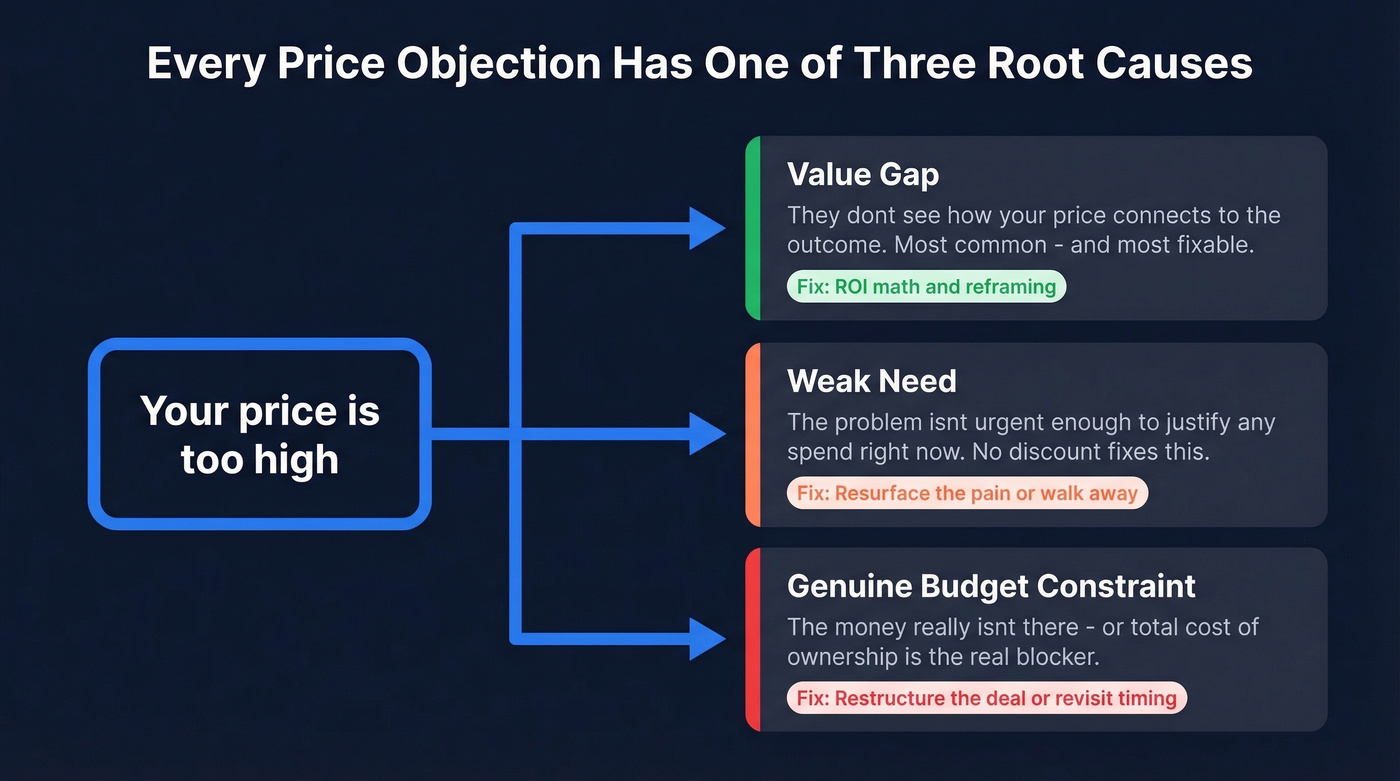
1. The value gap. The buyer doesn't connect your price to the outcome. They're comparing you to a cheaper competitor, or they haven't internalized what the problem costs them today. This is the most common cause - and the most fixable. (If you need a tighter way to frame outcomes, see how to add value in sales.)
2. Weak need. "Too expensive" is sometimes a polite exit. The problem you solve isn't urgent enough to justify any spend right now. No discount fixes a prospect who doesn't feel the pain.
3. Genuine budget constraint. Sometimes the money really isn't there. But dig deeper - total cost of ownership (implementation, training, switching costs) often drives more resistance than the sticker price itself.
We've watched reps burn 30 minutes defending a price when the real issue was that the prospect didn't feel enough pain to buy anything. Diagnose first, respond second.
When to Discuss Price
If a prospect asks about pricing in the first five minutes, you haven't earned the right to quote a number. Four gates need to clear first:
- Deep discovery complete - you understand their pain, not just their title (use sharper discovery questions to get there faster)
- Business case sketched - you can quantify the cost of inaction
- Decision-maker aligned - don't quote pricing to someone who can't approve it (this is where MEDDPICC economic buyer discipline pays off)
- Executive sponsorship validated - someone with budget authority knows you exist
If they push early, try: "To give you the most accurate price, can I first learn about your priorities? It really depends on what you need." If they push harder, give a wide range and move on. Don't anchor yourself before you understand the deal.
Two Frameworks That Handle Pricing Resistance
If you remember one framework, make it ACAC. Selling enterprise? Learn LAER too.
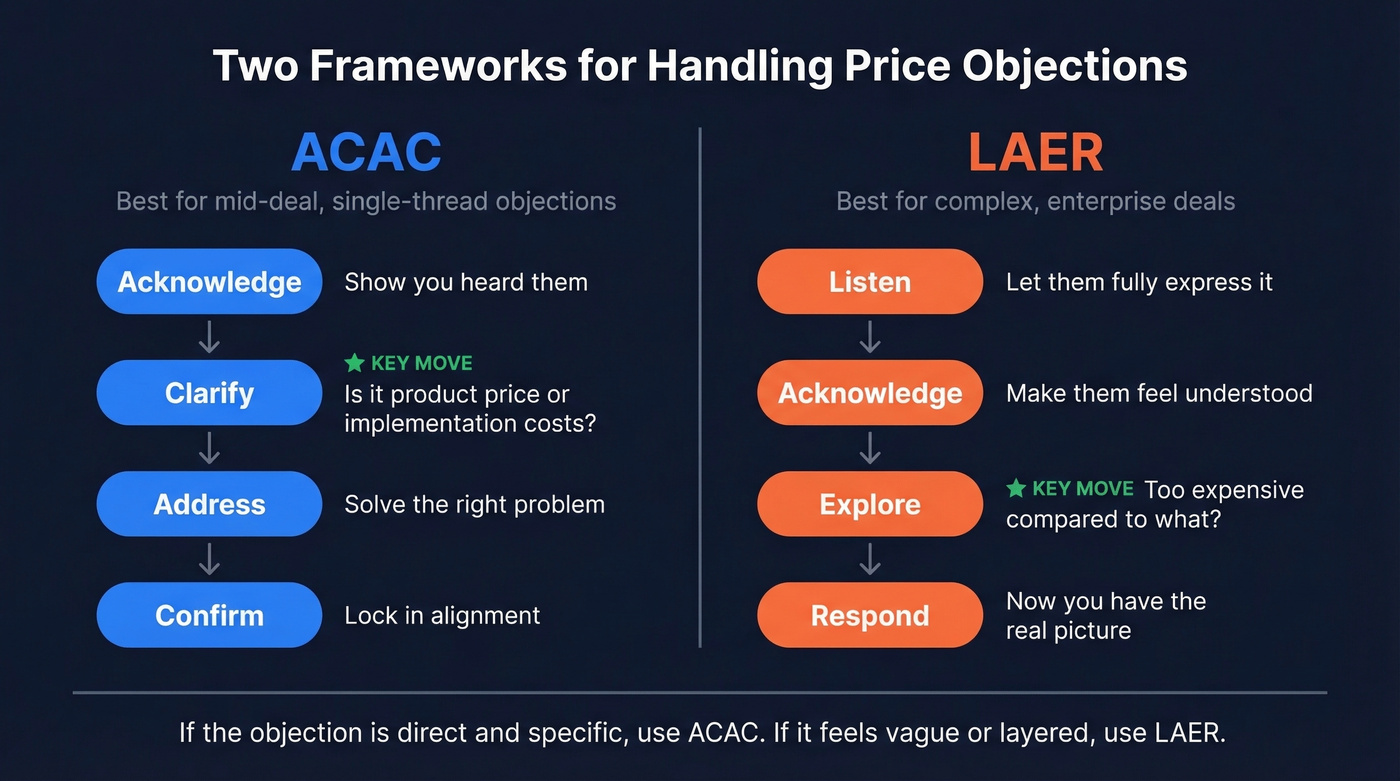
ACAC: Acknowledge, Clarify, Address, Confirm
Built for mid-deal objections where the relationship is warm. The key move is Clarify - it forces the buyer to articulate the real issue: "Is it the product price or the implementation costs that concern you most?" Don't skip it. Most reps jump straight from Acknowledge to Address and end up solving the wrong problem.
LAER: Listen, Acknowledge, Explore, Respond
Better for complex, multi-stakeholder deals where the objection is a proxy for something else entirely. The Explore phase goes deeper: "Too expensive in relation to what?" As Chris Voss writes in Never Split the Difference, people are willing to be influenced by those they feel understood by. LAER is built around that principle, and it works because enterprise buyers rarely say what they actually mean the first time.
| ACAC | LAER | |
|---|---|---|
| Best for | Mid-deal, single-thread | Complex, enterprise |
| Key question | "Product price or implementation?" | "Too expensive compared to what?" |
| When to use | Objection is direct and specific | Objection feels vague or layered |
Scripts That Work on Actual Calls
The most effective price-objection response is a question, not a statement. Pricing pushback usually signals a gap in certainty, clarity, or alignment - your job is to figure out which one.
Here are five you can use tomorrow:
- "Too expensive compared to what?" - Forces the buyer to name their anchor. Half the time, they can't, which tells you the objection is emotional.
- "What happens if this problem isn't solved in 6 months?" - Shifts the conversation from your cost to their cost of inaction.
- "If budget wasn't an issue, would this be the right fit?" - Isolates whether it's truly a budget problem or a value problem wearing a budget mask.
- "What's the biggest risk in proceeding? What about in staying with the status quo?" - Perfect for late-stage stalls where decision anxiety is the real blocker.
- "Let's look at what this costs per month versus what you're losing per month without it." - Reframes the entire conversation from expense to investment math.
That last one is the one we've seen work most consistently in our own sales conversations. It turns the abstract ("too expensive") into something concrete and comparative.

Price objections get worse when your pipeline is thin and every deal feels do-or-die. Prospeo gives you 300M+ profiles with 98% email accuracy at $0.01/email - so you always have another conversation waiting. Teams using Prospeo book 35% more meetings than Apollo users.
Walk into every pricing conversation with pipeline confidence behind you.
Build a One-Slide ROI Case
Every sales training deck says "sell on value, not price." Nobody tells you how to actually calculate that value. A clear ROI case is the single most effective way to neutralize pricing concerns before they even surface.
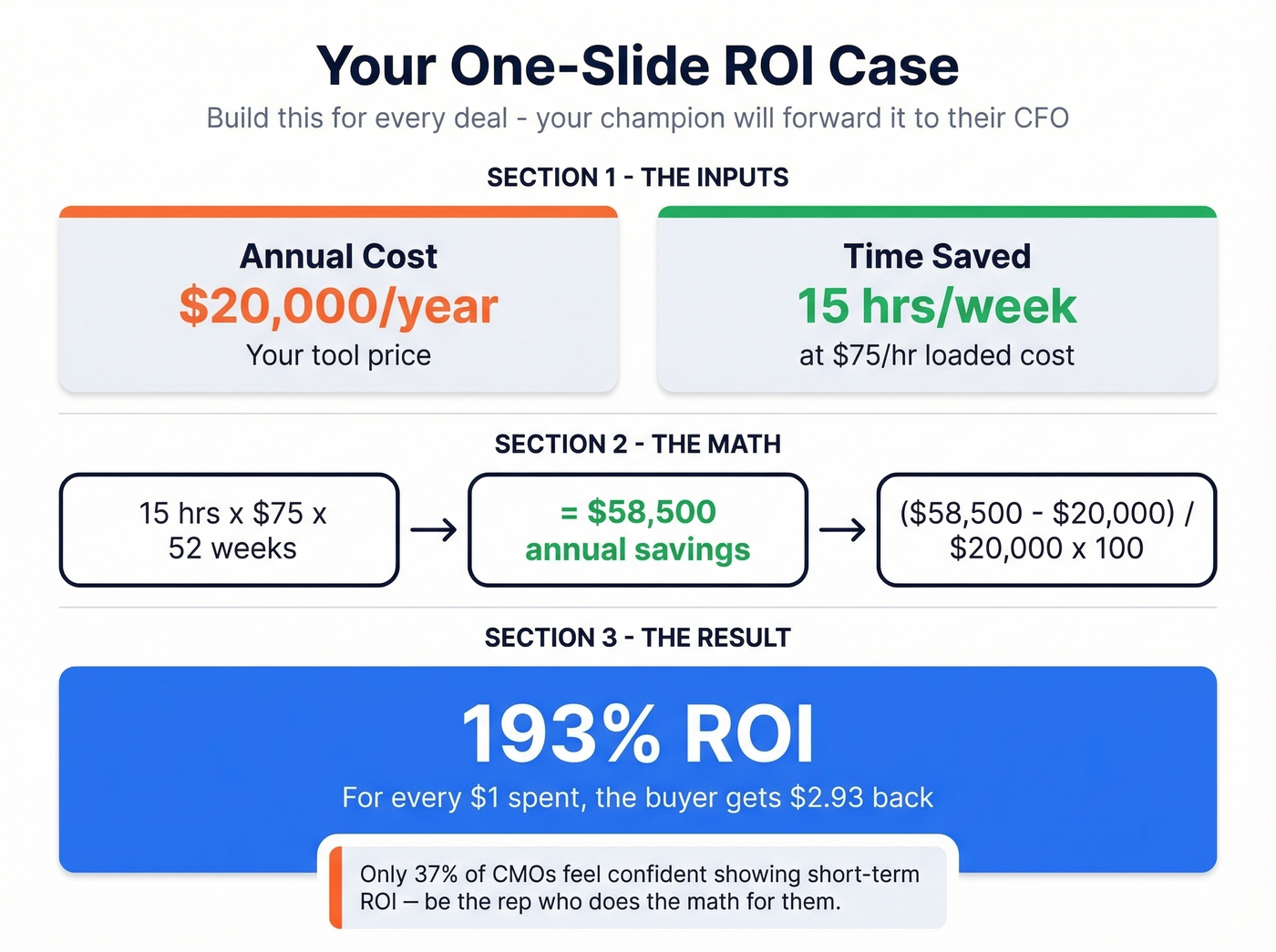
ROI = (Net Benefit / Cost) x 100
Worked example: your tool costs $20,000/year. It saves 15 hours/week of manual work at $75/hour loaded cost - that's $58,500 in annual savings (15 x 75 x 52). ROI = (($58,500 - $20,000) / $20,000) x 100 = 193%.
Here's why this matters: only 37% of CMOs say they're confident showing short-term ROI, and just 31% can demonstrate long-term ROI. Your champion faces the same challenge internally. Build the one-slide business case they can forward to their CFO without editing a single number.
If you can't calculate your own ROI for the buyer in under two minutes, you deserve the price objection. That's not the prospect's failure - it's yours.
Mistakes That Kill Your Pricing Power
The fastest way to make price objections worse is to emphasize price over value. If your first instinct is to explain your pricing tiers, you've already lost the frame. Lead with outcomes, not line items.
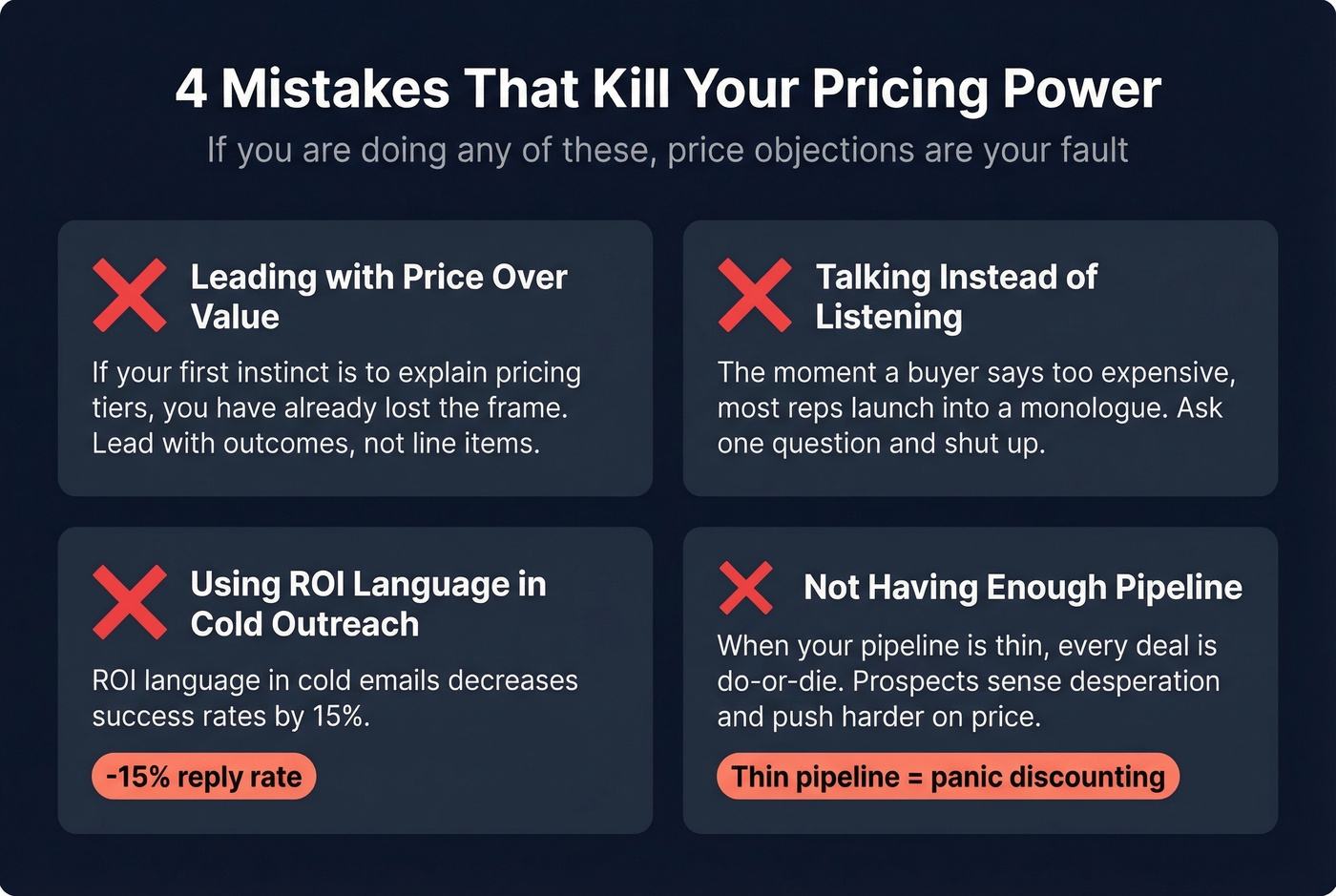
The second mistake is talking instead of listening. The moment a buyer says "too expensive," most reps launch into a monologue. Resist. Ask one question and shut up.
Third - and this surprises people - using ROI language in cold outreach backfires. Gong's research shows ROI language in cold emails decreases success rates by 15%. "Lead with value" works on calls, not in the first email a stranger reads. (For better outreach structure, borrow from these sales follow-up templates.)
Finally, not having enough pipeline to walk away is the silent killer. When your pipeline is thin, every deal becomes do-or-die, and you panic-discount. Prospects sense desperation and push harder on price because your positioning erodes. The root cause is often upstream: unreliable contact data means bounced emails, fewer conversations, and fewer at-bats. Fixing data quality - tools like Prospeo with 98% email accuracy across 300M+ profiles - means you always have another conversation waiting, and that confidence shows up in how you hold your price. (If you're pressure-testing your top-of-funnel, start with sales prospecting techniques and sales pipeline challenges.)
The article above proves it: the best defense against price objections is a full pipeline. Prospeo's 7-day data refresh and 98% verified emails mean fewer bounces, more at-bats, and zero desperation discounting. One agency tripled their pipeline from $100K to $300K/week.
Fix your pipeline upstream so you never flinch on price again.
Enterprise Deals Are Different
In enterprise, "your price is too high" often comes from procurement, not from the person who actually wants your product. The fix isn't better scripts - it's multi-threading.
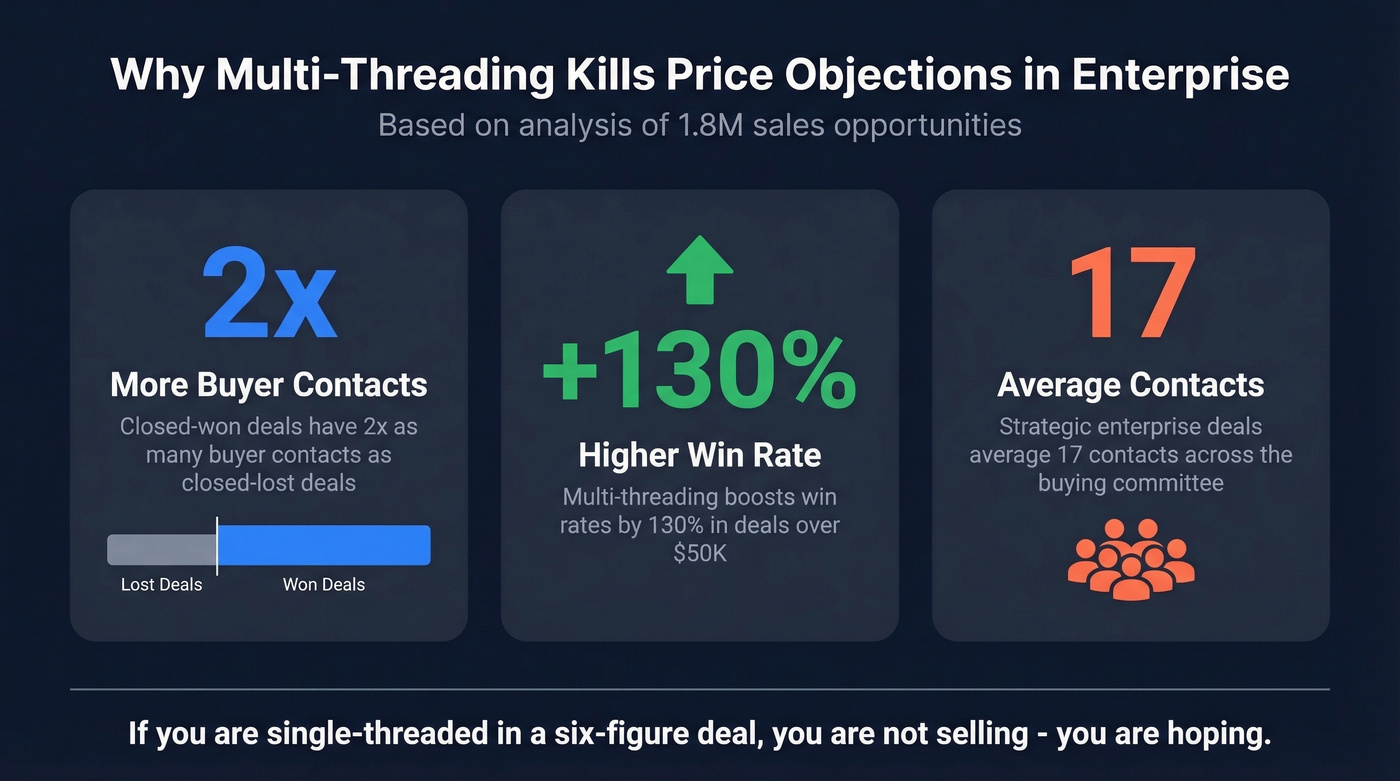
An analysis of 1.8M opportunities found that closed-won deals have 2x as many buyer contacts as closed-lost. In deals over $50K, multi-threading boosts win rates by 130%, and strategic enterprise deals average 17 contacts. More internal allies means less resistance when procurement tries to squeeze you on price. Let's be honest - if you're single-threaded in a six-figure deal, you're not selling. You're hoping. (For a deeper enterprise motion, see enterprise B2B sales.)
Skip the multi-threading playbook if you're selling sub-$10K deals to single decision-makers. It'll slow you down more than it helps. But the moment you're above $25K with a buying committee, it's non-negotiable.
Price Objection FAQ
What's the best response to "your price is too high"?
Ask "too expensive compared to what?" to surface their price anchor, then reframe around value and ROI. Never lead with a discount - it validates the objection and trains the buyer to push harder next time.
Should you ever discount to close a deal?
Only if you get something back. A shorter contract term, case study rights, expanded scope, a faster close date, or a multi-year commitment are all fair trades. Never discount without a concession in return.
When should you bring up pricing?
After deep discovery, a quantified business case, and decision-maker alignment. Introducing price before the buyer connects emotionally to the pain is what creates the objection in the first place.
How do you handle price objections in enterprise deals?
Multi-thread across stakeholders - closed-won enterprise deals have 2x more buyer contacts than lost ones. Build allies across the buying committee so procurement can't kill the deal on price alone. The consensus on r/sales is that single-threaded enterprise deals are dead deals walking, and the data backs that up.