

How to Overcome Sales Objections: What 300M Cold Calls Actually Reveal
You don't need 50 scripts pinned to your monitor. Analysis of 300M+ cold calls found that just five objections account for 74% of all pushback. That's it. Learning how to overcome sales objections starts with mastering a small set, responding with discipline, and letting fewer conversations stall at the same predictable friction points.
Quick version: Master 5 objections. Pause 5x longer than feels comfortable. Diagnose before you rebut - the first objection is almost never the real one.
The 9 Types of Sales Objections
Outreach's framework breaks objections into nine categories: price, timing, authority, need, competitor, product, trust, indifference, and risk. That's useful for taxonomy, but frequency matters more. Gong's data collapses real-world objections into three buckets with wildly uneven distribution:
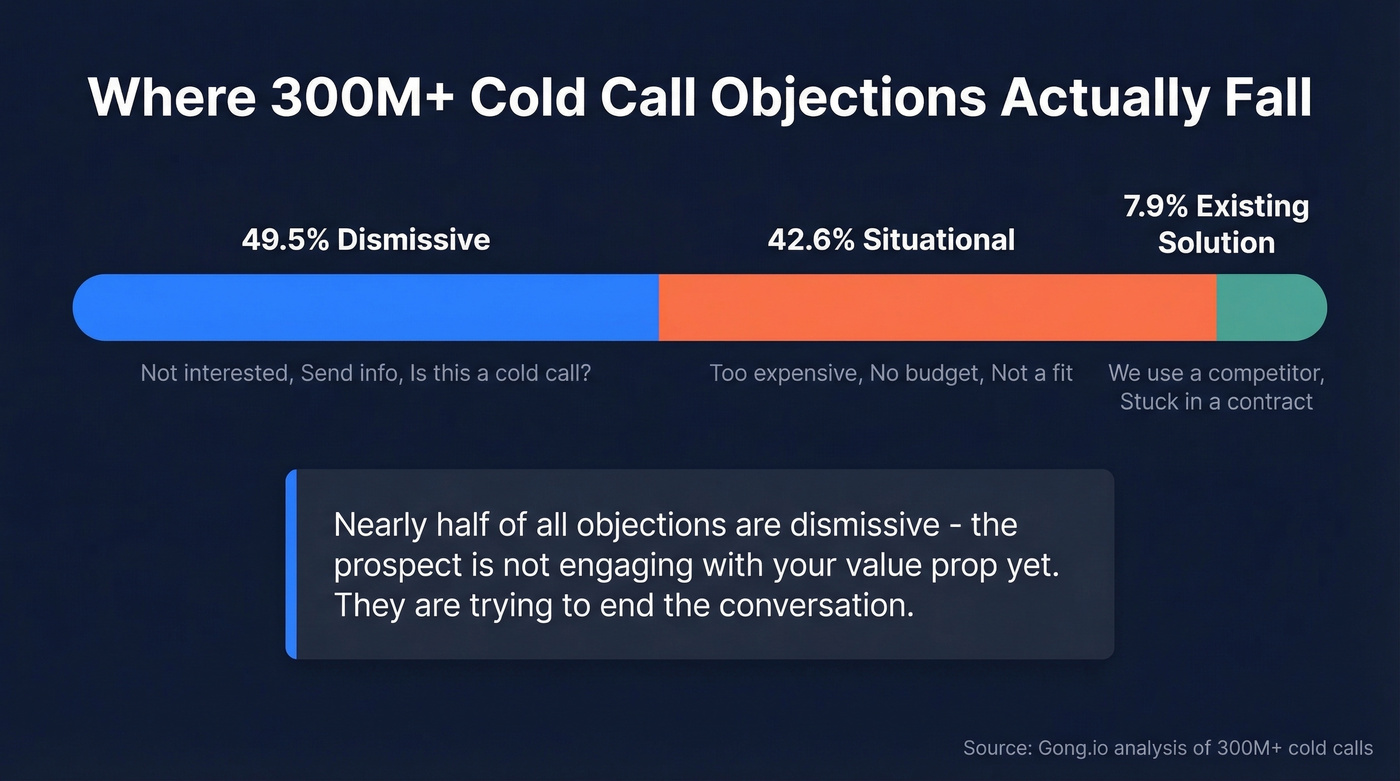
| Category | Share | Examples |
|---|---|---|
| Dismissive | 49.5% | "Not interested," "Send info," "Is this a cold call?" |
| Situational | 42.6% | "Too expensive," "No budget," "Not a fit" |
| Existing solution | 7.9% | "We use a competitor," "Stuck in a contract" |
Nearly half of all objections are dismissive - the prospect isn't engaging with your value prop yet. They're trying to end the conversation. That changes everything about how you respond. You don't counter a dismissive objection with ROI data. You earn the right to keep talking.
Here's the thing: an objection isn't the same as a hang-up. A hang-up is a rejection. An objection is friction you can work through, and learning to navigate that friction is what separates average reps from the ones consistently hitting quota.
A Framework to Handle Any Objection
Forget memorizing rebuttals for every scenario. A five-step framework handles anything:
If you want to reduce pushback upstream, pair this with a system to reduce sales objection rate across your whole funnel.
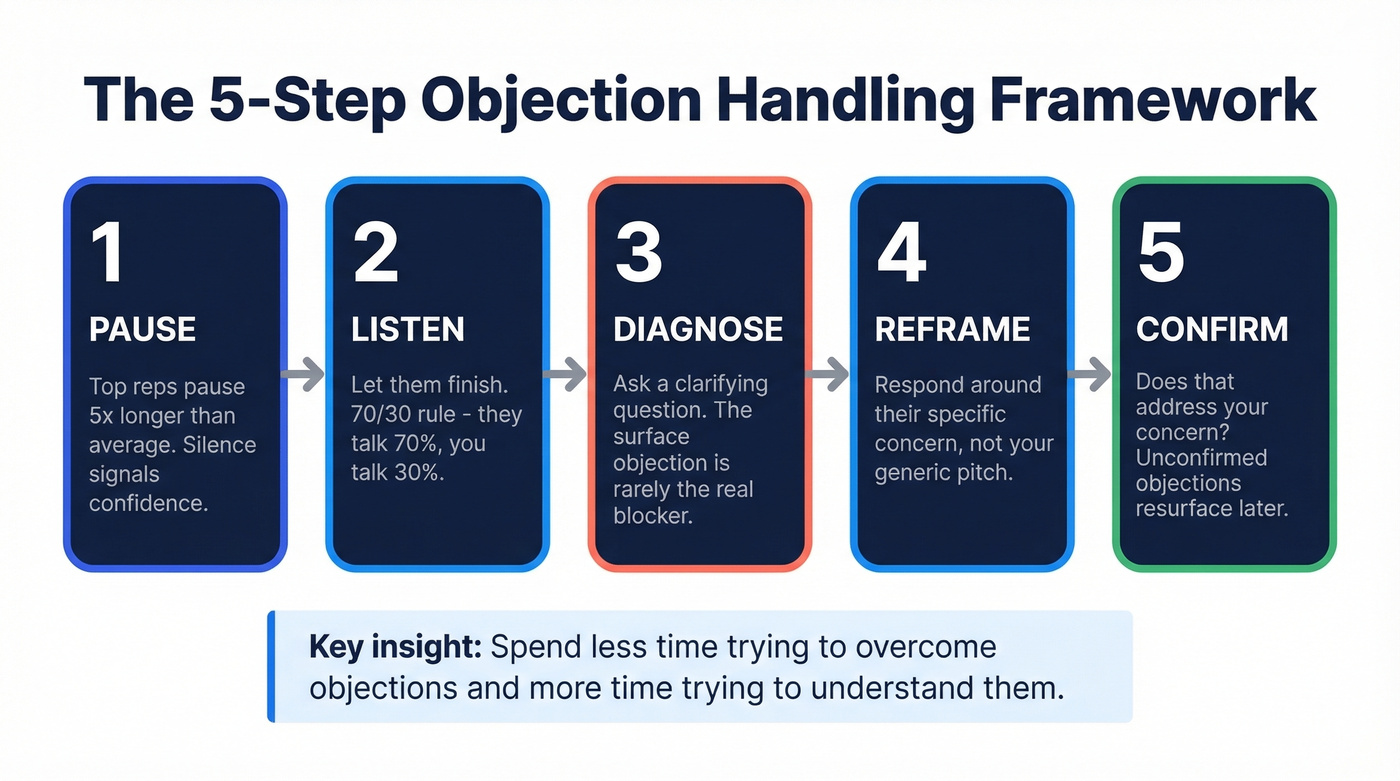
- Pause. Top performers pause 5x longer than average reps after hearing an objection. This comes from analysis of 67,149 sales calls. The silence signals confidence and gives you time to think.
- Listen. Let them finish. Don't interrupt. Aim for the 70/30 rule - the prospect talks 70%, you talk 30%.
- Diagnose. Ask a clarifying question. "Can you tell me more about that?" or "Compared to what?" The surface objection is rarely the real blocker. Stronger discovery makes this easier - use a tighter set of discovery questions.
- Reframe. Respond around their specific concern, not your generic pitch.
- Confirm. "Does that address your concern?" Unconfirmed objections resurface at the worst possible moment.
As Jamie Yates at Outreach puts it: spend less time trying to "overcome" objections and more time trying to understand them. This framework works whether you're handling pushback on a $5k deal or a six-figure enterprise contract - especially in enterprise B2B sales.
The 5x pause rule is the single highest-leverage behavioral change you can make today. It costs nothing, requires no training budget, and works on every objection type.
Scripts That Actually Work
Frameworks are great. But when a prospect says "I'm not interested" three seconds into a cold call, you need words, not theory. If you’re building a repeatable motion, start with a full cold calling system.
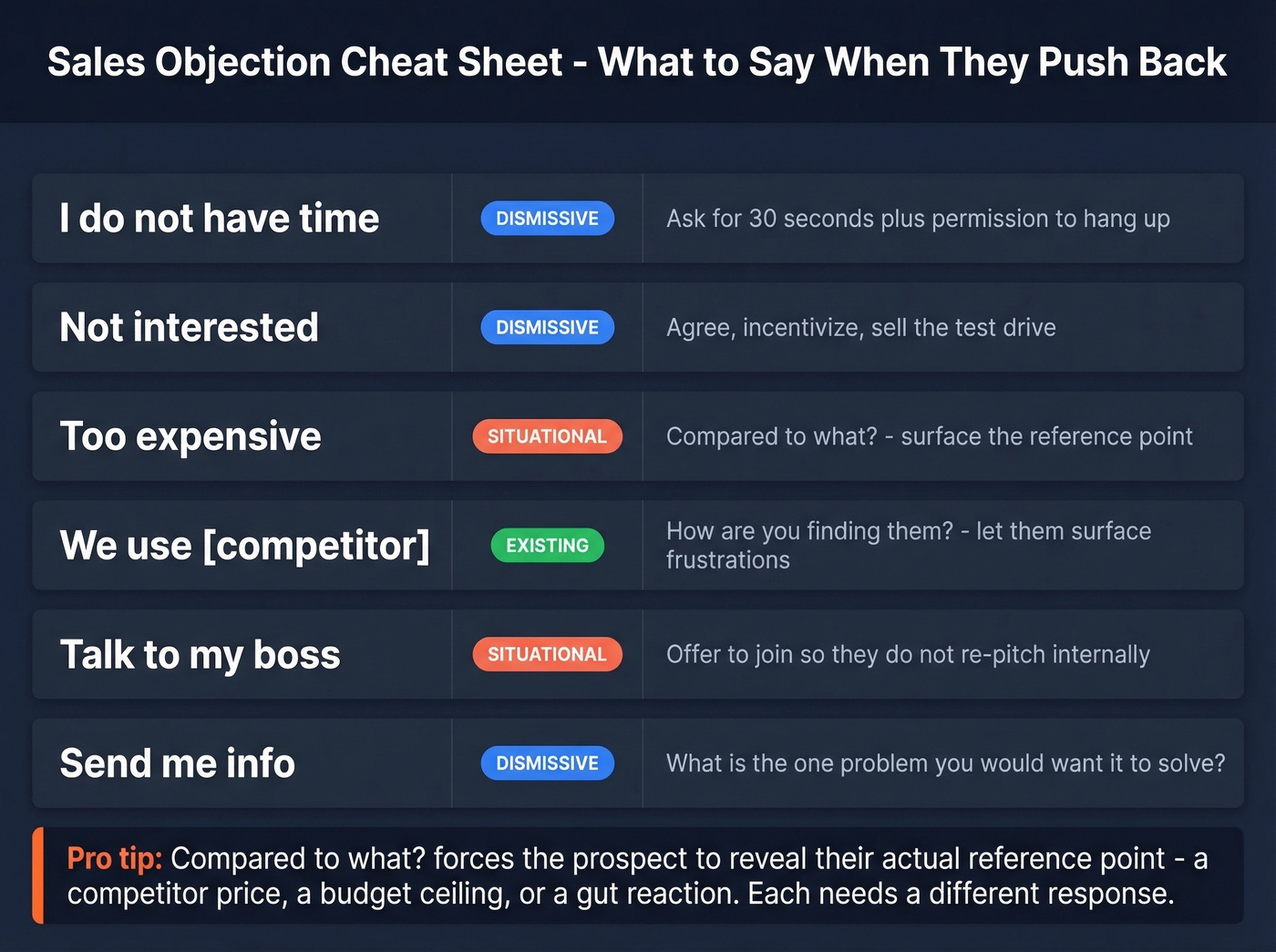
| Objection | Category | Response Principle |
|---|---|---|
| "I don't have time" | Dismissive | Ask for 30 seconds + permission to hang up |
| "Not interested" | Dismissive | Agree, incentivize, sell the test drive |
| "Too expensive" | Situational | "Compared to what?" - surface the reference point |
| "We use [competitor]" | Existing solution | "How are you finding them?" - let them surface frustrations |
| "Talk to my boss" | Situational | Offer to join so they don't re-pitch internally |
| "Send me info" | Dismissive | "What's the one problem you'd want it to solve?" |
"Compared to what?" deserves special attention. It forces the prospect to reveal their actual reference point - a competitor's price, an internal budget ceiling, or a gut reaction. Each requires a completely different response, and you can't know which until you ask.
For "I don't have time," Morgan Ingram's full version goes: "Totally fair - can I get 30 seconds? If it's not relevant, you can hang up on me." Short. Disarming. It works because it hands control back to the prospect.

You just learned that half of all objections are dismissive - prospects trying to end the conversation before you deliver value. But here's the objection you never hear: the one from prospects who never got your email. Teams using Prospeo cut bounce rates from 35% to under 4% with 98% verified email accuracy. Your scripts only work when they reach real inboxes.
Stop losing deals to bad data before objections even start.
Closing Tips: Resolve Objections Before They Stall
The biggest mistake reps make is treating objection handling and closing as separate skills. They aren't. Resolving pushback and closing are one continuous motion - every objection you address during discovery is one fewer roadblock at the finish line. If you want a clean end-to-end motion, map this to the steps to close a sale.
Three closing-specific principles:
- Surface objections early. Ask "What would stop you from moving forward?" in discovery. Dealing with objections that appear for the first time at the contract stage is exponentially harder, because now there's legal review, procurement, and a dozen other stakeholders who weren't in the room when you built rapport.
- Stack confirmations. Each time you resolve an objection, get a micro-commitment. By the time you ask for the signature, you've already closed five smaller yeses.
- Name the elephant. If you sense hesitation at close, say it out loud: "It sounds like something's holding you back - what is it?" Late-stage pushback requires directness, not more slides.
Handling Objections Over Email
You can't pause and listen in an email, so you preempt objections instead of reacting to them. Zig Ziglar's five obstacles - no need, no money, no hurry, no desire, no trust - map cleanly to a follow-up sequence. Address one per email across your cadence rather than cramming everything into a single message. For ready-to-send sequences, keep a library of sales follow-up templates.
But none of that matters if your emails never land. When a third of your emails bounce - not uncommon with stale lists - you're not facing objections at all. You're facing bad data. We've seen teams using Prospeo's 98%-accurate email verification cut bounce rates from 35% to under 4%, which means their objection-handling skills actually get a chance to work. If you’re benchmarking and fixing this, start with email bounce rate and then go deeper with an email deliverability guide.
5 Mistakes That Kill Deals
- Treating the first objection as the real one. "Too expensive" usually means "I can't justify this to my boss." Dig deeper.
- Jumping into defense mode. The moment you get defensive, the prospect mirrors you. Now you're in a fight, not a conversation.
- Responding before diagnosing. Discounting immediately when someone says "too expensive" leaves money on the table and trains prospects to always push on price.
- Assuming the objection is resolved. Always confirm. Skip this and the objection resurfaces at close - and navigating pushback at the contract stage is far harder than addressing it in discovery.
- Dwelling after it's handled. Once confirmed, move forward. Revisiting a resolved objection reopens doubt.
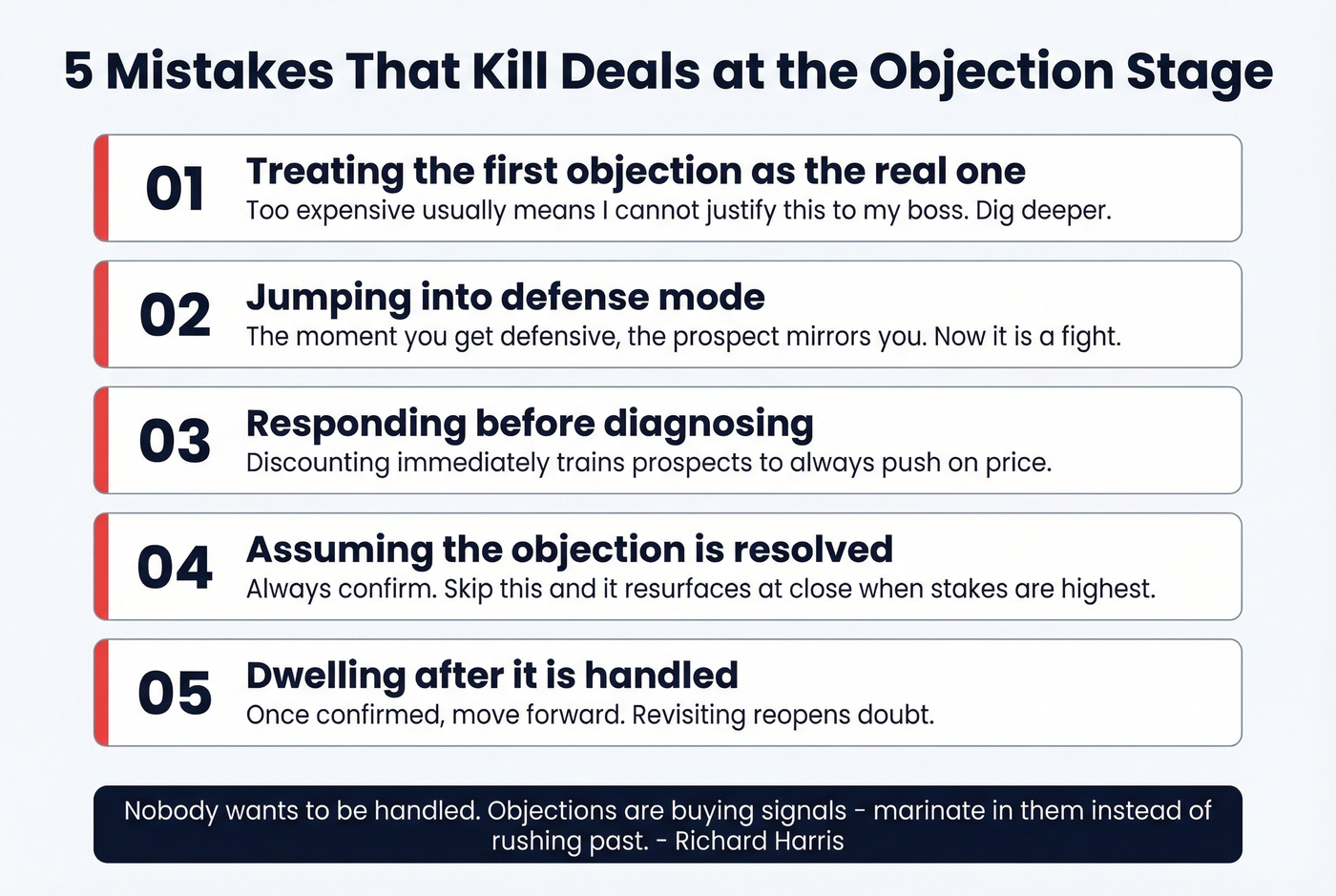
Richard Harris nails it: "Nobody wants to be 'handled.' Objections are buying signals - marinate in them instead of rushing past."
Why Reading This Isn't Enough
Sellers forget 70% of training within a week. Let's be honest - reading this article won't rewire your instincts. Role-play with your team twice a week, record your calls and review the objection moments, and use AI practice tools to get more reps at bat. If you’re formalizing enablement, use these sales training tips.
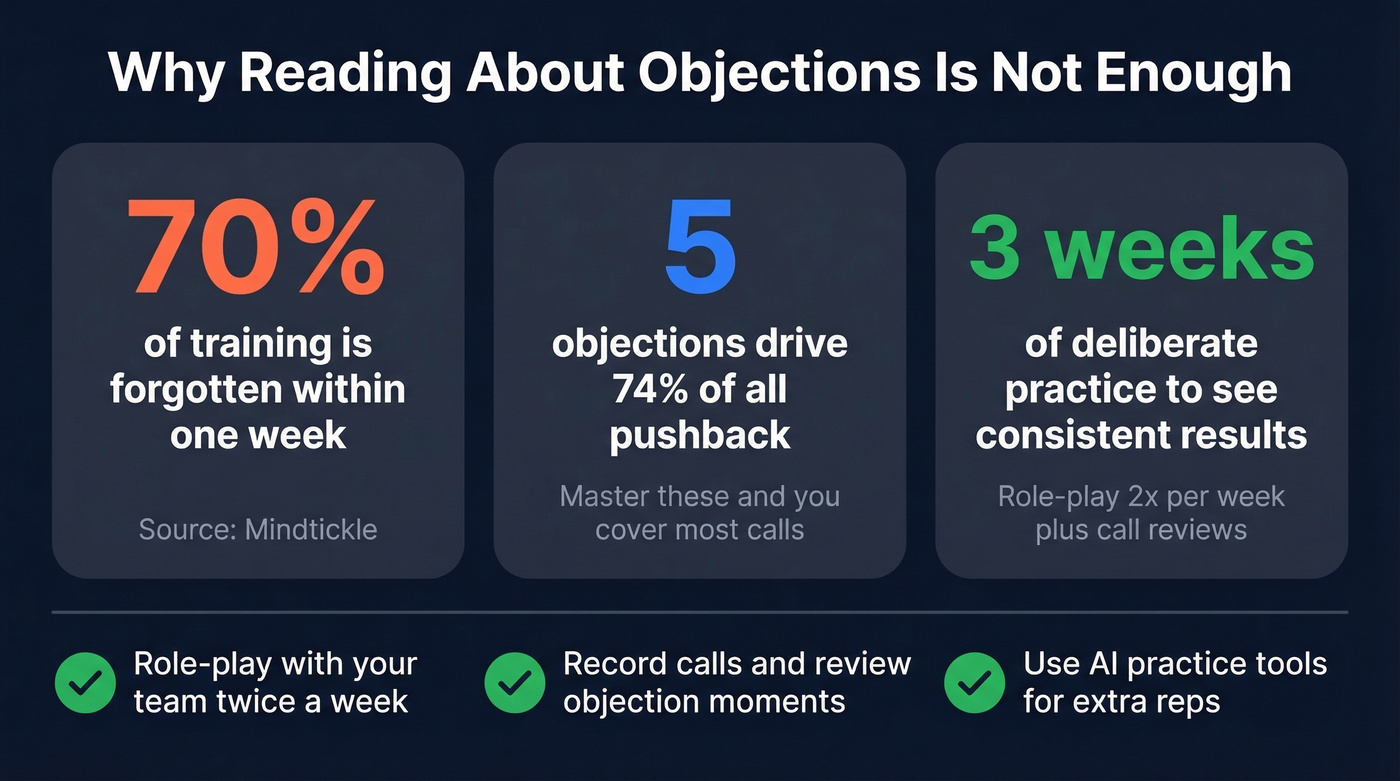
We've watched teams go from shaky objection handling to consistent performance in about three weeks of deliberate practice. The ones who stall are always the ones who read the framework, nod, and never drill it live.
Hot take: If your average deal size is under $10k and your reps can't handle "not interested" and "too expensive" cold, you don't have a training problem. You have a hiring problem. These objections show up constantly. They should be muscle memory by week two.
The core message fits on a sticky note. Master five objections. Pause longer than feels comfortable. Diagnose before you respond. The hard part is doing it under pressure, on the fourth call of the hour, when someone hits you with "not interested" before you finish your first sentence. That only comes from practice.
Every objection you handle is worthless if you're pitching the wrong person. Prospeo's 30+ search filters - including buyer intent, job changes, and department headcount - put you in front of decision-makers who actually have budget and authority. No more "talk to my boss" objections because you started at the top.
Reach the decision-maker directly and skip the authority objection entirely.
FAQ
What's the most common sales objection?
Dismissive objections - "not interested," "send me info," "is this a cold call?" - account for 49.5% of all objections across 300M+ analyzed cold calls. The top five objections cover 74% of pushback, so mastering a small set handles most of what you'll encounter.
How do you handle price objections?
Ask "Compared to what?" to surface the prospect's actual reference point - a competitor's price, an internal budget ceiling, or a gut reaction. Then reframe value relative to their specific pain. The real blocker is often budget timing or internal justification, not your sticker price.
What's the difference between an objection and a rejection?
A rejection is a firm no or a hang-up - the conversation is over. An objection is pushback that often masks a deeper concern and can usually be navigated by pausing, diagnosing, and confirming. Treat objections as buying signals, not dead ends.
How does better data reduce sales objections?
Bad contact data creates phantom objections - bounced emails, wrong numbers, and gatekeepers who block you from decision-makers. Verified data with a short refresh cycle means you reach the right person directly, cutting through "talk to my boss" and "send me info" before they happen.
Does objection handling training actually improve close rates?
Yes, but only with consistent practice. Sellers forget 70% of training within a week. Teams that role-play twice weekly and review recorded calls see compounding gains because reps build muscle memory for the five objections that drive 74% of pushback.