

How to Send a Networking Email That Actually Gets a Reply
You sent 15 networking emails last month. One person wrote back - a polite "not right now." The average cold email reply rate sits at 5.8%, and roughly 17% of cold emails never even reach the inbox thanks to bounces and spam filtering. But networking emails aren't cold sales pitches. They're warmer, more personal, and should convert significantly higher - if you stop making the mistakes everyone makes.
The template isn't the hard part. We've seen people agonize over word choice for an hour and spend zero minutes verifying the email address. Finding the right address, writing a first line that proves you're a real person, and following up without being annoying - that's where replies actually come from.
The System at a Glance
- Write a subject line under 50 characters with their name or company.
- Keep the email under 100 words. Personalized opener, one sentence of context, specific ask, easy CTA.
- Send Tuesday-Thursday, 8-10 AM their time zone.
- Follow up once after 3 days, once more after 7. Then stop.
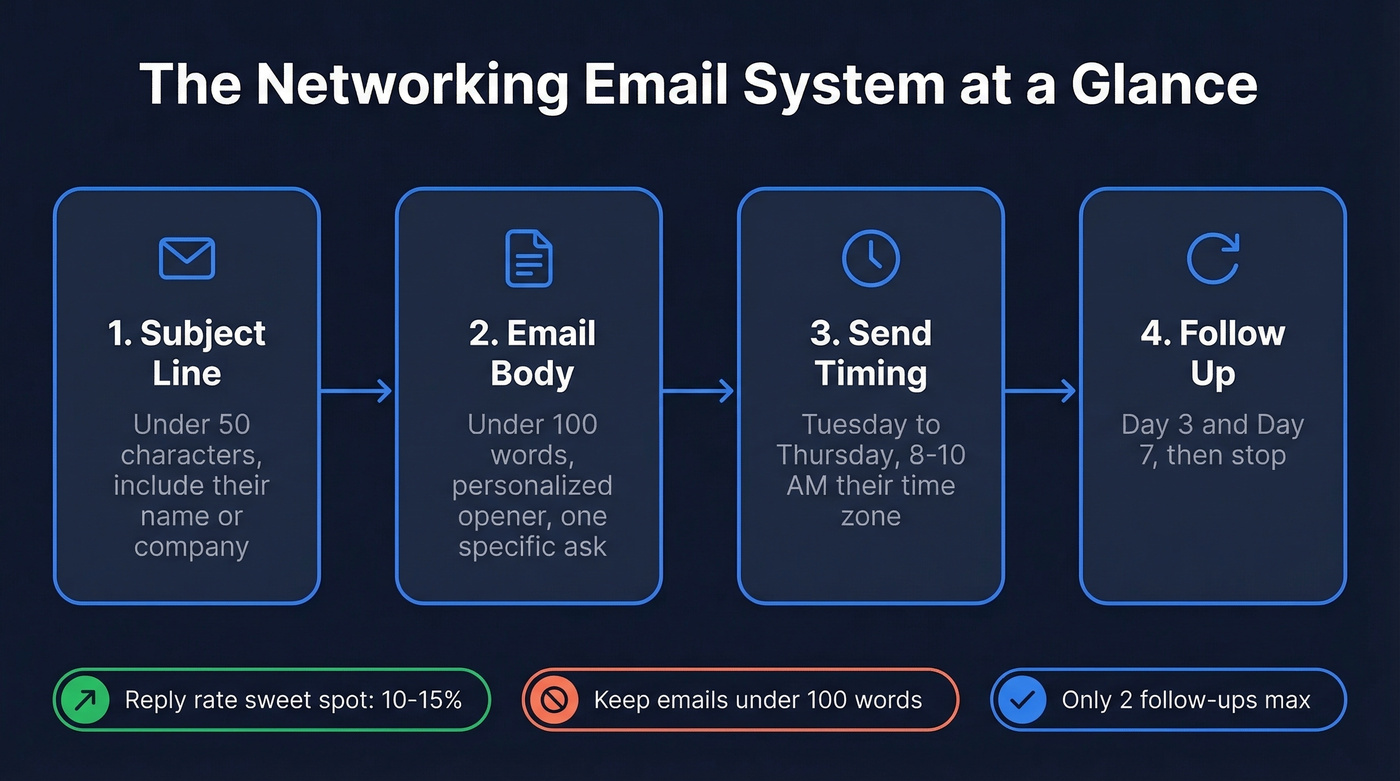
Everything below is the detail behind each step.
Find the Right Email First
This is the step every networking guide skips, and it's the reason most networking emails never get sent - or bounce when they do. Only 18.7% of company websites list even one email address. And even when you guess a format, Hunter's analysis of 12M+ addresses found that 49.9% of companies use {first}@domain.com. The other half don't. Guessing isn't a strategy.
Here's the thing: bouncing off a corporate mail server doesn't just waste your time. It damages your sender reputation. Keep bounce rate under 2% or you'll start landing in spam folders for everyone, not just the person you missed.
Here's the workflow we recommend:
- Check their company website - About, Team, and Contact pages specifically.
- Verify before sending. Even if you found an address manually, run it through verification. Bounces at large firms with strict email security can tank your domain reputation fast.
One practitioner on Reddit cut their bounce rate from 11% to under 2% just by verifying every address before sending - and their reply rate doubled from 3% to 6%.
Subject Lines That Get Opened
Personalized subject lines hit a 35.69% open rate versus 16.67% for generic ones. More than double. Keep it under 50 characters - 35 if you want it fully visible on mobile.
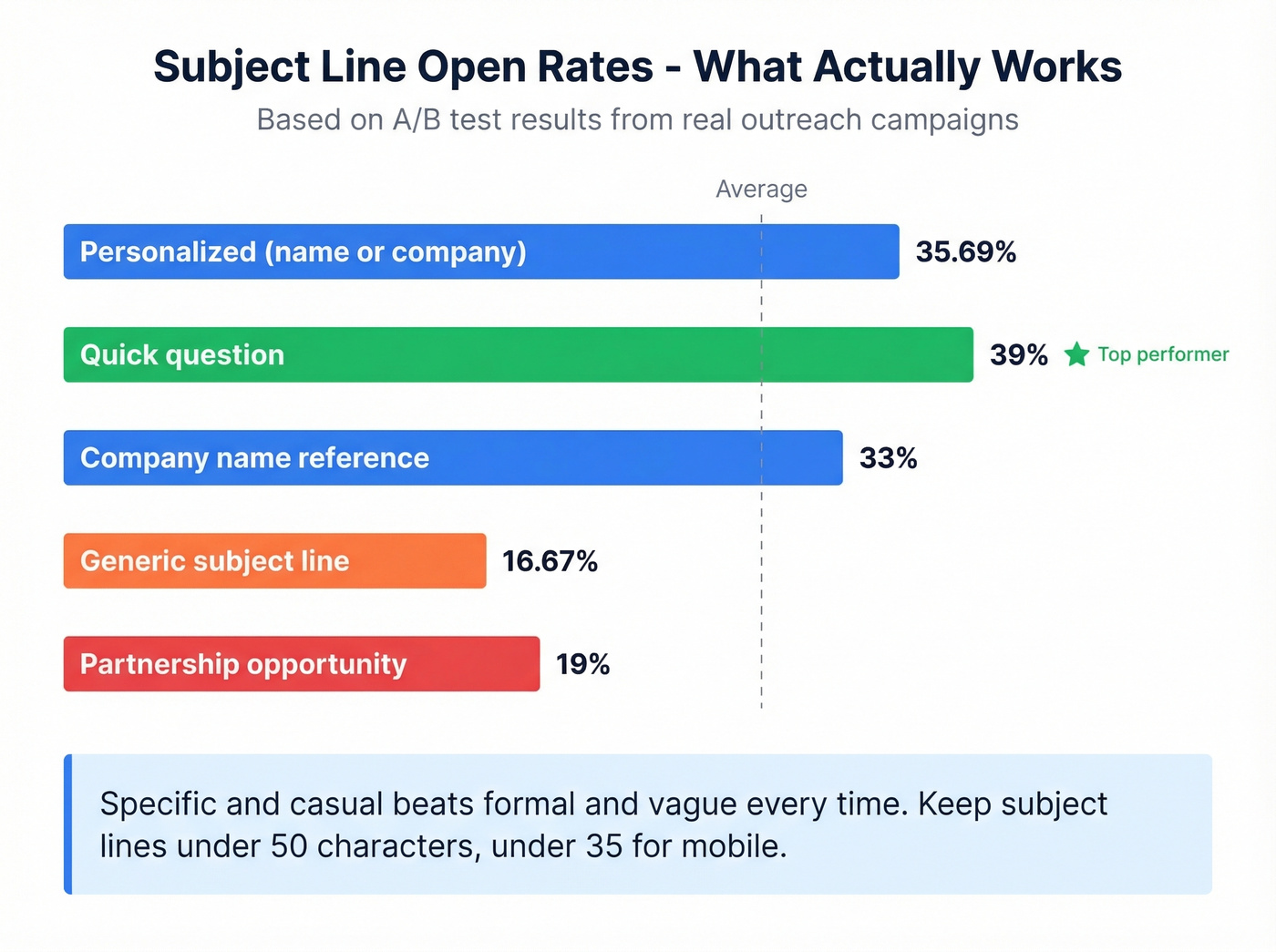
A founder on r/Entrepreneur shared A/B results that tell the story clearly: "Quick question" pulled 39% opens, a subject line with the company name hit 33%, and "Partnership opportunity" tanked below 19%. Specific and casual beats formal and vague every single time.
Here are subject lines that work, organized by scenario:
Cold outreach to a stranger:
- "Your [specific talk/post] - quick question"
- "[Mutual industry] - would love 15 min"
- "Fellow [role/industry] - one question about [topic]"
Mutual connection:
- "[Name] suggested I reach out"
- "[Name] said you're the person to talk to"
Post-event:
- "Great meeting you at [event name]"
- "Following up from [event] - [specific topic]"
Informational interview:
- "Curious about your path to [role]"
- "15 min on [specific topic] - your perspective?"
Notice what's missing from all of these: exclamation points, ALL CAPS, and anything that sounds like a sales pitch. Skip the fancy email signature with 15 links while you're at it - it screams sales rep, not peer. If you want more ideas, pull from a swipe file of email subject line examples.
Nail the Email Structure
A 50-word email with a specific ask beats a 200-word email with a vague one. The Belkins analysis of 16.5M cold emails shows 6-8 sentences hitting a 42.67% open rate and a 6.9% reply rate - the sweet spot. For networking, where context is warmer, our experience is that under-50-word emails consistently push reply rates to 10-15% when paired with genuine personalization and a specific ask.
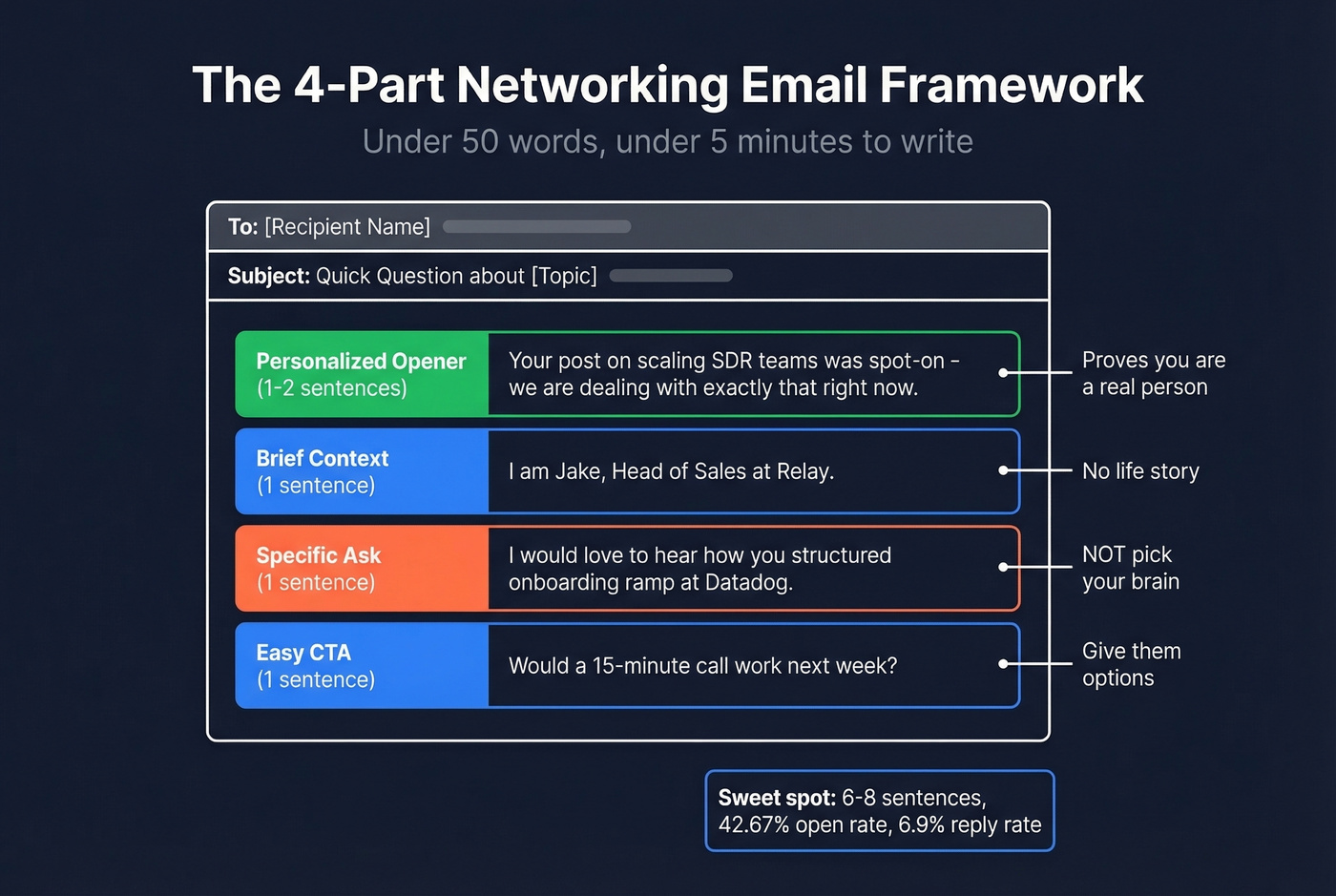
Here's the four-part framework:
Personalized opener (1-2 sentences). Reference something specific - a recent post they wrote, a talk they gave, a company milestone. This proves you did homework, not that you copied a template.
Brief context (1 sentence). Who you are and why you're reaching out. No life story.
Specific ask (1 sentence). Not "Can I pick your brain?" - that's the fastest way to get archived. Name one or two specific topics you want to discuss. "I'd love to hear how your team approached [specific challenge]" is infinitely better than "I'd love to learn from your experience."
Easy CTA (1 sentence). Give them a multiple-choice response: "Would a 15-minute call work better this week or next?" is easier to answer than "Let me know if you're free sometime." A low-pressure PS like "Totally understand if the timing doesn't work" reduces friction without sounding desperate. If you need help tightening the ask, use a simple email call to action framework.
If you're spending more than 5 minutes writing a networking email, you're overthinking it.

Every bounced networking email chips away at your sender reputation - and your confidence. Prospeo verifies emails through a 5-step process with 98% accuracy, so your carefully crafted message actually lands in their inbox, not a bounce-back folder.
Verify any professional email in seconds for $0.01.
Templates for Every Scenario
Cold Outreach to a Stranger
Hi Sarah,
Your post on scaling SDR teams without burning out new hires was spot-on - we're dealing with exactly that right now.
I'm Jake, Head of Sales at Relay. I'd love to hear how you structured onboarding ramp at Datadog - would a 15-minute call work next week?
Either way, thanks for sharing that publicly.
Jake
That's 58 words. Notice the structure: specific reference, one-line context, named topic, time-bounded ask. Swap in your details and you're done.
Mutual Connection Introduction
This is the highest-converting networking email you can send. A name they trust in the first line does more work than any subject line optimization ever will.
Hi [Name],
[Mutual contact] suggested I reach out - they mentioned you'd be a great person to talk to about [specific topic].
I'm [your name], [one-line context]. Would you have 15 minutes for a quick call this week or next?
And if there's anyone else you think I should connect with on this, I'm all ears.
The "who else should I talk to?" line is a chain-networking move we've seen recommended repeatedly on r/jobsearch. It turns one conversation into three.
Post-Event Follow-Up
Send within 24-48 hours. After a week, they won't remember the conversation clearly enough for the reference to land.
Hi [Name], great talking with you at [event] about [specific topic]. [One sentence on what stuck with you.] I'd love to continue that conversation - are you free for a quick call this week?
That's it. Post-event emails are the easiest ones to write because the personalization is already done - you had the conversation. The only mistake is waiting too long.
Informational Interview Request
Informational interviews are one of the most underused networking tactics. Most people skip straight to asking for referrals, which puts the recipient in an awkward position. An informational interview lets them help you without committing to anything.
What not to write: "I'd love to pick your brain about your career journey and any advice you might have for someone in my position." That's vague, open-ended, and signals an unstructured hour of their time.
What to write instead:
Hi [Name],
I've been following your work at [company] - specifically [one specific thing]. I'm exploring [career area/topic] and would love to hear your perspective on [1-2 specific topics].
Would you have 15-20 minutes for a call? Happy to work around your schedule - [suggest two time windows] or whatever works best.
This follows the Forbes-recommended structure: greeting, brief intro, specific topics, time-bounded ask, easy scheduling. Don't ask for a referral directly - instead, ask "what's the best way to stay in the loop for opportunities on your team?" It opens the door without sounding transactional.
Reconnecting After a Gap
The concrete update is what separates "just checking in" from a real email. Without it, the recipient assumes you want something but won't say what.
Hi [Name],
It's been a while since we connected at [context]. Since then, [one concrete update - new role, project, milestone].
I'd love to catch up and hear what you've been working on. Would a quick call work sometime this month?
Keep the update to one sentence. This isn't a newsletter about your life - it's a signal that you've progressed and the relationship is worth re-engaging.
Follow Up Without Being Annoying
Nobody likes following up. But the data is unambiguous: 44% of people give up after one email. Meanwhile, a first follow-up lifts replies by up to 65.8%. And 42% of all replies come from follow-ups. You're leaving replies on the table if you send once and stop. If you want plug-and-play language, use these sales follow-up templates as a starting point.
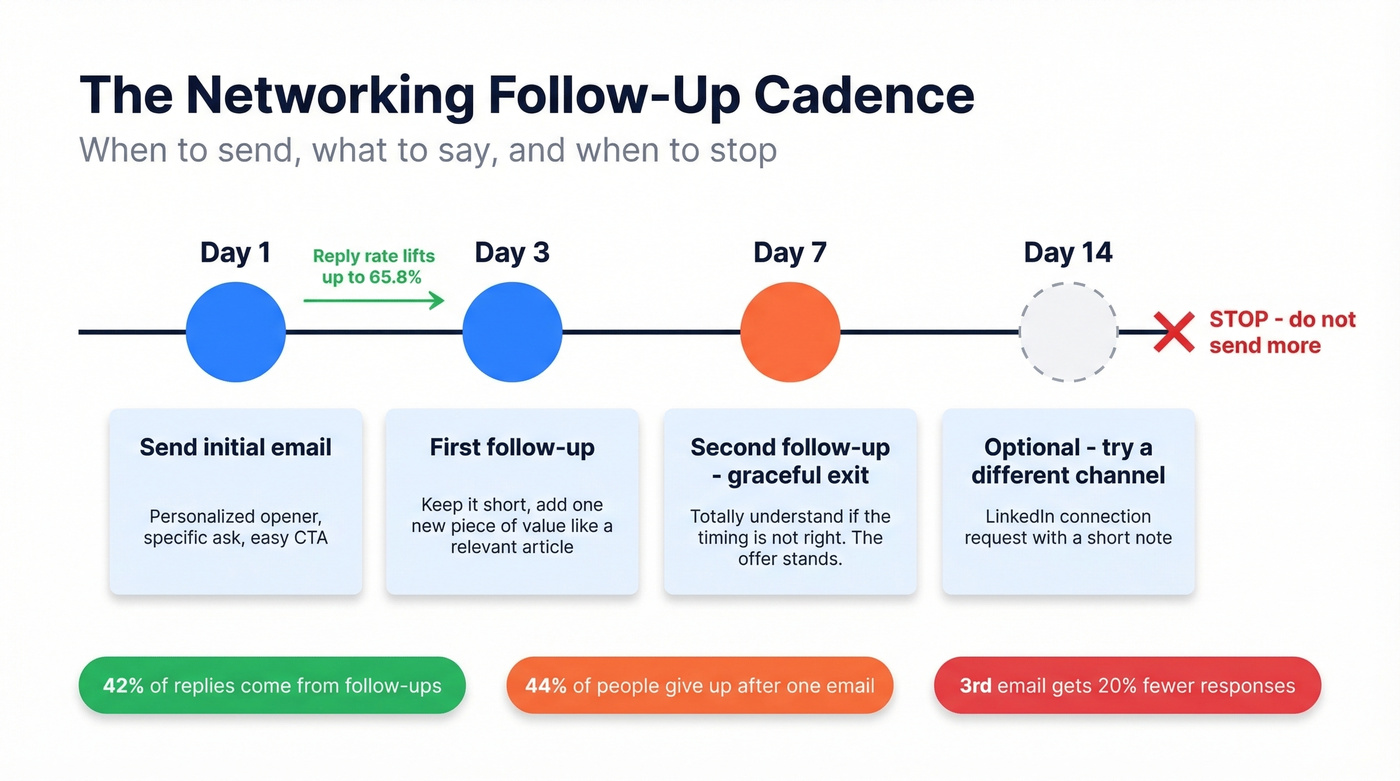
But there's a ceiling. The third email produces 20% fewer responses than earlier ones, and spam complaint rates climb from 0.5% on the first email to 1.6% by the fourth.
Here's the networking-specific cadence:
- Day 1: Send the initial email.
- Day 3: First follow-up. Keep it short and add one new piece of value - a relevant article, a specific reason you thought of them.
- Day 7: Second follow-up. Graceful exit: "Totally understand if the timing isn't right. The offer stands if things change."
- Day 14: Optional - try a different channel entirely with a connection request and a short note.
Two follow-ups is the sweet spot for networking. Three is the absolute max. After that, you're hurting yourself. If you're unsure about timing, this guide on when should i follow up on an email breaks it down.
Common Mistakes to Avoid
The vague ask. "Let me know if you hear of anything" is the networking equivalent of "thoughts?" on a Slack message. Name a specific company, role, or question you want help with.
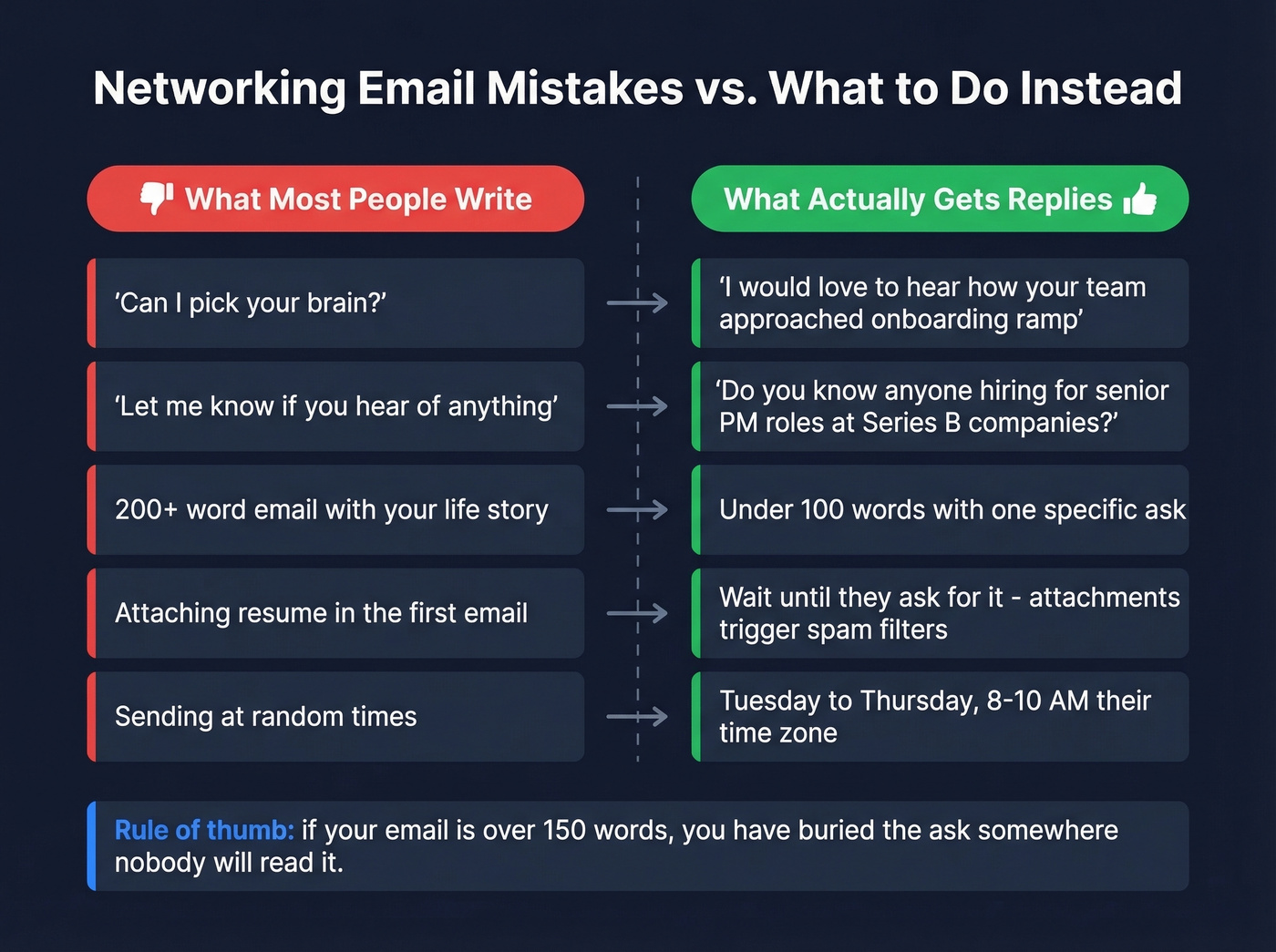
Attaching your resume in the first email. Most large firms automatically flag attachments from unknown senders as spam. Even if it lands, it feels transactional. Wait until they ask for it.
Writing your life story. Under 100 words. Period. If you can't explain why you're emailing in three sentences, you haven't thought about it enough. I've reviewed hundreds of networking emails, and the ones over 150 words almost always bury the ask somewhere in paragraph three where nobody reads it. If you want to sharpen the writing, borrow a few principles from email copywriting.
"Can I pick your brain?" This signals vague, unstructured, and one-sided. Name one or two specific topics instead. The recipient needs to know what they're agreeing to.
Bad timing. Thursday has the highest reply rate at 6.87%. Monday is the lowest at 5.29%. Stick to Tuesday-Thursday, 8-10 AM their time zone. (If you're optimizing send windows, see best time to send cold emails.)
Never following up. You already know the data. One follow-up at Day 3, minimum.
Ghosting after the conversation. Send a thank-you within 24 hours. Then send an update later on what came of their advice. As one hiring manager on r/jobsearch put it bluntly: people who ghost after getting help don't get help again. 90% of the time people don't follow up with thanks or updates - which means doing it puts you in the top 10%.
Email vs. LinkedIn InMail
InMail response rates run 18-25% - dramatically higher than cold email's 1-5%. But premium plans cap you at roughly 50 InMail credits per month. That's not enough volume for serious outreach.
Email scales better. You can send 20 thoughtful networking emails in a week without hitting any limits. For many professionals - especially in finance, consulting, and senior leadership - email is where real business communication happens. One thread in r/FinancialCareers put it bluntly: "Most bankers don't check LinkedIn very often."
Let's be honest: if your target is a VP or above, email wins every time. Senior leaders treat their inbox like a to-do list. They treat LinkedIn like a news feed. One gets action, the other gets a scroll.
Start with email. If no response after two follow-ups, try a connection request with a short note. Don't do both simultaneously - it feels desperate. For a deeper breakdown of outreach styles, compare personalized outreach approaches.
Best Times to Send
| Factor | Best | Avoid |
|---|---|---|
| Day of week | Tue-Thu | Monday, weekends |
| Time of day | 8-10 AM recipient TZ | Late Friday afternoon |
| Post-event | Within 24-48 hours | More than a week later |
| Evening send | 8-11 PM via auto-schedule | Middle of the night |
The time-zone detail is the one most people miss. If you're on the West Coast emailing someone in New York, schedule for 5-7 AM your time so it lands in their 8-10 AM window. Every major email client and outreach tool has scheduling built in - use it.
The article says it best: people spend an hour on word choice and zero minutes finding the right address. Prospeo's Chrome extension lets you pull verified emails from LinkedIn profiles, company sites, and CRMs in one click - used by 40,000+ professionals who refuse to guess.
Find the right email first. Write the perfect message second.
FAQ
How long should a networking email be?
Six to eight sentences, under 100 words. The Belkins dataset shows this range hits a 6.9% reply rate for cold outreach. Networking emails carry warmer context, so expect 10-15% when you combine brevity with personalization and a specific ask.
How many follow-ups should I send?
Two follow-ups, spaced 3 and 7 days after the initial email. A single follow-up lifts replies by up to 65.8%. After three total emails, spam complaints rise and you risk damaging the relationship before it starts.
Should I attach my resume?
Never in the first email. Large firms flag attachments from unknown senders as spam, and it signals "I want something from you" before you've built any rapport. Wait until they explicitly ask.
What if I can't find their email address?
Use an email finder like Prospeo - paste a professional profile URL or search by name and company to get a verified address. The free tier gives you 75 lookups per month with 98% accuracy, which is more than enough for networking without burning your sender reputation.
How do I email someone I've never met?
Start with a specific reference to their work - a post, talk, or company milestone - so they know you're not blasting a template. Follow the four-part structure: personalized opener, one sentence of context about you, a named topic you want to discuss, and a time-bounded ask. Keep it under 100 words and make the CTA easy to answer with a yes or no.