

How to Set Sales Quotas Your Team Will Actually Trust
It's Q4 planning. Finance sent over next year's revenue target - 25% growth. Your team missed this year's number by 15%, and now you're supposed to figure out how to set sales quotas that bridge that gap without losing half your reps.
The top complaint on r/sales? "Leadership just raises the number for the sake of raising the number." The data confirms the frustration: only 53% of salespeople hit quota, per Korn Ferry. Bridge Group data puts AEs at 51%. That's not a rounding error - it's a systemic failure in how companies approach quota planning.
Quota setting isn't hard math. It's straightforward math that most companies skip in favor of "last year plus 15%." Let's fix that.
The Quick Version
Sales Capacity = Reps x Quota x Average Attainment %
- Start with your company revenue target - not last year's quota.
- Convert headcount into Ramped Rep Equivalents (RREs), not raw headcount.
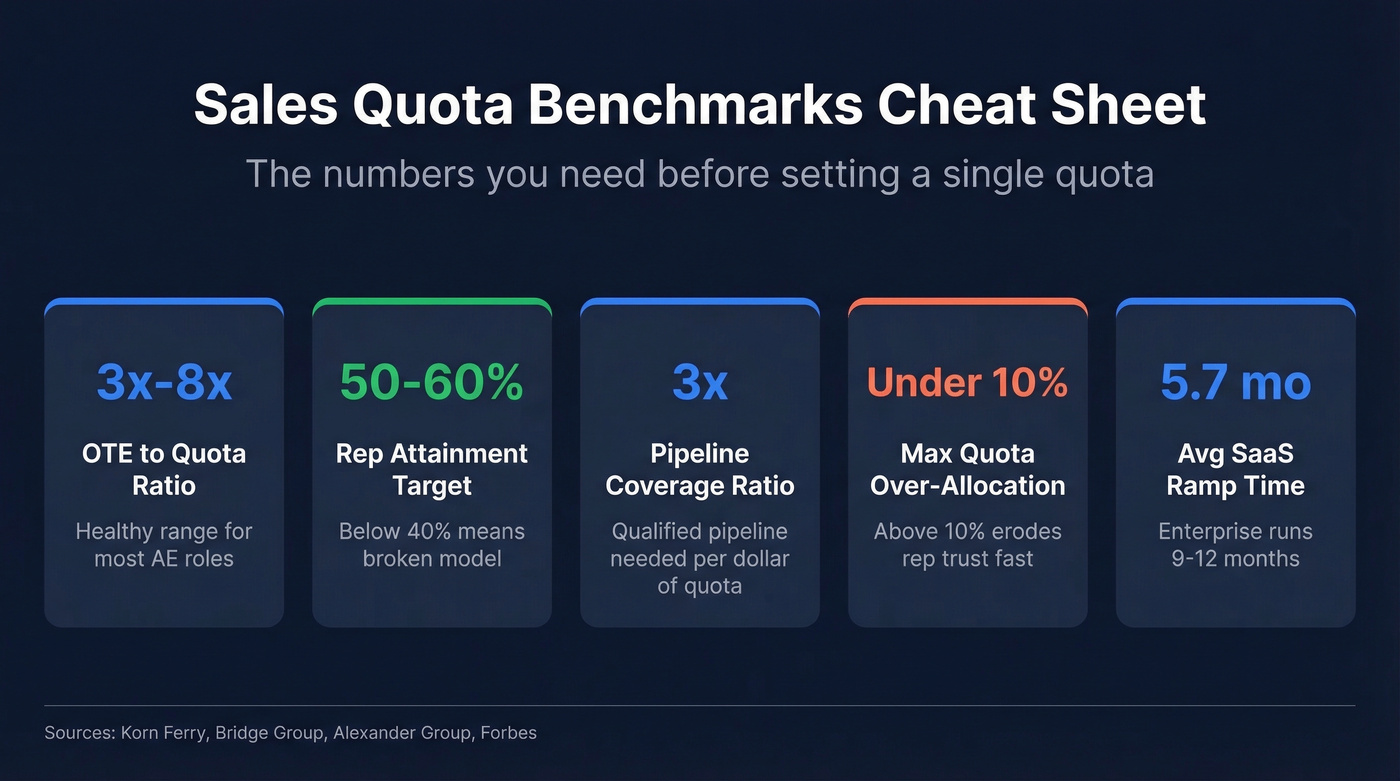
- Divide target by RREs. Sanity-check against OTE multiples (3x-8x) and pipeline coverage (3x).
- Use a hybrid top-down/bottom-up approach - companies that do are 37% more likely to hit revenue goals.
Quota Types Worth Knowing
Before you build the model, decide what you're measuring.
| Type | What It Measures | Best For |
|---|---|---|
| Revenue | Closed-won dollars | Most AE roles |
| Volume/Unit | Deals closed or units sold | Transactional sales |
| Activity | Calls, meetings, demos | SDRs, new hires in ramp |
| Profit | Margin on closed deals | Teams with discount authority |
| Combination | Blended (e.g., 70% revenue + 30% activity) | Complex roles with multiple KPIs |
Revenue quotas are the default for a reason - they tie directly to the company target. But combination quotas are underrated for roles where deal quality matters as much as volume. If your reps have heavy discount authority, a profit-based component keeps them from racing to the bottom on price just to close.
Top-Down vs. Bottom-Up: Hybrid Wins
Top-down starts with the board's revenue target and divides across reps. 64% of sales managers prefer it. The problem? It ignores territory reality. A rep covering 50 enterprise accounts doesn't have the same capacity as one covering 2,000 SMBs.
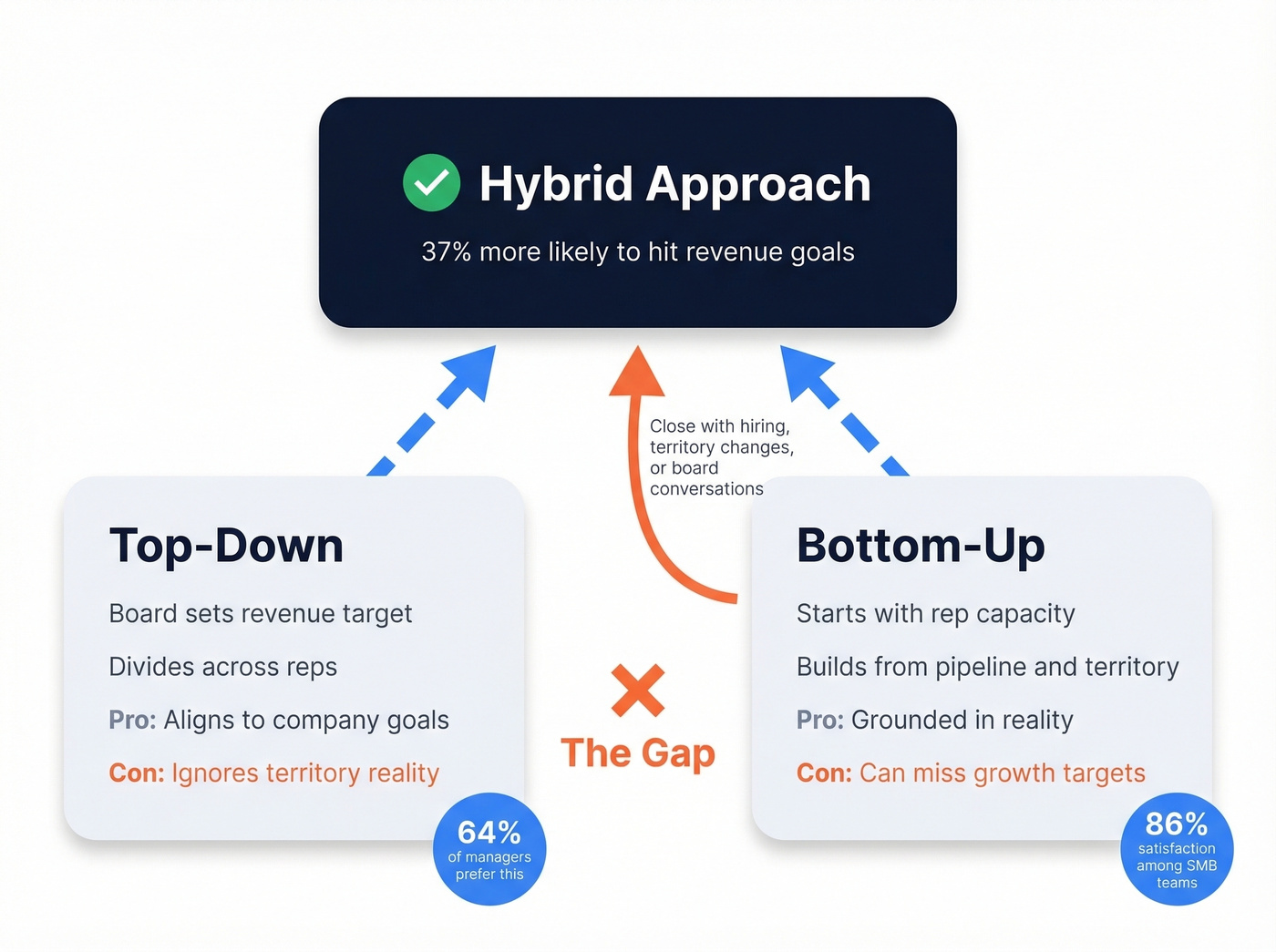
Bottom-up starts with what each rep can realistically close based on pipeline and territory. Among SMB and mid-market companies surveyed, 86% of the most satisfied used bottom-up planning.
Hybrid does both, then reconciles the gap. Run top-down to set the target, bottom-up to stress-test it, and close the gap with hiring, territory adjustments, or honest conversations with the board. Finance knows the top-line number but rarely the mechanics of rep-level capacity - the hybrid model bridges that disconnect. This is the core of effective quota planning: aligning leadership ambition with ground-level reality.

Your hybrid quota model means nothing if reps can't fill 3x pipeline coverage. Prospeo gives every rep access to 300M+ verified contacts with 30+ filters - intent data, headcount growth, technographics - so territory capacity matches reality, not guesswork.
Hit quota with pipeline that actually converts.
The Actual Math Behind Quotas
This is the section most guides skip. Here's a worked example that shows how quotas get built from first principles.
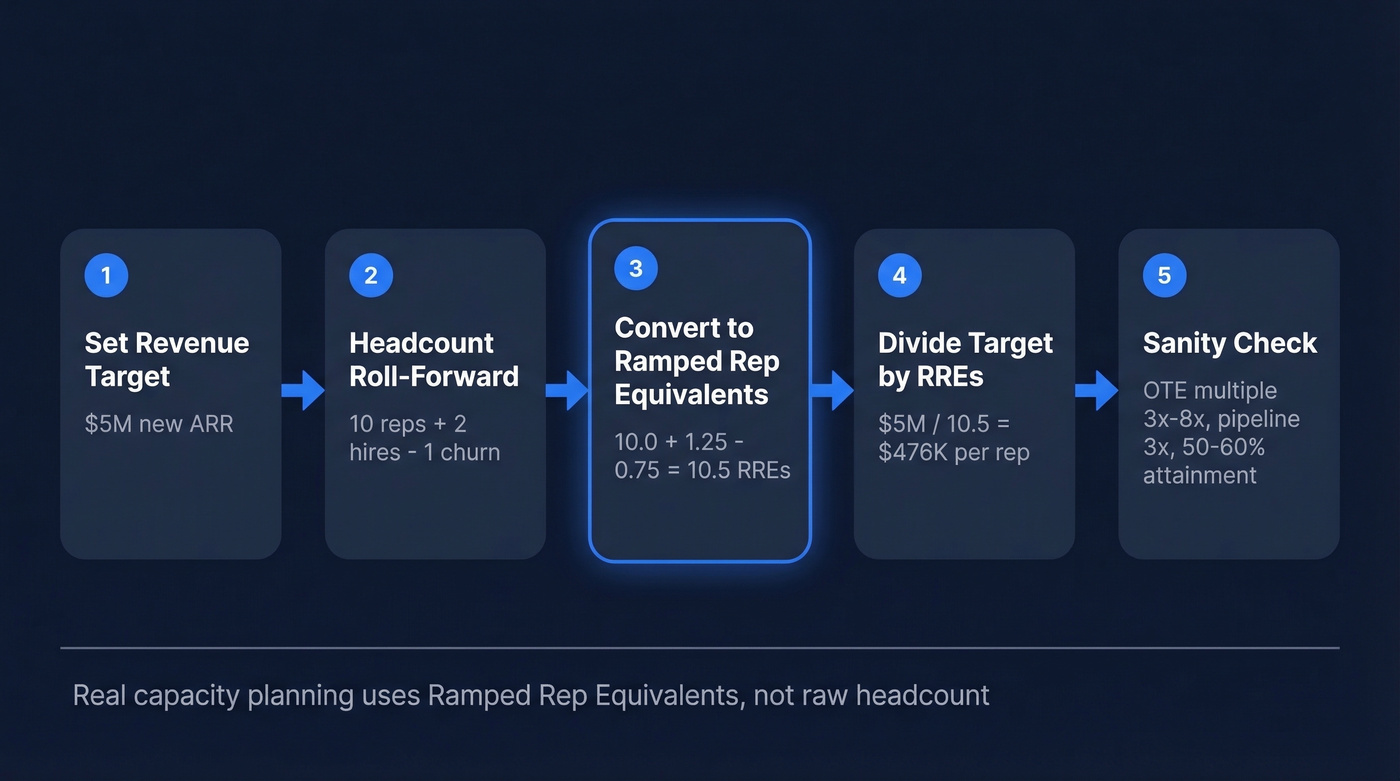
Step 1: Set the revenue target. $5M in new ARR.
Step 2: Build a headcount roll-forward. 10 starting reps + 2 Q1 hires - 1 expected mid-year churn.
Step 3: Convert to Ramped Rep Equivalents. This separates real quota models from guesswork. A rep in month two of a six-month ramp isn't producing at 100%. Here's the conversion:
- 10 tenured reps productive all 4 quarters = 10.0 RREs
- 2 Q1 hires at ~25% productivity Q1, ~50% Q2, ~75% Q3, 100% Q4 = avg ~62% across the year = 1.25 RREs
- 1 churn at mid-year removes 2 quarters of capacity = -0.75 RRE
Total: 10 + 1.25 - 0.75 = ~10.5 RREs of productive capacity.
Wait - that doesn't look right. Let's be more precise. You started with 10 reps, but one leaves mid-year, so that rep only contributes half a year. The 2 new hires ramp gradually. Your real productive capacity is closer to 10.5 RREs, not the 12 headcount you'd see on a roster.
Step 4: Divide. $5M / 10.5 = ~$476K per fully ramped rep.
Step 5: Sanity-check everything. If AEs have $120K OTE, a $476K quota is roughly 4x - right in the healthy 3x-8x range. Pipeline coverage: each rep needs ~$1.4M in qualified pipeline at a 3x ratio. Can your territory and lead gen support that? And 50-60% of reps should hit quota. If you're projecting 80% attainment, quotas are too soft. Below 40%, your model or hiring is broken.
One more guardrail: keep quota over-allocation under 10%. Over-allocation above that isn't a strategy - it's organizational dishonesty that erodes trust the moment reps do the math themselves.
Ramp Quotas Done Right
Stop punishing new hires with full quotas on day one. Average SaaS ramp time has climbed to roughly 5.7 months, and enterprise ramp runs 9-12 months. Assigning 100% quota to someone who hasn't closed their first deal is a fast track to attrition.
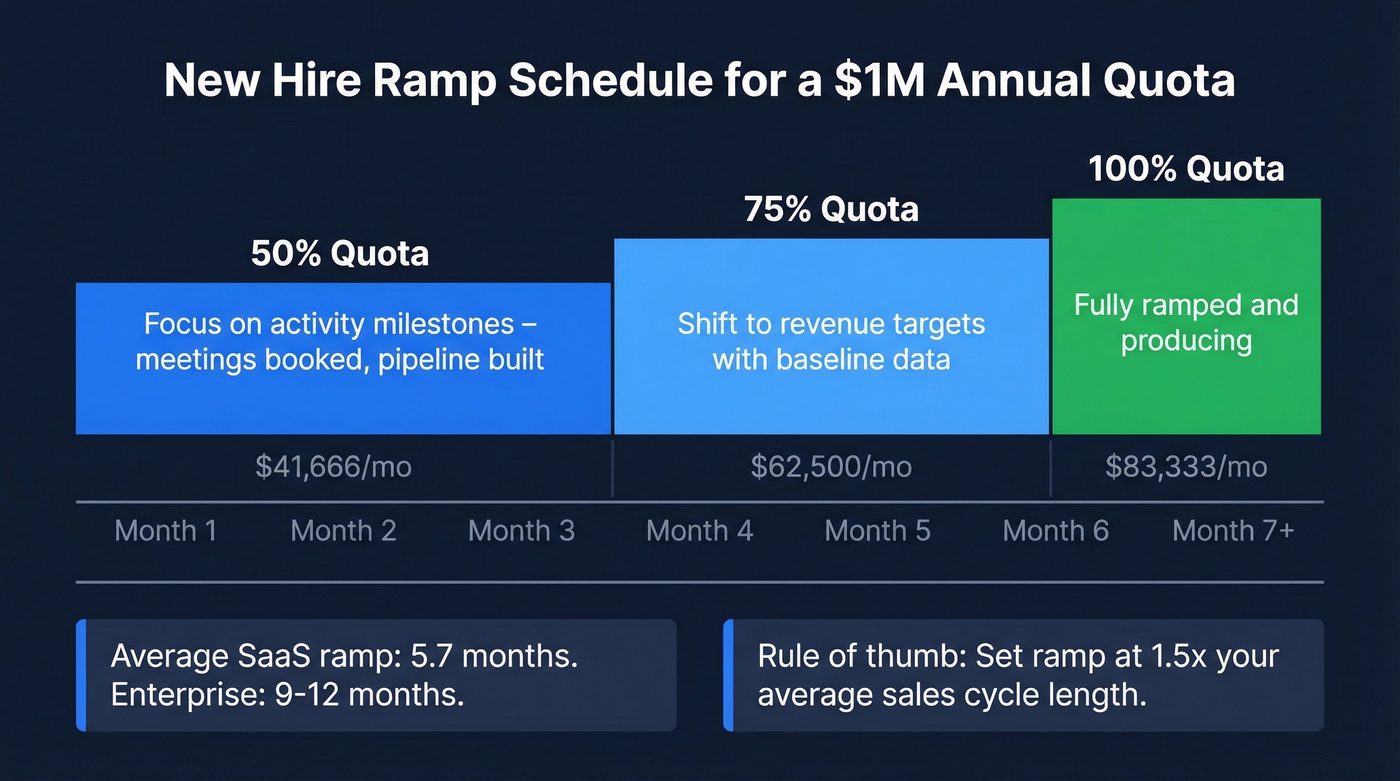
A standard ramp schedule for a $1M annual quota:
| Period | Quota % | Monthly Target |
|---|---|---|
| Months 1-3 | 50% | $41,666 |
| Months 4-6 | 75% | $62,500 |
| Month 7+ | 100% | $83,333 |
Set ramp length at roughly 1.5x your average sales cycle. Four-month deal cycle? Six-month ramp. Use activity-based milestones early - meetings booked, pipeline generated - then shift to revenue targets once the rep has baseline data. We've seen teams cut ramp time nearly in half by pairing structured onboarding with clean prospecting data, so new reps aren't wasting their first months chasing dead contacts.
Mistakes That Kill Attainment
"Last year + 15%" across the board. This isn't a method - it's a guess with a spreadsheet. We've watched teams do this and end up with only ~25% of reps hitting quota while churn jumps 40%+ year over year.
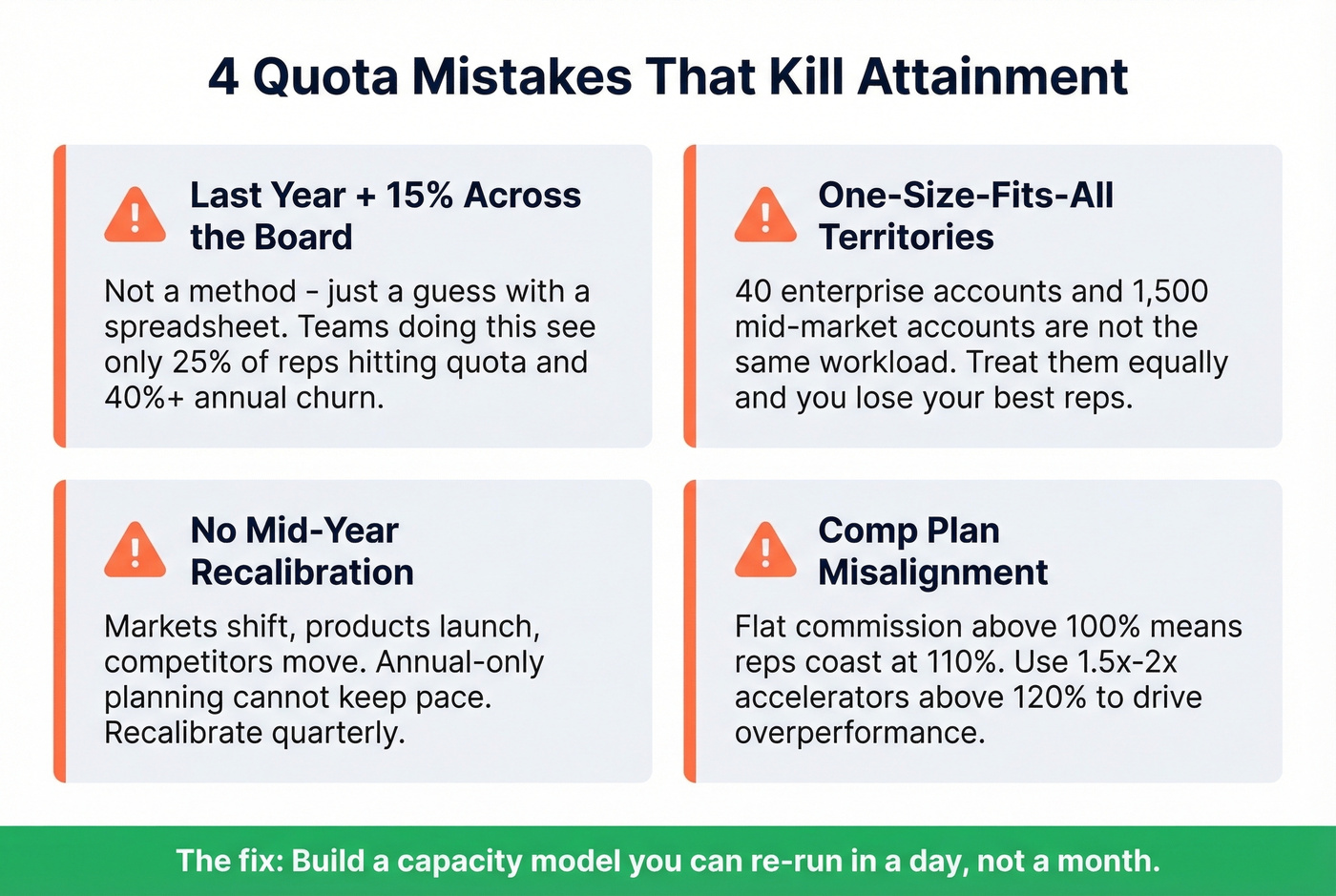
One-size-fits-all territories. A rep with 40 named enterprise accounts and a rep covering 1,500 mid-market accounts don't have the same capacity. Treat them identically and you'll lose your best people.
No mid-year recalibration. Markets shift. Products launch. Competitors move. Annual-only quota planning can't keep pace. Quarterly recalibration should be the standard - and if your model is built right, re-running the numbers takes a day, not a month.
Comp plan misalignment. If commission is flat above 100%, reps coast at 110%. Accelerators of 1.5x-2x above 120% attainment fix this, but only if the quota itself is achievable enough to make the accelerator feel reachable. Skip this if your comp plan already has strong accelerators - the quota model won't fix a broken incentive structure.
Making Quotas Stick
The best quota model fails if reps don't trust it. As one r/Sales_Professionals commenter put it: "Reps don't trust the numbers and leaders don't trust the forecast."
Show them the math. Literally walk through the capacity model in a team meeting. In our experience, teams who share the full model with reps see dramatically less pushback on quota day. When reps see how their number connects to the company target, territory data, and ramp assumptions, the number stops feeling arbitrary and starts feeling like something they can actually work toward.
Recalibrate quarterly. Korn Ferry recommends allocating at least 60 days for initial quota planning, but the model should re-run quickly when conditions change.
Here's the thing most quota models ignore: data quality. If 30% of your outbound emails bounce, only 70% of your activity is even reaching prospects - so reps need about 43% more activity to generate the same delivered volume and pipeline. That's a hidden quota increase nobody budgeted for. Prospeo closes this gap at the data layer - 98% email accuracy on a 7-day refresh cycle means your pipeline math assumes reps can actually reach the right people, and the quota model holds.
Most teams over-engineer the quota formula and under-invest in the data that feeds it. A perfect capacity model built on a CRM full of bounced emails is just theater. Fix the inputs first - starting with email validation.
New hires in ramp burn months chasing bad contacts. Teams using Prospeo's 98% accurate emails and 125M+ verified mobiles have cut ramp time nearly in half - turning those 5.7-month ramps into productive selling weeks, not wasted dials.
Stop subsidizing bad data with longer ramp schedules.
FAQ
What percentage of reps should hit quota?
Target 50-60%. Above 70% means quotas are too low and you're leaving revenue on the table. Below 50% consistently signals broken territories, unrealistic targets, or a hiring problem - not a rep problem.
How often should you adjust quotas?
Quarterly at minimum. Build your capacity model to re-run in under a day so recalibration isn't a two-month project. Markets shift faster than annual plans can accommodate, and treating quota setting as a living process rather than an annual event keeps your team aligned with reality.
How do you set sales quotas for a new team?
Use the OTE multiple heuristic: 3x-5x OTE for early-stage teams without historical close-rate data. Pair with activity-based milestones for the first two quarters, then shift to revenue quotas once you have baseline conversion metrics. Verified contact data helps new teams build pipeline faster during ramp when every dial and email matters - GreyScout, for example, cut rep ramp time from 8-10 weeks to 4 by giving new hires clean data from day one.
Does data quality affect quota attainment?
Absolutely. If your bounce rate runs 30-35%, reps need 43% more outbound activity to hit the same pipeline targets - effectively inflating their quota without changing the number. Snyk saw bounce rates drop from 35-40% to under 5% after cleaning up their data infrastructure, and AE-sourced pipeline jumped 180%. The quota didn't change. The inputs got better.