

How to Start a Follow-Up Email After No Response
You sent a proposal three days ago. Radio silence. Now you're staring at a blank reply window wondering if "just wanted to follow up" makes you sound desperate.
Here's the thing: your email probably got buried, not ignored. 40% of people have 50+ unread emails sitting in their inbox right now, and Yesware research shows 70% of sales emails need at least one follow-up to get any response at all. Woodpecker's data backs this up - a single follow-up converts 22% more prospects, with experienced senders seeing reply rates jump from 16% to 27%.
So figuring out how to start a follow-up email after no response is mostly about that first sentence. And most people get it wrong. Lead with new value or a specific context reminder - never "just checking in." Wait 3 business days, send 2-3 follow-ups max, and if you're getting zero opens, verify your contact data before rewriting your copy.
Five Opening Lines That Get Replies
The opener is the whole game. Your recipient decides in under two seconds whether to keep reading or archive, and context should appear in the opening lines so the reader instantly knows why you're in their inbox. We've tested all five of these formulas across sales and client outreach - here they are, ranked by versatility.
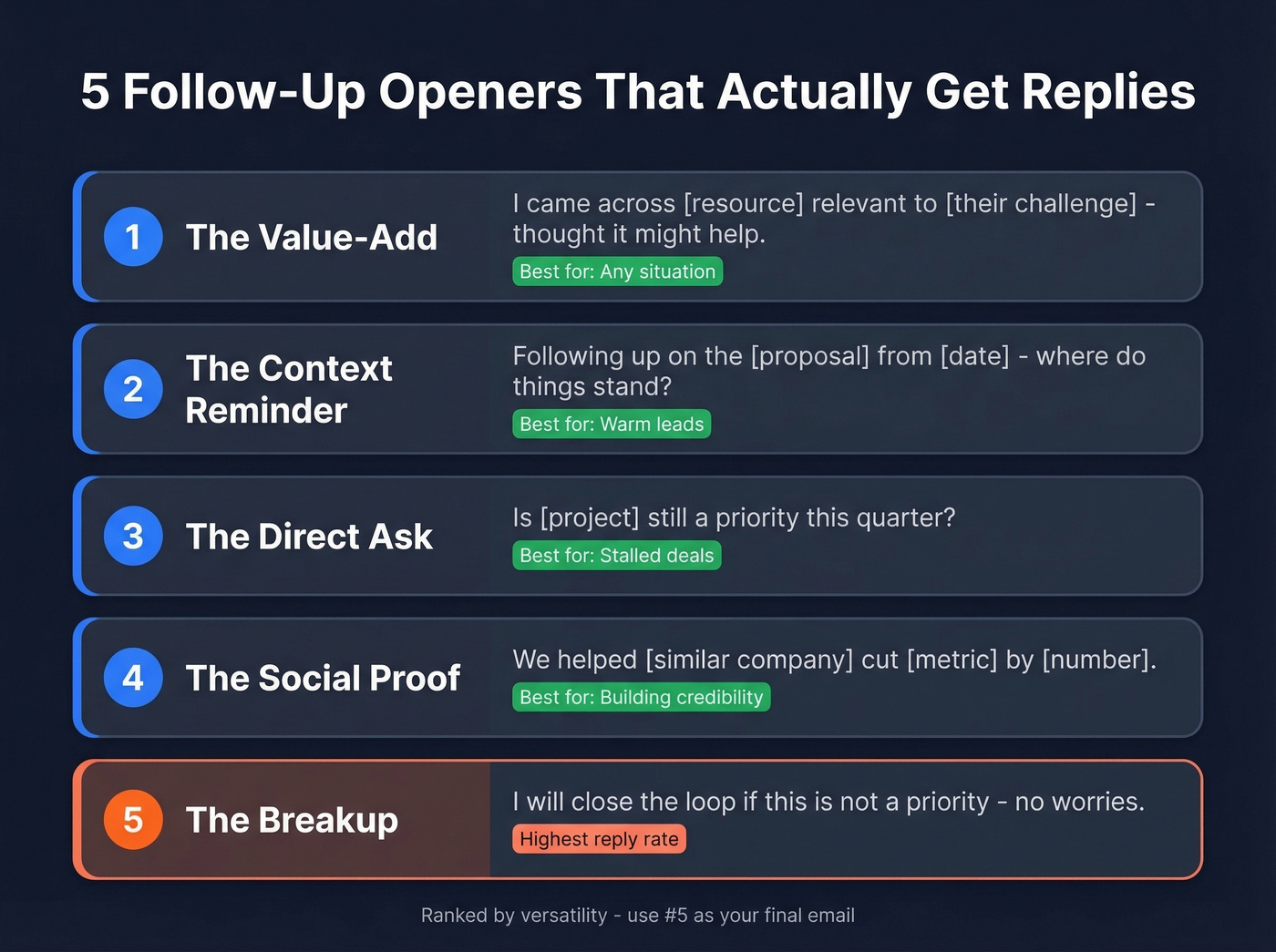
1. The Value-Add Lead with something new they didn't have before.
"I came across [specific resource] relevant to [their challenge] - thought it might help."
2. The Context Reminder Anchor them back to the original conversation with a specific detail.
"Following up on the [proposal/demo] from [date] about [topic] - where do things stand?"
3. The Direct Ask Skip the preamble. One question. Easy to reply to.
"Is [specific project] still a priority this quarter, or has the timeline shifted?"
4. The Social Proof Name-drop a relevant result. Works best when credibility is the bottleneck.
"Since we last spoke, we helped [similar company] cut [metric] by [number]."
5. The Breakup Signal this is your last email. In our experience, the breakup email outperforms every other opener on reply rate - it removes pressure and creates a small sense of loss. The consensus on r/sales backs this up: people reply to breakup emails because they feel like they owe you a response before the door closes.
"I don't want to crowd your inbox. If [project] isn't a priority, no worries - just let me know and I'll close the loop."
When to Send Your Follow-Up
Timing matters more than most people think.
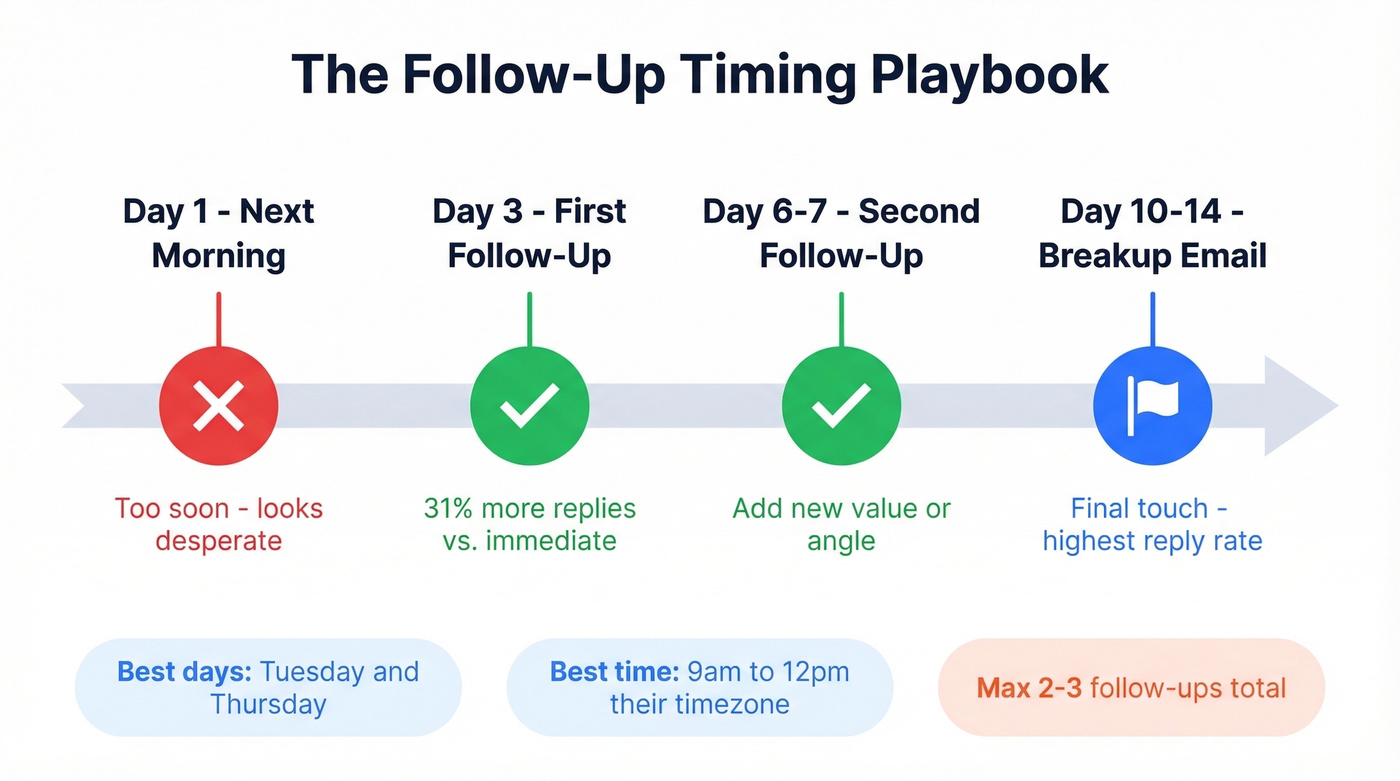
Wait at least 3 business days. This yields 31% more replies than following up immediately. Sending the next morning looks desperate.
Send 2-3 follow-ups, max. Reply-rate gains become negligible after the fifth email, and spam complaint risk spikes well before that. If your average deal size is under $5k, two follow-ups is plenty - save the three-email sequences for accounts worth the persistence. If you want a deeper benchmark-driven breakdown, see follow-up timing.
Aim for Tuesday or Thursday, 9am-12pm in the recipient's timezone. HubSpot's research consistently points to late morning mid-week as the best window, and that lines up with what we've seen across our own outbound campaigns.
Thread or New Subject Line?
Reply in the same thread if they've already engaged - opened your email, had a prior conversation, or you have an existing relationship. Threading preserves context and feels natural.
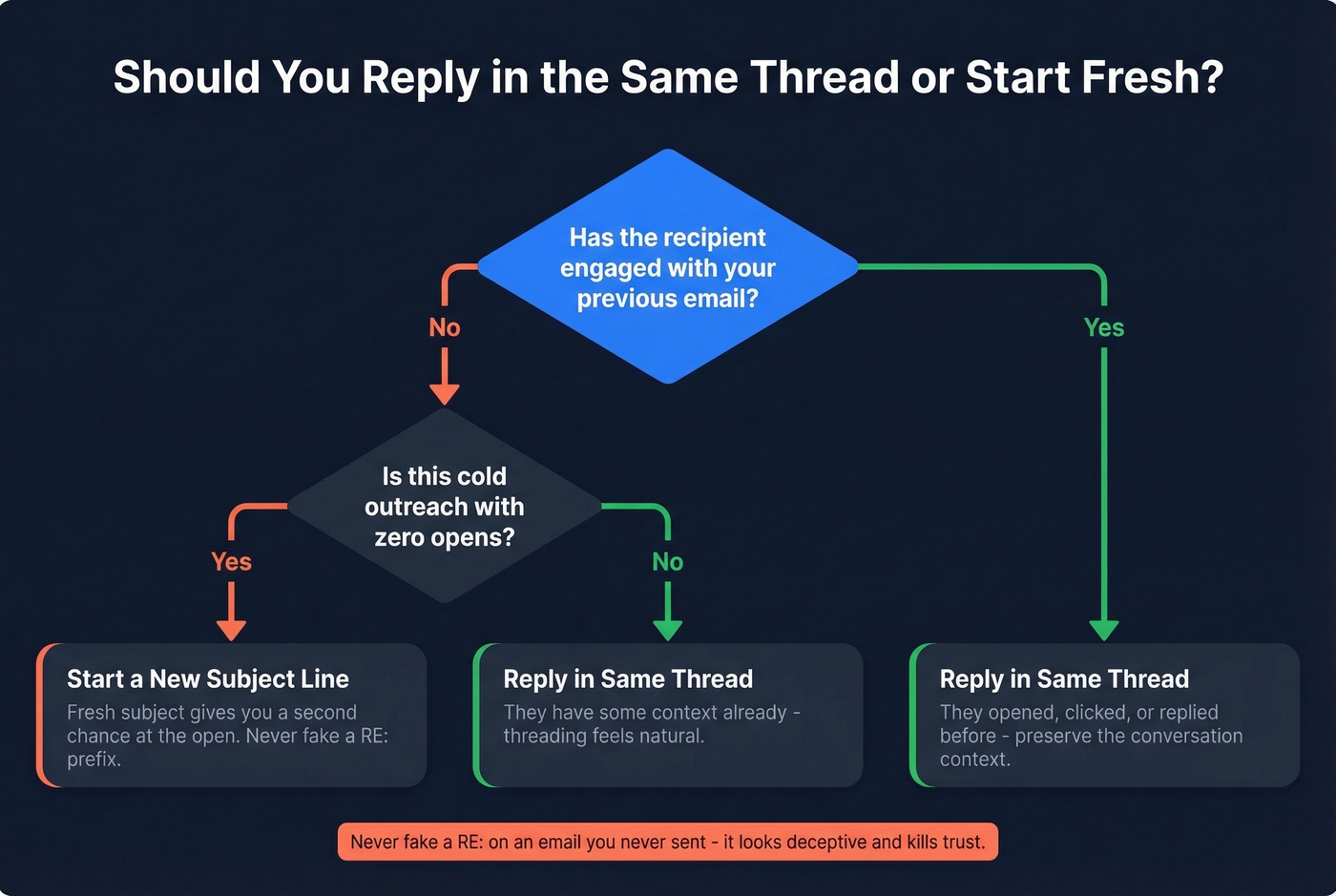
Start a new subject line if it's cold outreach and your first email got zero engagement. A fresh subject gives you a second chance to earn the open. Don't fake a "RE:" on an email you never sent. That trick looks deceptive and erodes trust fast. For ideas, browse these email subject lines.

The best follow-up opener in the world won't help if your email bounces. B2B contact data decays 20-30% every year - and stale addresses tank your deliverability. Prospeo verifies emails in real time with 98% accuracy on a 7-day refresh cycle, so every follow-up lands in a real inbox.
Stop rewriting copy when the real problem is bad data.
Templates You Can Copy
Sales follow-up (Value-Add):
Hi [Name], I put together a quick breakdown of how [your solution] could impact [their specific metric] based on what you shared last week. Worth 5 minutes? [Link]
Client/proposal follow-up (Context Reminder):
Hi [Name], circling back on the proposal from [date] for [project]. Happy to adjust scope or timeline - just let me know what works.
Job interview follow-up (Direct Ask):
Hi [Name], I enjoyed our conversation about the [role] on [date]. Is there anything else I can provide to help with next steps?
Breakup email:
Hi [Name], I've reached out a couple of times about [topic] and haven't heard back. If anything changes, I'm here. Otherwise, I'll close this out.
Let's be honest - templates are starting points, not scripts. Swap in real details from your last interaction and you'll outperform any canned message. If you want more options, these sales follow-up templates are a good next step.
Mistakes That Kill Your Follow-Up
"Just checking in," "touching base," and "I hope you are doing well" are filler phrases that signal you've got nothing new to say. Every follow-up needs a reason to exist. If you need alternatives, here’s how to say just checking in professionally.
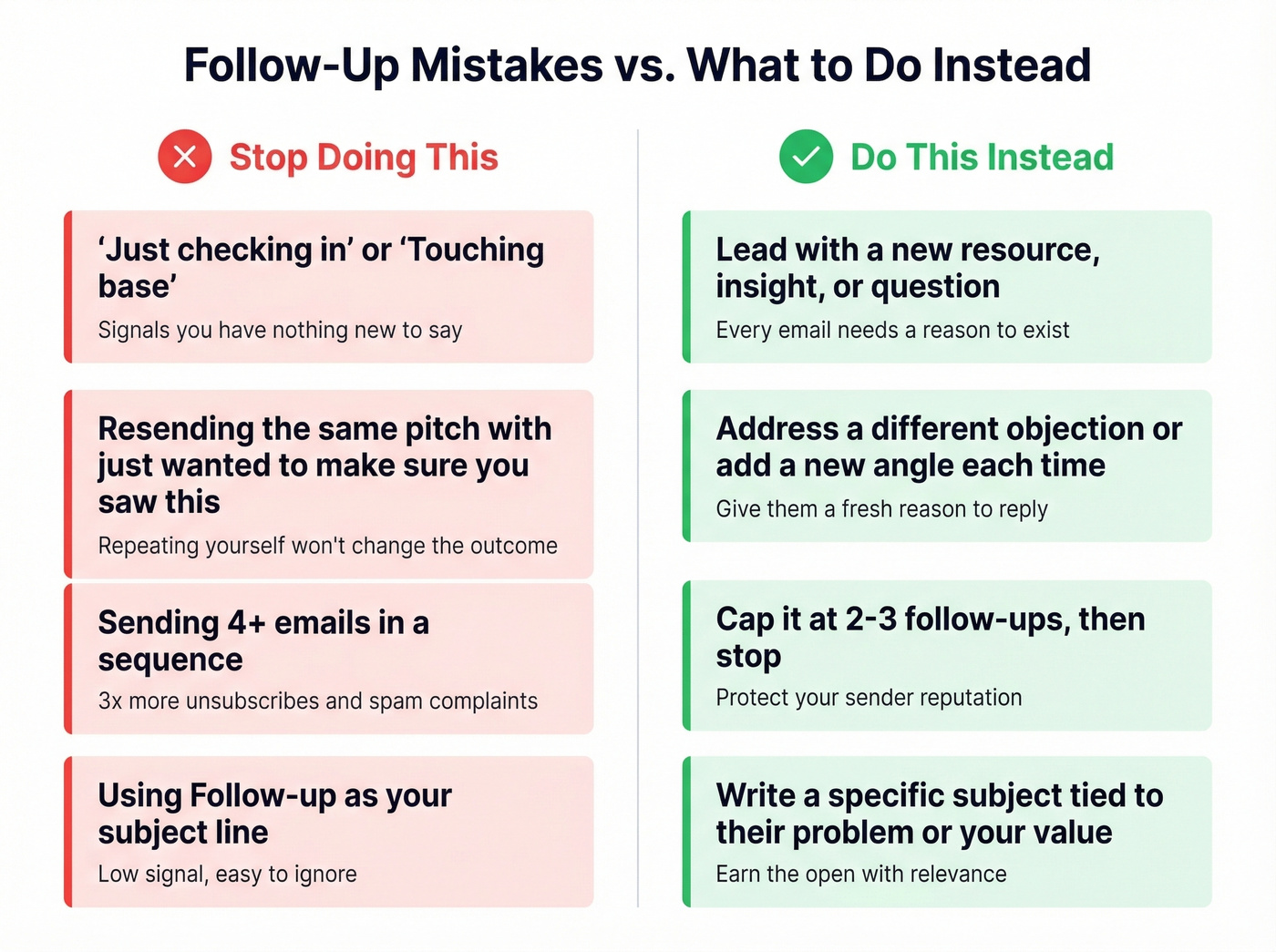
The other common failure is bumping without new information. Resending the same pitch with "just wanted to make sure you saw this" won't change the outcome - each email should address a different objection or add a new angle. And don't send 4+ emails in a sequence. Belkins' study of 16.5 million cold emails across 93 business domains found that four or more emails more than triples unsubscribe and spam complaint rates. Skip "follow-up" in the subject line too - it's low-signal and easy to ignore. If you're building sequences at scale, consider tightening your sequence management.
Check Your Data Before You Follow Up
Look, if you've sent 2-3 follow-ups with zero opens, the problem isn't your copy - it's your data. B2B contact data decays 20-30% annually as people change jobs and email addresses go stale. We had a client last year who rewrote their follow-up sequence three times before realizing 34% of their list was bouncing to dead addresses.
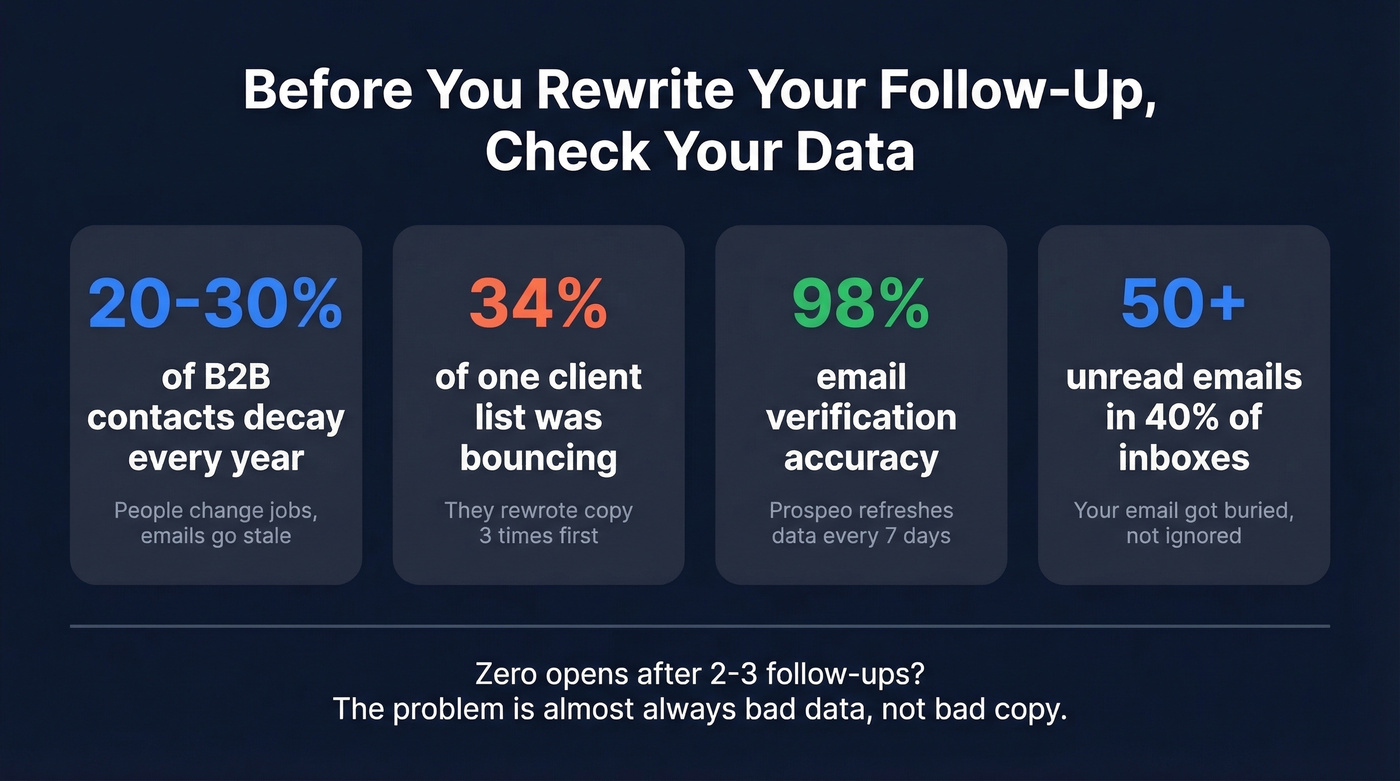
Before you draft another email, verify the address is still active. Prospeo handles this in real time with 98% email accuracy on a 7-day refresh cycle, and the free tier covers 75 verifications per month - enough to audit your pipeline's most important contacts before your next send. If you're troubleshooting deliverability, start with email bounce rate and this email deliverability guide.
You're crafting the perfect follow-up sequence - but are you sending it to the right person? Prospeo's database of 300M+ profiles with 30+ filters helps you find verified decision-maker emails at ~$0.01 each. No contracts, no sales calls, free tier included.
Find the right contact, then follow up with confidence.
FAQ
How many follow-up emails should I send?
Two to three is the sweet spot. Reply-rate gains become negligible after the fifth email, and four or more triples unsubscribe and spam complaints. For deals under $10k, two is usually enough.
Should I reply in the same thread or start a new one?
Start a new subject line for cold outreach with zero prior engagement - it gives you a second shot at the open. Use the same thread for warm contacts who already have context from a previous conversation.
What if I get zero opens on my follow-ups?
Zero opens almost always means a dead or incorrect email address, not bad copy. B2B data decays 20-30% per year. Verify the address before sending another message - otherwise you're just hurting your sender reputation.