

How to Write an Email After a Business Meeting
We've watched deals go sideways because the prospect remembered the meeting differently than the team did. No recap email, no paper trail, nothing to point to. The "that's not what we discussed" conversation always happens later - when it's harder to fix.
48% of sales reps never follow up after a meeting. That stat, from HubSpot's sales research, should make you wince. The email you send within 24 hours aligns expectations, assigns ownership, and creates a written record that protects everyone involved. Knowing how to write an email after a business meeting is one of the highest-return skills in professional communication, and most people never learn it properly.
The 3-Sentence Follow-Up Rule
If you remember nothing else: what was decided, who's doing what, when you're meeting next. Everything else is decoration. Keep the whole thing under 150 words. If your email requires scrolling on mobile, cut it in half.
Here's a trick we use internally: pre-write the skeleton of your follow-up before the meeting starts. Open a draft with the subject line, greeting, and section headers already in place. You'll capture sharper details and send faster than anyone starting from scratch afterward.
Three Types of Post-Meeting Emails
Not every follow-up serves the same purpose. Know which one you're sending before you start typing.
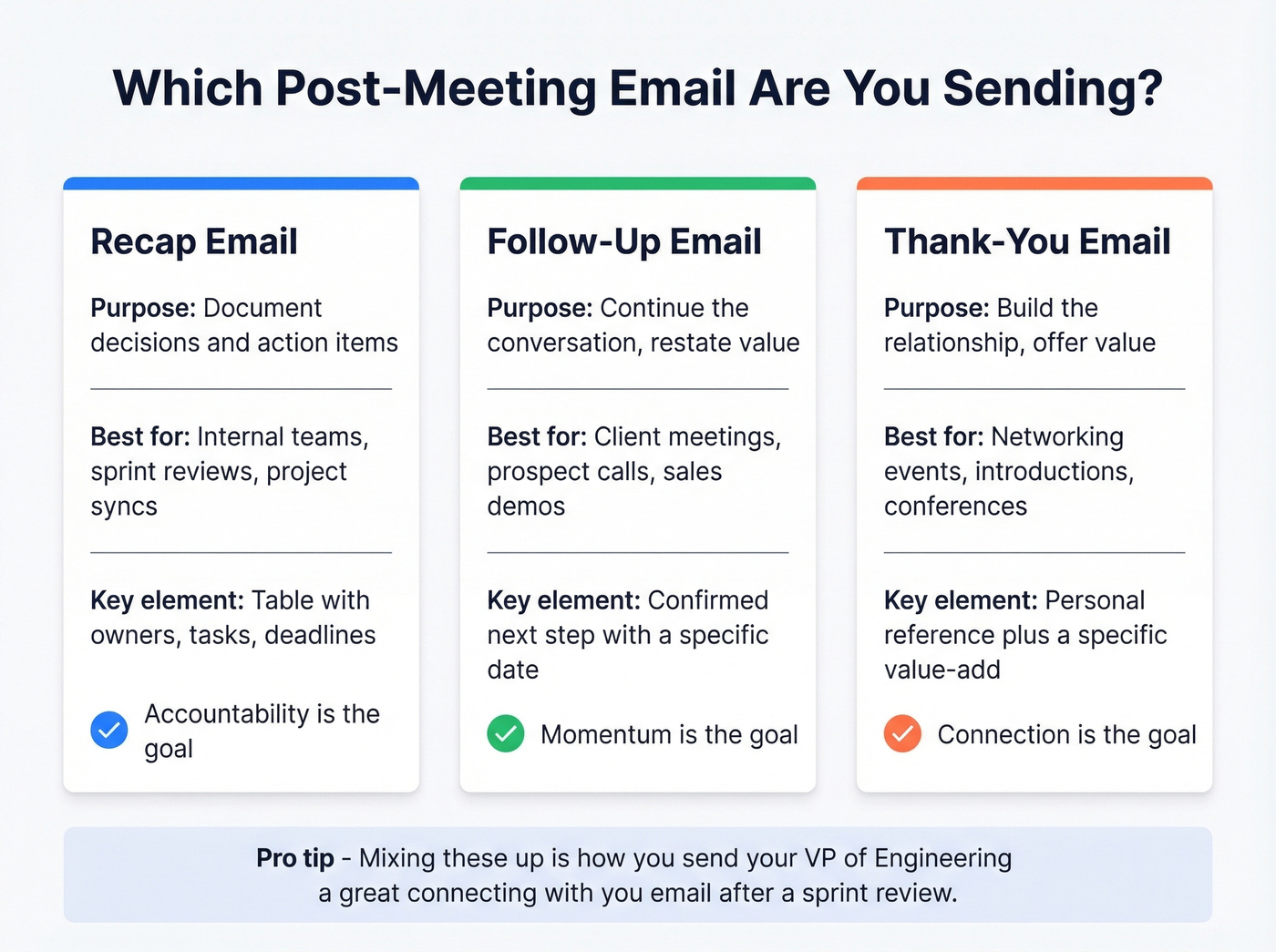
Recap emails document decisions and action items - lightweight meeting minutes for internal teams where accountability matters. Follow-up emails continue the conversation with a prospect or client, restating value and confirming next steps. Thank-you emails build relationships after networking events or introductions with a personal reference, a specific value-add, and a clear next step.
Internal meetings need recaps. Client meetings need follow-ups. Networking conversations need thank-yous. Mixing them up is how you end up sending your VP of Engineering a "great connecting with you!" email after a sprint review.
The Structure That Works Every Time
Every effective post-meeting follow-up hits three beats. First, thank them briefly - one sentence, don't overdo it. Second, recap decisions and action items. This is the meat. Use a table when there are multiple owners, because it's scannable and leaves zero room for ambiguity about who's responsible for what. Third, confirm the next step with a specific date, time, or deliverable.
Not "let's circle back soon." A date.
| Owner | Task | Deadline |
|---|---|---|
| Sarah | Send revised SOW | Fri 1/17 |
| Mark | Schedule legal review | Wed 1/15 |
| You | Share case study deck | Mon 1/13 |
This format prevents the "I thought you were handling that" conversation and saves hours of confusion down the line.
Subject Lines That Get Opened
Seven words and roughly 41 characters is the sweet spot. With 42% of emails opened on mobile, shorter wins.
- "Next steps from our [date] call"
- "3 takeaways from today's meeting"
- "Action items - [project name]"
- "Recap: [topic] discussion [date]"
- "Quick summary + next steps"
Skip "Follow-up" as your subject line. It's generic, signals low effort, and it's easy to ignore. Something like "Circling back with two ideas I didn't get to share" works because the recipient feels like they're missing something valuable.
If you want more options, pull from these email subject line examples and adapt them to your meeting context.

A perfect follow-up email means nothing if it bounces. Prospeo finds verified email addresses from 300M+ professional profiles with 98% accuracy - so your post-meeting recap actually reaches the person you met with.
Stop crafting follow-ups that land in the void. Start with a verified email.
When to Send (by Meeting Type)
| Meeting Type | Send Within |
|---|---|
| Internal team | 24 hours |
| Client / stakeholder | Same day |
| Sales demo / proposal | 24-72 hours |
| Networking / conference | 1-2 days |
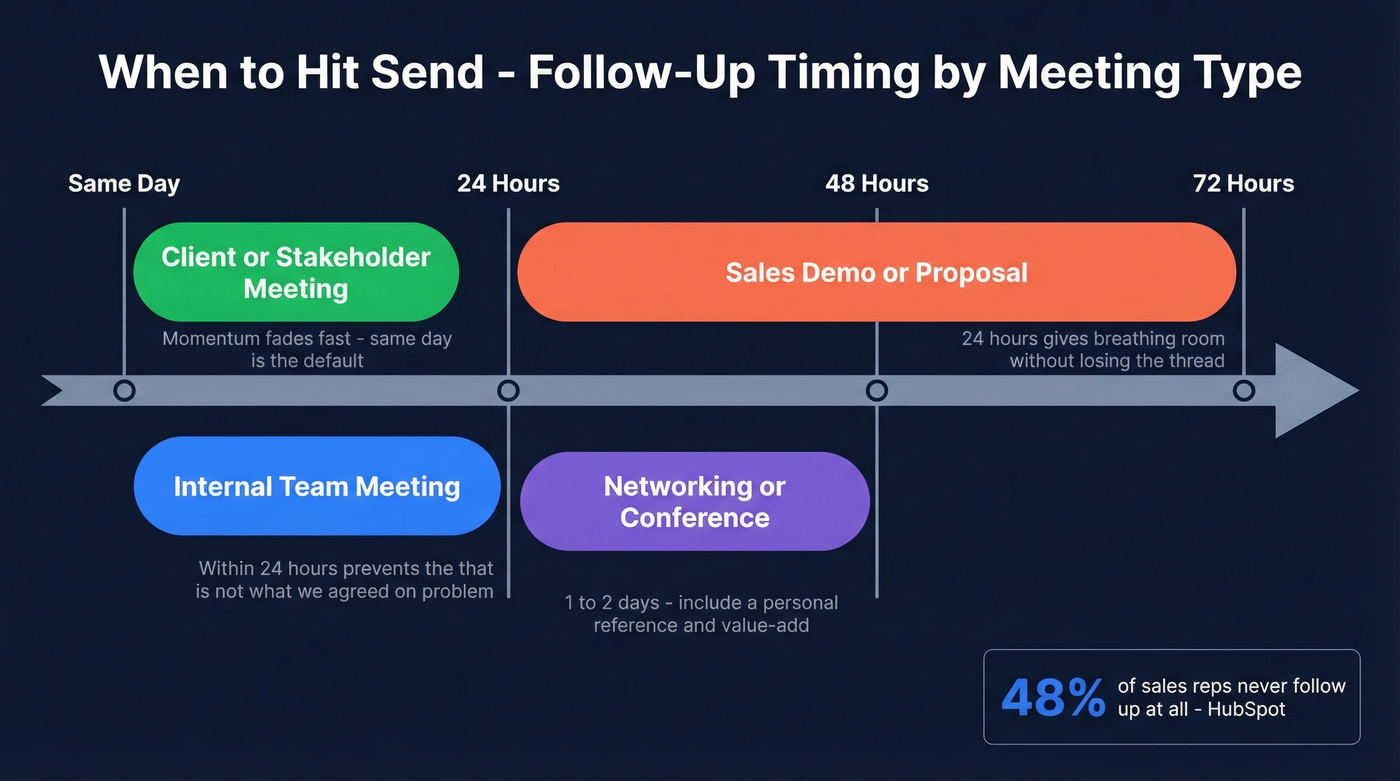
Sales practitioners on r/sales debate whether waiting a day creates "better pacing." Same-day is the right default. Momentum fades fast, and details get fuzzy. The one exception worth considering: sales demos, where 24 hours gives the prospect breathing room without losing the thread.
If you're building a repeatable process around this, these sales follow-up templates can help you standardize what gets sent and when.
Three Templates You Can Steal
Client or Prospect Meeting
Subject: Next steps from our [date] call
Hi [Name],
Thanks for the time today. Here's what we aligned on:
- [Decision 1]
- [Decision 2]
I'll send the revised proposal by [date]. Can we lock in [date/time] for the next check-in?
Internal Team Meeting
Subject: Action items - [project] sync [date]
Team,
Quick recap:
| Owner | Task | Deadline | |-------|------|----------| | [Name] | [Task] | [Date] | | [Name] | [Task] | [Date] |
Next sync: [date/time]. Flag anything blocked before then.
Networking or Event Meeting
Subject: Great chatting about [topic] at [event]
Hi [Name],
Enjoyed our conversation about [specific topic]. I mentioned [resource] - here's the link: [URL].
Free for a 15-minute call [next week]?
Five Mistakes That Kill Follow-Ups
- "Just checking in" / "touching base" - These phrases signal you have nothing new to say. Add value or don't send the email. (If you need alternatives, see how to say just checking in professionally.)
- "Follow-up" as your subject line - One of the most common and least effective patterns in business email. Be specific.
- Bumping with no new info - Each follow-up should include something new: a data point, a resource, a relevant update. This is the core of how to add value in sales without sounding needy.
- CC/Reply-All abuse - CC is for stakeholders who need visibility, not action. The "Thanks!" reply-all to 15 people is how you become the person everyone mutes.
- Waiting too long - Same-day beats next-day. Details fade, momentum dies, someone else fills the gap.
What to Do When You Get No Response
Don't panic. Follow this cadence instead.
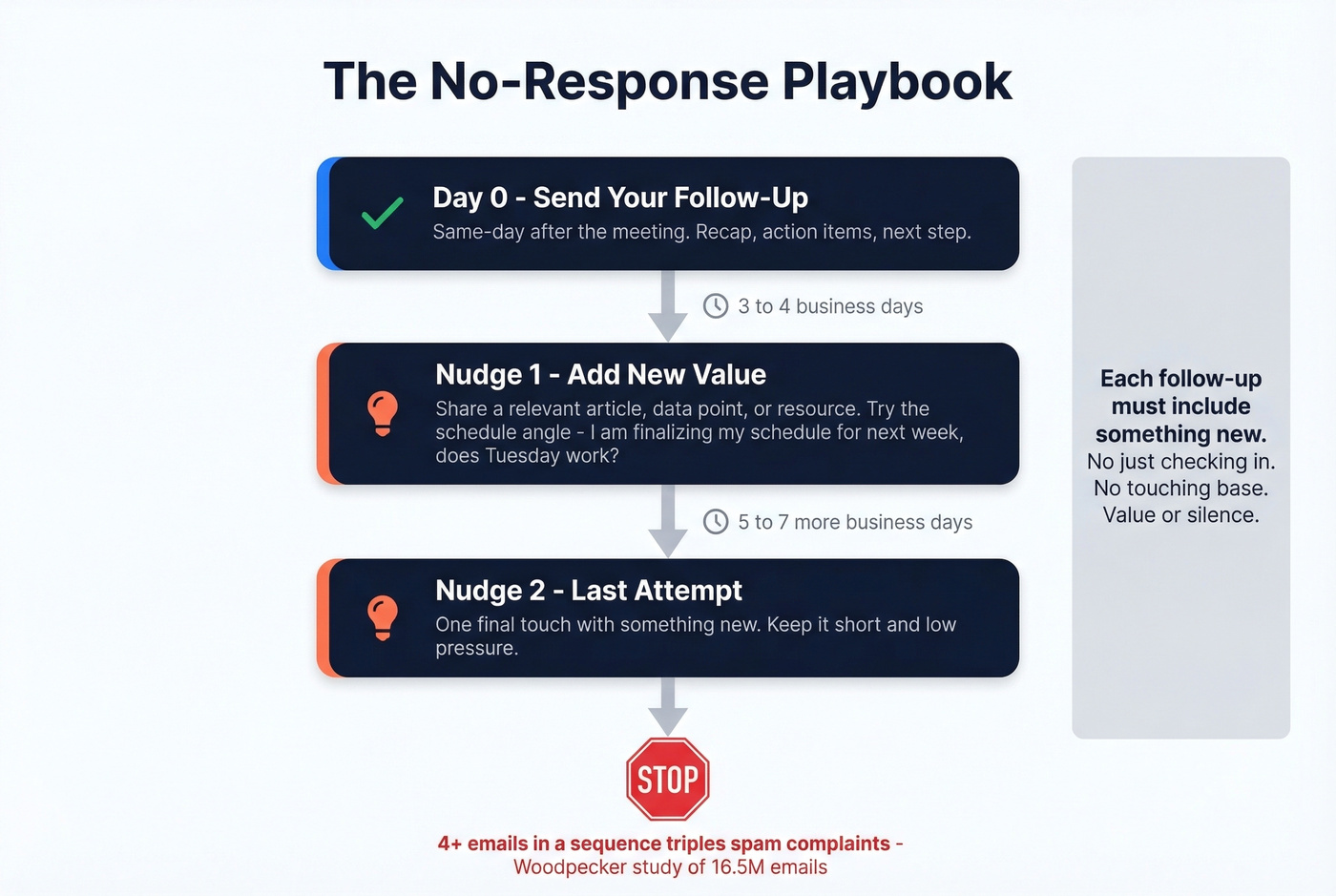
At 3-4 business days, send your first nudge with a new piece of value: a relevant article, a data point, a specific question. Try the schedule-finalization angle that's popular in outbound circles: "I'm finalizing my schedule for next week - does [date] work?" It creates a soft deadline without being pushy.
At 5-7 business days after that first nudge, send a second. Then stop. An analysis of 16.5M cold emails found that sending 4+ emails in a sequence more than triples spam complaints. Know when to walk away.
If you want a clearer rule of thumb for timing, use this guide on when should i follow up on an email.
Email Mechanics Most Guides Skip
Reply to the original thread instead of starting a new email - threading keeps context intact and makes it easy for the recipient to scroll back. Keep it plain text or close to it. Heavy formatting and HTML templates look like marketing, not a colleague following up.
CC stakeholders who need to stay informed, and never BCC to hide communication. Design for mobile: short paragraphs, bullets, no walls of text. 50-125 words is the sweet spot, which means two scrolls or fewer on a phone screen. And if you're running outbound campaigns alongside these follow-ups, keep your bounce rate under 2%; above 5% and you're actively damaging your domain reputation. (If deliverability is a priority, start with an email deliverability guide and a plan to improve sender reputation.)
Keeping bounce rates under 2% starts with verified data. Prospeo's 5-step email verification and 7-day data refresh mean every follow-up you send protects your domain reputation - not damages it. Emails start at $0.01 each.
Send follow-ups that land. 75 free verified emails per month, no contracts.
FAQ
How do you write a professional email after a meeting?
Cover what was decided, who owns which action items, and the next step with a specific date - all in under 150 words. Thank them in one sentence, list decisions and owners in a table or bullets, and close with a concrete next step. The 50-125 word range is the sweet spot for mobile readability.
What's the best subject line for a post-meeting email?
Keep it under seven words and reference the meeting specifically: "Action items from [date] call" or "Next steps - [project name]." Avoid generic phrases like "Follow-up" or "Checking in" - they signal low effort and get ignored.
Should I send a follow-up email after an internal meeting?
Yes - within 24 hours. Internal recaps prevent the "that's not what we agreed on" problem that derails projects weeks later. Focus on action items with owners and deadlines. Skip the thank-you pleasantries.
What if I don't have the person's email address after a networking event?
Use an email finder tool like Prospeo - enter their name and company to get a verified address. Sending to an unverified or guessed email risks bouncing, which damages your sender reputation. A healthy bounce rate stays under 2%.