

How to Write an Email After No Response
You sent a good email. Silence. Now you're staring at your inbox wondering what went wrong.
Here's the uncomfortable truth most guides skip: a study of 16.5 million cold emails found the highest reply rate - 8.4% - came from a single email with zero follow-ups. Each additional message degraded performance. That doesn't mean you should never follow up. It means you should follow up deliberately, not reflexively.
The Short Version
- Wait 3 days before your first follow-up. Next-day follow-ups reduce replies by 11%.
- Cap it at 2-3 follow-ups total. After four or more, unsubscribe rates triple and spam complaints spike even harder.
- Verify the email address first. Silence often means the email never arrived.
Why People Don't Reply
Inbox overload is the obvious culprit - 40% of people have 50+ unread emails at any given time. But the most common reason is simpler than that: bad timing. They saw your message during a meeting, meant to respond, and forgot.
Low priority is harder to fix. Your email didn't create enough urgency to earn a reply right now, and no amount of "just bumping this" will change that.
Then there's the reason nobody thinks about: the email never arrived. Invalid addresses, full inboxes, spam filters - your message hit a dead end. This is more common than most people realize, and it's the one scenario where following up is completely pointless.
When to Send Your Follow-Up
An 85,000-email dataset from Siege Media found that emails sent between 6-9am PST on Monday hit a 2.8% reply rate - the highest of any time slot tested. Tuesday morning was close behind.
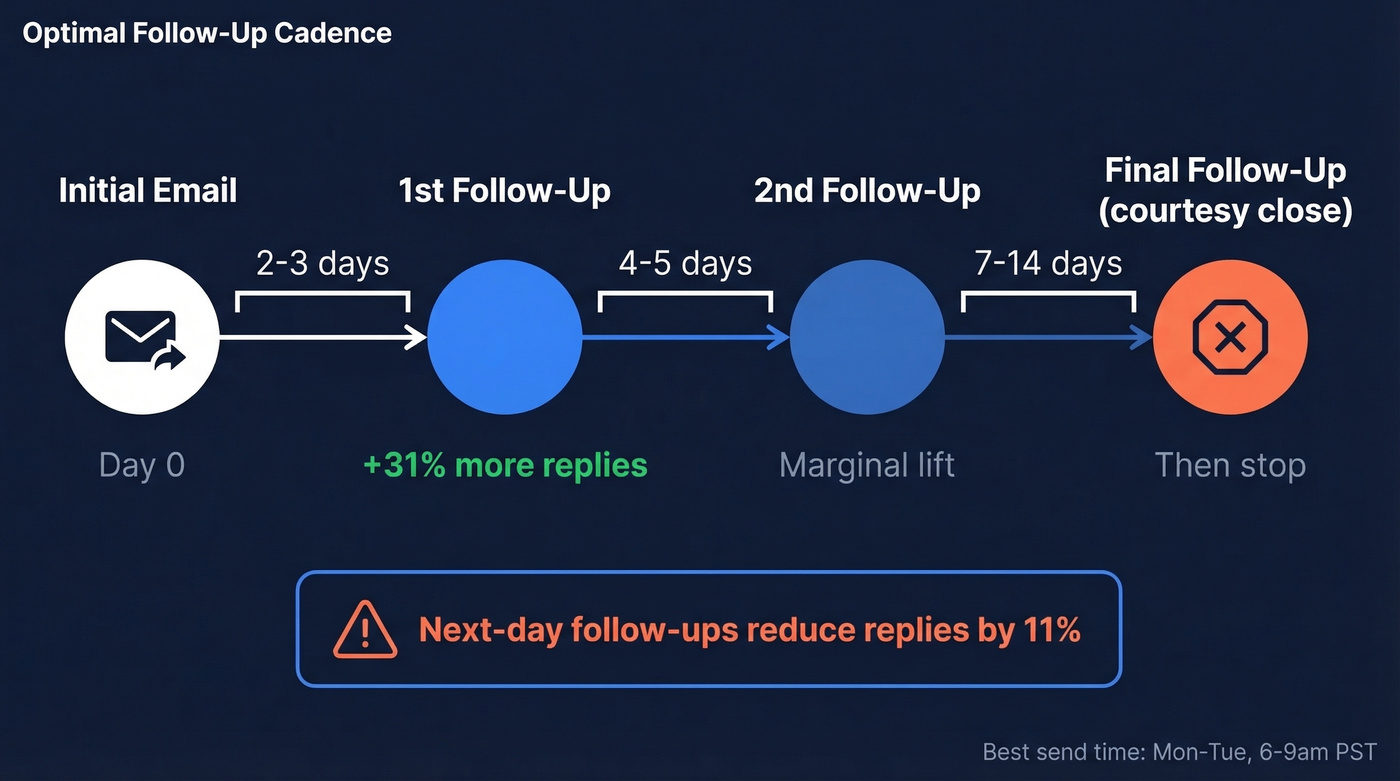
For spacing, use a graduated cadence:
| Follow-Up | Wait Time | What to Expect |
|---|---|---|
| 1st | 2-3 days | Most replies come here |
| 2nd | 4-5 days | Marginal lift at best |
| 3rd (final) | 7-14 days | A courtesy close |
Waiting three days before your first follow-up increases replies by 31%. Sending the next day actually hurts your chances.

Most follow-up sequences fail before they start - because the email address was invalid. Prospeo's 5-step verification catches bad addresses, spam traps, and honeypots before you hit send. 98% accuracy at $0.01 per email. Stop following up into the void.
Verify every address before you waste a single follow-up.
How Many Follow-Ups to Send
Two to three. That's it.
The first follow-up carries a 40% effectiveness boost over the initial send. After that, you're fighting diminishing returns and rising risk. At four or more emails in a sequence, unsubscribe rates triple and spam-complaint risk more than triples - which actively damages your sender reputation.
Company size matters, though. Small businesses (2-50 employees) tolerate follow-ups better: 9.2% reply rate on the first email, 8.0% on the first follow-up, and 8.4% on the second. Enterprise segments (1,000+ employees) drop off faster and are far less tolerant of persistence.
Here's the thing: if you need more than three follow-ups to get a reply, the problem isn't your persistence - it's your targeting or your offer. Fix those before adding more emails to the sequence.
For cold outreach, a multi-channel approach beats stacking emails. Combining a message on a professional network with a profile visit hit an 11.87% reply rate - higher than any email-only sequence in the dataset. We've seen this firsthand: the third follow-up email rarely changes the outcome, but a different channel sometimes does.
Crafting the Right Message
Certain phrases feel professional in your head but read as passive-aggressive on the receiving end:
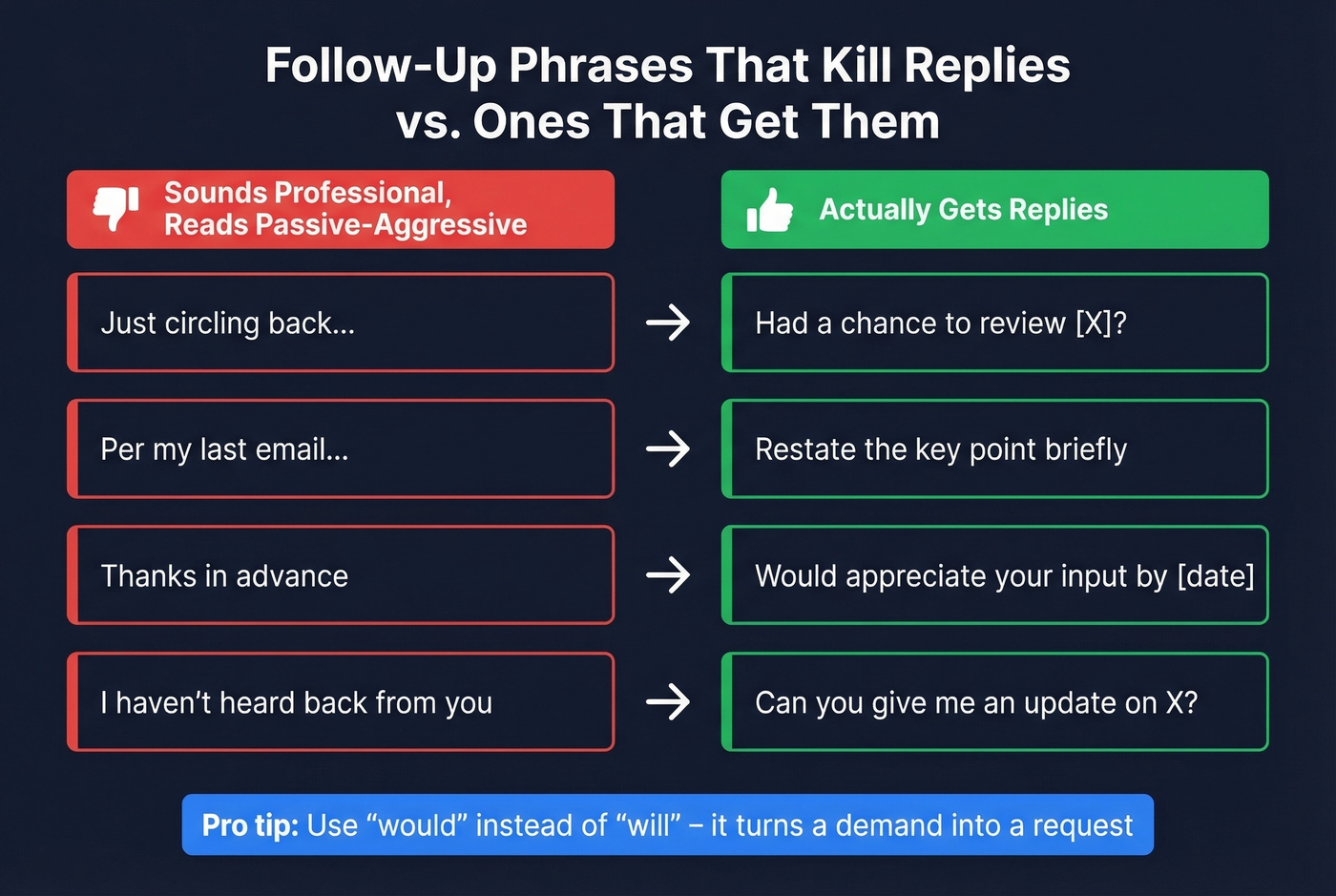
| Don't Write | Write This Instead |
|---|---|
| "Just circling back" | "Had a chance to review [X]?" |
| "Per my last email" | Restate the key point briefly |
| "Thanks in advance" | "Would appreciate your input by [date]" |
| "Please advise" | Ask a specific question |
One micro-tip from a heavily upvoted Stack Exchange thread: use "would" instead of "will." "Would you be able to share an update?" reads as a request. "Will you send me an update?" reads as a demand. Small word, big difference.
The broader principle is to ask for a status update rather than pointing out the silence. "Can you give me an update on X?" always outperforms "I haven't heard back from you on X." If you want more options, see these sales follow-up templates and cold email follow-up templates.
Follow-Up Templates by Scenario
Cold Sales Follow-Up
Subject: Re: [original subject]
Hi [Name],
Quick follow-up - I shared [specific value prop] last [day]. If reducing [pain point] by [metric] is still a priority, I'd love 15 minutes this week. If not, no worries - just let me know and I'll close the loop.
The templates that actually get replies share one trait: they give the recipient an easy out. "No worries" isn't weakness - it's permission to respond honestly, which people actually do.
Job Application Follow-Up
Subject: Following up - [Position Title] application
Hi [Name],
I applied for the [Position] role about a week ago and wanted to follow up. I'm excited about [something specific from the posting or company news] and think my experience in [relevant skill] would be a strong fit.
Wait at least one week after applying. If the posting says don't contact, don't. A hiring manager on r/jobsearchhacks recommends referencing something specific from your interview - use their own answers about team challenges to position yourself as the solution.
Client Follow-Up
Subject: Re: [Project/Invoice]
Hi [Name],
Following up on [project milestone / invoice #] from [date]. Could you give me a quick update on where things stand? If it's easier to hop on a call, I'm free [two specific times].
After two unanswered emails, pick up the phone. Email silence from a client usually means they're overwhelmed, not avoiding you. If two emails and a call go unanswered, update your CRM and move them to a nurture sequence - don't keep chasing.
Internal / Workplace Follow-Up
Your coworker isn't ignoring you maliciously - they're drowning in Slack notifications and forgot. Frame it as alignment, not accountability:
Subject: Re: [original subject]
Hi [Name],
Would you be able to share an update on [specific item]? Want to make sure we're aligned before [deadline/meeting].
Don't CC their boss. That's an escalation move that damages the relationship. If you need to escalate, do it in a separate conversation.
Verify Delivery Before You Follow Up
I've watched teams burn through entire follow-up sequences only to discover the email address was invalid from the start. If someone hasn't replied, the first question shouldn't be "what do I write?" - it should be "did my email actually arrive?" (If you're troubleshooting bounces, start with email bounce rate and this email deliverability guide.)
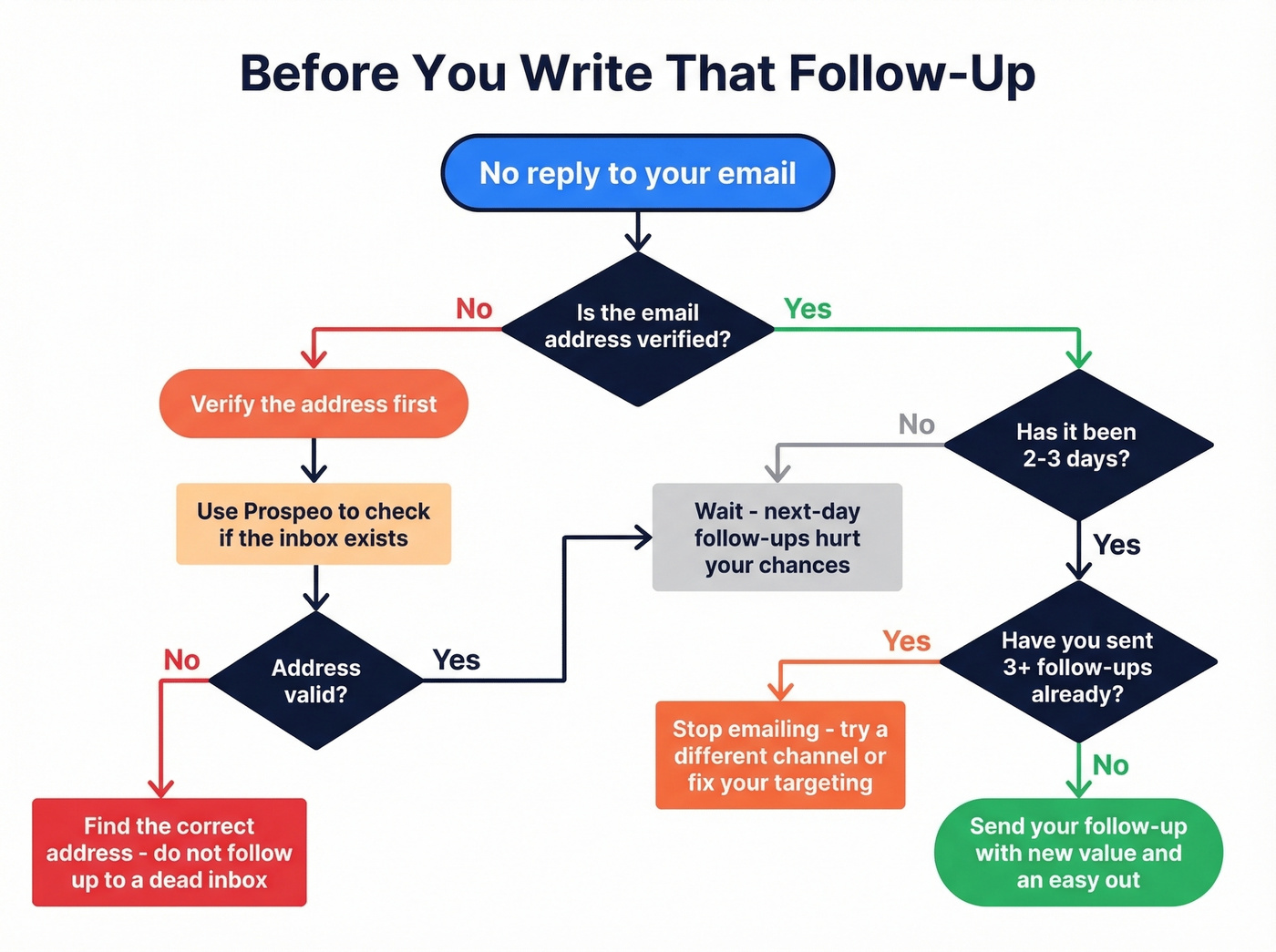
Prospeo verifies email addresses in real time with 98% accuracy, catching invalid addresses, spam traps, and honeypots before you send. Its 5-step verification process includes catch-all domain handling, so you're not guessing whether a corporate inbox is real. The free tier gives you 75 verifications per month - enough to check a prospect list before you waste time crafting follow-ups to dead inboxes. If you need a broader stack, compare email reputation tools and an email spam checker.

If your follow-ups aren't landing, the problem might be your data, not your copy. Prospeo refreshes 300M+ contacts every 7 days - so you're never emailing outdated addresses. Teams using Prospeo see bounce rates drop from 35% to under 4%.
Fix your data first. The replies will follow.
FAQ
Should I reply to my original email or start a new thread?
Reply to the original thread. It preserves context and lets the recipient scroll down to see what you're referencing without searching their inbox. Only start a new thread if the subject line was wrong or the topic has fundamentally changed.
What subject line works best for a follow-up?
Keep the original subject line by replying to your sent message - "Re:" threads get 92% of follow-up replies. If you're starting fresh, use something specific like "Quick question about [topic]." Avoid "Checking in" or "Touching base" - they signal low-priority content.
How do I follow up after a week of silence?
Reply to your original thread with new context - a relevant article, a brief case study, or a specific question that's easy to answer. Don't rehash your first message word for word. The goal is to give them a fresh reason to engage, not remind them they ignored you.
How do I know if my email was even delivered?
Don't rely on open tracking - Belkins stopped tracking open rates in 2024 because tracking pixels were hurting deliverability. The reliable method is email verification before you send. Tools like Prospeo validate addresses in real time so you know the inbox exists before you follow up.
Is it rude to send a follow-up after no response?
No. One follow-up after 2-3 days is expected in professional communication. Two is fine. Three is the absolute ceiling. What's rude is the fourth email with "just wanted to make sure you saw this" - that's not persistence, it's pressure. Knowing how to write an email after no response is a core professional skill, not an imposition.