

Hunter Mentality in Sales: Why System Beats Mindset Every Time
Your VP just told the team to "put on your hunter hats." It's the Monday after a bad quarter, pipeline's thin, and someone printed motivational quotes about wolves. Nobody defined what "hunting" actually means in operational terms. No activity targets, no sequence framework, no data quality standards - just vibes and aggression.
That's not a strategy. That's a pep rally.
The hunter mentality in sales is real, but it's a system you build - not a personality you're born with. Companies that screen for "hunger" instead of building process often churn through SDRs fast, with average tenure of 14-16 months before reps leave or get managed out.
Quick version: Define your ICP with firmographic precision. Run a 3-week multichannel sequence at 25 touches per day. Verify every contact before it enters a sequence. The mentality follows the math, not the other way around.
What "Hunter Mentality" Actually Means
A hunter mentality means proactively creating pipeline rather than waiting for it. Hunters source their own opportunities through outbound prospecting - cold calls, cold emails, social touches - instead of relying on inbound leads or existing accounts.
The classic hunter vs. farmer distinction is a common org-design framework. But the two archetypes serve fundamentally different economic functions.
| Trait | Hunter | Farmer |
|---|---|---|
| Primary goal | New logos | Retention + expansion |
| Core activity | Prospecting, cold outreach | Relationship management |
| Revenue type | Net-new ARR | Upsell, cross-sell, renewal |
| Risk profile | High volume, low close rate | Low volume, high yield |
| Key metric | Pipeline created | Net revenue retention |
Here's the tension most orgs ignore: acquiring a new customer costs 8-10x more than retaining an existing one. New-customer win rates hover around 33%. Farming is more capital-efficient by almost every measure. But without hunters, there's no install base to farm. Both functions are essential - the mistake is treating "hunter" as the aspirational identity and "farmer" as the consolation prize.
Beyond the Binary
The 4-Type Model
The hunter/farmer framework misses nuance. A more useful taxonomy breaks salespeople into four types.
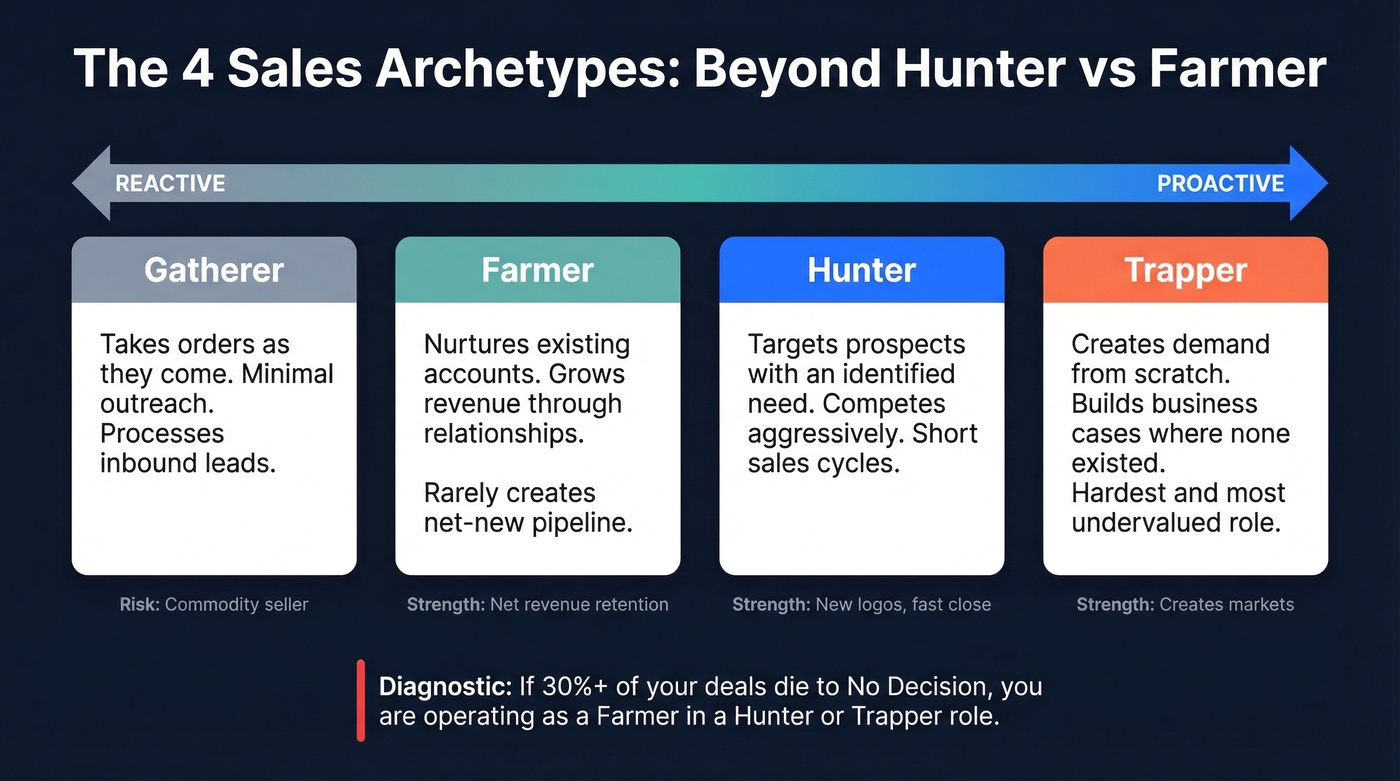
Gatherers and Farmers sit on the reactive end. Gatherers take orders - leads come in, they process them, minimal proactive effort. Farmers nurture existing relationships and grow accounts over time, but they're relationship-first and rarely create net-new pipeline.
Hunters target prospects who've already identified a need. They move fast, often with short sales cycles, and compete aggressively for deals already in motion. If you're winning competitive bake-offs, you're hunting. Trappers create demand where none existed - they build business cases from scratch, working deals that weren't on anyone's forecast. This is the hardest role in sales and the most undervalued.
The diagnostic that matters: if 30% or more of your deals die to "No Decision," you're operating as a Farmer in a role that requires a Hunter or Trapper. No Decision isn't a competitor. It's inertia. And inertia kills pipeline faster than any rival vendor.
The Numbers Behind Hunting
The economics of hunting are brutal but honest.
| Metric | Benchmark |
|---|---|
| New-customer win rate | ~33% |
| Acquisition cost vs. retention | 8-10x higher |
| Enterprise stakeholders per deal | 10+ |
| Marketing leads close rate | 50-60% |
| Cold-generated leads close rate | ~5% |
That last row stings. The consensus on r/sales is that marketing-sourced leads close at 50-60%, while cold-generated leads close around 5%. A 10x gap. It doesn't mean cold outbound is worthless - it means the math demands volume, discipline, and verified data to make it work.
On the farming side, companies using customer consumption data for upsell and cross-sell see service revenue more than double. Even more striking: companies that deploy services teams for lead generation gain nearly 3x more revenue from their existing customer base.
The takeaway isn't "don't hunt." It's "hunt with your eyes open about the economics."
If your average deal size is under $15k and you've got a healthy install base, you probably don't need a dedicated hunter team. You need a farmer with a Trapper's instincts and a solid expansion playbook. Most companies over-invest in net-new acquisition and under-invest in the customers already paying them.

Cold outbound closes at ~5%. That math only works with volume and verified contacts. Prospeo gives hunters 300M+ profiles with 98% email accuracy and 125M+ verified mobiles - refreshed every 7 days so your 25 daily touches actually land.
Stop hunting with stale data. Fill your 1,500-prospect funnel with contacts that connect.
When "Hunter Mentality" Becomes a Red Flag
Job Posting Warning Signs
The #1 complaint about "hunter mentality" on r/sales? It's a red flag in job postings. One thread puts it bluntly: if a job description says "looking for hunters," move on as fast as you can.
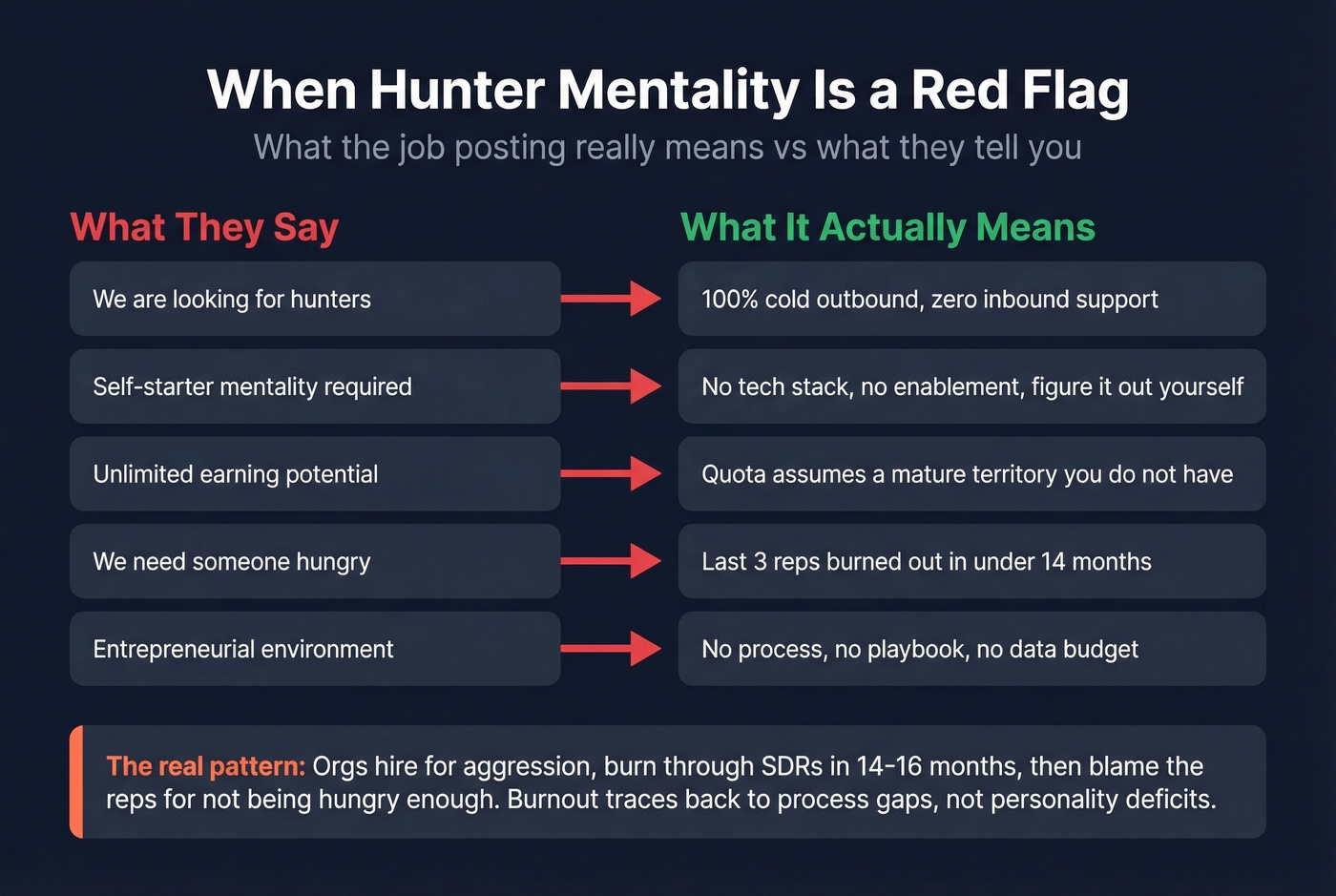
The pattern is predictable. A company posts an AE or "business development" role. The interview reveals it's 100% cold outbound with no inbound support, no tech stack, and a quota that assumes a mature territory. That's not a hunter role - it's a resourcing failure disguised as a mindset requirement.
The Consultative Seller Penalty
Enterprise deals with 10+ stakeholders don't need battering rams. They need navigators - people who can decode dysfunction and spot where the decision's stuck. But consultative sellers consistently get penalized in interviews for lacking "hunger," even when their skill set is exactly what complex deals require.
The result is a self-defeating cycle. Orgs hire for aggression, burn through SDRs in 14-16 months, then blame the reps for not being "hungry enough." We've seen it over and over - burnout warning signs like sleep issues, cynicism, and performance plateaus almost always trace back to process gaps, not personality deficits.
The Hunter's Pipeline Math
Forget motivation. The most useful framework for hunter discipline comes from a simple funnel management model that generalizes across industries.
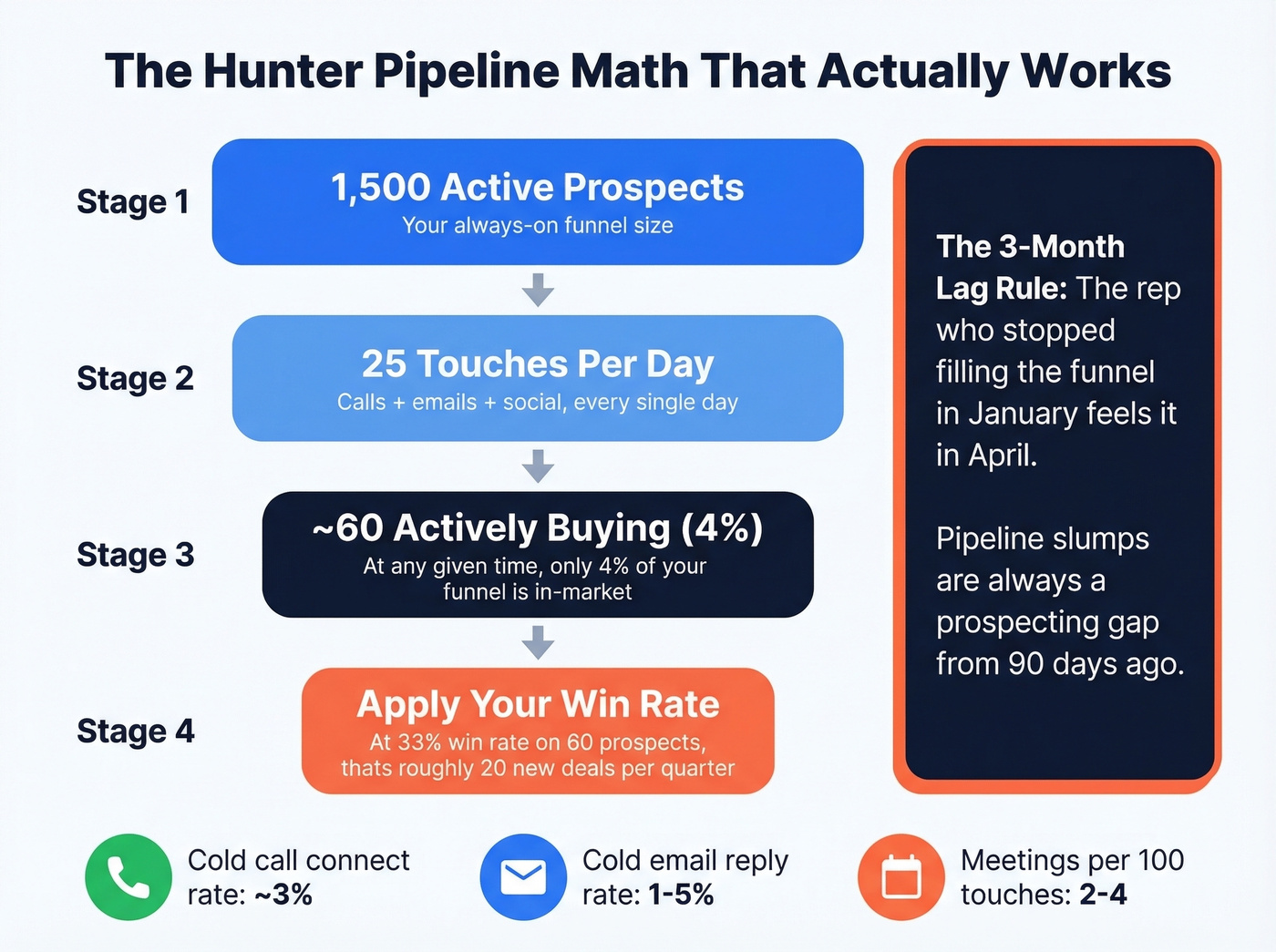
- Maintain ~1,500 prospects in your active funnel at any time.
- Make 25 touches per day across calls, emails, and social.
- At that cadence, each prospect gets contacted roughly once per quarter.
- Industry averages suggest about 4% of your funnel is actively buying at any given moment - roughly 60 prospects out of 1,500. Apply your win rate to those 60, and you've got your quarterly number.
Most sales slumps trace back to a prospecting gap three months earlier. The rep who stopped filling the top of the funnel in January feels it in April. A hunter mindset without this underlying math is just optimism dressed up as strategy. A system you can model is a system you can fix.
The Modern Hunter's Playbook
Multichannel Sequences
Single-channel outbound is dead. Based on analysis of 85M+ cold emails, a 3-week multichannel sequence combining calls, emails, and social touches can double outbound meetings.
Here are the baseline benchmarks every hunter should know: cold call connect rates run about 3%, cold email reply rates land between 1-5%, and you'll book roughly 2-4 meetings per 100 touches across channels. Those numbers look small in isolation. At scale, with a 1,500-prospect funnel and 25 daily touches, they compound into real pipeline.
Data Quality as the Foundation
A 3-week multichannel sequence means nothing if a big chunk of your emails bounce. Activity without accuracy is theater - you're burning domain reputation and rep hours on contacts that don't exist.
Let's be honest about the difference clean data makes. Snyk's sales team went from a 35-40% bounce rate to under 5% after switching to Prospeo. AE-sourced pipeline jumped 180%, and they now generate 200+ new opportunities per month across 50 AEs. That's not a mindset shift - it's a data quality shift that made the entire hunter system actually function.
Skip this step if you want to learn the hard way. We've watched teams run beautiful multichannel sequences into the ground because 30% of their contact list was garbage. Fix the data first. Everything else is downstream.
Build a System, Not a Persona
The obsession with finding "natural hunters" is why sales orgs churn through SDRs so quickly. Build the process, and the mentality follows. Every effective outbound system has three components.
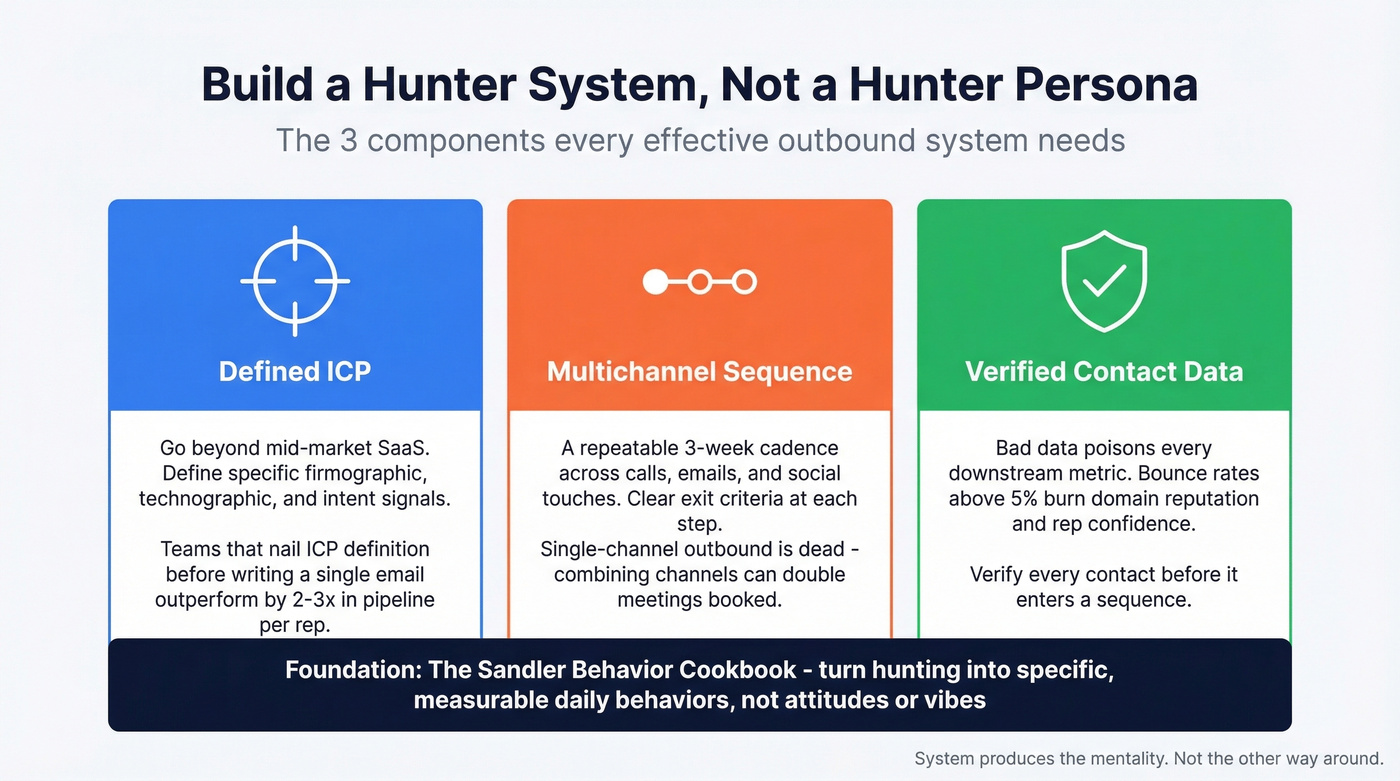
A defined ICP goes beyond "mid-market SaaS." It means specific firmographic, technographic, and intent signals that predict buying behavior. In our experience, teams that nail ICP definition at this level before writing a single email outperform those that skip straight to sequences by a wide margin - sometimes 2-3x in pipeline generated per rep. (If you want the nuance, see ICP vs Persona.)
Next, a multichannel sequence: a repeatable 3-week cadence across calls, emails, and social touches with clear exit criteria. And underneath it all, verified contact data - which starts with B2B list building and ends with email verification. Bad data poisons every downstream metric.
The Sandler Behavior Cookbook is the best framework for turning "be a hunter" into daily actions. It breaks prospecting into specific, measurable behaviors - not attitudes, not vibes, not wolf posters. Pair it with a CRM, a multichannel outreach tool like Instantly or Lemlist, and a verified data source, and you've got infrastructure that makes any rep dangerous. The traits of a hunter salesperson - resilience, initiative, comfort with rejection - emerge naturally when the system removes ambiguity about what to do next.
If you want to operationalize this, build it into a real sales playbook and track it with a small set of sales productivity metrics (not vanity activity).
SDR burnout isn't a mindset problem - it's a data problem. Reps churning through bad numbers and bounced emails lose confidence fast. Prospeo's 30% mobile pickup rate and under-4% bounce rates give your hunters the system that keeps them in the game.
Give your hunters verified direct dials and emails for $0.01 per lead.
FAQ
Is the hunter mentality a personality trait or a skill?
It's a skill built through process. Pipeline math, multichannel sequences, and data discipline are all learnable. Companies that hire for "innate hunger" instead of building systems see the highest SDR turnover - often 14-16 months before reps leave or get managed out.
How do I spot a legitimate hunter role?
Ask about inbound lead flow, tech stack, and quota-to-OTE ratio during interviews. If the answer is "we need someone who can build from scratch" with no tools or marketing support, that's a resourcing failure. Legitimate hunter roles come with infrastructure - CRM, sequencer, and verified data at minimum.
What tools do outbound sales hunters need?
Three essentials: a CRM like Salesforce or HubSpot, a multichannel outreach platform like Instantly or Lemlist, and a verified contact data source for accurate emails and direct dials. Everything else is optimization - get these three right first.