


Hunter.io Reviews 2026: Pricing, Accuracy & Alternatives
You opened Hunter.io for the first time in six months, and the interface looks exactly the same. That's either comforting or concerning, depending on what you need from an email finder in 2026. Hunter reviews across G2, Capterra, and Trustpilot paint a consistent picture: a simple, reliable tool that hasn't kept pace with what modern outbound demands. It's the Honda Civic of email finders - gets you from A to B, but the B2B data market left "finds emails from public web pages" behind a while ago.
30-Second Verdict
Hunter carries a solid ~4.4 average across 1,600+ reviews on G2, Capterra, and Trustpilot. Users love the simplicity. The verification tool reduces bounces. And the free tier is generous enough to test before committing.
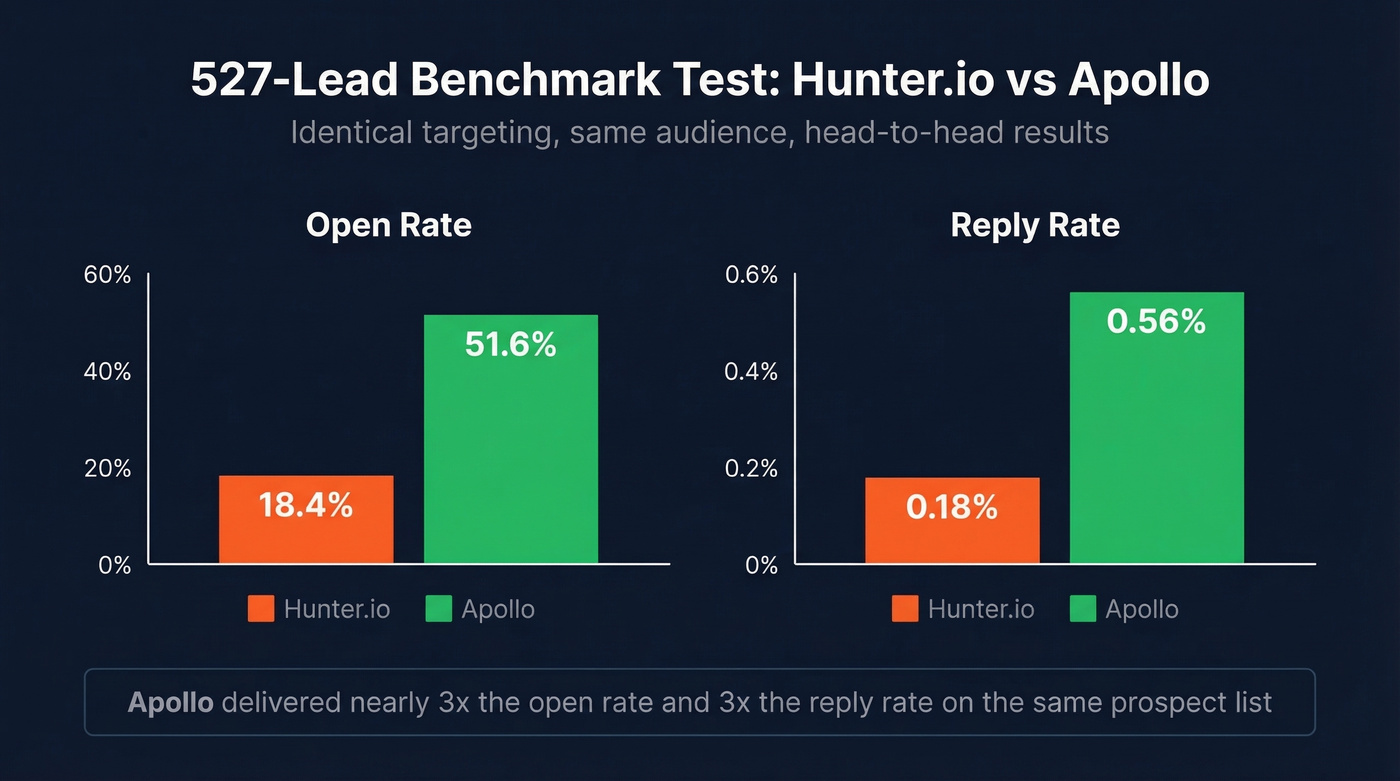
Here's the thing, though: Hunter doesn't have mobile phone numbers. Zero. It doesn't do multichannel sequences. Its campaigns feature is text-only with no A/B testing. And a 527-lead benchmark test showed Hunter pulling an 18.4% open rate versus Apollo's 51.6% on identical targeting.
Good for: Freelancers, solo founders, anyone sending under 100 cold emails a month who only needs email addresses.
Skip it if: You need phone numbers, multichannel outreach, or data on smaller companies with thin web footprints.
What Hunter.io Actually Is
Hunter is an email finder that indexes email addresses from public web pages and ties them to domains. It lets you search, verify, and export them. It's not pulling from a proprietary database the way ZoomInfo does - it's aggregating what's already publicly visible online.

The database covers roughly 200M contacts, updated daily. Around that core, Hunter has built several modules: Domain Search pulls emails at a company, Email Finder gets a specific person's email from name plus domain, and Email Verifier checks deliverability. Discover is a B2B lead database with filters, and Signals provides intent-style alerts for recent funding, hiring surges, and company changes. Campaigns handles basic cold email sequences. A Chrome extension and Google Sheets add-on round things out.
Hunter positions itself as GDPR-compliant, with source URLs shown for every email found and a removal mechanism for anyone who wants their data deleted. That transparency is useful - you can see exactly where Hunter found an address, which helps you judge whether it's current.
What 1,600+ Users Say on G2, Capterra & Trustpilot
| Platform | Rating | Reviews | Notable |
|---|---|---|---|
| G2 | 4.4/5 | 634 | 69% five-star |
| Capterra | 4.6/5 | 703 | Ease of use: 4.8 |
| [Trustpilot | 4.2/5](https://www.trustpilot.com/review/hunter.io) | 296 | Replies to 100% of negatives |
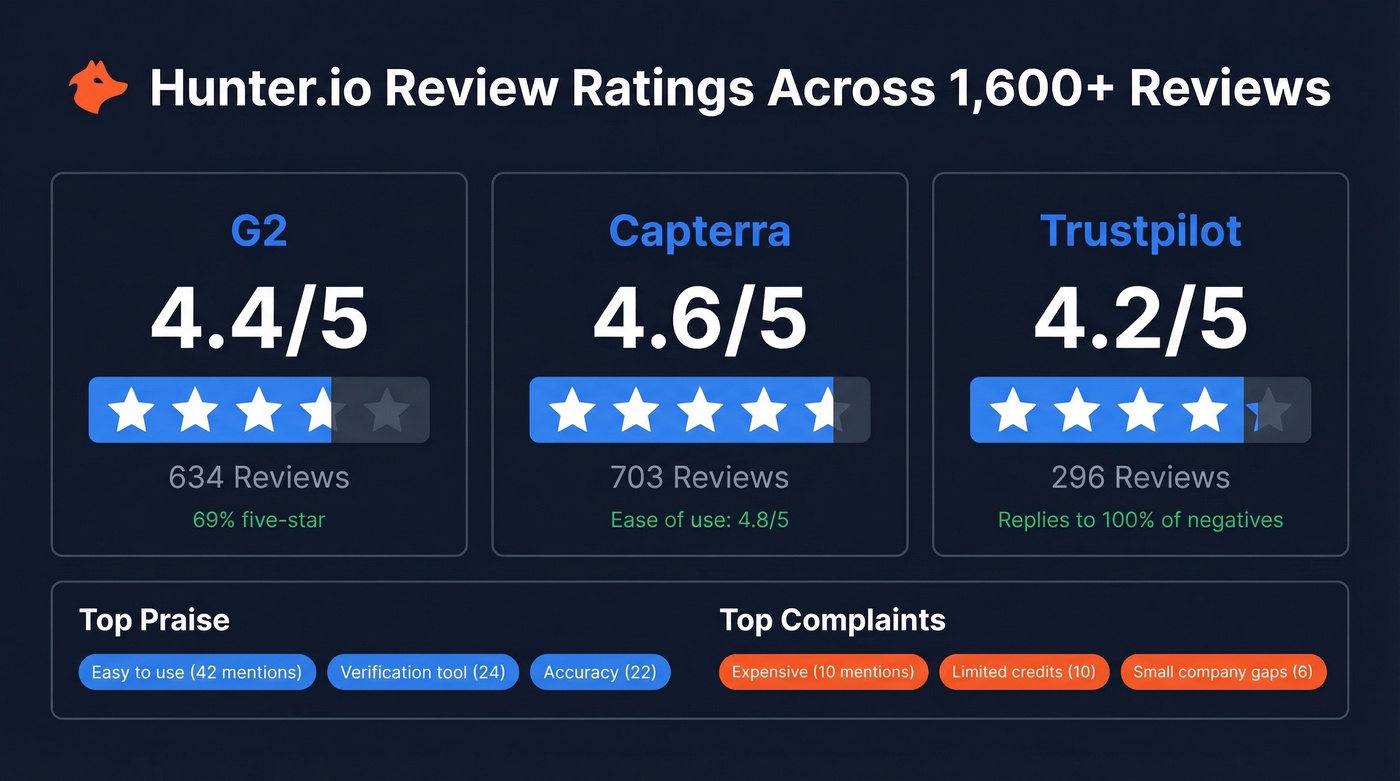
The praise patterns are consistent. G2's AI-aggregated review themes show ease of use at 42 mentions, verification tool at 24, and accuracy at 22. Capterra's ease-of-use score of 4.8 out of 5 is impressive - this is a tool people figure out in minutes, not days.
The complaints are equally consistent. On G2, "expensive" and "limited credits" each hit 10 mentions. Plan limitations, including the lack of social profile integration, show up 7 times. Limited contacts for smaller companies appears 6 times - if you're targeting niche startups or local businesses, Hunter's web-indexing model simply won't find much.
On Trustpilot, the most pointed complaint is outdated data. One reviewer claimed 50%+ of the names and emails listed for their company no longer worked there. Hunter responds to every negative review, typically within 48 hours, which is solid customer service but doesn't fix the underlying data freshness issue.
The user base skews heavily SMB: 366 small business reviewers on G2 versus 200 mid-market and just 51 enterprise. Hunter knows its audience, and that audience is small teams doing lightweight outreach. Reddit threads on Hunter alternatives tend to be thin - most users discuss it in passing rather than debating it deeply, which tells you something about its positioning as a utility tool rather than a platform people build workflows around.
Hunter Pricing in 2026
Hunter's pricing is straightforward compared to most sales prospecting databases. No "talk to sales" gates for standard plans.
| Plan | Monthly | Annual | Credits/mo | Email Accounts | Recipients |
|---|---|---|---|---|---|
| Free | $0 | $0 | 50 | 1 | 500 |
| Starter | $49 | $34/mo | 2,000 | 3 | 2,500 |
| Growth | $149 | $104/mo | 10,000 | 10 | 5,000 |
| Scale | $299 | $209/mo | 25,000 | 20 | 15,000 |
| Enterprise | Custom | Custom | Custom | Custom | Custom |
In mid-2025, Hunter migrated to a Unified Credits system. Previously, you had separate buckets for searches and verifications - confusing and wasteful. Now it's one credit pool. One search costs 1 unified credit. One verification costs 0.5 unified credits. No price change accompanied the switch, and Hunter added a Credit Dashboard and Pricing Calculator to help you estimate usage.
For bulk operations, Hunter sells credit packs separately: $50 per 1,000 search credits and $1 per 1,000 verification credits, valid for 12 months. Paid subscribers also get free monthly re-verification for emails already stored in their Leads database - a nice touch that reduces wasted credits.

Hunter's unified credits still only buy you emails - no phone numbers, no multichannel data. Prospeo gives you 98% accurate emails and 125M+ verified mobile numbers from a single credit pool, starting at $0.01 per email. No contracts, no sales calls.
Get the emails and direct dials Hunter can't give you.
Features Worth Knowing About
What Works
Domain Search remains Hunter's strongest feature. Enter a domain, get up to 10 email addresses per credit with verification scores and source URLs. The source transparency is something most competitors don't offer - you can actually see where the email was found and judge its freshness yourself.
Email Verifier uses a confidence score system rather than a simple valid/invalid binary. It's more nuanced, though it comes with a catch we'll cover in the limitations section.
Discover is Hunter's B2B lead database, and it's more capable than most people realize. Filters include HQ location, industry, company type, keywords, technologies used, funding data, and job postings. Hunter reports 60% more profiles now include job titles and locations, making Discover filters more useful than they were a year ago. Signals layers on top with alerts for funding rounds, hiring surges, and company changes - lightweight intent data.
The browser extension works well for quick lookups. Integrations include HubSpot, Salesforce, Pipedrive, Google Workspace, and Zapier for everything else.
What Doesn't
Campaigns is the weak link. It's text-only - no images, no A/B testing, no multichannel steps, no inbox rotation. One Capterra reviewer specifically flagged the text-only limitation. It's fine if you're a freelancer sending 20 personalized emails a week. It's inadequate for any sales team running real sequences.
The AI Writing Assistant is still in beta. And Hunter has no built-in warm-up tool, which means you'll need a separate deliverability solution if you're sending at any volume (see our email deliverability guide).
Where Hunter Falls Short
No mobile phone numbers. This is the biggest gap, full stop. Hunter is email-only. In 2026, when multichannel outbound is standard practice, having zero phone data is a serious limitation. You can't build a call-first or call-backup workflow with Hunter alone (here are proven sales prospecting techniques for multichannel teams).
No social profile integration. Hunter removed its integration with professional networking platforms years ago due to legal pressure. You're relying entirely on web-sourced data, which misses decision-makers who don't have their emails published on company websites.
Accept-all domain risk. Hunter's confidence score is helpful, but it's not the same as true verification. Accept-all (catch-all) domains show a high confidence score even when the specific mailbox doesn't exist. We've seen teams treat Hunter's confidence score as a green light, then hit 15%+ bounce rates on catch-all domains. That's a domain reputation killer (more on email bounce rate benchmarks and fixes).
Credit costs scale fast. At about $0.0245 per search on the Starter plan, a five-person team can burn through $150-$300/month and still have zero phone numbers to show for it. The credit model works for solo operators, but it becomes a real cost driver the moment you add headcount.
Data gaps for smaller companies. This came up 6 times in G2 reviews. Hunter's web-indexing model depends on companies having a meaningful web presence. If you're targeting smaller or niche companies, expect thinner coverage.

Data freshness concerns. The Trustpilot complaint about 50%+ outdated contacts at a single company is anecdotal, but the pattern is real. Web-sourced data captures a snapshot - if someone leaves a company and their email gets removed from the website, Hunter eventually catches up, but the lag can be weeks or months. The 527-lead benchmark reinforces this: Hunter hit an 18.4% open rate and 0.18% reply rate versus Apollo's 51.6% and 0.56% on identical targeting. One test isn't definitive, but a nearly 3x difference in open rates suggests real data quality gaps.
What's New in 2025-2026
Hunter hasn't been standing still, even if the core product feels familiar:
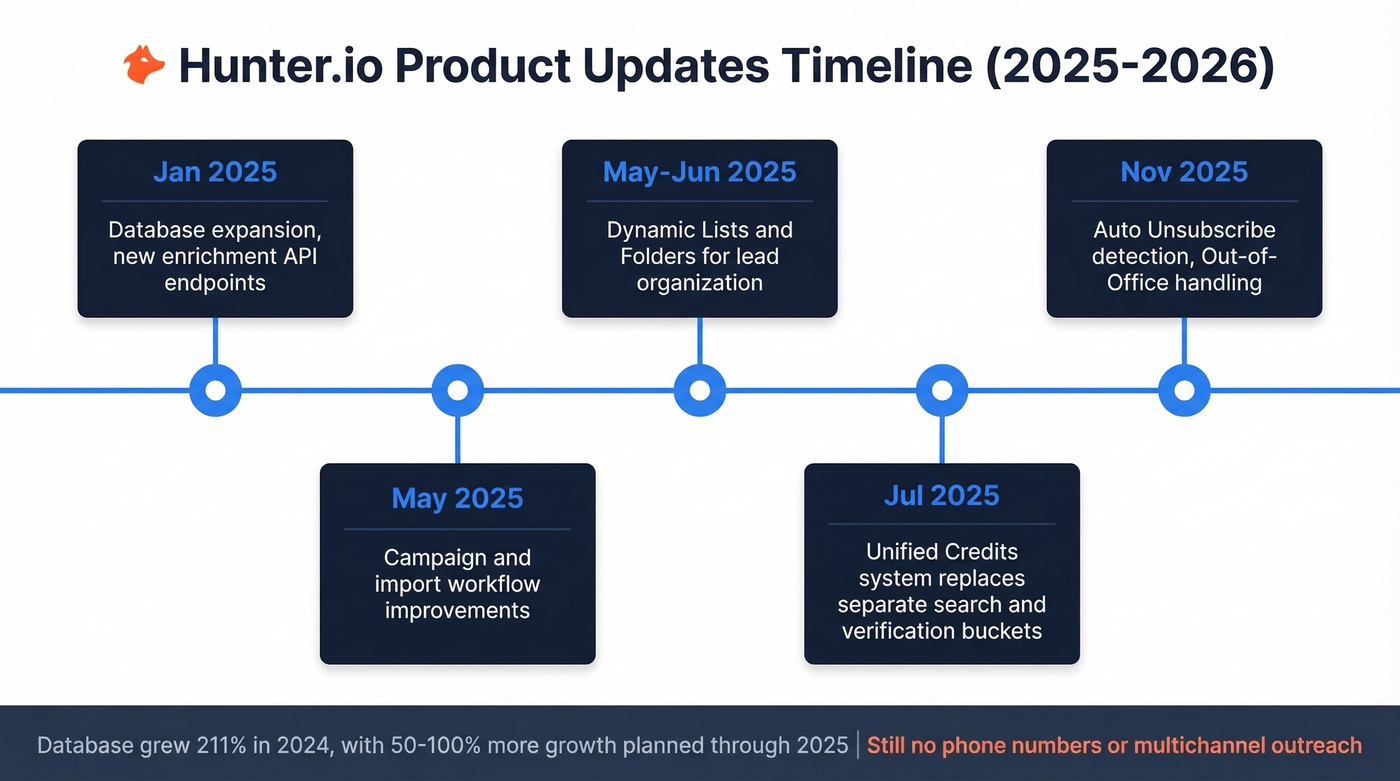
- Jan 2025: Database expansion plus new enrichment API endpoints
- May 2025: Campaign and import workflow improvements
- May-Jun 2025: Dynamic Lists and Folders for better lead organization
- Jul 2025: Unified Credits system replacing separate search/verification buckets
- Nov 2025: Auto Unsubscribe detection and Out-of-Office handling in Campaigns
Hunter reported a 211% increase in total profiles between January and October 2024, with a planned 50-100% increase through 2025. The trajectory is positive - but the product still doesn't address the fundamental gaps around phone numbers and multichannel outreach.
Who Should Use Hunter (and Who Shouldn't)
Good fit:
- Freelancers and solo founders sending under 100 cold emails per month
- Marketers who only need email addresses
- Teams that value simplicity and a clean UI over feature depth
- Anyone trying cold email for the first time and wanting a low-risk starting point (see more free lead generation tools)
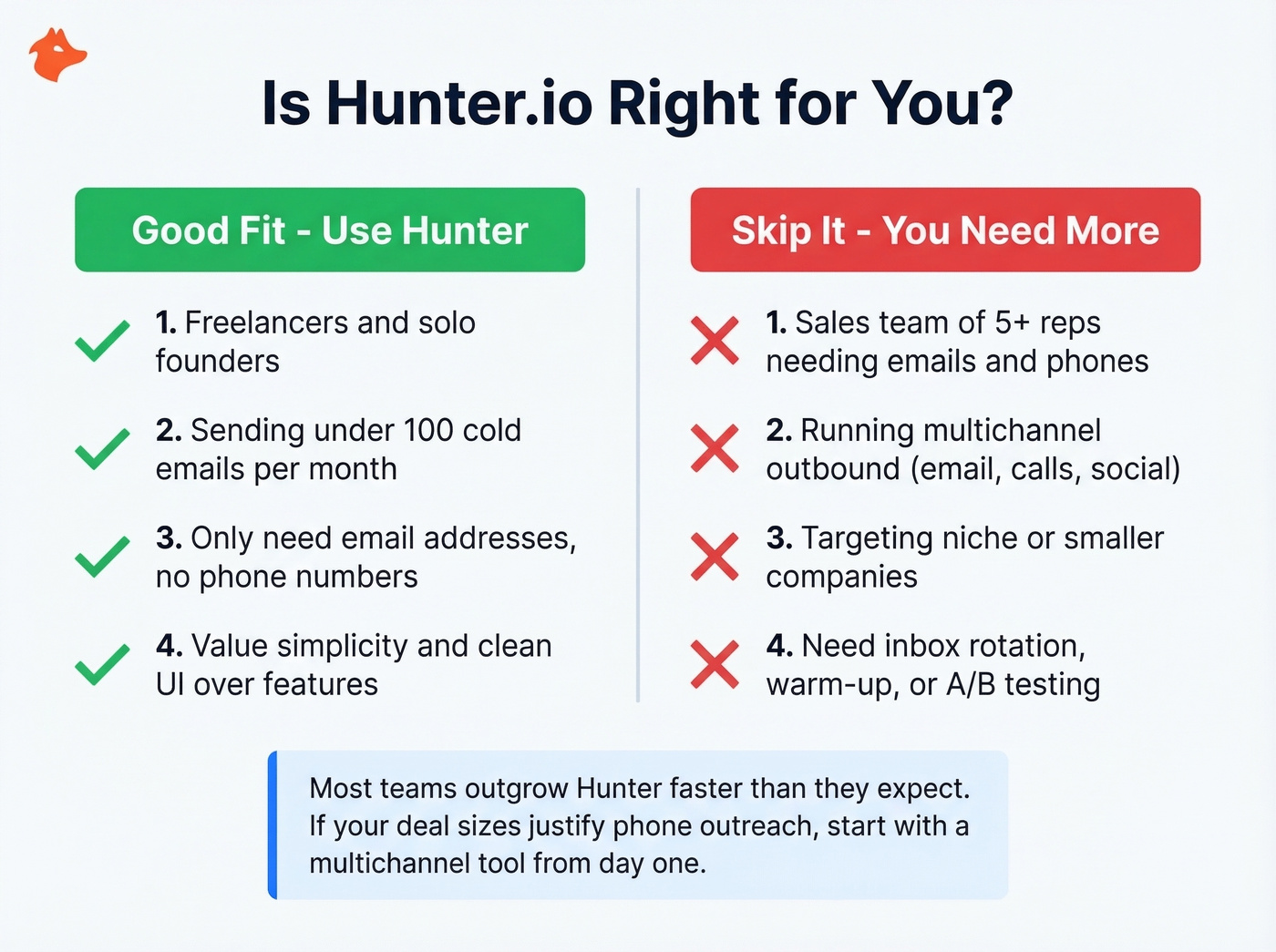
Skip it if:
- You're a sales team of 5+ reps who need emails and phone numbers
- You're running multichannel outbound with email, calls, and social touches
- You're targeting smaller or niche companies with thin web footprints
- You need inbox rotation, warm-up, or A/B testing in your sequences
Let's be honest: if your deal sizes are modest and you're only sending email, Hunter is perfectly fine. But the moment you need to pick up a phone or scale past one rep, you've outgrown it. In our experience, most teams outgrow it faster than they expect.
Best Hunter Alternatives
| Starting price | $49/mo | ~$0.01/email | $59/mo/user | ~$39/mo |
| Free tier | 50 credits | 75 emails + 100 ext. | Yes | Yes |
| Verified mobiles | ❌ | 125M+ | Yes | Limited |
| Data refresh | Daily | Every 7 days | Varies | Every few weeks |
| Email accuracy | 4.4/5 (G2) | 98% | Higher in tests | 98% claimed |
| Campaigns | Basic (text-only) | Integrates w/ tools | Full sequences | Yes + warm-up |
| Contracts | No | No | No | No |
| Best for | Solo email outreach | Emails + mobiles + fresh data | All-in-one platform | Deliverability focus |
Prospeo
Prospeo covers Hunter's two biggest gaps - mobile numbers and data freshness - without enterprise pricing. The database spans 300M+ professional profiles with 143M+ verified emails at 98% accuracy and 125M+ verified mobile numbers with a 30% pickup rate. A 5-step verification process with catch-all handling, spam-trap removal, and honeypot filtering means you're not guessing about deliverability the way you do with Hunter's confidence scores. The 7-day data refresh cycle keeps contacts current rather than relying on web-sourced snapshots that can be months old.
Native integrations push directly into Salesforce, HubSpot, Smartlead, Instantly, and Lemlist - so you don't need Hunter's basic campaigns feature when your sequencer is already connected. Real results back this up: Snyk's 50 AEs cut bounce rates from 35-40% to under 5% and generated 200+ new opportunities per month after switching. Free tier available, paid plans run about $0.01 per email with no contracts.
Apollo.io
Best for: Teams that want database, sequences, dialer, and analytics in one platform.
The 527-lead benchmark showed Apollo pulling a 51.6% open rate versus Hunter's 18.4% on identical targeting, which suggests meaningfully better data quality for outbound campaigns. Free tier is generous, paid plans start around $59/month per user. For teams that want a single tool instead of a stack, Apollo is the strongest alternative on feature breadth alone. The tradeoff is complexity - expect a steeper setup curve than Hunter, and the UI can feel overwhelming if you just need emails.
Snov.io
Snov.io's standout advantage is its built-in warm-up tools, something Hunter doesn't offer at all. For teams that prioritize inbox placement alongside prospecting, that's a real differentiator. Free tier available, paid plans from ~$39/month, and they claim 98% verification accuracy. The weakest link is mobile phone coverage - it's limited compared to Prospeo or Apollo.
RocketReach
Strong for individual lookups and one-off research. Plans from ~$53/month. Listed as a top G2 alternative to Hunter. Less useful for bulk prospecting workflows - think of it as a research tool rather than an outbound platform.
Hunter's web-scraping model struggles with smaller companies and stale data. Prospeo's proprietary database of 300M+ profiles refreshes every 7 days - not whenever a web crawler revisits a page. That's why teams using Prospeo book 35% more meetings than Apollo users.
Stop sending emails to people who left the company six months ago.
FAQ
Is Hunter.io accurate?
Hunter carries a 4.4 on G2 with "accuracy" appearing in 22 positive review mentions. For emails it finds, verification scores are generally reliable. The catch: accept-all domains inflate confidence scores, and the 527-lead benchmark showed a mediocre 18.4% open rate in a controlled test. Accurate for what it finds, but coverage has real gaps.
Is Hunter.io free?
Yes. The free plan includes 50 credits per month, 1 connected email account, and 500 campaign recipients. That's enough to test the product and send a handful of cold emails weekly - not enough for sustained outbound.
Does Hunter.io have phone numbers?
No. Hunter provides zero mobile or direct-dial numbers - it's email-only. For phone data, Prospeo offers 125M+ verified mobiles with a 30% pickup rate, or Apollo includes direct dials in its paid plans.
What happened to Hunter's credit system?
In July 2025, Hunter replaced separate search and verification credit buckets with Unified Credits. One search equals 1 unified credit; one verification equals 0.5 unified credits. Pricing didn't change. The switch simplified billing and added a Credit Dashboard for tracking usage.
Is Hunter.io better than Apollo?
Hunter is simpler, cheaper to start, and easier to learn. Apollo is a fuller platform with sequences, a dialer, and a larger database. That 527-lead test showed Apollo outperforming on both open rates (51.6% vs 18.4%) and reply rates (0.56% vs 0.18%). For solo operators who only need emails, Hunter works. For sales teams running real outbound, Apollo or Prospeo is the stronger play.