


Hunter vs Apollo.io: Which One Do You Actually Need in 2026?
Apollo is the better platform. Hunter is the better email finder. These are different things, and confusing them is how teams end up paying for features they don't use - or missing features they desperately need.
If you're weighing Hunter vs Apollo.io, the answer depends entirely on what you're building. Pick Apollo if you want an all-in-one outbound engine. Pick Hunter if you just need clean emails fast.
What Each Tool Does
Apollo covers ~275M contacts with built-in sequences, a dialer, CRM sync, and buying-intent features. It's trying to be your entire outbound stack in one tab. On G2, it carries a 4.7/5 rating across 9,512 reviews - the sheer volume tells you how widely it's adopted.
Hunter is a focused email finder with domain search, verification, and basic cold email sequences bolted on. It scores 4.4/5 on G2 from 634 reviews, but wins on ease of setup (9.5 vs Apollo's 8.9) and ease of use (9.4 vs 9.0). You find an email, verify it, send a sequence - no learning curve. Some teams actually run both: Apollo for broad list-building, Hunter for email verification on top.
Feature Comparison
| Feature | Apollo.io | Hunter |
|---|---|---|
| Database size | ~275M contacts | Domain-search based (+ Discover database) |
| Email accuracy | ~70-80% | ~75-85% |
| Phone numbers | Yes (5 mobile/mo on Free; up to 125 mobile/mo on higher tiers) | No |
| Sequences | Full multi-channel | Basic email only |
| CRM integrations | CRM sync | Salesforce, HubSpot, Zapier |
| Chrome extension | Yes | Yes |
| API access | Paid plans (advanced on higher tiers) | Paid plans |
| Free tier | 10,000 email credits/mo, 5 mobile credits/mo, 2 sequences, 10 export credits/mo | 50 credits/mo, 1 email account, unlimited team members |
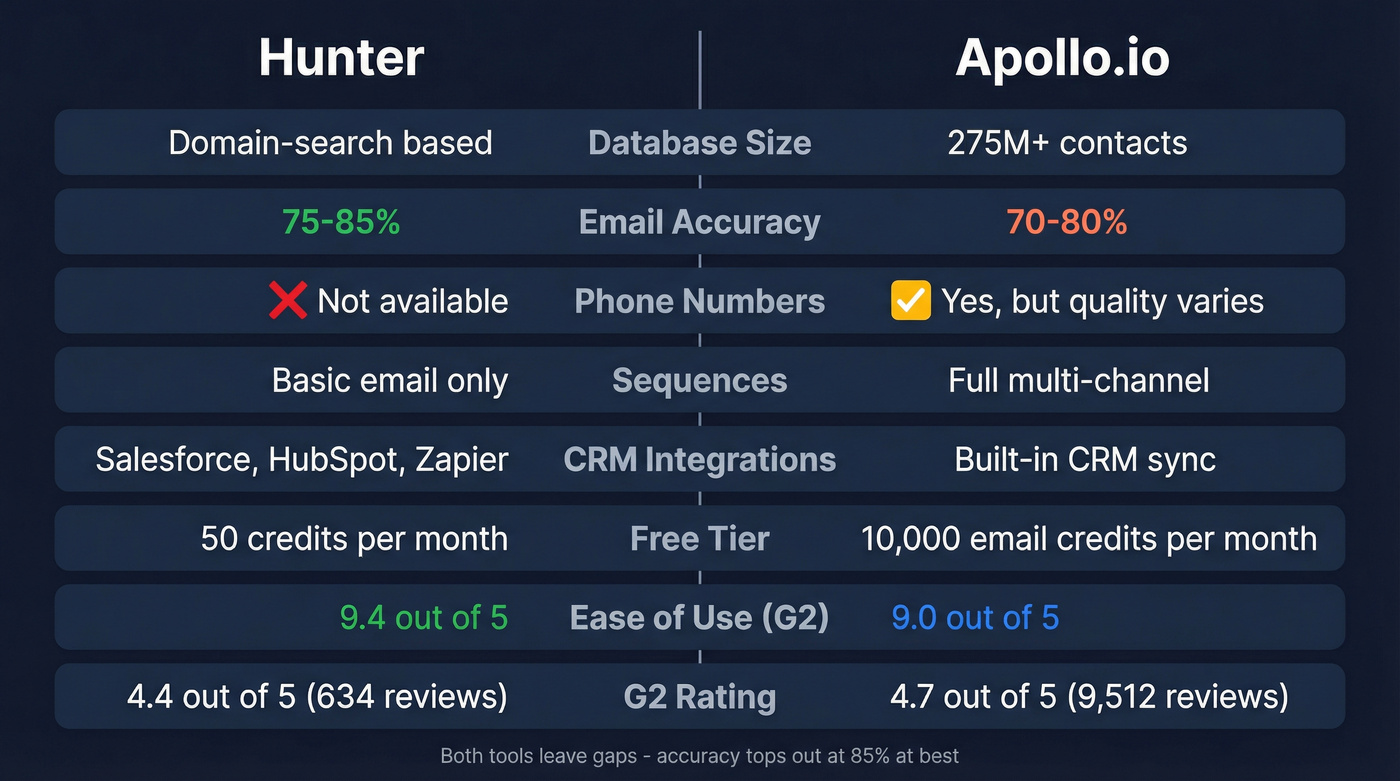
The big structural difference: Apollo has phone numbers, Hunter doesn't. But Apollo's phone data quality is suspect - Reddit threads flag that up to 70% of phone numbers in big databases are wrong. Having phone numbers and having useful phone numbers aren't the same thing.
If you're building a full outbound stack, compare it against other SDR tools before you commit.

Hunter tops out at 75-85% accuracy. Apollo sits at 70-80%. Both leave you verifying emails through a second tool or eating 30%+ bounce rates. Prospeo delivers 98% email accuracy with built-in 5-step verification - no stacking subscriptions, no duct-taping workflows.
Get cleaner data than Hunter and Apollo combined - for $0.01/email.
Pricing Breakdown
| Plan | Apollo.io | Hunter |
|---|---|---|
| Free | $0 (10K email credits/mo, 5 mobile credits/mo) | $0 (50 credits/mo) |
| Basic / Starter | $59/mo ($49/mo billed annually) | $49/mo |
| Professional / Growth | $99/mo ($79/mo billed annually) | $149/mo |
| Top tier | ~$119/user/mo billed annually (3-user minimum) | $299/mo |
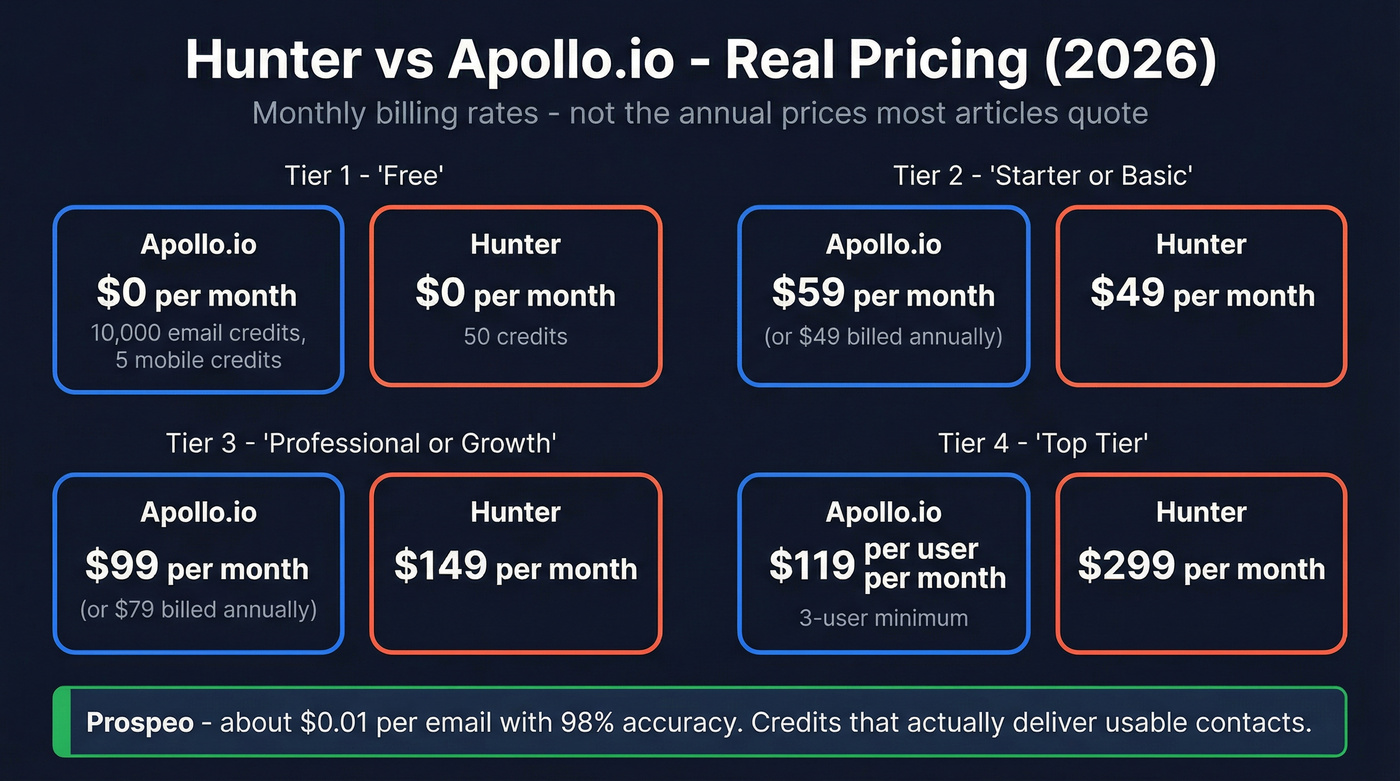
Every article quoting $49 for Apollo Basic is citing the annual rate without saying so. Monthly billing is $59/user/month. That matters when you're stacking it against Hunter's $49/mo Starter plan.
Here's the thing: Apollo credits don't roll over, and its waterfall enrichment queries multiple sources per lookup, so credit consumption varies by ICP and geography - you'll burn through credits faster than the math suggests. Hunter charges credits to find emails, and verification is a separate step. With 20-25% bounce rates reported by users, you can still end up paying for dead leads.
Prospeo flips the economics: ~$0.01/email with 98% accuracy. The cheapest tool isn't always the cheapest per usable contact.
If you want a broader view of pricing models across providers, see our breakdown of email search tools.
Accuracy and Deliverability
This is where both tools show cracks.
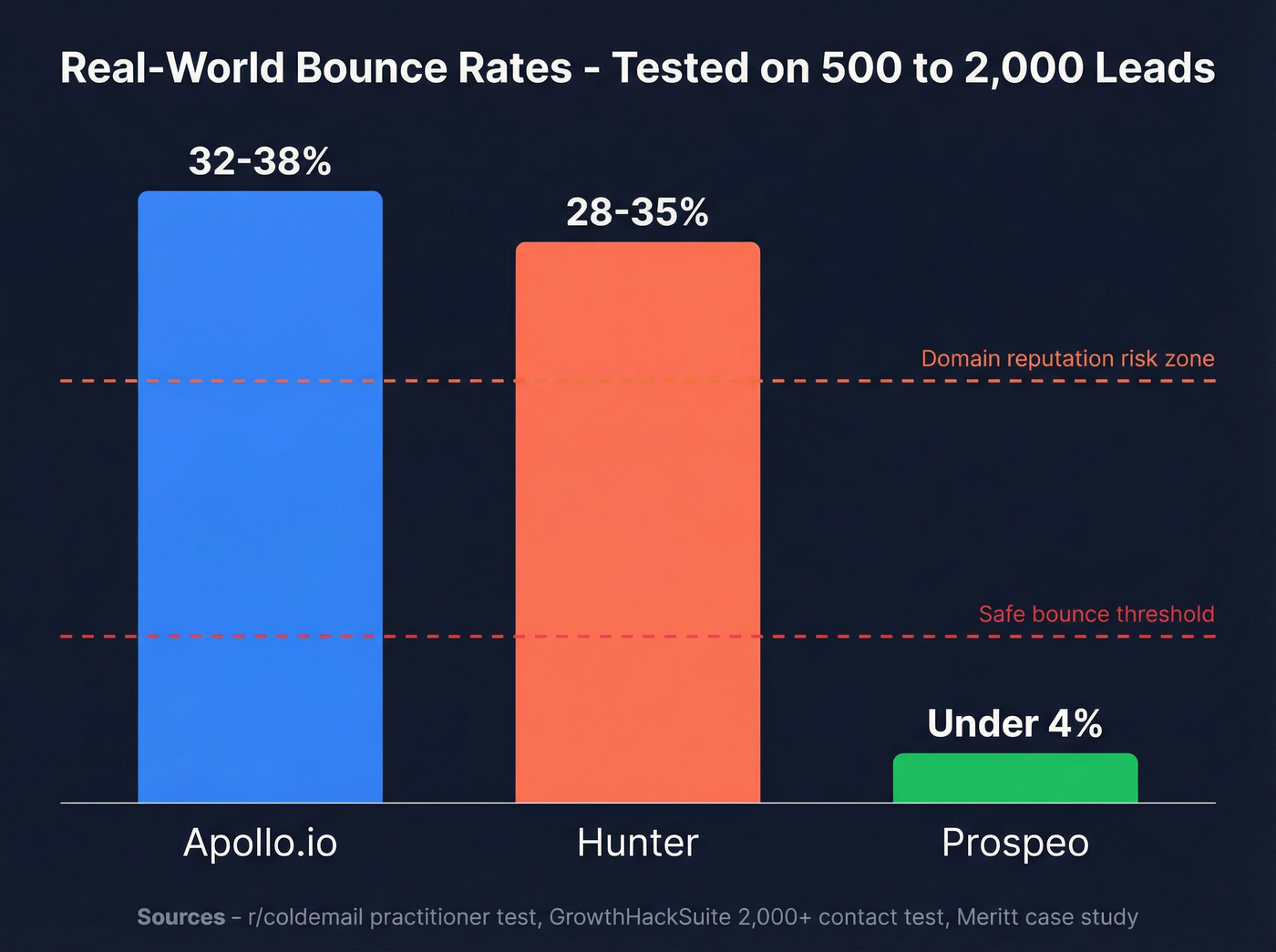
A practitioner test on r/coldemail - 500-1,000 leads per tool, verified via NeverBounce - found Apollo bouncing 32-38% and Hunter bouncing 28-35%. A GrowthHackSuite test across 2,000+ contacts showed Hunter's valid email rate exceeding Apollo's by 14-18%.
Hunter is cleaner, but not clean enough. On G2, 503 Apollo reviewers specifically flag "Inaccurate Data" as a con, and Hunter isn't far behind. B2B contact data decays 20-30% per year. A 275M-record database loses 55-82.5M contacts annually to job changes, company closures, and email rotations - that's a staggering amount of rot happening in real time, and it explains why no static database stays accurate for long.

Teams using waterfall enrichment through Clay and multiple data sources report 10-14% bounce rates, but that requires stitching tools together and managing multiple subscriptions. We've found that a 7-day data refresh cycle - like what Prospeo runs - gets you to similar results natively, without the duct-taping.
If deliverability is the priority, start with the fundamentals in our email deliverability guide and track your email bounce rate by campaign and list source.
Who Should Pick What
Use Hunter if you're a solo founder or freelancer who needs clean emails with zero learning curve. The free tier and Starter plan are simple, and you won't drown in features you don't need.
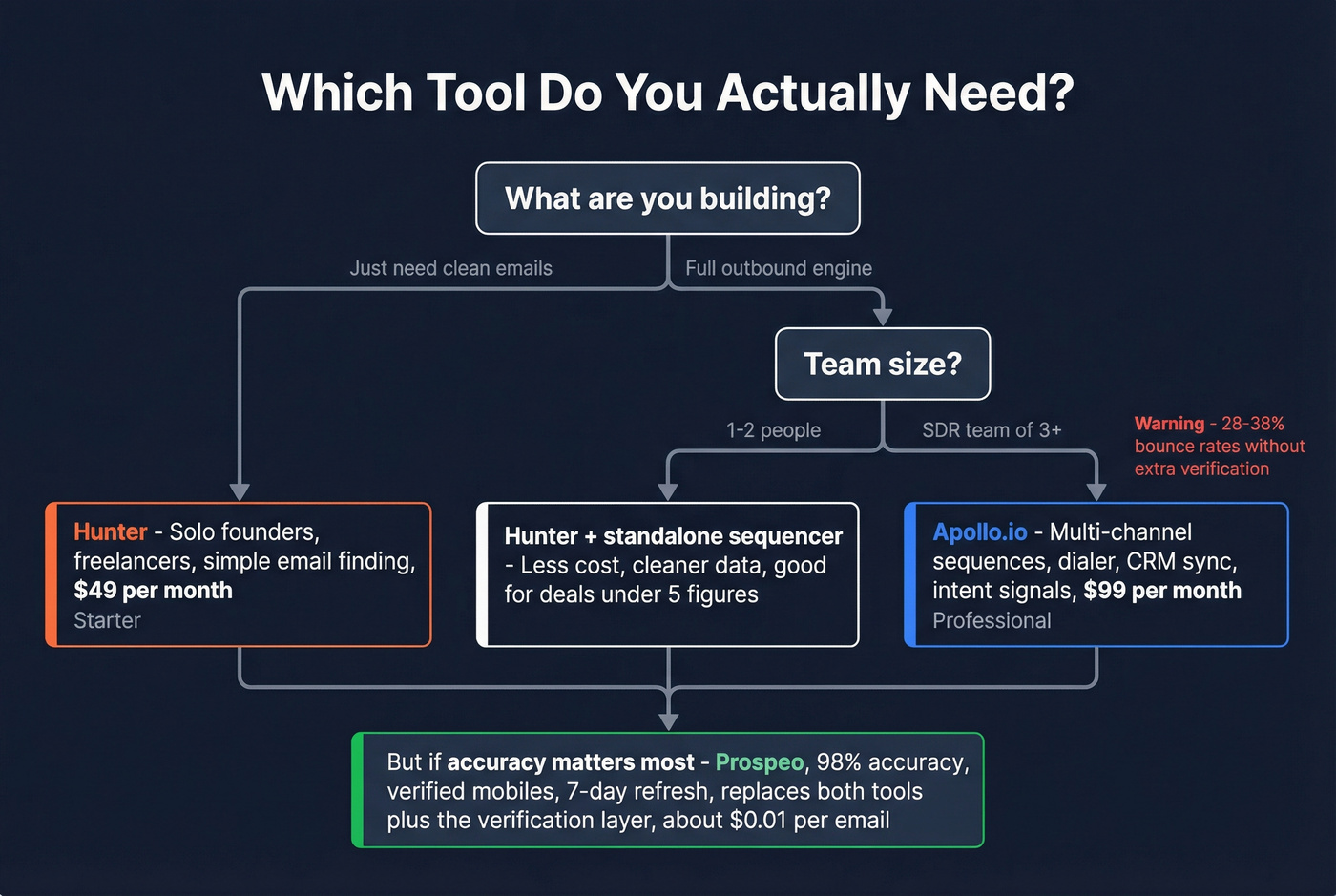
Use Apollo if you're running an SDR team doing multi-channel outbound. Sequences, dialer, CRM sync, intent signals - it's all there. The Professional plan at $99/mo is where Apollo actually makes sense.
Hot take: If your average deal size is under five figures, you probably don't need Apollo's full platform. Hunter plus a standalone sequencer will cost less and give you cleaner data.
Agencies managing multiple client domains should skip both entirely. Bounce rates of 28-38% will torch your clients' sender reputation. We've seen teams like Meritt go from 35% bounce rates to under 4% after switching to verified-first data - that's the difference between keeping a client and losing their domain.
If you're trying to scale outbound without wrecking domains, use a tighter B2B cold email sequence and follow modern sales prospecting techniques instead of brute-force volume.
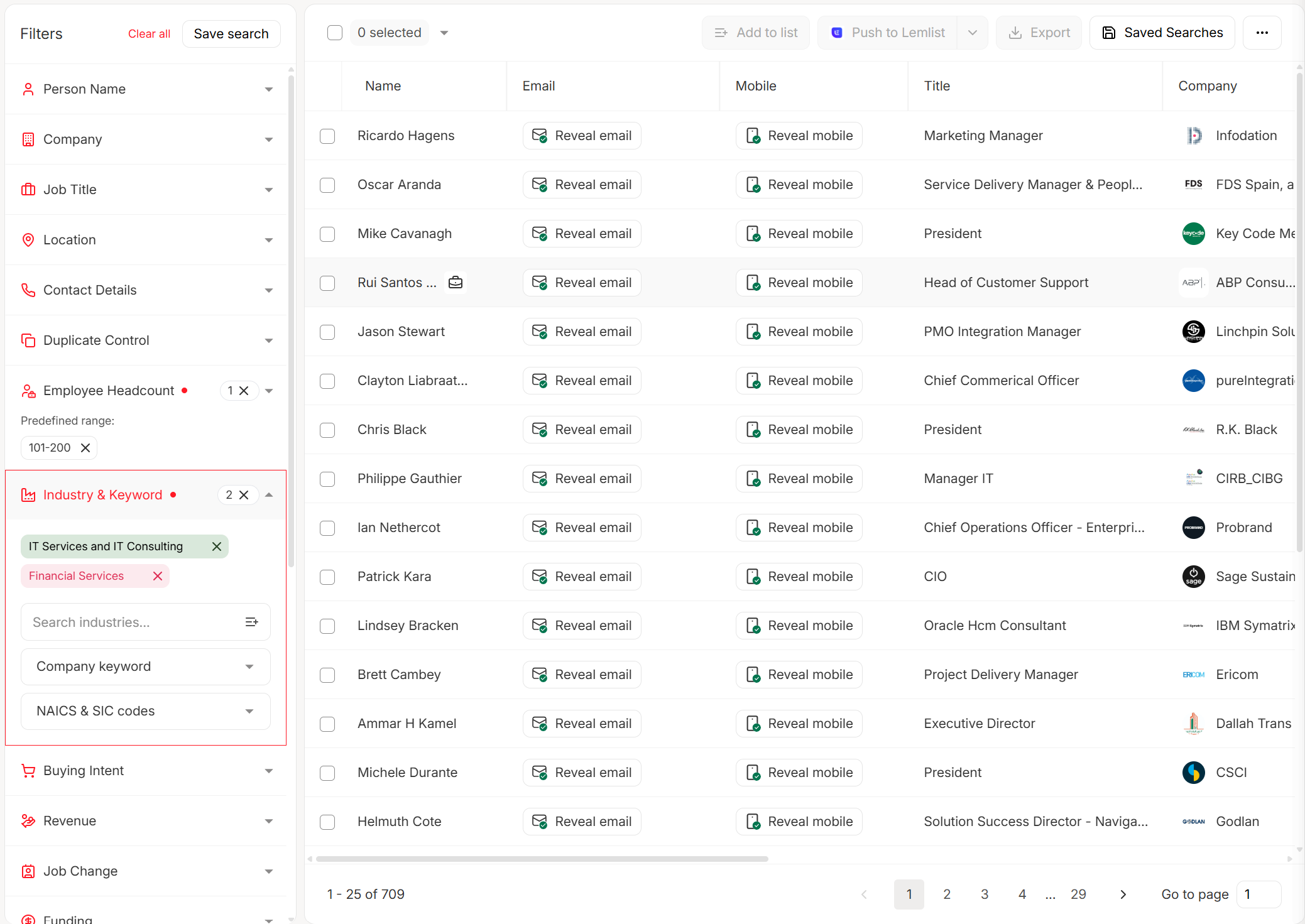
Neither Hunter nor Apollo offers verified mobile numbers you can trust. Prospeo gives you 125M+ verified mobiles with a 30% pickup rate, plus 300M+ profiles refreshed every 7 days - not every 6 weeks. One platform replaces both tools and the verification layer on top.
Skip the Hunter + Apollo stack. Get emails, mobiles, and sequences in one platform.
FAQ
Is Apollo.io better than Hunter for cold email?
Apollo wins for full outbound campaigns with sequences and a dialer. Hunter wins for finding clean emails fast. For cold email specifically, Apollo's workflow is stronger - but verify emails separately since bounce rates run 32-38%. Teams prioritizing deliverability often pair either tool with a verification layer or switch to a provider with built-in verification like Prospeo.
Why do Apollo.io pricing pages show different numbers?
Most comparison articles quote annual billing (~$49/user/month) without specifying the billing cycle. Monthly billing is $59/user/month for Basic, $99 for Professional. Always check whether you're reading annual or monthly rates before comparing plans.
What's a more accurate alternative to both tools?
Prospeo delivers 98% email accuracy with a 7-day refresh cycle and 300M+ profiles, plus 125M+ verified mobile numbers with a 30% pickup rate. The free tier includes 75 emails per month - built for teams that can't afford 28-38% bounce-rate risk.
Can I use Hunter and Apollo together?
Yes, and many teams do. A common setup is Apollo for list-building and sequencing, then Hunter for email verification before sending. This reduces bounces by 10-15% but doubles your subscription costs. A single platform with built-in verification eliminates that overhead entirely.