

What to Say Instead of "I Haven't Heard Back From You"
"I haven't heard back from you" is sitting in your draft folder, and something about it feels off. You're right to hesitate - not because it's rude, but because it's lazy. It puts the spotlight on someone's silence instead of giving them a reason to respond.
Here's the thing: 70% of sales emails need a follow-up to get any response at all. Woodpecker data shows response rates jump from 16% to 27% with just one follow-up. The problem isn't following up. It's how you do it. Belkins analyzed 16.5 million cold emails and found the highest reply rate (8.4%) comes from a single email, with performance declining as you stack more follow-ups on top. Once you hit four or more emails in a sequence, unsubscribe and spam complaint rates more than triple.
Quick Summary
- The phrase shifts blame. Better alternatives name the topic, not the silence.
- One follow-up is usually enough. One initial email plus one follow-up hits the sweet spot - four or more emails more than triples unsubscribe and spam complaint rates.
- Timing beats wording. 24-48 hours for urgent items, 3-5 business days as default, one week for proposals.
- Copy-paste templates below cover sales, job search, client, and networking scenarios.
Better Alternatives to "I Haven't Heard Back"
The phrase reads as an accusation even when you don't mean it that way. Better phrasing redirects attention to what you're following up about, not the fact that someone ghosted you. There's also a subtle difference between "I haven't heard from you" (neutral check-in) and "I haven't heard back from you" (implies they owe you something). Both benefit from a rewrite. And if you're thinking "I didn't hear back from you" sounds softer, it carries the same baggage - the fix is the same regardless of tense.
| Phrase | Tone | Best For |
|---|---|---|
| I wanted to follow up on [topic] | Professional | Any scenario |
| I haven't received a response yet - wanted to check in | Direct | Client, job search |
| Circling back on [topic] | Professional | Sales, client |
| Following up in case this got buried | Casual | Sales, client |
| Any updates on [specific item]? | Professional | Job search, client |
| I'm just checking in on [deliverable] | Casual | Client, networking |
| Wanted to see where things stand with [topic] | Professional | Job search, sales |
| Bringing this back to the top of your inbox | Casual | Sales, networking |
| Quick follow-up on [subject] | Professional | Sales, client |
| Hope you had a chance to review [item] | Formal | Client, proposals |
| Reaching out again regarding [topic] | Formal | Job search, client |
| Let me know if you need anything else to move forward | Professional | Sales, client |
| Happy to resend if this got lost | Casual | Sales, networking |
| Still interested in connecting on [topic] | Casual | Networking |
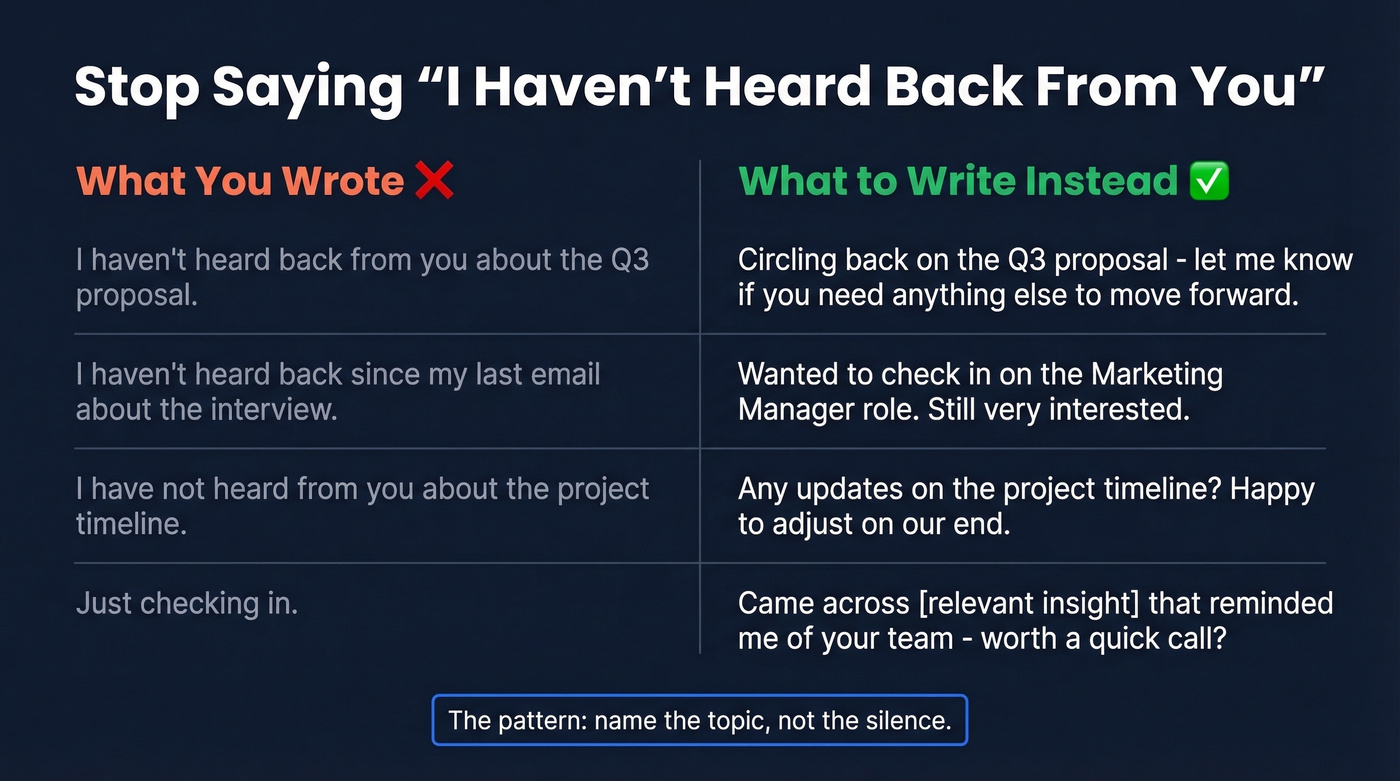
The pattern: name the topic, not the silence. Here's what that looks like in practice:
❌ "I haven't heard back from you about the Q3 proposal." ✅ "Circling back on the Q3 proposal - let me know if you need anything else to move forward."
❌ "I haven't heard back from you since my last email about the interview." ✅ "Wanted to check in on the Marketing Manager role. Still very interested."
❌ "I have not heard from you about the project timeline." ✅ "Any updates on the project timeline? Happy to adjust on our end."
When to Send a Follow-Up After No Response
Send too early and you look desperate. Wait too long and the conversation goes cold. Neither helps.
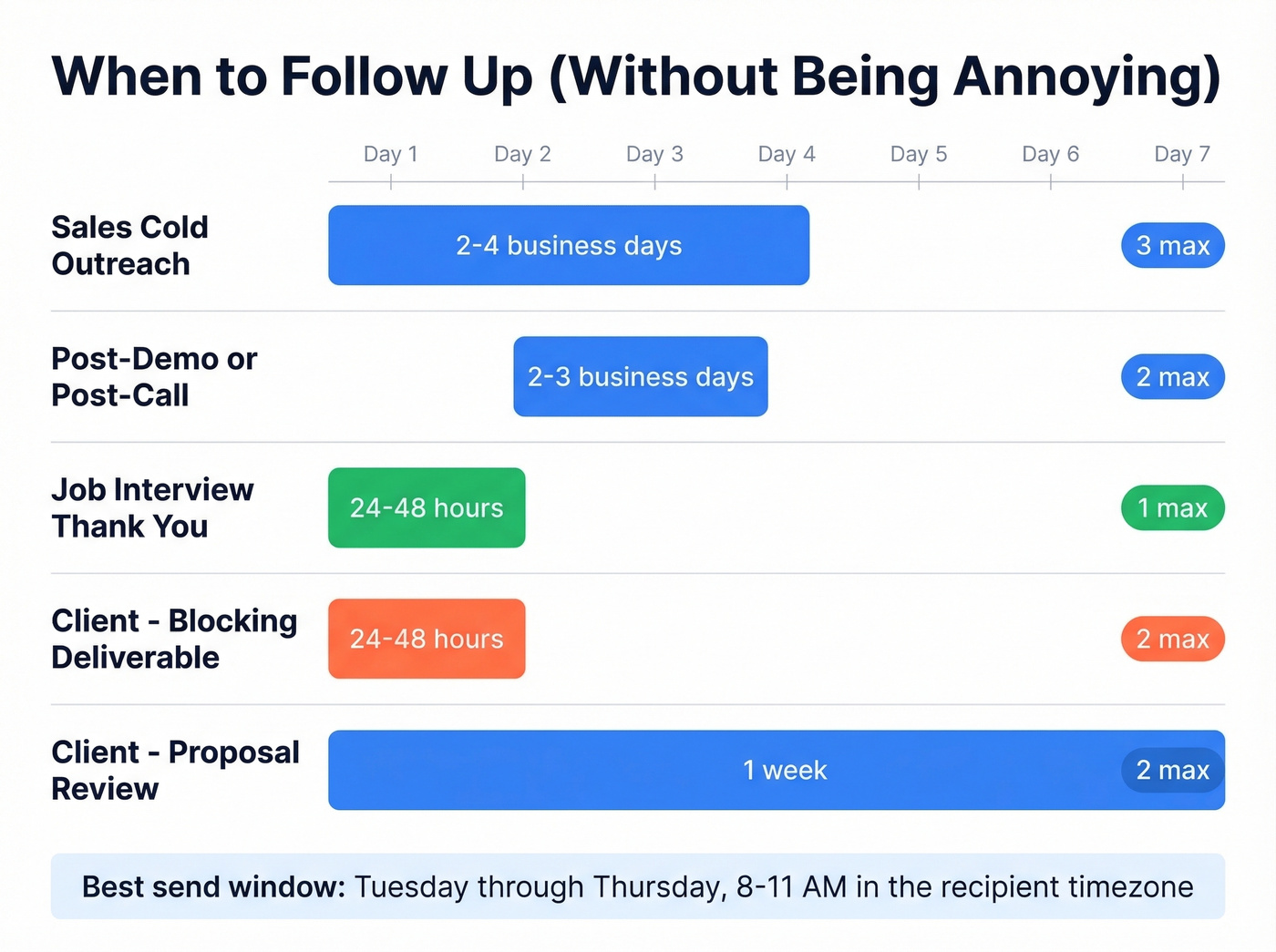
| Scenario | Wait Time | Max Follow-Ups |
|---|---|---|
| Sales cold outreach | 2-4 business days | 3 |
| Post-demo / post-call | 2-3 business days | 2 |
| Job interview thank-you | 24-48 hours | 1 |
| Job interview status check | 5-7 business days | 1-2 |
| Client (blocking deliverable) | 24-48 hours | 2 |
| Client (proposal/review) | 1 week | 2 |
| Networking | 1 week | 1 |
For cold outreach, 3-4 touchpoints spaced 2-4 business days apart is a solid sequence structure. Beyond that, you're pushing into unsubscribe and spam-complaint territory. One cold email practitioner reported that sending Tuesday through Thursday, 8-11 AM in the recipient's timezone, gave them a noticeable lift in opens.
If you want a deeper timing breakdown by context, see When Should You Follow Up on an Email?.

Half the reason you're not hearing back? Bad email addresses. 35% bounce rates kill your sender reputation and bury future follow-ups in spam. Prospeo's 5-step verification delivers 98% email accuracy - so your carefully crafted follow-up actually reaches a real inbox.
Stop following up into the void. Start with emails that land.
Follow-Up Email Templates for Every Scenario
Personalized follow-ups achieve roughly 18% response rates compared to 9% for generic ones - a 2x difference just from referencing something specific. Fill in every placeholder with a real detail.
If you want more plug-and-play options, these sales follow-up templates cover common objections and stages.
Sales Follow-Up
Template 1: First follow-up (adds new value)
Subject: Quick question about [specific challenge]
Hi [Name],
Sent a note last week about [specific topic]. Since then, I came across [relevant insight or stat] that reminded me of your team's situation.
Worth a 15-minute call this week?
[Your name]
Each follow-up earns its spot by adding something new. A cold email practitioner on r/Entrepreneur cut emails from 141 to under 56 words and saw reply rates double. The subject line "Quick question" pulled 39% open rates in their tests. If you're testing subject lines systematically, borrow ideas from these email subject line examples.
Template 2: Breakup email
Subject: Should I close your file?
Hi [Name],
I've reached out a couple of times about [topic]. Totally understand if the timing isn't right.
If you'd like to revisit this later, just reply whenever. Otherwise, I'll assume we're good and won't follow up again.
Best, [Your name]
Breakup emails work because they give permission to say no, which counterintuitively triggers responses. Use them sparingly though - a breakup email cleans your pipeline but can close the door if their timing changes later.
Job Interview Follow-Up
Template 1: 24-hour thank-you note
Subject: Thanks for the conversation, [Name]
Hi [Name],
Really enjoyed learning about [specific thing discussed]. The [project/initiative] you mentioned is exactly the kind of work I'm looking for.
Looking forward to next steps. Happy to provide anything else you need.
Best, [Your name]
80% of hiring managers say thank-you notes affect their decisions, yet only 24-57% of candidates actually send them. Easiest edge you'll ever get.
Template 2: Status check at 5-7 days
Subject: Following up on [Role Title] interview
Hi [Name],
Wanted to check in on the [Role Title] position. I'm still very interested and happy to provide references or additional information.
Appreciate any update when you have a moment.
[Your name]
The consensus on r/RecruitingHell is blunt: if a company wants you, they move fast. Follow-ups rarely change outcomes. But a well-written one protects your reputation and occasionally tips the scale. Send one. Maybe two. After that, you have your answer.
Client Follow-Up
Subject: Quick check-in on [deliverable/approval]
Hi [Name],
Wanted to follow up on [specific item] - we're ready to move to the next phase once you've had a chance to review. Let me know if you need anything else from our side.
[Your name]
For extended silence, swap the framing: "It's been a few weeks since we last connected on [project]. Wanted to see if priorities have shifted or if there's a better time to revisit."
Avoid guilt-based phrasing like "Just making sure you saw this" - it reads as passive-aggressive even when you don't intend it. A good follow-up focuses on the next step, not the missed one. For more client-specific phrasing, see how to follow up with a client.
Networking Follow-Up
Subject: Great meeting you at [event]
Hi [Name],
Enjoyed our conversation about [specific topic]. Your point about [specific detail] stuck with me. Would love to continue the conversation - coffee or a quick call sometime?
[Your name]
One follow-up is the ceiling for networking. If they don't respond, the relationship isn't there yet, and pushing won't build it.
How Many Follow-Ups Are Too Many?
Most follow-up advice tells you to push hard - some sales methodologies recommend 5-12 touchpoints before closing. Let's be honest: that advice conflates channels in a way that's misleading.
The key distinction is channel mix. Five touchpoints doesn't mean five emails.
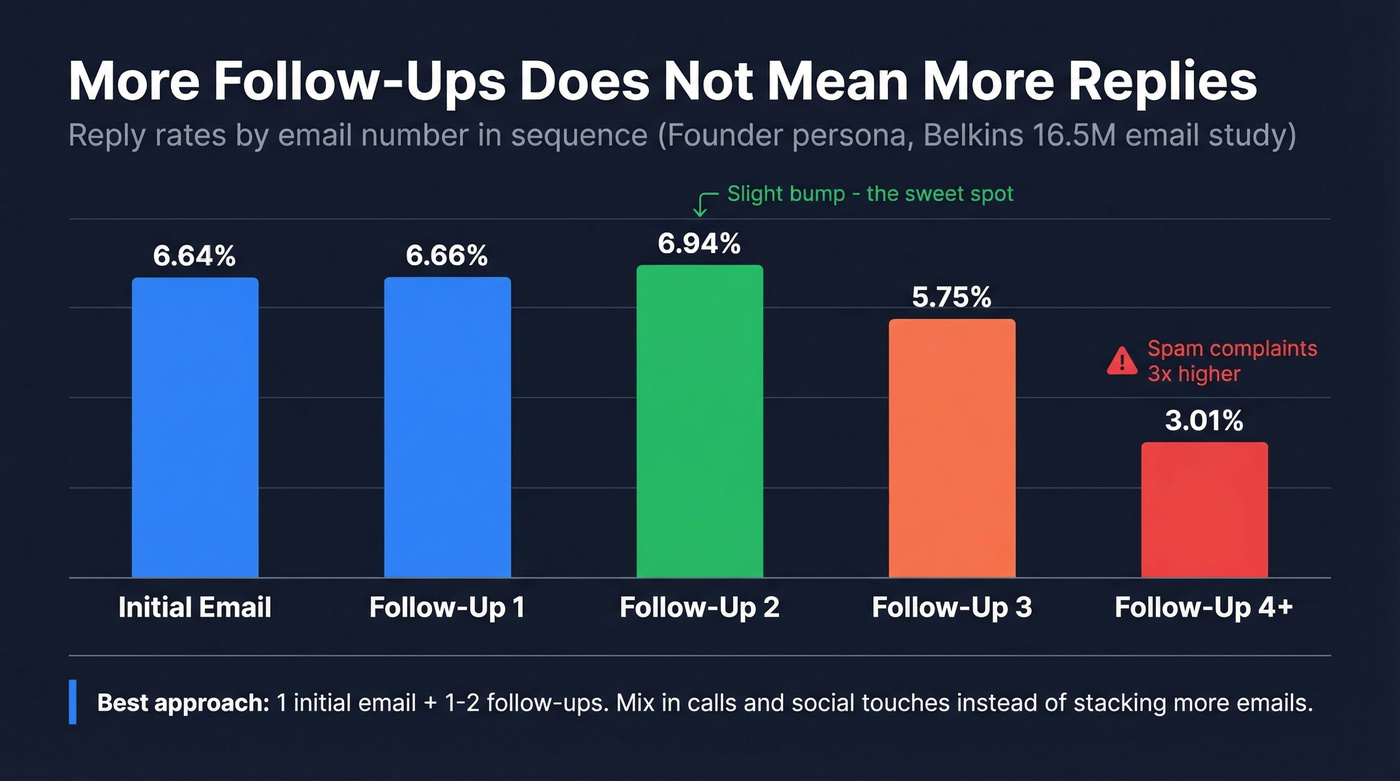
Belkins' 16.5-million-email dataset paints a clear picture: the best performance comes from a single email, and results decline as you add follow-ups. For the founder persona specifically, initial reply rate was 6.64%, first follow-up 6.66%, second 6.94% (a slight bump), third 5.75%, fourth 3.01%. The dropoff is steep and the spam risk is real.
We've seen teams book meetings with three emails, two calls, and a couple of social interactions - seven touchpoints without ever sending a fourth email. A message-plus-visit combo on professional networks can hit 11.87% reply rates. The spam risk comes from hammering one channel, not from persistent multi-channel outreach. If you're building a repeatable outbound motion, these sales prospecting techniques help you diversify beyond email-only sequences.
Five Mistakes That Kill Response Rates
1. The empty bump. "Just checking in" adds zero value and gives zero reason to respond. Lead with new information - follow-ups referencing specific numbers dramatically outperform generic bumps. If you need cleaner phrasing, use this guide on how to say just checking in professionally.
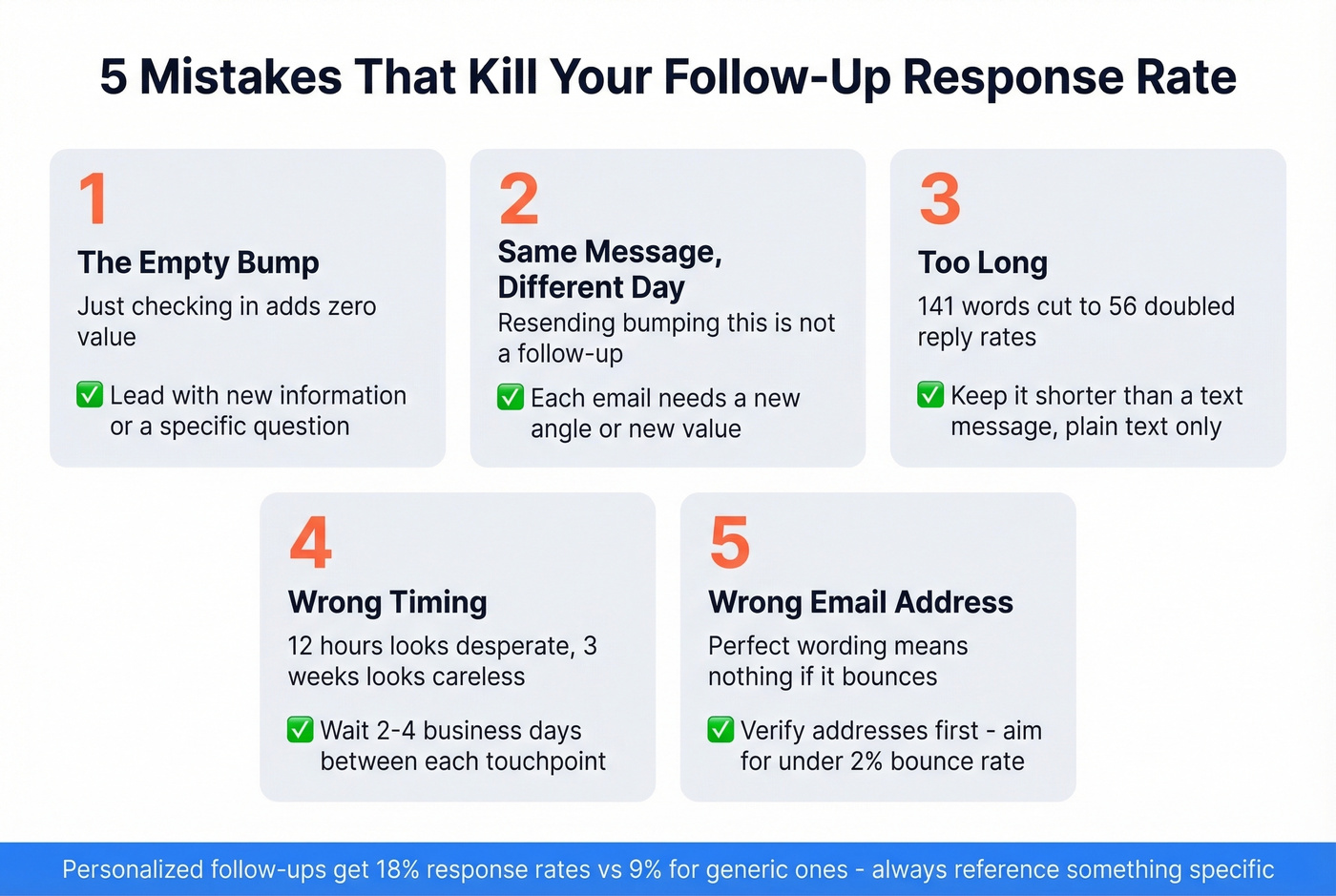
2. Same message, different day. Resending with "bumping this to the top" isn't a follow-up. Each touchpoint earns its existence with a new angle, a new question, or a new piece of value.
3. Too long. That Reddit practitioner who doubled reply rates cut emails from 141 words to under 56. Plain text, reply-in-thread, no HTML. If your follow-up is longer than a text message, trim it.
4. Wrong timing. Twelve hours after your first email signals desperation. Three weeks signals you don't care. Stick to 2-4 business days apart, three touchpoints max for cold outreach.
5. Wrong email address. You've crafted the perfect follow-up and it bounced. That same practitioner saw their bounce rate drop from 11% to under 2% after switching to manual verification. If you're doing any kind of outbound at scale, Prospeo verifies emails in real-time with 98% accuracy and offers 75 free checks per month - so your follow-up actually reaches a human inbox. (If you're troubleshooting deliverability, start with email bounce rate benchmarks and fixes.)
Look, if your bounce rate is above 5%, stop tweaking your subject lines. Bad data is the invisible prerequisite to everything in this article. The phrasing doesn't matter if the address is dead.

When email follow-ups go silent, a direct phone number changes everything. Prospeo gives you 125M+ verified mobile numbers with a 30% pickup rate - so you can skip the inbox entirely and have the conversation that moves deals forward.
Skip the third follow-up. Call them directly instead.
FAQ
Is it rude to say "I haven't heard back from you"?
Not rude exactly, but it shifts blame to the recipient and sounds passive-aggressive in writing. Swap it for "Wanted to check in on [specific thing]" - same intent, zero accusation. The fix works in sales, job search, and client contexts alike.
How long should I wait before following up?
Default is 3-5 business days. For time-sensitive items like approvals, 24-48 hours. For proposals and strategic decisions, a full week. For job interviews, send a thank-you within 24 hours, then a status check at 5-7 business days.
How many follow-up emails is too many?
Three is a safe maximum for cold outreach. Belkins' 16.5-million-email study found that four or more emails in a sequence more than triples unsubscribe and spam complaint rates. For job interviews, one thank-you plus one status check is the ceiling.
What if my follow-up emails keep bouncing?
Bounces mean the email address is invalid or outdated - no amount of better wording fixes that. Verify addresses before sending with a tool like Prospeo, which checks emails in real-time with 98% accuracy and offers 75 free verifications per month.
What can I say instead of "just following up"?
Try "Wanted to share a quick update on [topic]" or "Any movement on [specific item]?" Name the subject, add value, and skip the filler phrase. If you don't have something new to say, you probably don't need to send the email yet.