

ICP in Sales: How to Build, Score, and Operationalize Yours in 2026
You sent 500 outbound emails last week. You booked two meetings. One was a tire-kicker who ghosted after the discovery call, and the other asked for a feature you'll never build. That's not a volume problem - it's an ICP problem. Half of all prospects simply aren't a good fit for what you sell, and without a clear ideal customer profile, your reps are burning hours figuring that out one bad call at a time.
The Short Version
An ICP is a detailed, company-level description of the accounts most likely to buy, succeed, and stay. Companies with a strong ICP achieve 68% higher win rates. The single biggest upgrade most teams can make? Building a negative ICP - a clear definition of who not to sell to - alongside the positive one.
What Does ICP Mean in Sales?
ICP stands for Ideal Customer Profile - a description of the company that's the best fit for your product. Not the person. The company. That distinction changes everything about how you prospect. Buyer personas describe the VP of Sales who signs the contract; the ICP describes the type of organization where that VP works, has the budget, feels the pain, and gets real value from your solution.
Your ICP defines who should buy, not who can buy. Plenty of companies can use your product. A much smaller set will actually succeed with it, renew, expand, and refer others. That smaller set is your ideal customer profile - the accounts where your solution delivers maximum value and your sales team closes with confidence.
ICP vs. Buyer Persona vs. Target Market
These three concepts form a strategic funnel that narrows from broad to specific. Your target market is the universe of companies that could theoretically buy. Your ICP is the subset that should buy. Your buyer persona is the individual decision-maker within those ICP-fit accounts.
| Scope | Level | Data Type | Update Cadence | Example | |
|---|---|---|---|---|---|
| Target Market | Broad | Market segment | Macro demographics | Annually | B2B SaaS, 50-5,000 employees |
| ICP | Focused | Company | Firmographic + technographic | Quarterly | B2B SaaS, 200-1,000 employees, uses Salesforce, $10M-$100M revenue |
| Buyer Persona | Narrow | Individual | Psychographic + behavioral | Semi-annually | VP Sales, manages 10-20 reps, frustrated by stale data |
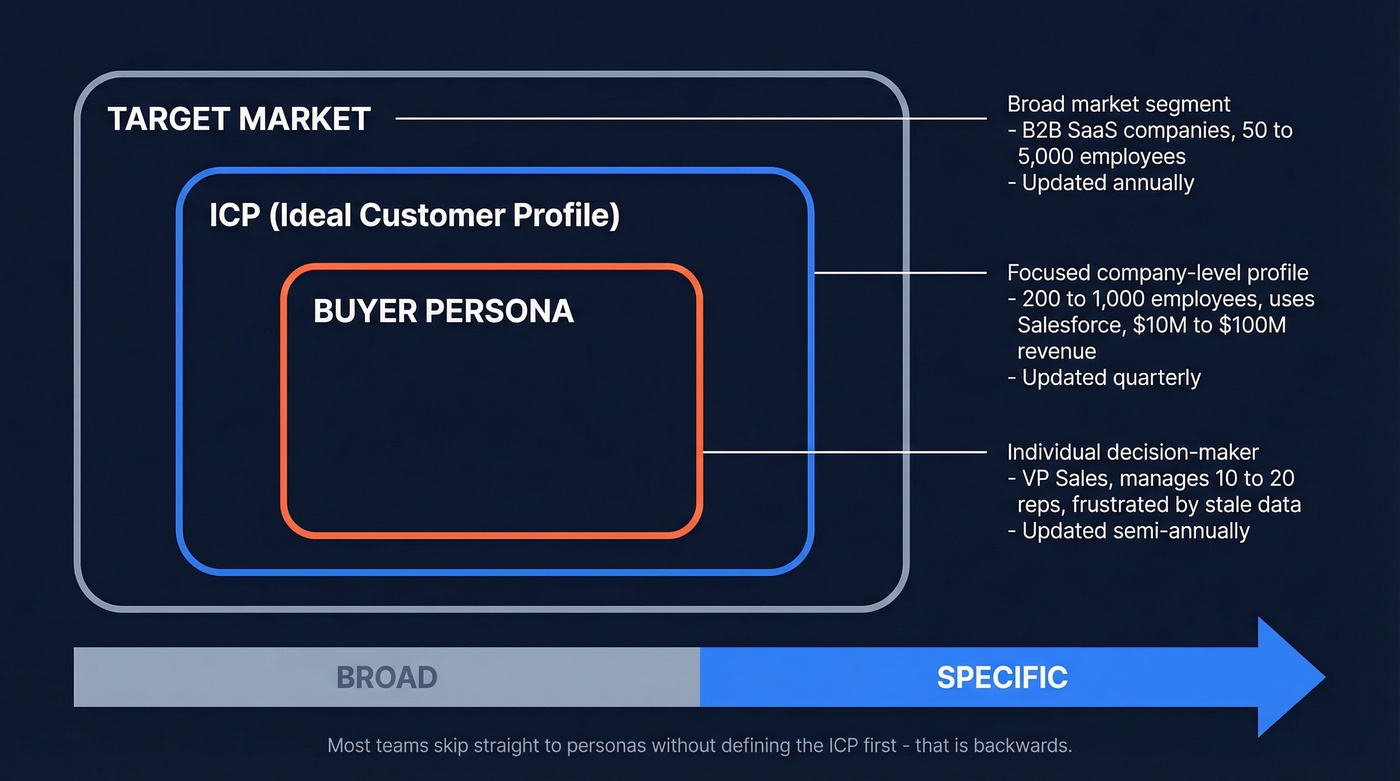
Most teams skip straight to personas without defining the ICP first. That's backwards. You end up with a beautifully detailed persona of a person who works at a company that'll never close.
Why Defining Your ICP Is the Highest-ROI Sales Activity
Companies with a well-defined ideal customer profile see 68% higher win rates and are 67% more likely to exceed quota, per LinkedIn's analysis. The average B2B SaaS conversion rate sits around 1.2%](https://electroiq.com/stats/average-conversion-rate-benchmark-statistics/). That means 98.8% of your outreach doesn't convert - even filtering out the 50% of prospects who were never going to buy can move that number significantly.
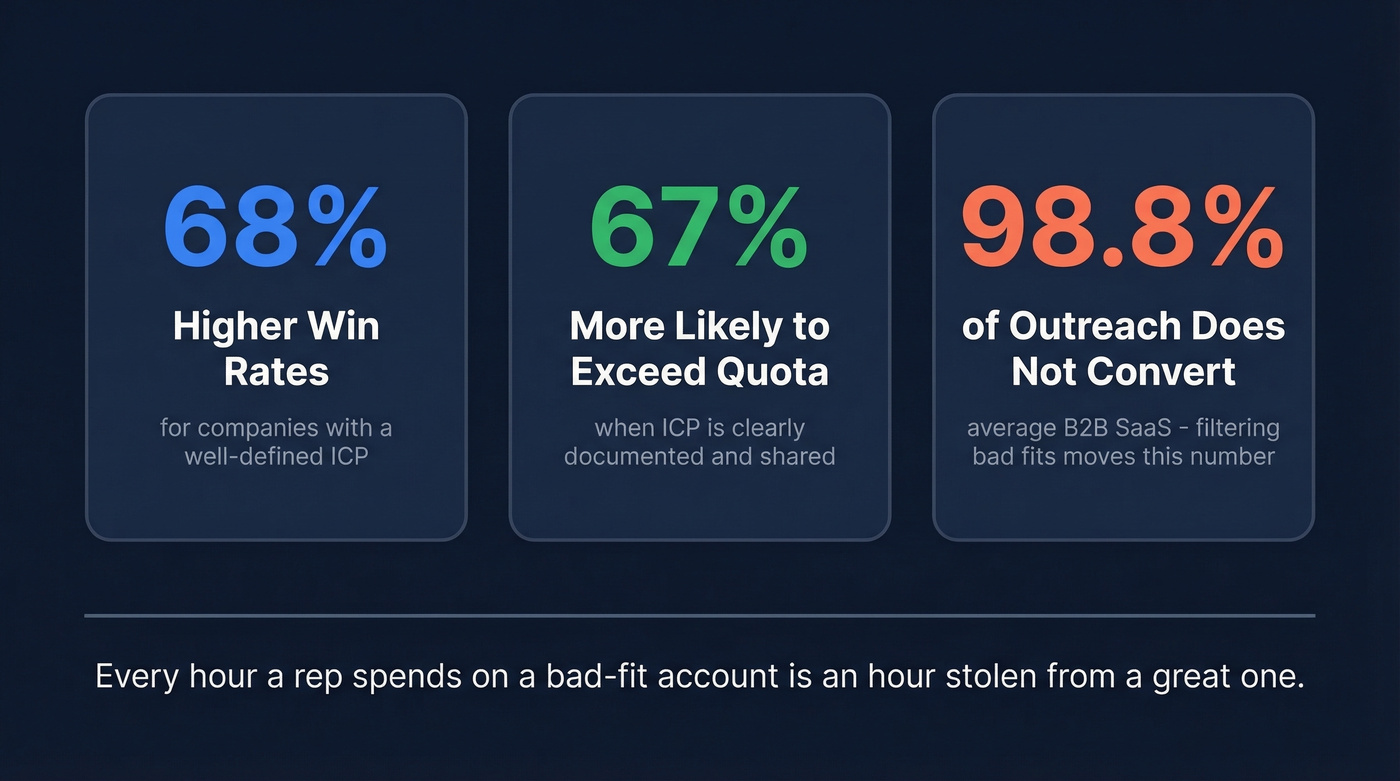
But the ROI isn't just in higher conversion. It's in shorter sales cycles, lower churn, higher expansion revenue, and reps who don't burn out chasing accounts that were never going to close. Every hour a rep spends on a bad-fit account is an hour stolen from a great one. Your ICP is the filter that makes that tradeoff before they pick up the phone.
Here's the thing: if your average deal size is under $10K, you probably don't need ZoomInfo-level data infrastructure. But you absolutely need a tight ICP. Targeting precision matters more than data volume at every price point.
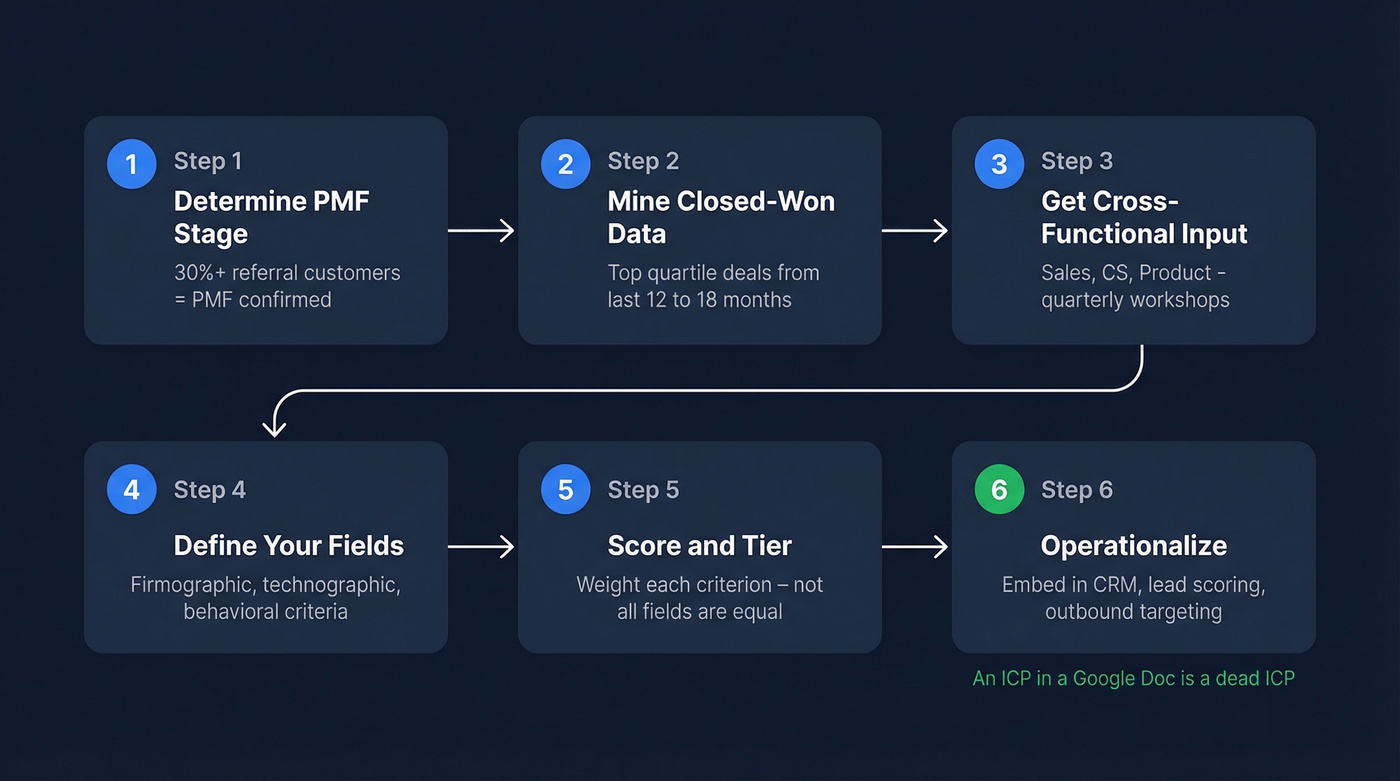
How to Define Your ICP in 6 Steps
1. Determine Your PMF Stage
Before you build anything, figure out where you are on the product-market fit spectrum. Kalungi's litmus test works well: if roughly 30% or more of your customers came from referrals, you've hit PMF in that segment. If you have PMF, lean heavily on firmographic and technographics - your closed-won data will show clear patterns. If you don't have PMF yet, lean on psychographics and jobs-to-be-done instead. You're still discovering who your best-fit customer is.
2. Mine Your Closed-Won Data
Pull your last 12-18 months of closed-won deals. Sort by deal size, sales cycle length, retention, and expansion revenue. Look for firmographic and technographic patterns in your top quartile - industry, company size, tech stack. This analysis is usually straightforward once you actually sit down and do it. We've seen teams discover that most of their best customers share a handful of attributes they'd never explicitly defined, and the "aha" moment hits fast once the data is in front of them.
3. Get Cross-Functional Input
Your ICP can't live in a marketing silo. Run quarterly workshops with sales, customer success, and product. Sales knows which deals close fast. CS knows which accounts churn. Product knows which feature requests signal a misfit customer.
Review NPS scores, support ticket themes, and feature requests - they'll tell you who's thriving and who's struggling. I once watched a marketing team spend six weeks building an ICP that sales rejected in a single meeting. Getting the team aligned on these criteria early prevents months of wasted effort.
4. Define Your Fields
Don't just write "mid-market SaaS companies." Define every field that matters: industry, headcount range, revenue range, tech stack requirements, geographic focus, buying triggers, and disqualification criteria. The complete field checklist below gives you the full picture, but the key is specificity. If it can't be filtered in a database or tagged in a CRM, it isn't actionable.
5. Score and Tier
Assign weights to each criterion. Not every field matters equally - a company in the right industry with the wrong tech stack is a different kind of miss than one with the right tech stack but too few employees. The scoring rubric later in this article gives you a production-ready model.
6. Operationalize
An ICP that lives in a Google Doc is a dead ICP. Embed your criteria into CRM tags, lead scoring rules, and outbound sequence targeting. Every new lead should be scored against your profile automatically. Build a seed list of your top 100-200 accounts to test your criteria before scaling outbound.

You just built a razor-sharp ICP. Now you need a database that can actually filter on it. Prospeo gives you 30+ search filters - buyer intent, technographics, headcount growth, funding stage, job changes - across 300M+ profiles. Every email is 98% verified. Every record refreshes every 7 days. Your ICP criteria become a live target list in minutes, not weeks.
Stop defining your ICP in a spreadsheet and start filling your pipeline with it.
Complete ICP Field Checklist
Most ICP templates cover firmographics and stop. Here's the full picture, drawing from Yesware's criteria framework and fields that r/ProductMarketing practitioners consistently recommend - including channels and watering holes, a field most templates miss entirely.
| Category | Fields | Example Values |
|---|---|---|
| Firmographics | Industry, headcount, revenue, geography, funding stage | B2B SaaS, 200-1,000 employees, $10M-$100M, North America, Series B+ |
| Technographics | Tech stack, maturity, key tools | Uses Salesforce, runs outbound sequences, has marketing automation |
| Business Challenges | Pain points, goals, triggers | Low reply rates, stale CRM data, scaling outbound team |
| Buying Committee | Decision-maker, influencer, user, blocker | VP Sales (decision), RevOps (influencer), SDR Manager (user) |
| Channels | Where they learn, who they follow | SaaStr, r/sales, Pavilion, outbound-focused podcasts |
| Disqualification | Negative indicators | <50 employees, no outbound motion, locked into competitor contract |
Filled-Out Example: Mid-Market SaaS
Here's a complete profile for a mid-market company selling sales engagement software.
| Field | Value |
|---|---|
| Industry | B2B SaaS |
| Headcount | 200-1,000 employees |
| Revenue | $10M-$100M |
| Geography | North America, UK, DACH |
| Funding Stage | Series B+ or profitable |
| Tech Stack | Salesforce or HubSpot CRM, uses Outreach/Salesloft or similar |
| Pain Points | Low reply rates, stale contact data, reps spending 4+ hrs/week on manual prospecting |
| Decision-Maker | VP Sales or Head of RevOps |
| Buying Trigger | New sales leadership, headcount growth >20% YoY, recent funding round |
| Negative Indicators | <50 employees, no dedicated outbound motion, just signed 3-year competitor contract |
This fits on one slide - which is exactly the heuristic Kalungi recommends. If your ICP needs a 10-page deck to explain, it's too complex for reps to internalize.
The Anti-ICP: Who NOT to Sell To
Most teams define who they want. Almost nobody defines who they don't want. An anti-ICP - sometimes called a negative ICP - is an explicit exclusion profile describing the types of accounts that drain resources, dilute margins, or churn predictably.
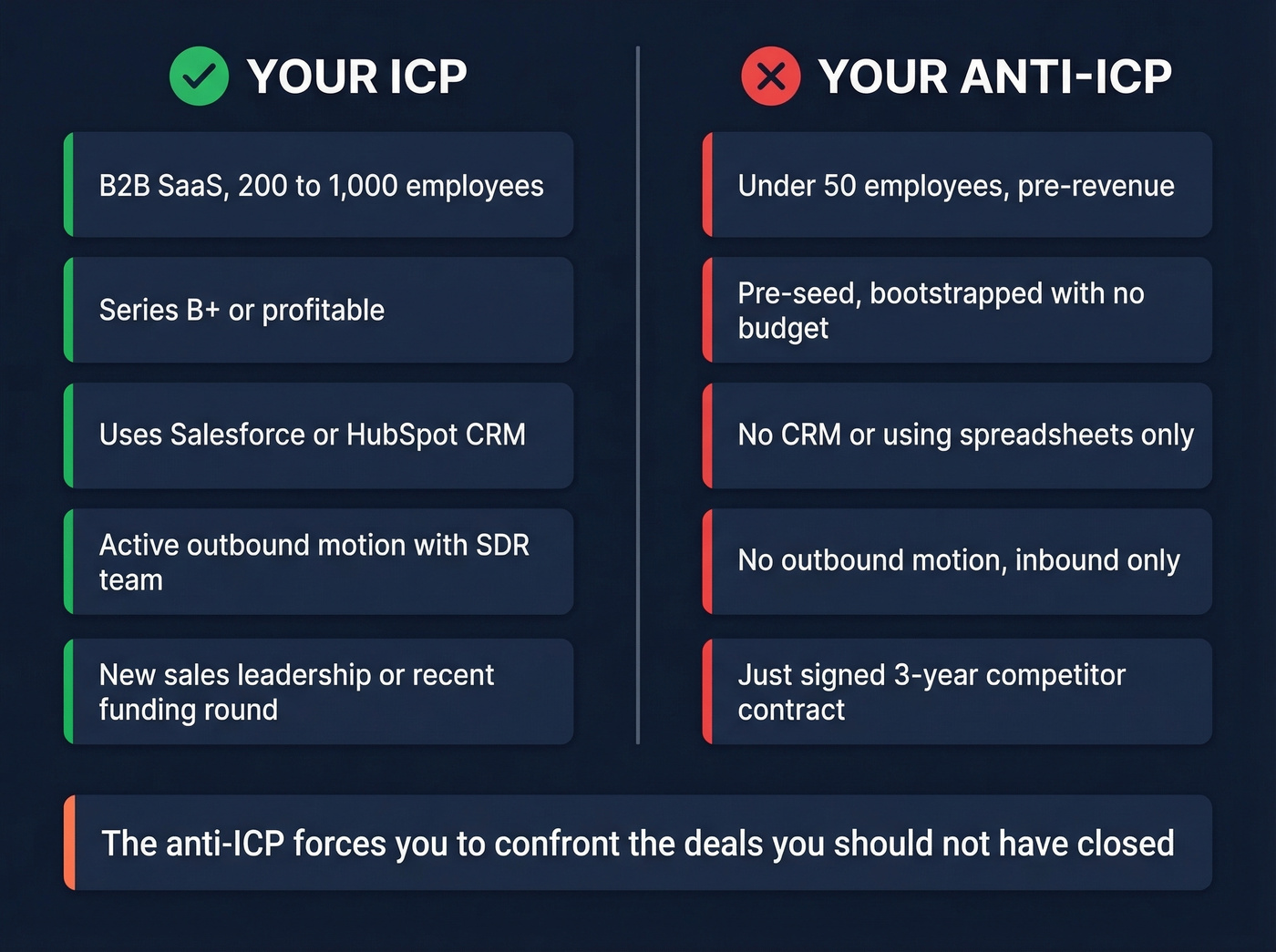
Think about the small startups that sign quickly but churn the moment budgets tighten. Or the industries that demand heavy customization your product team can't scale. Or the companies with wildly incorrect expectations about what your product does - they'll leave negative reviews and burn support hours. The negative persona categories worth documenting:
- Low-LTV buyers who purchase once and never expand
- Excessive support consumers who cost more to serve than they pay
- Price-sensitive discount seekers who'll leave for a 10% cheaper competitor
- Misaligned expectations - they want something your product simply isn't
The consensus on r/b2bmarketing is that most ICPs are "fairytale personas" built without talking to customers or sales. The anti-ICP is the antidote. It forces you to confront the deals you shouldn't have closed - the ones that looked good on paper but destroyed your NPS and ate your CS team's bandwidth.
How to Score Every Account Against Your ICP
Defining your profile is step one. Scoring accounts against it is what makes it operational. Businesses using lead scoring see a 77% boost in lead generation ROI compared to those that don't.
Production-Ready Scoring Rubric
Here's a 0-100 model with explicit weights you can implement this week.
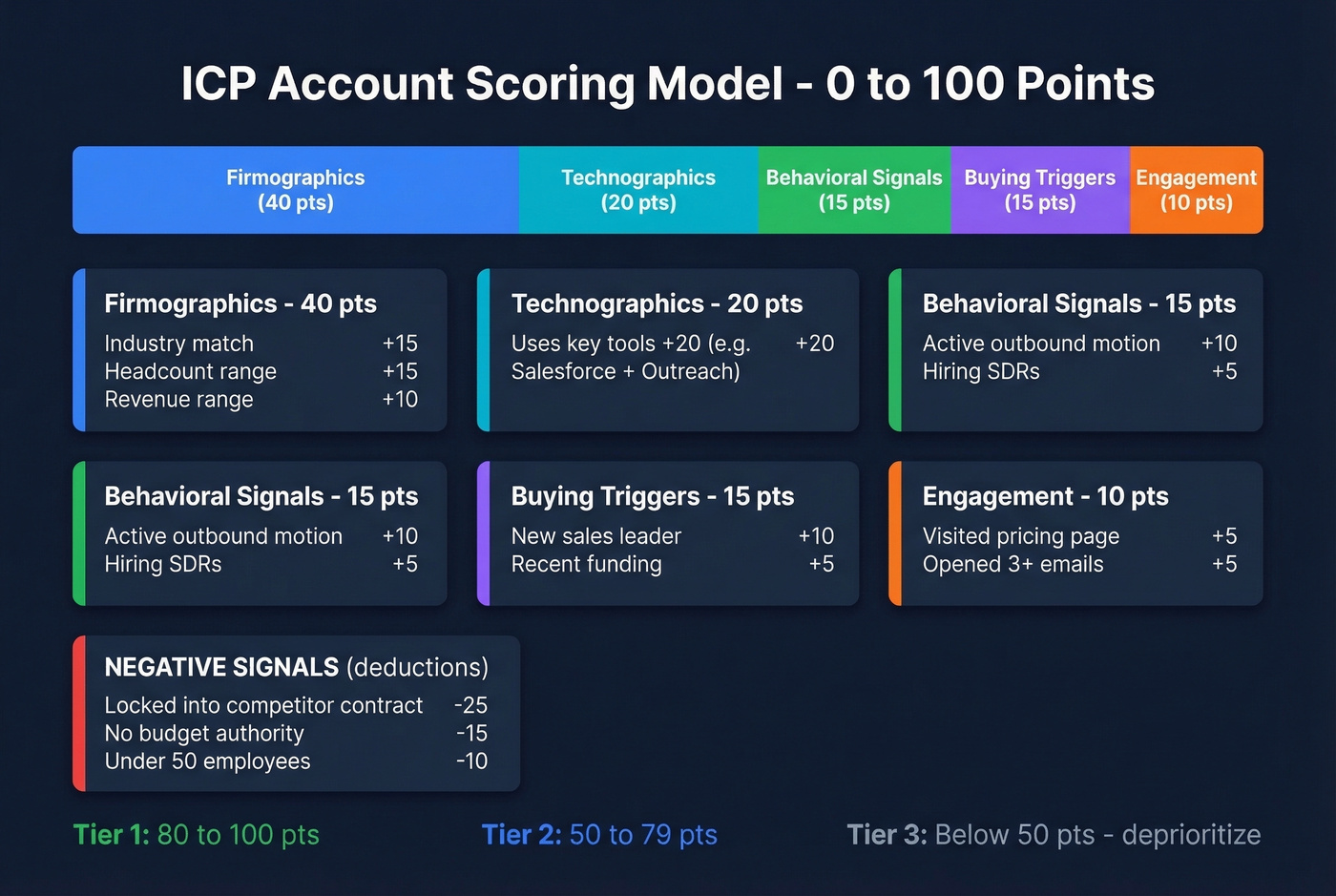
| Category | Criteria | Points | Example |
|---|---|---|---|
| Firmographics | Industry match | +15 | B2B SaaS = +15 |
| Firmographics | Headcount range | +15 | 200-1,000 = +15 |
| Firmographics | Revenue range | +10 | $10M-$100M = +10 |
| Technographics | Uses key tools | +20 | Salesforce + Outreach = +20 |
| Technographics | Tech maturity | +20 | Has marketing automation = +20 |
| Intent Signals | Active research | +10 | Bombora intent on topic = +10 |
| Intent Signals | Buying trigger | +10 | Recent funding or hiring = +10 |
And the piece most rubrics miss - negative scoring:
| Signal | Score Adjustment | Rationale |
|---|---|---|
| Free email domain (@gmail) | -50 | Almost certainly not a real buyer |
| Competitor lock-in | -20 | Just signed a multi-year contract |
| <50 employees | -15 | Below minimum viable account size |
| No outbound motion | -10 | Product won't deliver value |
Tier thresholds: >70 = AE priority (route immediately), 40-70 = nurture (marketing sequences), <40 = disqualify (don't waste time).
Score Decay and Validation
Intent signals have a half-life. A company researching "sales engagement platforms" two weeks ago might've already bought from a competitor. Build in score decay: if no new intent signal appears within 14 days, decay the intent portion by 15% per week. This keeps your pipeline honest.
Here's the validation step most teams skip: compare match scores against actual engagement rates. If accounts scoring 80+ convert at the same rate as accounts in the 50-60 range, your weights are wrong. Recalibrate quarterly - pull closed-won and closed-lost data, check whether scoring predicted outcomes, and adjust. The profile that was perfect in Q1 might need tuning by Q3. In our experience, teams that treat ICP scoring as a living system rather than a one-time exercise see compounding returns over two to three quarters.
How to Operationalize Your ICP
A profile document that isn't embedded in your systems is just a PDF nobody reads. Tag every customer tier in your CRM. Build lead scoring rules that automatically classify inbound leads. Align your outbound sequences so reps only prospect into best-fit accounts.
Your ICP is only as good as your data. If your CRM is full of stale records with wrong titles and dead email addresses, scoring against your profile is scoring against garbage. ZoomInfo runs $15K-$40K+/year for enterprise-grade data. Apollo starts at $49/user/month. Prospeo takes a different approach - its 30+ search filters map directly to ICP fields like buyer intent, technographics, and headcount growth, turning your profile document into a live search query with 98% email accuracy on a 7-day refresh cycle.
For product marketing alignment, share your scoring model with the marketing team so campaigns, content, and ad targeting all point at the same account profile. When sales and marketing agree on who the ideal customer is, every dollar works harder.

Half your prospects aren't a good fit - the article just told you that. Prospeo's intent data tracks 15,000 topics so you can layer buying signals on top of your ICP filters. Combine firmographics, technographics, and in-market intent to find accounts that match your profile AND are actively looking. At $0.01 per email, qualifying before you call costs almost nothing.
Find ICP-fit accounts showing buying intent right now.
5 ICP Mistakes That Kill Pipeline
Mistake 1: Confusing ICP and personas. Your ICP is a company profile. Your persona is a person profile. Define the company first, then build personas for the individuals within those companies. Getting this backwards means you're profiling people at companies that'll never buy.
Mistake 2: Building in a silo. If sales, CS, and product aren't in the room, your profile is a guess. Quarterly cross-functional workshops - not annual strategy retreats - fix this.
Mistake 3: Using B2C demographics for B2B. "Male, 35-45, lives in San Francisco" tells you nothing useful for B2B targeting. Layer firmographics, technographics, and psychographics instead. Your ICP describes a company's attributes, not a person's lifestyle.
Mistake 4: Skipping disqualification criteria. We've talked about this already, but it bears repeating. If you don't define who to avoid, your reps will waste cycles on accounts that look promising on paper but churn in three months. Skip this if you enjoy watching pipeline evaporate.
Mistake 5: Building it and never using it. The fix is the same as mistake 4: embed your criteria - including negative signals - into CRM tagging, lead scoring, and outbound sequences. Refresh quarterly. An ICP that only exists in a slide deck doesn't exist at all.
FAQ
What does ICP stand for in sales?
ICP stands for Ideal Customer Profile - a company-level description of the accounts most likely to buy, succeed with your product, and renew long-term. It defines organizational attributes like industry, headcount, tech stack, and pain points rather than individual traits. It's distinct from a buyer persona, which describes the person, not the organization.
How do you build an ideal customer profile from scratch?
Analyze your top-quartile closed-won deals from the past 12-18 months, identify shared firmographic and technographic patterns, then validate with cross-functional input from sales, CS, and product. Codify those patterns into a scored, filterable profile with explicit disqualification criteria. The six-step process above walks through each stage.
How often should you update your ICP?
Review quarterly at minimum. Pull closed-won/lost data, churn patterns, and competitive dynamics each quarter and recalibrate scoring weights. If you've launched a major feature or entered a new market, update immediately - in-market signals shift fast, and a stale profile costs pipeline.
Can a company have more than one ICP?
Yes - most B2B companies serving multiple segments need two or three. A company selling to both mid-market SaaS and enterprise financial services has fundamentally different ideal accounts. More than three usually means your profiles are too narrow or your product positioning is unfocused.
What's the fastest way to turn an ICP into a prospect list?
Use a B2B database with filters that match your profile criteria directly. Let's say you've defined your ICP as Series B+ SaaS companies with 200-1,000 employees using Salesforce - you can plug those exact attributes into a tool like Prospeo's database, layer on intent signals, and export verified contacts to your CRM in under 10 minutes.