

How to Improve Sales Close Rate: Data, Diagnosis, and Fixes That Work
One SaaS rep tracked their demo-to-close rate for six months. Started at 18%. Ended at 34%. The interesting part isn't the improvement - it's what didn't work. Better slides, more features, mid-demo discounts. All useless. The moves that actually doubled their number were structural, quiet, and available to any rep willing to change their process instead of their pitch deck.
What You Need (Quick Version)
- Pre-demo qualification. Five questions before the call. Filter bad fits before you burn 25 minutes.
- 25-minute, problem-first demos. Cut the feature tour. Lead with discovery, discuss pricing early, end with an explicit next step.
- Audit your contact data. Your follow-up cadence is worthless if a third of your emails bounce. Prospeo's bulk email verification flags bad addresses in minutes - upload your list, remove bounces, protect your domain.
Close Rate vs. Win Rate
Most teams use these interchangeably. They shouldn't.
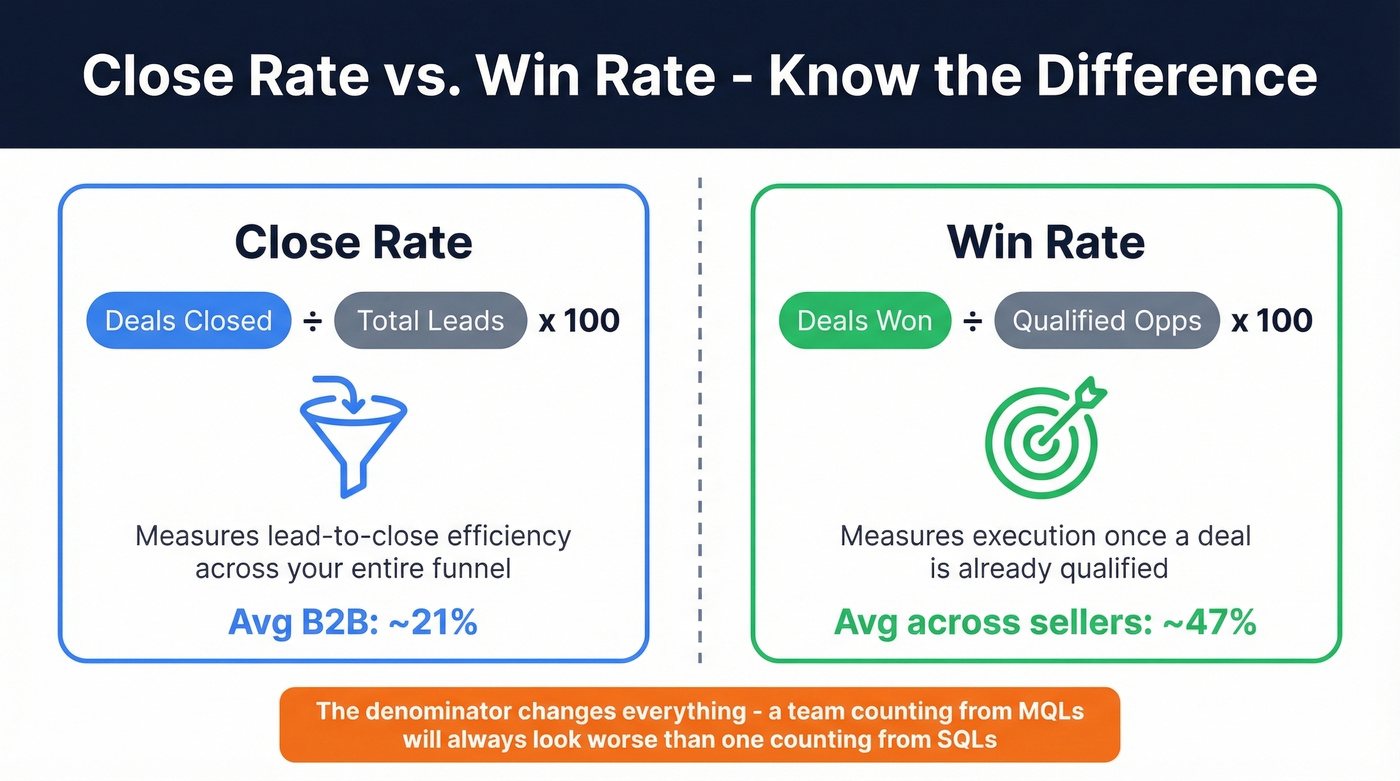
Close rate = deals closed / total leads x 100. It's a lead-to-close metric. Win rate = deals won / qualified opportunities x 100. That's an opportunity-stage execution metric. The denominator matters enormously - a team counting from MQLs will always look worse than one counting from SQLs, which is why benchmarks vary so wildly across reports.
| Metric | Formula | Measures |
|---|---|---|
| Close rate | Closed / total leads | Lead-to-close efficiency |
| Win rate | Won / qualified opps | Opportunity-stage execution |
Here's the number that should bother you: RAIN Group's data across 472 sellers puts the average win rate at 47%. But the distribution is brutal. The top 7% hit roughly 75%. The remaining 80% average just 40%.
Benchmarks by Industry
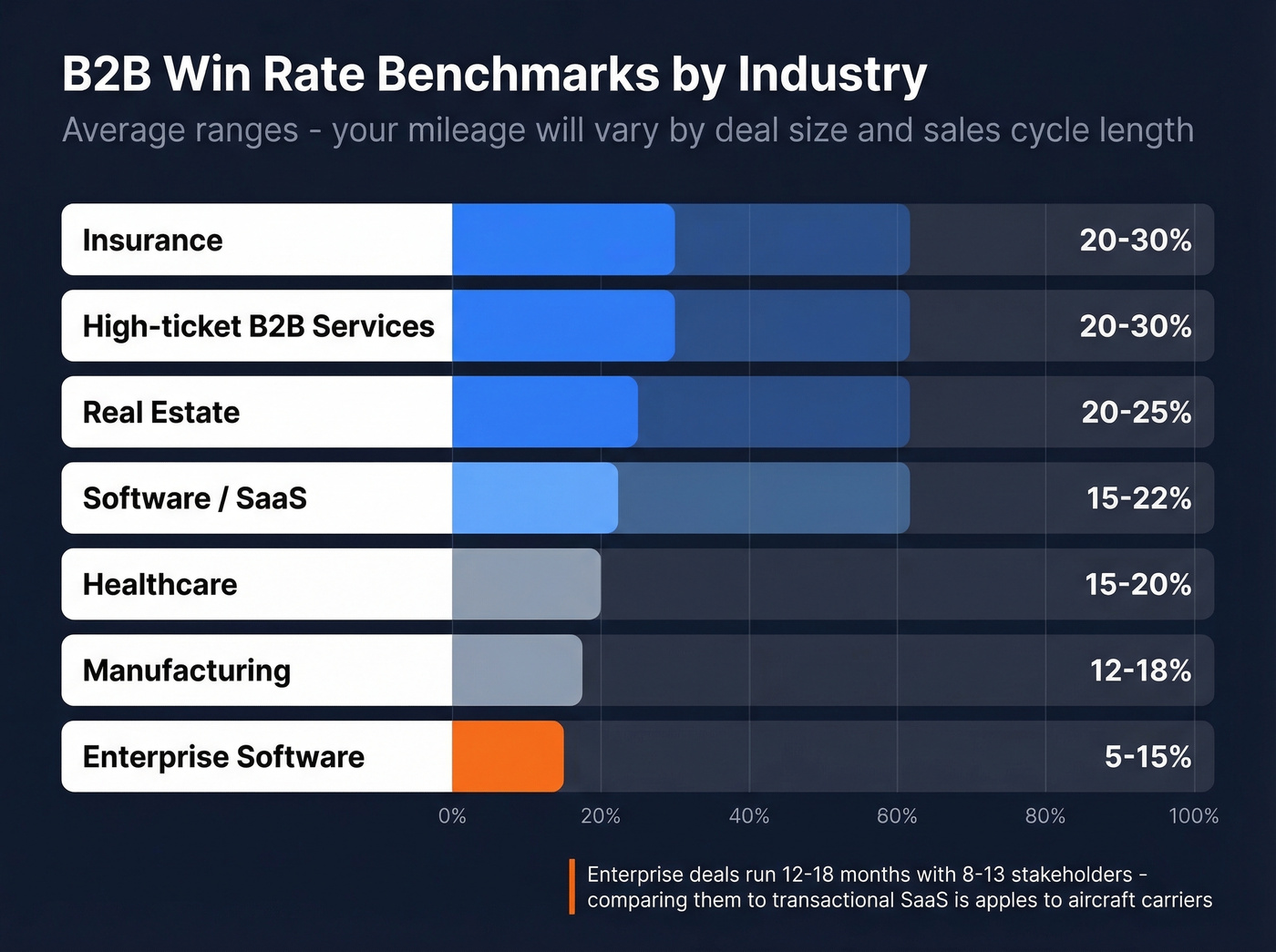
The average B2B win rate runs about 21%. That number is nearly meaningless without context:
| Industry | Win Rate Range |
|---|---|
| Insurance | 20-30% |
| High-ticket B2B services | 20-30% |
| Real estate | 20-25% |
| Software/SaaS | 15-22% |
| Healthcare | 15-20% |
| Manufacturing | 12-18% |
| Enterprise software | 5-15% |
| Medical devices | 3-5% |
Enterprise software sits at the bottom because those deals can run 12-18 months and often involve 8-13 stakeholders. Comparing your enterprise closing ratio to a transactional SaaS benchmark is apples to aircraft carriers.

Bad contact data kills close rates before your pitch even starts. If a third of your follow-ups bounce, no cadence or demo fix will save you. Prospeo's 5-step email verification delivers 98% accuracy - teams using it cut bounce rates from 35%+ to under 4% and tripled pipeline.
Stop losing closeable deals to bad emails. Verify your list in minutes.
Why Your Close Rate Is Stuck
Your CRM's closed-lost reasons are often misleading. "Price" and "went with competitor" are surface-level labels hiding the real problems - inadequate discovery, poor demo execution, and insufficient multi-threading.
The biggest silent killer? No-decision losses. These account for up to 40% of your pipeline. Not lost to a competitor. Lost to nothing. The buyer just stopped responding. Five drivers behind this:
- Status quo inertia - the buyer didn't feel enough urgency to act
- Discovery gap - you pitched features instead of consulting on their problem
- Bad ICP fit - should've been disqualified before the demo
- ROI fog - the buyer couldn't justify the spend internally
- Experience drift - the buyer ghosted because the process felt off
Every minute chasing a no-decision deal is stolen from one that would actually close. Let's be honest: most reps know which deals are dead but keep them in the pipeline because an empty forecast feels worse than a fictional one.
Five Ways to Improve Sales Close Rate
Qualify Before the Demo
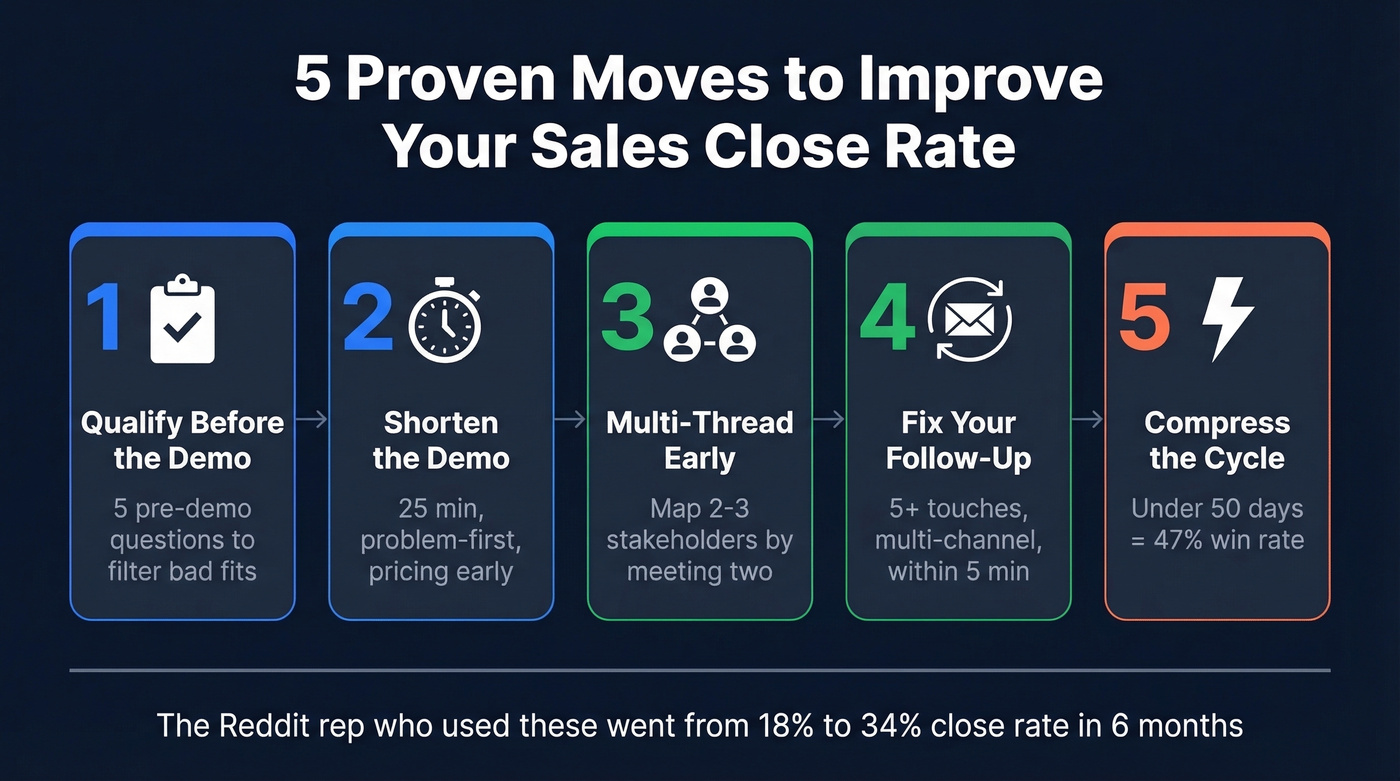
Buyers are 70% through their buying process before they talk to sales, and Gartner's research shows 75% of B2B buyers now prefer a rep-free experience entirely. That makes the remaining demos higher-stakes, not lower. The Reddit rep's single biggest lever was a pre-demo qualification form: five questions, sent before the call. Nothing fancy - just enough to confirm budget authority, timeline, and whether the problem they described actually matches what you sell.
Use this if you're running 8+ demos per week and closing fewer than 20%. Skip this if your pipeline is so thin that filtering anyone feels dangerous - fix top-of-funnel first.
Shorten the Demo
The same rep cut demos from 45 to 25 minutes. The first 10 became problem-first discovery - no slides, no feature tour, just understanding the buyer's pain. Pricing came up early. Every call ended with an explicit next step.
What didn't help: showing more features or offering discounts. Discounting actually attracted price-sensitive buyers who churned faster. This tracks with what we've seen across dozens of sales teams - the reps who lead with value and discuss money early close at higher rates than the ones who save pricing for a "follow-up email."
Use this if your average demo runs 40+ minutes and your post-demo ghost rate exceeds 50%. Skip this if you sell complex enterprise deals where 25 minutes genuinely isn't enough to cover technical requirements.
Multi-Thread or Lose
B2B buying groups now include 8-13 stakeholders. If you're single-threaded to one champion, you're gambling. Gong's analysis shows multi-threading can lift win rates by roughly 130%.
We've seen teams lose six-figure deals because their champion changed roles mid-cycle and nobody else in the account knew the project existed. Multi-thread early, not after the deal stalls. Map the buying committee in your first discovery call, ask your champion to introduce you to at least two other stakeholders by the second meeting, and build separate value narratives for each persona. It's one of the most reliable ways to close more deals consistently.
Fix Your Follow-Up Cadence
80% of sales require 5+ touchpoints, yet 48% of reps never follow up after the first call. Leads contacted within 5 minutes are 9x more likely to convert. A multi-channel cadence - email, phone, social - yields 28% higher conversion than single-channel outreach.
If you're giving up after two touches, you're abandoning deals that were going to close on touch six. In our experience, the teams that build automated multi-touch sequences see the fastest improvement - not because the emails are brilliant, but because they actually get sent.
Use this if your CRM shows most deals dying between touch 1 and touch 3. Skip this if you're already running a 7+ touch sequence and the problem is upstream.
If you need a starting point, steal a few follow-up templates and adapt them to your deal stages.
Compress the Sales Cycle
Outreach's data tells a stark story: deals closed within 50 days have a 47% win rate. After 50 days, that drops to roughly 20%.
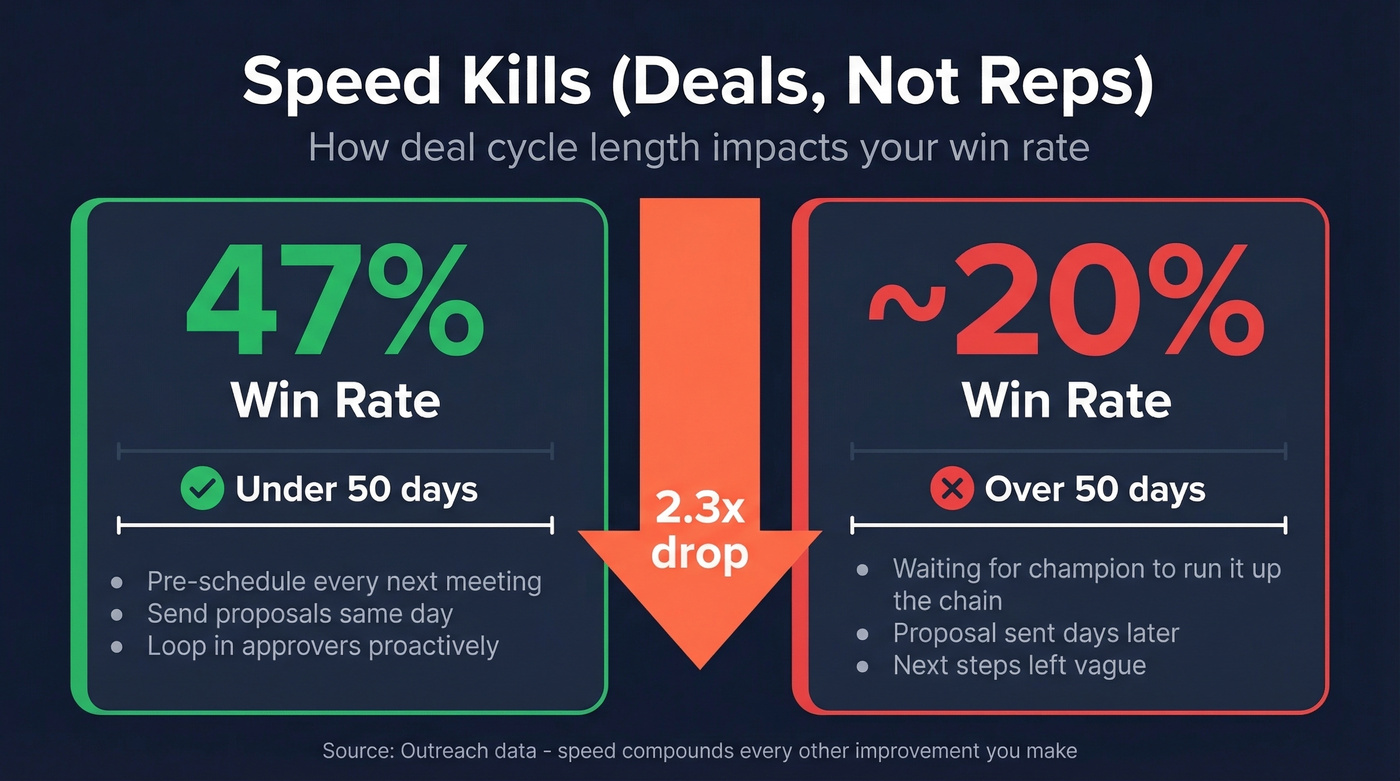
Speed doesn't mean rushing the buyer. It means eliminating dead time - faster follow-ups, pre-scheduled next meetings, and removing internal approval bottlenecks before they stall momentum. Book the next meeting before the current call ends. Send the proposal the same day. Identify who needs to sign off and loop them in proactively instead of waiting for your champion to "run it up the chain."
Use AI to Coach Yourself
The consensus on r/b2b_sales is clear: reps who systematically review their own calls improve faster than those who wing it. The workflow is simple - call ends, auto-transcript via Fathom or Fireflies, feed it to an AI that scores talk ratio and objection handling, iterate on the next call.
LinkedIn's 2026 State of Sales data backs this up: 56% of sales professionals now use AI daily, and AI users are 2x more likely to exceed targets. Gartner reports sellers who effectively partner with AI tools are 3.7x more likely to meet quota. I'd go further: if you're not reviewing at least two calls per week with AI-assisted coaching, you're improving slower than every competitor who is.
If you're building this into your routine, treat it like sales performance management: consistent review beats occasional “big changes.”
Fix Your Data First
Here's the thing: every tactic above assumes your follow-ups actually reach the buyer. If 35% of your emails bounce, your 5-touch cadence is really a 3-touch cadence. Your speed-to-lead advantage evaporates when the first email hits a spam trap.
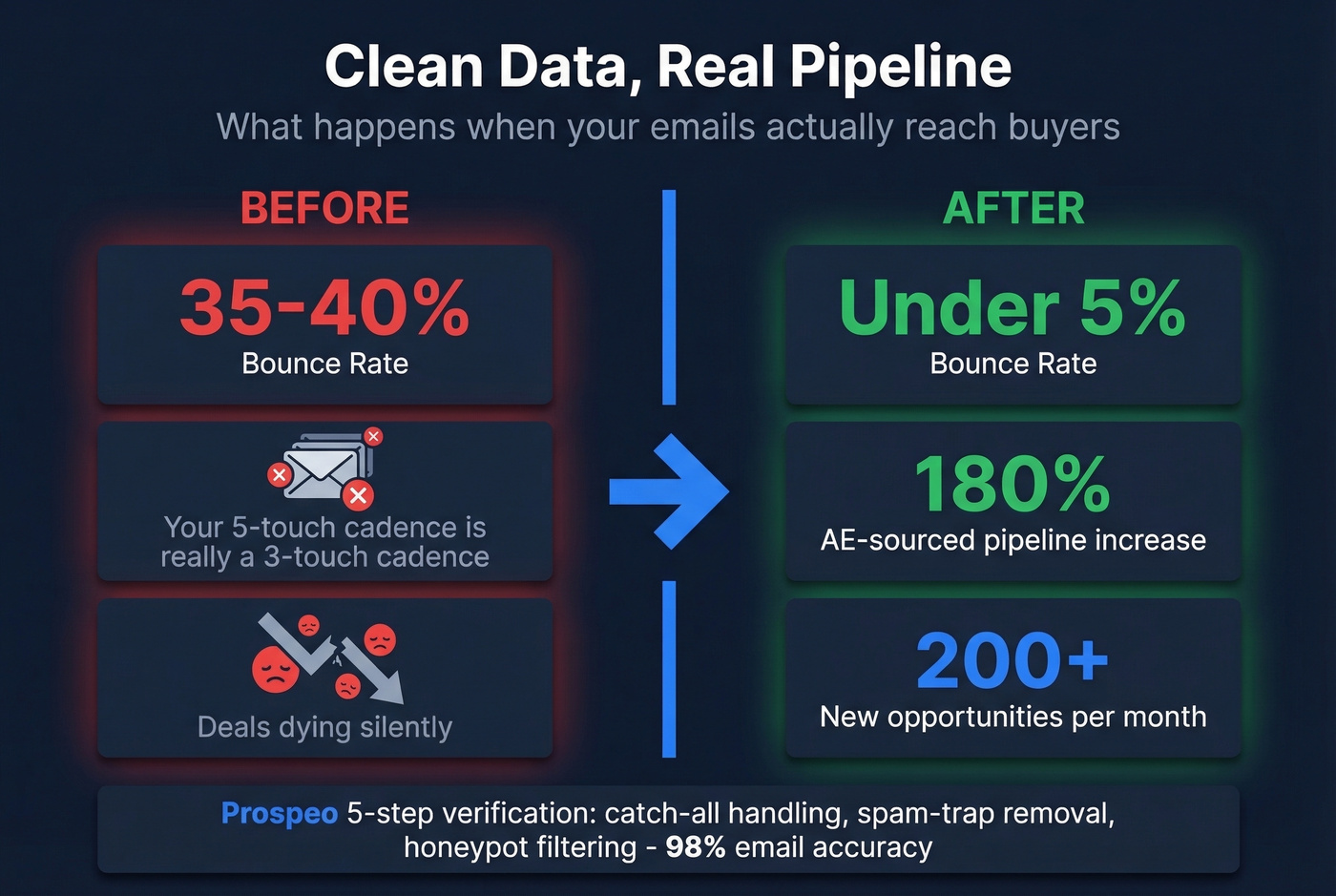
Bad contact data destroys more closing ratios than bad sales technique. Most teams obsess over scripts and objection handling while a third of their emails silently bounce. Snyk's 50 AEs were running bounce rates of 35-40% before cleaning their data. After switching to verified contacts: under 5% bounces, AE-sourced pipeline up 180%, and 200+ new opportunities per month. That's what happens when every email in your sequence actually lands.
Prospeo's 5-step verification - including catch-all handling, spam-trap removal, and honeypot filtering - delivers 98% email accuracy, so your cadence hits real inboxes instead of dead ends. If your current provider doesn't tell you their bounce rate, that's your answer.
To go deeper on the mechanics, start with email bounce rate benchmarks and an email deliverability audit.
Multi-threading lifts win rates 130%, but only if you can actually reach those 8-13 stakeholders. Prospeo gives you verified emails and direct dials for entire buying committees - 300M+ profiles, 125M+ mobile numbers, refreshed every 7 days. At $0.01 per email, one closed deal pays for a year of data.
Reach every stakeholder in the deal, not just your single-threaded champion.
FAQ
What's a good close rate in B2B sales?
The average B2B win rate sits around 21%, with SaaS specifically at 15-22%. RAIN Group's top 7% hit roughly 75%. Standardize whether you're measuring from all leads or qualified opportunities before benchmarking - the denominator changes everything.
Why do deals stall after the demo?
No-decision losses account for up to 40% of pipeline. The root causes are status quo inertia, weak discovery, and missing next steps. Reps who discuss pricing early and end every call with a concrete commitment - "does it make sense to schedule implementation review by Friday?" - see significantly fewer stalls.
How does bad contact data affect close rates?
High bounce rates kill your follow-up cadence and damage sender domain reputation, meaning even your valid emails start landing in spam. Teams that clean their data routinely see bounce rates drop from 35%+ to under 5%, with corresponding jumps in pipeline. Clean data is the cheapest way to improve sales close rate without changing a single word in your pitch.
What's the fastest way to increase closing ratio?
Compress your sales cycle. Deals closed within 50 days win at 47%, while deals past 50 days drop to roughly 20%. Pre-schedule every next meeting before the current call ends, and eliminate internal approval bottlenecks proactively. Speed compounds every other improvement you make.