

The Data-Backed Inbound Sales Call Script (With Objection Handling)
Most inbound sales call script articles hand you a greeting, three generic questions, and abandon you the second a prospect says "just send me an email." The data tells a sharper story. Leads contacted within five minutes are 21x more likely to convert, yet the average B2B response time sits at 42 hours. That's not a gap - it's a canyon.
Below is the full script, stage by stage, plus objection-handling lines and the mistakes we see kill deals over and over again.
The Full Script, Stage by Stage
Think of this as a decision tree, not a teleprompter. Each stage has one job. Skip one and the next one breaks.
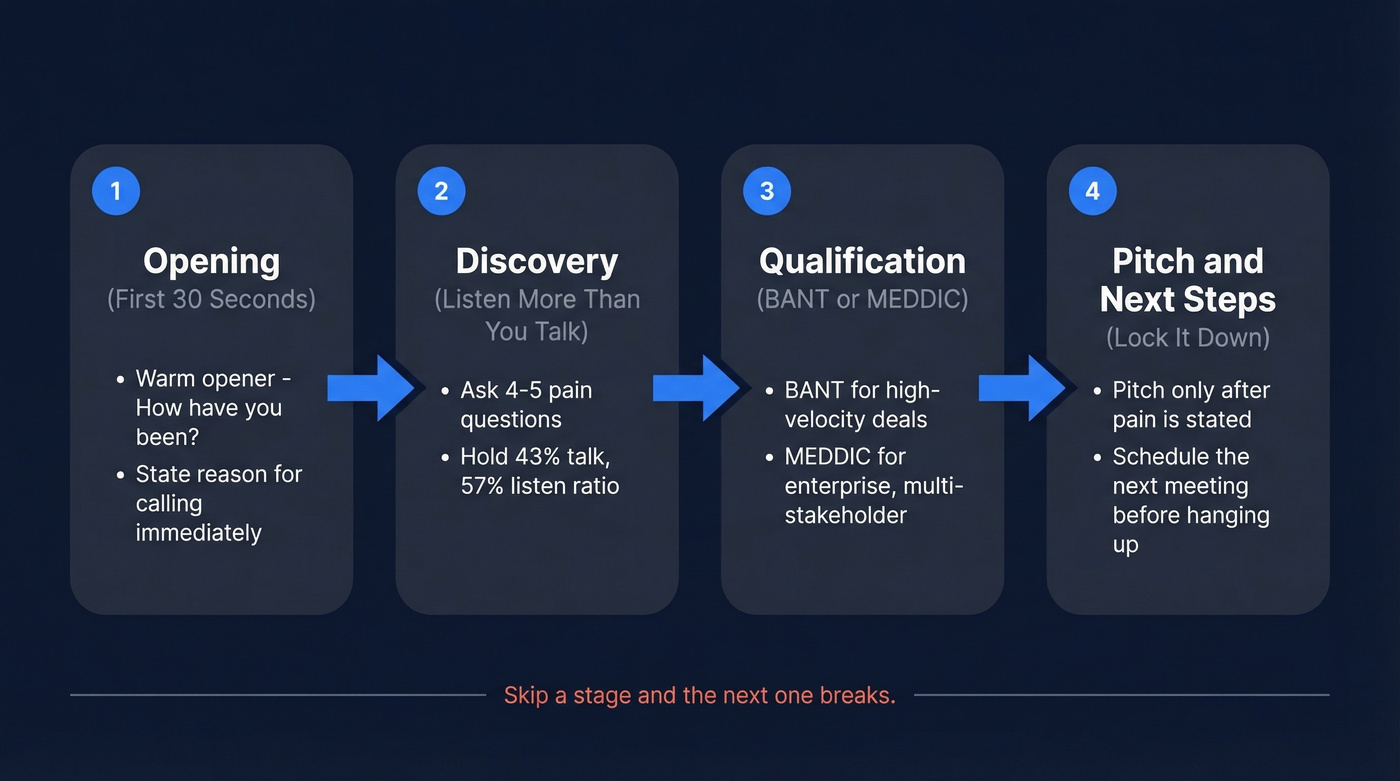
Opening: The First 30 Seconds
"Hey [Name], it's [Your Name] from [Company]. How have you been?"
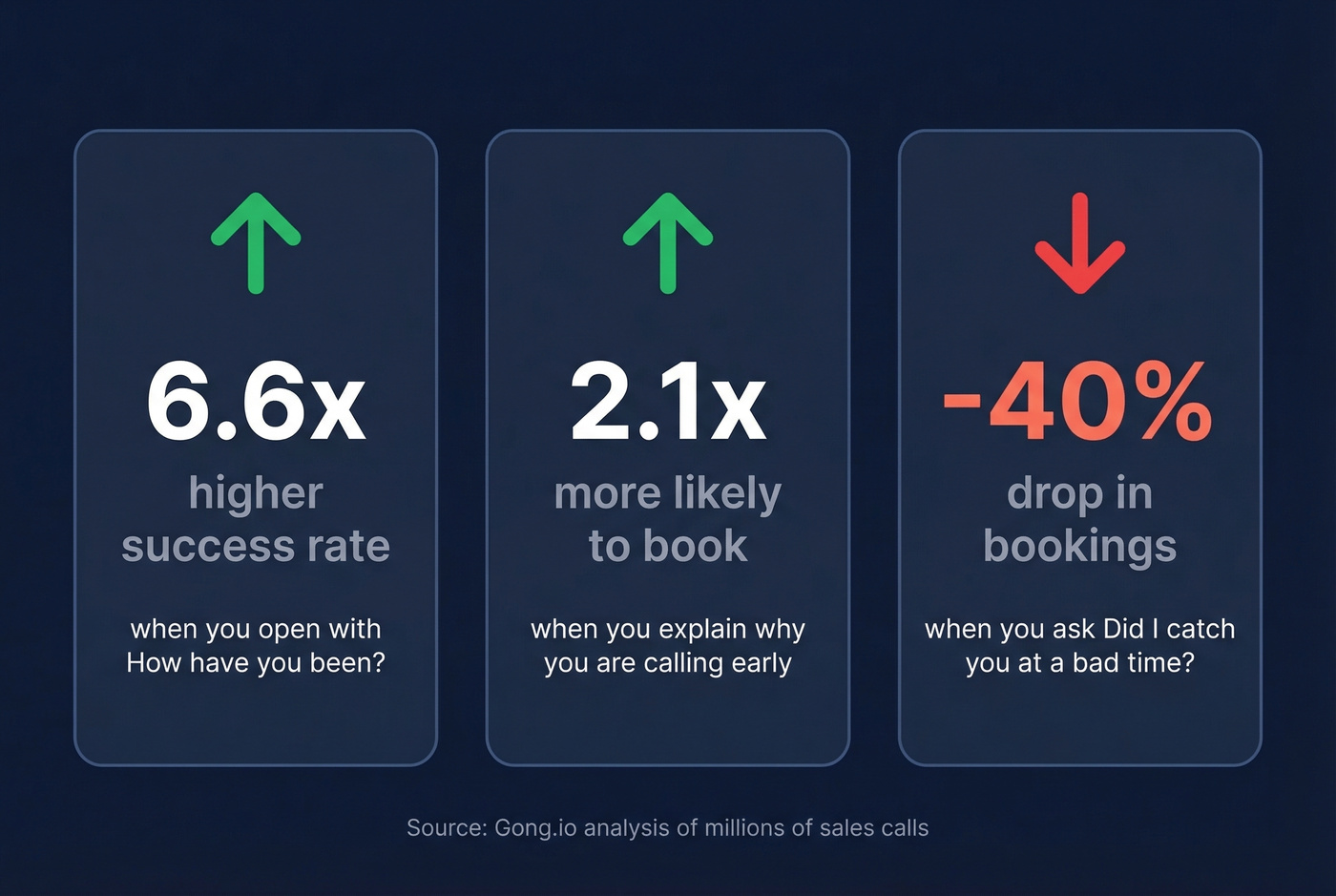
That "How have you been?" line isn't small talk - it carries a 6.6x higher success rate than baseline openers. Gong measured this on outbound calls, but the principle transfers: warm openers disarm. After the pleasantry, state your reason for calling immediately. Calls where the rep explains why they're calling early see 2.1x higher success rates in Gong's dataset.
"I saw you [requested a demo / downloaded our guide / signed up for a trial] - wanted to make sure I could answer any questions while it's fresh."
Here's the thing: never open with "Did I catch you at a bad time?" That single phrase craters bookings by 40%. Kill it today. Whether you're handling a warm lead or running a sales introduction call, the first 30 seconds set the tone for everything after.
Discovery Questions
This is where most reps blow it. They ask one question, hear a keyword, and launch into a pitch.
The optimal ratio is 43% talking, 57% listening. High performers hold that ratio consistently across won and lost deals, while low performers swing from 54% talk in wins to 64% in losses - they talk more precisely when they should be listening more. Let the prospect verbalize pain before you pitch:
- "What prompted you to look into this now?"
- "How are you handling [pain point] today?"
- "What does the impact look like when that breaks down?"
- "Who else on your team feels this?"
- "What does a good outcome look like in 90 days?"
We've found that preparation before the call - company size, funding, recent news - matters as much as the script itself. The consensus on r/sales backs this up. Do your homework so these discovery questions land with context, not cold.
Qualification: BANT vs. MEDDIC
No other script guide tells you when to switch frameworks. Here's the rule: for high-velocity inbound with clear buyer intent and short cycles, BANT works fine.
"Do you have budget earmarked, or would we need to build a case?" "Are you the one making the final call, or is there a team involved?" "What's driving the timeline?"
For enterprise or multi-stakeholder deals, switch to MEDDIC. Analysis of 1.8 million opportunities shows closed-won deals have 2x as many buyer contacts, and multi-threading boosts win rates by 130% on deals over $50K.
"Who else would need to sign off before this moves forward?" "What criteria will the team use to evaluate options?"
Don't over-qualify simple deals. Don't under-qualify enterprise ones. That flexibility separates closers from note-takers.
Pitch and Next Steps
Only pitch after the prospect has described their pain in their own words. We've watched reps lose winnable deals because they jumped to features before the prospect finished a sentence - it's genuinely painful to witness on call recordings. Time-box it: "Let me take 90 seconds to show you how we solve exactly what you described." Then stop talking.
The close isn't the pitch - it's the next step. The fastest deals spend 53% more time discussing next steps in the first meeting compared to average deals. And Chili Piper's analysis of 4M form submissions shows teams that offer immediate scheduling hit a 66.7% booking rate, more than double the 30% industry average. When you've got five minutes left, lock it down:
"Based on what you've shared, here's what I'd recommend - [demo / technical deep-dive / intro to your team]. I've got [Tuesday at 2 or Thursday at 10] - which works better?"
Schedule it before you hang up. Momentum dies the second the call ends.
Objection-Handling Scripts
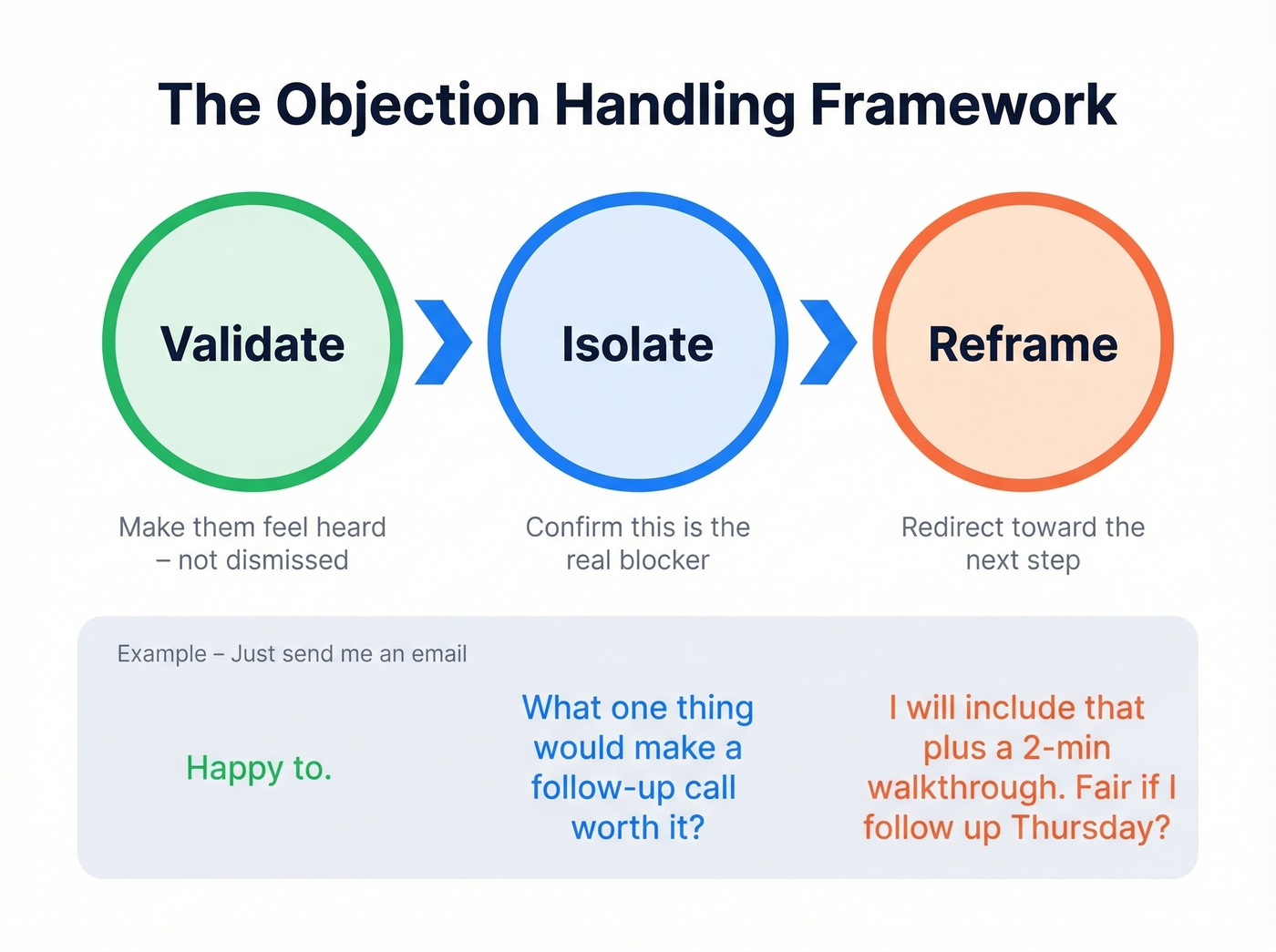
Use the Validate, Isolate, Reframe framework. Validate so the prospect feels heard. Isolate to confirm it's the real blocker. Reframe to move forward.
| Objection | Validate | Isolate | Reframe |
|---|---|---|---|
| "Too expensive" | "Totally fair." | "If price weren't a factor, is this the one?" | "Let's map cost vs. quarterly impact of [problem]." |
| "Using a competitor" | "They're solid for [X]." | "How are you handling [gap]?" | "Most teams use us alongside - want to see where?" |
| "Bad timing" | "I get it." | "What changes next quarter?" | "Let's book 20 min in [month] so you're not starting cold." |
| "Need to check with my boss" | "Makes sense." | "What questions will they ask that we haven't covered?" | "I'll send a one-pager. Want to loop them into a 15-min call?" |
| "Just send me an email" | "Happy to." | "What one thing would make a follow-up call worth it?" | "I'll include that plus a 2-min walkthrough. Fair if I follow up Thursday?" |
That last one - "just send me an email" - is the objection that kills the most pipeline because reps treat it as a polite ending instead of a negotiation. It isn't. The prospect is telling you they're interested but not convinced enough to keep talking. The isolate question ("What one thing would make a follow-up call worth it?") forces them to name their real concern, which gives you something concrete to address in the email and a reason to call back.

You just read that doing homework before the call matters as much as the script. Prospeo gives you 50+ data points per contact - company size, funding, tech stack, intent signals - so every discovery question lands with context, not cold.
Stop Googling prospects. Start every inbound call fully prepared.
Five Mistakes That Kill Inbound Calls
Slow follow-up. Leads are 21x more likely to convert within five minutes and 60x more likely to qualify within the first hour. At 42 hours, you're competing with every competitor who picked up the phone first.
If you want a tighter system for what happens after the call, keep a set of sales follow-up templates ready so reps don't improvise under pressure.
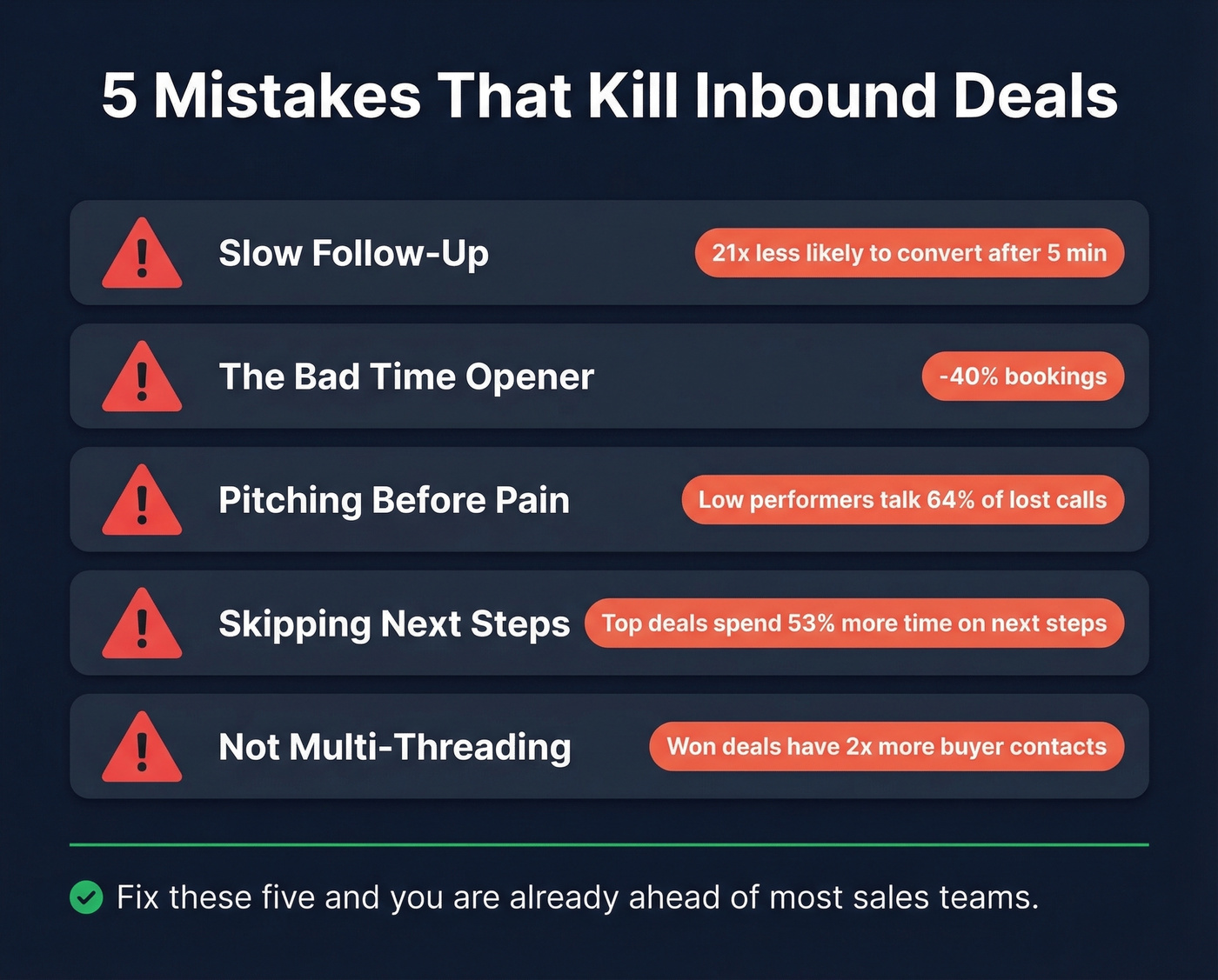
The "bad time?" opener. Drops bookings by 40%. Replace with "How have you been?" and state your reason for calling within 15 seconds.
Pitching before pain. Low performers talk 64% of the call in lost deals. If you haven't heard the prospect describe their problem, you're not ready to pitch. Period.
Skipping next steps. The fastest-closing deals spend 53% more time on next steps. No scheduled follow-up means no deal.
Not multi-threading. Won deals have 2x as many buyer contacts. If you're only talking to one person, you're one reorg away from a dead deal. Skip this at your own risk - especially on anything above $50K ACV.
Verify Contact Data Before Follow-Up
You nailed the call. Now make sure the email you captured is real before your follow-up sequence fires.
14.1% of form fills are junk - spam, personal emails, or bad data. A bounced follow-up after a strong inbound call means your message never arrives, and the prospect assumes you ghosted them. We've seen this torpedo deals that were otherwise closed. Prospeo's real-time verification catches spam traps, honeypots, and catch-all domains with 98% accuracy across 143M+ verified addresses. The free tier covers 75 emails per month, no credit card required - enough to validate every inbound lead before your sequence fires.
If you're building a broader workflow around this, start with lead enrichment and then layer in data enrichment services based on your volume and SLA.
14.1% of form fills are junk, and your follow-up sequence is only as strong as the email behind it. Prospeo's 5-step verification delivers 98% email accuracy - so the momentum you built on that call doesn't die in a bounce.
Verify every inbound lead's email before you hit send.
FAQ
How long should an inbound sales call last?
Aim for 15-25 minutes covering discovery and qualification. The fastest deals don't run longer calls - they spend proportionally more time on next steps. Get to the scheduling moment before the clock runs out.
What's a good conversion rate for inbound calls?
Inbound conversion rates typically range from 13-25% depending on industry. Software averages sit around 9.39%, while referral-sourced leads convert at 25.56%. Below 13%, your qualification or follow-up process has a gap worth auditing.
Can I adapt this script for outbound?
The discovery and objection-handling sections translate directly to any inside sales call script. The main difference is the opening - outbound calls need a stronger pattern interrupt since the prospect didn't raise their hand. Swap the "I saw you downloaded..." trigger for a relevant insight about their company, and the rest of the framework holds.
How do I verify a prospect's email after the call?
Run the address through a verification tool before your follow-up sequence fires. Bouncing on a warm lead is one of the most avoidable mistakes in sales, and it happens constantly when teams trust form data at face value.