

The Inbound Sales Framework You Can Actually Implement
61% of B2B buyers prefer a rep-free buying experience. 73% will dodge your outreach entirely if it feels irrelevant. So when a buyer actually raises their hand - fills out a form, requests a demo - and your team fumbles the response, that's revenue walking out the door.
Every guide gives you the inbound sales framework skeleton. We're giving you the muscle: the scoring model, the SLA targets, and the discovery structure that separate teams booking 78%+ of qualified leads into meetings from the median sitting at 62%.
What Separates Top Performers
RevenueHero's benchmark across 1M+ inbound form submissions tells the story clearly: the top 10% of B2B SaaS teams book roughly 8 out of 10 qualified leads into meetings. The median? 62%. Despite growing content volume, inbound still feels unpredictable for most teams - not because the methodology is wrong, but because the infrastructure behind it is broken.
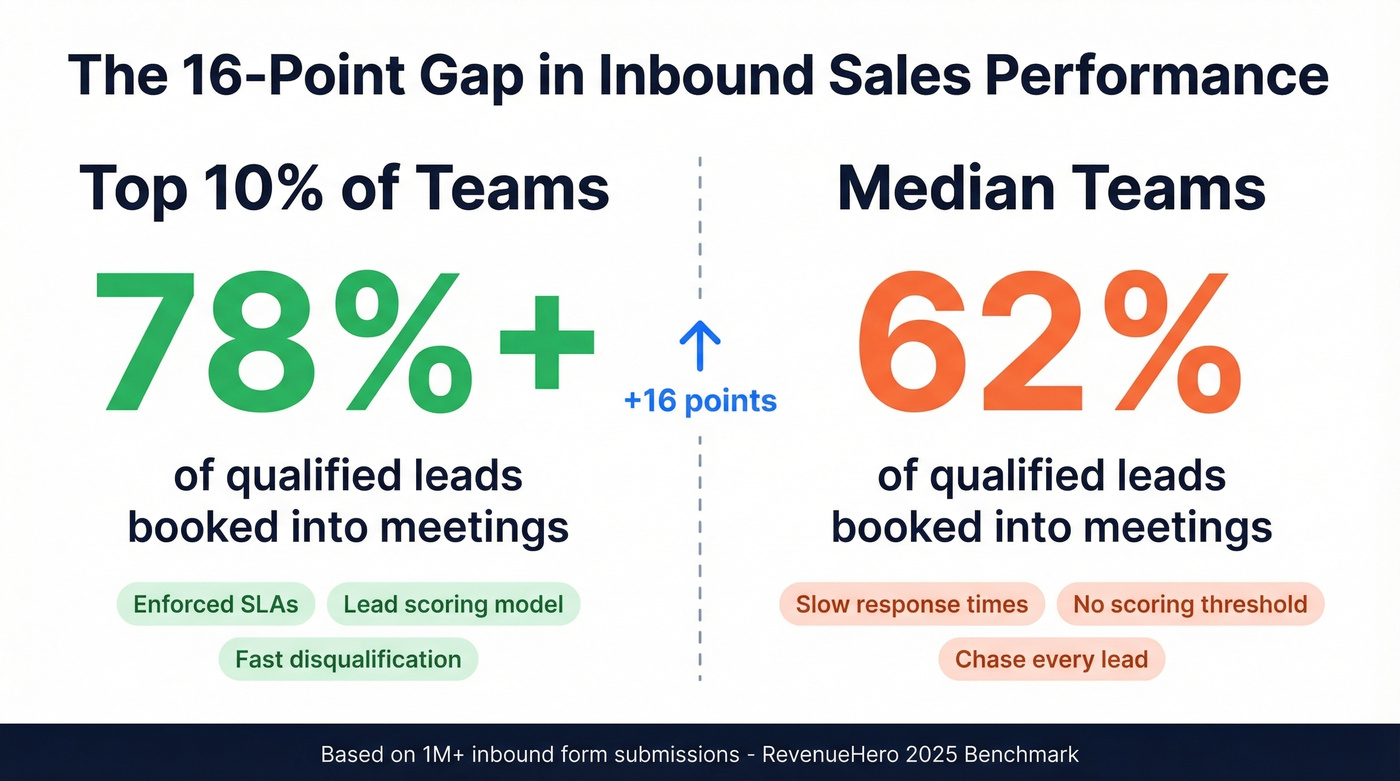
The gap comes down to three operational pillars: a lead scoring model that routes the right leads and disqualifies the rest, a 5-minute speed-to-lead SLA with defined handoff windows, and a discovery structure that disqualifies fast and sells the decision rather than the product.
Here's the thing: most teams don't need a better framework. They need to enforce the SLA they already wrote down and never measured. If you implement nothing else from this article, implement the SLA. Everything downstream depends on it.
The 4-Stage Inbound Sales Process
Identify - Score and Prioritize
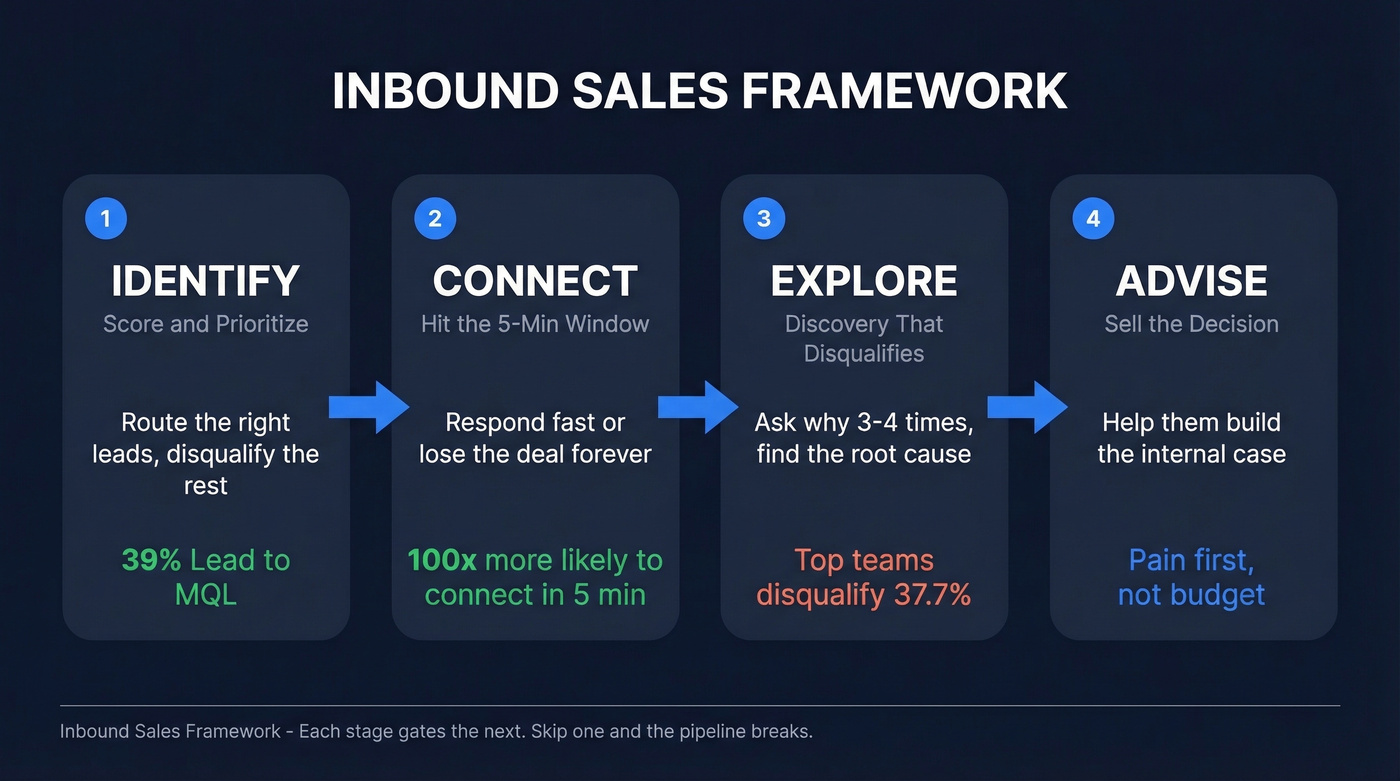
Not every form fill deserves a rep's time. First Page Sage's funnel data puts B2B SaaS Lead-to-MQL conversion at 39%, meaning over 60% of inbound leads aren't qualified. You need a scoring model that separates signal from noise before anyone picks up the phone.
| Signal | Points |
|---|---|
| Job title match | +10 |
| Company size >100 | +5 |
| Pricing page visit | +15 |
| Contact form submit | +20 |
| 3+ emails opened | +8 |
| Unsubscribed | -15 |
Threshold: score >50 = MQL. Anything below gets nurtured, not called.
A lot of inbound leads arrive with incomplete contact records - generic emails, missing phone numbers. When that happens, enrich instantly. Prospeo returns contact data on 83% of leads with 98% email accuracy, so your SDR isn't wasting the 5-minute window chasing a bounced address.

Connect - Hit the 5-Minute Window
Speed-to-lead is the single highest-leverage fix in your entire inbound operation. Responding within 5 minutes makes you 100x more likely to connect and 21x more likely to qualify versus waiting just one hour. That's not a marginal improvement. It's a different sport.
Set these SLAs and hold people to them:
- MQL to SDR touch: 15 minutes maximum
- SDR to AE handoff: within 24 hours
- AE to CS notification: same day on closed-won
One operational detail most guides skip: "Book a Demo" CTAs outperform "Request a Demo" in conversion rate. And form length matters less than field purpose - forms with 2 fields and forms with 13 fields both convert above 76% when every field serves a routing or qualification function. Cut vanity fields, keep routing fields.
If you're running HubSpot (~$9/seat/month) or Salesforce, automate the routing. Pair with Chili Piper (~$30/seat/month) or Calendly ($10/user/month) for instant booking.
Explore - Discovery That Disqualifies
Top-quartile inbound teams disqualify 37.7% of leads. Bottom quartile? Just 18.7%. We've seen this pattern repeatedly in our own work: if you're qualifying everything, you're qualifying nothing.
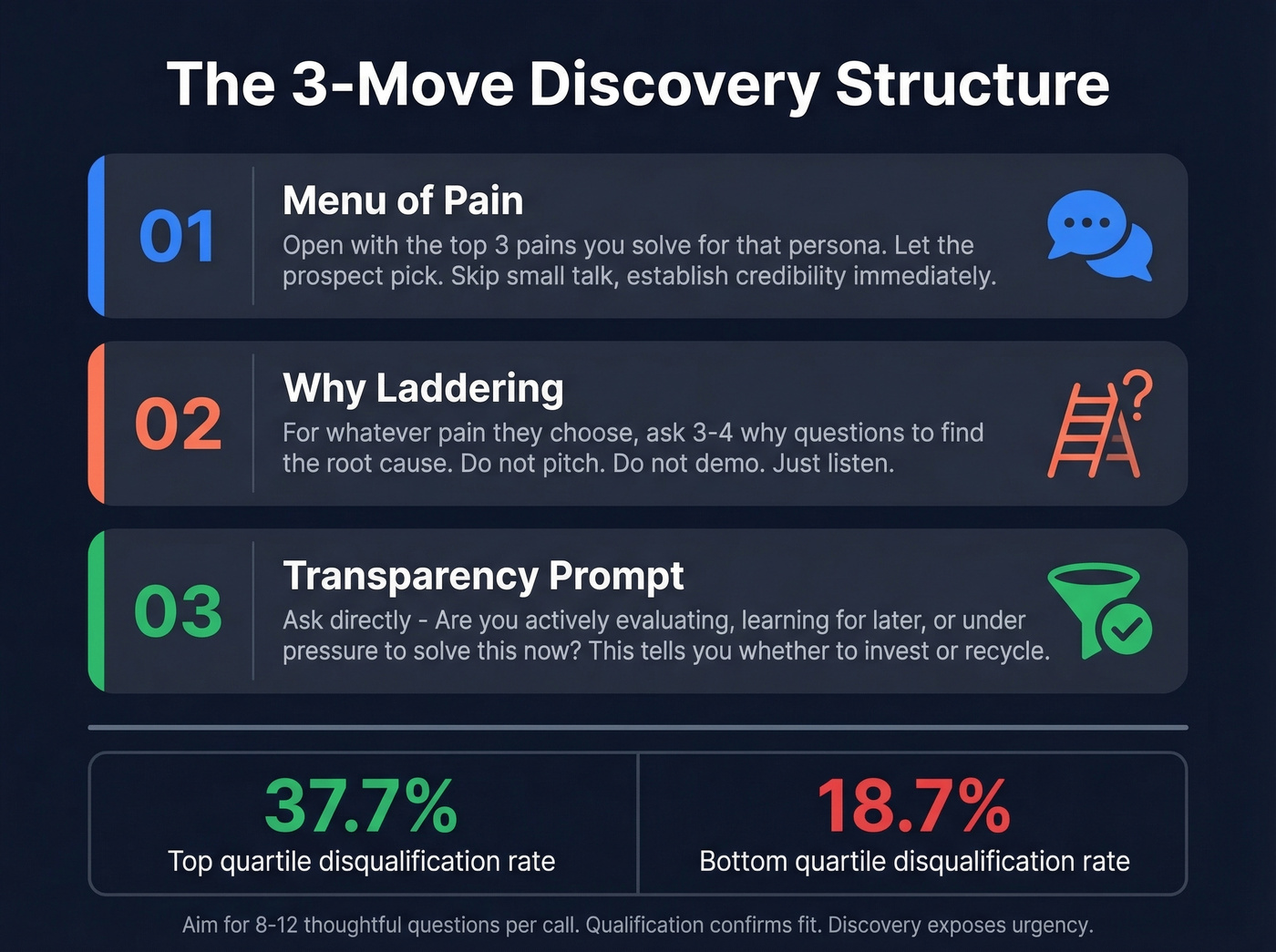
Structure discovery calls around three moves:
Menu of Pain. Open with the top 3 pains you solve for that persona and let the prospect pick. This skips small talk and establishes credibility immediately.
Why Laddering. For whatever pain they choose, ask 3-4 "why" questions to find the root cause. Don't pitch. Don't demo. Just listen.
Transparency Prompt. Ask directly: "Are you actively evaluating, learning for later, or under pressure to solve this now?" This single question tells you whether to invest or recycle the lead back to nurture.
Aim for 8-12 thoughtful questions per call. Qualification confirms fit. Discovery exposes urgency. You need both. If you want a tighter structure, use a discovery questions bank and standardize it across reps.
Advise - Sell the Decision
BANT works fine for outbound-heavy motions. For inbound, start with pain, not budget. The buyer already showed intent - your job is to help them build the internal case, not interrogate their procurement process.
Use a practitioner qualification framework: Requirements, Budget, Competition. Understand what they need and why, benchmark their budget range, then honestly assess whether you win against the alternatives they're considering. If you don't have strengths where they have requirements, disqualify early and save everyone's time.

Your 5-minute SLA means nothing if the email bounces. Prospeo enriches inbound leads with 98% verified emails and 50+ data points - so your SDR spends that critical window selling, not chasing bad contact records.
Stop burning your speed-to-lead advantage on bounced addresses.
Benchmarks That Actually Matter
| Stage | B2B SaaS Benchmark |
|---|---|
| Lead to MQL | 39% |
| MQL to SQL | 38% |
| SQL to Opportunity | 42% |
| SQL to Closed Won | 37% |
| Qualified to Booked | 62% (median) |
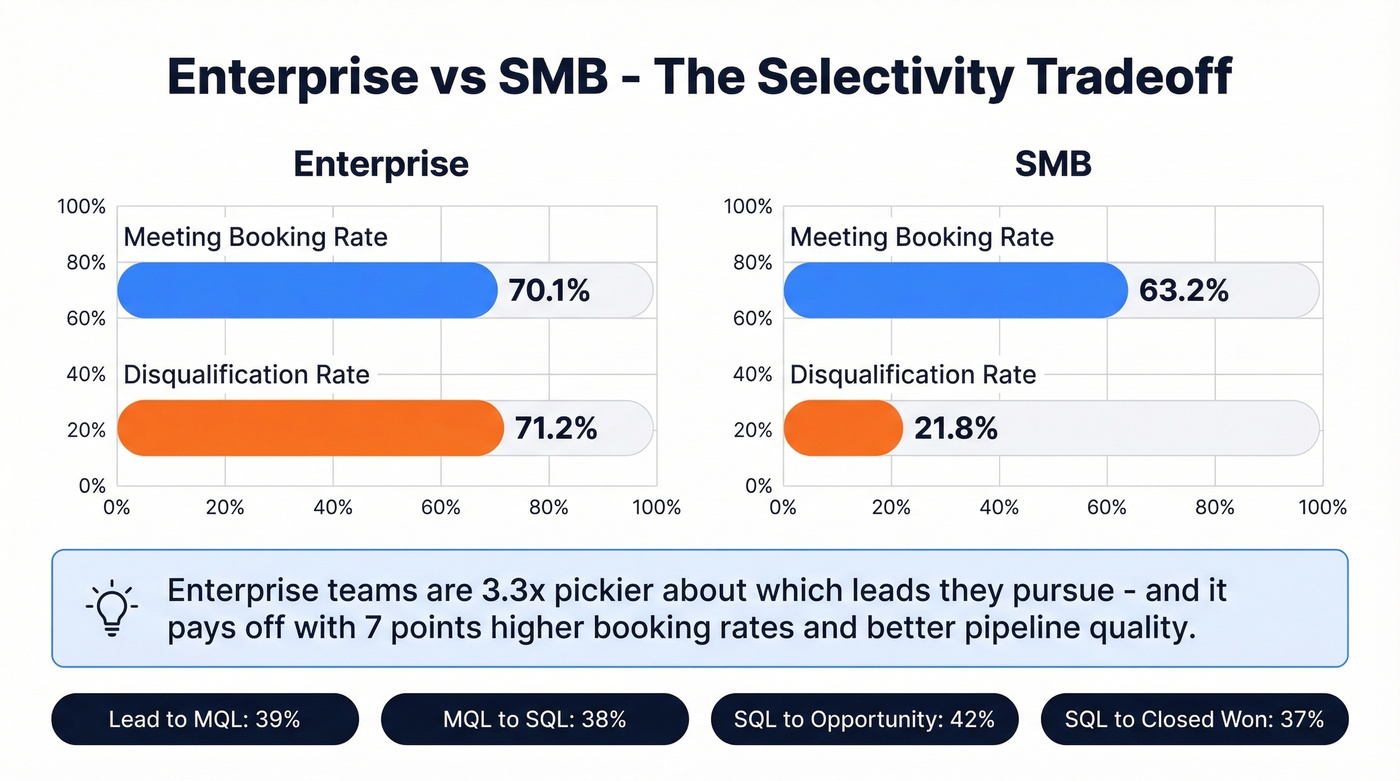
Enterprise teams book meetings at a 70.1% rate but disqualify 71.2% of leads. SMB teams book at 63.2% but only disqualify 21.8%. The lesson is clear: enterprise teams are pickier, and it pays off in pipeline quality and close rates.
At scale, expect visitor-to-demo request rates to fall under 1% once you're past 25K monthly visitors. That's normal. The fix isn't more traffic - it's better conversion infrastructure at every stage below the fold. Track it like a system with funnel metrics, not vibes.
Why Inbound Deals Die
Let's be honest about the failure modes, because we've watched teams repeat every one of these:
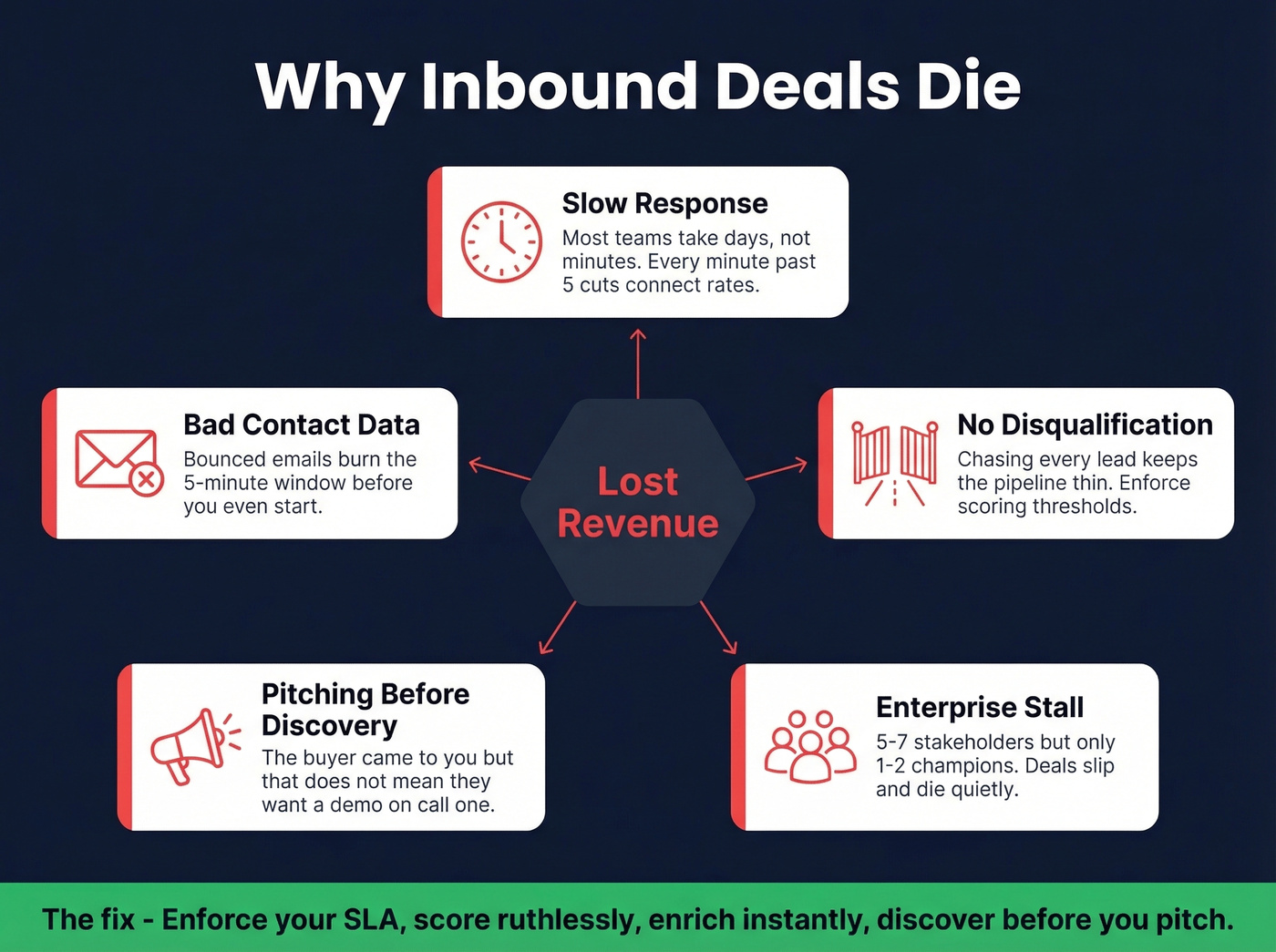
Slow response. Most teams take days, not minutes. Every minute past 5 cuts your connect rate dramatically.
No disqualification discipline. Reps chase every lead because pipeline feels thin. The pipeline stays thin because reps chase bad leads. It's a vicious cycle, and the only way out is enforcing scoring thresholds. (If this is a recurring issue, it usually shows up alongside broader sales pipeline challenges.)
Enterprise stall. As one enterprise AE described on r/sales, deals involve 5-7 stakeholders but only 1-2 champions - without broader alignment, deals slip quarter-to-quarter and die quietly. If your champion can't articulate the business case without you in the room, you haven't done enough discovery.
Pitching before discovering. The buyer came to you, but that doesn't mean they're ready for a demo on the first call. Use a consistent product demo checklist so demos happen after qualification, not instead of it.
Bad contact data. 45% of buyers now use AI tools during purchase research, which means they're moving faster than ever. If your enrichment returns a bounced email, the 5-minute window is already gone before you start. Monitor your email bounce rate and fix the root cause, not just the symptom.
Half of inbound leads arrive with incomplete data - missing direct dials, generic emails, wrong titles. Prospeo fills the gaps on 83% of records at $0.01/email, giving your reps the context they need for discovery calls that actually disqualify.
Turn every qualified form fill into a complete, callable contact record.
FAQ
What's the difference between inbound and outbound sales?
Inbound responds to buyers who've already shown intent - form fills, demo requests, content downloads. Outbound initiates contact cold. Inbound converts at higher rates (39% Lead-to-MQL vs roughly 2% cold outbound) but requires sustained content investment to generate volume.
How fast should you respond to an inbound lead?
Within 5 minutes. Responding in 5 minutes versus 1 hour makes you 100x more likely to connect. Set your SLA at MQL-to-SDR touch in 15 minutes maximum, and measure compliance weekly.
What tools do you need for inbound lead management?
At minimum: a CRM like HubSpot or Salesforce, a data enrichment tool to fill gaps in lead records before reps reach out, and a scheduling tool like Chili Piper or Calendly for instant booking. The stack matters less than the speed-to-lead SLA you enforce.