

Inbound vs Outbound Sales Strategy: How to Actually Decide Your Mix
The standard advice on your inbound vs outbound sales strategy is "do both." That's not wrong, but it's useless. The real question isn't which motion to pick - it's how to weight the mix based on your deal size, your buyer's behavior, and the team you've actually got.
Quick Verdict
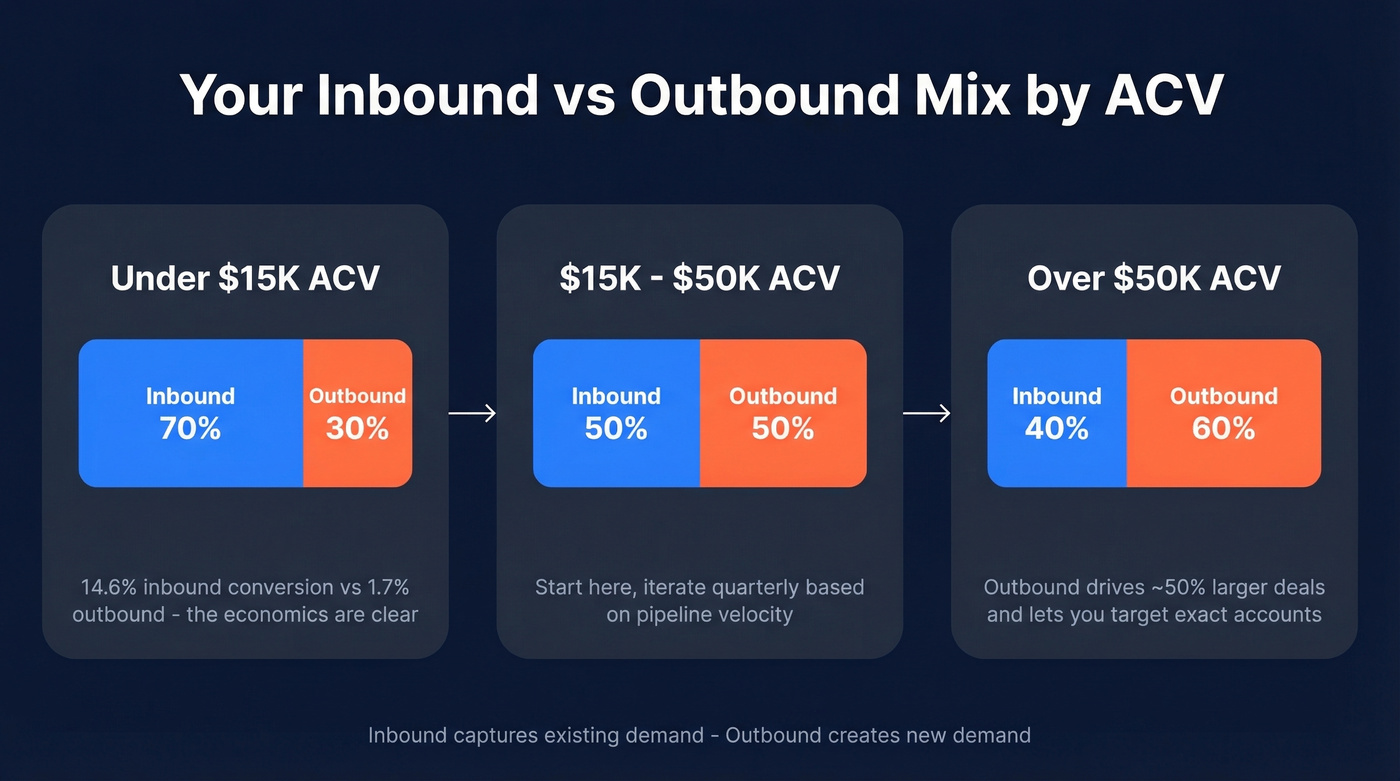
- Under $15K ACV: Go inbound-heavy, roughly 70/30. Inbound leads convert at 14.6% vs 1.7% for outbound, and the economics don't support an expensive SDR motion at this price point.
- Over $50K ACV: Go outbound-heavy, roughly 60/40. Outbound generates ~50% larger deal sizes and lets you target exact accounts.
- $15K-$50K: Start at 50/50 and iterate quarterly based on pipeline velocity.
The Real Difference
Inbound captures existing demand. Outbound creates new demand. That single distinction drives everything - cost structure, conversion rates, speed, and scalability. Inbound compounds over time like a content flywheel; outbound can deliver pipeline in days but requires constant fuel.
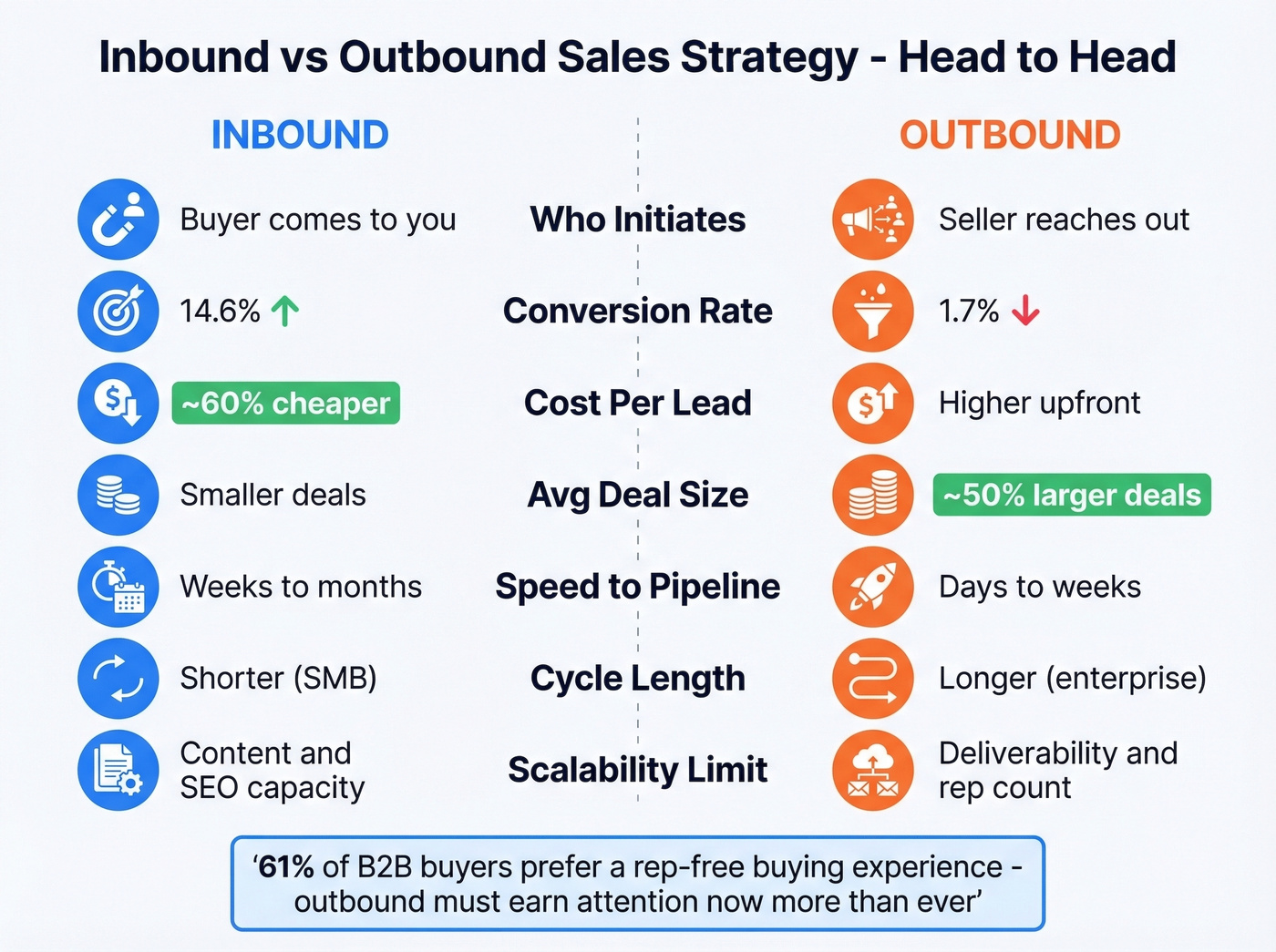
| Dimension | Inbound | Outbound |
|---|---|---|
| Who initiates | Buyer | Seller |
| Conversion rate | ~14.6% | ~1.7% |
| Cost per lead | ~60% cheaper | Higher upfront |
| Avg deal size | Smaller | ~50% larger |
| Speed to pipeline | Weeks to months | Days to weeks |
| Typical cycle length | Shorter (SMB) | Longer (mid-market & enterprise) |
| Scalability limit | Content/SEO capacity | Deliverability + reps |
One stat reframes the whole debate: 61% of B2B buyers prefer a rep-free buying experience. Outbound isn't dead, but it has to earn attention in a way it didn't ten years ago. Understanding the core mechanics of each motion is what separates teams that scale from teams that stall.
When to Lean Inbound or Outbound
Deal size is the biggest lever, but not the only one. Here's the decision matrix we walk teams through:
| Variable | Lean Inbound | Lean Outbound |
|---|---|---|
| ACV | Under $15K | Over $50K |
| Team size | Small team, no dedicated SDRs | 2+ SDRs or outsourced BDR agency |
| Market maturity | Buyers already search for your category | New category or new market entry |
| Buyer behavior | Self-serve research, short cycle | Committee buying, longer cycle |
If you're in a category buyers already search for, inbound captures that intent efficiently. Creating a new category? Outbound is the only way to generate pipeline fast.
Here's the thing: most teams with deals under $30K shouldn't hire SDRs at all. The math just doesn't work. SDRs are expensive, they take months to ramp, and outbound converts at ~1.7%. Put that budget into content and paid search instead - you'll build a compounding asset rather than a recurring cost center.
But inbound has a blind spot. One sales leader we spoke with described waiting five years for two dream accounts to fill out an inbound form. They never did. Outbound lets you target those accounts tomorrow morning. The consensus on r/sales lines up: any serious tech company should generate around 75% of leads through inbound, SDRs, and partners combined - pure cold outreach alone won't land enterprise accounts.

Outbound converts at 1.7% - which means your targeting and data quality carry the entire motion. Prospeo gives you 30+ filters (intent, technographics, job changes, funding) to nail your ICP, then delivers 98% accurate emails on a 7-day refresh cycle. Meritt tripled their pipeline from $100K to $300K/week and cut bounces from 35% to under 4%.
Stop burning your sender reputation on stale data.
How Outbound Works in 2026
The Predictable Revenue playbook - hire SDRs, blast 200 emails a day - is dead. Volume-based prospecting burns bridges because buyers are saturated. Modern outbound runs on signals.
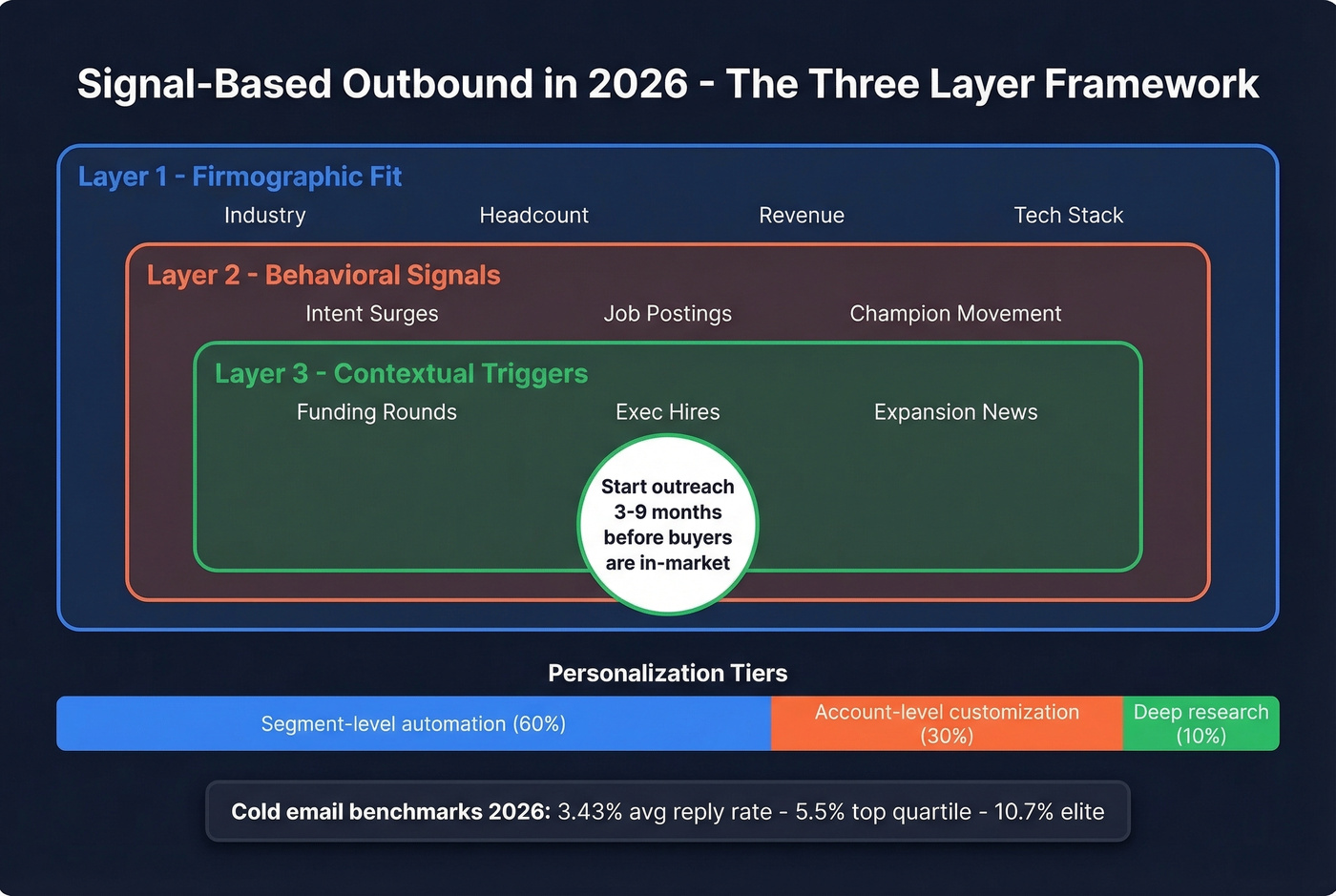
Signal-based ICP targeting works in three layers. First, firmographic fit: industry, headcount, revenue, tech stack. Second, behavioral signals like intent surges, job postings, and champion movement. Third, contextual triggers - funding rounds, exec hires, expansion announcements. The best teams start outreach 3-9 months before buyers are in-market, building familiarity before the buying window opens. Relevance beats personalization every time; a perfectly personalized message about the wrong problem gets deleted just as fast as a generic blast.
Personalization follows a tiered model. About 60% of your sequences get segment-level automation, 30% get account-level customization, and only the top 10% warrant deep research. Multichannel sequences combining email, phone, and professional social touches drive 40%+ better engagement than email alone.
Cold email benchmarks for 2026: 3.43% average reply rate, 5.5% top quartile, 10.7% elite. If you're below 3%, your targeting or messaging needs work - not your volume.

Deliverability Is the Gatekeeper
None of this works if your emails don't land. SPF, DKIM, and DMARC authentication are table stakes. Spam complaints need to stay under 0.3%, bounces under 2%. New domains should start at 5-10 emails per day and ramp over 4-6 weeks. CAN-SPAM penalties run $51,744-$53,088 per non-compliant message.
Bad data is one of the biggest reasons outbound fails. Bounced emails damage sender reputation, which tanks deliverability, which kills your entire outbound motion - a cascade failure that starts with one bad list. We've seen this pattern repeatedly: a team invests in great copy and careful targeting, then loads a purchased list with 15% bounces and wonders why replies dry up within two weeks.
Prospeo's database covers 300M+ profiles with 98% email accuracy on a 7-day refresh cycle, and that weekly refresh matters because stale data is bounced data. Meritt's bounce rate dropped from 35% to under 4% after switching, and their pipeline tripled from $100K to $300K per week. At roughly $0.01 per email with no contracts, it's a fraction of what enterprise platforms typically cost.
How Inbound Works in 2026
Inbound follows four stages: identify prospects showing intent signals, connect with context, explore their problem, and advise on a solution. The buyer's questions decide the stage - not your sales process.
Speed matters more than most teams realize. Contacting an inbound lead within 5 minutes increases conversion by up to 9x. Yet most teams route leads through lead scoring models and round-robin assignment that adds hours of latency. That's a massive, fixable leak.
The inbound signals that actually predict buying intent are pricing page visits, repeat visits within a short window, and demo requests. Blog traffic and ebook downloads are top-of-funnel noise. Don't treat them the same - a pricing page visit from a VP of Sales at a 200-person SaaS company is worth more than 50 whitepaper downloads from students.
The Hybrid Playbook
Hybrid teams see 38% higher revenue growth than single-motion teams. But most hybrid implementations fail for predictable reasons.
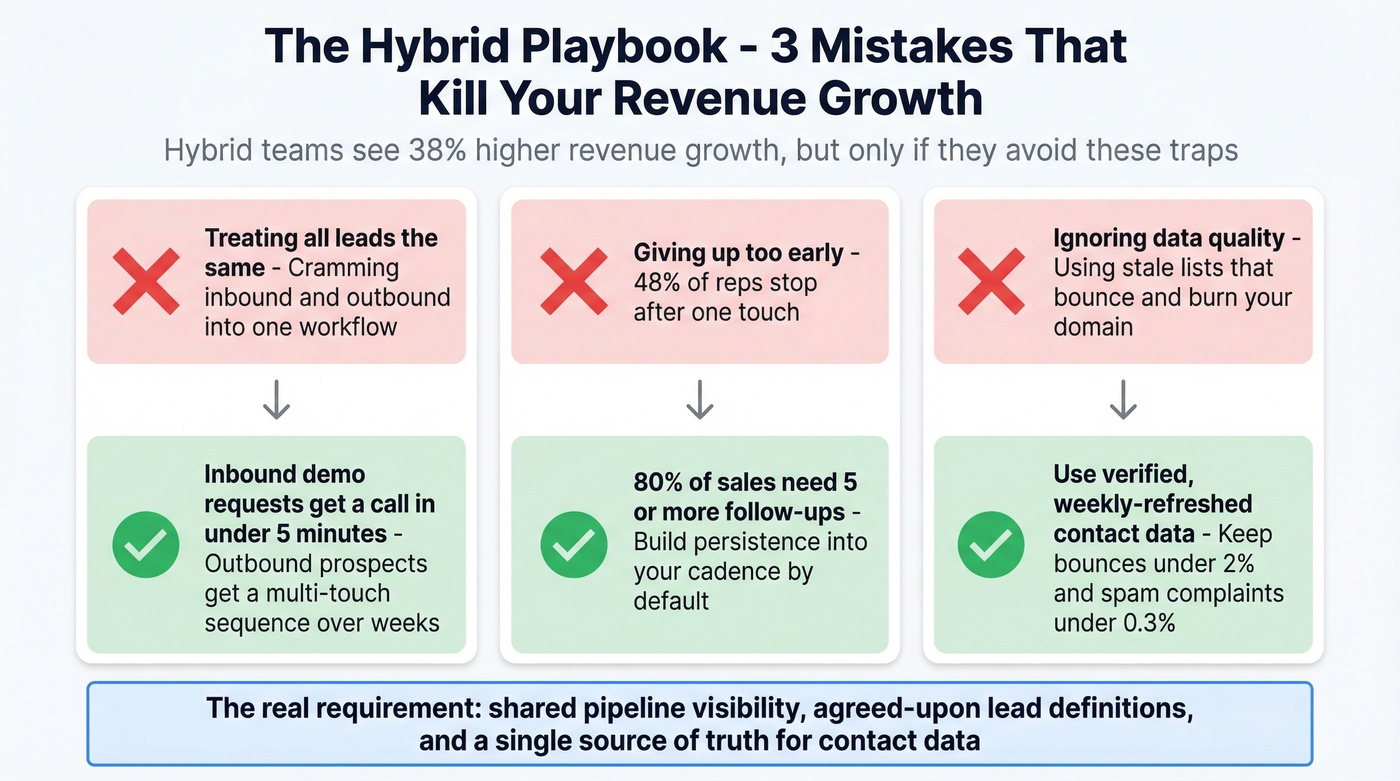
Mistake #1: Treating inbound and outbound leads identically. An inbound demo request needs a call within minutes. An outbound prospect who's never heard of you needs a multi-touch sequence over weeks. Different cadences, different messaging, different expectations. Cramming both into the same workflow guarantees you'll botch at least one.
Mistake #2: Giving up too early. 48% of reps stop after one touch, while 80% of sales require 5+ follow-ups. One AE on r/techsales described their BDR team as not having "given me a single lead this entire year." That's not a BDR problem - it's a process and persistence problem. (If you need a system, start with proven sales follow-up templates.)
Mistake #3: Ignoring data quality. Your hybrid engine is only as good as the contact data feeding it. Verified, weekly-refreshed emails keep your outbound sequences from burning your domain while your inbound motion builds credibility. Skip this if you enjoy explaining to your CEO why your domain got blacklisted.
Let's be honest about what makes hybrid work in practice: it's not a strategy deck, it's operational discipline. Inbound and outbound teams need shared pipeline visibility, agreed-upon lead definitions, and a single source of truth for contact data. Without that, you've got two teams working in parallel who occasionally step on each other's toes.
If you want to operationalize the outbound side, start with a clear ideal customer profile, then standardize your sales prospecting techniques and tooling (a modern SDR stack helps more than another “spray and pray” list).
Whether you're running 60/40 outbound or 70/30 inbound, the outbound portion lives or dies on deliverability. Bad data cascades into bounces, spam flags, and dead domains. Prospeo's 300M+ profiles are verified through a 5-step process and refreshed every 7 days - not the 6-week industry average. At ~$0.01 per email with no contracts, it costs less than one bounced opportunity.
Get enterprise-grade data without the enterprise contract.
FAQ
Is inbound or outbound better for B2B SaaS?
Neither alone - hybrid teams see 38% higher revenue growth. Lean inbound when deals are under $15K ACV; lean outbound when deals exceed $50K. Conversion rates and deal sizes favor different motions at different price points, so the right blend depends on your go-to-market maturity and how many reps you can actually support.
What's a good cold email reply rate in 2026?
Average is 3.43%, top quartile hits 5.5%, and elite performers exceed 10.7%. Signal-based outreach using intent data and verified contacts routinely drives 2-3x higher reply rates than batch-and-blast campaigns.
How do you run outbound without burning your domain?
Keep bounce rates under 2% and spam complaints under 0.3%. Authenticate with SPF/DKIM/DMARC, warm new domains at 5-10 emails per day for 4-6 weeks, and use verified contact data refreshed weekly. Stale lists are the number one domain killer we see across teams.
When should a team shift its inbound-outbound ratio?
There's rarely a clean switch. Most teams shift budget and headcount gradually as deal sizes grow or market conditions change. If your ACV climbs past $50K and inbound volume can't fill the pipeline, start layering in outbound motions while keeping your content engine running. Review quarterly, not annually.