

The Best Inbox Placement Tools in 2026 - And the 3 You Actually Need
53% of senders measure deliverability using delivery rate. The problem? 88% of them can't even define what delivery rate means. Only 13% use actual inbox placement tools - the kind that tell you whether your emails land in the inbox or vanish into spam.
One sender on r/coldemail reported placement dropping from 55-60% to 35% after the Google/Yahoo authentication changes, despite having SPF, DKIM, and DMARC configured and bounce rates under 3%. The right testing tools existed. They just weren't using them.
Our Picks
You don't need six tools. You need three:
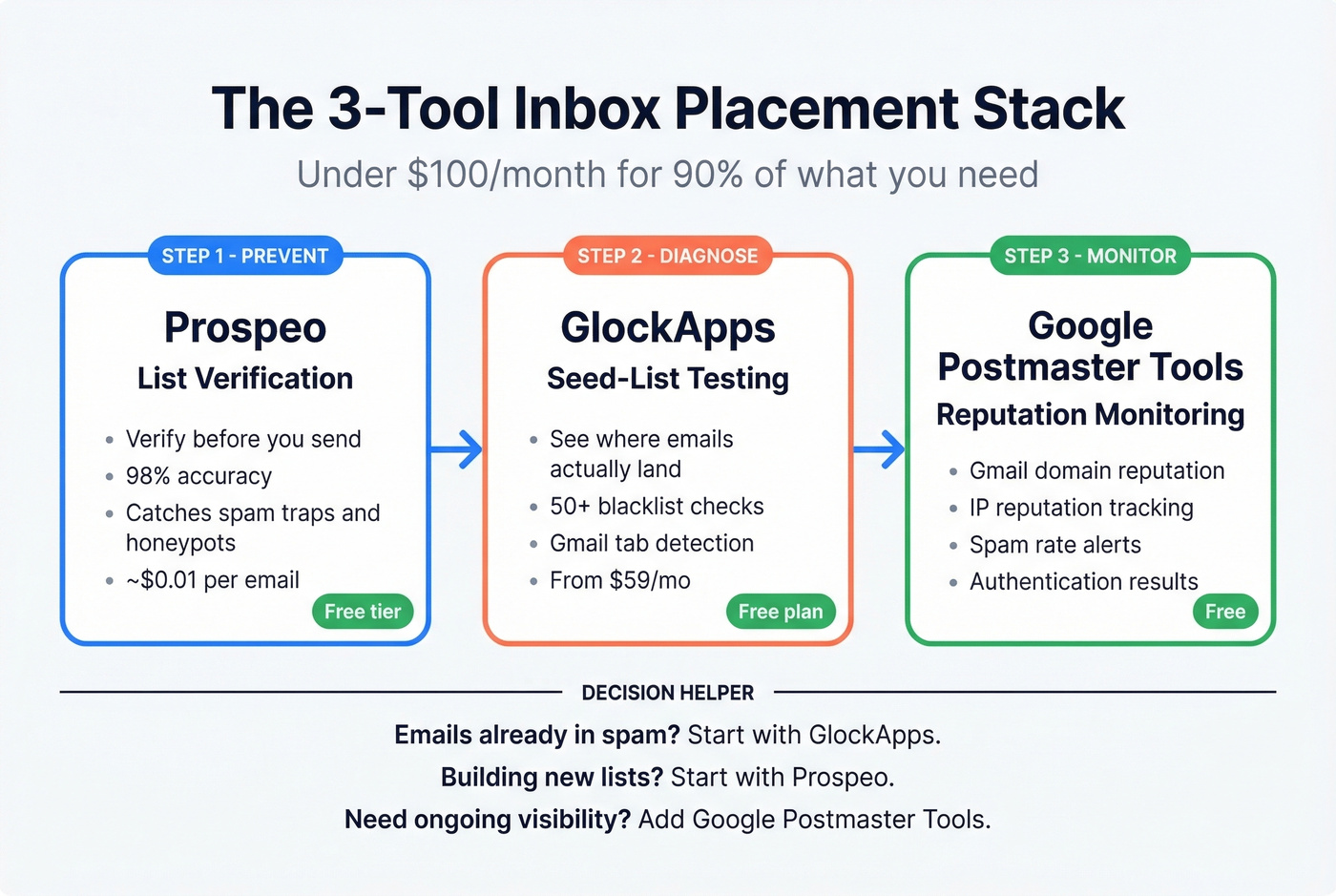
- Prospeo - Verify your list before you send. Prevents the problem upstream. Free tier, ~$0.01/email.
- GlockApps - Seed-list placement testing. Measures where emails actually land. Free plan; paid plans from $59-$99/mo.
- Google Postmaster Tools - Ongoing Gmail reputation monitoring. Free.
For many small senders, this comes in under $100/month plus verification usage and covers 90% of what you need.
If your emails are already landing in spam, start with GlockApps to diagnose. Building new lists? Start with Prospeo to prevent the damage before it happens. Need ongoing monitoring? Add Google Postmaster Tools.
What "Inbox Placement" Actually Means
Delivery rate and inbox placement rate aren't the same thing. Delivery rate counts every email accepted by the receiving server - including those routed straight to spam. A 95% delivery rate can easily hide a 70% inbox placement rate.
If you want the full context, start with an email deliverability guide before you obsess over tool dashboards.
Inbox Placement Rate = (Messages in Inbox / Messages Delivered) x 100
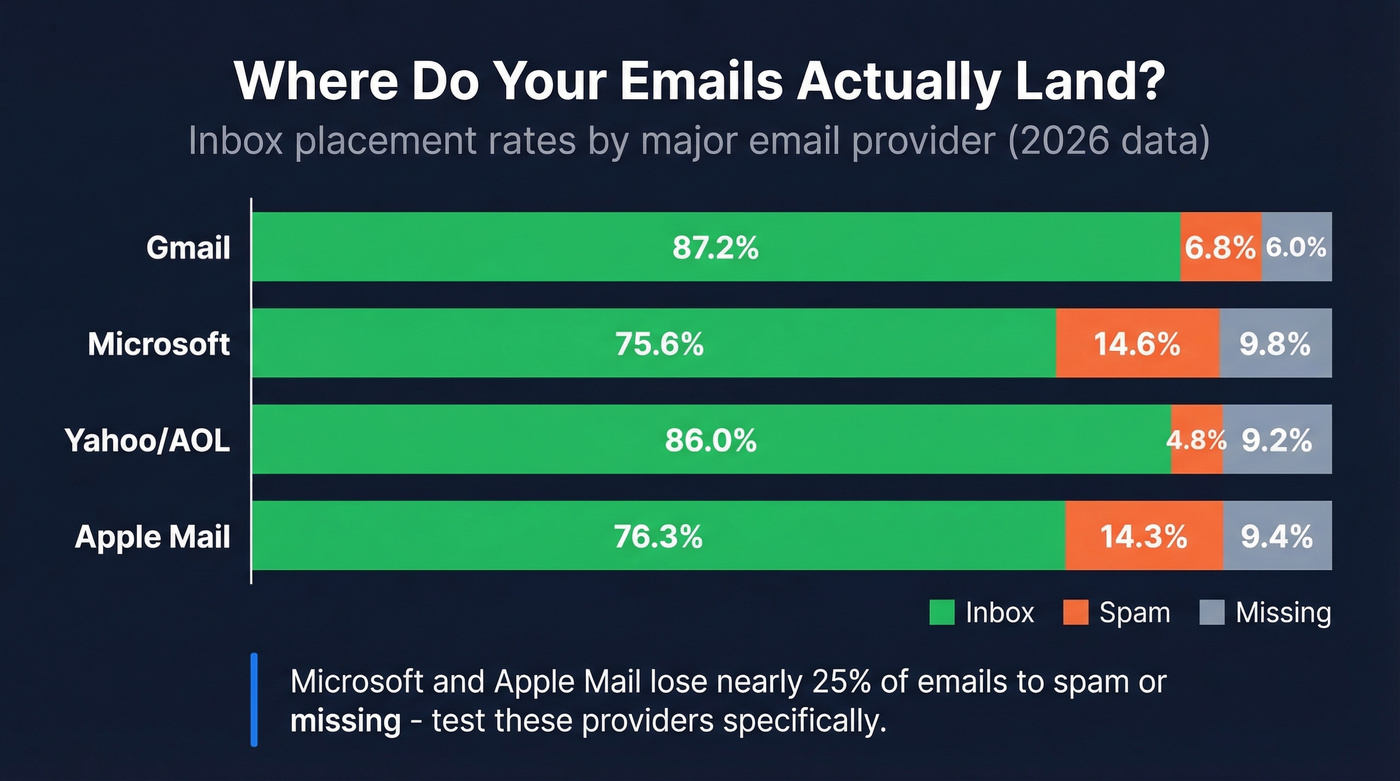
Here's how the major providers stack up, based on Validity and Litmus data:
| Provider | Inbox | Spam | Missing |
|---|---|---|---|
| Gmail | 87.2% | 6.8% | 6.0% |
| Microsoft | 75.6% | 14.6% | 9.8% |
| Yahoo/AOL | 86.0% | 4.8% | 9.2% |
| Apple Mail | 76.3% | 14.3% | 9.4% |
Microsoft and Apple are where emails go to die. One more number worth knowing: Google and Yahoo now enforce a 0.3% spam complaint threshold. Exceed it and your placement craters regardless of authentication.
If you're seeing unexplained drops, it’s usually a sender reputation issue - and you’ll want a plan for how to improve sender reputation before you scale volume.

Bad data is the #1 cause of inbox placement drops. Prospeo's 5-step verification catches spam traps, honeypots, and invalid addresses before they torch your sender reputation - with 98% accuracy and a 7-day refresh cycle.
Fix placement upstream for ~$0.01 per email. No contracts.
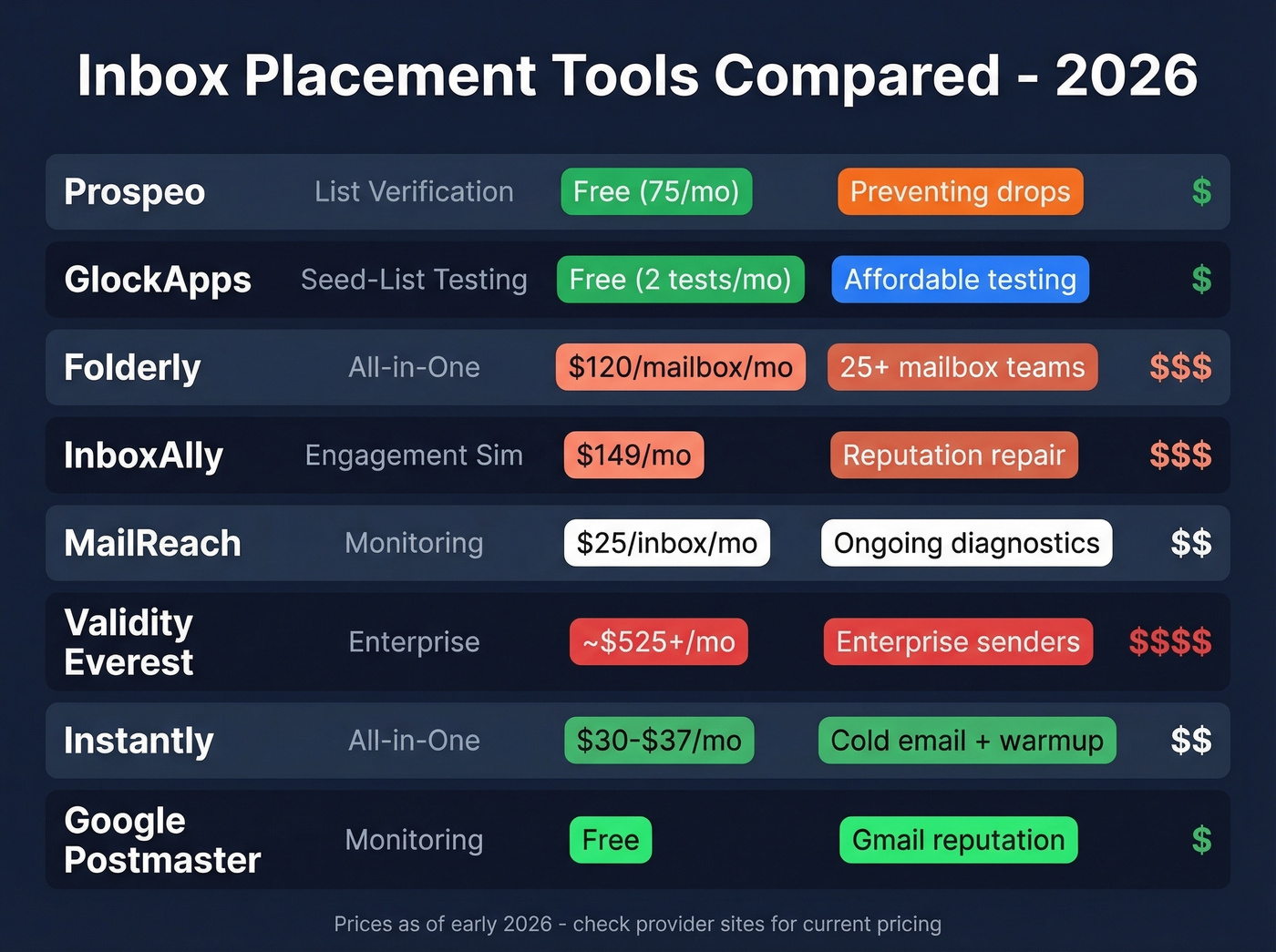
Top Email Placement Tools Compared
| Tool | Category | Starting Price | Best For | G2 Rating |
|---|---|---|---|---|
| Prospeo | List Verification | Free (75/mo) | Preventing placement drops | - |
| GlockApps | Seed-List Testing | Free (2 tests/mo) | Affordable placement testing | 4.1/5 (26) |
| Folderly | All-in-One | From $120/mailbox/mo | 25+ mailbox teams | 4.8/5 (101) |
| InboxAlly | Engagement Sim | $149/mo | Reputation repair | 4.7/5 |
| MailReach | Monitoring | $25/inbox/mo | Ongoing diagnostics | - |
| Validity Everest | Enterprise Platform | ~$525/mo | Enterprise senders | - |
| Instantly | All-in-One | $30-$37/mo | Cold email + warmup | - |
| Google Postmaster | Monitoring | Free | Gmail reputation | - |
Prospeo - Verify Before You Send
Most placement testing tools measure symptoms. Prospeo prevents the cause.
Sending to invalid addresses, spam traps, honeypots tanks your sender reputation - and once reputation drops, no amount of warmup fixes it quickly. The 5-step verification process delivers 98% email accuracy, catches invalid addresses, handles catch-all domains, and strips spam traps and honeypots before they touch your sending infrastructure. Records refresh every 7 days, which is critical for catching addresses that go stale between campaigns.
If you’re troubleshooting bounces alongside placement, use an email bounce rate benchmark + fix list hygiene first.
Use Prospeo if you're running outbound at any scale and want to eliminate list quality as a variable. Stack Optimize built their agency to $1M ARR using Prospeo's verification, maintaining 94%+ deliverability, bounce rates under 3%, and zero domain flags across all clients.
The free tier gives you 75 email verifications per month. Paid plans run ~$0.01 per email with no contracts. For a 10,000-contact list, that's roughly $100 to verify everything - less than one month of most tools on this list.
If you’re comparing verifiers, start with our breakdown of Bouncer alternatives.
GlockApps - The Seed-Testing Standard
GlockApps is the tool most practitioners reach for when they need to know where emails are landing. It sends to a seed list of around 100 mailboxes across major providers and shows you inbox/spam/tabs placement plus "missing" where messages don't arrive at all. Reddit threads on r/coldemail consistently recommend it as the go-to for affordable placement checks.
Pros:
- Checks against 50+ blacklists in every test
- Detects Gmail Primary vs. Promotions tab placement
- Covers country-specific providers like GMX and Web.de alongside the big four
- Free plan includes 2 tests/month - enough for monthly spot checks
- Users consistently praise the detailed, actionable reports
Cons:
- Seed list is ~100 mailboxes - don't over-interpret small sample results
- Some ESPs block seed list uploads, limiting testing for certain setups
- Pricing varies by plan: Essential commonly shown at $59/month, some listings show $85/month
- Customer support gets mixed reviews
Here's the thing: GlockApps tells you what's happening. It doesn't fix anything. Pair it with list verification upstream and you've got both diagnosis and prevention.
If you need a second opinion beyond seed tests, add an email spam checker to your workflow.

Folderly - Powerful but Overpriced
Use Folderly if you're managing 25+ mailboxes and need an all-in-one warmup, monitoring, and placement testing platform. The 4.8/5 rating across 101 reviews is strong for a reason - the product works.
Skip Folderly if you're running fewer than 10 mailboxes. At $120/mailbox/month for 1-9 mailboxes, you're paying more than GlockApps + list verification + MailReach combined. The price drops to $50/mailbox at 100-499 mailboxes, which is where the economics start making sense. Watch out for the "$64/month" figure floating around - that refers to a limited plan or add-on, not the 1-9 mailbox pricing tier. The seed list covers only four ESPs: Google Workspace, Microsoft 365, Gmail, and Outlook. Users have also flagged weekend warmup timing issues causing Monday deliverability dips.
If you’re scaling volume, make sure you understand email velocity limits before you blame the tool.
InboxAlly - Engagement Simulation
InboxAlly takes a different approach: instead of testing placement, it tries to improve it by simulating real engagement. Their network of seed accounts opens your emails, replies, and marks them as "not spam" - training ISP filters to trust your sending domain.
It works. For a while.
But genuine reputation building typically takes 4-8 weeks of real engagement. Simulated engagement is a band-aid, not a cure. If you stop paying, the signals stop, and placement can regress. Pricing starts at $149/mo for Starter and climbs to $1,190/mo for Premium. There's a 10-day free trial if you want to test the effect.
Real talk: if your average deal size sits below five figures and you're spending $149+/month on engagement simulation, the math doesn't work. Fix your list quality and authentication first - those are free or nearly free.
If you’re doing cold outbound, pair deliverability work with a solid B2B cold email sequence so engagement signals are real.
MailReach - Monitoring & Diagnostics
MailReach is the practitioner's favorite for ongoing monitoring. At $25/month per inbox, it runs continuous diagnostics on your sending reputation and flags problems before they become crises. You also get 3 free spam tests per day, and their pay-as-you-go option runs ~$9.60 for 25 tests. We've found MailReach pairs well with a dedicated seed tester like GlockApps - use MailReach for daily monitoring, GlockApps for periodic deep checks.
Validity Everest, Instantly & Google Postmaster Tools
Validity Everest is the enterprise play. Their inbox placement insights are thorough, but you're looking at Elements Plus starting around $525+/month, with full platform contracts running well into five figures annually. If you have to ask the price, you're probably not the target buyer.
Instantly bundles warmup, sending, and basic placement testing into an all-in-one cold email platform starting around $30-$37/mo depending on tier and billing. Placement testing lives in higher tiers, but for teams already using Instantly for outbound, it's a convenient add-on. Mailgun/Sinch is another option worth mentioning, but one sender reported a $30K overage invoice after contract end - vet billing terms carefully.
Google Postmaster Tools is free and essential. Every sender should have it configured. It shows Gmail-specific reputation data: domain reputation, IP reputation, spam rate, authentication results. It won't tell you about Outlook or Yahoo, but for Gmail, it's the ground truth.
If you want more options in this category, see our roundup of email reputation tools.
How to Read Seed-Test Results
Seed tests are useful, but they're also easy to over-trust. The Certified Senders Alliance puts it bluntly: modern filtering relies heavily on engagement signals like opens, clicks, replies, and complaints. Seed addresses don't generate any of those, so filters treat them differently. Results are directional, not absolute.
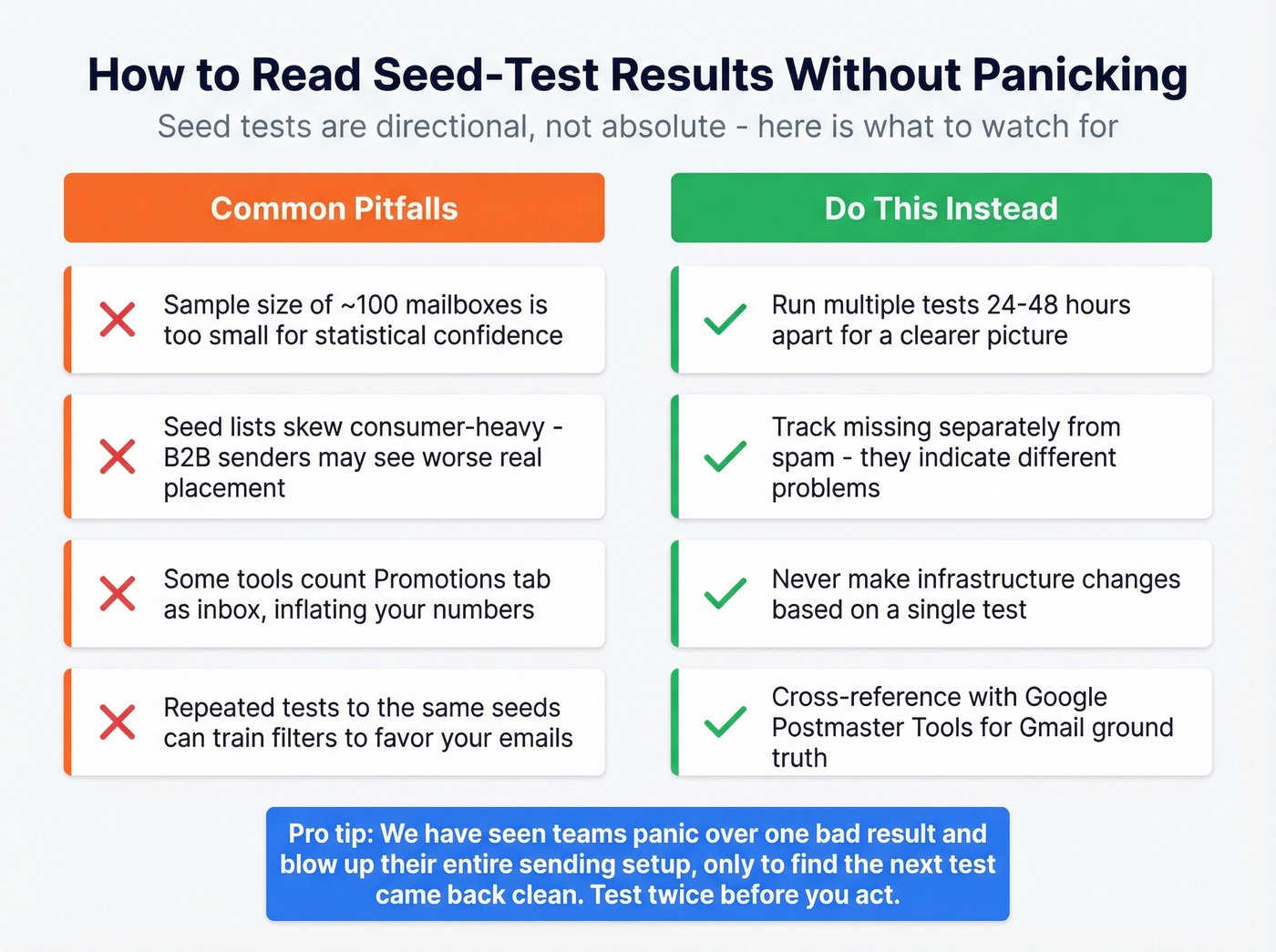
A few things that skew seed-test data:
- Sample sizes of ~100 mailboxes are too small for statistical confidence
- Your seed provider mix may not match your actual audience - if you're a B2B sender, most seed lists skew consumer-heavy, so your actual placement may be lower than results suggest
- Some tools count Promotions tab as "inbox," inflating your numbers
- Repeated tests to the same seeds can train filters to favor your test emails
In our experience, testing multiple times 24-48 hours apart gives a much clearer picture. Track "missing" separately from "spam" - they indicate different problems. And never make a major infrastructure change based on a single seed test. Let's be honest: we've seen teams panic over one bad GlockApps result and blow up their entire sending setup, only to find the next test came back clean.
If you’re tightening your copy to improve engagement (and placement), pull from these cold email subject line examples.
Stack Optimize maintained 94%+ deliverability and zero domain flags across every client - all built on Prospeo-verified lists. When your bounce rate stays under 3%, inbox placement takes care of itself.
Stop diagnosing placement problems. Prevent them with clean data.
FAQ
What is inbox placement rate?
Inbox placement rate measures the percentage of delivered emails that reach the primary inbox - not just the server. The formula: (messages in inbox / messages delivered) x 100. A 95% delivery rate can mask a 70% placement rate because spam-folder delivery still counts as "delivered." The global average sits around 84%.
How often should I test inbox placement?
Monthly testing works for steady-state senders with stable infrastructure. Switch to weekly during warmup periods, after domain or IP changes, or when you notice deliverability drops. Between formal seed tests, keep Google Postmaster Tools running for continuous Gmail reputation monitoring - it's free and catches problems early.
Can email verification improve inbox placement?
Yes. Sending to invalid addresses, spam traps, and honeypots directly damages sender reputation, which tanks placement rates. Clean lists are the single highest-leverage fix. Prospeo's 5-step verification catches catch-all domains, spam traps, and honeypots at ~$0.01/email. Stack Optimize maintains 94%+ deliverability across all clients by verifying every list before sending.
What's the best free tool for monitoring placement?
Google Postmaster Tools is the best free option for Gmail-specific reputation data - domain reputation, spam rate, and authentication status. GlockApps also offers a free plan with 2 seed-list tests per month, and Prospeo provides 75 free email verifications monthly to keep lists clean upstream.