

How to Build an Incentive Program for Your Sales Team (With Real Numbers)
It's Q3 and your team is sitting at 68% of annual target. You're not alone - only 43% of reps hit quota industry-wide last year, and 76.6% missed targets that had already been lowered. The VP of Sales wants to "run a SPIF" to close the gap. The CFO wants to know why you're spending more money when the existing comp plan should be enough. And you're stuck in the middle, knowing that throwing $500 gift cards at the problem won't fix broken quotas - but also knowing that the right incentive structure genuinely moves numbers.
Here's the playbook, with actual dollar figures, research-backed frameworks, and the tax rules nobody bothers to mention.
Three Principles Before You Design Anything
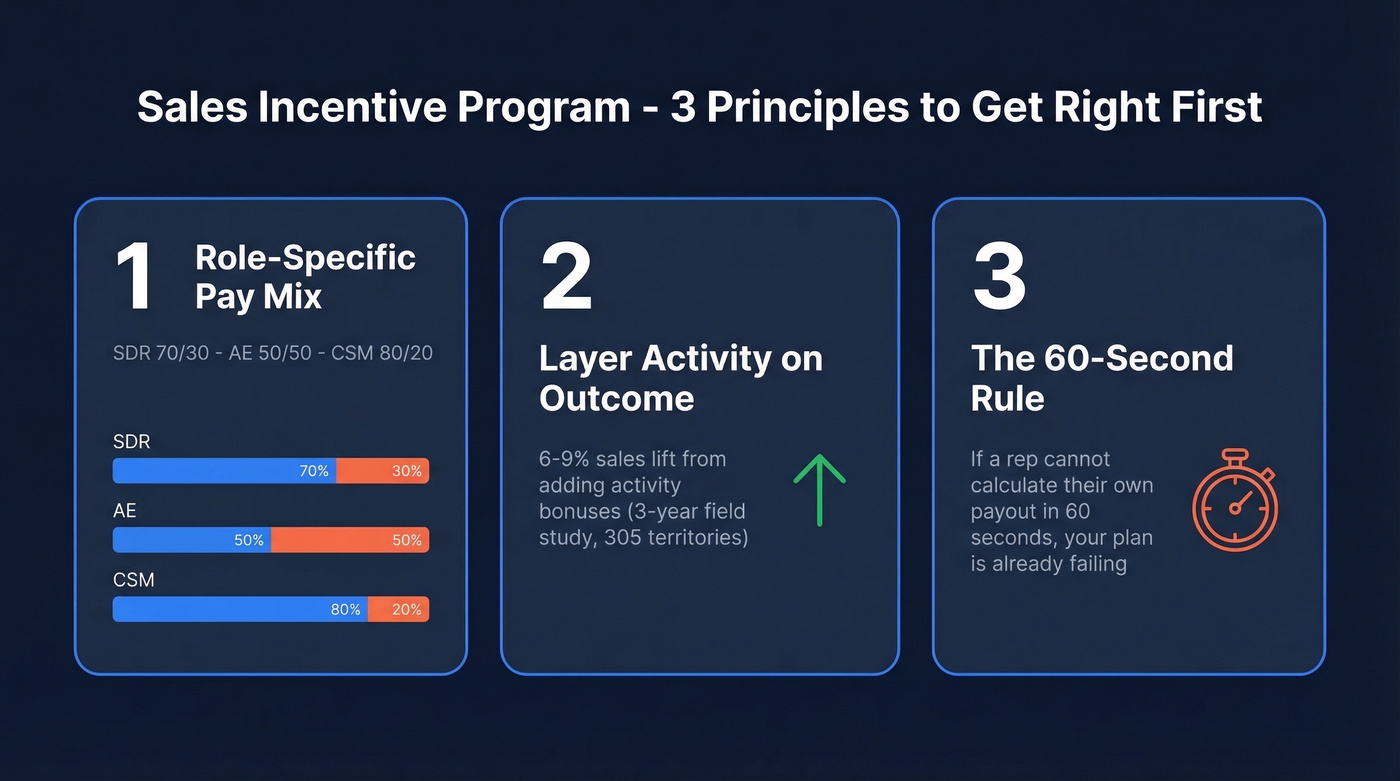
- Set role-specific pay mix ratios - SDR 70/30, AE 50/50, CSM 80/20. One plan for everyone is a plan for no one.
- Layer activity-based incentives on top of outcome-based comp. A three-year field study across 305 sales territories showed a 6-9% sales lift from adding modest activity bonuses.
- Keep it simple enough that any rep can calculate their own payout in 60 seconds. If they can't, your plan is already failing.
What Is a Sales Incentive Program?
Your compensation plan - base salary plus commission - is the foundation. It's what reps expect. An incentive program is everything you layer on top to drive specific behaviors or outcomes beyond standard quota attainment.
SPIFs are short-term performance bonuses targeting a specific product or behavior, often run as 1-4 week blitzes. Contests pit teams or individuals against each other with defined prizes. Accelerators bump commission rates above quota. Non-cash rewards include President's Club trips, extra PTO, and professional development stipends. The best programs blend cash and non-cash, activity-based and outcome-based, individual and team - picking just one is how you end up with a structure that motivates a third of your floor and bores the rest.
Why Most Sales Incentive Programs Fail
Before you design anything, understand the five ways these programs die.
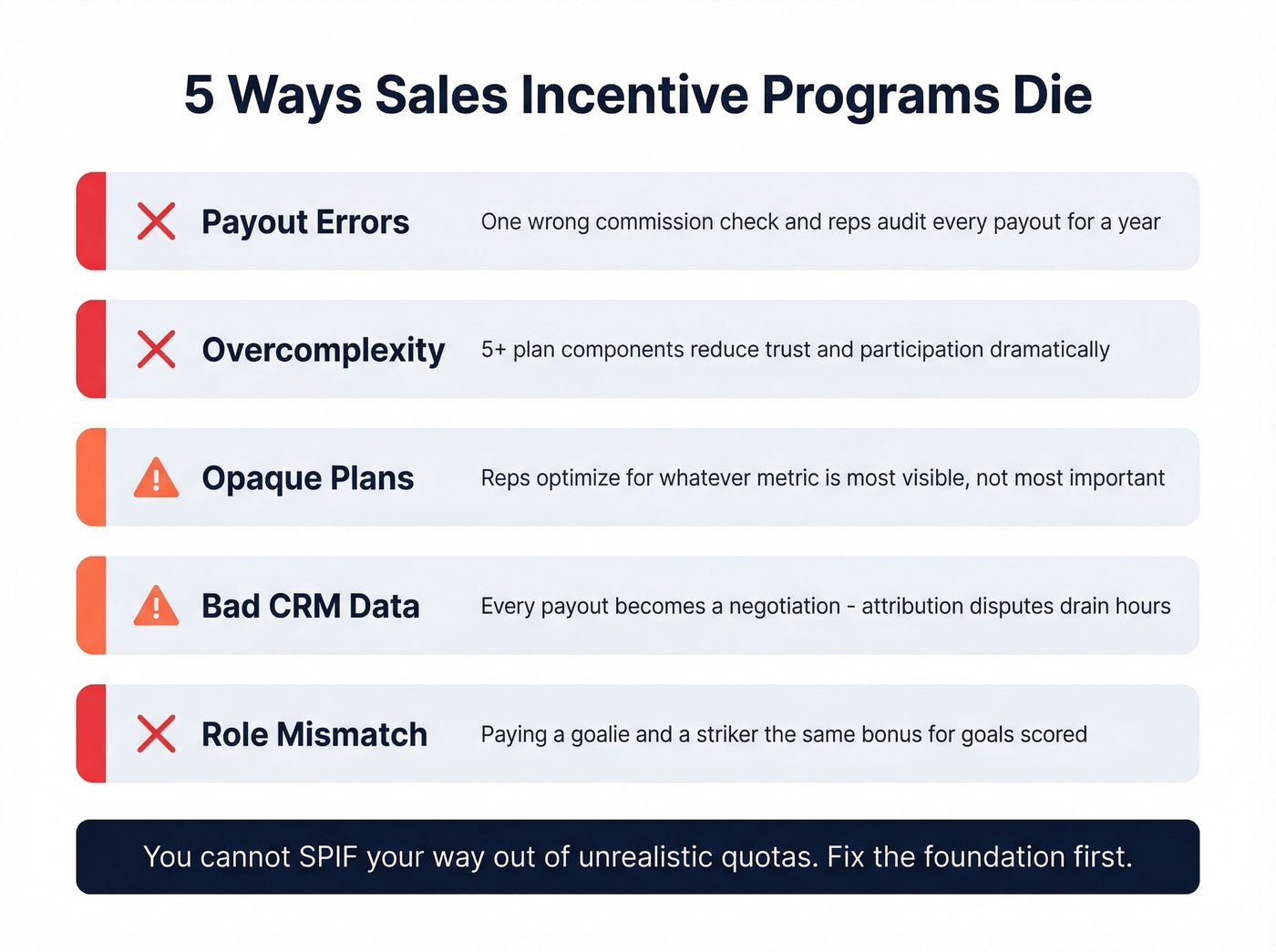
Payout errors destroy trust instantly. When a rep's commission check is wrong - even once - they stop trusting the system. Ask any rep who's been shorted: they'll audit every payout for the next year. That's mental energy you want them spending on deals, not spreadsheets.
Overcomplexity kills engagement. Plans with five or more components reduce trust and participation. If your plan requires a spreadsheet to decode, reps will default to doing whatever feels right and ignore the structure entirely. We've watched teams spend weeks building elaborate multi-tier programs that nobody on the floor could explain back to us.
Opaque plans get gamed. When sellers can't see how the math works, they optimize for whatever metric is most visible - not whatever metric matters most. Transparency isn't a nice-to-have. It's structural.
Bad data creates attribution disputes. If your CRM data is unreliable, every payout becomes a negotiation. Reps argue about who sourced what, managers spend hours reconciling, and finance loses confidence in the numbers. In regulated industries, poorly designed incentives can also inadvertently encourage compliance violations - a risk most companies don't consider until it's too late.
Role mismatch is the most common design error we see, and it's the easiest to fix. An SDR booking meetings and an AE closing six-figure deals have fundamentally different jobs. Incentivizing them with the same structure is like paying a goalie and a striker the same bonus for goals scored.
Here's the thing: you can't SPIF your way out of unrealistic targets. If your baseline quotas are wrong, no incentive program will save you. Fix the foundation first, then layer incentives on top.
Activity-Based vs. Outcome-Based Incentives
Activity-based incentives are the most underused lever in sales management.
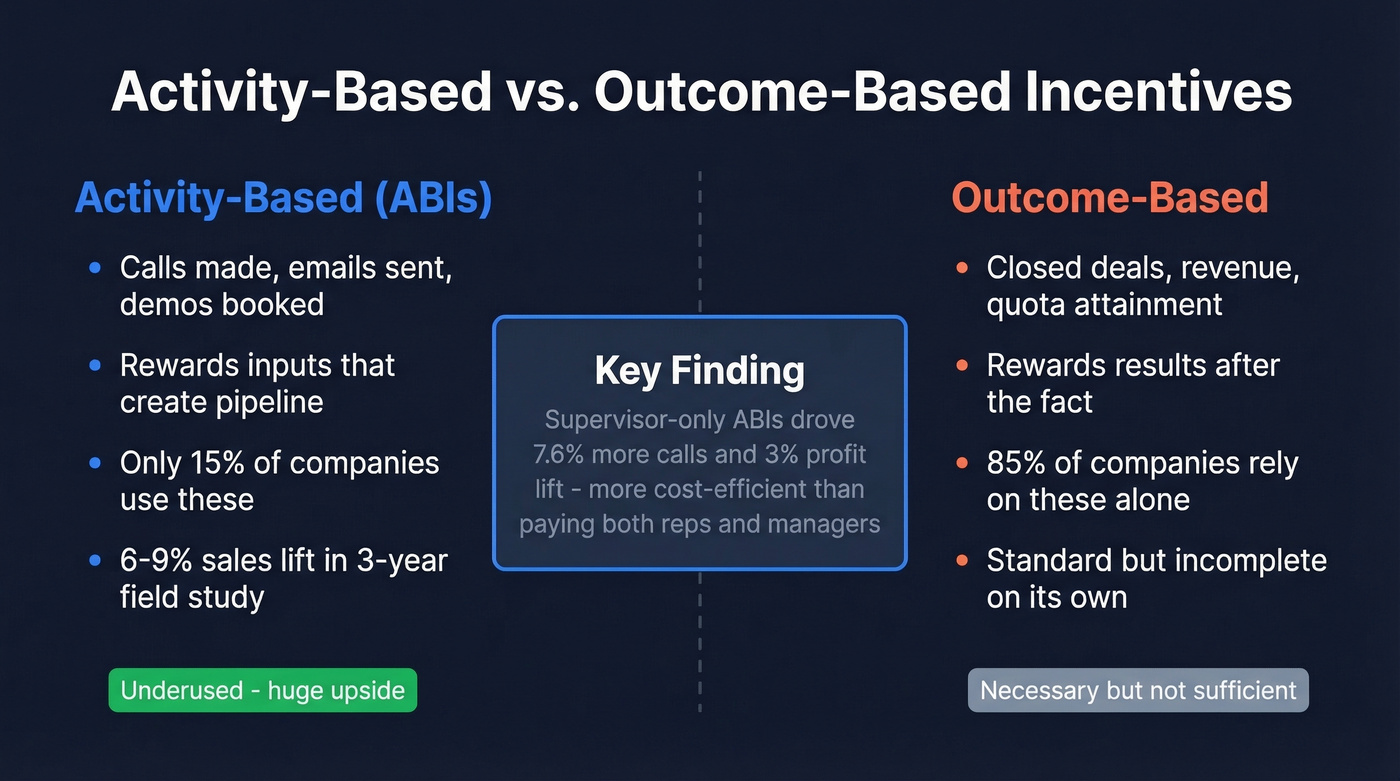
Most companies only reward outcomes - closed deals, booked revenue, quota attainment. That ignores the inputs that create those outcomes. And the research is clear: rewarding activities works. The JMR field study ran a three-year intervention across 305 sales territories at a pharmaceutical company, and when modest activity-based incentive pay was added for frontline salespeople and supervisors, sales rose 6-9% compared to the no-ABI baseline. When ABIs were removed, sales dropped back. The effect was causal, not correlational.
One finding surprised us: when only supervisors received activity bonuses, they drove 7.6% more calls and profits rose 3%. The researchers concluded that ABIs targeted at supervisors alone were more cost-efficient than paying both reps and managers. Supervisors with skin in the game coached harder.
Despite this evidence, only about 15% of companies award bonuses for activities like calls, meetings, or pipeline creation. The other 85% are leaving a measurable lift on the table.
For a phone-heavy sales team, activity KPIs might include 100-150 outbound calls per day, 3-4 hours of talk time, 3-5 verbal offers per day, and 1 contract signed per day. You don't incentivize all of these - pick the 1-2 leading indicators most correlated with closed revenue and attach a modest bonus.

Activity-based incentives are only as good as the contact data behind them. If 40% of the phone numbers your reps are dialing are dead, you're incentivizing frustration, not productivity. Prospeo's database includes 125M+ verified mobile numbers with a 30% pickup rate, so reps dial numbers that actually ring. That's the foundation activity incentives need.
If you're rebuilding your outbound motion, start with sales prospecting techniques that match your market and team size.

Your activity-based incentive program is only as strong as the data behind it. If reps burn hours dialing dead numbers, you're rewarding frustration - not performance. Prospeo gives your team 125M+ verified mobile numbers with a 30% pickup rate and 98% email accuracy, so every incentivized activity actually connects to a real buyer.
Fix the data first, then watch your SPIFs actually move the needle.
Cash vs. Non-Cash Rewards
Cash is table stakes. If your entire reward structure is "hit quota, get commission," you don't have an incentive program - you have a comp plan.
If you're formalizing compensation beyond incentives, it helps to align on OTE definitions and benchmarks first.
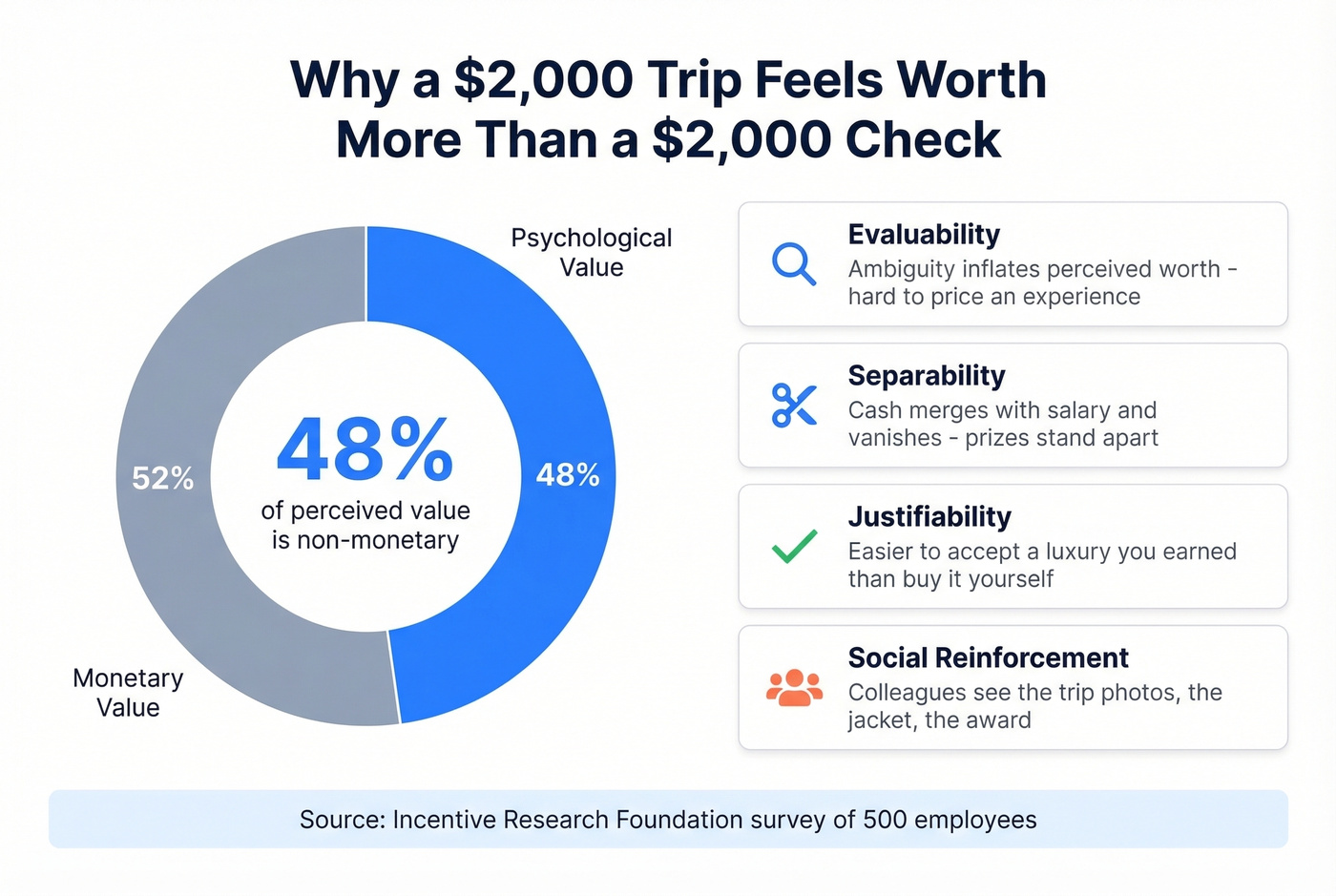
Non-cash rewards punch above their weight. An IRF survey of 500 employees found that monetary value accounts for only 52% of a non-cash reward's appeal. The other 48% comes from psychological factors that cash can't replicate. Research from the Incentive Research Foundation identifies four mechanisms behind this:
- Evaluability - people struggle to assign precise value to experiences and merchandise, and that ambiguity inflates perceived worth. A $2,000 trip to Cabo feels more valuable than a $2,000 check.
- Separability - cash gets mentally merged with salary and disappears into the mortgage payment. A watch, a trip, or a trophy sits apart from everyday spending.
- Justifiability - reps can justify accepting a luxury they earned more easily than buying it themselves. Nobody feels guilty about a prize.
- Social reinforcement - non-cash rewards are visible. Colleagues see the trip photos, the jacket, the award.
Use that asymmetry. A $500 experience reward delivers more motivational impact than a $500 bonus check that vanishes into a bank account.
How to Design Your Program by Role
Stop copying enterprise structures if you're a 15-person sales team. Simplicity wins. But role-specific design is non-negotiable.
If you're building the operating cadence around these roles, a 30-60-90 day plan helps reps ramp into the new rules without confusion.
SDRs
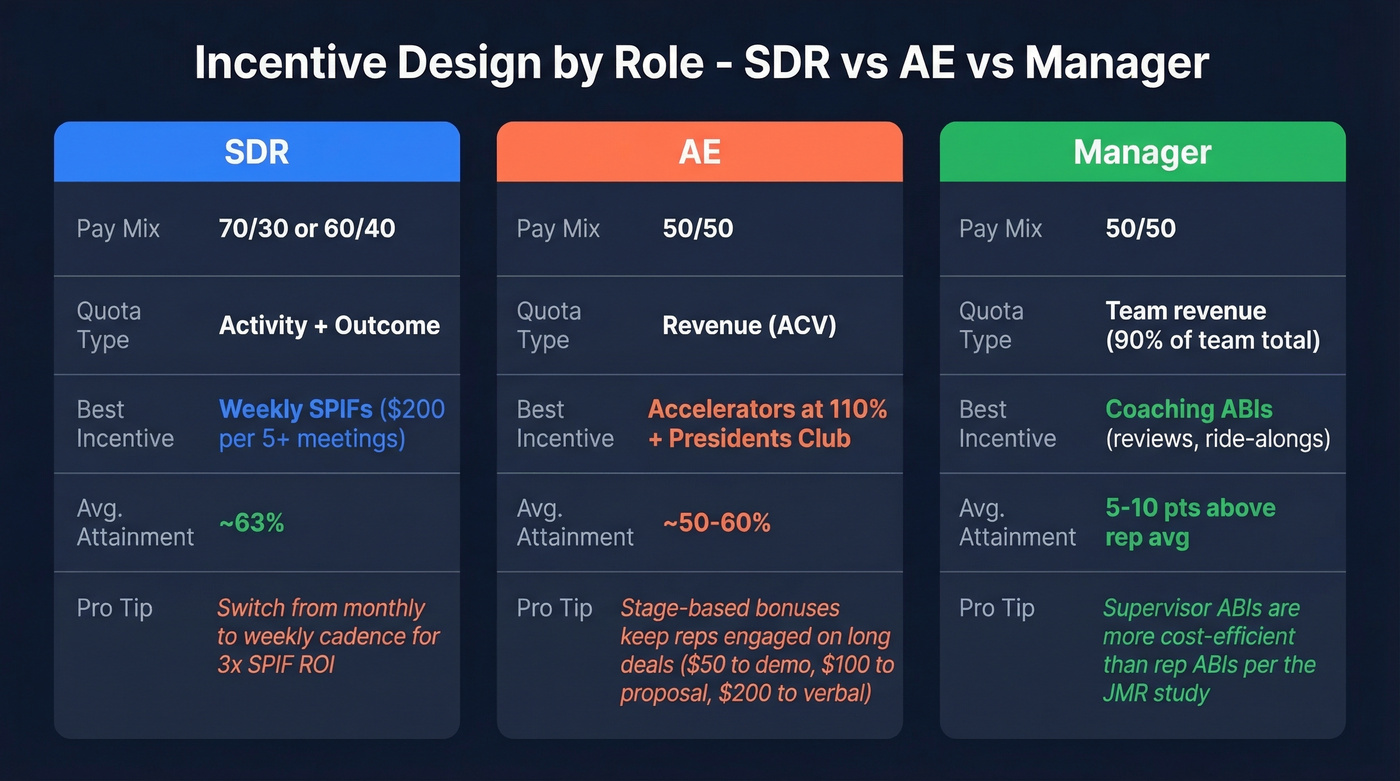
SDR pay mix should sit at 70/30 or 60/40. Their quotas blend activity metrics - calls made, emails sent - with outcome metrics like meetings booked and SQLs generated. About 63% of SDRs achieve quota on average, which means your targets should be ambitious but not demoralizing.
Weekly SPIFs work best for this role because the feedback loop is short. We've seen teams triple SPIF ROI just by switching from monthly to weekly cadences for SDRs. A $200 bonus for booking 5+ qualified meetings in a week costs you $800-$1,000 if four reps hit it, and the meetings are worth multiples of that in pipeline.
If you need a clean definition of what to reward, use a short list of sales activities that correlate with pipeline.
AEs
AEs run a 50/50 pay mix with accelerators kicking in above quota. For SaaS companies, the median commission rate at 100% attainment is 11.5% of ACV. Accelerators typically bump that to 15-20% for deals above target.
In our experience, the 50/50 split works best when accelerators kick in at 110%, not 100% - it prevents reps from coasting once they've barely crossed the line. President's Club remains the single most effective non-cash motivator for AEs, and the social reinforcement is enormous. Stage-based bonuses also sustain motivation through long B2B cycles: $50 for advancing a deal to demo, $100 for proposal, $200 for verbal commit. These keep reps engaged on enterprise deals that take months to close.
If your AEs are struggling to move late-stage deals, map incentives to the steps to close a sale so payouts match real progress.
Sales Managers
Manager comp is where most companies get lazy. Here's a worked example from QuotaPath: take a team of 6 reps each carrying $175K/quarter. Set the manager's quota at 90% of the team total - that's $945K per quarter. With a $200K OTE split 50/50, the commission rate works out to about 2.65% of all deals their reps close. The 10-20% buffer below team total acknowledges that managers can't control every deal and prevents the perverse incentive of managers cherry-picking accounts from their own reps.
The JMR study reinforces this: supervisor ABIs are more efficient than rep ABIs. Pay your managers for coaching activities - pipeline reviews completed, ride-alongs conducted, deal strategy sessions held - and you'll see downstream revenue lift.
If you're standardizing manager reporting, tie coaching ABIs to pipeline health metrics that predict revenue.
| SDR | AE | Manager | |
|---|---|---|---|
| Pay Mix | 70/30 or 60/40 | 50/50 | 50/50 |
| Quota Type | Activity + outcome | Revenue (ACV) | Team revenue (buffered) |
| Best Incentive | Weekly SPIFs | Accelerators + trips | Coaching ABIs |
| Avg. Attainment | ~63% | ~50-60% (SaaS) | 5-10 pts above rep avg. |
10 Sales Incentive Ideas That Actually Work
These aren't theoretical. Each one includes a budget range and implementation note.
Two-week SPIF for cold outbound. $200 per rep who books 5+ meetings from outbound. Budget: ~$1,000-$2,000 total. Run monthly during slow quarters.
Deal-size kicker. Extra 2-3% commission on deals above $50K ACV. Costs nothing until it works - and when it works, you're happy to pay.
Team quota bonus. If the entire team hits 100%, everyone gets a $500-$1,000 bonus. Creates peer accountability without toxic competition. Team-based incentives reduce sandbagging because reps stop hoarding leads when everyone's payout depends on the group number.
President's Club trip. Top 10% earn an annual trip. Budget $2K-$10K per winner depending on destination. Design for the middle 60% of your team, not just the top performers. The 20-60-20 rule says your core performers - the ones who could go either way - are where incentive programs create the most incremental lift. The top 20% will perform regardless. The bottom 20% won't respond to incentives. Target the movable middle.
Experience rewards. Concert tickets, spa days, cooking classes. $100-$500 per reward. Trophy value makes these feel bigger than their price tag.
Professional development stipend. $500-$1,500/year for courses, conferences, or coaching. This works better than cash for retaining ambitious reps because it signals investment in their career, not just their quota. We've found it reduces attrition among top performers who are most likely to get poached.
Extra PTO day. Zero marginal cost. Offer a Friday off for hitting a weekly stretch goal. Surprisingly effective for parents and remote workers.
Peer recognition program. Monthly "rep's choice" award where the team votes. Pair with a $100-$250 gift. Social reinforcement at its simplest.
Charitable donation in rep's name. $250-$500 to a cause they choose. Works especially well for senior reps who don't need another gift card.
Accelerator cliff. Commission jumps from 10% to 18% at 120% of quota. The cliff creates urgency in the final weeks of the quarter. Budget it carefully - model the worst case where everyone hits it.
Tax Rules Nobody Tells You About
Every gift card, trip, and trophy is taxable income. Here's what you need to know before you promise your team a trip to Cabo.
All incentive prizes are taxable. Cash, merchandise, travel, gift cards - IRS Publication 525 treats performance awards as income. Awards for outstanding work must appear on the rep's W-2 and are subject to FICA.
Employee achievement award exclusion. Tangible personal property (not cash or gift cards) can be excluded up to $1,600/year. This covers watches, plaques, or branded merchandise - but not gift cards, which the IRS treats as cash equivalents.
De minimis gifts. Small gifts up to roughly $100 can be treated as de minimis and not reported, depending on frequency and value. A $25 coffee gift card after a big week is fine. A $100 gift card every month probably isn't.
Business gift deduction limit. You can only deduct $25 per recipient per year for business gifts. Incidental costs like engraving or shipping are excluded from that cap.
Valuing non-cash rewards. Merchandise FMV runs about 70% of catalog price - the other 30% covers shipping, handling, insurance, and admin. Travel FMV is roughly 73-76% of land cost, with no discount on airfare.
Incentive travel deductibility. Must be ordinary, necessary, directly related to business, and not extravagant. A team dinner in Miami qualifies. A week at a five-star resort with no business content is harder to defend.
Let's be honest: gross up your non-cash awards so reps don't get a surprise tax bill. Nothing kills the motivational value of a $5,000 trip faster than a $1,500 tax hit the rep didn't expect.
Measuring Your Program's ROI
A reasonable budget benchmark is 1-3% of sales revenue. On a per-rep basis, many teams end up in the low-thousands per rep per year for structured incentives beyond standard commission, then scale up what proves incremental. Your target ROI should be at least 1:5 - every dollar spent on incentives should generate five dollars in incremental revenue.
The results can be dramatic when the program is well-designed. Companies that align incentives with specific product objectives see an average 30% sales increase. One global HVAC company saw a 45% increase in sales of high-priority products using reloadable debit card rewards tied to specific units sold. A lift truck manufacturer drove a 205% increase in program adoption through a mobile app-based incentive platform.
Track four KPIs: quota attainment delta (before vs. after), activity volume change, deal velocity, and rep attrition. If your incentive program isn't moving at least two of these within 90 days, something's wrong with the design, not the concept.
Don't wait until year-end to fix a broken plan. Markets shift, products launch, territories change. The best programs build in quarterly review checkpoints where leadership can adjust thresholds, swap SPIF targets, or recalibrate accelerator cliffs. Skip this if you're running a one-off SPIF - but for any ongoing program, mid-cycle iteration isn't optional.
Measurement also requires clean CRM data. If your enrichment workflows return incomplete records, your dashboards and attribution models reflect noise rather than signal. Tools like Prospeo return 50+ data points per contact at a 92% API match rate, which keeps your reporting honest.
If you're evaluating vendors for this layer, compare data enrichment services before you lock in a workflow.
Bad CRM data turns every commission payout into an attribution fight. Prospeo's enrichment API returns 50+ data points per contact at a 92% match rate - clean records that eliminate disputes and let your incentive program run on trust, not spreadsheets.
Stop losing rep trust to payout errors caused by garbage data.
FAQ
What's the difference between a SPIF and a commission plan?
A commission plan is your ongoing compensation structure - base plus a percentage of closed revenue, paid every pay period. A SPIF is a short-term bonus layered on top, typically lasting one to four weeks, targeting a specific behavior or product. Commission is the foundation; SPIFs are tactical accelerants you deploy for a targeted push.
How much should I budget for sales incentive programs?
Plan for 1-3% of total sales revenue. Individual SPIFs usually run $50-$500 per payout, while annual President's Club trips cost $2,000-$10,000 per winner. Start conservative, measure incremental revenue, and scale what works toward a 1:5 cost-to-revenue ratio.
Are gift cards and incentive trips taxable?
Yes - all incentive prizes are taxable income under IRS Publication 525 and must appear on the employee's W-2. The one exception: tangible personal property awards (not cash or gift cards) can be excluded up to $1,600/year as employee achievement awards. Gross up non-cash rewards so reps aren't surprised at tax time.
How do I make sure activity data is accurate before incentivizing it?
Activity-based incentives fall apart when reps dial dead numbers or email invalid addresses - you end up rewarding effort against bad data. Verify phone numbers and emails before loading them into sequences, and audit bounce rates monthly. A 7-day data refresh cycle (vs. the 6-week industry average) keeps records current so your activity metrics reflect real outreach, not wasted dials.