

Inside Sales Lead Generation: A Data-First Playbook for 2026
It's Monday morning. Your SDR team fires off 2,000 emails, dials through a purchased list, and logs activity like their jobs depend on it - because they do. By Friday, the pipeline report shows three meetings booked, two of which won't show. Meanwhile, 84% of reps missed quota last year, and 67% don't expect to hit it this year.
The volume playbook isn't broken. It was never built for the way B2B buyers operate now.
The real issue isn't effort - it's precision. 70% of generic B2B outreach gets ignored, and teams still grinding through bulk lists are burning reps, domains, and budget in equal measure. A modern inside sales lead generation system demands verified data, coordinated channels, and trigger-based timing. Not more dials.
The Short Version
- Data quality beats volume. Verify every email and phone before it enters a sequence. A high bounce rate can tank your domain reputation for months.
- 2-3 coordinated channels > 12 scattered ones. Omnichannel outreach hits an 18.96% engagement rate vs. 5.4% for single-channel, but "omnichannel" means two or three channels working together, not a dozen firing at random.
- Speed-to-lead is non-negotiable. Responding within 5 minutes increases contact rates by 900%.
- Build trigger-based lists, not bulk purchases. Job changes, funding rounds, tech installs - these signals tell you when to reach out, not just who.
- Start lean. A verified data platform, HubSpot free CRM, and a basic dialer often gets you a functional sales stack for under $500/mo.
What Is Inside Sales Lead Generation?
Inside sales lead generation is the process of identifying, qualifying, and engaging potential buyers remotely - through phone, email, video, and social channels - without leaving the office. It's the engine that feeds your pipeline with meetings, demos, and revenue.
The distinction from outside sales matters more than most people think. Inside reps operate at fundamentally different economics:
| Metric | Inside Sales | Outside Sales |
|---|---|---|
| Daily touches | ~60 calls | ~5 visits |
| Lead conversion | 20% | 40% |
| Avg salary + comm | ~$71.4K | ~$109.9K |
Outside reps often convert at higher rates per interaction, but inside reps cover dramatically more ground at lower cost. That math is why 53.7% of US sales reps now work inside sales roles, and the share keeps climbing. For B2B companies selling deals under $100,000, remote selling isn't just viable. It's the default.
Why the Old Playbook Fails
B2B buyers have rewired how they purchase. They now engage across an average of 10 channels - up from 5 in 2016. 80% of B2B sales interactions happen in digital channels, and 75% of buyers prefer a rep-free experience early in their journey.
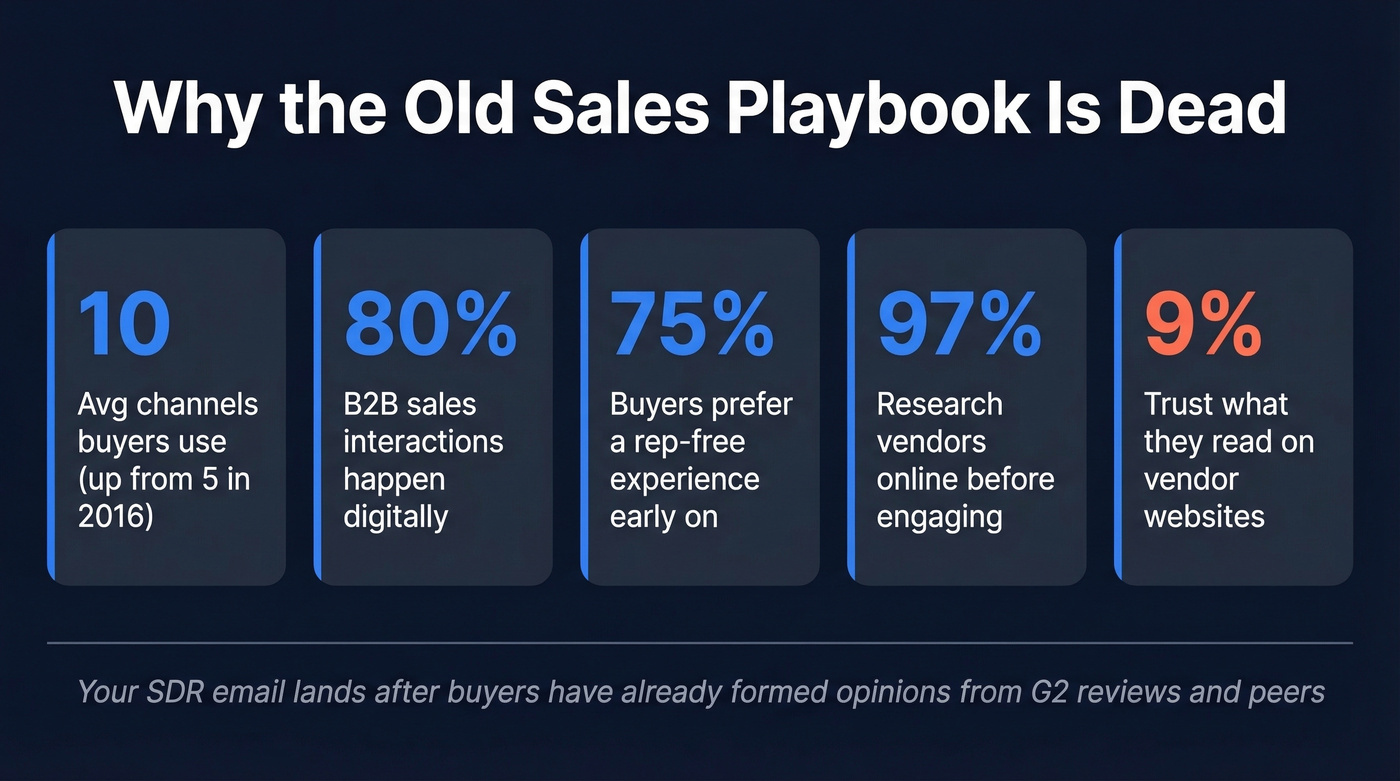
97% of buyers research vendors online before any engagement, but only 9% trust what they read on vendor websites. They're checking G2 reviews and peer recommendations long before your SDR's email lands. Social media now delivers 42% response rates in some contexts - nearly double email. LinkedIn alone drives 80% of B2B social leads.
Here's the thing: the old playbook of "buy a list, blast emails, hope for replies" doesn't just underperform. It actively damages your sender reputation and brand.
Building a Lead Gen System That Converts
Define Your ICP With Precision
Every deal now involves 6-10 decision-makers. If your ICP definition stops at "VP of Marketing at mid-market SaaS companies," you're targeting a persona, not a buying committee. Get specific across three dimensions: firmographics (industry, headcount, revenue, growth stage), technographics (a company using Outreach is a different buyer than one on Mailchimp), and intent signals (hiring patterns, funding events, vendor research activity).
Why does this matter operationally? 82% of buyers accept meetings when reps demonstrate clear understanding of their business. The tighter your ICP, the fewer leads you need to hit the same pipeline number. We've seen teams cut list size by 60% and increase meetings booked simply by filtering harder upfront.
Pick 2-3 Channels and Own Them
Not every channel deserves your team's time. Here's what the benchmarks actually look like:
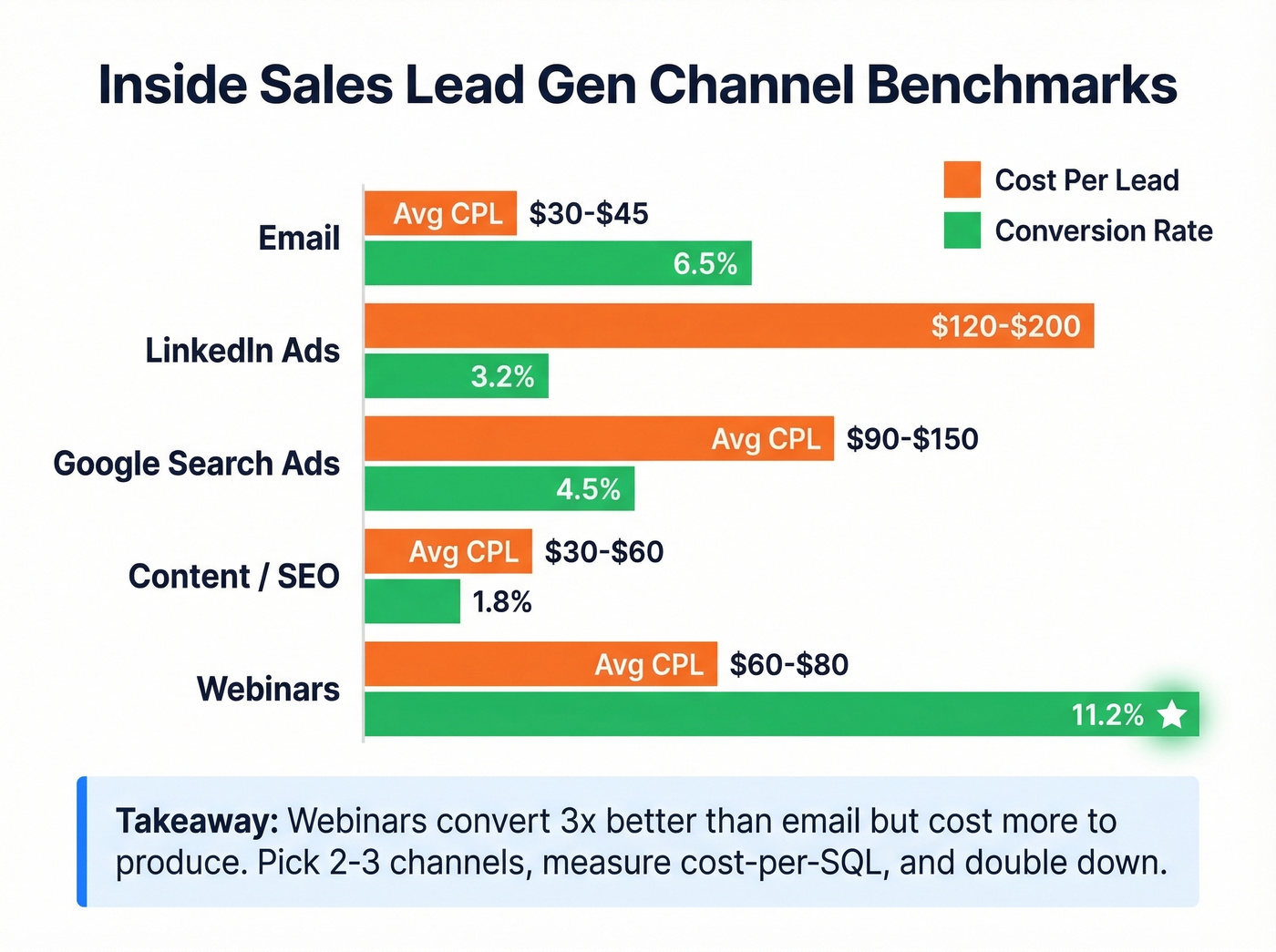
| Channel | Avg CPL | Conversion Rate |
|---|---|---|
| $30-$45 | 6.5% | |
| LinkedIn ads | $120-$200 | 3.2% |
| Google search ads | $90-$150 | 4.5% |
| Content/SEO | $30-$60 | 1.8% |
| Webinars | $60-$80 | 11.2% |
Webinars convert at 11.2% but require real production effort. Email is cheap and scales, but cold email reply rates average 3.5%. The right answer depends on your deal size and sales cycle - but the wrong answer is always "let's try all of them at once." Pick two or three, run them for 60-90 days, measure cost-per-SQL (not just CPL), and double down on what works.
If your average deal is under $15K, you probably don't need anything beyond email, phone, and one social channel. The teams we see overinvesting in paid acquisition at that price point almost always have a conversion problem, not a traffic problem.
Build Trigger-Based Lists
Reps spend only 28% of their week actually selling. If your SDRs are manually building their own prospect lists, you're paying $60K/year for data entry.
Trigger-based lists flip this entirely. Instead of static lists pulled from a database once a quarter, you build dynamic lists around buying signals: a VP of Sales just got hired, a company raised a Series B, a target account started researching your category on Bombora. These triggers tell you when someone is likely to buy, not just that they exist. Personalized outreach built around these signals increases response rates by up to 32%.
Verify Everything Before Outreach
This is where most lead generation efforts hemorrhage pipeline without anyone realizing it.
You build a great list, write sharp copy, and launch a sequence - then a chunk of your emails bounce. Your domain reputation craters. Deliverability drops across all your campaigns, not just the one with bad data. And you spend the next two months warming a new domain instead of booking meetings.
Prospeo handles this with 143M+ verified emails at 98% accuracy and 125M+ verified mobile numbers hitting a 30% pickup rate. Every record refreshes on a 7-day cycle - the industry average is six weeks, which means most databases serve you stale data by default. At roughly $0.01 per email, the economics are almost absurd compared to the cost of a burned domain.
Real example: Meritt, a sales agency, was running a 35% bounce rate before switching. After migration, bounces dropped under 4% and pipeline tripled from $100K to $300K per week.
Score, Route, and Respond Fast
Once leads enter your system, speed determines whether they convert or go cold.
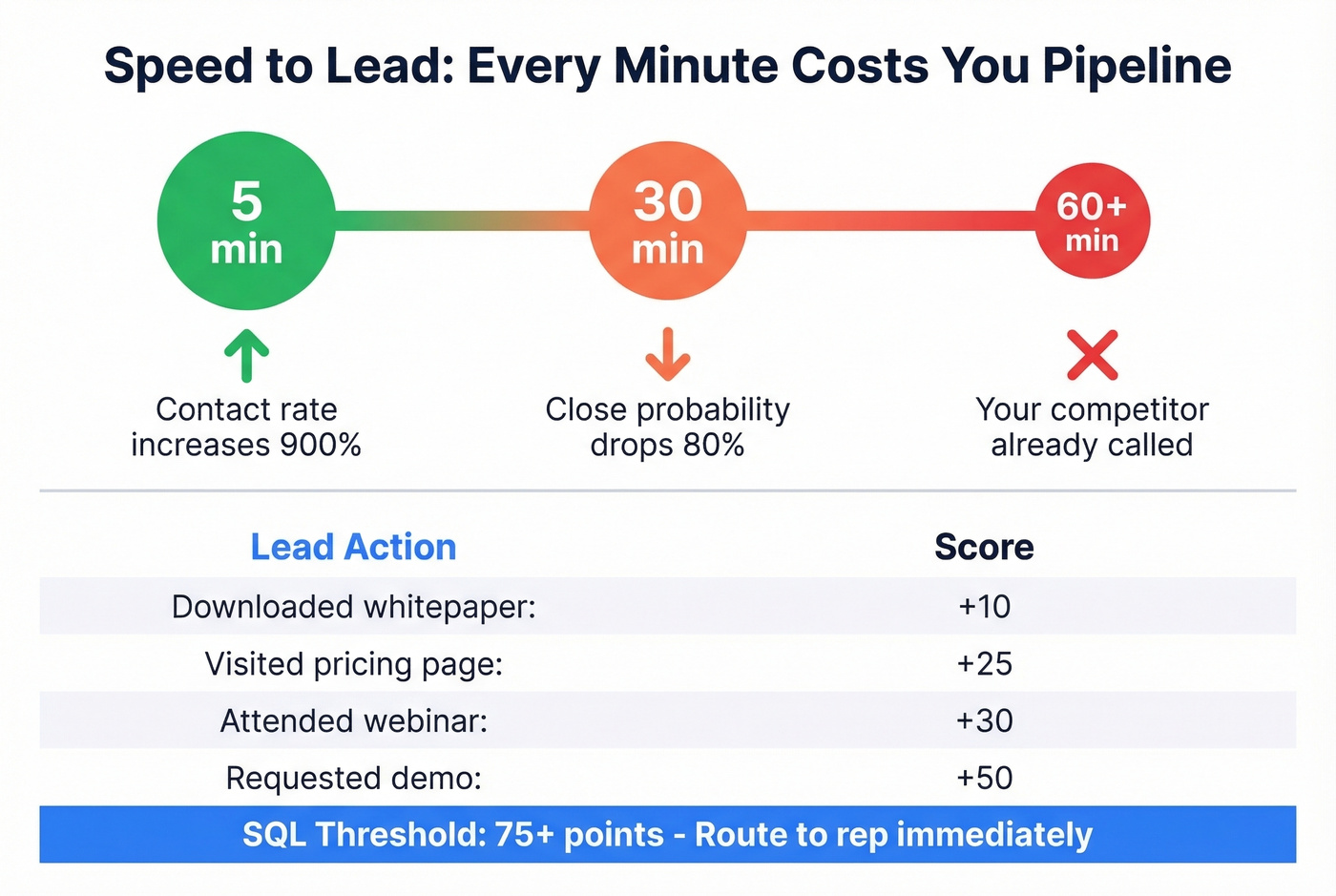
Responding within 5 minutes increases contact rates by 900%. Wait 30 minutes and close probability drops 80%. Your competitors are reaching out while your lead sits in a routing queue.
Build a simple scoring model that separates three tiers:
| Action | Points |
|---|---|
| Downloaded whitepaper | +10 |
| Visited pricing page | +25 |
| Attended webinar | +30 |
| Requested demo | +50 |
| SQL threshold | 75+ |
Route SQLs and PQLs to reps immediately. MQLs go into nurture sequences. The taxonomy matters less than the speed - get hot leads to a human within minutes, not hours.

Trigger-based lists only work when the data behind them is real. Prospeo's 300M+ profiles refresh every 7 days - not every 6 weeks - so your SDRs reach buyers at the right moment with 98% verified emails and 125M+ direct dials.
Stop burning domains. Start booking meetings with data you can trust.
SDR Outreach Playbook
Multi-Channel Cadence
A single email isn't outreach. It's a lottery ticket. Follow-up emails account for 50% of total responses, and calls convert warmed accounts 2-3x better than cold dials. Structure your 28-32 day cadence in four phases:
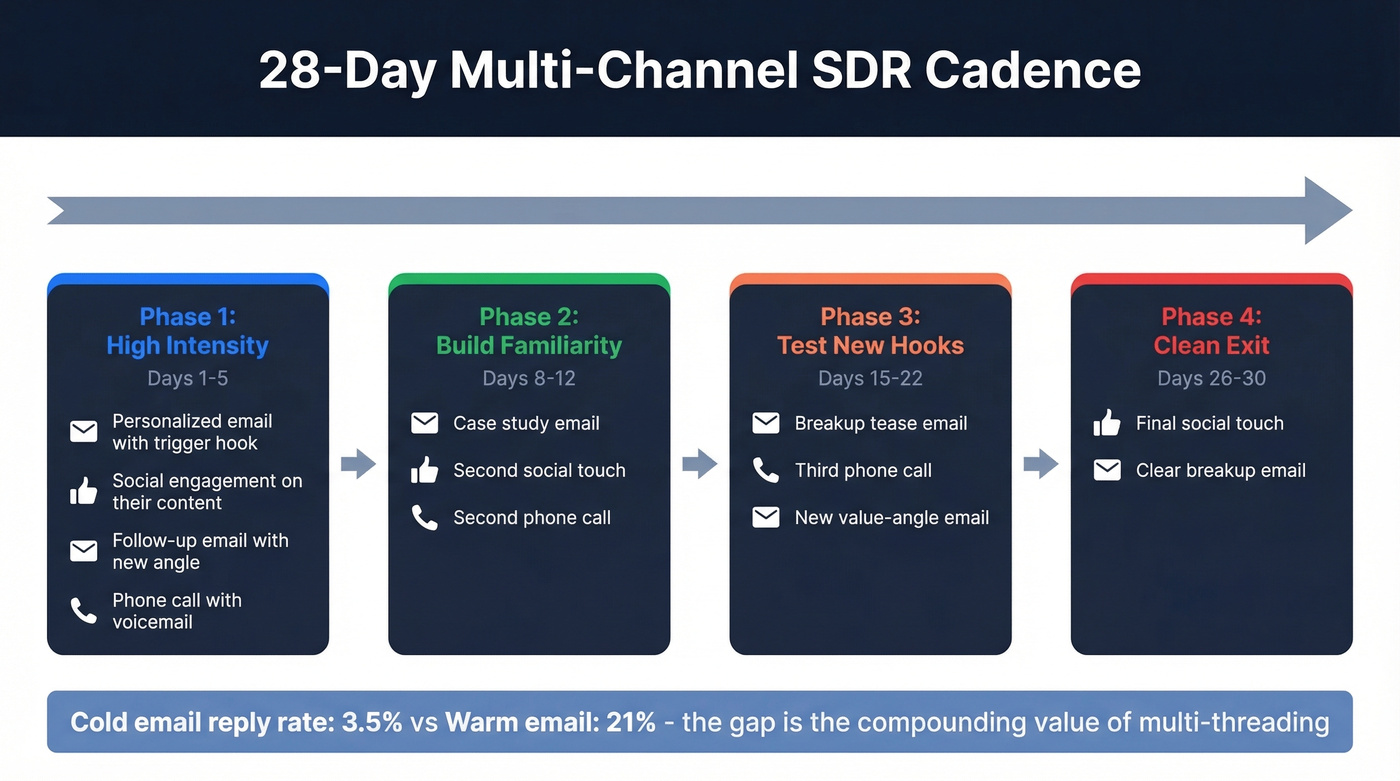
Phase 1 (Days 1-5): Personalized email with a trigger-based hook, social engagement with their content, follow-up email with a new angle, then a phone call with voicemail. This is your highest-intensity window.
Phase 2 (Days 8-12): Case study email, second social touch, second phone call. You're building familiarity - by the time you call, they've seen your name three times.
Phase 3 (Days 15-22): Breakup tease email, third phone call, new value-angle email. Spacing widens as you test different hooks.
Phase 4 (Days 26-30): Final social touch, then a clear breakup email. Respectful, direct, no guilt trips.
Cold email reply rates average 3.5%. Warm email hits 21%. That gap is the compounding value of multi-threading across channels before you ever ask for a meeting.
Daily SDR Workflow
Structure beats volume every time. Here's a time-blocked rhythm that prioritizes quality over raw activity:
- 8:00-10:30 - Inbox health check, then dial block #1 (prioritize intent-warmed accounts)
- 10:30-12:00 - Personalization sprint: research and write new sequences
- 1:00-2:30 - Dial block #2
- 2:30-4:00 - Social touches, CRM hygiene, next-day prep
Rebalance account quality across SDRs regularly so no rep is stuck working dead territory while another cherry-picks. For teams that don't have the headcount to run this motion in-house, outsourced SDR services ($3,950-$6,750/mo) can bridge the gap while you build - just make sure they're using verified data, not recycled lists.
Inside Sales Tech Stack
You don't need 12 tools. You need four categories covered well.
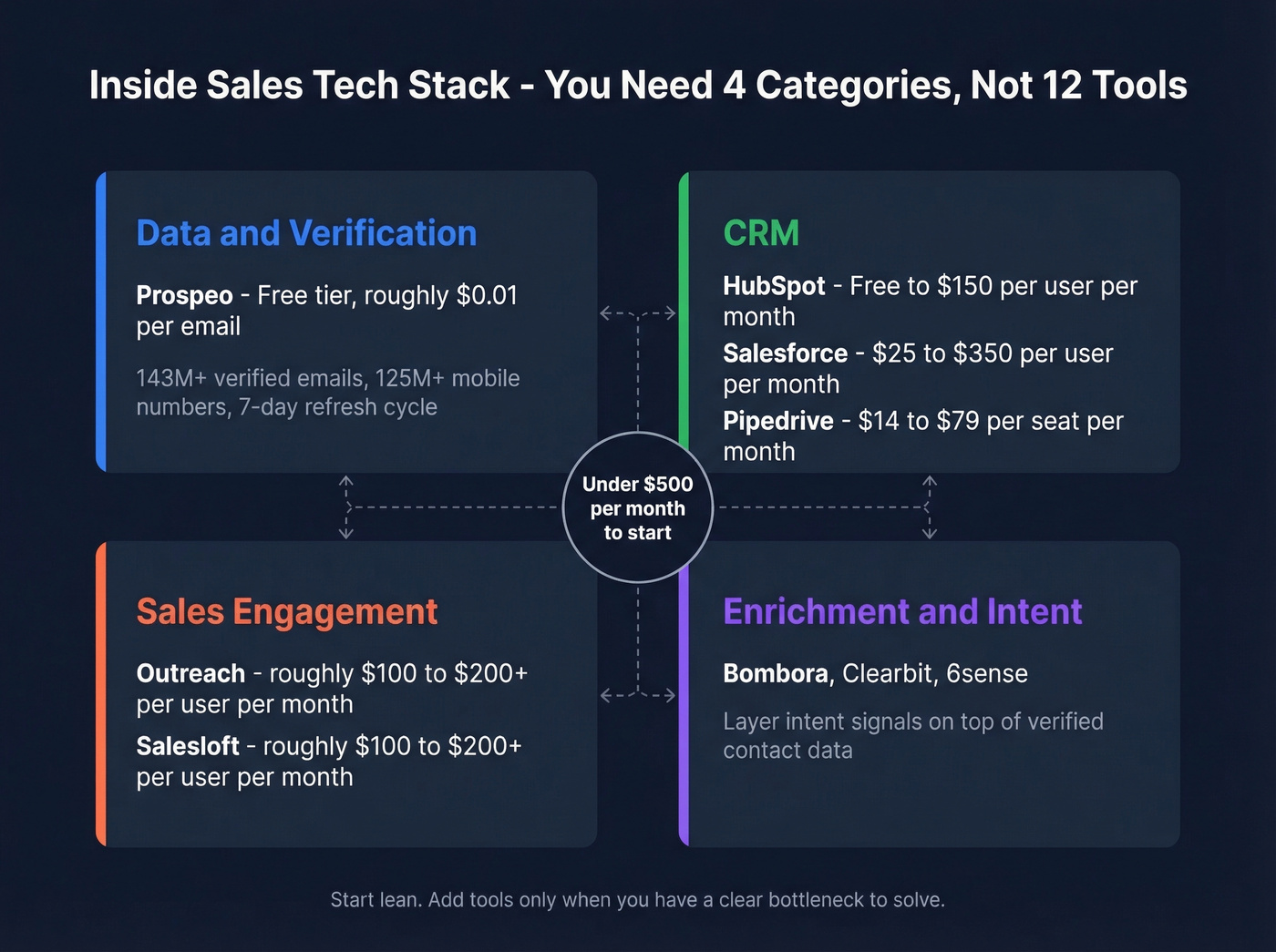
| Category | Tool | Pricing |
|---|---|---|
| Data & Verification | Prospeo | Free tier; ~$0.01/email |
| CRM | HubSpot | Free - $150/user/mo |
| CRM | Salesforce | $25 - $350/user/mo |
| CRM | Pipedrive | $14-$79/seat/mo |
| Sales Engagement | Outreach | ~$100-$200+/user/mo |
| Sales Engagement | Salesloft | ~$100-$200+/user/mo |
| Enrichment | Apollo.io | Free; paid from $49/user/mo |
| Enrichment | Clay | From $134/mo |
Starter stack (under $500/mo): Verified data platform, HubSpot free CRM, and a basic dialer. This covers a 2-3 rep team running outbound without overcommitting on tooling.
Scale stack ($1,000-3,000/mo): Add Salesforce or HubSpot Pro, a dedicated sales engagement platform, and layer in intent data. At this point you're running a proper revenue operation, not just prospecting.
5 Mistakes That Kill Pipeline
1. Misaligned handoffs. If MQL volume is rising but SQL volume is falling, your marketing and sales teams don't agree on what "qualified" means. Fix the definitions before you fix the funnel.
2. Bad data destroying your domain. A 15% bounce rate doesn't just waste sends - it's a major deliverability red flag. Verify your list before every campaign. Every time. (If you need a baseline, start with bounce rate benchmarks.)
3. Slow lead activation. If your average response time is over 15 minutes, you're leaving money on the table. Automate routing. Set SLAs. Measure response time weekly.
4. No real nurture. Sending the same generic drip to every lead who didn't convert isn't nurture - it's noise. Segment by intent level, engagement history, and buying stage. Marketing automation drives a 451% increase in qualified leads when done right.
5. Volume-over-precision mindset. 500 emails to unverified contacts at companies outside your ICP will always lose to 50 emails sent to verified decision-makers showing buying intent. The math doesn't lie.
Benchmarks for Inside Sales Teams
If you're significantly below these ranges, you've got a system problem, not an effort problem. Let's be honest - most teams we talk to have never benchmarked themselves against real numbers, and that's half the issue.
| KPI | Target Range |
|---|---|
| Spam placement | <5% |
| Bounce rate | <2% |
| Positive reply rate | 2-5%+ |
| Call connect to meeting | 10-25% |
| Meetings held rate | 70-85% |
| SQL rate | 30-60% |
| Close rate | 10-25% |
For broader context: the average B2B close rate is 29%, average sales cycles run 1-3 months, and the average CPL across industries is $198. If your CPL is dramatically higher, you're likely over-indexed on expensive channels or under-optimized on conversion.
If you want to go deeper on the mechanics, map your funnel end-to-end with a simple lead generation workflow and track the right lead generation metrics before you change channels or headcount.
Your reps spend 72% of their week not selling. Prospeo's 30+ search filters - buyer intent, job changes, funding, technographics - build qualified lists in minutes, not hours. At $0.01 per email, you get enterprise-grade data without the enterprise contract.
Give your inside sales team the precision they've been missing.
FAQ
What's the difference between inside sales and outside sales?
Inside sales reps sell remotely via phone, email, and video - averaging around 60 touches per day at lower cost per rep. Outside sales reps meet prospects in person, convert at higher rates per interaction, but cover far fewer accounts. Today, 53.7% of US sales reps work inside sales roles, and the split continues shifting toward remote selling as digital channels dominate B2B buying.
How much does inside sales lead generation cost?
A fully-loaded inside sales rep costs $100K-$150K per year including salary, benefits, tooling, and management overhead. Outsourced SDR services run $3,950-$6,750 per month. The average CPL across B2B industries is $198, and tool stacks range from $200/mo for a lean setup to $3,000+/mo for enterprise configurations.
What tools do inside sales teams need?
At minimum: a CRM (HubSpot free or Pipedrive), a verified data platform for accurate contact data, a sales engagement tool for sequencing, and a dialer. That four-tool stack covers list building, outreach execution, and pipeline management. Add intent data and enrichment as you scale past 3-5 reps.
How many touches to convert a lead?
Most B2B deals require 8-12 touches across multiple channels before a prospect converts to a meeting. Follow-up emails alone account for 50% of total responses, and calls convert warmed accounts 2-3x better than cold dials. The teams booking the most meetings run coordinated 28-32 day cadences across email, phone, and social.
What's a good cold email reply rate in 2026?
Cold email reply rates average 3.5% across B2B outbound. Warm email - where the prospect has seen your name through social touches or content - hits around 21%. Below 2% on cold means your data quality, subject lines, or targeting need work. Above 5% means you're running a strong operation.