

The Inside Sales Process That 84% of Reps Are Missing
A RevOps lead we know ran a pipeline audit recently. The team had great reps, solid product-market fit, and a real tech stack behind them. They were still missing quota. The problem wasn't talent - it was their inside sales process. Every rep was running a different playbook, qualifying differently, and quitting cadences at touch four.
84% of reps missed quota last year. Meanwhile, 80% of B2B sales interactions now happen in digital channels. The reps who win aren't the ones with the best pitch - they're the ones with a repeatable process behind every call, email, and demo.
On Reddit, inside sales reps talk about getting stretched thin across 100+ accounts, wanting automated follow-up reminders, and trying to build better time-blocking systems. The fix isn't more hustle. It's a tighter process.
What Is Inside Sales?
Inside sales is selling remotely. No flights, no handshakes, no expensed steaks. Your reps work from an office or home, closing deals through phone, email, video, and chat. The "inside" part just means the selling happens without physically visiting the buyer.
Don't confuse it with telemarketing. Telemarketing involves random outreach, scripted reading, and limited product knowledge. Inside sales is consultative, multi-touch, and relationship-driven - often spanning weeks or months with the same account.
Inside Sales vs. Outside Sales
The debate isn't really "which is better." It's about matching your motion to your deal size, cycle length, and buyer expectations.
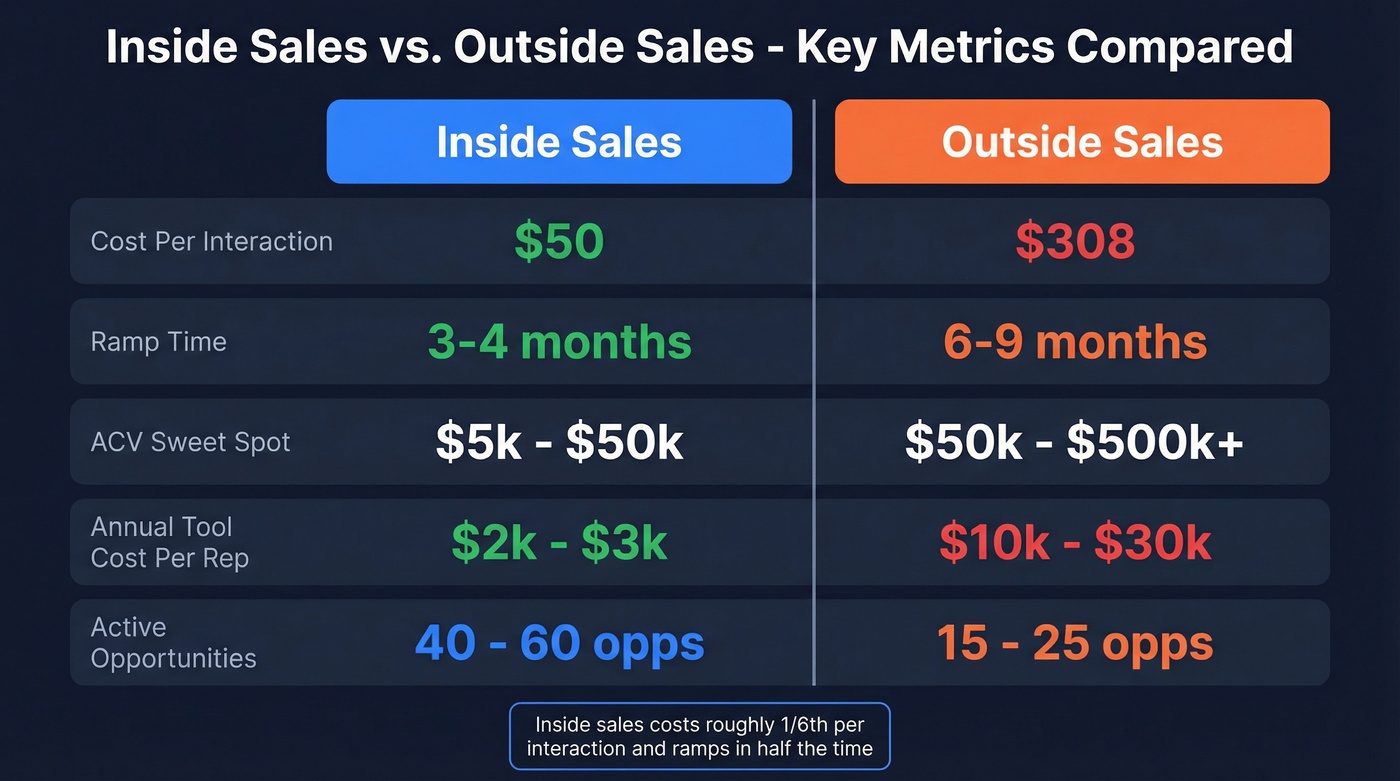
| Dimension | Inside Sales | Outside Sales |
|---|---|---|
| Cost per interaction | ~$50 | ~$308 |
| Ramp time | 3-4 months | 6-9 months |
| ACV sweet spot | $5k-$50k | $50k-$500k+ |
| Annual tool cost | $2k-$3k/rep | $10k-$30k travel |
| Opportunity volume | 40-60 active opps | 15-25 active opps |
The cost gap is stark. An inside rep's interaction costs roughly one-sixth of an outside rep's, and they ramp in half the time. For deals under $50k, the math almost always favors inside sales.
That said, 40% of high-growth teams run hybrid models. The VP of Sales closes a $200k enterprise deal in person while the SDR team that sourced it works entirely remotely. The real question isn't inside or outside - it's which stages of your process need which motion.
Here's the thing: if your average deal size sits below $10k, you almost certainly don't need outside sales at all. Every dollar you spend on travel is a dollar you could spend on better data and more reps.
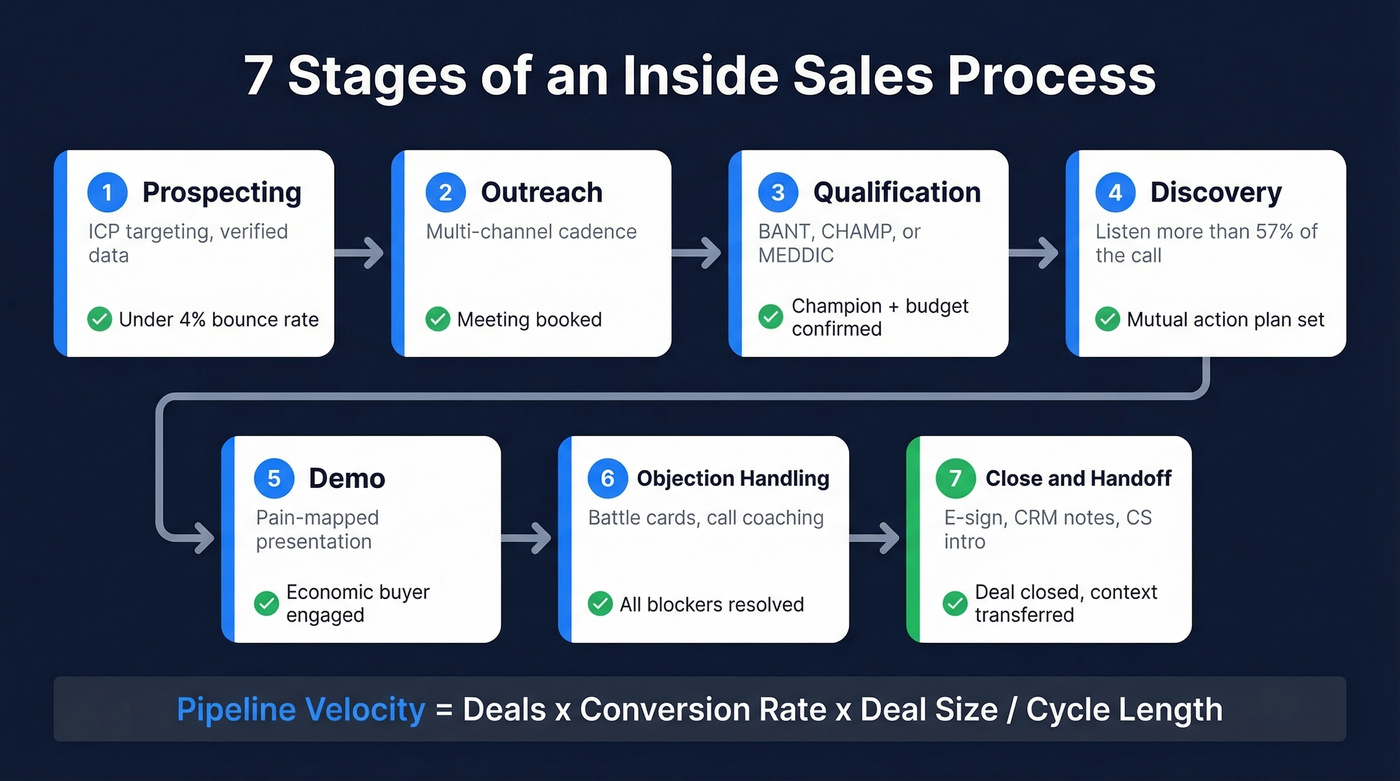
The 7 Stages of an Inside Sales Process
Most teams have some version of these stages, but they're informal. Reps interpret them differently. Exit criteria don't exist. Handoffs are messy. Let's fix that.
Stage 1 - Prospecting & List Building
This is where everything either works or falls apart. Get prospecting wrong, and your cadences bounce, your dials go to voicemail, and your domain reputation tanks for months.
Good prospecting starts with a tight ICP definition - industry, headcount, tech stack, funding stage, buyer intent signals. Then you need a data source that actually delivers verified contacts, not a database full of stale records. When your SDRs follow consistent list-building criteria, every rep starts with the same quality of prospect, and that consistency is what makes a real inside sales process different from a collection of individual efforts.
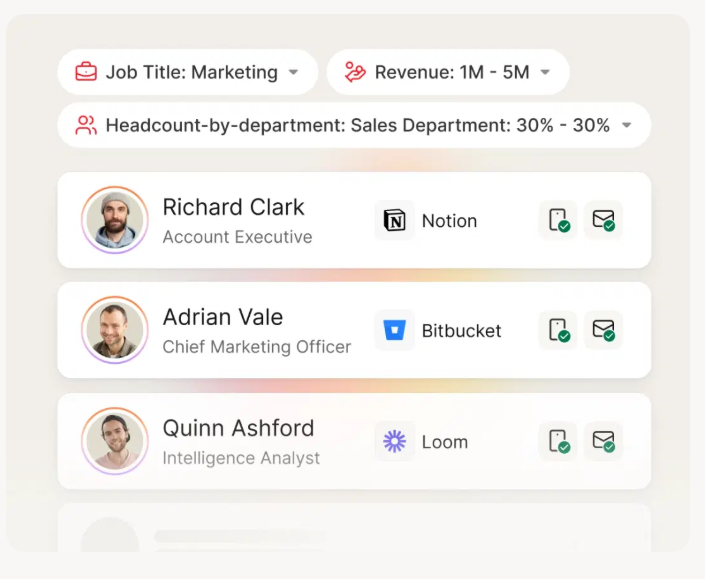
The 7-day data refresh cycle matters more than most teams realize. The industry average is six weeks. In six weeks, your champion changes jobs, the company gets acquired, and the email you're sending hits a deactivated inbox. Fresh data isn't a nice-to-have - it's the exit criteria for Stage 1.
Stage 2 - Initial Outreach
Multi-channel from day one. Email alone won't cut it. Phone alone won't cut it. Buyers now use 10 interaction channels on average, up from 5 in 2016. Your cadence needs to meet them across at least three.
RAIN Group research shows it takes 8 touches on average to book a meeting. Phone calls drive disproportionate response rates even when they represent only 20-30% of total touches. The reps who skip calling because "nobody picks up" are leaving meetings on the table.
Your first touch should match the prospect's signal strength. A cold prospect gets a problem-focused email. An inbound demo request gets a phone call within five minutes - not five hours, not the next morning.
One tactical detail most guides skip: cold calling peaks in effectiveness between 4-5 PM on Wednesdays and Thursdays. Block those hours for dials, not admin work.
Stage 3 - Qualification
Not every meeting deserves a demo. Qualification is the gate that separates pipeline from pipe dreams.
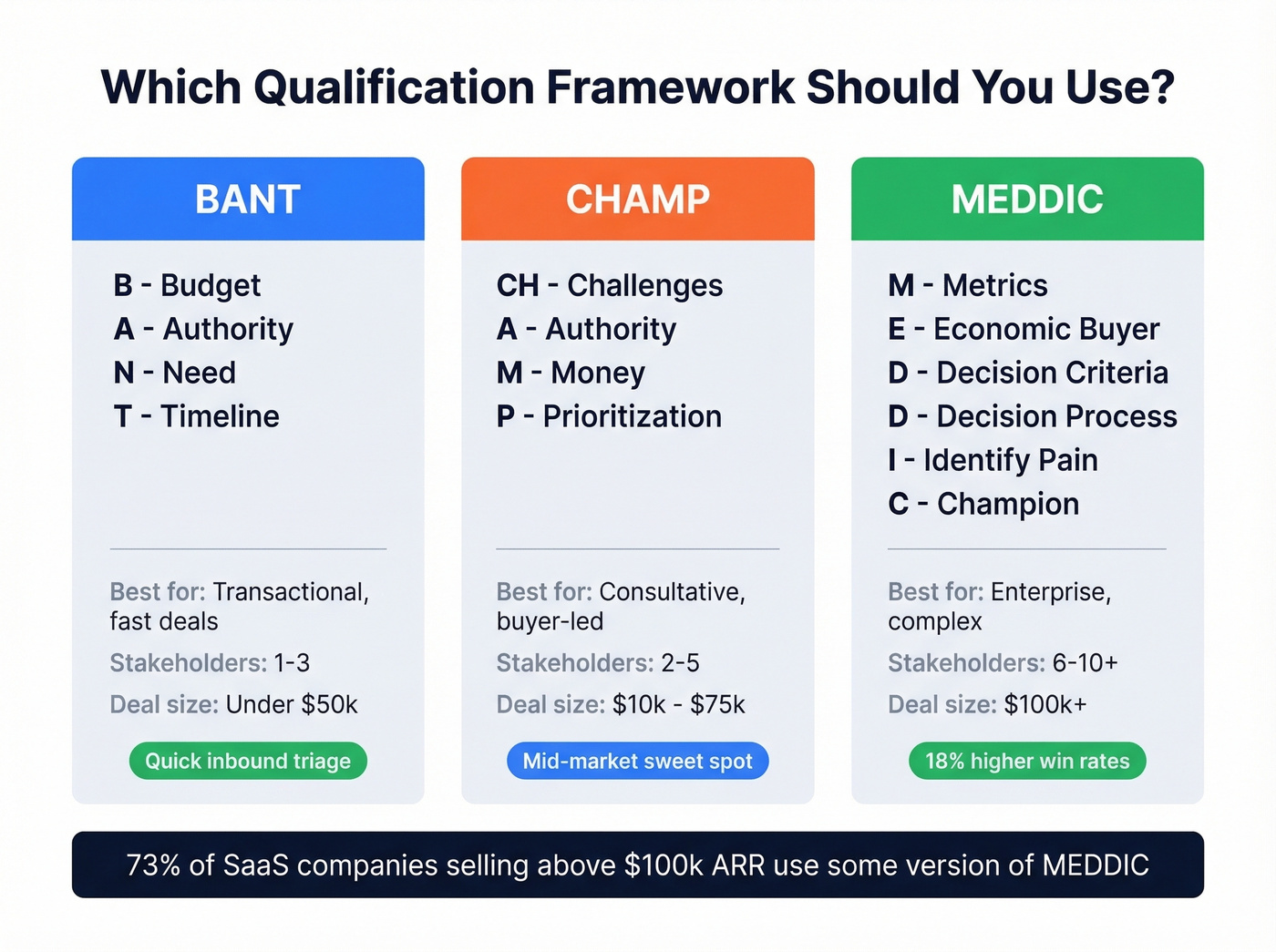
| Framework | Best For | Stakeholders | Deal Size |
|---|---|---|---|
| BANT | Transactional, fast | 1-3 | Under $50k |
| CHAMP | Consultative, buyer-led | 2-5 | $10k-$75k |
| MEDDIC | Enterprise, complex | 6-10+ | $100k+ |
73% of SaaS companies selling above $100k ARR use some version of MEDDIC. Full adoption correlates with 18% higher win rates and 24% larger deal sizes compared to simplified frameworks.
Our take: if you're unsure, start with MEDDIC simplified. BANT is fine for quick inbound triage, but it misses the decision process and champion dynamics that kill deals in the later stages. CHAMP is solid for mid-market consultative motions where the buyer's challenge should drive the conversation.
The champion test is the one most reps fail. A real champion spends political capital internally - they push your deal through procurement, loop in the economic buyer, and fight for budget. If your contact won't do that, they're a fan, not a champion. Qualify accordingly.
Stage 4 - Discovery & Needs Analysis
This is the stage where most reps lose deals by talking too much.
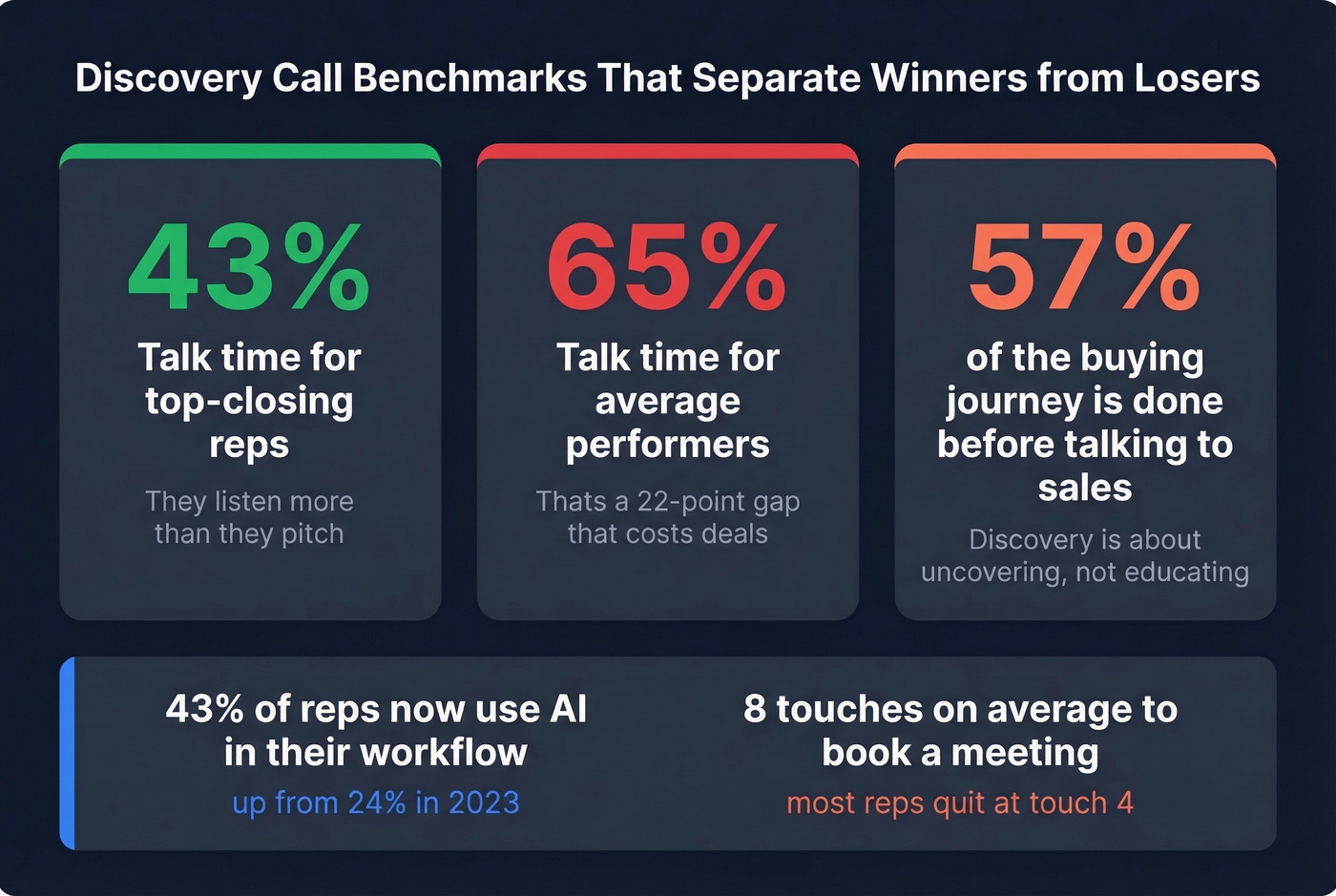
Gong's data is brutal: top-closing reps speak 43% of the time on discovery calls. Average performers hit 65%. That 22-point gap is the difference between understanding the buyer's world and pitching into a void.
57% of the buying journey is completed before a prospect talks to sales. They've already read your case studies, compared your pricing page to competitors, and formed opinions. Discovery isn't about educating - it's about uncovering the specific pain, the internal politics, and the decision timeline that no website can tell you.
43% of sales reps now actively use AI in their workflow, up from 24% in 2023. Conversation intelligence tools automatically flag talk-time ratios, competitor mentions, and pricing objections so managers can coach on patterns instead of guessing.
Exit criteria for discovery: you can articulate the prospect's problem better than they can, you know who else is involved in the decision, and you have a mutual action plan for next steps.
Stage 5 - Demo / Presentation
Three rules for demos that close:
Tie every feature to a discovery finding. If they said "our reps waste 3 hours building lists," show list building first. Generic product tours kill deals.
Multi-thread to the economic buyer. If only your champion attends the demo, you haven't earned the deal yet. Get the decision-maker in the room.
Set timeline expectations. The average B2B sales cycle runs 84 days. Don't promise a close in two weeks unless you've validated that timeline in discovery.
One more thing: invest in a decent camera and microphone. Buyers notice. A $100 webcam and a $50 USB mic pay for themselves on the first deal they help close.
Stage 6 - Objection Handling & Negotiation
Objections aren't rejections - they're process signals. "We need to check with legal" means you haven't mapped the decision process. "The price is too high" means you haven't connected value to their specific pain. "We're looking at competitors" means your champion isn't strong enough.
Every common objection traces back to a qualification or discovery gap. Teams that invest in battle cards and call reviews catch these patterns early. The best inside sales managers listen to 5-10 calls per week and coach on objection patterns, not scripts.
Stage 7 - Close & Handoff
If stages 1-6 were tight, the close is paperwork, not persuasion. E-signature tools like PandaDoc or DocuSign eliminate the "I'll send you a PDF" friction. CPQ tools handle complex pricing without spreadsheet errors.
What most teams botch is the handoff. The deal closes, the AE celebrates, and the customer success manager gets a Slack message with zero context. Clean CRM hygiene at close - notes on pain points, stakeholders, decision criteria, and implementation timeline - is what separates teams that retain customers from those churning at month three.
Quick Reference: All 7 Stages
| Stage | Key Activity | Exit Criteria |
|---|---|---|
| 1. Prospecting | ICP targeting, verified data | Clean list, <4% bounce rate |
| 2. Outreach | Multi-channel cadence | Meeting booked |
| 3. Qualification | BANT/CHAMP/MEDDIC | Champion + budget confirmed |
| 4. Discovery | Needs analysis, listen >57% | Mutual action plan set |
| 5. Demo | Pain-mapped presentation | Economic buyer engaged |
| 6. Objection handling | Battle cards, call coaching | All blockers resolved |
| 7. Close & handoff | E-sign, CRM notes, CS intro | Deal closed, context transferred |
The metric that ties all seven stages together is pipeline velocity: deals per stage x conversion rate x deal size / cycle length. If any stage is broken, velocity drops and you can see exactly where.

Stage 1 of your inside sales process lives or dies on data quality. Prospeo refreshes 300M+ profiles every 7 days - not the 6-week industry average - so your SDRs never start a cadence with stale contacts. 98% email accuracy means your domain stays clean and your reps stay in inboxes.
Stop losing deals at the prospecting stage. Start with data that's actually fresh.
Cadence Templates That Work
The cadence sweet spot is 8-12 touches over 17-21 days. Most reps quit at touch 4-5. That's not persistence - it's process failure. McKinsey found that systematic sales engagement drives 10-20% pipeline improvements. The cadence is the system.
If you want plug-and-play messaging, start with these follow-up templates.
Cold Outbound Cadence (8 Touches / 12 Days)
| Day | Channel | Action |
|---|---|---|
| 1 | Problem + proof + question | |
| 2 | Phone | Call + short voicemail |
| 3 | Specific outcome story | |
| 5 | Social | Signal-based touch + DM |
| 7 | Asset (60s video or screenshot) | |
| 9 | Phone | Reference asset, confirm priority |
| 11 | Handle common objection | |
| 12 | Breakup / graceful close |
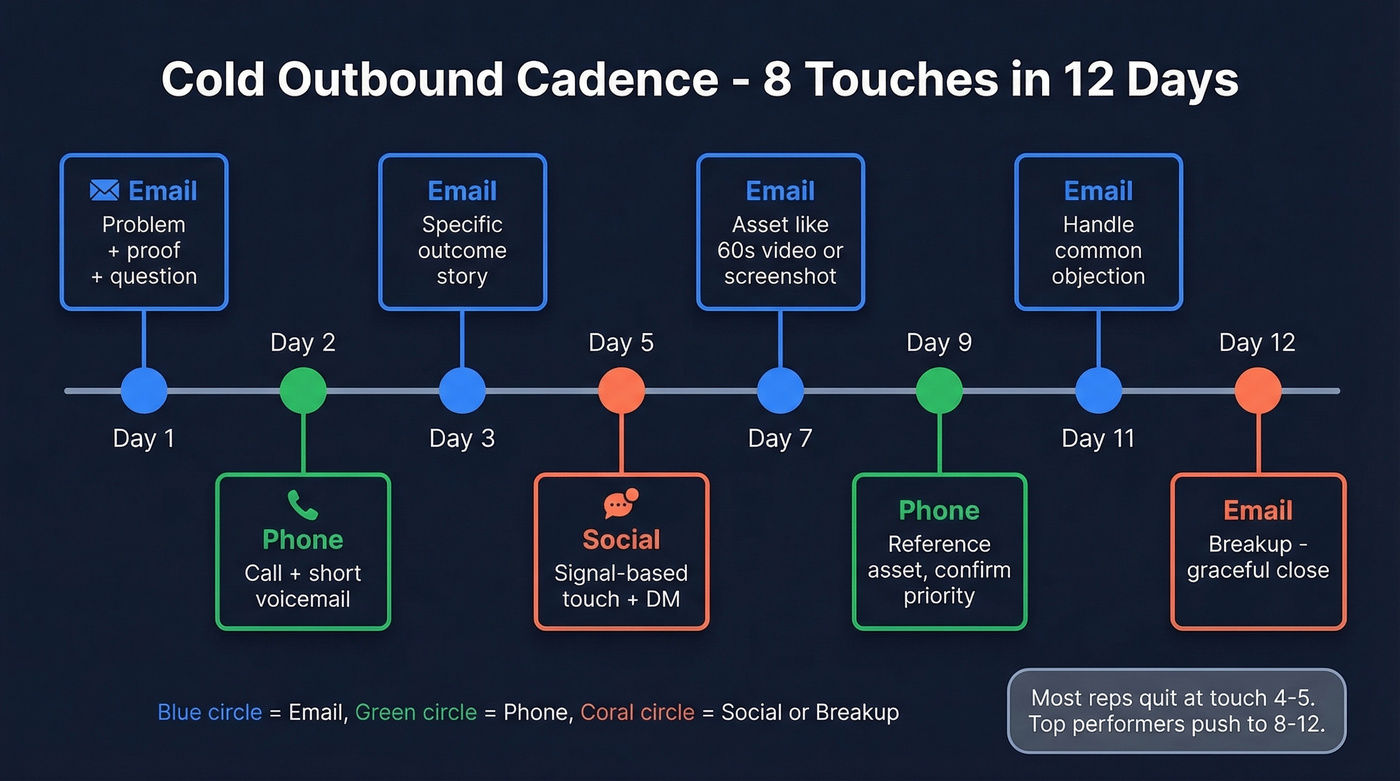
Notice the channel mix. Two calls out of eight touches - roughly 25%. That matches the data on phone driving disproportionate responses at 20-30% of total touches. The social touch on Day 5 should reference a real signal: a job change, a funding round, a relevant post. Generic "just connecting" messages get ignored.
Time those phone touches for 4-5 PM Wednesday or Thursday when connect rates peak.
Inbound Follow-Up Cadence (8-12 Touches / 10-15 Days)
| Day | Channel | Action |
|---|---|---|
| 1 | Phone | Call within 5 min of demo request |
| 2 | Follow-up with meeting link | |
| 3 | Social | Connect request with context |
| 4 | Proof point (case study) | |
| 6 | Phone | Call with specific question |
| 8 | Summary of value + next steps | |
| 10 | Breakup | |
| 30 | Light re-engagement |
The Day 1 phone call is non-negotiable for inbound. If your SDRs aren't calling inbound demo requests immediately, you're leaving the highest-intent leads on the table.
KPIs and Funnel Benchmarks
If your numbers fall below these, your pipeline has a leak. The question is which stage.
| Funnel Stage | B2B SaaS Benchmark |
|---|---|
| Lead to MQL | 39% |
| MQL to SQL | 38% |
| SQL to Opportunity | 42% |
| SQL to Closed Won | 37% |
Activity-level benchmarks for inside sales teams:
| Metric | Typical Range |
|---|---|
| Cold email reply rate | 3-8% |
| Cold call connect rate | 5-15% |
| Connect to meeting | 5-20% |
| Average B2B close rate | 29% |
The average B2B close rate of 29% means roughly 7 out of 10 qualified opportunities don't close. That's normal. The teams that outperform don't close at 80% - they fill the top of the funnel with better-qualified prospects and lose fewer deals to "no decision" in the middle stages.
Look at your stage-to-stage conversion rates. If Lead to MQL is strong but MQL to SQL drops off a cliff, your qualification criteria are too loose. If SQL to Opportunity is healthy but close rates are low, your discovery and demo stages need work. The funnel tells you where to focus.
Inside Sales Tech Stack
Most teams buy too many tools too early. Start with three - a CRM, a verified data source, and a sequencing platform. Everything else is optimization.
| Category | Tools | Est. Pricing |
|---|---|---|
| CRM | Salesforce, HubSpot | $0-$150/user/mo |
| B2B Data | Prospeo, ZoomInfo, Apollo | Free tier-$40k/yr |
| Sales Engagement | Outreach, Salesloft, Instantly, Lemlist | $30-$200/user/mo |
| Conversation Intel | Gong | Mid four-figures/user/yr |
| Dialer | CallHippo | $30-$100/user/mo |
| E-Sign / Scheduling | PandaDoc, Calendly | $10-$50/user/mo |
Most teams underestimate how much data enrichment and list hygiene affect every downstream metric.
The B2B Data row deserves a closer look. ZoomInfo runs $15k-$40k/year for most teams, and you're locked into an annual contract. Prospeo starts free with 75 verified emails/month plus 100 Chrome extension credits/month, and scales at roughly $0.01 per email with no contracts. For a 5-rep team doing serious outbound, that's a $25k+ line item versus a few hundred dollars a month - with higher email accuracy and weekly data refreshes.
The sales engagement platform market hit an estimated $7B in 2025 and is projected to reach $11.1B by 2033. Outreach and Salesloft dominate mid-market and enterprise. Instantly and Lemlist are popular choices for SMB teams and agencies running high-volume cold outreach.
Mistakes That Kill Your Pipeline
No dedicated inside sales manager. Without someone reviewing calls, coaching on objection patterns, and enforcing process, every rep runs their own playbook. That's not a team - it's a collection of freelancers.
Bad prospect data breaking everything downstream. This is the silent killer. High bounce rates don't just waste rep time - they destroy your sender domain reputation, which tanks deliverability for months. We've seen teams go from 38% bounce to under 4% just by switching their data source. Skip this if you think "good enough" data is fine - it isn't, and your deliverability will prove it.
Job creep loading reps with non-selling tasks. Data entry, list building, CRM admin, internal reporting. Every hour a rep spends on non-selling activities is an hour they're not in conversations. Audit your reps' calendars. If less than 60% of their time is actual selling activity, you have a job creep problem.
Over-indexing on product training, underinvesting in prospecting training. Your reps can recite every feature. They can't write a cold email that gets a reply. Flip the ratio. (If you need a refresher, start with these sales prospecting techniques.)
CRM not configured for inside sales workflows. If your CRM doesn't track attempts, completed calls, decision-maker conversations, and stage-level conversion rates, you're flying blind. Default CRM setups are built for marketing, not inside sales.
Leaving calling and data strategy to individual reps. Some prospects get called five times in a week. Others never get touched. Centralized cadence management and territory rules fix this.
Talking too much on discovery calls. I can't stress this enough. If your reps are at 65% talk time, they're pitching, not discovering. The target is 43%. Record calls, measure the ratio, and coach relentlessly.
Your reps are running 8-touch cadences across email, phone, and LinkedIn. One bad number or bounced email breaks the whole sequence. Prospeo delivers 143M+ verified emails and 125M+ verified mobiles with a 30% pickup rate - so every channel in your cadence actually connects.
Give your inside sales team contacts that pick up and inboxes that don't bounce.
FAQ
What's the difference between inside sales and telemarketing?
Inside sales is consultative, multi-touch, and relationship-driven - reps manage accounts over weeks or months using phone, email, video, and social. Telemarketing is scripted, single-call, and transactional. Different skill sets, different outcomes.
Which qualification framework should I use?
BANT works for deals under $50k with 1-3 stakeholders. MEDDIC is the standard for enterprise deals above $100k with 6-10+ decision-makers, correlating with 18% higher win rates. When in doubt, start with simplified MEDDIC.
How many touches does it take to book a meeting?
Eight on average, according to RAIN Group research. Most reps quit at touch 4-5, abandoning prospects right before the inflection point. Build cadences with 8-12 touches over 17-21 days across email, phone, and social.
What tools do I need to start an inside sales team?
Three essentials: a CRM (HubSpot's free tier works), a verified data platform like Prospeo (free tier includes 75 emails/month), and a sequencing tool like Instantly or Lemlist from ~$30/mo. That's under $100/month per rep. Add conversation intelligence once you have enough call volume to justify it.
What are the stages of an inside sales process?
Seven stages: prospecting and list building, initial outreach, qualification, discovery and needs analysis, demo/presentation, objection handling and negotiation, and close with handoff. Each stage has specific exit criteria - advancing a deal without meeting them is how pipeline stalls.