

The Definitive Guide to Hiring an Interim Sales Manager
Your VP of Sales just gave two weeks' notice. Q3 pipeline review is in 30 days. The board wants to know who's running the number. You start looking for an interim sales manager and find a wall of staffing agency pitches, job board listings, and articles that define the term like you've never heard of management before. None of them tell you what it actually costs, what the first 90 days look like, or when you should skip the interim route entirely.
In our experience, most companies wait four to six weeks too long before pulling the trigger on interim leadership. That delay costs more than the temporary hire ever will.
The Quick Decision Framework
- $10M+ revenue, 10+ reps, sudden leadership gap - hire a full-time interim. Expect $200K-$350K/year for a 6-12 month engagement.
- $1M-$10M revenue, 2-10 reps - go fractional. $10K-$12K/month for 10-15 hours a week gets you strategic leadership without the overhead.
- Just need a sales process audit - skip both. Hire a consultant for 4-8 weeks, get a playbook, and move on.
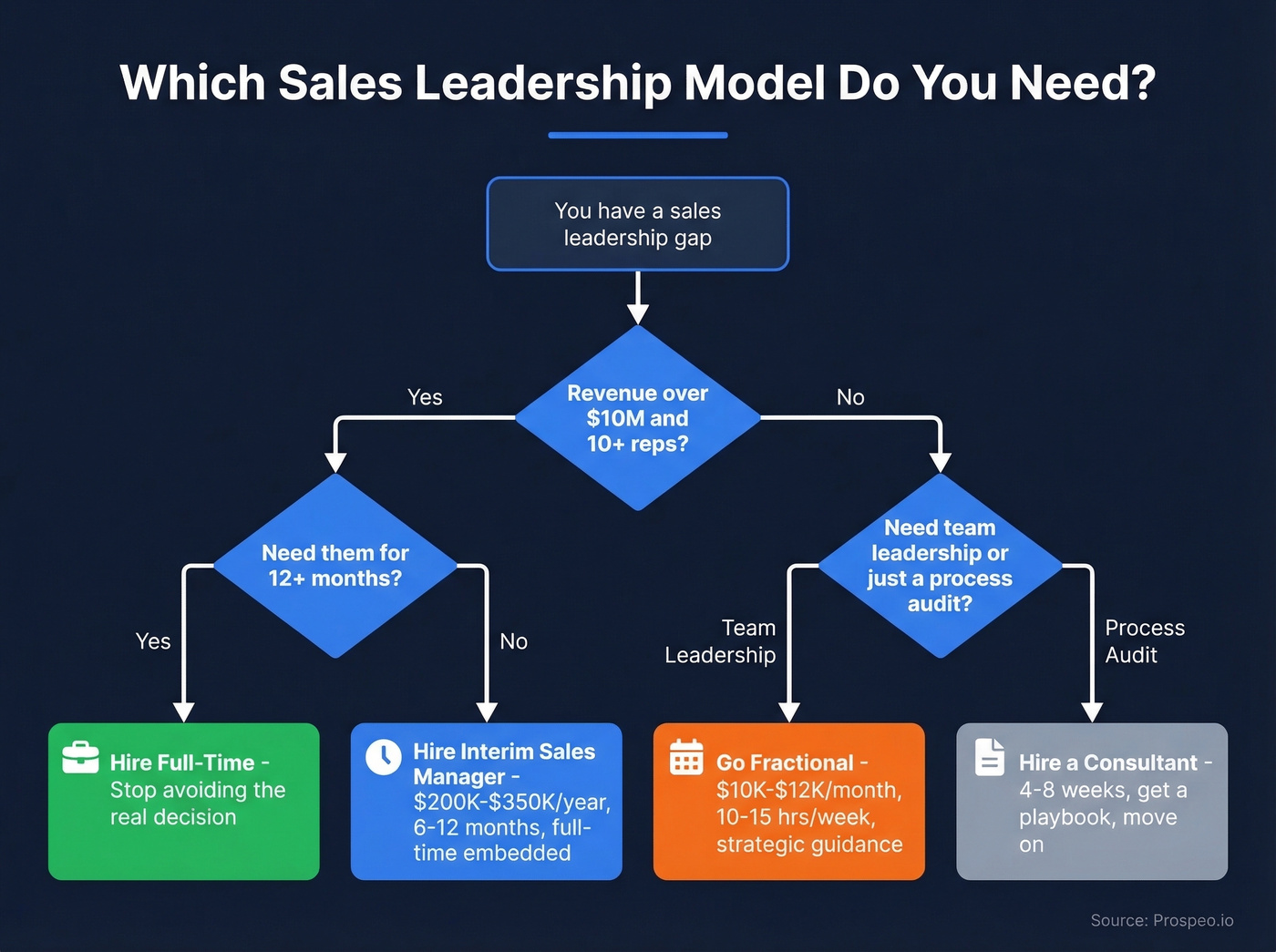
Here's the thing: if you need someone for 12+ months, just hire permanently. An interim engagement that drags past a year is a sign you're avoiding a real hiring decision.
What Does This Role Actually Mean?
An interim sales manager is a full-time, temporary sales leader who steps into your organization with execution authority. They run the team, own the number, hire, fire, coach, and build pipeline - just like a permanent VP of Sales, but with a defined end date.
A fractional sales leader works part-time, typically 5-15 hours per week, over a longer engagement. They advise and guide but aren't embedded daily. A sales consultant is advisory only - no direct reports, no team authority, no ownership of outcomes. They deliver a report and leave.
ZRG Partners frames the decision around three questions: Are you leading a team or advising one? Is this a short-term fix or a long-term gap? Do you need someone embedded daily or checking in periodically? If the answers are "leading," "short-term," and "embedded," you need an interim.
When to Hire One
VP departure with no succession plan. The most common trigger. Pipeline doesn't pause while you run a 90-day executive search. Deploy within two weeks of a leadership vacancy.
M&A integration. Two sales teams, two CRMs, two comp plans, zero alignment. A temporary leader can rationalize the mess without the political baggage of picking a side.
Turnaround or crisis. Revenue's falling, reps are leaving, and the board's patience is running out. An interim brings urgency without the ramp time of a new permanent hire.
Rapid scaling. You've closed a funding round and need to double the team in six months. An interim builds the hiring process, onboarding playbook, and territory model while you search for a long-term leader.
Product launch without sales leadership. New market, new motion, no one to run it. A seasoned interim can stand up the GTM function from scratch.
Audit and restructure. The team exists but isn't performing. You need someone to assess, restructure, and hand off a clean operation.
One warning: don't default to promoting someone internally as "acting" sales leader. This pattern shows up repeatedly in sales leadership forums - an internal leader serves as Interim VP of Sales for six months while still doing their real job, then the company hires an external candidate anyway. If you're going interim, commit to the model.
Interim vs. Fractional vs. Full-Time
| Interim | Fractional | Full-Time | |
|---|---|---|---|
| Weekly hours | 30-40 | 5-15 | 40+ |
| Engagement | 6-24 months | 12-48 months | Permanent |
| Company size | $10M+ revenue | $1M-$10M revenue | Any |
| Team size | 10+ reps | 2-10 reps | Any |
| Annual cost | $200K-$350K | $120K-$180K | $250K-$500K+ |
| Best for | Leadership vacuum, 10+ reps | Growing teams, under $10M | Long-term, any size |
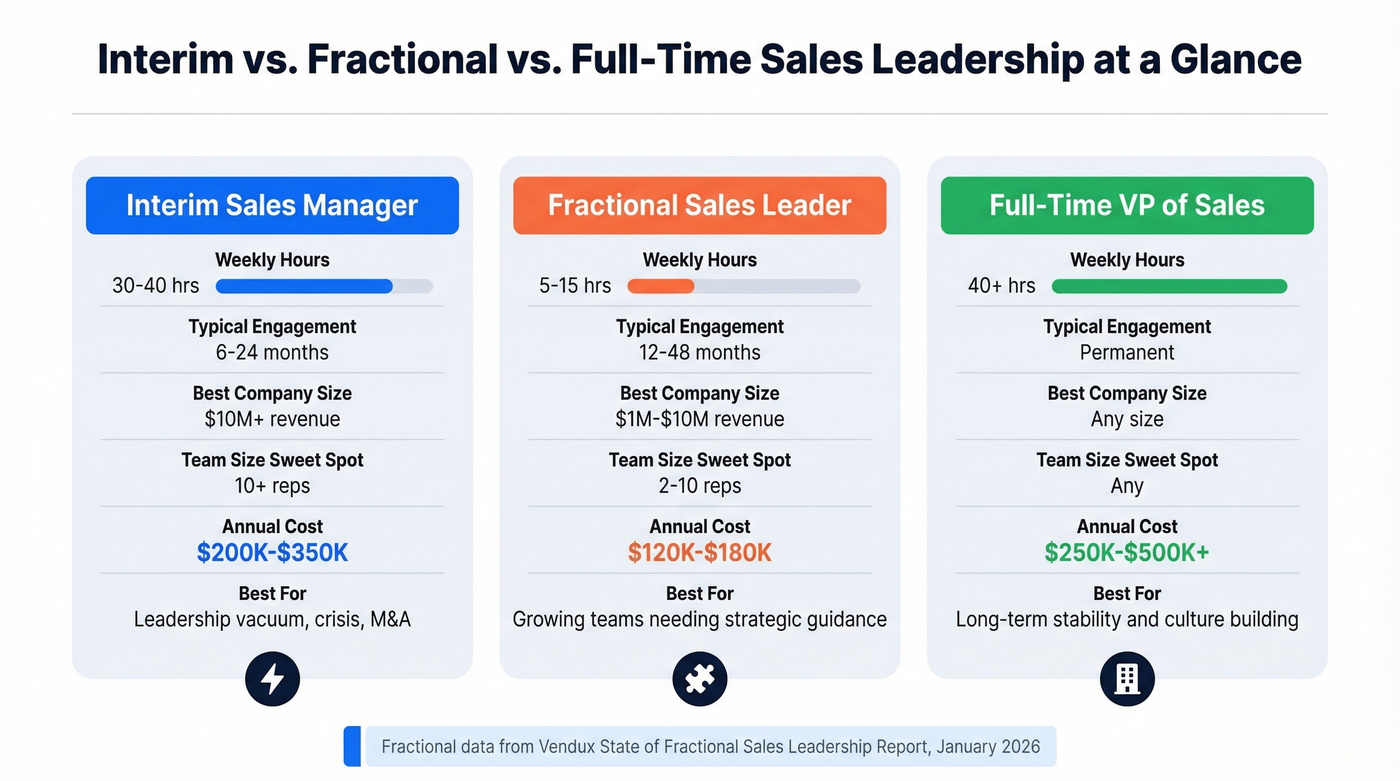
The fractional numbers come from Vendux's State of Fractional Sales Leadership report released in January 2026: average monthly compensation of $11,732, average hourly rate of $225, and an average engagement of 9.7 months at 14.6 hours per week. The interim ranges align with SalesQB's comparison data.
For most companies under $10M revenue, fractional is the better choice. You don't need 40 hours a week of sales leadership when you have four reps. You need someone who sets the cadence, coaches the deals, and builds the process - then gets out of the way.

An interim sales manager's first job is separating real pipeline from dead contacts. Prospeo's bulk verification checks your entire CRM against 300M+ profiles with 98% email accuracy - at roughly $0.01 per email. Know exactly what your new leader is working with before week one ends.
Give your interim clean data from day one.
The First 90 Days
The difference between a great interim and an expensive seat-warmer shows up in the first two weeks.
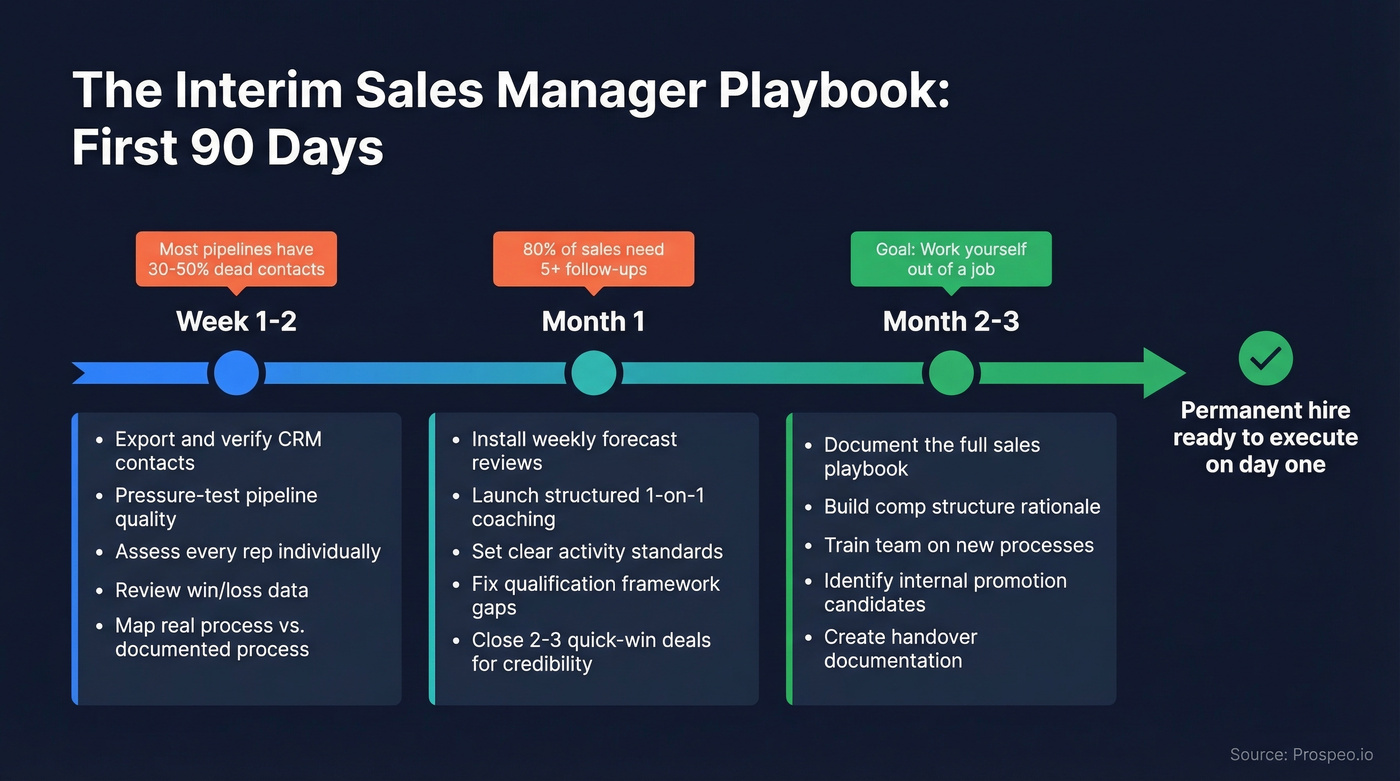
Week 1-2: Audit and Assess
Everything starts with data. A competent interim sales manager's first move is exporting the CRM contact list and pressure-testing its quality through a verification tool like Prospeo - 98% email accuracy across 300M+ profiles at roughly $0.01 per email. In hours, not weeks, you know exactly how much of your pipeline is real and how much is built on dead contacts.
Simultaneously, the interim assesses every rep. Who's performing? Who's coasting? They review win/loss data, sit in on calls, and map the current sales process against what's actually happening in the field.
Month 1: Operating Rhythm
This is where the interim earns their fee. They install the cadences that hold a sales team together: weekly forecast reviews, structured 1:1s, daily standups for pipeline generation, and clear activity standards. No ambiguity, no "we'll figure it out next quarter."
Process gaps get fixed fast. If reps don't have a defined qualification framework, they get one. If the handoff from marketing is broken, it gets rebuilt. The interim identifies two or three quick wins - deals stuck in pipeline, pricing misalignments, territory overlaps - and closes them to build credibility with the team.
Let's be honest: 44% of unsuccessful salespeople stop pursuing a prospect after a single objection, and 80% of sales require at least five follow-ups. A good interim instills a prospecting-first mentality. They build the discipline that outlasts their engagement. (If you need ready-to-use sequences, keep sales follow-up templates on hand.)
We see this repeatedly with remote teams: a rep "acts like they understand" but logs zero activity and surfaces confused two weeks later. An interim managing remote reps needs to build inspection cadences immediately - daily CRM hygiene checks, recorded call reviews, and structured accountability that doesn't feel like micromanagement but absolutely is.
Month 2-3: Build for the Successor
The best interims work themselves out of a job. They document the playbook - the sales process, the comp structure rationale, the territory model, the coaching framework - so the permanent hire can walk in and execute from day one. They train the team on the new process, identify internal candidates for promotion, and create the handover documentation that most companies never bother with until it's too late.
How Much It Costs
Nobody puts real numbers on their website. Here are the actual figures.
US Rates
| Model | Cost Range |
|---|---|
| Full-time interim | $200K-$350K/year |
| Day rate | $1,000-$2,500/day |
| Fractional (monthly) | ~$11,732/month avg |
| Fractional (hourly) | ~$225/hour avg |
Glassdoor's median for a general "Interim Manager" in the US sits at $97K/year as of early 2026, but that's not sales-specific. Sales leadership commands a premium because of the direct revenue impact. A VP-level interim running a 15-person team in a $20M+ company will land in the $250K-$350K range.
DACH and European Rates
The European interim market is mature and well-benchmarked. AIMP's 2025 Market Study puts average daily rates at EUR 1,338 in Germany, EUR 1,712 in Switzerland, and EUR 1,282 in Austria. For senior sales leadership, expect EUR 1,800-2,200/day.
A useful heuristic: the "1% rule." An interim's net day rate roughly equals 1% of the gross annual salary for a comparable permanent role. A EUR 180,000/year sales director translates to roughly EUR 1,800/day as an interim. The DACH interim management market ran EUR 3.09B in 2024, with Germany accounting for about 78% of that volume.
What Results to Expect
The most concrete case study we've found: a PE-owned industrial services company brought in external sales leadership for a 16-week engagement. The result was nearly 5X ROI on reported EBITDA, with project costs recovered in under three months. The work included territory restructuring, pipeline process buildout, new reporting cadences, and sales team realignment.
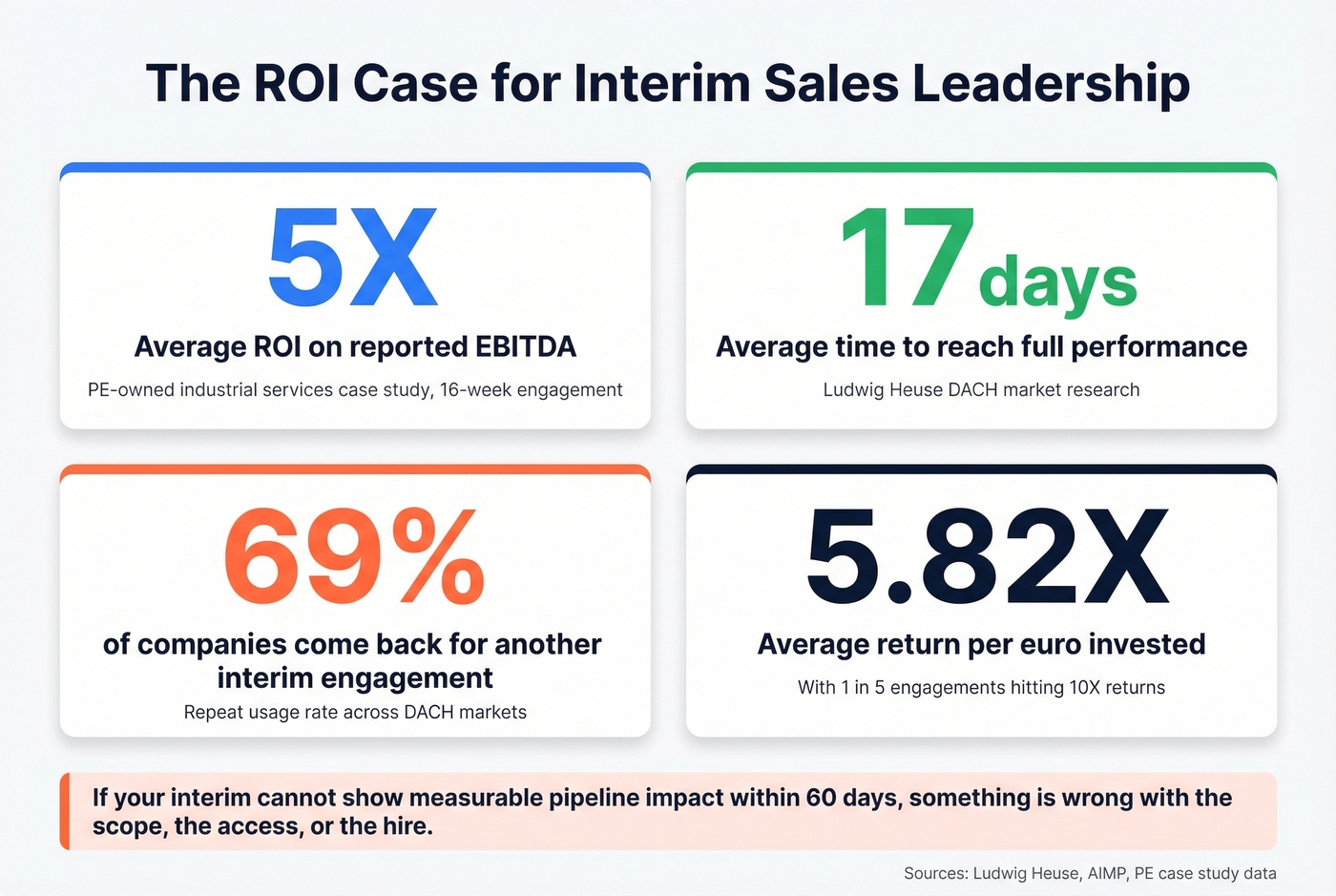
DACH market data reinforces this. Ludwig Heuse studies report an average ROI of 5.82 per euro invested, with one in five engagements delivering 10X returns. Interims reach full performance after just 17 project days, and 69% of companies that use interim managers come back for another engagement.
If your interim can't show measurable pipeline health impact within 60 days, something is wrong with the scope, the access, or the hire.
Common Failure Modes
The most vivid failure mode comes from a Reddit thread where a temporary sales leader turned loose guidelines into rigid KPIs - demanding 15-18 logged CRM calls as hard targets, requiring make-up activity for prior weeks, and mandating multiple recorded calls per week. Experienced AEs felt managed like SDRs. The interim forced their style onto the team without understanding the existing culture or the autonomy that senior reps need to perform.
That's the failure mode to watch for: overcorrection. Someone who comes in swinging with process and inspection before earning the team's trust will destroy morale faster than a leadership vacuum would.
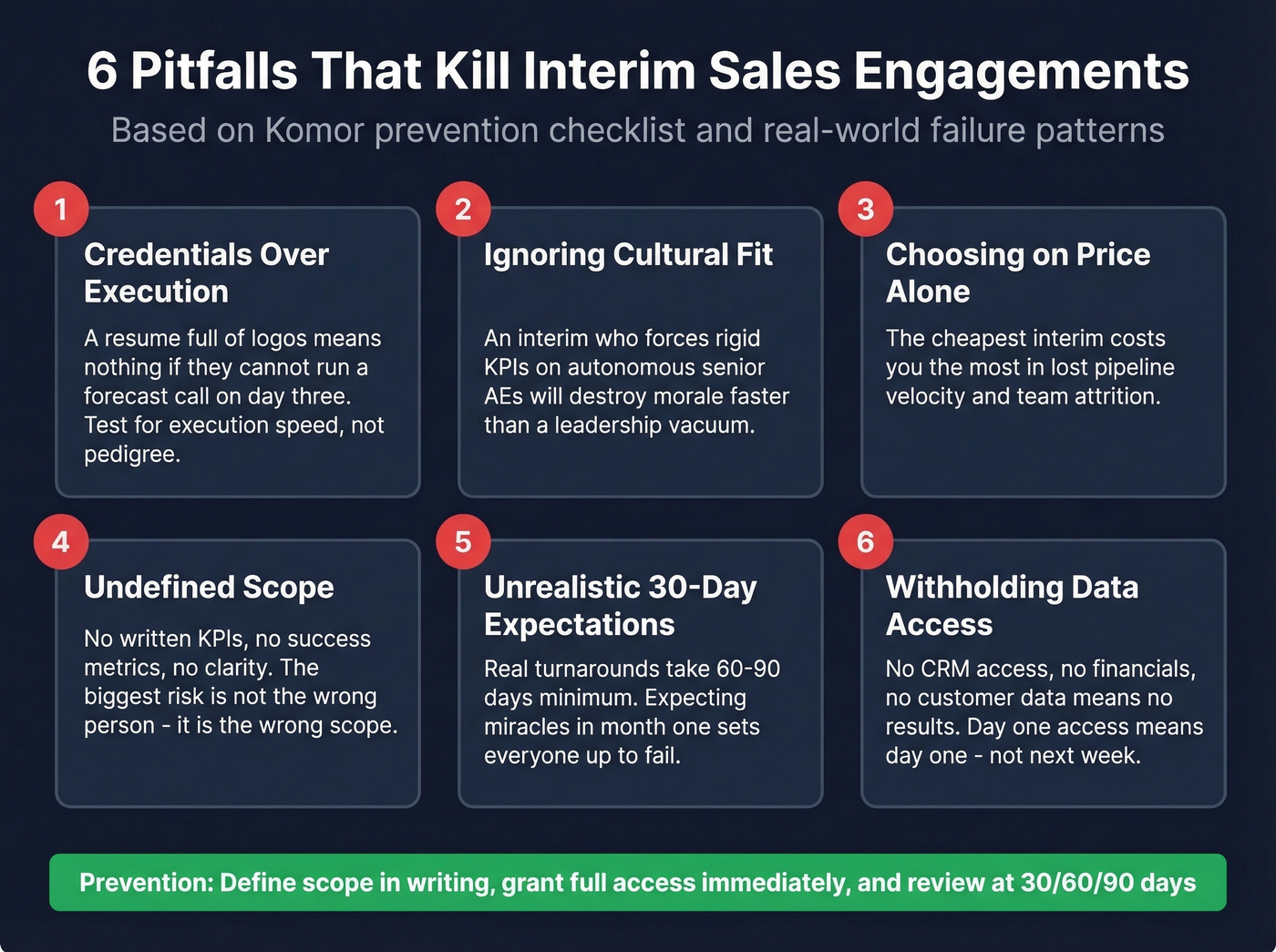
Komor's six pitfalls provide a solid prevention checklist: overweighting credentials over execution ability, ignoring cultural fit, choosing on price alone, leaving scope undefined, setting unrealistic 30-day turnaround expectations, and withholding CRM and financial data access. Skip this list at your own risk.
The biggest risk isn't hiring the wrong person. It's giving them the wrong scope.
Setting Up for Success
Six things to do before your interim's first day:
- Define scope and success metrics in writing. Pipeline coverage ratio, forecast accuracy, rep retention - pick three to five KPIs and agree on targets.
- Grant full CRM and data access immediately. No "we'll get you set up next week." Day one means day one.
- Introduce the interim to key stakeholders in week one. CEO, CFO, marketing lead, top customers. Political capital matters.
- Set a 30/60/90-day review cadence. Check progress formally, not just in hallway conversations.
- Plan handover documentation from the start. The playbook your interim builds is half the value of the engagement.
- Equip them with the right tools from day one. A verified data platform eliminates the "bad data" excuse and gives them a clean pipeline to work with immediately, so the first weeks are spent selling - not cleaning spreadsheets.
Building a successor-ready playbook means arming reps with verified contact data that doesn't decay. Prospeo refreshes every record on a 7-day cycle - not the 6-week industry average - so the process your interim builds keeps working long after they leave.
Stop handing your permanent hire a database full of dead emails.
FAQ
How long does an interim engagement last?
Most interim sales manager engagements run 6-24 months, while fractional arrangements average 9.7 months. If you're still extending past 18 months, convert the role to permanent - you've already proven the need exists.
What's the difference from a sales consultant?
An interim manages the team with full execution authority - they hire, fire, and own the number. A consultant advises but has no direct reports. Daily decisions and team leadership = interim. Diagnosis and playbook delivery = consultant.
Can they work remotely?
Yes, but only with aggressive accountability systems: daily standups, CRM hygiene standards, recorded call reviews. Remote interims succeed when they over-index on structured check-ins during the first 30 days and use verified data to keep pipeline audits objective rather than anecdotal.
What should they accomplish in 30 days?
Audit pipeline data, assess every rep, establish a forecast cadence, identify two to three quick wins, and document the current state. The first 30 days are about diagnosis and credibility - not wholesale transformation.
Is the cost justified for smaller teams?
DACH studies show an average ROI of 5.82 per euro invested in interim leadership. For teams under $5M revenue, a fractional model at $10K-$12K/month often delivers the same strategic impact at a fraction of the cost. The expense of having no sales leadership - pipeline decay, rep attrition, missed quota - almost always exceeds the fee.