

How to Introduce Yourself to a Client via Email - Without Making It About You
You just got assigned a new book of business. Your manager says "send intro emails by Friday." You open a blank compose window and type your name, your title, your years of experience - and you've already lost them.
The best client introduction emails aren't about you at all. They're about what changes for the client now that you're here.
What You Need (Quick Version)
- Lead with what you'll do for the client, not your resume
- Keep it under 5 sentences with a single, specific CTA
- Add one personalized detail that proves you did research
- Verify the email address before sending - bounced intros waste goodwill and time
Research the Client First
Every line should answer the client's unspoken question: what's in it for me? You can't answer that without homework. Before drafting, check their business and competitive position, your contact's role and tenure, and any recent news you can reference naturally - funding rounds, product launches, leadership changes.
One step people forget: verify the email address. Contact data goes stale fast, especially when accounts change hands. A bounced intro email is worse than no email at all - it signals sloppiness before you've even had a conversation. We use Prospeo for real-time verification (98% accuracy, free tier covers 75 verifications a month), but whatever tool you pick, don't skip this step. If you need options, compare email verification tools before you commit.

Anatomy of a Strong Client Intro Email
Five parts. No more.
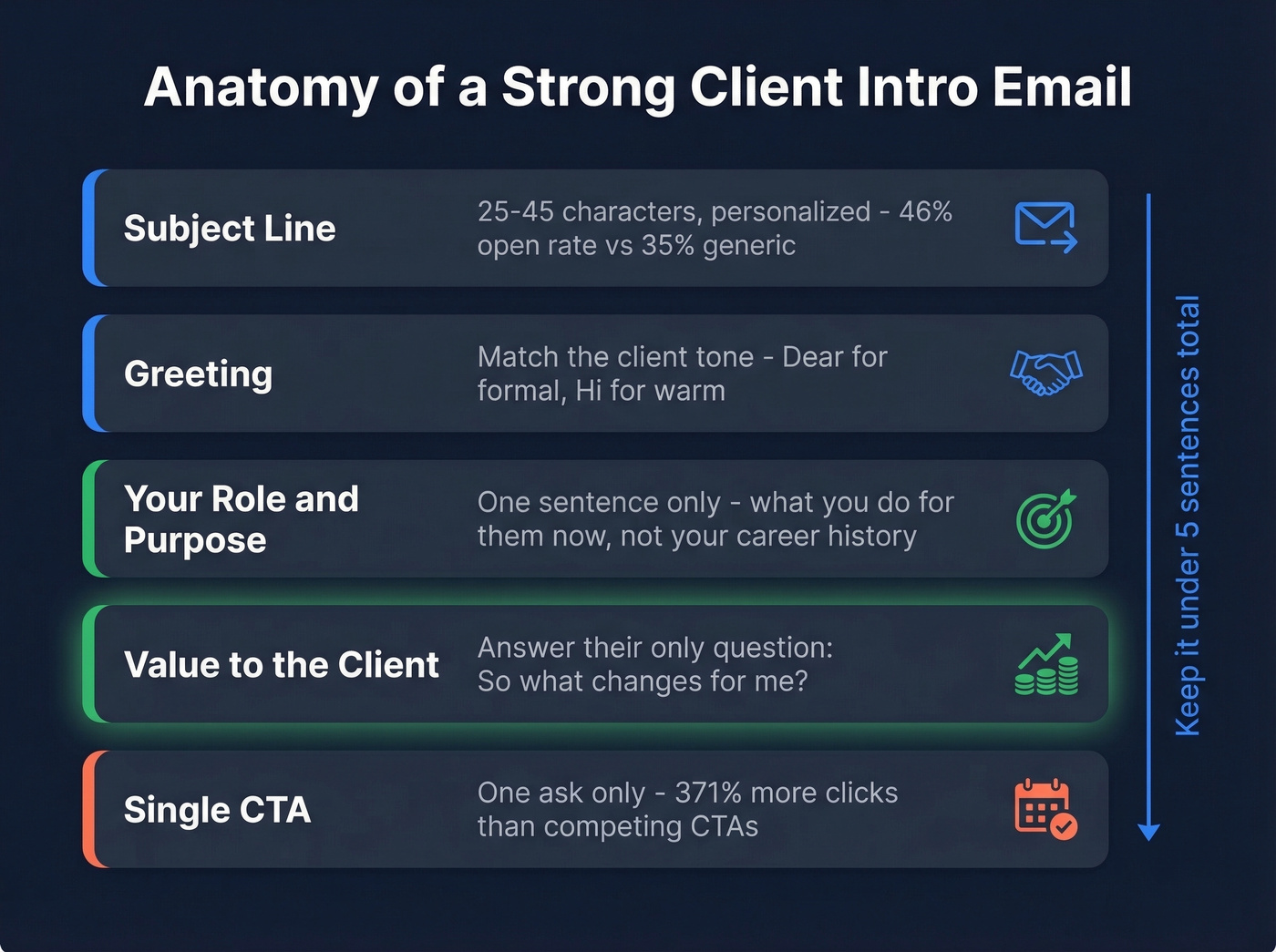
Subject line. Personalized subject lines hit 46% open rates versus 35% for generic ones. Stay between 25-45 characters so mobile doesn't truncate. "Your new point of contact at [Company]" beats "Introduction" every time. If you want more ideas, pull from these subject lines.
Greeting. Formal contexts get "Dear [Name]:" with a colon. Warmer relationships get "Hi [Name]," with a comma. Match the client's tone from previous correspondence - if their last email started with "Hey," don't open with "Dear Mr. Thompson."
Your role and purpose. One sentence. Not your career history, just what you do for them now.
Value to the client. This is where most people fumble. They default to talking about themselves instead of answering the only question the client has: "So what?" Welcome emails average 83% opens while cold intros sit around 28%, so your client intro should land somewhere in between depending on the existing relationship. One caveat worth knowing: Apple Mail Privacy Protection inflates open rates by roughly 18 points across 46% of email clients, so reply rate is a more reliable signal that your intro actually landed. If you're trying to improve outcomes, focus on emails that get responses, not vanity metrics.
A single CTA. One ask. Not three. Emails with a single CTA increase click-through by 371% compared to emails with competing asks. "15 minutes, here's my calendar link" is almost always stronger than "let me know what works" because it removes the back-and-forth. If you want to tighten this up, use proven email call to action patterns.

A bounced intro email kills the relationship before it starts. Prospeo verifies emails in real time with 98% accuracy and a 7-day data refresh cycle - so you're never sending to stale contacts. The free tier covers 75 verifications a month, enough to nail every new client introduction.
Verify every client email before you send that first impression.
6 Templates You Can Steal
Account Handoff (Replacing Someone)
What if the client already has a bad taste from the last rep? Your job is to signal continuity and competence fast. This template works well for transitions where trust needs rebuilding.
Subject: Picking up where [Previous Rep] left off
Hi [Name],
I'm [Your Name], your new [Role] at [Company]. I've reviewed your account history and want to make sure nothing falls through the cracks.
Could we grab 15 minutes this week so I can hear what's working and what isn't? [Calendar link]
Best, [Your Name]
For a more formal tone, swap "Hi" for "Dear" and "grab 15 minutes" for "schedule a brief call." If you're doing a full transition, a dedicated handoff email can help.
New Account Manager / CSM Introduction
The most common scenario. You've inherited a book of business and need to introduce yourself to existing contacts. Keep it short, give them an agenda so the meeting feels worth their time.
Subject: New CSM - quick intro
Hi [Name],
I'm [Your Name], your new CSM at [Company]. I'd love 15 minutes to hear what success looks like right now and align on your goals for [current quarter]. Here's my [calendar link].
PS - Congrats on [specific thing from their site or news]. Would love to hear more.
Best, [Your Name]
That PS line is doing real work. It proves this isn't a copy-paste intro.
New Client Welcome / Onboarding
The client just signed. They're excited but uncertain about what happens next. Remove that uncertainty.
Subject: Welcome aboard - here's what happens next
Hi [Name],
I'm [Your Name], your primary contact through onboarding. This week: dashboard access within 24 hours, a getting-started guide, and a 30-minute kickoff call. If anything comes up before then, reply here or reach me at [phone/Slack].
Looking forward to it, [Your Name]
Project Kickoff Introduction
Different from onboarding - this is for a specific engagement with defined scope.
Subject: [Project Name] kickoff - your point of contact
Hi [Name],
I'm [Your Name], leading [Project Name] on our side. Scope: [one-line summary]. Timeline: [start] through [end]. First deliverable: [what and when].
Can we do 20 minutes this week to confirm priorities? Does [Day] at [Time] work?
Best, [Your Name]
Warm Introduction via Mutual Connection
When someone refers you, make the email easy for the referrer to forward. Don't bury the mutual connection three paragraphs deep - lead with it.
Subject: [Mutual Contact] suggested we connect
Hi [Name],
[Mutual Contact] mentioned you're working on [specific challenge] and thought we should talk. I'm [Your Name] at [Company] - we help teams [one-line value prop].
Would 15 minutes next week make sense? [Calendar link]
Best, [Your Name]
Cold Introduction to a Prospective Client
Every word has to earn its place here. No relationship exists yet, so lead with relevance, not credentials. This is the hardest version because there's zero existing trust.
Subject: [Specific result] for [their company type]
Hi [Name],
I noticed [Company] recently [specific trigger - hiring, funding, expansion]. We've helped similar teams [specific outcome with a number].
Worth a 15-minute conversation? [Calendar link]
[Your Name]
If you're building a full outbound motion, pair this with a B2B cold email sequence instead of a one-off.
When They Don't Reply
Here's the thing: most people give up after one email. That's a mistake. Most business relationships require 5-12 touchpoints before meaningful engagement, and only 8% of reps follow up more than five times. The math is obvious.
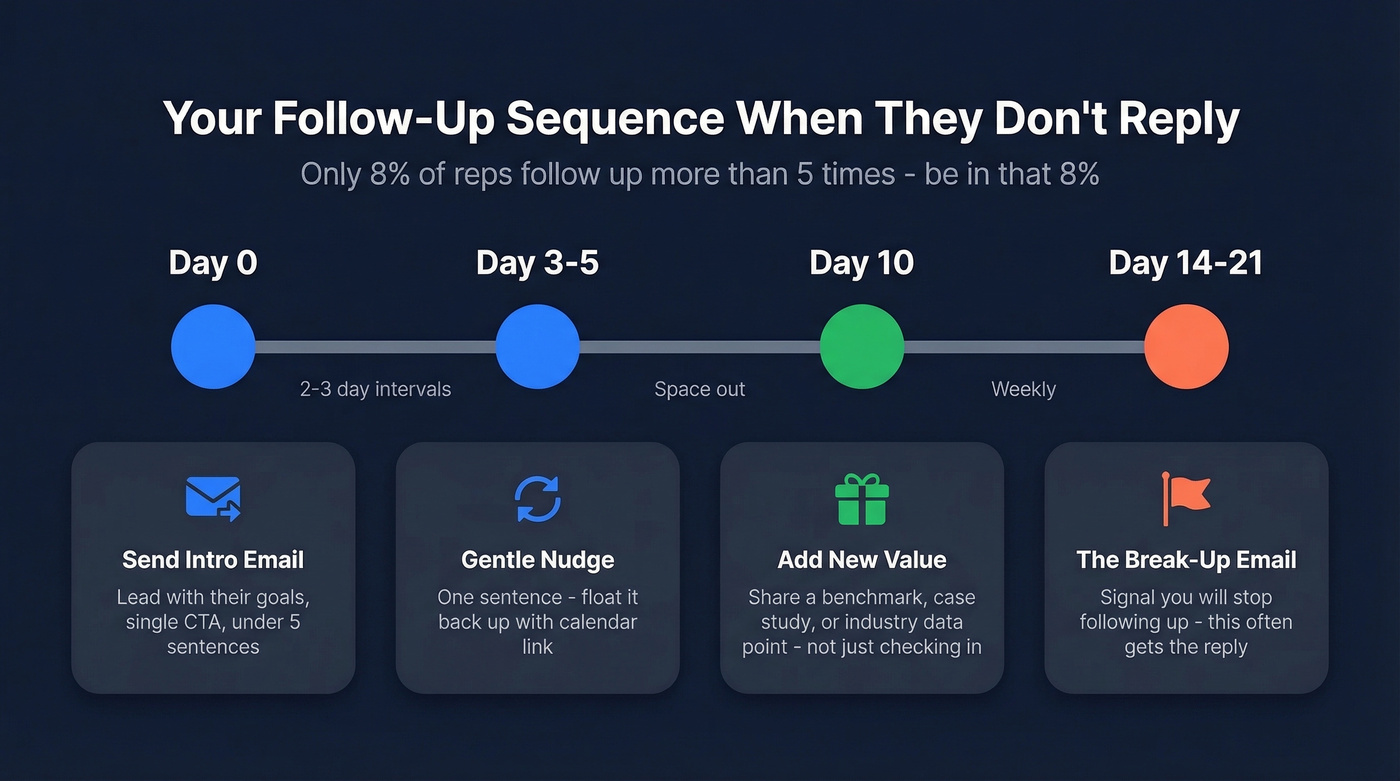
Day 3-5 - Gentle nudge. One sentence: "Just floating this back up - would love to find 15 minutes. [Calendar link]"
Day 10 - Add new value. Don't repeat your ask. Bring something useful: an article, a benchmark, a case study relevant to their situation. We've found that sharing a specific data point about their industry gets replies far more often than a generic "just checking in."
Day 14-21 - The break-up email. Signal you won't keep following up. This often gets the reply: "I don't want to crowd your inbox. If now isn't the right time, no worries - I'll close this thread."
Follow up at 2-3 day intervals for the first few touches, then space out to weekly. If you want ready-to-send copy, use these sales follow-up templates and adapt them to your account context.
Three Mistakes That Kill Client Intros
Peacocking. Extended bios nobody asked for. One poster in r/CustomerSuccess called it "pointless at best and tacky peacocking at worst." Your client doesn't care where you went to school. They care whether you'll make their life easier.
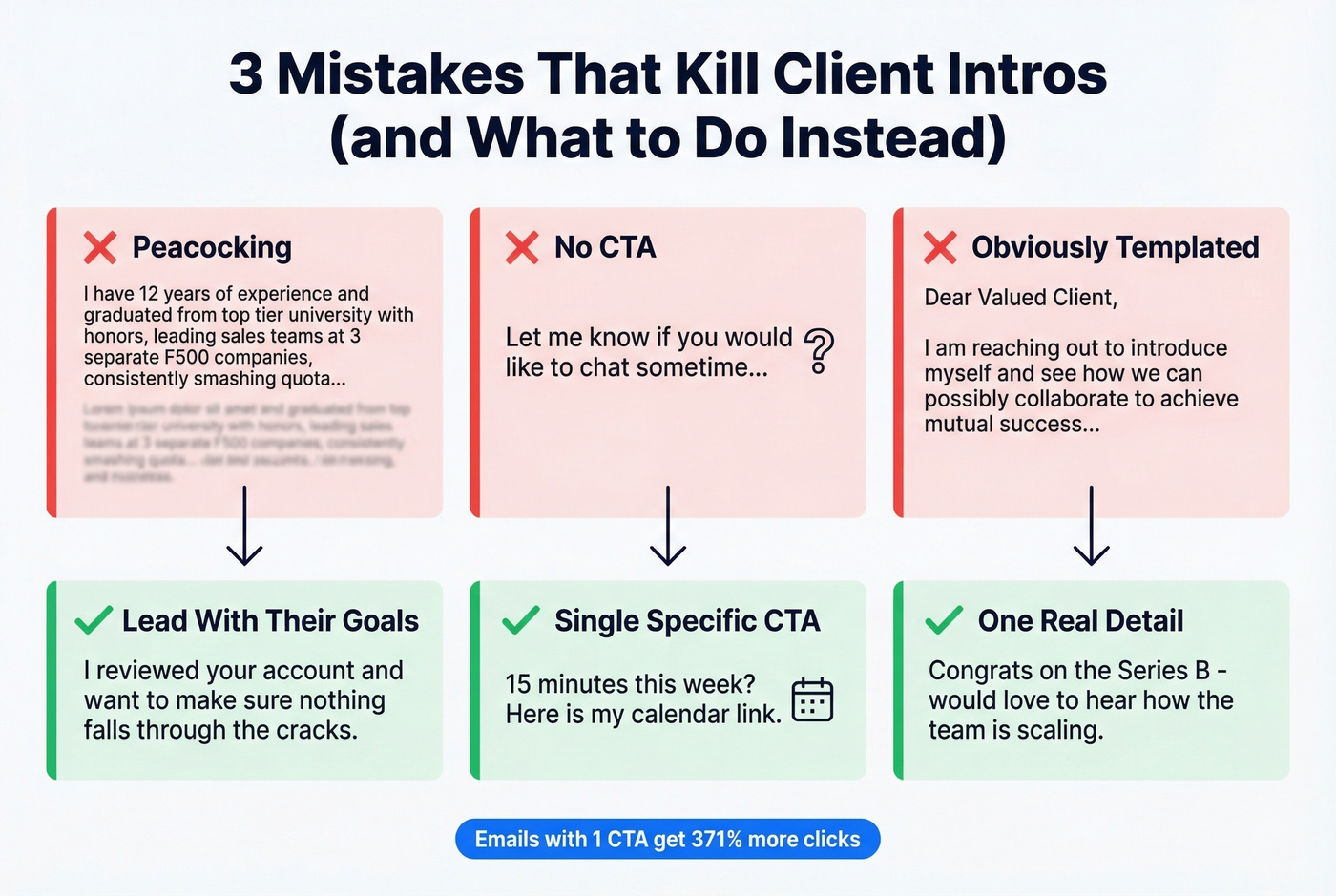
No CTA. If you don't tell them what to do next, they'll do nothing. "15 minutes, here's my calendar" beats "let me know if you'd like to chat sometime" every single time. It's not pushy - it's respectful of their time because it eliminates scheduling friction.
Obviously templated. Even one personalized line changes the feel of the entire email. Generic intros get generic responses, or none at all. Whether you're introducing yourself for the first time or reaching out to existing clients after an internal transition, personalization is what separates replies from silence. Skip the templates entirely if you can't be bothered to swap in at least one real detail about the recipient - a half-personalized email reads worse than a fully generic one because it shows you tried and still didn't care enough. If you need a system, start with personalized outreach.
Writing the perfect client intro email is half the battle. The other half is making sure it actually lands. Prospeo's Email Finder pulls verified emails from 300M+ professional profiles - so when accounts change hands and contacts go stale, you're reaching the right person, not a dead inbox.
Find and verify your new client's email in one click.
Quick-Reference Checklist
- Subject line under 45 characters, personalized
- One CTA only - don't split their attention
- Under 5 sentences total
- At least one personalized detail (company news, achievement, mutual connection)
- Verify the email address before sending
- Lead with their goals, not your background
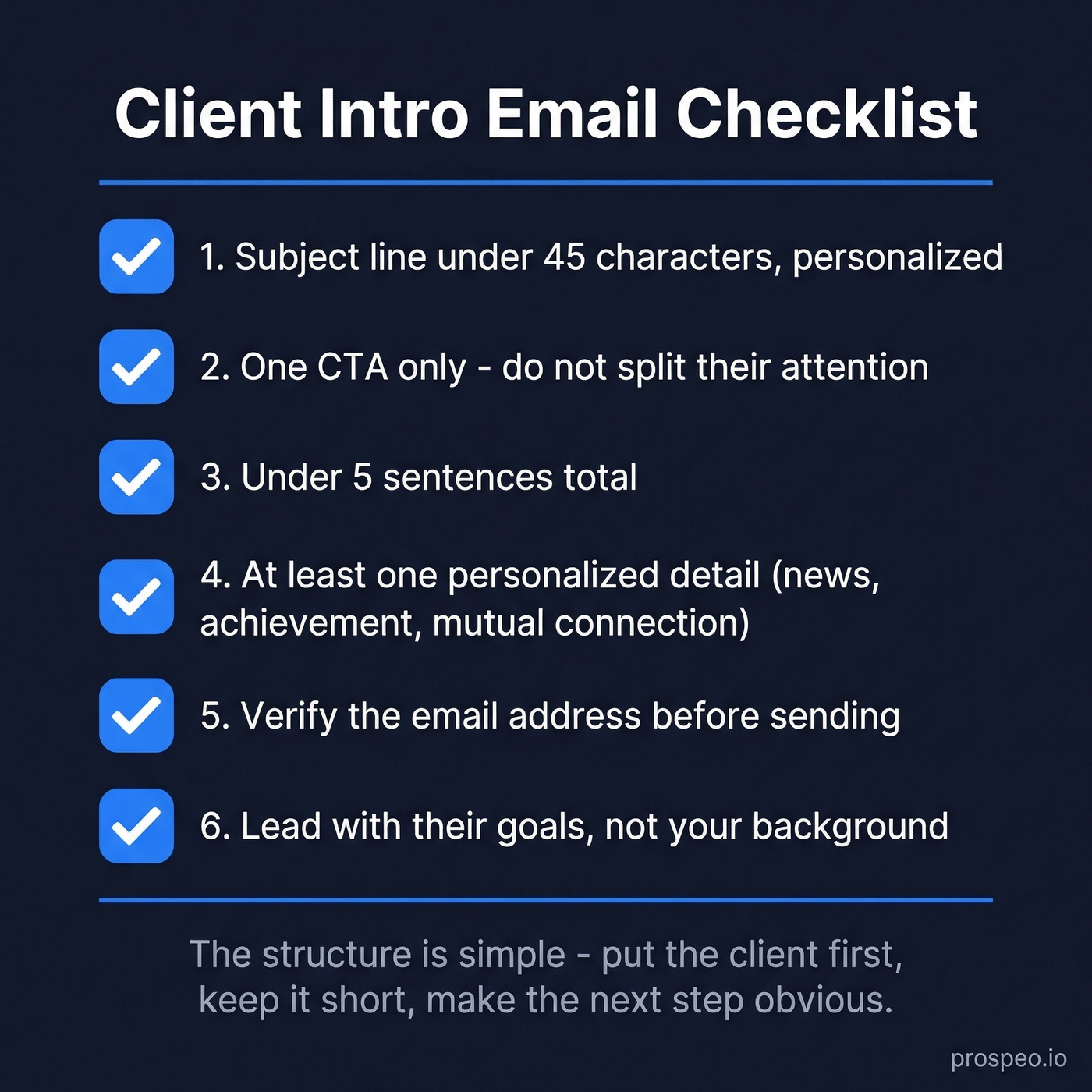
Let's be honest: the structure of a great client intro email isn't complicated. Adapt any of the templates above to match your industry's tone - formal for finance and legal, conversational for SaaS and creative agencies. The register shifts, but the bones stay the same. Put the client first, keep it short, and make the next step obvious.