

Is My IP Flagged? How to Check, Why It Happens, and How to Fix It
You're browsing normally, and suddenly every site throws a CAPTCHA at you. Cloudflare says "suspicious network activity." Google makes you prove you're human three times in a row. Or maybe you're an SDR whose bounce rate just spiked to 25%, and your sequences are dying in spam folders. If you're asking "is my IP flagged?" - something is definitely wrong, and the answer depends on what symptoms you're seeing.
Quick Answers by Symptom
Getting CAPTCHAs or Cloudflare blocks: Your IP reputation is degraded, but you're probably not on a formal email blacklist. Restart your router to grab a new dynamic IP, or contact your ISP for a fresh one.
Emails are bouncing: Check Spamhaus and MxToolbox immediately. A listing on a major blocklist can reduce deliverability by 90% within hours.
Streaming services think you're on a VPN: Your IP is misclassified in an IP intelligence database. Switch to mobile data to confirm the issue is IP-based, then contact your ISP.
Signs Your IP Is Flagged
Constant CAPTCHAs. Google, Reddit, and Cloudflare-protected sites keep asking you to prove you're human - especially in incognito mode. If it happens across multiple browsers, the problem is your IP, not your cookies.
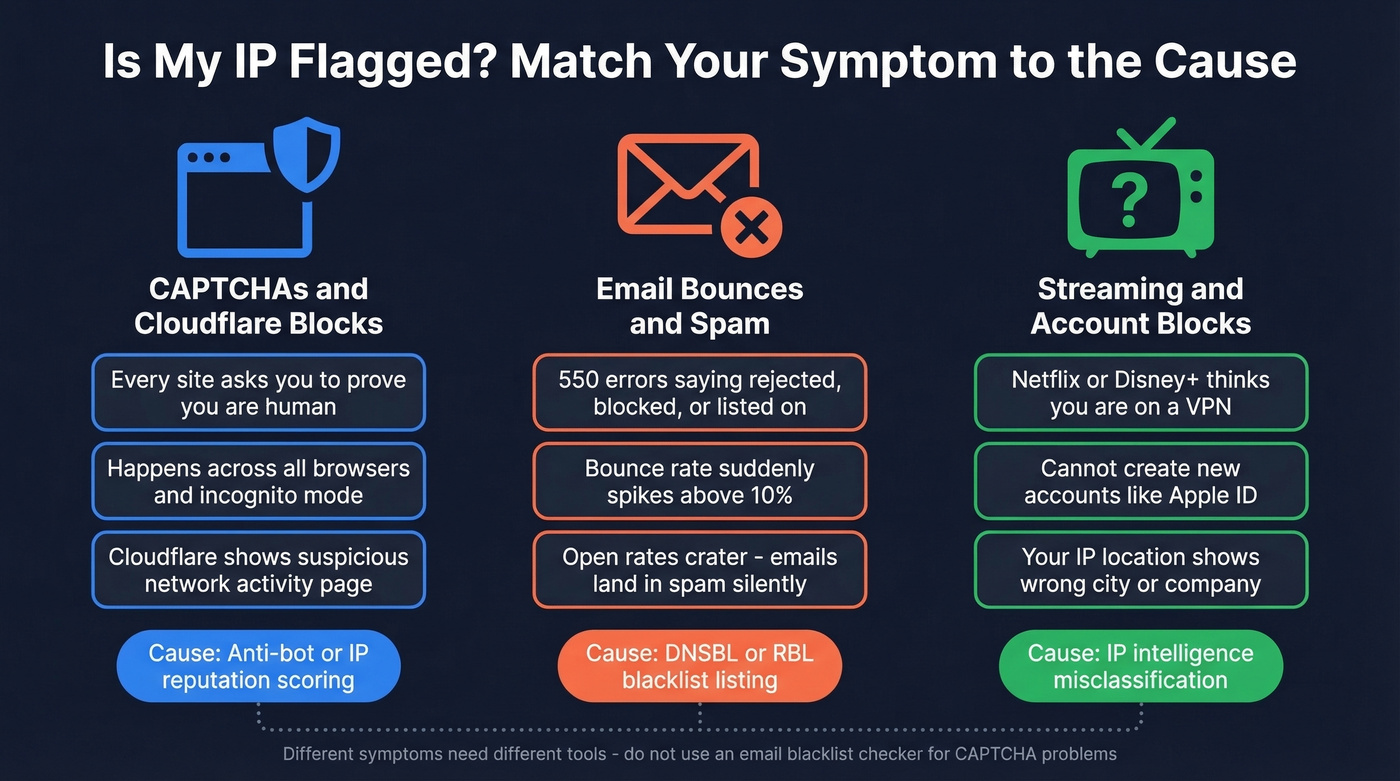
Email bounces with 550 errors. You're seeing "rejected," "blocked," or "listed on" messages in your bounce logs. This is the clearest sign of a DNSBL listing.
Streaming services can also misidentify your connection. One Ziply Fiber user on Reddit reported their home IP showing up as "Google" in Mountain View on whatismyipaddress.com - a textbook IP intelligence misclassification. Similarly, account creation can fail silently. A sysadmin on r/sysadmin described Apple Support having to manually "flip a switch" to allow account creation from their office IP because anti-bot systems had flagged the entire range.
Throttled email delivery without bounces is the sneakiest variant. Your emails aren't bouncing, but open rates have cratered because messages are landing in spam or being silently deprioritized. We've seen outbound teams lose weeks of pipeline before realizing their IP reputation had tanked.
How to Check If Your IP Is Flagged
Most people get this wrong: they jump straight to a blacklist checker when their problem is CAPTCHAs or streaming blocks. Those use completely different reputation databases than email blacklists. Match the tool to the symptom.
| Tool | What It Checks | Best For | Cost |
|---|---|---|---|
| MxToolbox | 100+ DNSBLs | Email blacklists | Free (paid monitoring available) |
| Spamhaus | SBL/XBL/PBL | The most impactful major blocklist | Free |
| AbuseIPDB | Abuse reports | Bot/scraping flags | Free |
| Google Postmaster | Gmail reputation | Gmail-specific delivery | Free |
| Sender Score | 0-100 reputation | Overall email reputation | Free |
| Talos Intelligence | Cisco reputation | Enterprise network blocks | Free |
| WhatIsMyIPAddress | DNSBL check | Quick consumer check | Free |
If your Sender Score is below 80, your reputation needs attention - even if you're not formally blacklisted anywhere. That's the threshold where ISPs start treating your mail with suspicion. (If you want a deeper playbook, see our guide on how to improve sender reputation.)
For non-email issues like CAPTCHAs, streaming blocks, or account creation failures, AbuseIPDB and WhatIsMyIPAddress are your starting points. They'll show whether your IP has been reported for abuse or whether you're tripping common blacklist checks.
Why IPs Get Flagged
IP flagging falls into three categories, and understanding which one you're dealing with determines the fix.
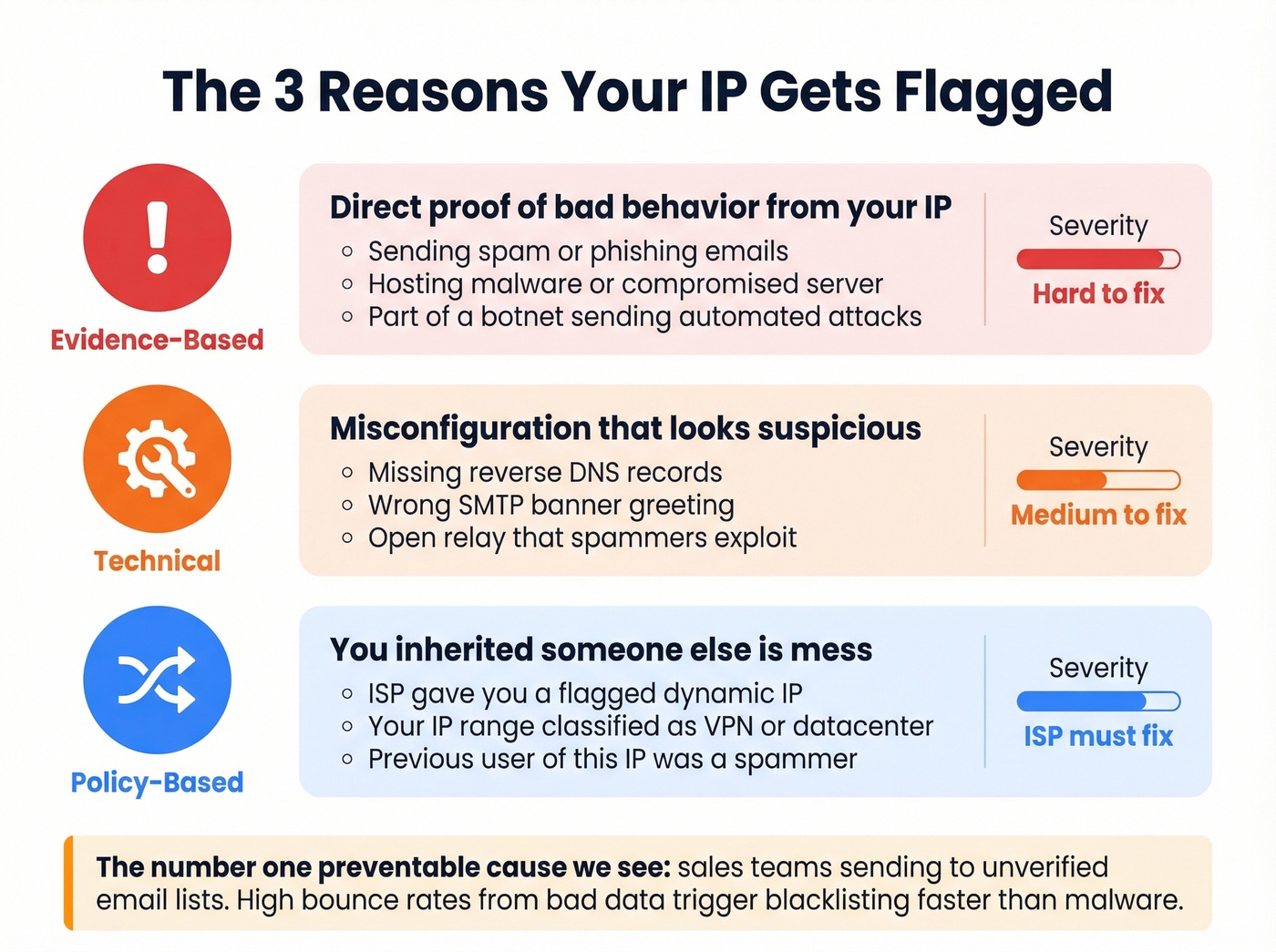
Evidence-based listings happen when there's direct proof of bad behavior from your IP - sending spam, hosting phishing pages, or running a compromised server that's part of a botnet. These are the most serious and the hardest to reverse.
Technical listings come from misconfiguration. Missing reverse DNS, wrong SMTP banner greetings, or an open relay that spammers are exploiting. You didn't do anything malicious; your setup just looks suspicious.
Policy-based listings are the most frustrating because they're not about what you did. Your ISP assigned you a dynamic IP in a residential range listed on the Spamhaus PBL, or your IP block got classified as a datacenter/VPN range. You inherited someone else's mess. Reddit threads are full of users reporting exactly this: streaming services flagging their home IP as a VPN when no VPN is configured.
Here's the thing most people miss: the majority of IP flagging isn't caused by hackers or malware. It's caused by sales teams sending to unverified email lists. High bounce rates from bad data are a leading preventable cause of blacklisting we see, and it's entirely avoidable. (If you're building lists, this lead generation workflow breakdown helps prevent hygiene issues upstream.)

Most IP blacklistings we see start the same way: sales teams sending to unverified lists, bounce rates spike past 10%, and Spamhaus comes knocking. Prospeo's 5-step email verification and 98% accuracy rate keep your bounce rate under 4% - the same threshold that took Snyk's 50-person sales team from 35% bounces to under 5%.
Stop fixing blacklist problems. Prevent them with verified data.
Types of IP Flagging
Your IP can be "flagged" without being blacklisted. These are four distinct mechanisms.
DNSBL/RBL listing is binary - you're either on the list or you're not. This primarily affects email delivery. Spamhaus, Barracuda, and SpamCop are the big ones.
IP reputation scoring works on a spectrum. Sender Score rates you 0-100, and mailbox providers use their own internal scoring. You can have a mediocre reputation that throttles your email without ever appearing on a formal blacklist - and that gray zone is where a lot of outbound teams get stuck for months without realizing what's happening. (More on monitoring in our roundup of email reputation tools.)
VPN/proxy misclassification hits consumers hardest. IP intelligence databases used by streaming services, payment processors, and anti-fraud systems categorize your IP as a VPN, proxy, or datacenter address - even when it's a standard residential connection.
Anti-bot/anti-fraud flagging triggers CAPTCHAs, blocks account creation, and gets you Cloudflare challenge pages. Apple, Google, and Cloudflare maintain behavioral reputation databases completely separate from email blacklists.
Which Blacklists Actually Matter
Not all blacklists carry equal weight.
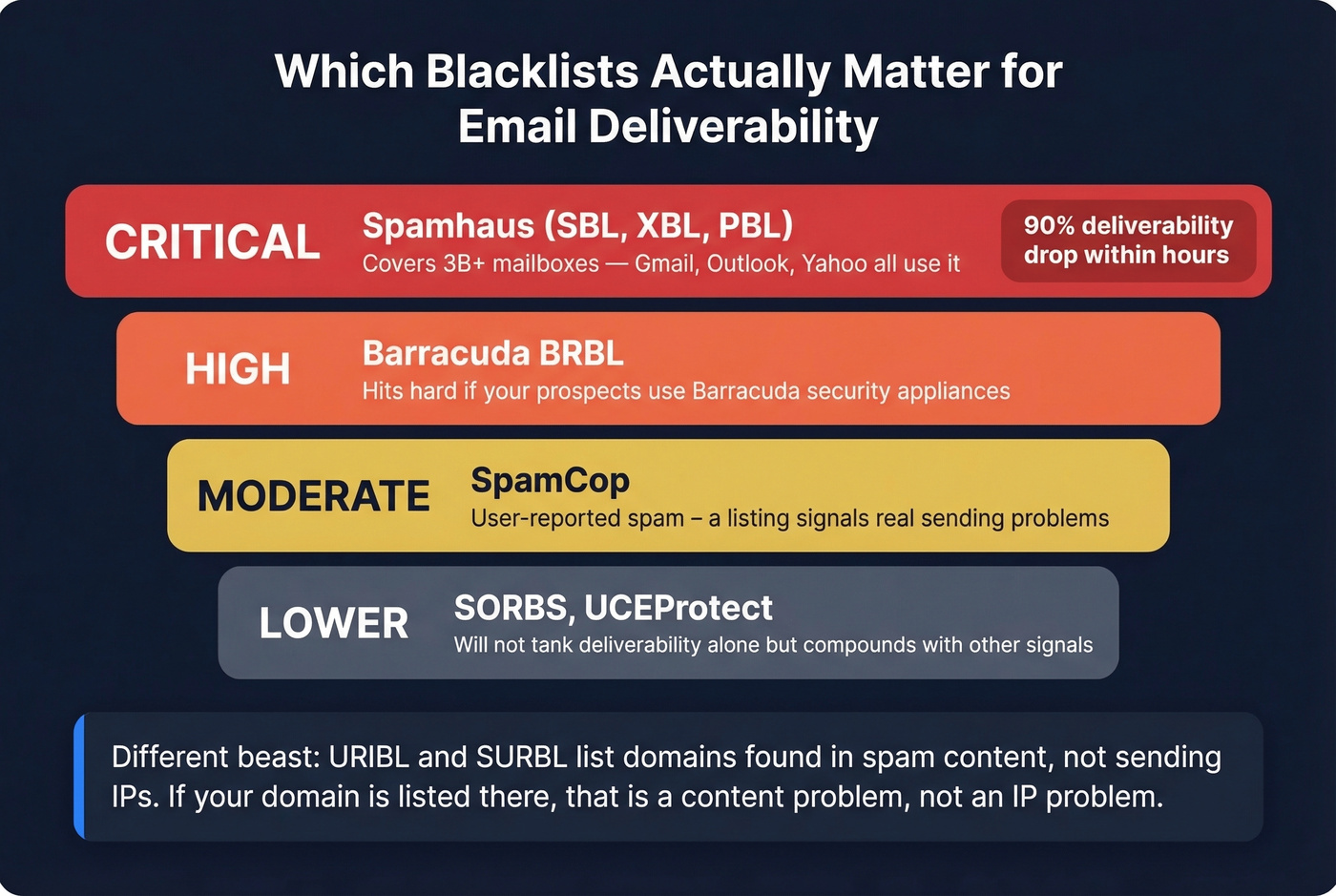
Critical - Spamhaus (SBL/XBL/PBL). Covers 3B+ mailboxes and is used by major providers including Gmail, Outlook, and Yahoo. A listing here can reduce deliverability by 90% within hours. This is the one that keeps email ops people up at night.
Enterprise-important - Barracuda BRBL. If your prospects' companies run Barracuda security appliances, this list hits hard.
Moderate - SpamCop. User-reported spam list. Less impactful than Spamhaus, but a listing signals a real problem with your sending practices.
Lower impact - SORBS, UCEProtect. A listing here alone won't tank deliverability, but combined with other signals, it compounds.
Different beast - URIBL/SURBL. These list domains found in spam content, not sending IPs. If your domain is on URIBL, that's a content/link problem, not an IP problem. Skip this section if you're only dealing with CAPTCHAs or streaming blocks - domain blocklists aren't your issue.
How to Get Delisted
Step 1: Stop all sending immediately. Every additional message generates more evidence against you.
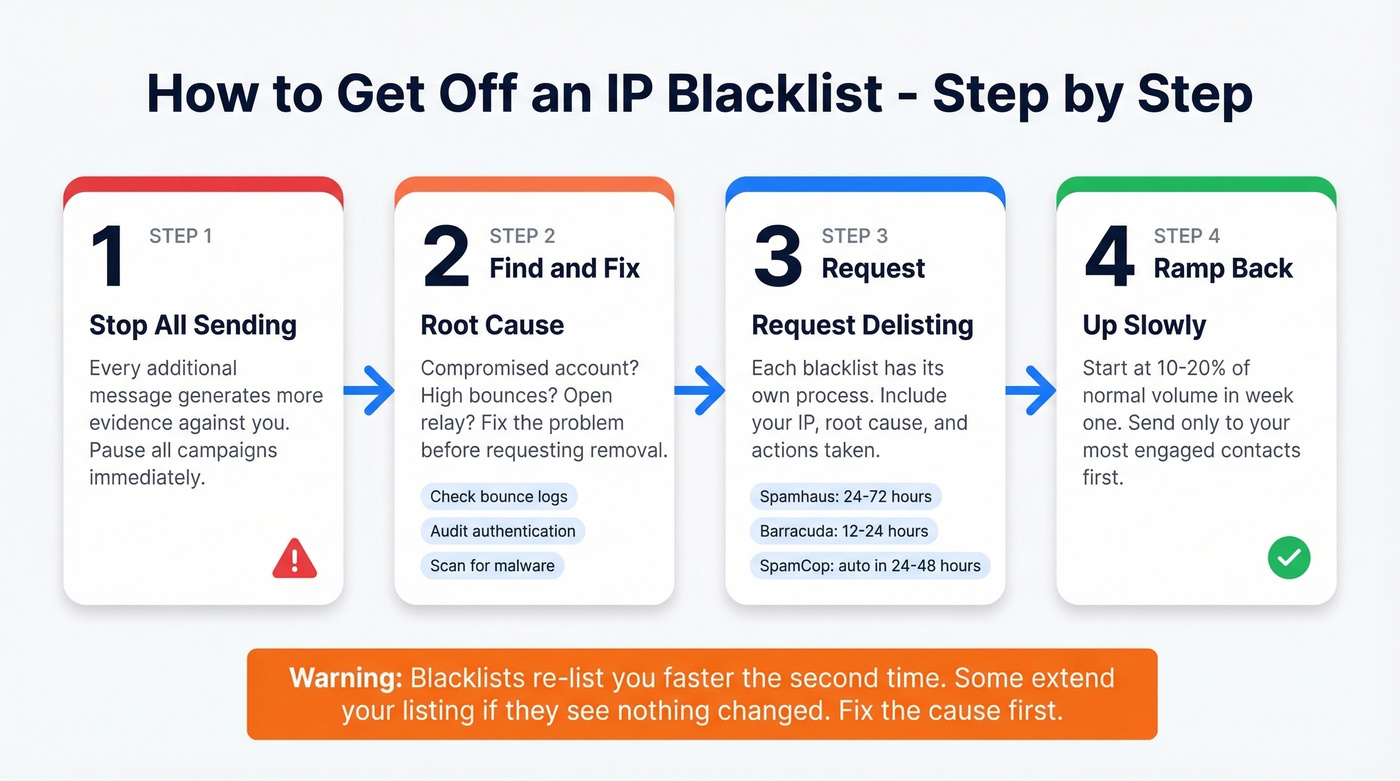
Step 2: Identify and fix the root cause. Compromised account? High bounce rates? Open relay? Don't request delisting until you've fixed the underlying problem - blacklists re-list you faster the second time, and some will extend your listing duration if they see you haven't changed anything.
Step 3: Request delisting. Each blacklist has its own process:
| Blacklist | Method | Timeline |
|---|---|---|
| Spamhaus SBL | Manual request | 24-72h |
| Spamhaus XBL | Auto via CBL | Hours-24h |
| Spamhaus PBL | Justify use | Varies |
| Barracuda | Request + verify email | 12-24h |
| SpamCop | Auto-delist | 24-48h (no new reports) |
| UCEProtect L1 | Wait | 7 days free |
Real talk: UCEProtect offers "express" paid delisting. Don't bother - it's a racket. Just wait the 7 days.
Use this template for manual requests:
Subject: Delisting Request - [Your IP]
IP: [x.x.x.x] | Root cause: [e.g., compromised account sending spam] | Actions taken: [e.g., account secured, SPF/DKIM configured, list verification added]
After delisting: Ramp back up at 10-20% of normal volume in week one, sending only to your most engaged contacts. Gradually increase over 1-2 weeks. Patience here saves you from a second listing that's much harder to undo. (If you're scaling outbound again, follow safe email velocity limits.)
Fixing Non-Email IP Issues
If your problem is CAPTCHAs, streaming blocks, or account creation failures, the playbook is different.
Restart your router. If your ISP assigns dynamic IPs, this may give you a fresh one. Check your IP before and after to confirm it actually changed - some ISPs hold your assignment for days even after a power cycle.
Switch to mobile data as a diagnostic. If the problem disappears on 5G/LTE, you've confirmed it's your home/office IP. That narrows the fix.
Contact your ISP. Request a new static IP or report that your current IP is misclassified. The Ziply Fiber case is a perfect example - only the ISP could fix the upstream classification in IP intelligence databases. Be specific about what's broken; "my IP is flagged" won't get you far, but "my residential IP is classified as a Google datacenter address on WhatIsMyIPAddress" will.
Use a VPN as a temporary bypass. This works, but VPN IPs are often flagged themselves. It's a workaround, not a solution.
Contact the blocking service directly. For Apple ID creation issues, Apple Support can manually whitelist your network. For Cloudflare blocks, the site owner controls the security settings.
Preventing Future IP Flagging

Prevention is cheaper than remediation. We've seen outbound teams go from 25% bounce rates to under 3% just by adding verification before sending. Let's break down what actually works.
Set up SPF + DKIM + DMARC. All three, together. Start DMARC in monitoring mode so you can see what's happening before enforcing. This is table stakes in 2026. (If you want the technical checklist, start with DMARC alignment and a working SPF record example.)
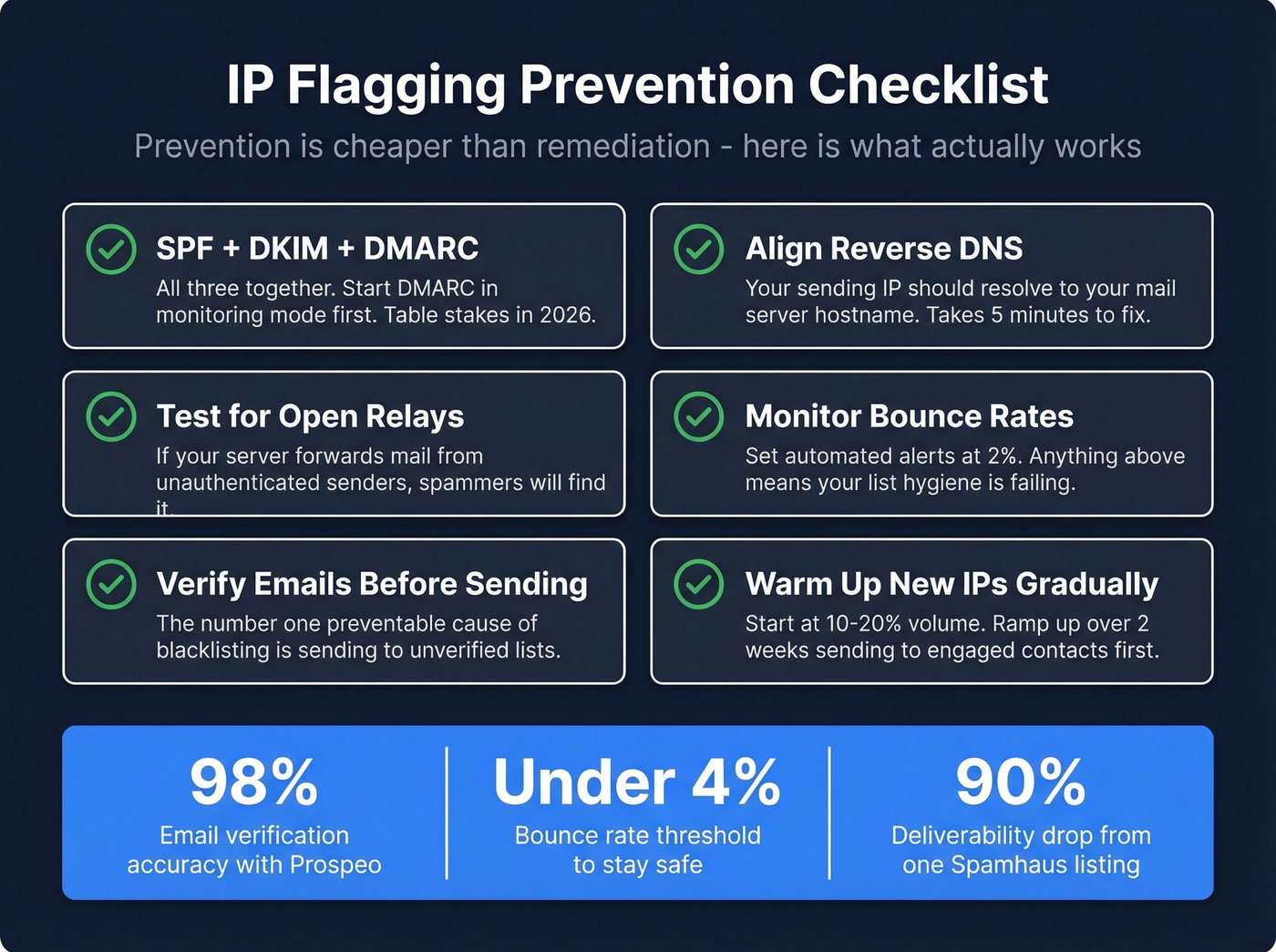
Align your reverse DNS. Your sending IP should resolve to your mail server hostname. Misaligned rDNS is one of the most common technical triggers for blacklisting, and it takes five minutes to fix.
Test for open relays. If your mail server accepts and forwards mail from unauthenticated senders, spammers will find it.
Monitor bounce rates - alert at >2%. Anything above 2% means your list hygiene is failing. Set up automated alerts so you catch spikes the same day, not two weeks later when the damage is done.
Monitor spam complaints - alert at >0.1%. Set up feedback loops with major ISPs. One complaint per thousand emails is where problems start.
Never send to purchased or scraped lists without verification. This is where most outbound teams fail. Unverified lists mean spam traps, honeypots, and invalid addresses that spike your bounce rate overnight. Prospeo's 5-step verification catches these before they trigger bounces - 98% email accuracy with spam-trap removal and honeypot filtering built in. (If you suspect traps are involved, see our spam trap removal guide.)
Monitor continuously. Google Postmaster Tools for Gmail reputation, Microsoft SNDS for Outlook, and MxToolbox for ongoing DNSBL monitoring. Don't wait for bounces to tell you something's wrong.
Technical deep dive - how DNSBL queries work: To check if
192.0.2.1is listed on Spamhaus ZEN, your mail server queries1.2.0.192.zen.spamhaus.org. Return codes tell you why:127.0.0.2= confirmed spam source,127.0.0.4-7= compromised system,127.0.0.10-11= policy block for dynamic/residential IPs.
Delisting your IP is a temporary fix if you're still sending to bad addresses. Every email Prospeo delivers passes catch-all verification, spam-trap removal, and honeypot filtering - refreshed every 7 days, not the 6-week industry average that lets data rot and bounces pile up.
Clean data every 7 days means your IP stays clean too.
FAQ
Can I check if my IP is flagged for free?
Yes - MxToolbox, Spamhaus, AbuseIPDB, Sender Score, and Google Postmaster Tools are all free. WhatIsMyIPAddress runs your IP against 50+ DNS-based anti-spam databases in one click. Paid tools add continuous monitoring, but the initial check costs nothing.
How long does it take to get delisted?
SpamCop auto-delists in 24-48 hours if no new reports arrive. Spamhaus SBL takes 24-72 hours after a manual request. Barracuda processes removals in 12-24 hours. Full reputation recovery takes 2-4 weeks of careful volume ramping.
Does restarting my router fix a flagged IP?
It can if your ISP assigns dynamic IPs - a restart may give you a new address. Check your IP before and after, because some ISPs hold your assignment for days even after a power cycle. If it doesn't change, call your ISP directly.
Can a VPN fix IP flagging issues?
As a temporary bypass, yes. But VPN IPs are frequently flagged themselves, especially on streaming services and payment processors. Address the root cause with your ISP instead of relying on a workaround.
How do outbound teams prevent IP blacklisting?
Verify every email list before sending, implement SPF/DKIM/DMARC, and keep bounce rates below 2%. In our experience, these three steps prevent the vast majority of incidents. The consensus on r/sales backs this up - bad list hygiene is the number-one cause of deliverability problems for outbound teams.