


Joomag Pricing, Reviews, Pros & Cons (2026)
You want to know what Joomag costs. Joomag doesn't want to tell you. Every tier on their pricing page says "Let's Talk," and the numbers floating around directories don't match each other. Here's what we've pieced together - and whether it's actually worth the demo call.
30-Second Verdict
Joomag carries a 4.5/5 on G2 across 85 reviews and earns genuine praise for its editor, analytics, and support. The product is strong. The pricing model is frustrating: opaque, enterprise-oriented, and roughly 2.5-3x the cost of entry-level alternatives like Flipsnack ($16/mo on annual billing) or Issuu ($19/mo). If you're a 10+ person team that needs CRM integrations and reader-level analytics, Joomag is worth exploring. Everyone else should look at the alternatives first.
What Is Joomag?
Joomag positions itself as a "content experience platform," not just a flipbook maker. The distinction matters. Beyond converting PDFs into interactive publications, it layers in forms, surveys, 3D tours, dynamic charts, and behavioral analytics that track individual reader journeys. There's a built-in email marketing suite, CRM integrations with Salesforce and HubSpot, and content gating for lead capture.
Think of it as a publishing tool that wants to be a demand gen platform.
Joomag Plans and Costs in 2026
Joomag's official pricing page shows "Let's Talk" for every single tier. No public prices. That tells you exactly who they're selling to - enterprise buyers with procurement teams, not solo publishers with a credit card.

The numbers that do exist come from software directories and editorial reviews, and they don't align:
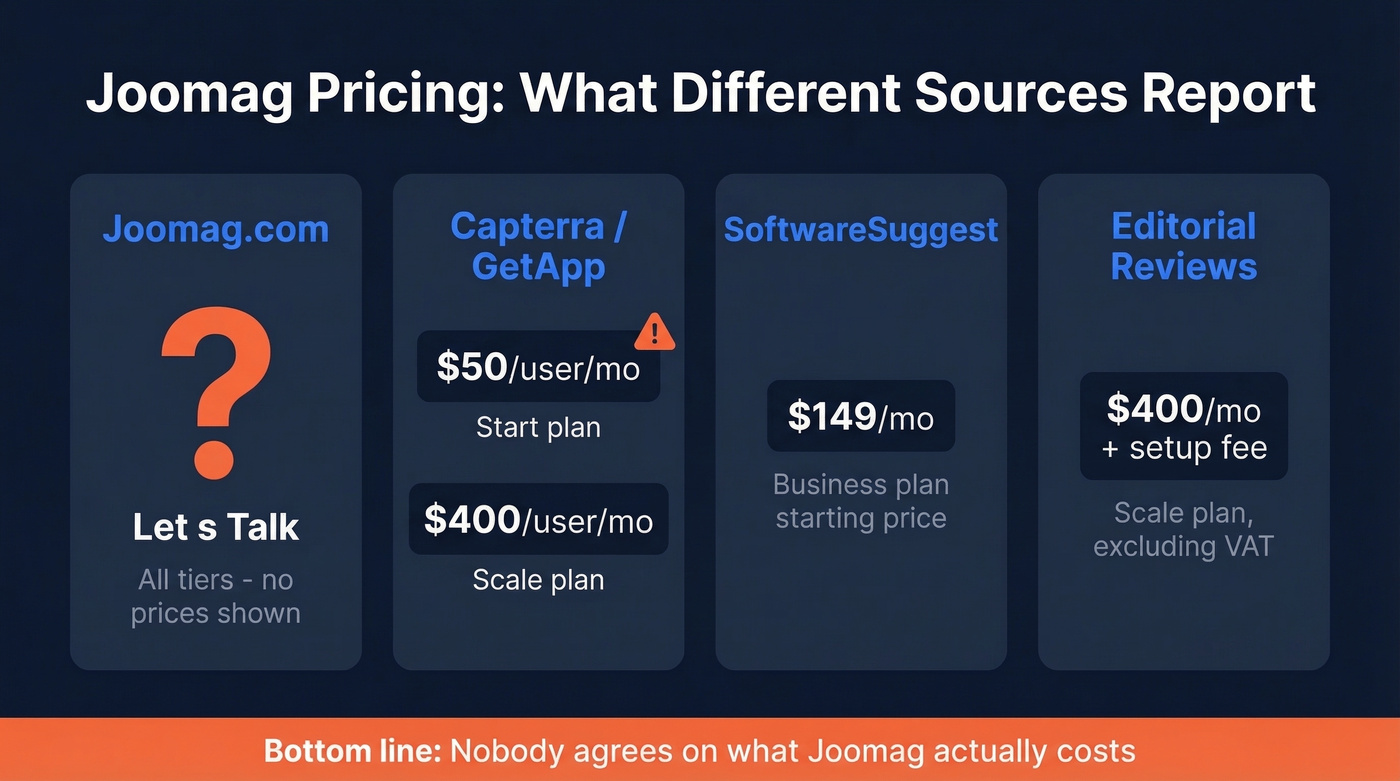
- Official site (current model): Lite / Scale, Business, Enterprise - all quote-based.
- Directory snapshots: Start at $50/user/month, Scale at $400/user/month, Enterprise custom.
- Editorial coverage: State of Digital Publishing lists Scale at $400/month + a setup fee (excluding VAT).
- SoftwareSuggest: Shows a $149/month starting price for a Business plan.
Free trial availability is also a mess. GetApp lists a free trial and mentions a free plan, while Capterra lists neither . We couldn't confirm either way on Joomag's own site.
What You'll See in the Wild
| Pricing view | Plans listed | Price |
|---|---|---|
| Official Joomag pricing page | Lite / Scale, Business, Enterprise | "Let's Talk" for all tiers |
| Capterra / GetApp | Start, Scale, Enterprise | $50/user/mo, $400/user/mo, custom |
| SoftwareSuggest | Business (starting price) | $149/mo |
Joomag Pros
- Easy to learn. Reviews consistently favor usability, and the platform includes 300+ templates.
- Deep analytics. Individual reader journey tracking is a real differentiator in this category - few competitors offer anything close.
- Responsive live chat. This comes up repeatedly across review sites.
- Rich interactivity. Forms, surveys, quizzes, 3D tours, dynamic charts, GIFs, and video embeds.
- Solid integrations. Salesforce, HubSpot, Zapier, Google Analytics - the CRM connections separate Joomag from simpler flipbook tools. If you're mapping this into a broader sales enablement workflow, integrations matter a lot more than templates.

Joomag's CRM integrations are powerful - but only if your contact data is accurate. Prospeo delivers 143M+ verified emails at 98% accuracy with a 7-day refresh cycle, so your sales enablement content actually reaches real decision-makers. No "Let's Talk" gates. Self-serve from day one.
Great content means nothing if it bounces. Fix your contact data first.
Joomag Cons
Here's the thing: the product itself isn't the problem. The buying experience is.
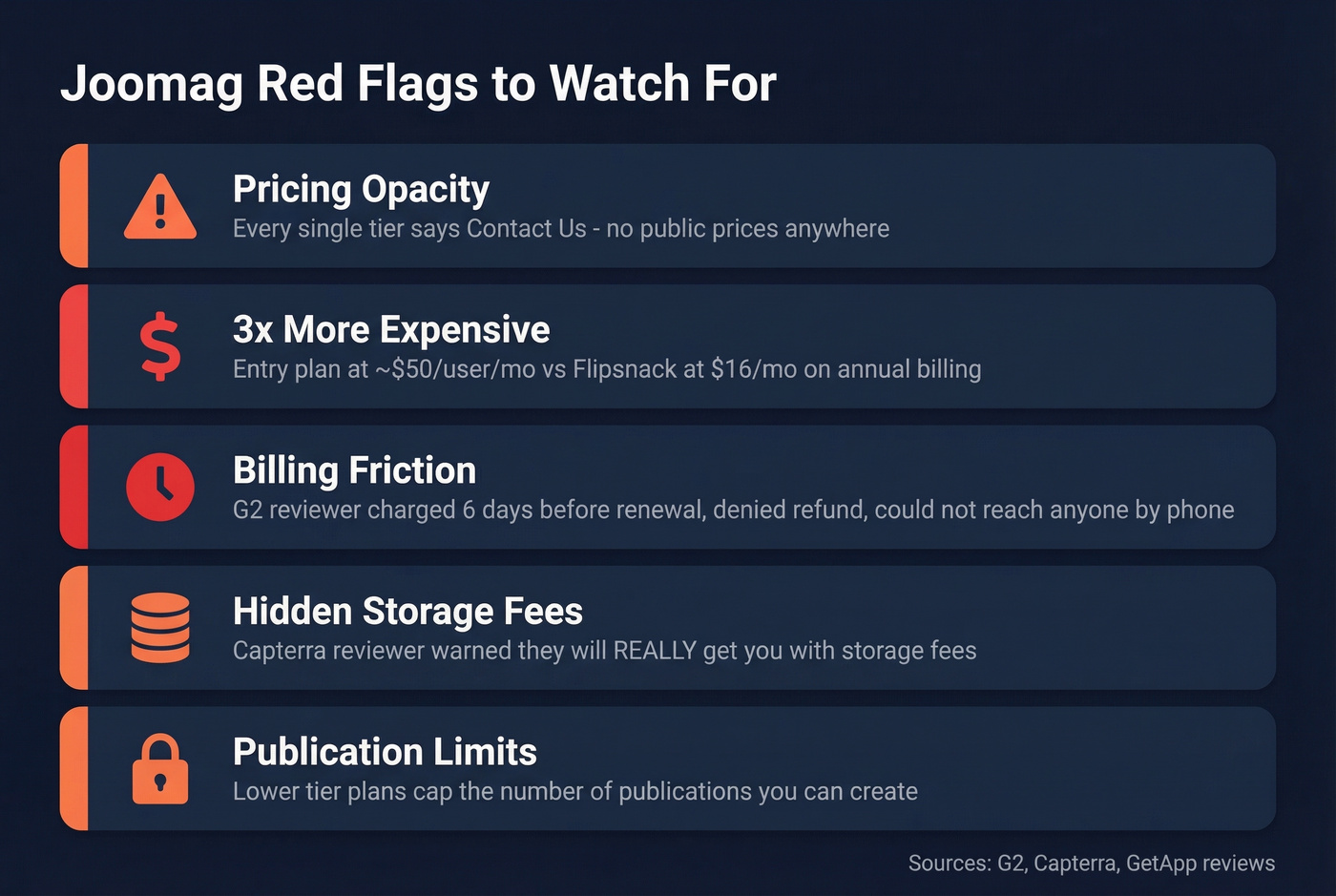
- Pricing opacity. "Contact us" for every tier in 2026 is a red flag for self-serve buyers. If you're used to transparent SaaS sales motions, this will feel like a step backward.
- Expensive relative to alternatives. At ~$50/user/month for the entry plan, Joomag costs about 3x what Flipsnack charges for its Starter tier on annual billing.
- Billing and cancellation friction. One G2 reviewer describes being charged six days before renewal, denied a refund, and unable to reach anyone by phone. That's rough.
- Hidden storage fees. A Capterra reviewer called storage costs a painful surprise - "they will REALLY get you with storage fees."
- Publication limits on lower plans. Multiple reviews flag caps on the number of publications you can create.
- After-hours support gaps. If something breaks during off-hours publishing, you're waiting until the next business day.
Joomag vs. Flipsnack vs. Issuu
| Joomag | Flipsnack | Issuu | |
|---|---|---|---|
| Starting price | ~$50/user/mo | $16/mo (annual) | $19/mo |
| Free plan | Conflicting reports | Yes (3 flipbooks, watermark) | Yes (limited) |
| Free trial | Conflicting reports | 14-day, no CC | Yes |
| Capterra rating | 4.4/5 (26 reviews) | 4.6/5 (307 reviews) | 4.5/5 (153 reviews) |
| Best for | Enterprise publishers needing analytics + CRM | Small teams, budget-conscious | Distribution, embeds, shareability |
| Pricing transparency | "Contact us" | Fully published | Partially published |
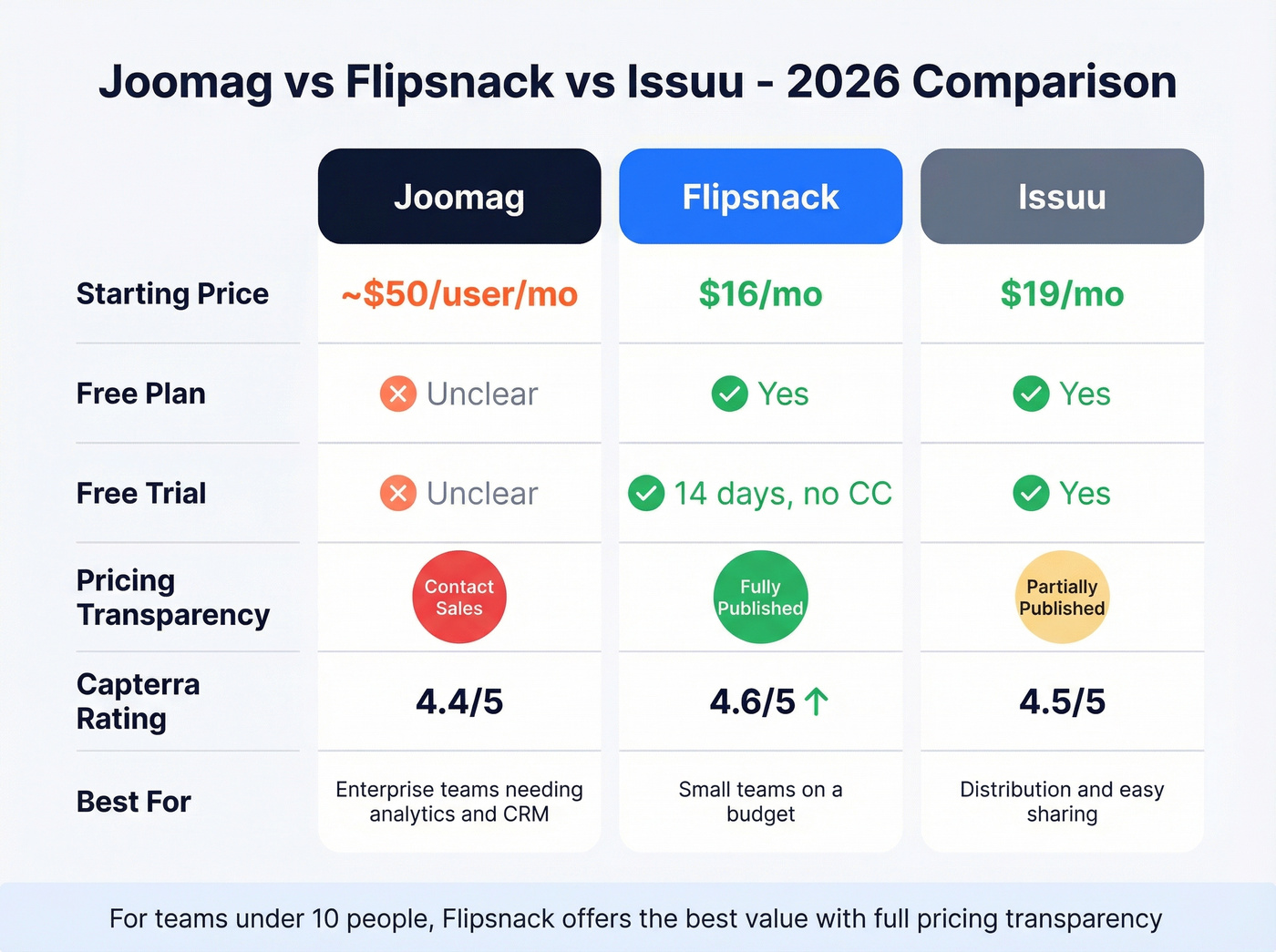
Flipsnack is the clear winner for small teams. Published pricing, a free plan, a 14-day trial with no credit card - it's the opposite of Joomag's sales-led model. On annual billing, plans scale from $16/mo (Starter) to $258/mo (Team). Monthly, Starter jumps to $35/mo and Team to $319/mo.
Issuu is a strong pick if your priority is distribution and easy sharing/embedding, starting at $19/mo.
Joomag wins when you need the full stack: reader-level behavioral analytics, CRM integrations, content automation, and gated access controls. The analytics and CRM depth justify the premium - if you'll actually use them. If you're building a measurable funnel, align this with your funnel metrics so the analytics actually drive decisions.
Let's be honest: most teams buying Joomag are paying for analytics depth they'll check twice and then forget about. Unless reader-level journey tracking directly feeds your sales process, you're overpaying for dashboards that collect dust.
Who Should (and Shouldn't) Use Joomag
Use Joomag if you have a 10+ person team creating sales enablement content, need Salesforce/HubSpot integration with reader analytics, and your budget supports $50+/user/month comfortably. Individual reader journey tracking should be a real requirement, not a nice-to-have. If you're formalizing that requirement, start with an Ideal Customer Profile so the tool matches the motion.
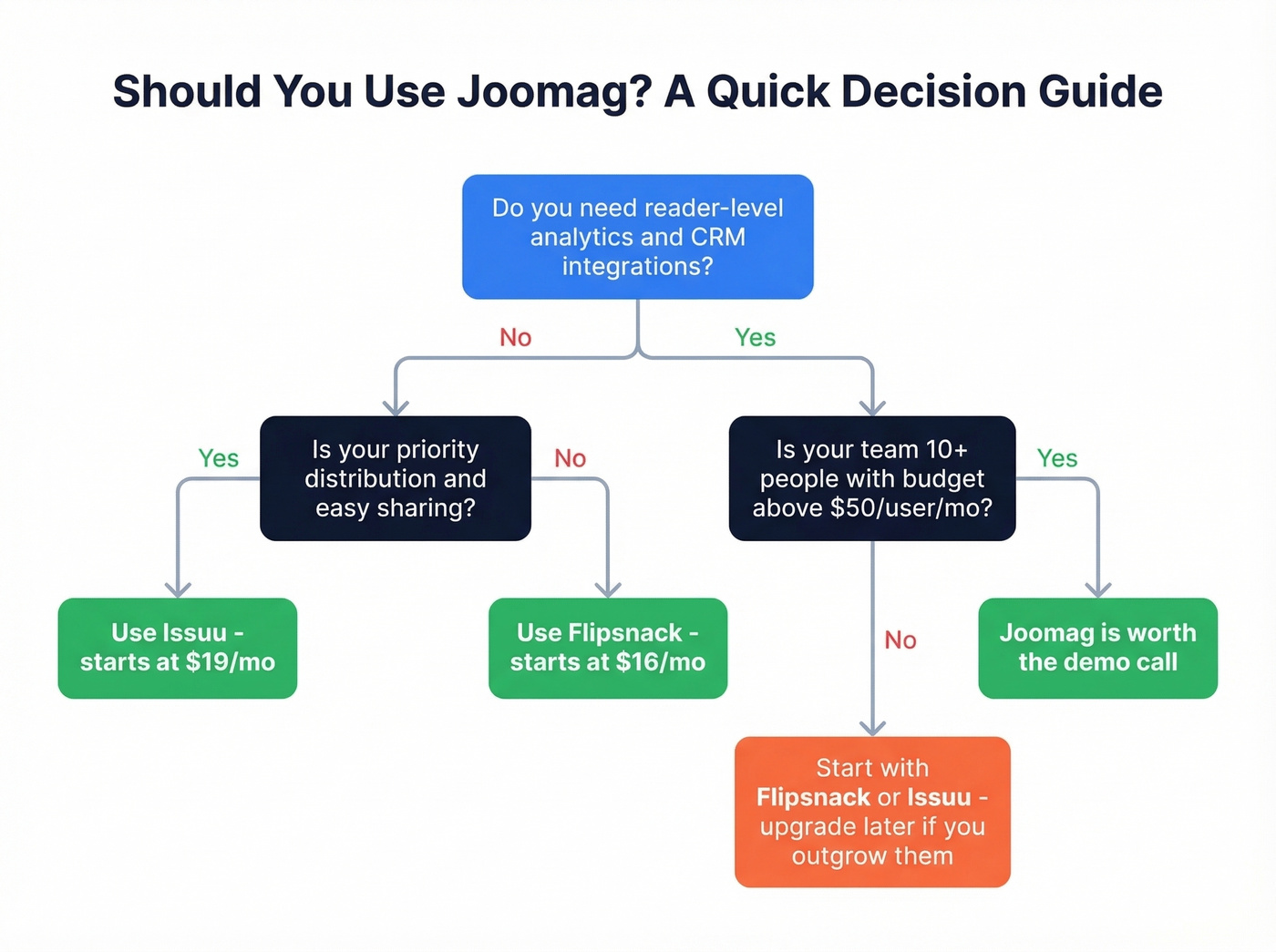
Skip Joomag if you're a small team or solo publisher, you want to see pricing before talking to sales, your budget is under $100/month, or you just need interactive flipbooks without the enterprise analytics stack. In our experience, teams under 10 people rarely use the analytics features enough to justify the cost difference. If your real goal is pipeline, focus on lead generation metrics before paying for enterprise dashboards.
Once you've picked your publishing platform, the next bottleneck is getting that content in front of decision-makers. Prospeo handles that piece - 143M+ verified emails at 98% accuracy, self-serve pricing starting free, no sales call required. Pair it with a clean lead generation workflow so content distribution doesn't stall after creation.
You just spent hours building interactive sales collateral. Don't waste it on dead email addresses. Prospeo finds and verifies B2B emails at $0.01 each - 90% cheaper than ZoomInfo - with transparent pricing you can see before talking to anyone.
Send your best content to verified inboxes, not spam folders.
Bottom Line
Joomag is a strong content experience platform trapped behind an enterprise pricing wall. The editor is excellent, the analytics are deep, and the CRM integrations set it apart from simpler flipbook tools. But the opaque pricing, hidden fees, and billing friction make it a tough sell for anyone who isn't already budgeted for enterprise software. If you're evaluating enterprise buying motions, use a product demo checklist so the call actually answers pricing and implementation questions.
For teams with the budget, request the demo. For everyone else, start with Flipsnack or Issuu and save yourself the sales call.