

Why "Just Following Up" Gets Ignored (And What to Say Instead)
You sent the proposal on Tuesday. It's Friday. You open a blank compose window, type "Hi [Name], just following up on my previous email..." and hover over send.
You've written this email a hundred times. So has everyone else - and that's exactly why it doesn't work.
This isn't a phrasing problem. It's a strategy problem. Replace the generic follow-up opener with a specific question or new information. Use a 5-touch sequence (Day 1, Day 3, Day 6, Day 12, Day 24). Write informally - informal tone drives a 78% higher positive reply rate than formal. And before rewriting anything, verify your contact list. Almost 20% of cold emails get flagged as spam before anyone reads them.
Why the Generic Follow-Up Email Fails
The word "just" is a minimizer. It signals that even you don't think this email is worth the recipient's time. When you write "just following up on this," you're saying "I have nothing new to offer, but I'd like your attention anyway."
Three things go wrong at once:
- Zero new value. The recipient already knows you emailed them. Reminding them adds nothing. If they didn't reply the first time, a content-free nudge won't change the calculus.
- Passive-aggressive subtext. "Just following up on my last email" reads as "why haven't you responded?" It creates guilt, not motivation - and guilt makes people avoid you, not engage.
- The minimizer trap. As CNBC's guidance on professional messaging points out, minimizing openers make your message feel optional rather than actionable. "Following up with a question about timeline" is already better because it has a reason attached.
The fix isn't finding a fancier synonym for "following up." It's rethinking what a follow-up email is supposed to do.
The Data: Follow-Ups Work (But Not How You Think)
Here's the paradox: the lazy follow-up fails, but follow-ups as a category are essential. How essential depends on who's counting. Instantly's 2026 benchmark puts it at 42% of all replies coming from follow-ups. A Sales.co analysis of 2M+ emails says 20.6%, with initial outreach driving 79.4%. The real number sits somewhere in that range - but either way, follow-ups matter.
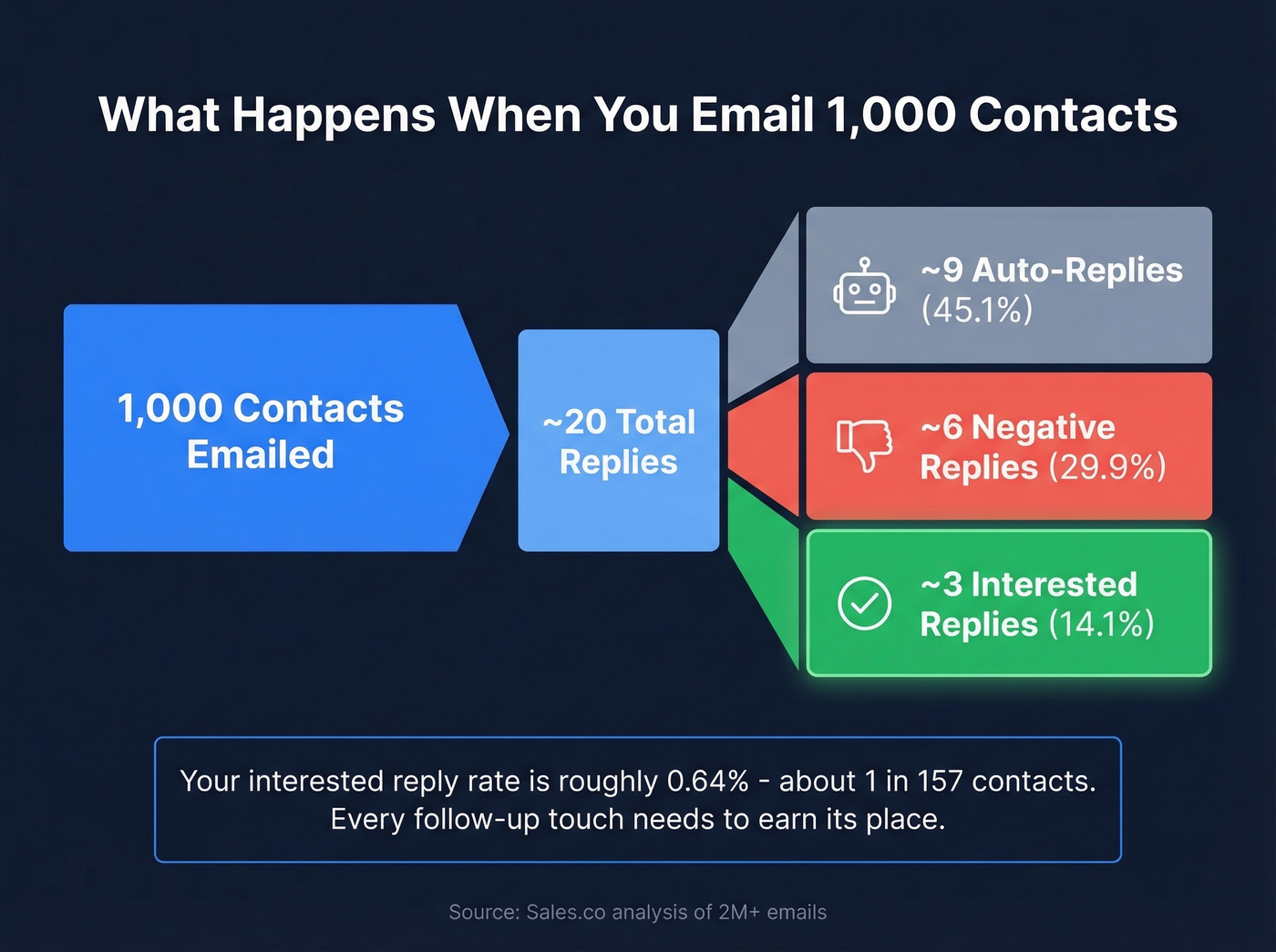
What matters more is what "reply" actually means. The Sales.co data breaks it down: 45.1% of replies are auto-replies. Another 29.9% are negative ("not interested," "remove me"). Only 14.1% are genuinely positive.
Run the math on their full dataset of 1,369,823 contacts, and the interested reply rate drops to roughly 0.64% - about 1 in 157 contacts. That's the real number.
Reply doesn't equal Interested Reply. Of every 1,000 contacts you email, expect ~20 replies total. Of those, ~9 are auto-replies, ~6 are "no thanks," and ~3 are genuinely interested. Follow-ups move that needle - but only if each one earns its place in the inbox.
This is why sending a substance-free nudge is such a waste. You're spending one of your precious 5-7 touches on a message that adds nothing.
Why People Ghost Your Follow-Ups
Ghosting isn't personal. It's cognitive.
Your initial email created an open loop in the recipient's mind - what psychologists call the Zeigarnik Effect. People remember unfinished tasks better than completed ones. A good follow-up resurfaces that loop with a new angle. A bad one ("just checking in") doesn't trigger recall because it contains no new information to process.
Loss aversion explains why "You might miss X" outperforms "You could gain X" in subject lines and CTAs. People are wired to avoid losses more strongly than they pursue equivalent gains. A follow-up framed around what the prospect stands to lose - a competitive edge, a closing window, a budget cycle - creates urgency that gain-framed messages can't match.
The mere exposure effect works in your favor too. Repeated touches build familiarity and trust, not annoyance - but only if each touch adds value. Five emails saying "checking in" creates irritation. Five emails each sharing a different insight creates the impression you're a knowledgeable resource worth responding to. This is reciprocity in action: offer something useful first, and people feel compelled to respond.
What to Say Instead of "Just Following Up"
The principle is simple: follow-up emails should feel like replies, not reminders. 81% of decision-makers engage with cold outreach when it's tailored to their company and context - generic follow-ups don't qualify.
If you want plug-and-play options, start with these sales follow-up templates and adapt them to your prospect's context.
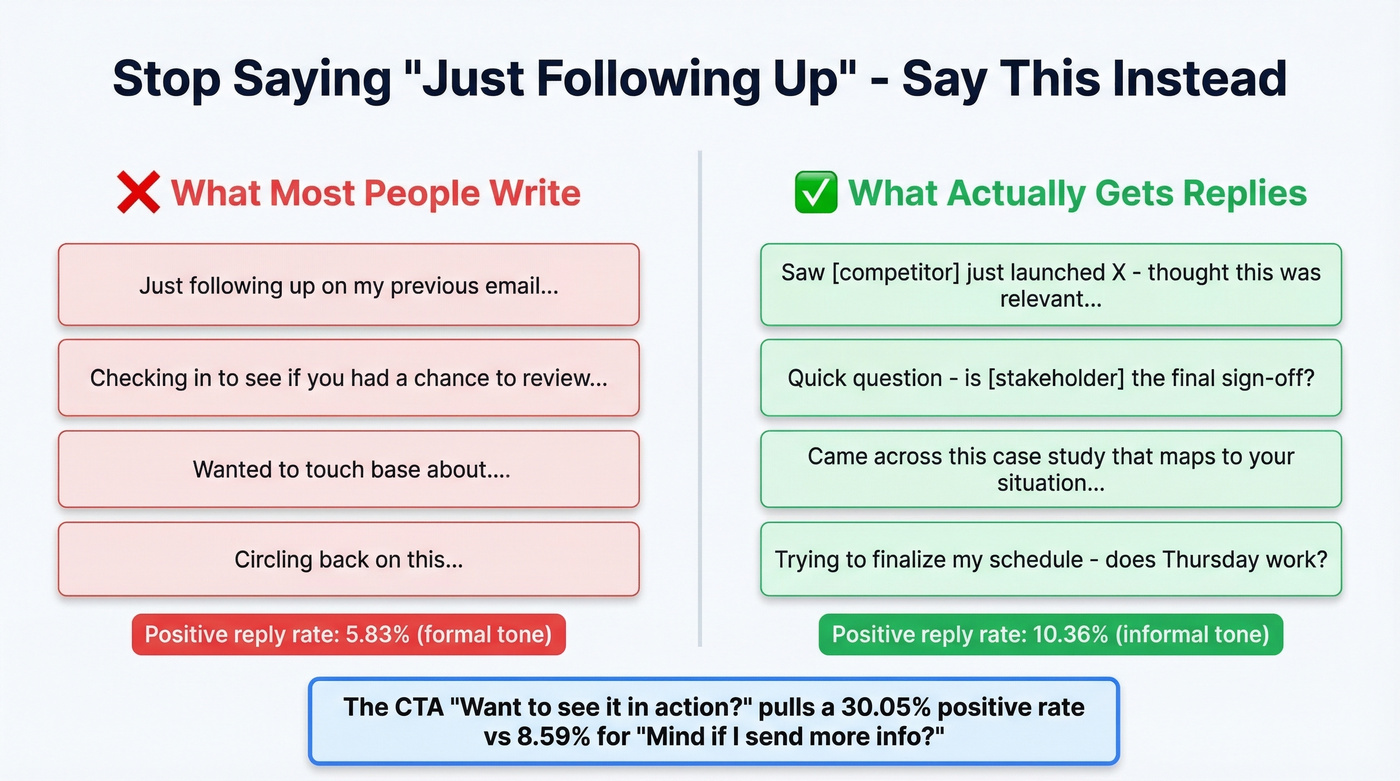
Informal tone yields a 78% higher positive reply rate than formal (10.36% vs 5.83%). And the CTA "Want to see it in action?" pulls a 30.05% positive rate versus 8.59% for "Mind if I send more info?" Specific, low-friction asks win every time.
Sales Follow-Up (No Response)
Lead with new value - a case study, a relevant stat, social proof from a similar company. Never just "bump" the thread.
Hi [Name], saw that [competitor/peer company] just [relevant trigger event]. We helped a similar team [specific result] - thought it might be relevant given [their situation]. Worth a 15-minute look? Here's a quick case study: [link]
New information gives them a reason to engage that didn't exist in the first email.
Post-Meeting Recap
Confirm the next step and ask a specific question. Don't just say "great meeting."
Hey [Name], good talking earlier. To recap: you're evaluating [solution area] before [timeline]. I'll send over the ROI breakdown by Thursday. One question - is [specific stakeholder] the final sign-off, or should we loop in anyone else?
This moves the deal forward instead of acknowledging the meeting happened.
Job Application
Reference something specific from the role or company. Generic enthusiasm is invisible. Resist the urge to write "just to follow up on my previous email" - hiring managers see that opener dozens of times a week.
Hi [Name], following up on my application for [role]. I noticed [company] just [launched X / expanded into Y] - my experience with [specific relevant skill] maps directly to that. Would a 10-minute call work this week?
One sales rep on r/sales put the principle well: instead of the generic check-in, they write something like "I'm trying to finalize my schedule for next week, wanted to know if X date worked for you?" Specificity forces a response because it asks for a decision, not just attention.
Internal Stakeholder
Hey [Name], need your input on [specific decision] before I can finalize [project] by Friday. Can you weigh in by EOD Wednesday? If the current approach works, a quick "looks good" is all I need.
Clear deadline. Low-effort response option. Every friction point removed. Even internally, a vague nudge adds nothing - state what you need and by when.
Networking / Event Follow-Up
Hey [Name], enjoyed our conversation about [specific topic] at [event]. You mentioned [specific challenge] - just came across [article/resource] that's relevant. Worth a look: [link]. Coffee sometime?
The callback to a real conversation proves you were listening, and the resource adds value before you ask for anything.

You just learned that nearly 20% of cold emails get flagged as spam before anyone reads them. No subject line trick fixes a bad list. Prospeo's 5-step verification and 7-day data refresh keep your bounce rate under 4% - so every carefully crafted follow-up actually lands.
Stop perfecting emails that bounce. Start with verified contacts at $0.01 each.
The Follow-Up Sequence That Works
Here's the thing: 44% of salespeople give up after one follow-up. Meanwhile, 80% of sales require 5+ touches. The gap between those two numbers is where deals die.
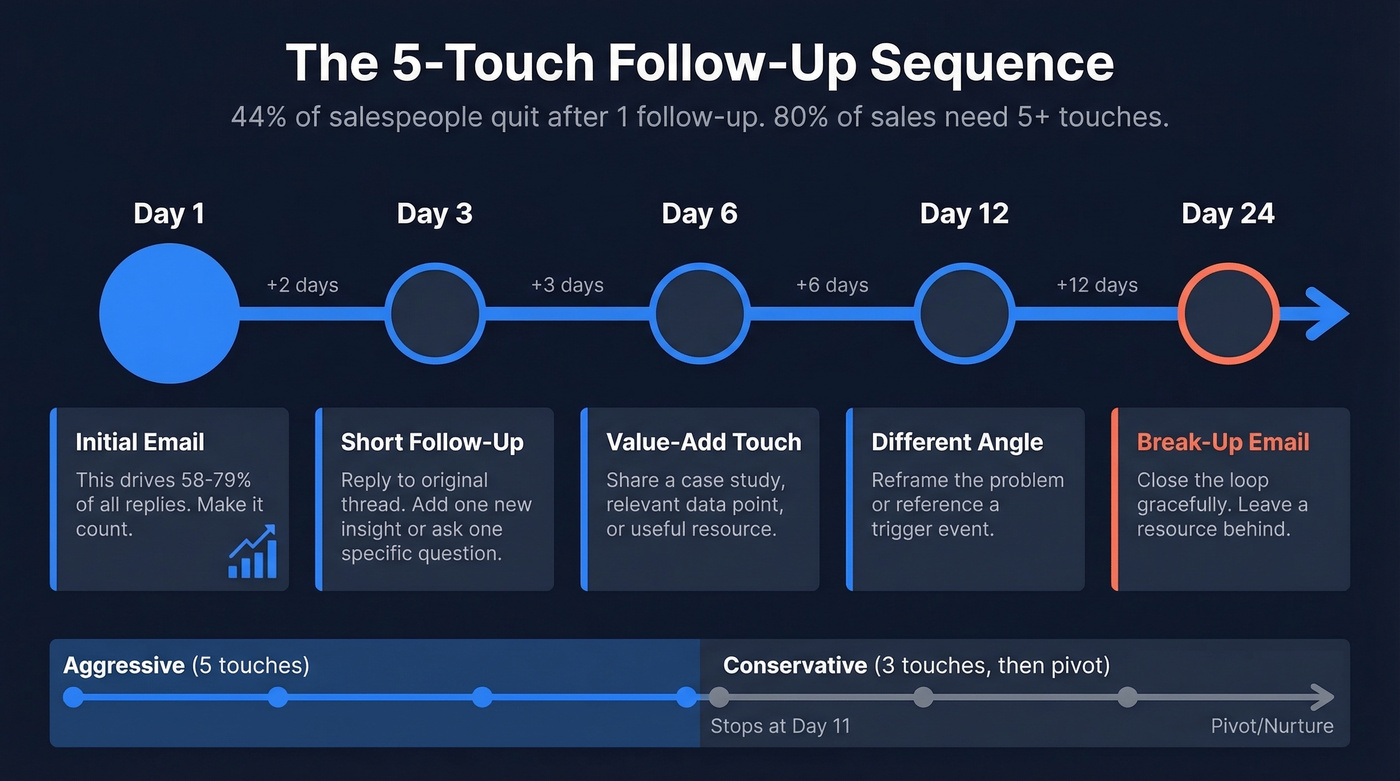
- Day 1 - Initial email. This drives 58-79% of all replies. Make it count.
- Day 3 - Short follow-up. Reply to your original thread. Add one new insight or ask one specific question.
- Day 6 - Value-add touch. Share a case study, relevant data point, or resource.
- Day 12 - Different angle. Reframe the problem or reference a trigger event.
- Day 24 - Break-up email. "Looks like the timing isn't right. I'll close this out, but [resource] is here if things change."
If you're building this into tooling, use a sequence management approach so each touch has a distinct job (value-add, objection handling, break-up) instead of five versions of the same nudge.
| Aggressive (5-touch) | Conservative (3-touch) | |
|---|---|---|
| Best for | High-value targets, sales | High-volume outbound, domain protection |
| Timing | Day 1, 3, 6, 12, 24 | Day 1, 4, 11 |
| Touches | 5 | 3 |
| Then | Break-up email | Pivot to another channel |
The conservative approach, recommended by deliverability-focused teams, caps at 3 emails to protect sender reputation, then pivots to phone or other channels.
Best days and times: Monday pulls the highest overall reply rate, while Thursday has the highest positive-reply rate at 10.5%. For a safe mid-week window, Tuesday through Thursday is the standard default. Send at 10 AM or 2 PM in the recipient's timezone. (If you want a deeper breakdown, see our guide on the best time to send cold emails.)
Let's be honest about something: if your first email isn't getting replies, more follow-ups won't save you. Across the Sales.co dataset, initial outreach drives 79.4% of all replies. Most teams don't have a follow-up problem - they have a first-email problem. Fix that before optimizing touch #4.
Subject Lines That Don't Get Flagged
69% of people who report an email as spam do so based solely on the subject line. Your follow-up content could be perfect, but a bad subject line means it never gets read - or worse, it tanks your sender reputation.
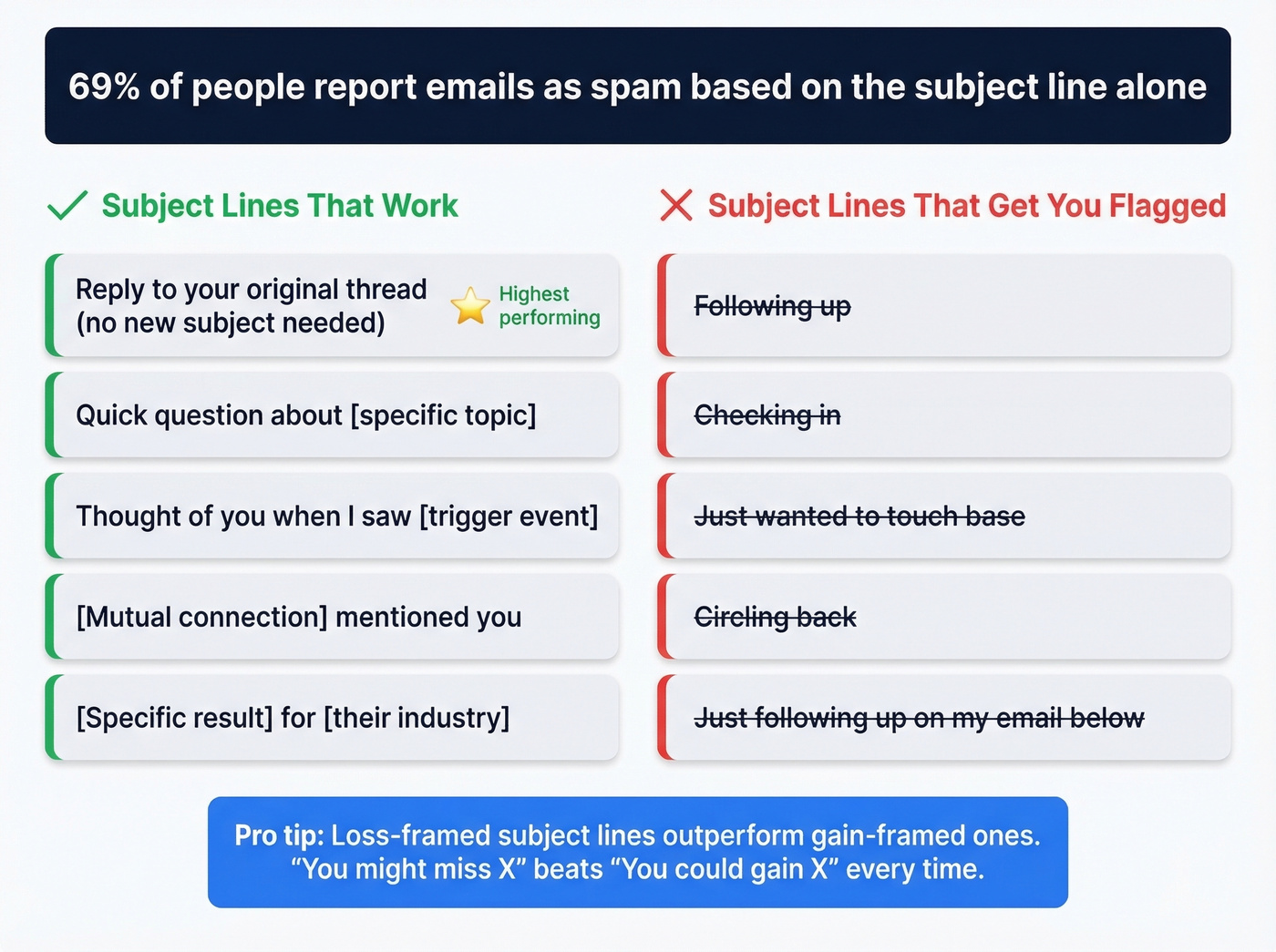
Do this:
- Reply to your original thread (no new subject line needed) - highest-performing approach
- "Quick question about [specific topic]"
- "Thought of you when I saw [trigger event]"
- "[Mutual connection] mentioned you"
- "[Specific result] for [their industry]"
Not this:
- "Following up"
- "Checking in"
- "Just wanted to touch base"
- "Circling back"
- Any subject line that could apply to literally anyone
If you need ideas, pull from these email subject line examples and then tailor them to the account.
Loss-framed subject lines outperform gain-framed ones. Uncommon, emotionally resonant words cut through the noise better than corporate-speak. Writing "just following up on my email below" as a subject line is the fastest way to get ignored - or reported.
The Hidden Problem: Your Email Never Arrived
You can write the perfect follow-up sequence with flawless subject lines and behavioral-science-backed CTAs. None of it matters if your email bounced or landed in spam.
We've seen this pattern over and over: a team agonizes over copy and cadence while sitting on a contact list with a 35% bounce rate. Snyk's sales team was in exactly this situation - 50 AEs prospecting 4-6 hours per week, with bounce rates running 35-40%. After switching to Prospeo for verified contact data, bounces dropped under 5%, and AE-sourced pipeline jumped 180%.
Step zero of any follow-up sequence is verifying your contact data. A 98% email accuracy rate on a 7-day refresh cycle means you're not burning follow-ups on addresses that went stale three weeks ago. If you're diagnosing issues, start with your email bounce rate and then work through an email deliverability guide.
With only ~3 out of every 1,000 contacts sending a genuinely interested reply, you can't afford to waste touches on wrong emails. Prospeo gives you 98% accurate emails and 125M+ verified mobile numbers - so when you replace 'just following up' with real value, it reaches real people.
Make every follow-up count by reaching the right inbox first.
When to Stop Following Up
The break-up email (Day 24 in the sequence above) isn't just a courtesy - it's a conversion tool. Framing your exit creates a subtle loss-aversion trigger. "I'll close this out" signals that the opportunity is going away.
Stop emailing when you're caught in an auto-reply loop, you've received an explicit "not interested," or you've sent 5+ touches with zero engagement. At that point, more emails damage your domain reputation without any upside.
The pivot isn't giving up - it's switching channels. Engage on professional profiles, try a direct dial, or ask a mutual connection for a warm intro. The best follow-up strategy includes knowing when email has run its course. (For more nuance on timing, see: when should i follow up on an email.)
Follow-Up Email FAQ
Is it rude to follow up more than once?
No. 80% of sales require 5+ touches, and follow-ups contribute 21-42% of all email replies. The key is adding new value each time. Repetition without value is annoying; persistence with relevant insights is professional.
How long should I wait before following up?
Cold outreach: 3-4 days. Post-meeting recap: within 24 hours. Job applications: 48-72 hours. Internal stakeholders: 2-3 business days unless a deadline dictates otherwise. Thursday has the highest positive-reply rate at 10.5%.
What should I write instead of "just following up"?
Lead with a specific question, new information, or a clear ask. Reference a trigger event, share a relevant case study, or ask a decision-oriented question like "Does Tuesday or Thursday work better?" Every follow-up should give the recipient a reason to reply that didn't exist before.
What's the best subject line for a follow-up email?
Reply to your original thread - this is the highest-performing approach because it maintains context. If you're starting a new thread, use a specific reference: "Quick question about [topic]" or "Saw [trigger event] - thought of you." Skip generic openers like "Following up" or "Checking in."
How do I know if my follow-up emails are actually being delivered?
Check your bounce rate. If it's above 5%, you're burning sends on bad data. Tools like Prospeo verify emails in real-time with 98% accuracy and refresh records every 7 days. The free tier (75 verifications/month) lets you test deliverability before committing.