

Kaspr vs MailsHunt: One Works, One Doesn't
Most comparison articles pretend both tools are equal. In the Kaspr vs MailsHunt matchup, they aren't even close. Kaspr has 120M+ contacts and an active product. MailsHunt's site shows a "Deployment Paused" notice - no pricing, no sign-up, nothing. It still shows up on Chrome Web Store listings and stale blog posts, but that's about it.
30-Second Verdict
Kaspr wins by default. MailsHunt isn't operational in 2026 - no pricing page, no support portal, no way to create an account. It's a dead end.
What Is Kaspr?
Kaspr is a Chrome extension and web app for pulling B2B emails and phone numbers from professional profiles. Its sweet spot is European data - 120M+ contacts checked against 120 sources, with Europe coverage success rates north of 95%.

Use this if you prospect primarily in Europe and need direct dials. We've tested Kaspr's Chrome extension on EU prospect lists, and the hit rate is genuinely strong. Integrations with HubSpot, Salesforce, Pipedrive, Lemlist, and Aircall mean contacts flow straight into your stack. The free tier gives you 15 email and 5 phone credits per month - enough to test, not enough to run campaigns.
Skip this if you prospect globally. Coverage success rates drop to roughly 85-90% in North America and 60-80% elsewhere. That gap compounds fast when you're sending at volume.
Pricing starts at $49/user/month on annual billing. Monthly billing commonly runs around EUR 59/user/month, and the Business tier hits $79/user/month. Phone credits are billed separately on top of base plans. For a 5-rep team, you're looking at $2,940-$4,740/year on base plans alone, with add-on phone credits pushing the total much higher for high-volume outreach.
What Is MailsHunt?
MailsHunt launched in 2019 as an unfunded, cloud-based email finder and verifier. Its competitors per Tracxn included SignalHire, Hunter, and Dropcontact.
That's about all we can confirm. As of mid-2026, MailsHunt's official site shows a "Deployment Paused" notice. No pricing page, no feature documentation, no support portal. We found no meaningful review footprint on G2 or Capterra, and no relevant Reddit discussions surfaced in our research. Consider it inactive until proven otherwise.

MailsHunt is paused. Kaspr drops below 90% outside Europe. Prospeo covers 300M+ profiles globally with 98% email accuracy and a 7-day refresh cycle - so you're never sending to stale data. Start free with 75 emails/month, no credit card required.
Stop choosing between a dead tool and regional coverage.
Side-by-Side Comparison
| Criteria | Kaspr | MailsHunt |
|---|---|---|
| Database size | 120M+ (Europe-focused) | Unknown |
| Data quality | 90%+ email accuracy (95%+ in Europe) | Unknown |
| Pricing | Free tier; paid from $49/user/mo | Site paused |
| Chrome extension | Yes | Unknown |
| CRM integrations | HubSpot, Salesforce, Pipedrive + more | Unknown |
| Active in 2026? | Yes | No |
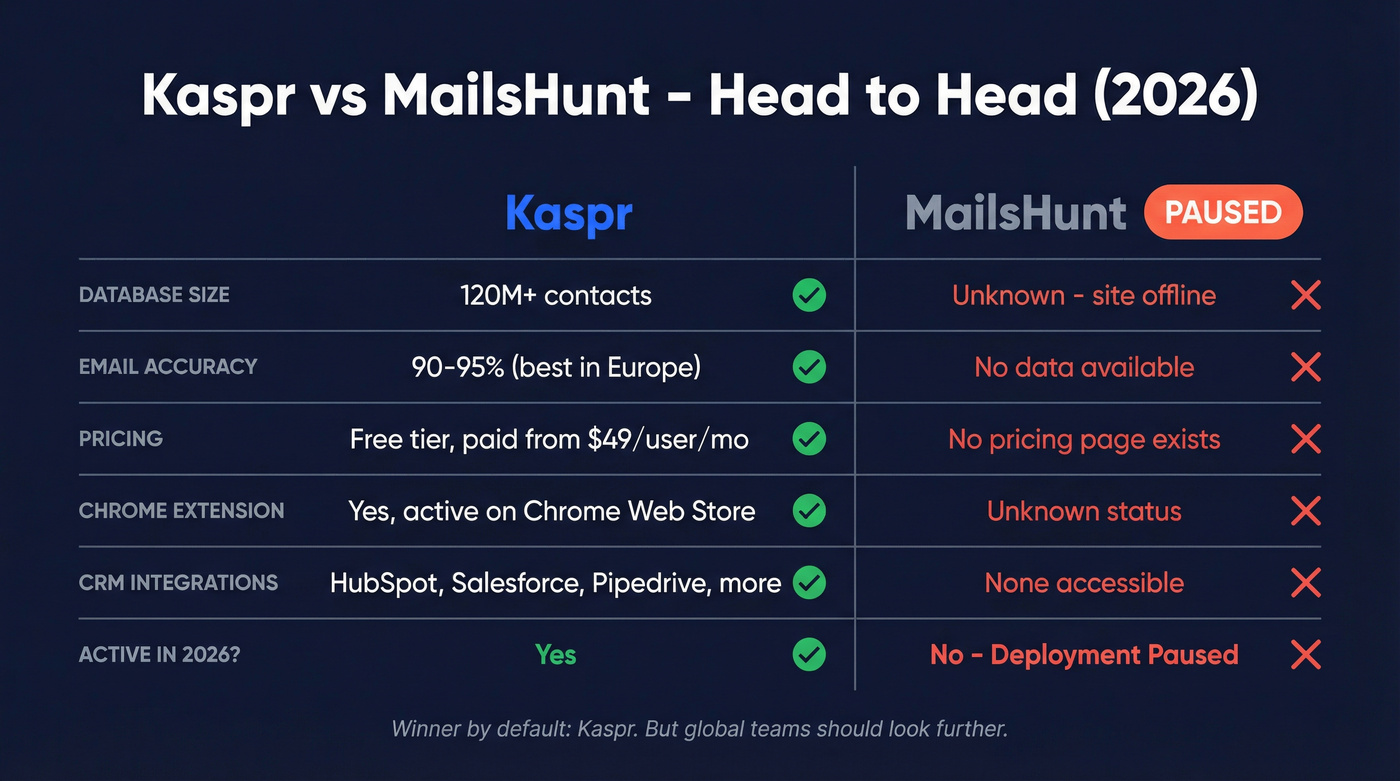
Every MailsHunt column says "unknown" because there's nothing to evaluate. For context, practitioners on r/agency consistently cite a sub-5% bounce rate as the minimum bar for any email finder worth paying for.
The Verdict
Let's be honest: this isn't a real comparison. One tool is operational with clear pricing and an established user base. The other doesn't have a functioning website. Nothing is more frustrating than researching a tool you can't even access - but that's exactly where MailsHunt stands in 2026.
If you're trying to reduce bounces and protect deliverability, start with the basics in our email deliverability guide and track your email bounce rate as a leading indicator.
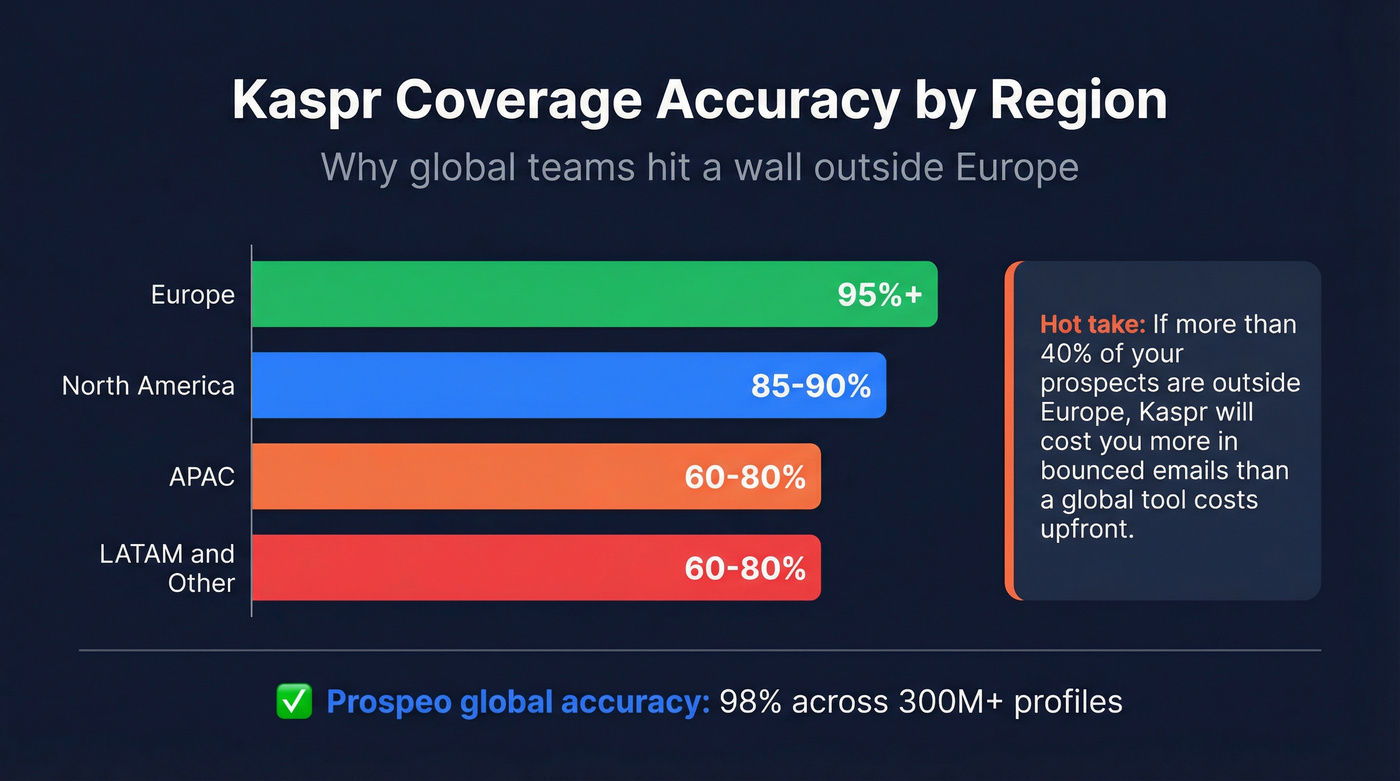
Kaspr wins by default, but that doesn't make it the right pick for everyone. It's built for Europe. If you're running outbound across North America, APAC, or LATAM, coverage drops and credit costs stack up quickly. One user on r/DigitalMarketing asked for a tool that's "completely up to date" with "international reach" - exactly the gap Kaspr leaves open outside its home turf.
Hot take: If your prospect list is more than 40% non-European, Kaspr will cost you more in bounced emails and wasted credits than a global-first tool would cost upfront.
What We'd Use Instead
In our experience, Prospeo's 7-day refresh cycle keeps bounce rates under 3%, while the industry average refresh sits around 6 weeks. That gap shows up fast when you're sending 500+ emails a day. The platform covers 300M+ professional profiles globally with 98% email accuracy and 125M+ verified mobile numbers.

The free tier includes 75 emails and 100 Chrome extension credits per month. Paid plans run about $0.01/email with no annual contracts. Native integrations push contacts directly into Salesforce, HubSpot, Lemlist, Instantly, and Clay. For teams that need global coverage without per-credit anxiety, it's the clearest upgrade from either tool in this comparison.
If you're evaluating other options, compare against the broader market in our guides to data enrichment services, outbound lead generation tools, and sales prospecting databases.
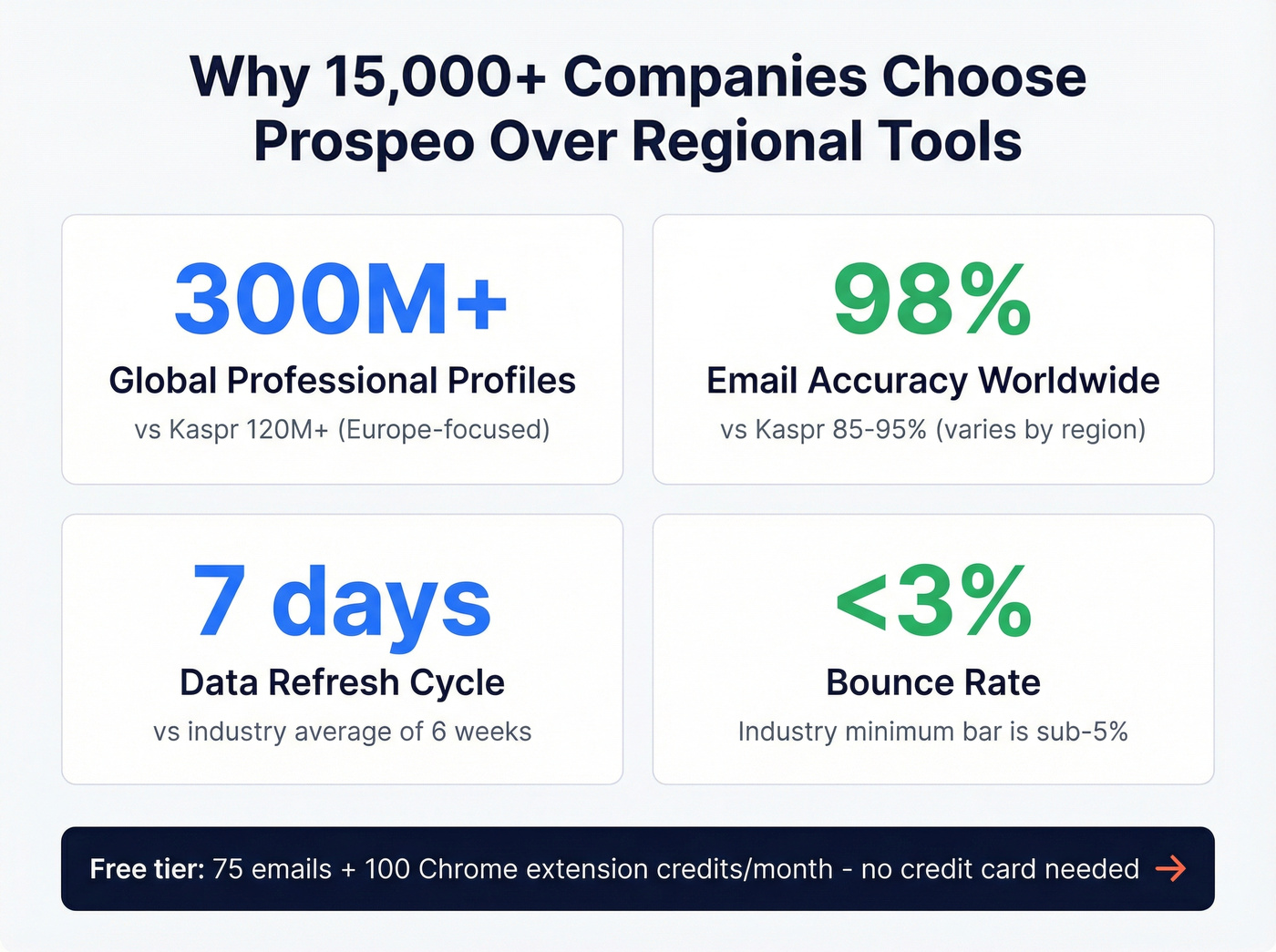
If your prospect list is more than 40% non-European, Kaspr's coverage gaps cost you in bounced emails and burned credits. Prospeo delivers 98% accuracy across 300M+ contacts worldwide at ~$0.01/email - with bounce rates under 3% thanks to a 7-day data refresh.
Global outbound deserves global data. 15,000+ companies agree.
FAQ
Is MailsHunt still active in 2026?
No. MailsHunt's site displays a "Deployment Paused" notice with no pricing, support, or sign-up pages accessible. Consider it inactive until proven otherwise.
Is Kaspr accurate outside Europe?
Coverage drops to roughly 85-90% in North America and 60-80% in other regions. For global prospecting, tools with broader databases and faster refresh cycles deliver more consistent results.
Is this comparison even fair?
No. One tool is operational with clear pricing and an established user base. The other has a paused site with no way to sign up. If you landed here because a blog post listed both, save your time - Kaspr is the only functioning option of the two, though global teams should evaluate alternatives with wider coverage.