


Klue Alternatives That Actually Matter in 2026
Most "Klue alternatives" lists include 10+ tools, half of which aren't CI platforms. One ranking page lists Figma as a Klue alternative. Another suggests Tableau. Let's skip the noise.
Klue is a strong product. G2 reviewers rate it 4.7/5 across 443 reviews, and its battlecard delivery into Salesforce and Slack is a genuine standout. But the complaints are consistent: difficult setup gets flagged repeatedly, the content creation UX is described as "really hard," and typical contracts land in the $20k-$40k/year range before you add integration and onboarding costs.
Here's the uncomfortable stat: 68% of sales deals involve direct competition, yet teams rate their competitive preparedness just 3.8 out of 10. Something's broken - and it's not always the platform. Sometimes it's the data underneath.
Our Picks (TL;DR)
- Direct Klue replacement: Crayon - similar feature set, easier setup (ease of setup: 9.1), median $28,750/year.
- CI on a budget: Kompyte - Semrush ecosystem, insights in 24-48 hours, typically cheaper than heavier platforms.
- Your real problem is stale contact data: Prospeo - 98% email accuracy, 7-day refresh, self-serve from $0/month.
Best Klue Alternatives Compared
Crayon
Use this if you want the closest feature-for-feature Klue replacement with less setup friction.
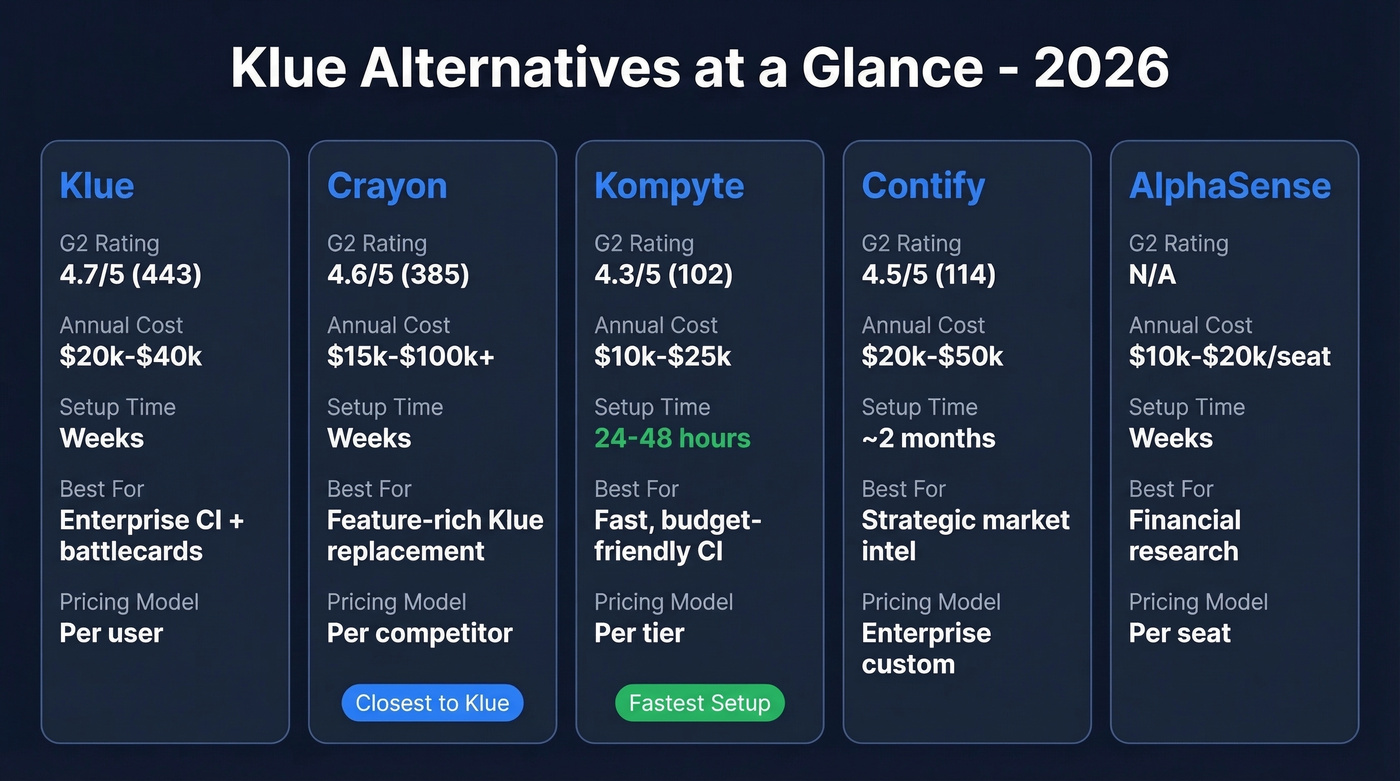
Crayon holds a 4.6/5 on G2 across 385 reviews, with an ease-of-setup score of 9.1. It's won PMA Pulse awards for best CI software three years running. The battlecard engine, competitive monitoring, and field intel capture are all mature - and the onboarding experience is noticeably smoother than Klue's, which matters more than people think when you're trying to get 50+ reps to actually use the thing.

Pricing works differently from Klue in a way that really matters for budgeting. Crayon charges based on the number of competitors tracked, while Klue scales with user count. Based on 90 real purchases tracked by Vendr, the median annual contract is $28,750, ranging from roughly $15k to $100k+ for enterprise deployments. Lots of users, few competitors? Crayon's model wins. Few users, many competitors? Klue's user-based pricing can be cheaper.
Skip this if your stack depends on tight integrations. "Poor integration" shows up as a recurring G2 con, and we've heard the same from teams running complex Salesforce orgs.
Kompyte
Kompyte takes a different approach: strip out the complexity and get teams running fast. Acquired by Semrush in 2022, it carries a G2 rating of 4.3/5 across 102 reviews and lets teams start seeing insights in 24-48 hours, with full implementation in one to two weeks. We've seen sub-50-rep teams get more value from Kompyte's speed than from a heavier platform they never fully adopt.
The tradeoff is depth. Klue's "meets requirements" sub-score on G2 is 9.1 versus Kompyte's 8.6, and quality of support scores 9.8 versus 8.9. If you need enterprise-grade customization, you'll feel that gap.
Packaging is transparent: Essentials gives you 10 tracked companies and 25 user licenses, Professional bumps to 20 companies and 100 licenses, and Unlimited removes caps and adds SSO. For many small-team deployments, expect roughly $10k-$25k/year.
Contify
Contify is the pick for strategic CI - tracking M&A activity, leadership changes, partnership announcements, and regulatory shifts across your market. It scores 4.5/5 on G2 with 114 reviews and excels at news monitoring and intelligence aggregation.
Don't buy it for sales enablement. Contify is built for analysts and strategy teams, not for arming SDRs before discovery calls. Implementation takes roughly 2 months with ROI at around 5 months. A common buyer objection: the platform is "more comprehensive than current requirements" - a polite way of saying you'll pay for capabilities you won't use. Expect $20k-$50k/year.
AlphaSense
Let's be honest: AlphaSense isn't a Klue alternative. It's a financial and market intelligence platform - premium research, expert transcripts, SEC filings, earnings calls. At $10k-$20k per seat annually, with enterprise deals running $50k-$100k+, it serves a completely different budget line and buyer. The company hit $500M ARR with 6,500+ customers. Impressive - just not what you need if your problem is "reps don't know how to position against Competitor X."

Teams spend $20k-$40k on CI platforms while their SDRs bounce 35% of emails. Prospeo delivers 300M+ profiles with 98% email accuracy, a 7-day refresh cycle, and costs ~$0.01 per email. Fix the data layer before you fund the intelligence layer.
Battlecards don't close deals when emails bounce. Start with clean data.
Pricing Comparison
Organizations undercount CI spend by 3-10x when you factor in the 10-20 hours per week of analyst labor needed to convert alerts into usable sales content - that's $26k-$83k/year in loaded labor costs on top of the platform fee.
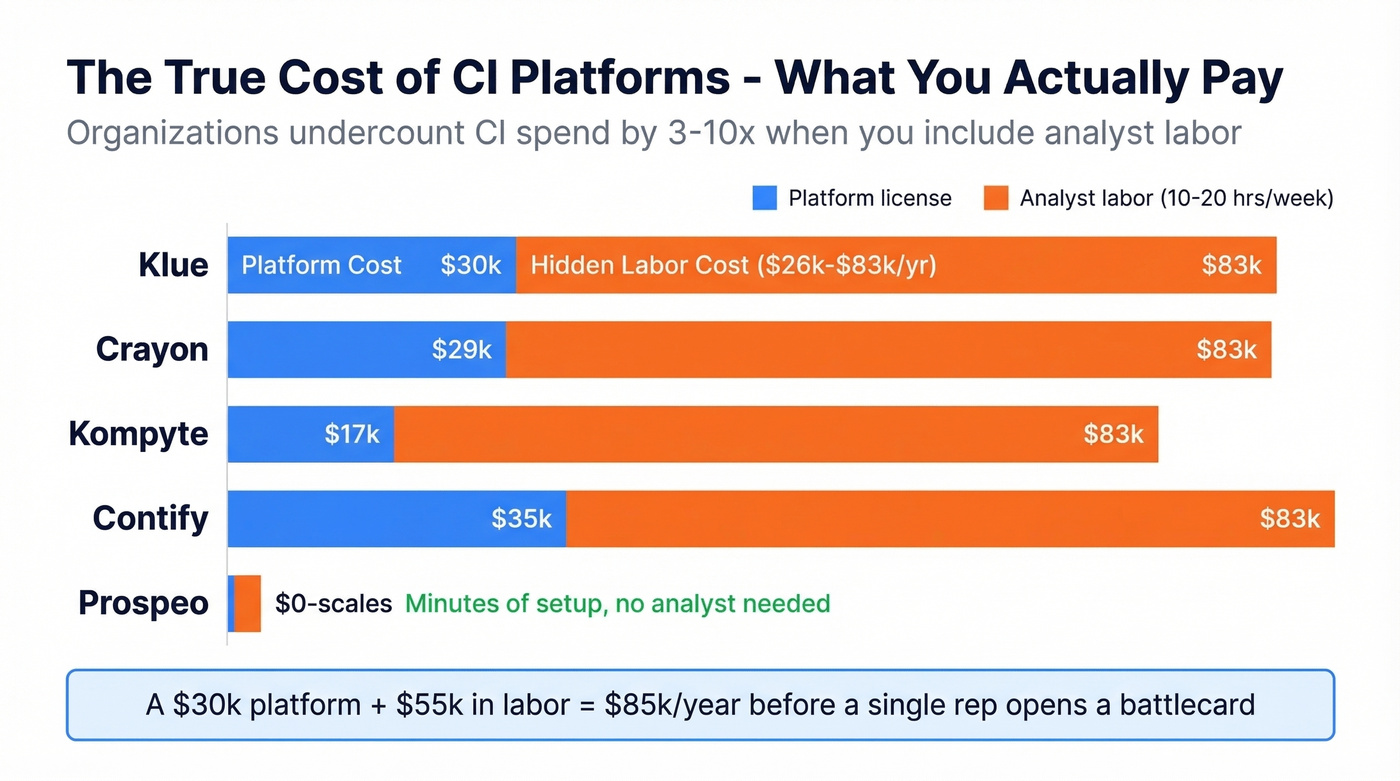
| Tool | Annual Cost | Pricing Model | Free Tier | Setup Time |
|---|---|---|---|---|
| Klue | $20k-$40k | Per user (custom) | No | Weeks |
| Crayon | $15k-$100k+ (median $28,750) | Per competitor | No | Weeks |
| Kompyte | ~$10k-$25k | Per tier | No | 24-48 hours |
| Prospeo | $0-scales | Credit (~$0.01/email) | Yes (75 emails/month) | Minutes |
| Contify | ~$20k-$50k | Enterprise custom | No | ~2 months |
| AlphaSense | $10k-$20k/seat | Per seat | No | Weeks |
How to Choose the Right CI Tool
Here's my hot take: for teams with fewer than 50 reps and fewer than 10 competitors, a $30k competitive intelligence platform is almost certainly overkill. The CI market is projected to grow from $4.85B to $10.25B by 2032, and vendors are pricing accordingly - but that doesn't mean your team needs to fund that growth. If you're building a repeatable program, start with a clear competitive intelligence strategy and then pick tooling that matches your operating model.
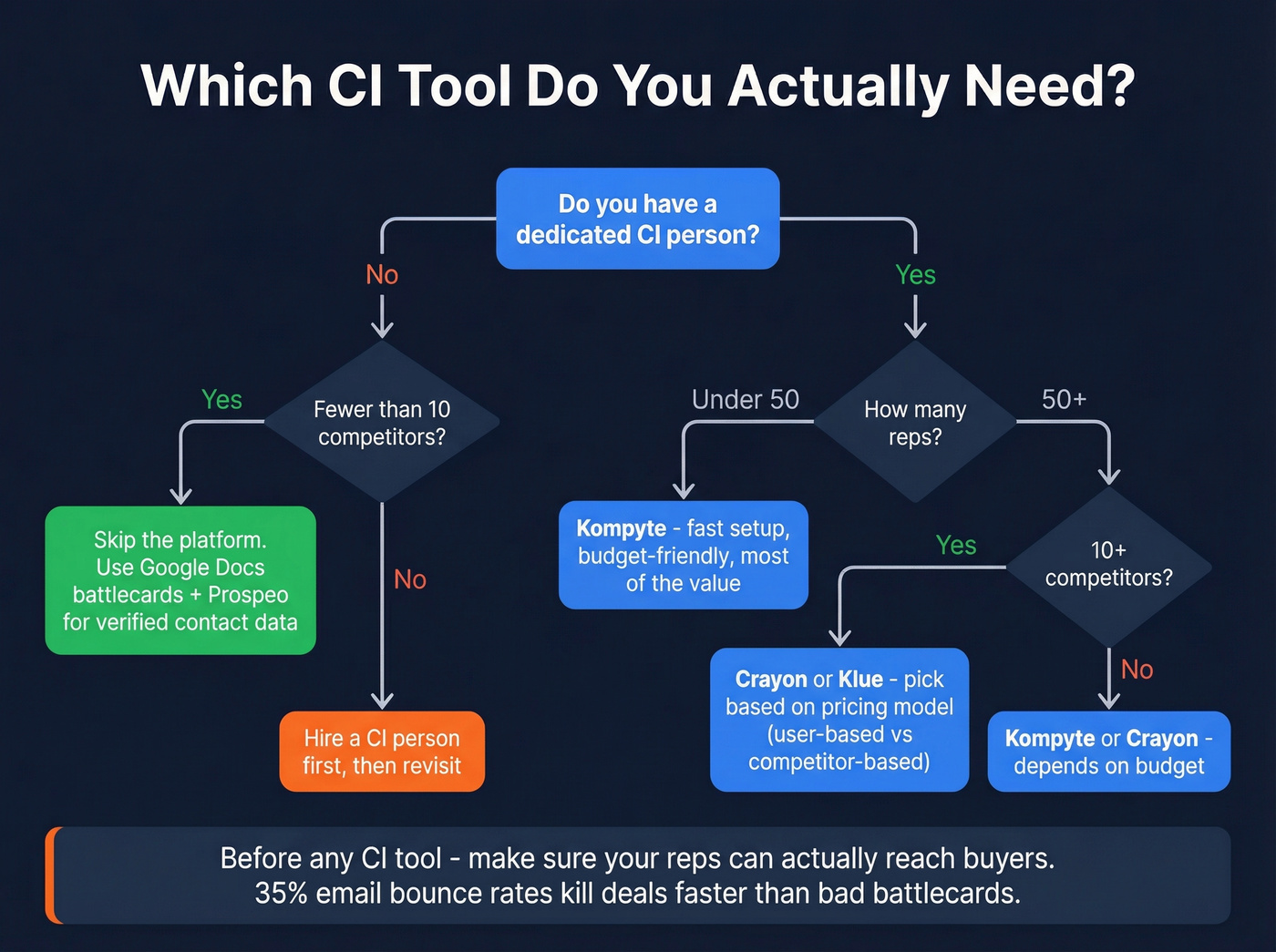
Before you evaluate any platform, answer two questions.
First, how many reps actually opened a battlecard last quarter? If the answer is single digits, your problem isn't the CI tool - it's adoption. Second, do you have a dedicated CI person? Without one, even the best platform becomes an expensive content graveyard.

In our experience, the decision breaks down like this:
50+ reps, 10+ competitors, dedicated CI person: Crayon or Klue. Pick based on pricing model fit - user-based versus competitor-based.
Under 50 reps, budget-conscious: Kompyte. You'll get most of the functionality fast, without the overhead of a heavier platform.
Under 10 competitors, no dedicated CI person: You probably don't need a CI platform at all. Manual battlecards in Google Docs plus verified contact data gets you most of the value at a fraction of the spend. If your real bottleneck is list quality, look at data enrichment services and a reliable sales prospecting database before you buy another enablement tool.
We've watched teams pour $40k into a CI platform while their SDRs bounce 4 out of 5 emails. That's backwards. Start with the data layer - make sure reps can actually reach the accounts they're targeting - and build the intelligence layer on top once adoption proves out. Prospeo covers 300M+ profiles with 98% email accuracy and a 7-day refresh cycle, starting at $0/month. CI tells you what to do; clean data makes sure you can act on it. If you're running outbound at scale, pair that with a solid email deliverability guide and track your email bounce rate.
Your CI tool tells reps what to say. Prospeo makes sure those reps reach real buyers. 143M+ verified emails, 125M+ verified mobiles, and a 7-day data refresh - no $30k contract, no weeks of setup. Self-serve from $0/month.
Competitive intelligence is useless if your contact data is dead. Fix that now.
Klue Alternatives FAQ
Is Crayon better than Klue?
Neither is universally better. Crayon is easier to set up (ease of setup: 9.1) with strong field intel capture. Klue has better support scores (9.8 vs 9.6) and more polished battlecard delivery. Klue prices by users, Crayon by competitors - your cost depends on team shape.
How much does Klue cost?
Klue typically costs $20,000-$40,000/year, scaling based on user count. Klue Access has four tiers: Starter, Essentials, Pro, and Plus. Competitive Intelligence and Win-Loss are separate products. Larger deployments can exceed $100k.
Do I need a CI platform at all?
If you have fewer than 50 reps and track fewer than 10 competitors, probably not. Manual battlecards plus a verified data tool for accurate contact information gets you most of the value at a fraction of the cost.
What's the fastest Klue alternative to deploy?
Kompyte. It goes live in 24-48 hours with full implementation in one to two weeks. Crayon and Klue both take multiple weeks. For teams under 100 reps where speed matters more than depth, it's the clear winner.