


Kompyte Review 2026: Pricing, Pros, Cons & Honest Verdict
Six review sites deep and you still don't know what Kompyte costs. That's not an accident - it's a sales strategy.
We've spent time digging through Gartner Peer Insights reviews, G2 threads, acquisition disclosures, and Vendr data to put together what "contact sales" pages won't tell you. This is the full picture: real pricing context, honest strengths and weaknesses, and whether Kompyte actually deserves a line item in your budget.
30-second verdict: Kompyte is a solid CI tool with fast setup and a clean UI. But pricing is opaque, AI features underdeliver, and you'll hit tier limits fast. If your budget supports $20K+/year, Klue is the stronger pick.
Kompyte at a Glance
Kompyte automates competitor tracking across websites, reviews, social media, ads, and job postings, then surfaces changes via AI-curated summaries and feeds them into sales battlecards.
Semrush announced the Kompyte acquisition on March 2, 2022, positioning it as a "perfect product to upsell" for existing Semrush customers and a way to expand Semrush .Trends. At the time, 88% of Kompyte's user base sat within sales organizations. A partnership with IcebergIQ for win-loss interview insights signals the product is still actively marketed and developed, though the pace of feature releases has slowed compared to Klue and Crayon.
What Does Kompyte Cost?
Kompyte doesn't publish pricing. The tiers are real, but the dollar figures live behind sales conversations.
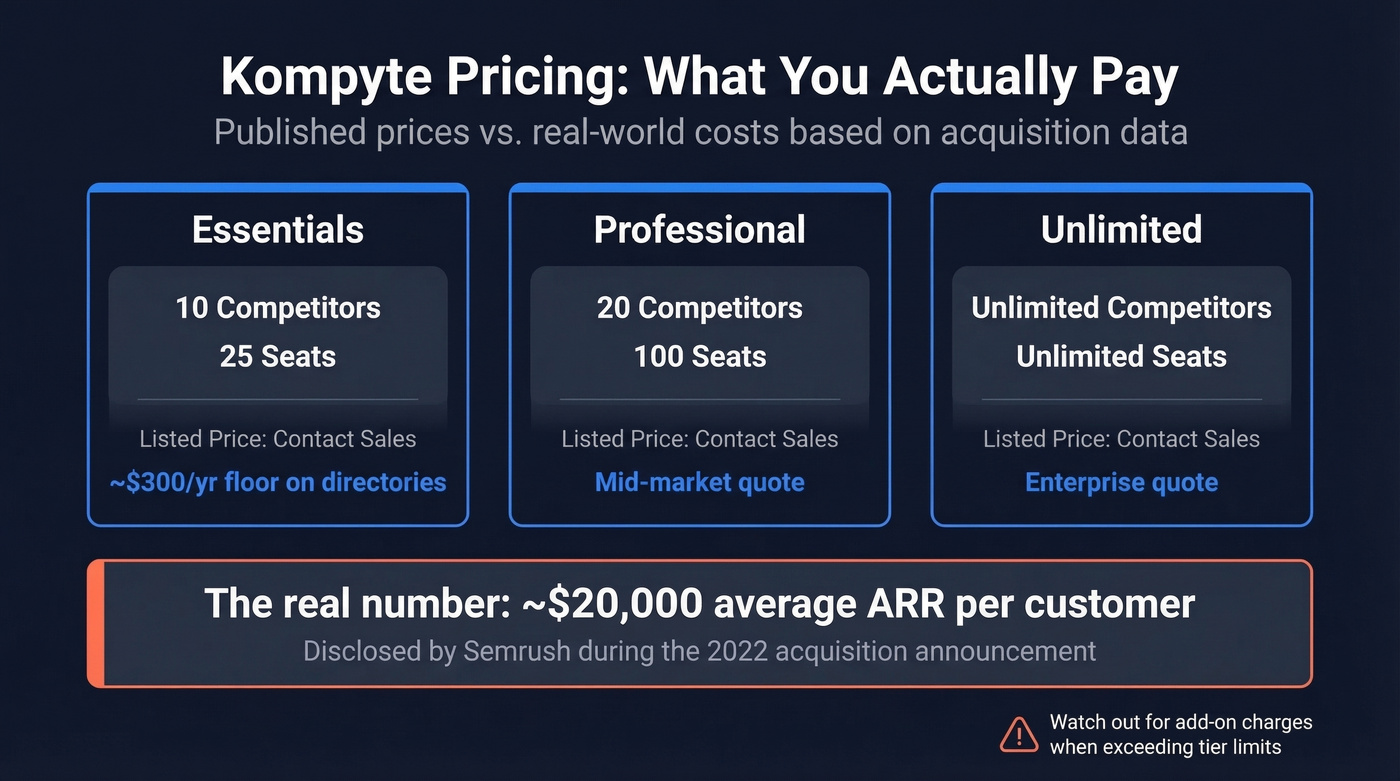
| Essentials | Professional | Unlimited | |
|---|---|---|---|
| Competitors tracked | 10 | 20 | Unlimited |
| User seats | 25 | 100 | Unlimited |
| Public price | Contact sales | Contact sales | Contact sales |
| Pricing context | ~$300/year floor on directories | Mid-market quote | Enterprise quote |
| Contract | Annual | Annual | Annual |
That $300/year floor shows up on directories like Software Advice and GetApp as a "starting from" price. But here's the number that actually matters: when Semrush announced the acquisition, it disclosed an average ARR per Kompyte customer of roughly $20,000. That's a far better indicator of what most real buyers end up paying.
The model can feel nickel-and-dime. A Gartner Peer Insights reviewer called out extra charges for adding competitors and for expanding who can see battlecards. Want to track an 11th competitor on Essentials? That turns into an upsell conversation - classic anchor in negotiation.
Pros: Where Kompyte Delivers
The UI is consistently praised for ease of use - the tile-based competitor dashboard is genuinely well-designed, and we've seen multiple reviewers call it out as the best part of the product. Setup is fast too. Where Crayon can take 7-8 weeks for full deployment, Kompyte gets you running with minimal onboarding friction.
- Responsive customer support. Reviewers highlight professional onboarding and attentive customer success managers who actually follow up.
- Daily automated competitor visits surface changes without manual effort - no more assigning an intern to check competitor websites every morning.
- Unlimited battlecards and reports across all plans, so sales teams can get value quickly regardless of tier.

Battlecards don't close deals - conversations do. While you're comparing Kompyte tiers and add-on costs, your competitors are already reaching decision-makers. Prospeo gives you 300M+ profiles with 98% email accuracy and 125M+ verified mobiles, refreshed every 7 days. No opaque pricing, no annual contracts.
Turn competitive intelligence into pipeline for $0.01 per verified email.
Cons: Where Kompyte Falls Short
Here's the thing: the cons aren't dealbreakers individually, but they stack up.
- AI summaries are underwhelming. A December 2025 Gartner review called them "replaceable with existing LLMs" and inconsistent with complex or unstructured text. For a tool that markets AI as a core feature, that stings - especially if you're building a broader competitive intelligence strategy.
- No PowerPoint or Excel export. You can't export battlecards into PowerPoint or tables into Excel, which forces manual copy-paste for exec presentations. In 2026, that's inexcusable.
- Financial data pulls from a single source (Crunchbase). Funding and revenue fields can be incomplete or outdated.
- Slack and HubSpot integrations feel half-baked with limited configuration options.
- Can miss smaller competitors. G2 reviews flag that niche or emerging players aren't captured as reliably as established ones.
- Opaque pricing with add-on creep. Multiple reviewers mention surprise costs when scaling beyond initial tier limits.
Ratings Across Review Platforms
| Platform | Rating | Reviews |
|---|---|---|
| G2 | 4.3/5 | 102 |
| Capterra | 4.6/5 | 37 |
| Gartner Peer Insights | 3.3/5 | 9 |
| Software Advice | 4.6/5 | 37 |
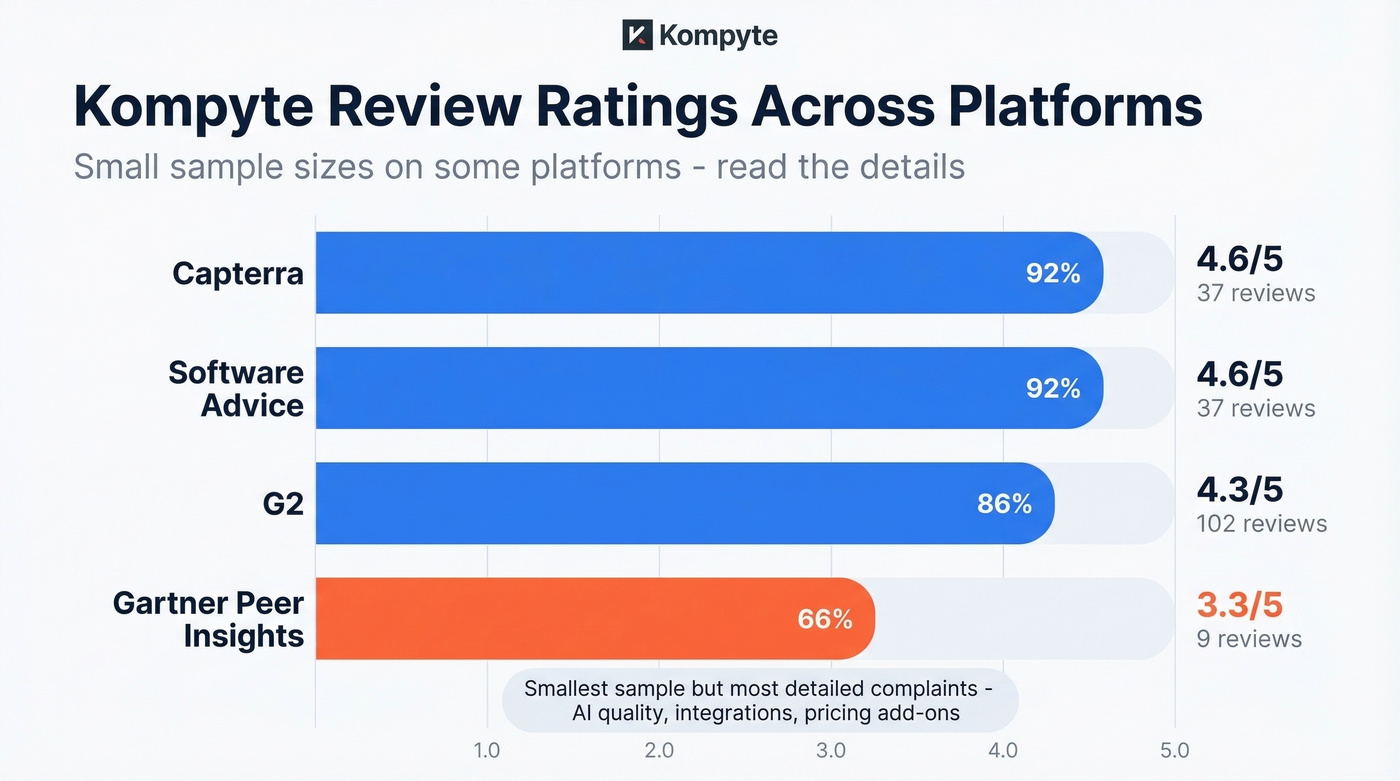
The Gartner score stands out - and not in a good way. The sample size is small, but the complaints are specific (AI usefulness, integrations, pricing add-ons), and they line up with what shows up across other review platforms. When the most detailed reviewers are the least satisfied, that tells you something.
Kompyte vs Alternatives
| Tool | Best for | G2 Rating | Est. Annual Cost | Key Differentiator |
|---|---|---|---|---|
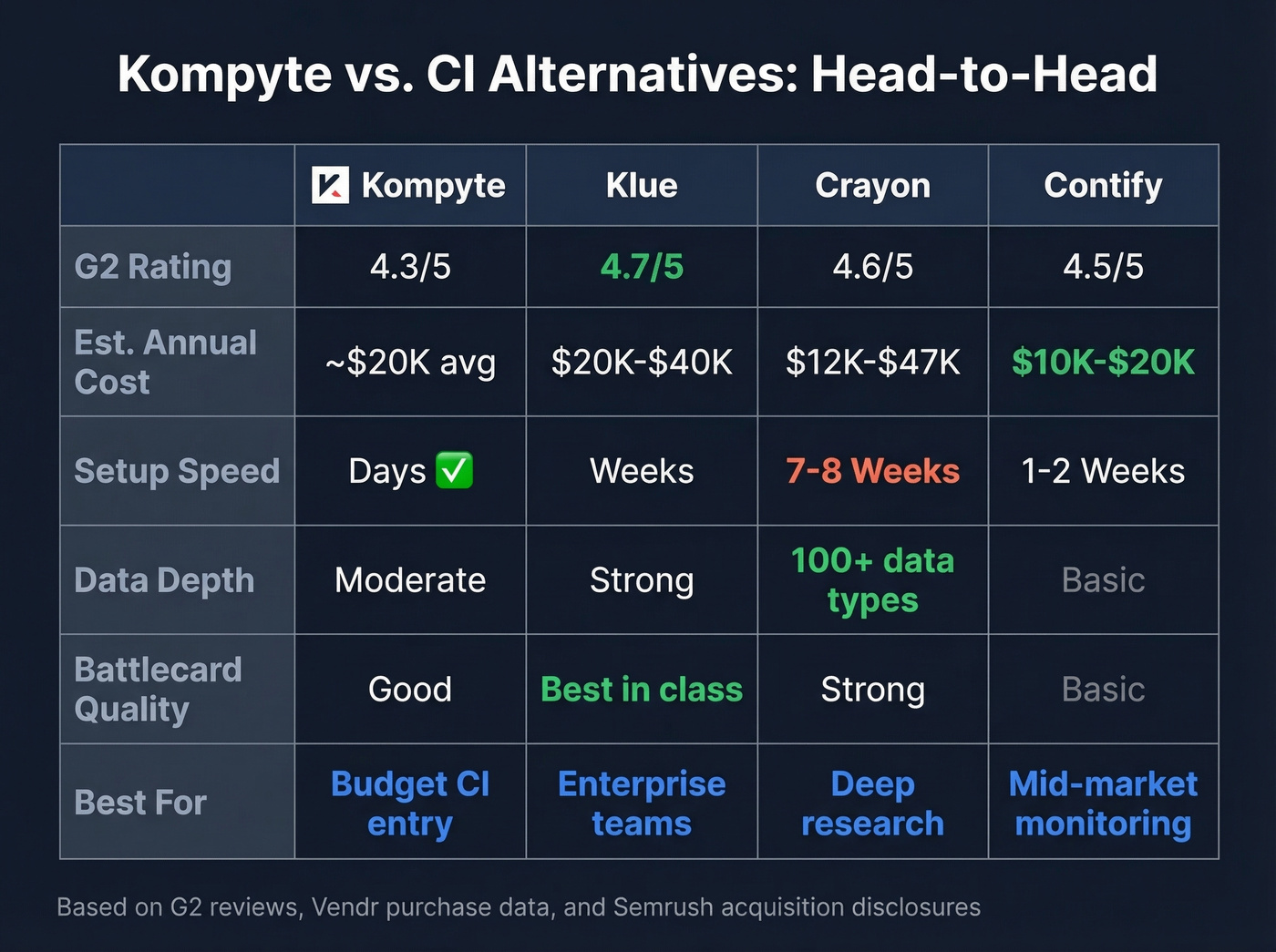
| Kompyte | Budget CI entry | 4.3/5 | ~$20K avg ARR | Fast setup, Semrush ecosystem |
| Klue | Enterprise battlecards | 4.7/5 (436 reviews) | $20K-$40K | Strongest ratings, scales by users |
| Crayon | Deep competitive tracking | 4.6/5 (386 reviews) | $12,450-$47,100 | 100+ data types, SEC filings |
| Prospeo | Verified contact data | - | From $0/mo | 98% email accuracy, 7-day data refresh |
| Contify | Lightweight CI feed | 4.5/5 (114 reviews) | $10K-$20K | Simpler, less expensive |
Klue
4.7 out of 5 across 436 G2 reviews - a massive sample for this category. Over 80 former Crayon clients have switched. Klue's model scales by users rather than competitors tracked, which avoids the nickel-and-dime trap that frustrates Kompyte buyers. If your budget supports $20K-$40K/year, Klue is the default recommendation for enterprise battlecard programs. It's not close.
Crayon
Crayon is known for deep CI coverage - including 100+ data types like patents and SEC filings. Vendr reports a median annual cost of $28,750 based on 90 purchases, with a range of $12,450 to $47,100. The tradeoff is implementation time: expect 7-8 weeks versus Kompyte's faster setup. For teams that need that depth, the wait is worth it.
Prospeo
Not a CI tool - it's the data layer that makes competitive intelligence actionable. CI platforms tell you what competitors are doing. Prospeo gives you verified emails and direct dials for the accounts those competitors are targeting, with 300M+ professional profiles and a 7-day data refresh cycle. With 98% email accuracy and 125M+ verified mobile numbers, it bridges the gap between knowing the competitive landscape and actually reaching the right buyers. Free tier available, no contracts.
Contify
Skip Crayon-level depth and Klue-level complexity if you don't need them. Contify runs $10K-$20K/year and delivers a clean CI feed for mid-market teams that want monitoring without the overhead. If you're tracking 5-10 competitors and just need a steady stream of updates, it's worth a look.
CI platforms tell you what competitors are doing. Prospeo tells you exactly how to reach the buyers they're targeting - with verified direct dials and emails, not stale data from a single source like Crunchbase. 92% API match rate, 30% mobile pickup rate, and a free tier to prove it.
Stop tracking competitors. Start reaching their prospects first.
Who Should (and Shouldn't) Use Kompyte
Use Kompyte if you track fewer than 10 competitors, need a CI tool running within days, already use Semrush, or have a CI budget under $5K/year.
If you're trying to operationalize this inside a broader RevOps motion, it helps to map CI outputs to your lead generation workflow and sales process optimization.
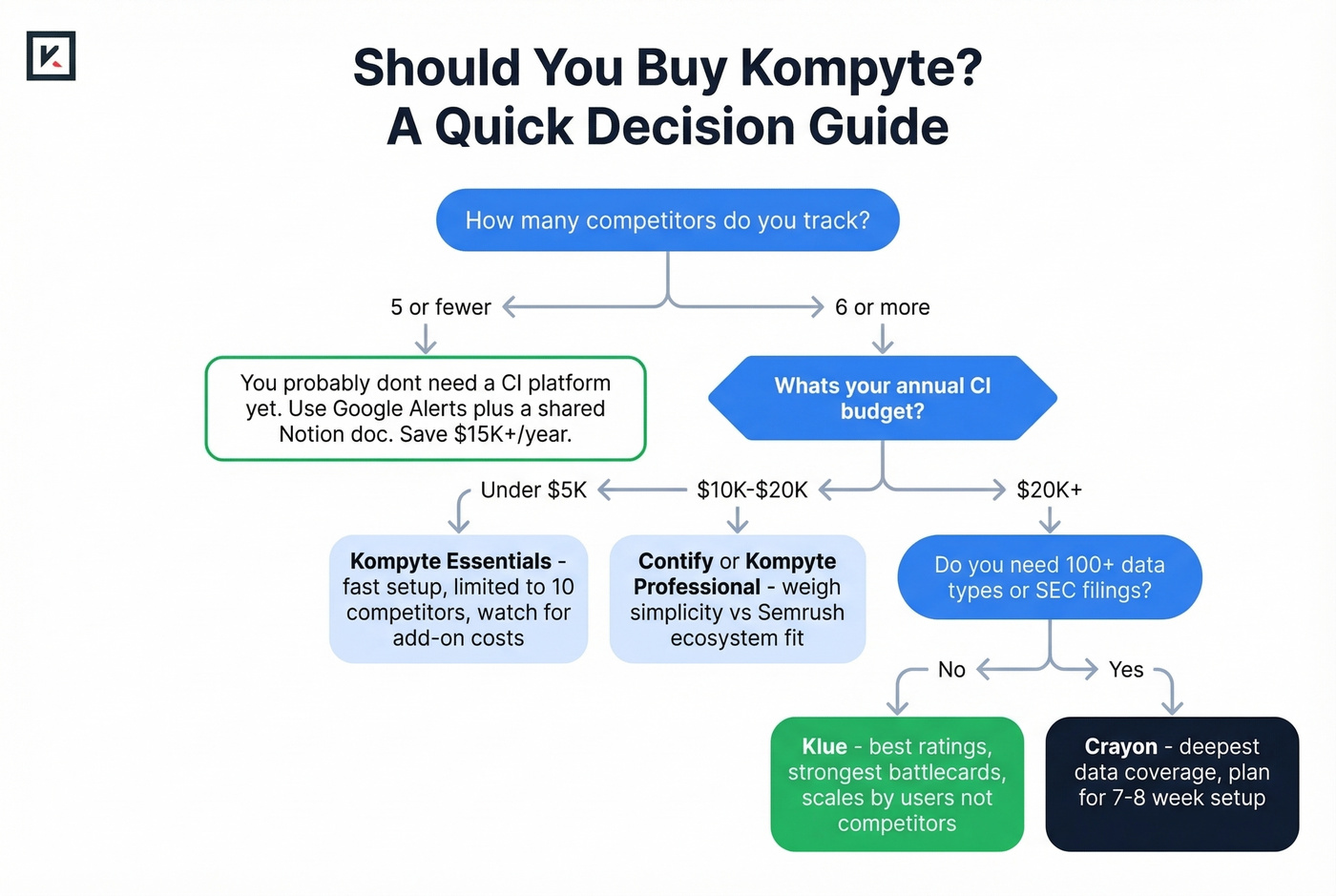
Skip Kompyte if you need deep data coverage across 100+ source types, require PowerPoint or Excel export for exec presentations, want reliable AI-generated summaries, or plan to track 20+ competitors without paying per-competitor premiums.
Let's be honest: most teams evaluating Kompyte don't actually need a dedicated CI platform yet. If you're tracking fewer than five competitors, a shared Notion doc with Google Alerts and a monthly review cadence gets you 80% of the value at zero cost. We've seen teams burn $15K/year on CI tools they barely log into. The real question isn't Kompyte vs. Klue - it's whether you've outgrown the DIY approach and are ready for more data-driven selling.
FAQ
Is Kompyte free?
No. Kompyte requires a paid subscription across all tiers (Essentials, Professional, Unlimited). There's no free plan or freemium option - every tier requires a sales conversation to get a quote.
Who owns Kompyte now?
Semrush acquired Kompyte on March 2, 2022. It operates as "Kompyte by Semrush" and targets sales teams already using Semrush .Trends for competitive intelligence workflows.
Is Kompyte worth it in 2026?
For small teams tracking under 10 competitors on a tight budget, Kompyte can work - especially if you're already in the Semrush ecosystem. For anything larger, Klue offers better ratings, deeper adoption, and stronger battlecard programs in the $20K-$40K/year range.
What's a good free tool to pair with CI platforms?
Prospeo offers a free tier with 75 email credits and 100 Chrome extension credits per month - useful for turning competitive insights into actual outreach. Google Alerts and Notion templates handle basic monitoring at zero cost.