

Best Lead Distribution Software for Every Team Type
Your SDR manager just pulled the numbers: average time-to-first-touch last quarter was 11 hours. That sounds decent until you realize 47% of companies don't respond to a new lead within 24 hours at all - and leads contacted within five minutes are 21x more likely to convert than leads left sitting for 30 minutes. The right lead distribution software closes that gap. The hard part is knowing whether you need a $12/mo CRM add-on or a $50k/year routing platform.
Our Picks (TL;DR)
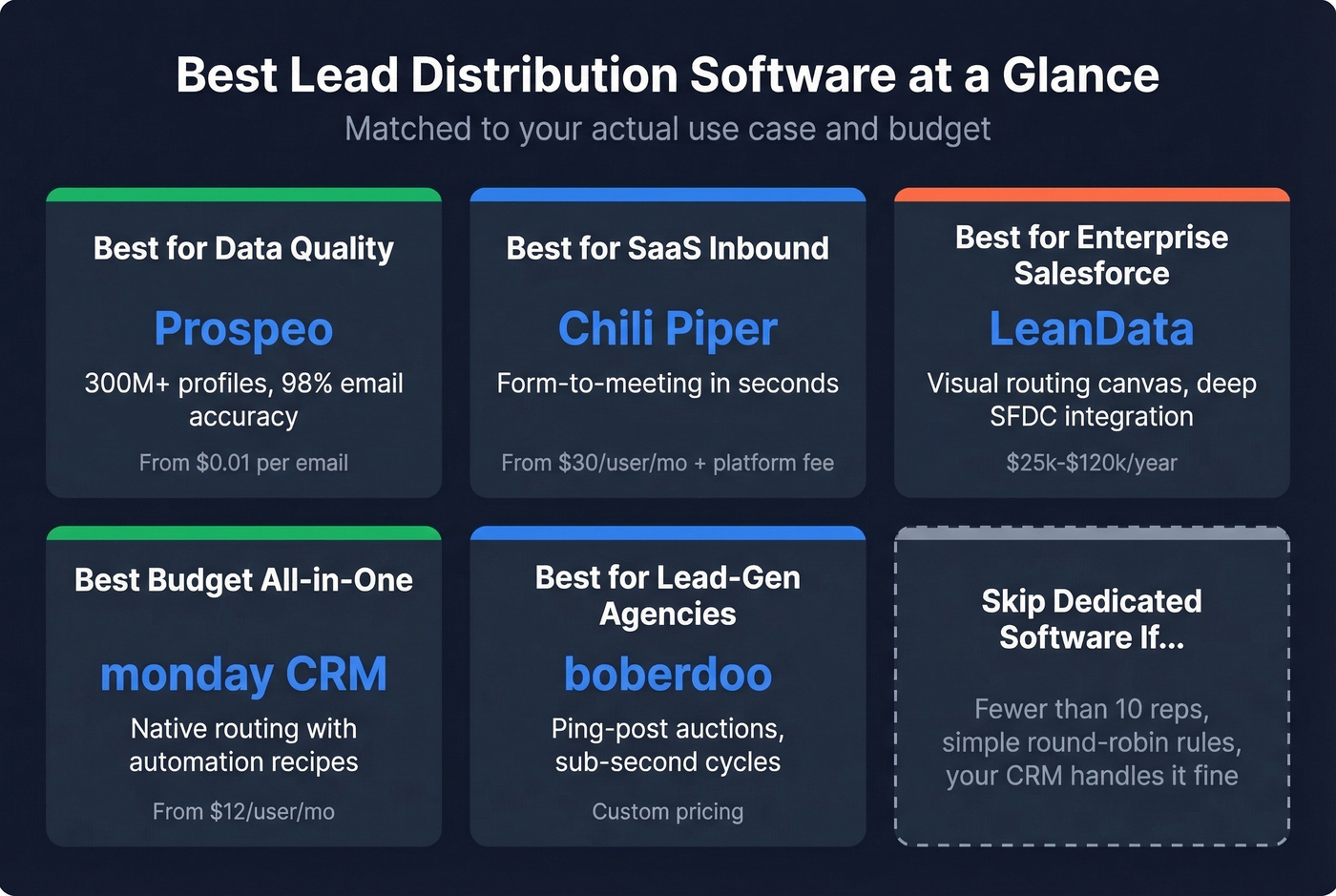
- Best for data quality + outbound distribution: Prospeo - routing garbage data faster doesn't help anyone
- Best for SaaS inbound routing: Chili Piper - gold standard, but budget more than you think
- Best for Salesforce-heavy teams: LeanData - powerful, expensive, Salesforce-only
- Best all-in-one on a budget: monday CRM - solid native routing starting at $12/user/mo
- Best for lead-gen agencies (ping-post): boberdoo - sub-second auction cycles built for the business
- Skip dedicated software if you have fewer than 10 reps and simple round-robin rules - your CRM's native assignment will do the job
Which Routing Platform Do You Actually Need?
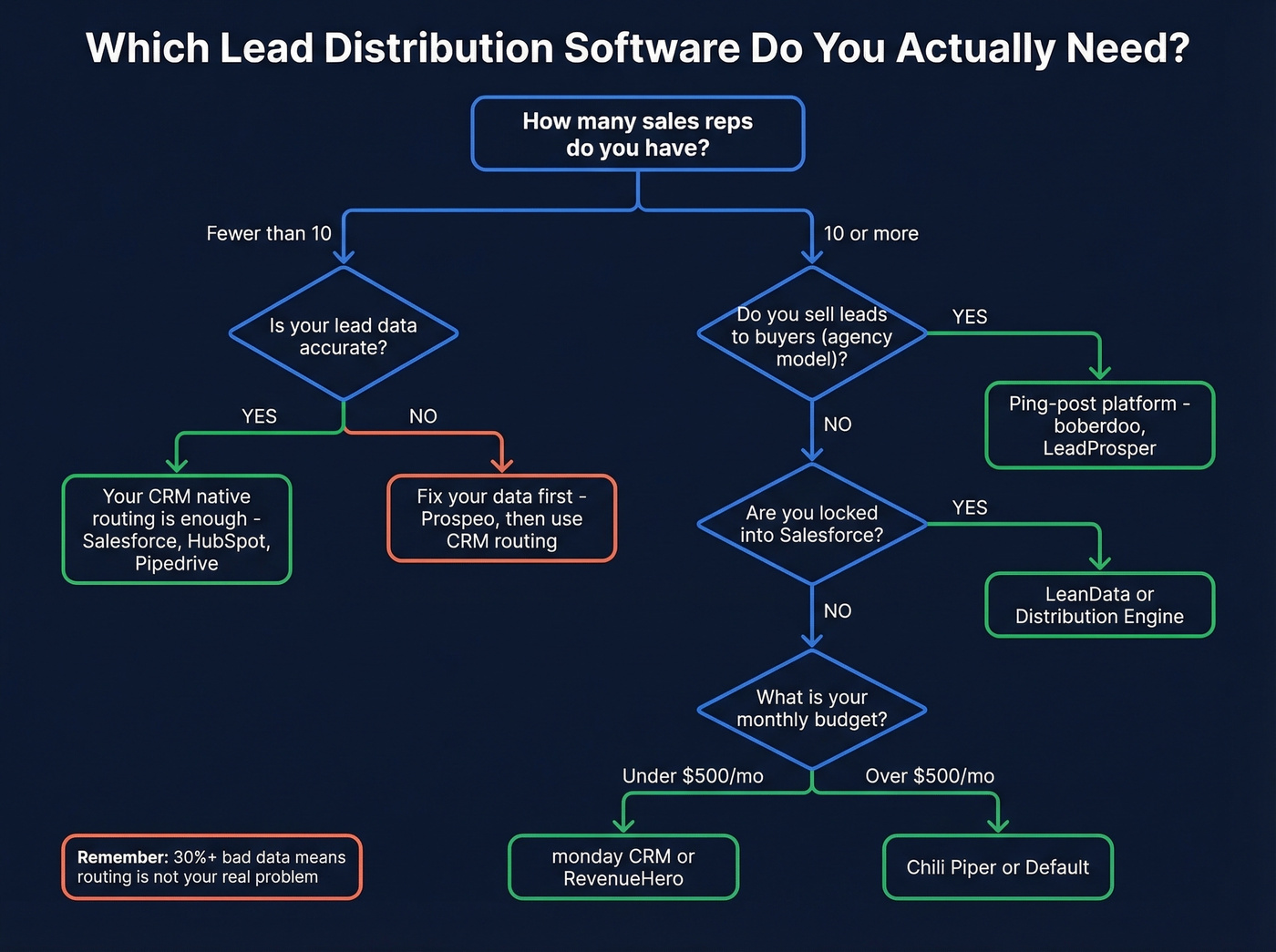
Not every team needs a dedicated routing platform. Figure out which category you fall into before comparing features.
| Category | Best For | Examples | When to Use |
|---|---|---|---|
| CRM-native routing | Teams <10 reps | Salesforce, HubSpot, Pipedrive | Simple round-robin, basic territory rules |
| Dedicated routing | 10+ reps, complex rules | Chili Piper, LeanData, Default | Speed-to-lead, account matching, weighted distribution |
| Ping-post platforms | Lead-gen agencies | boberdoo, LeadProsper | Real-time lead auction to buyers |
| Data-quality-first | Teams with bad contact data | Prospeo | 30%+ of leads have wrong emails or phones |
Here's the thing most articles about lead distribution miss: if your contact data is bad, better routing just delivers bad data faster. We tested this firsthand - running a 500-lead sample through an enrichment layer before routing cut bounce rates by over 80% and turned a "routing problem" into a non-issue. The routing worked fine all along. The data didn't.
If your reps complain about lead quality more than lead quantity, the fix isn't better routing logic. It's better data upstream.
The Best Lead Distribution Tools
Chili Piper
Use this if you're running inbound SaaS with 10+ reps and need instant lead-to-meeting conversion.
Skip this if you're on a tight budget and haven't done the real math on their pricing.
Chili Piper is the best inbound routing tool on the market. Concierge takes a form submission and turns it into a booked meeting before the prospect closes the tab. The scheduling UX is genuinely excellent, and the Salesforce/HubSpot integrations are deep. For teams that need meeting distribution at scale, it's the benchmark everyone else is chasing.
Now let's talk about what every other article gets wrong: the price. Most listicles say Chili Piper "starts at $15/user/month." That's ChiliCal - the scheduling-only product. It's not routing.
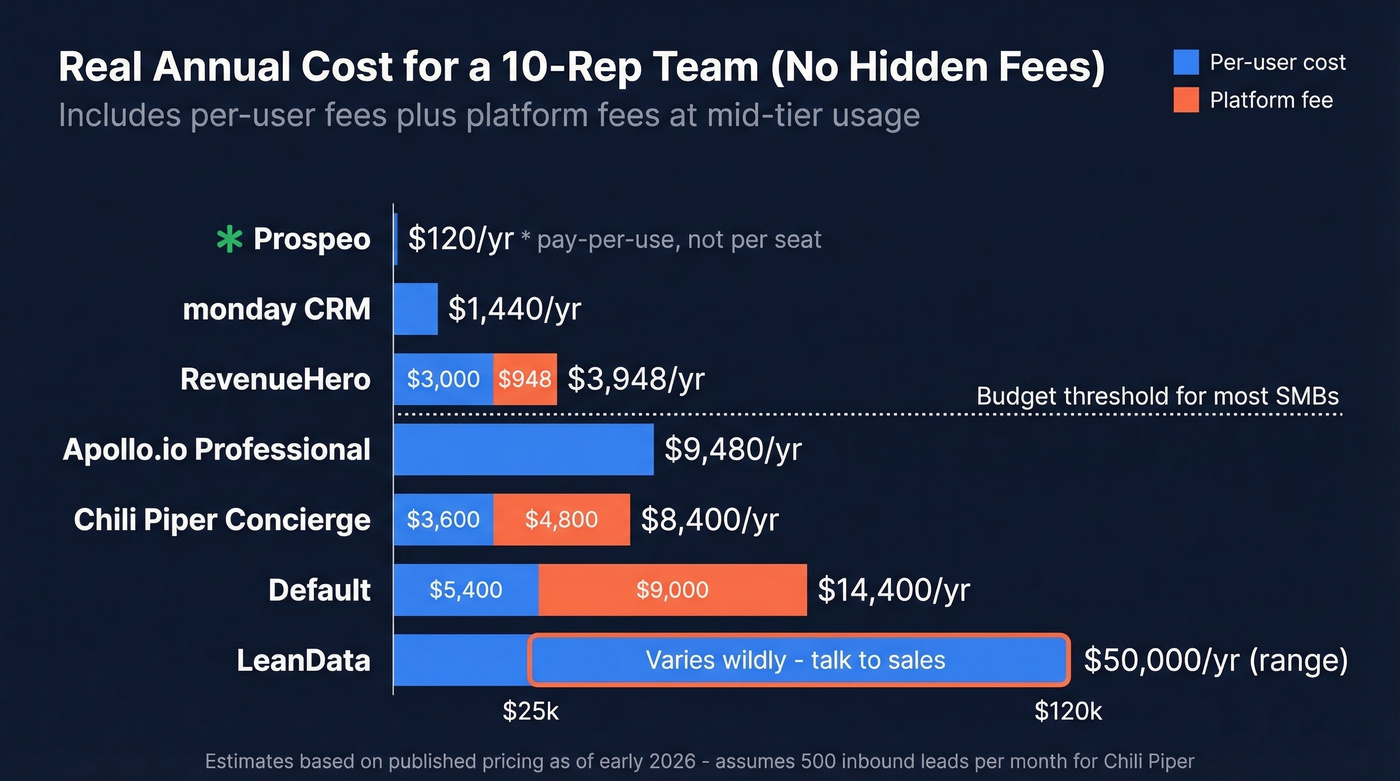
For actual lead distribution via Concierge, you're looking at $30/user/month plus a platform fee that scales by inbound volume: $150/mo for up to 100 leads, $400/mo for 101-1,000, and $1,000/mo for 1,000+. A 5-rep team processing 500 inbound leads per month pays $550/mo minimum. The pricing page is designed to make you think it's cheaper than it is.

Worth every dollar for high-velocity inbound teams. Just budget honestly.
Prospeo
Prospeo solves a different problem than every other tool on this list: it makes sure the leads entering your routing workflow are actually reachable. The database covers 300M+ professional profiles with 98% email accuracy and 125M+ verified mobile numbers, refreshed every 7 days - the industry average is six weeks.
For cold email distribution, the workflow is straightforward. Build targeted lists using 30+ filters covering intent data across 15,000 Bombora topics, technographics, job changes, and funding signals. Export contacts and verify emails before you push them into your sequencer or CRM. That way, you're not routing leads that'll bounce.

Snyk's 50-person AE team used Prospeo to verify contact data and dropped their bounce rate from 35-40% to under 5%, with AE-sourced pipeline up 180%. Pricing runs ~$0.01 per email with a free tier of 75 emails/month. No contracts, no sales calls. For teams whose routing is fine but whose data isn't, this is the highest-ROI investment on the list.
LeanData
LeanData is the enterprise answer to lead routing - and it knows it. The visual routing canvas inside Salesforce is genuinely powerful: a drag-and-drop flow builder across leads, contacts, accounts, and custom objects that RevOps teams love. G2 reviewers consistently praise the canvas but flag implementation timelines as longer than expected.

The frustration: LeanData won't publish a single dollar amount. Tiers (Standard, Advanced, Premium, Enterprise) are differentiated by which Salesforce objects you can route, and pricing is per-user-per-month - but you'll need to talk to sales. Expect $25k-$120k/year depending on your Salesforce footprint and tier. Onboarding is billed separately.
If you're a 200+ person Salesforce shop with complex territory rules and lead-to-account matching, LeanData is the answer. Everyone else will find the implementation cost and Salesforce lock-in make it overkill.
Default
Default bundles routing, enrichment, scheduling, and web intent into one platform aimed at growth-stage SaaS. The Startup tier runs $750/mo platform fee plus $45/user/mo on annual billing, with a web intent add-on at $400/mo and scheduling seats at $20/user/mo. Not cheap, but it replaces 2-3 tools for teams that want a single vendor. Best for companies between 20-100 reps that haven't committed to LeanData-level complexity. The product page shows the full feature breakdown.
Apollo.io
Pros: Generous free tier, massive database, strong list-building filters. Paid plans run $49/user/mo (Basic) and $79/user/mo (Professional).
Cons: The credit system creates real pricing anxiety - calls, AI features, and exports all eat credits differently. More importantly for distribution workflows, Apollo's data is user-populated, not independently verified. The consensus on r/sales is that the email infrastructure is "terrible" for deliverability.
Use it for list building, then verify contacts externally before sequencing or routing.
monday CRM
monday CRM is the budget play that actually works. Native lead routing with automation recipes handles round-robin and territory-based assignment without a separate tool. Basic starts at $12/user/mo, Standard at $17, Pro at $28. For teams under 15 reps with straightforward routing needs, this saves you $500+/mo versus dedicated routing software. It won't impress your RevOps team, but it'll get leads to reps fast.
boberdoo
If you're a lead-gen agency selling leads to buyers via real-time auction, boberdoo is the platform built for your business model. Ping-post distribution with sub-second auction cycles, buyer cap management, and TCPA compliance tooling. Pricing is custom (expect a demo), but the platform handles the full ping-bid-post workflow including consent logging and payout tracking. Purpose-built for the lead marketplace model, not SaaS inbound.
The Rest of the Field
Pipedrive adds basic lead routing through its LeadBooster add-on at $32.50/company/mo on annual billing. Good enough for SMB teams already on Pipedrive who don't want another vendor - but don't switch to Pipedrive just for this.
Distribution Engine ($45/user/mo) and LeadAngel ($99/company/mo, first six months free) both target the Salesforce mid-market. Think of them as LeanData alternatives at a fraction of the price. Distribution Engine is stronger on weighted round-robin; LeadAngel is stronger on lead-to-account matching. Pick based on which problem is bigger for your team.
RevenueHero takes Chili Piper's scheduling-first approach and undercuts it: $25/user/mo plus a $79/mo platform fee on annual billing. Less depth, but if your inbound volume doesn't justify Chili Piper's pricing, this is where to look.
LeadSquared is quote-based, typically $500-$2,000/mo. Built for high-volume B2C and field sales - think dealer networks, franchise routing, thousands of leads per day. Not SaaS.

Snyk dropped bounce rates from 35% to under 5% by verifying contacts before routing them. With 300M+ profiles refreshed every 7 days and 98% email accuracy, Prospeo ensures your lead distribution software actually routes reachable buyers - not dead ends.
Stop routing leads that bounce. Verify them for $0.01 each.
Pricing at a Glance
| Tool | Starting Price | Platform Fee | Free Tier | Best For |
|---|---|---|---|---|
| Prospeo | ~$0.01/email | None | 75 emails/mo | Data quality + outbound |
| Chili Piper | $30/user/mo | $150-$1,000/mo | No | SaaS inbound routing |
| LeanData | ~$25k-$120k/yr | Included | No | Enterprise Salesforce |
| Default | $45/user/mo | $750/mo | No | Growth-stage SaaS |
| Apollo.io | $49/user/mo | None | Yes (generous) | Prospecting + basic routing |
| monday CRM | $12/user/mo | None | No | SMB budget routing |
| boberdoo | ~$500-$1,500/mo | Included | No | Lead-gen agencies |
| Pipedrive | $32.50/co/mo | None | No | Existing Pipedrive users |
| Distribution Engine | $45/user/mo | None | No | Salesforce round-robin |
| LeadAngel | $99/co/mo | None | First 6 months free | Mid-market matching |
| RevenueHero | $25/user/mo | $79/mo | No | Budget inbound routing |
| LeadSquared | ~$500-$2,000/mo | Included | No | High-volume B2C/field |
How to Distribute Leads Effectively
| Strategy | Team Size | Complexity | When It Works |
|---|---|---|---|
| Round-robin | 2-10 reps | Low | Equal distribution, no territories |
| Territory-based | 10-50 reps | Medium | Geographic or vertical specialization |
| Capacity/weighted | 10-50 reps | Medium | Reps with different quotas or ramp stages |
| Account-based | 20+ reps | High | Named accounts, multi-threading into buying committees |
| AI-optimized | 50+ reps | High | Enough historical data to train conversion models |
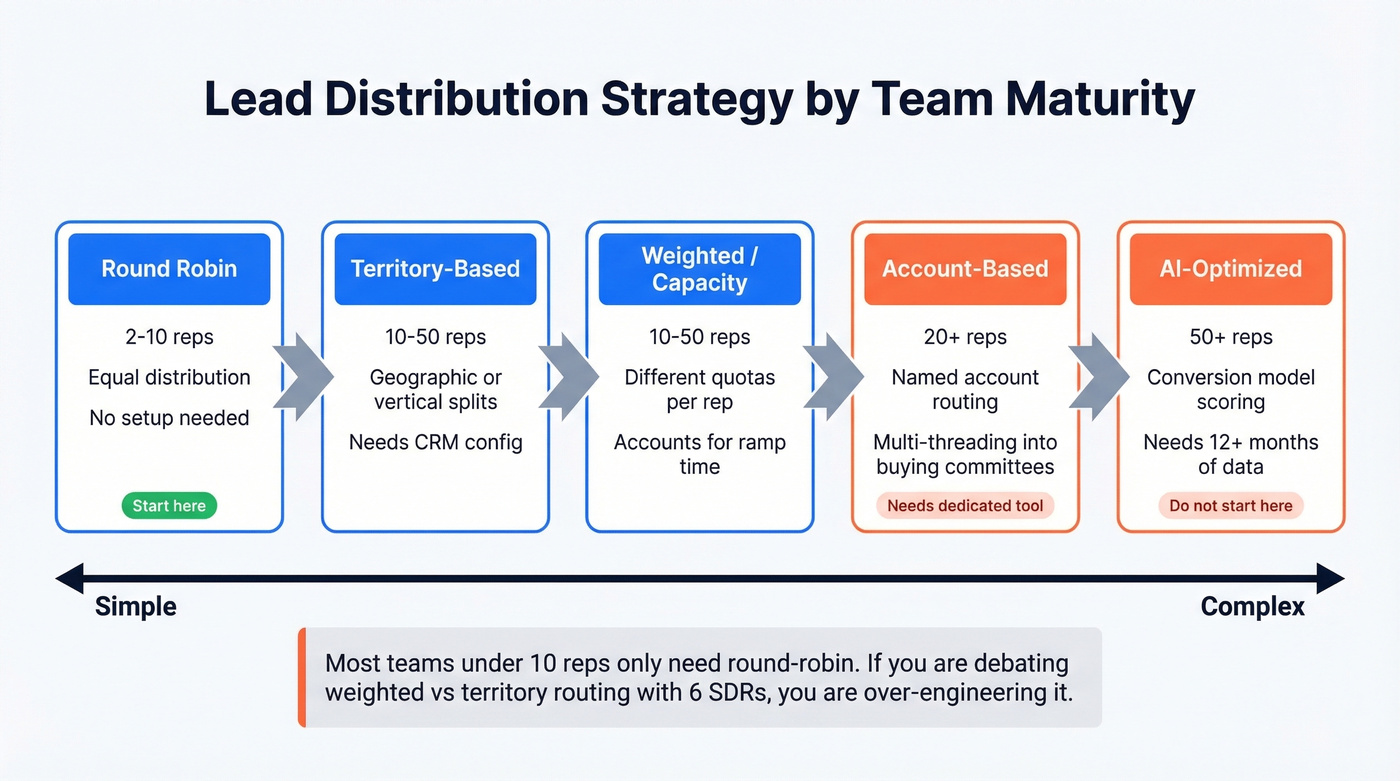
Most teams under 10 reps only need round-robin. Real talk: if you're a 6-person SDR team debating weighted vs. territory-based routing, you're over-engineering. Start with round-robin, measure speed-to-lead and acceptance rate for 90 days, then add complexity only where the data shows a gap.
AI-optimized routing sounds impressive in demos, but unless you have 50+ reps and at least 12 months of conversion data by rep, the model doesn't have enough signal to outperform a well-designed territory split. Most teams that buy AI routing are paying for a feature they won't meaningfully use for a year.
For account-based routing, the key isn't just matching leads to accounts - it's matching leads to the right person on the account team. That's where LeanData and Default earn their premium.
Fix Your Data Before You Route
Here's a scenario we've watched play out at least a dozen times: an SDR manager pulls the weekly report and discovers 40% of leads assigned that week had wrong phone numbers or bounced emails. The routing worked perfectly. The data didn't.
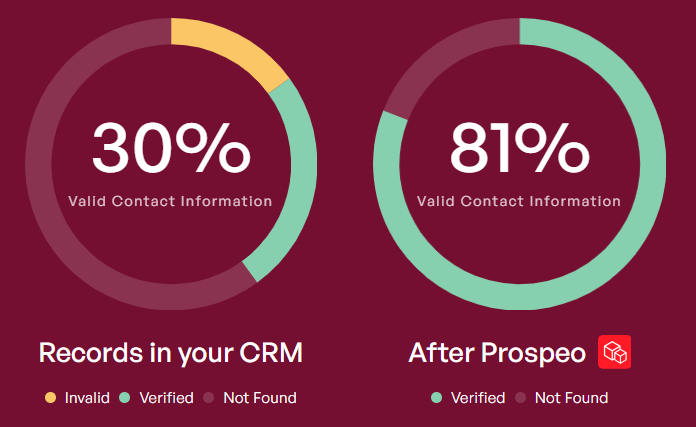
No routing platform fixes bad contact data. If your CRM is full of stale emails and disconnected numbers, you're distributing frustration to your reps faster. The fix is a verification layer before leads enter the routing workflow - enrichment that returns fresh, verified contact data so your assignment tool downstream never has to deal with bounces. (If bounce rates are a recurring issue, start with email bounce rate benchmarks and root causes.)
Implementation Mistakes to Avoid
PMI research shows 14% of IT projects fail completely and 43% go over budget. Routing tool rollouts are no exception. I've seen more teams fail at implementation than tool selection.
Define routing rules before you buy. Teams purchase the tool, then spend 3 months debating territory definitions. Write your rules in a spreadsheet first. If you can't articulate the logic in plain English, you're not ready for software.
Audit your CRM before signing. LeanData inside a messy Salesforce instance with 47 custom objects is a 6-month project, not a 6-week one. If you're unsure what "messy" looks like operationally, use a RevOps checklist to scope it.
Pilot first, expand second. Roll out to one team or one lead source. Measure for 30 days. Then expand.
Measure more than speed-to-lead. Speed matters, but track acceptance rate (do reps actually work the leads?), time-to-first-touch (not just assignment), and lead-to-opportunity conversion by routing method. That last metric tells you if your routing logic is actually matching leads to the right reps - and in our experience, it's the one most teams forget to track until quarter-end. Tie this back to your lead generation metrics so routing changes show up in pipeline, not just ops dashboards.
Your routing logic isn't the problem - your contact data is. Layer Prospeo's 30+ filters, intent signals across 15,000 topics, and verified emails upstream of your distribution workflow. Teams using Prospeo book 35% more meetings than Apollo users.
Clean data in, booked meetings out. No contracts required.
FAQ
What's the difference between lead distribution and lead routing?
They're used interchangeably in practice. Distribution refers to the broader process of assigning leads across a team; routing is the specific logic determining which rep gets which lead. Every tool that does one does the other. Don't get hung up on terminology.
Do I need dedicated software or can my CRM handle it?
CRM-native assignment works for teams under 10 reps using simple round-robin or territory rules. Dedicated lead distribution software earns its cost when you need sub-60-second speed-to-lead, complex matching logic, or account-based routing across multiple Salesforce objects.
How do lead qualification and distribution work together?
Qualification scores a lead on firmographics, intent signals, or engagement history; distribution assigns qualified leads to the right rep. The best setups run qualification first so reps only receive ICP-fit leads - improving acceptance rates by 20-40% in most implementations we've seen.
What is ping-post lead distribution?
A two-stage auction model for lead-gen agencies. A partial lead record (the "ping") goes to multiple buyers simultaneously, buyers bid, and the winner gets the full details (the "post") - all in under a second. boberdoo is the main platform for this model.
How do I improve lead quality before routing?
Run contacts through a verification and enrichment layer before they enter your CRM. Prospeo's 98%-accurate email verification and 7-day data refresh cycle catches stale records that would otherwise bounce - Snyk cut their bounce rate from 35-40% to under 5% this way. Cleaner data means your routing rules actually work.