

The Best Lead Enrichment Services in 2026: Pricing, Accuracy, and Honest Reviews
You send 1,800 cold emails on Monday. By Wednesday, 36% have bounced. Your domain reputation tanks, your sequences stall, and the "verified" list you paid for is now a liability. Leads contacted within 5 minutes are 21x more likely to convert - but that math only works if the contact data is real.
The difference between good lead enrichment services and bad ones isn't features. It's whether your emails actually land.
Our Picks (TL;DR)
| Use Case | Pick | Why |
|---|---|---|
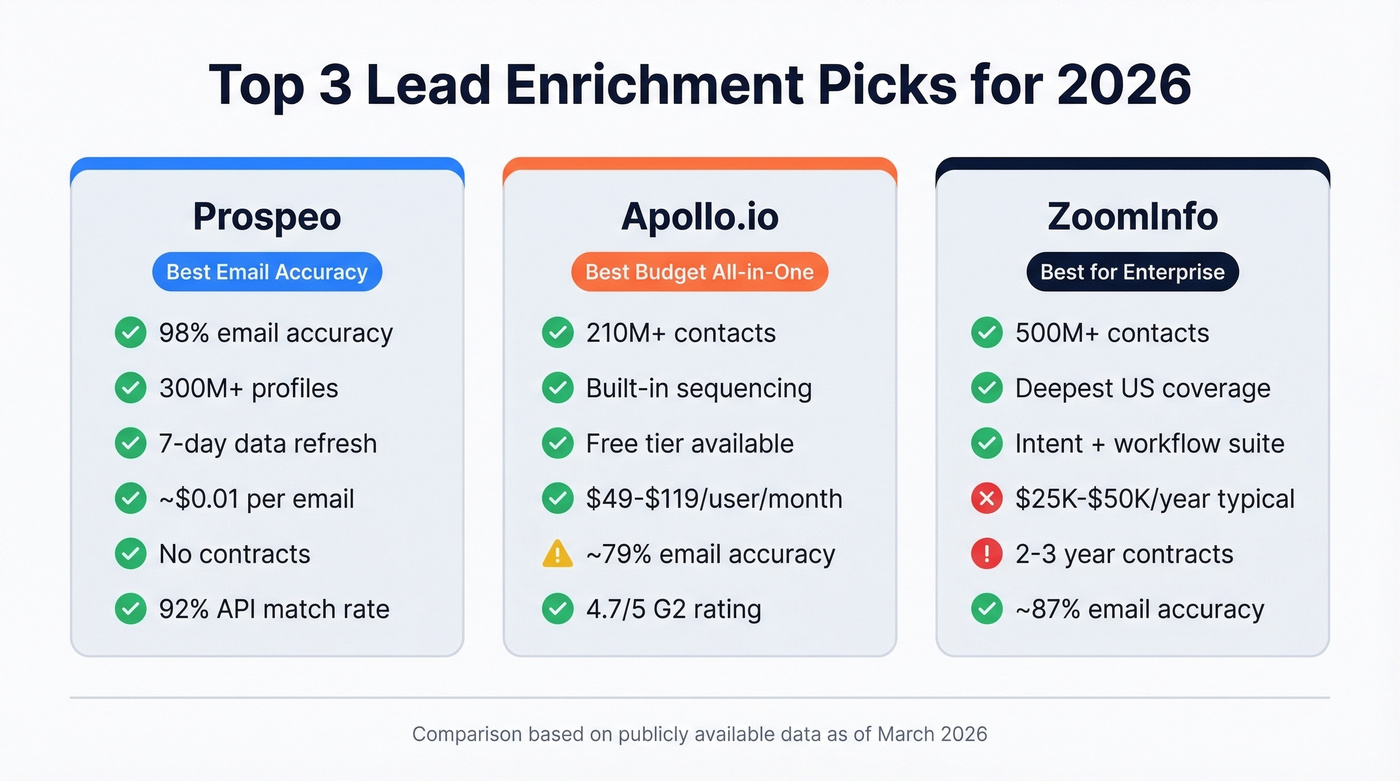
| Best for email accuracy + value | Prospeo | 98% email accuracy, 7-day refresh, ~$0.01/email |
| Best budget all-in-one | Apollo.io | 210M+ contacts, built-in sequencing, free tier |
| Best for enterprise teams | ZoomInfo | 500M+ contacts, deepest US coverage, intent + workflow suite |
What Does Lead Enrichment Do?
Lead enrichment takes a bare-bones lead record - maybe a name and company - and fills in everything your reps need to work the deal: verified emails, direct-dial mobile numbers, job title, seniority, company size, revenue, industry, tech stack, intent signals, and behavioral data like job changes or funding events.
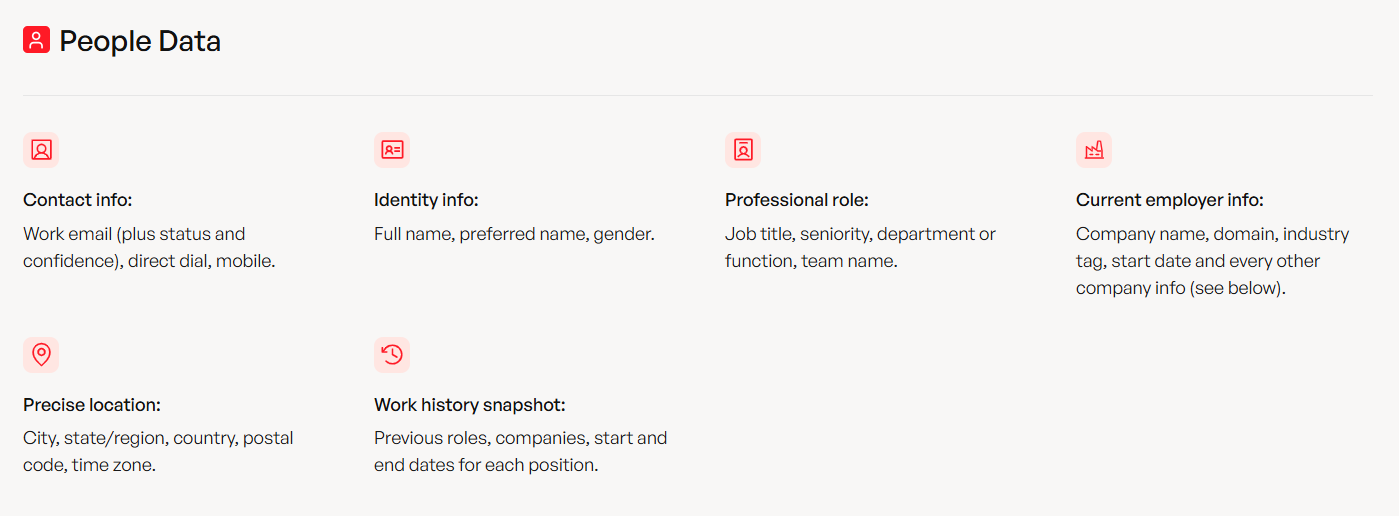
Here's how it works in practice. Leads enter your CRM incomplete, the enrichment service fills the gaps via API, CSV upload, or native CRM integration, and your reps get records they can actually act on. Without enrichment, you're guessing. With bad enrichment, you're guessing confidently - which is worse.
How to Evaluate an Enrichment Provider
Five criteria separate good enrichment from bad.
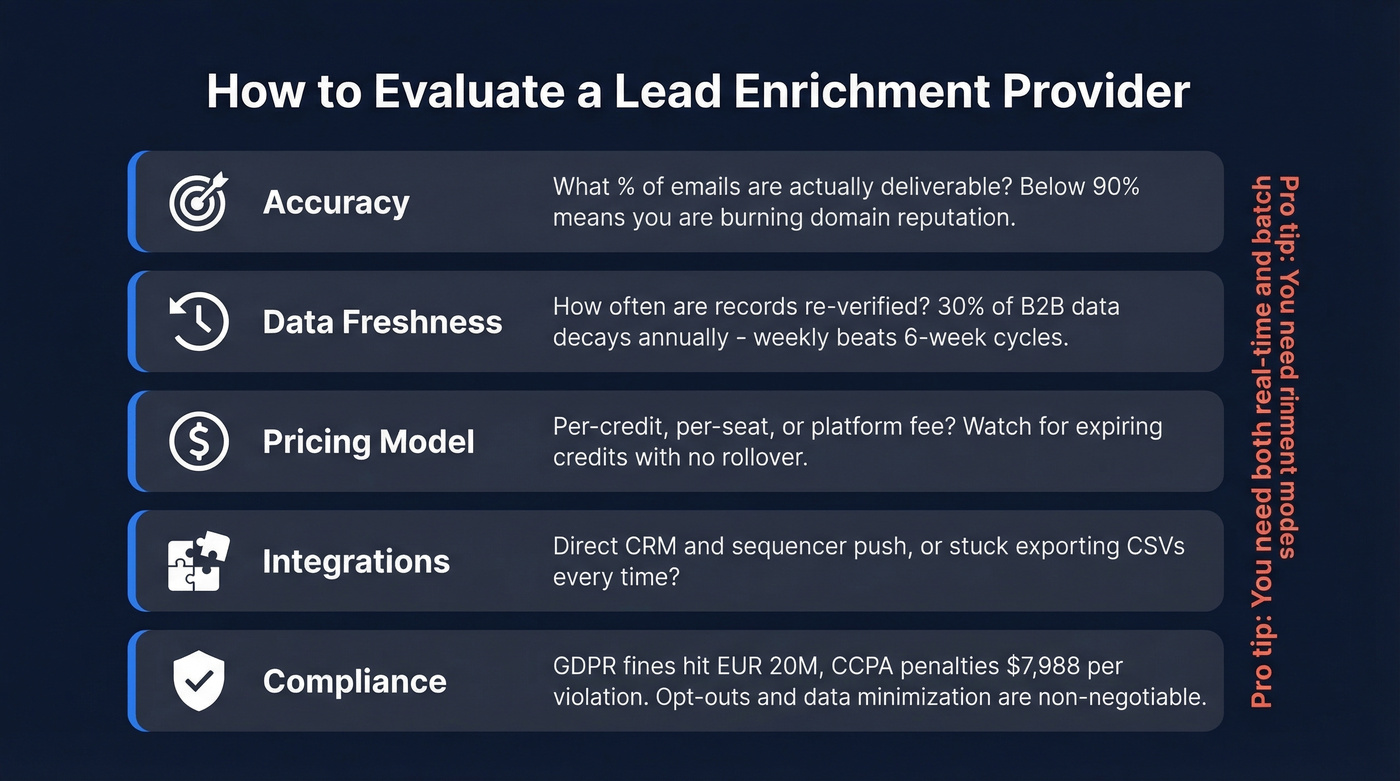
- Accuracy - What percentage of emails are deliverable? Anything below 90% means you're burning domain reputation on every campaign. (If you're troubleshooting bounces, start with an email bounce rate breakdown.)
- Data freshness - How often are records re-verified? Some providers refresh weekly. Others let data sit for 6 weeks. 30% of B2B data decays annually, and stale data compounds fast.
- Pricing model - Per-credit, per-seat, or platform fee? Watch for credits that expire monthly with no rollover. Understanding your cost per enriched record upfront prevents budget surprises when you scale from hundreds to tens of thousands of records per month.
- Integrations - Does it push directly into your CRM and sequencer, or are you exporting CSVs?
- Compliance - GDPR fines reach EUR 20M; CCPA penalties hit $7,988 per intentional violation. Your provider needs to handle opt-outs and data minimization.
One more factor worth weighing: real-time enrichment versus batch processing. Real-time fires the moment a lead enters your CRM or fills out a form - critical for inbound speed-to-lead. Batch processes lists on a schedule, which works fine for outbound prospecting. Most teams need both modes, so check whether your provider supports them.

Most enrichment services fail on the criteria that matter most: accuracy and freshness. Prospeo delivers 98% email accuracy, a 92% API match rate, and 50+ data points per record - all on a 7-day refresh cycle. At ~$0.01/email with no contracts, you stop paying for data that decays before you use it.
Enrich your first 75 leads free and see the difference fresh data makes.
The 8 Best Services for 2026
Prospeo - Best for Email Accuracy
Use this if you care about deliverability above all else and want transparent, self-serve pricing with no contracts.
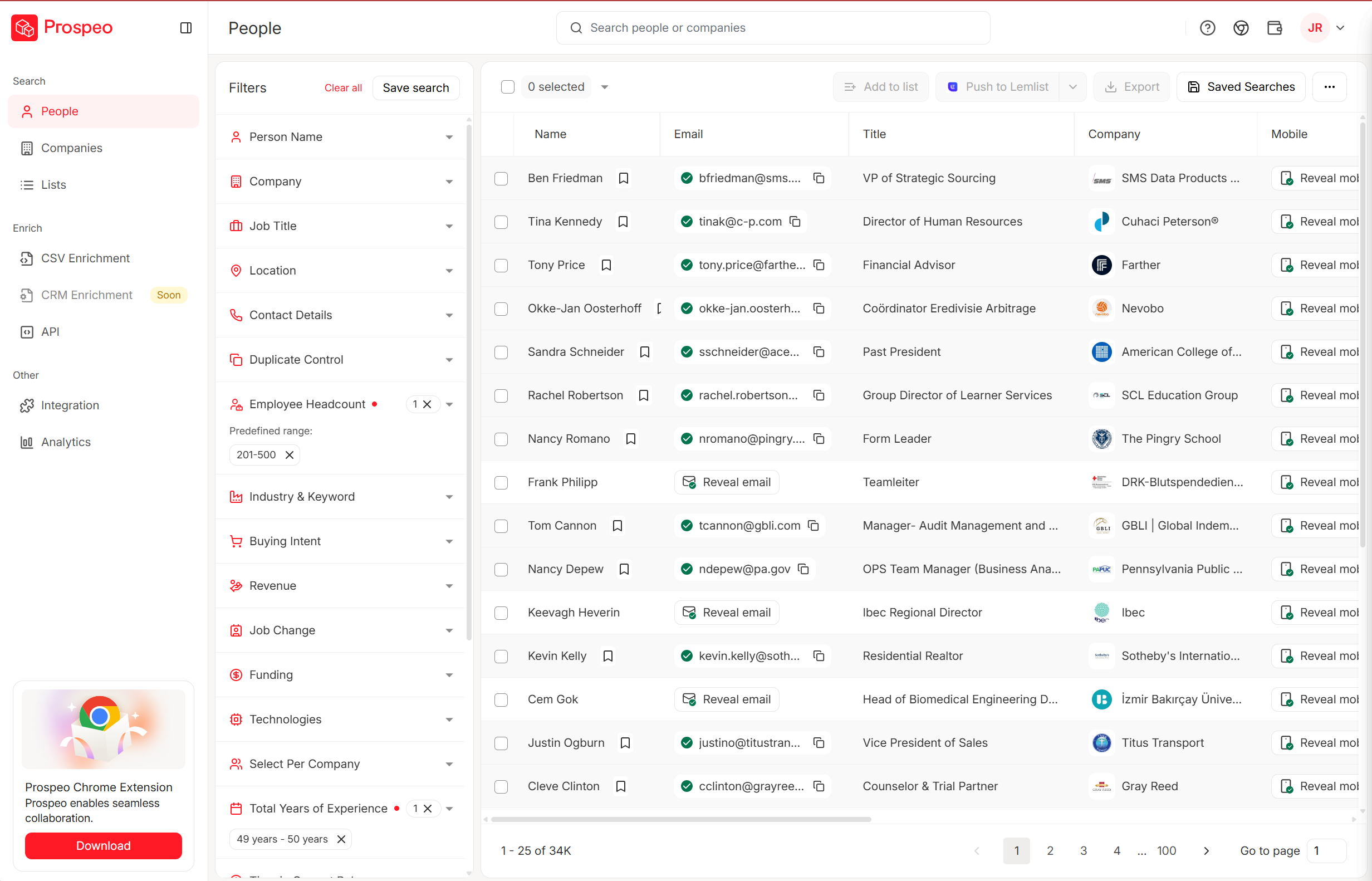
Prospeo's database covers 300M+ professional profiles, 143M+ verified emails, and 125M+ verified mobile numbers - all refreshed on a 7-day cycle. The industry average is 6 weeks, which means most providers serve you data that's already decaying by the time you export it. Email accuracy runs at 98%, backed by a proprietary 5-step verification process that includes catch-all handling, spam-trap removal, and honeypot filtering. Mobile numbers hit a 30% pickup rate across all regions, and the API match rate sits at 92%, returning 50+ data points per enrichment.
Intent data covers 15,000 topics via Bombora, so you can layer enrichment with in-market signals. Native integrations with Salesforce, HubSpot, Smartlead, Instantly, and Clay mean no CSV exports needed.
The proof point that sold us: Snyk's 50-person AE team was running 35-40% bounce rates before switching. After Prospeo, bounces dropped under 5%, and AE-sourced pipeline jumped 180% - over 200 new opportunities per month.
Pricing starts free (75 emails + 100 Chrome extension credits/month), with paid plans running ~$0.01/email. No contracts, cancel anytime.
Pairs best with your existing sales engagement platform - Prospeo handles the data, your sequencer handles the outreach. (If you're building the rest of the stack, see our guide to implementing a sales engagement platform.)
ZoomInfo - Best for Enterprise Coverage
ZoomInfo's database is the biggest in the space: 500M+ professional contacts, 200M+ verified emails, 120M+ direct dials. If you need sheer coverage across industries and geographies, especially in the US, nothing else matches the breadth.
Pros:
- Deepest US contact and company database
- Intent data, chat, workflow automation, and website visitor tracking in one platform
- G2 rating of 4.5/5 across 8,875 reviews
Cons:
- ZoomInfo Lite starts at $0 with 10 monthly credits, but enterprise plans commonly start around ~$15K/year for Professional. Most teams land at $25K-$50K/year once you add seats (~$1,500+/user/year), NeverBounce verification (~$3K), and global data (~$9,995).
- 2-3 year contracts with 60-90 day auto-renewal windows that are easy to miss
- Email accuracy runs around 87% - workable for some teams, painful for high-volume outbound
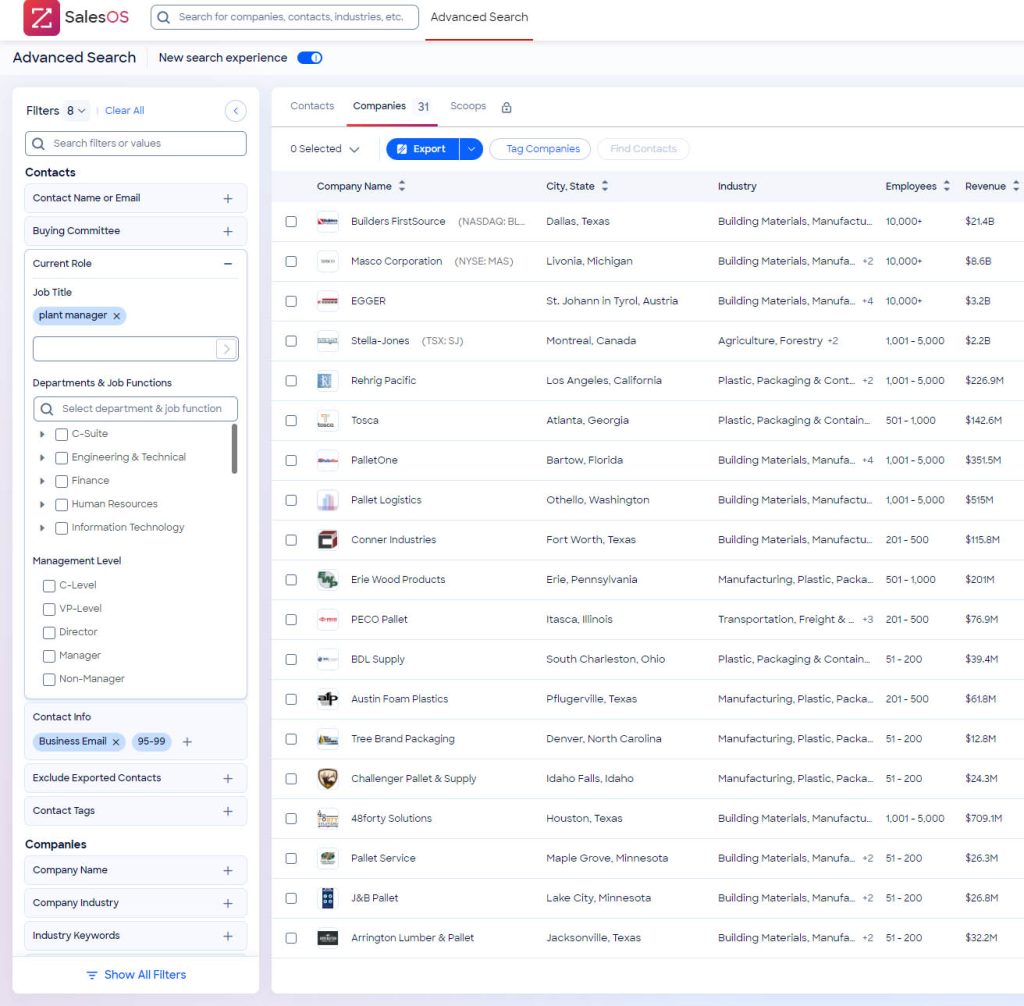
Here's the thing: if your average deal size is under $15K, you probably don't need ZoomInfo-level data. Most teams under 50 reps are overpaying by 3-5x. ZoomInfo makes sense when you're running outbound, ABM, intent, and visitor tracking from one platform. For everyone else, you're subsidizing features you don't use.
Apollo.io - Best Budget All-in-One
Apollo covers 210M+ contacts with a free tier that includes 50 AI credits and up to 2 sequences. Paid plans run $49-$119/user/month depending on billing cycle and packaging, with the Organization plan requiring a minimum of 3 seats. Built-in sequencing is the killer feature - you can find, enrich, and email from one tool without stitching together three vendors.
The tradeoff is accuracy. We've seen Apollo email accuracy hover around 79%, which means roughly 1 in 5 emails won't land. For high-volume outbound, that's a deliverability risk. Plan to run Apollo's exports through a separate verification layer (here are solid Bouncer alternatives if you’re comparing verifiers). Credits don't roll over, so budget accordingly. Apollo holds a 4.7/5 on G2 across 9,250 reviews - the highest satisfaction score on this list.
Skip this if you're sending 10K+ emails/month and can't afford a 20% bounce rate.
Clay - Best for Waterfall Enrichment
Clay doesn't have its own database. Instead, it queries multiple data providers sequentially - a waterfall approach that typically achieves 80%+ match rates for email discovery, compared to 40-50% from single-source tools. For teams that have tried one provider and found the coverage lacking, Clay's architecture is genuinely clever.
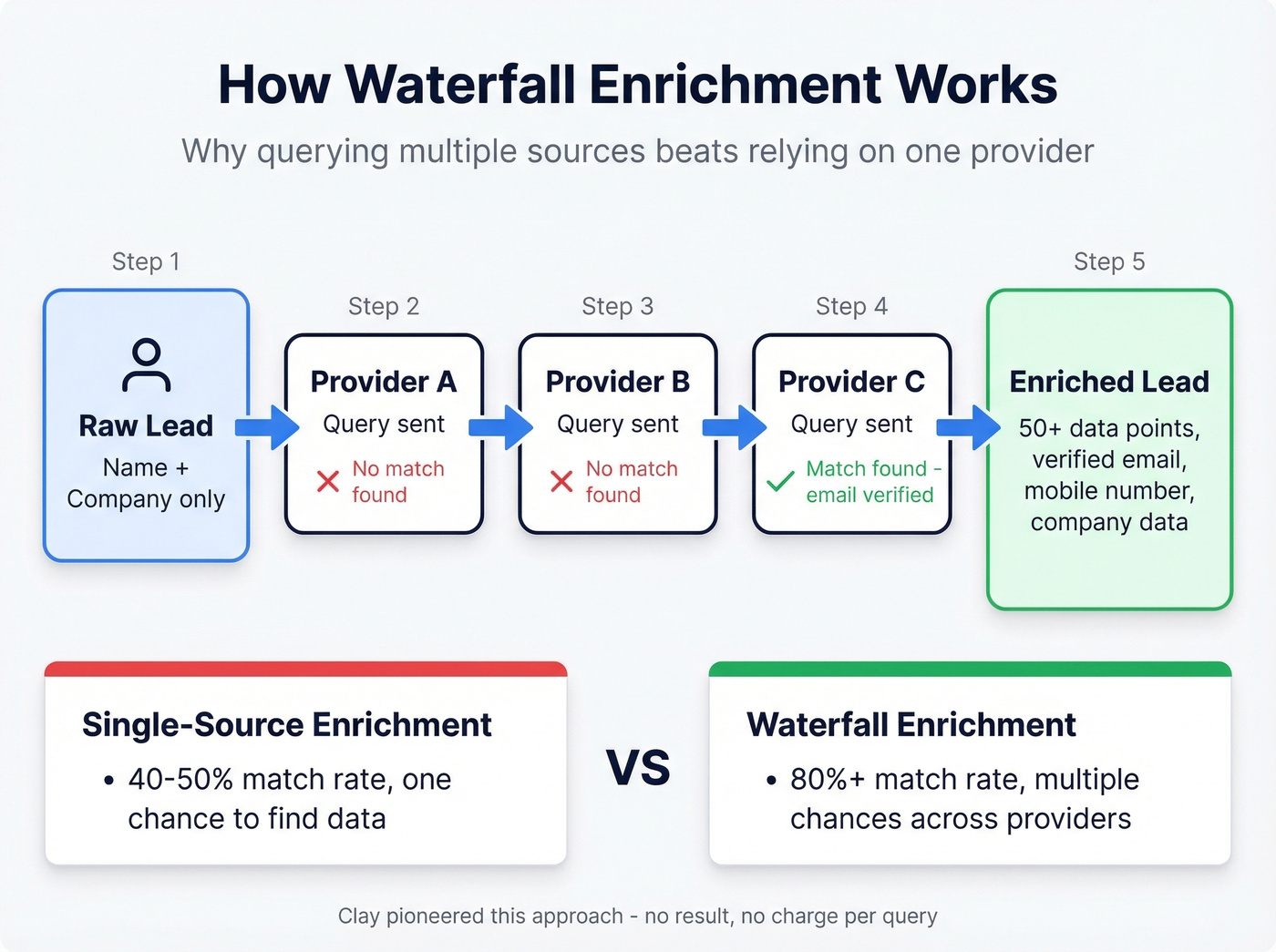
After a major pricing overhaul in March 2026, plans start at $185/month (Launch) with 2,500 Data Credits and 15,000 Actions, or $495/month (Growth) for heavier usage. The no-result-no-charge model is fair. But expect a 4-6 week learning curve - Clay is a workflow tool, not plug-and-play. A 5-person SDR team running multi-step workflows can burn through 38K+ credits/month, pushing costs into the $800+/month range. Clay holds a 4.8/5 on G2, though from only 174 reviews.
Clearbit (HubSpot Breeze Intelligence)
Clearbit is now fully absorbed into HubSpot's Breeze Intelligence. If you're already deep in the HubSpot ecosystem, the native integration is convenient - enrichment happens inside your CRM automatically, and real-time form enrichment reduces friction on inbound leads.
The downsides are real. Standalone Clearbit is gone, so you need a HubSpot subscription. Credits start at $45/month annually (or $50/month on monthly billing) for 100 records, scaling to ~$150/month for 1,000. Credits expire monthly with no rollover. A mid-market team on HubSpot Professional plus 1,000 credits is looking at $950-$1,040/month.
Let's be honest: tying Clearbit to HubSpot and adding expiring credits made it worse for everyone except HubSpot's revenue team. If you're not already committed to HubSpot, skip it.
Cognism - Best for EMEA Compliance
Cognism's Diamond Data - phone-verified mobile numbers - is the standout feature for teams selling into Europe. The platform is GDPR-compliant by design, with DNC list checking built in. Cognism wins over ZoomInfo on EMEA mobile coverage and compliance confidence. ZoomInfo still wins on US database depth and platform breadth.
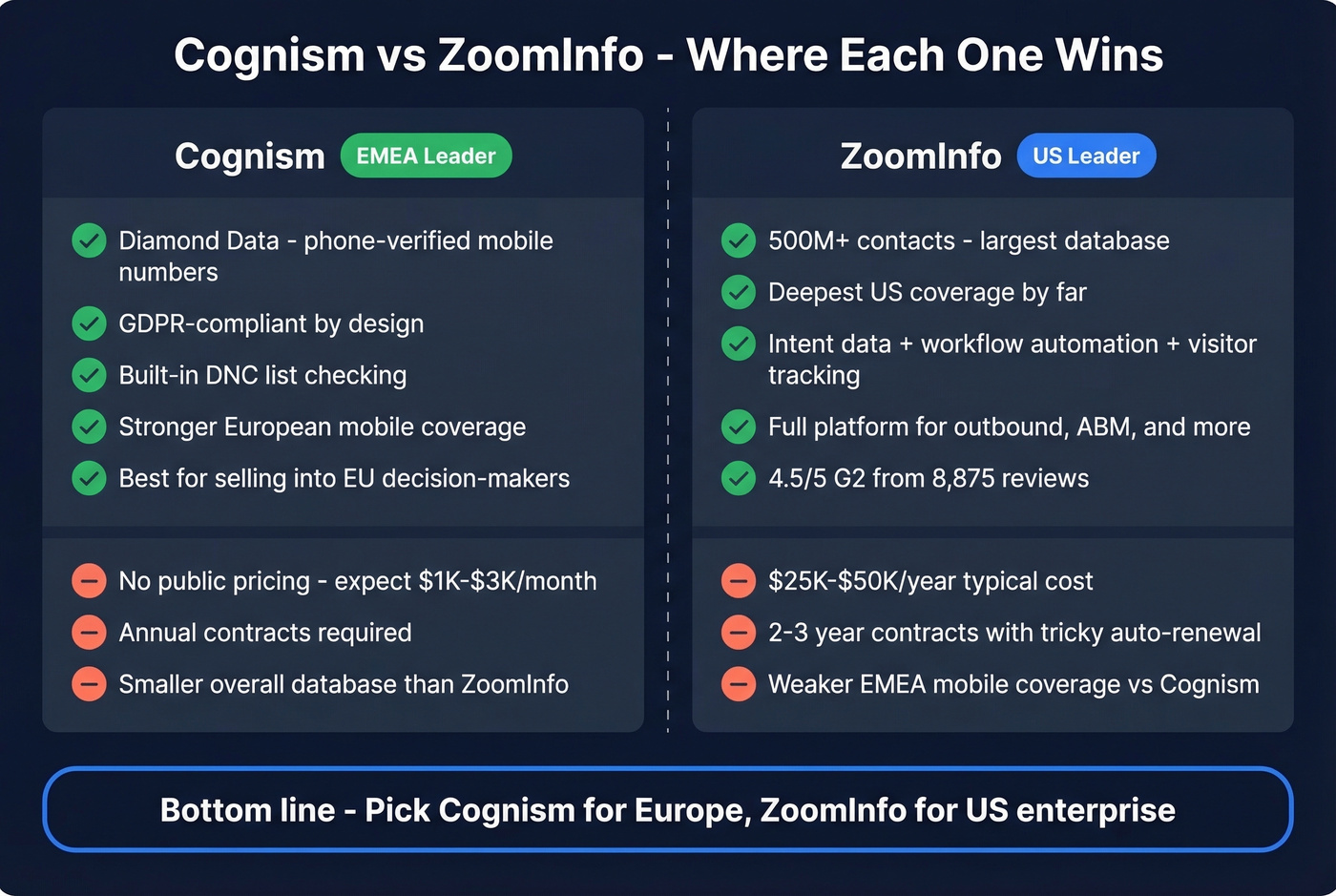
Pricing isn't public. Expect custom quotes typically ranging $1,000-$3,000/month for small teams, with annual contracts. Cognism holds a 4.5/5 on G2 across 1,200 reviews. If your ICP is European decision-makers, Cognism belongs on your shortlist.
Lusha - Lightest Option for SMBs
Lusha is the lightest tool on this list, and that's the point. Free tier gives you 50 emails and 5 phone numbers per month. Pro runs $36/user/month, Premium $59/user/month. Individual reps who need quick lookups on company websites will find it fast and frictionless, but the database depth doesn't compete with Tier 1 providers. Lusha holds a 4.3/5 on G2 from 1,566 reviews. Think of it as a pocket knife - useful, but not what you bring to a full kitchen.
Warmly - Best for Visitor Enrichment
Warmly focuses on de-anonymizing website visitors rather than traditional contact enrichment. Free tier covers 500 visitors/month; paid plans start around $10K/year. If your primary enrichment need is identifying who's on your site right now, Warmly fills a niche the others don't. It's a complement to a contact database, not a replacement.
Pricing Comparison
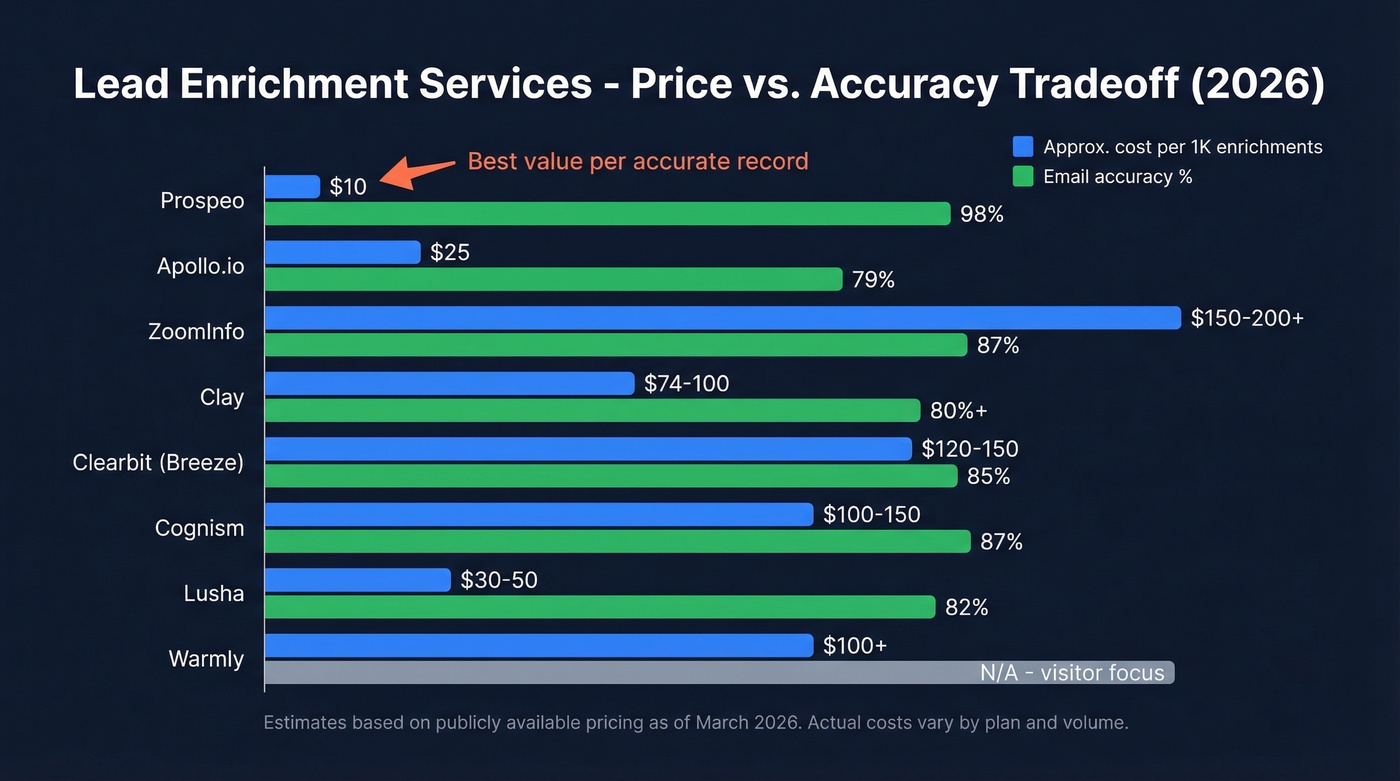
On a cost-per-1K-enrichments basis, the spread is enormous: from roughly $10 at the low end to $200+ at the enterprise tier. Tracking your cost per enriched record at scale is the single best way to compare providers apples-to-apples, since headline pricing often obscures what you pay per usable contact. (For a broader view beyond lead records, compare data enrichment services.)
Pricing Overview
| Tool | Entry Price | Mid-Market Annual Cost | Credit Model | Contract |
|---|---|---|---|---|
| ZoomInfo | ZoomInfo Lite ($0, 10 monthly credits) | $25K-$50K/yr | Annual + add-ons | 2-3 years |
| Apollo.io | Free (50 AI credits) | $5K-$14K/yr | Per-seat, no rollover | Annual |
| Clay | $185/mo | $2,220-$5,940/yr | Data + Actions | Monthly |
| Clearbit/Breeze | $45/mo annual (100 records) | $11K-$12K/yr | Expire monthly | Annual |
| Cognism | Not public | $12K-$36K/yr | Custom | Annual |
| Lusha | Free (50 + 5) | $4K-$7K/yr | Per-seat + credits | Monthly |
| Warmly | Free (500 visits) | $10K-$25K/yr | Visitor-based | Annual |
Accuracy and Freshness
| Tool | Email Accuracy | Data Refresh | G2 Rating |
|---|---|---|---|
| ZoomInfo | ~87% | Not disclosed | 4.5/5 |
| Apollo.io | ~79% | Not disclosed | 4.7/5 |
| Clay | Varies (waterfall) | Not disclosed | 4.8/5 |
| Clearbit/Breeze | Not published | Not disclosed | - |
| Cognism | Not published | Not disclosed | 4.5/5 |
| Lusha | Not published | Not disclosed | 4.3/5 |
| Warmly | N/A | Real-time | - |
How to Choose the Right Service
There's a Reddit thread that captures this dilemma perfectly: one ops leader running ZoomInfo for contacts, Clearbit for firmographics, BuiltWith for technographics, and 6sense for intent - spending $40K+ and still duct-taping data together. That's the consolidation trap, and we've seen it play out dozens of times.
Here's our contrarian take: you need one primary enrichment provider and maybe a verification layer. Two tools, not twelve. Set up conditional enrichment triggers - only enrich when key fields are missing - and you'll cut credit waste by 30-40%. (If you want the full framework, start with our lead enrichment guide.)
For teams under 20 reps where accuracy and cost matter most, Prospeo is the obvious choice. When you want prospecting, sequencing, and enrichment in one seat, Apollo delivers the best value. For enterprise orgs that need the deepest database and can justify the spend, ZoomInfo remains the benchmark. The right lead enrichment services for your team depend on volume, budget, and how much bounce-rate pain you're willing to tolerate.
Snyk's 50-person sales team cut bounce rates from 35-40% to under 5% and added 200+ new opportunities per month after switching their enrichment to Prospeo. Same team, same sequences - better data. That's what 98% accuracy and weekly-refreshed records do at scale.
Stop enriching leads with data that's already stale. Switch to 7-day freshness.
FAQ
What's the difference between lead enrichment and data enrichment?
Lead enrichment appends missing data specifically to sales leads - verified emails, phone numbers, firmographics, intent signals. Data enrichment is the broader category covering any dataset. In B2B sales the terms are interchangeable, but lead enrichment always implies a sales-ready output with actionable contact details.
How often should enrichment data be refreshed?
At minimum, quarterly. People change jobs every 2-3 years on average, and 30% of B2B data decays annually. The best providers refresh weekly - Prospeo uses a 7-day cycle versus the 6-week industry average. Stale data means bounced emails, wasted rep time, and damaged sender reputation.
Can I use multiple enrichment providers together?
Yes - this is called waterfall enrichment. You query one provider first, then pass unmatched records to a second. Clay automates this natively. You can also pair a primary database with a dedicated verification layer to maximize both coverage and accuracy. Two tools is usually the sweet spot.
What's a good free option for small teams?
Prospeo's free tier (75 emails + 100 Chrome extension credits/month) offers the best balance of accuracy and volume at no cost. Apollo's free plan includes 50 AI credits with basic sequencing. Lusha gives 50 emails and 5 phone numbers. For teams running real campaigns, 98% accuracy on the free tier prevents the domain damage that cheaper data causes.