

The Best Lead Finder Tools in 2026: Real Pricing, Real Accuracy Data
You exported 2,000 leads last Tuesday, loaded them into your sequencer, and watched 700 bounce before lunch. Your domain reputation took a hit, your warmup progress reset, and your SDRs spent the afternoon manually Googling contacts. The lead finder tool market was valued at $7.4B in 2025 and is climbing toward $16.2B by 2034, yet field tests on Reddit still show bounce rates landing in the 20-38% range for many single-source exports. That gap between "verified" and actually deliverable is where money gets wasted.
We've tested the tools below across real outbound campaigns - not sandbox demos. Here's what actually works.
Our Picks (TL;DR)
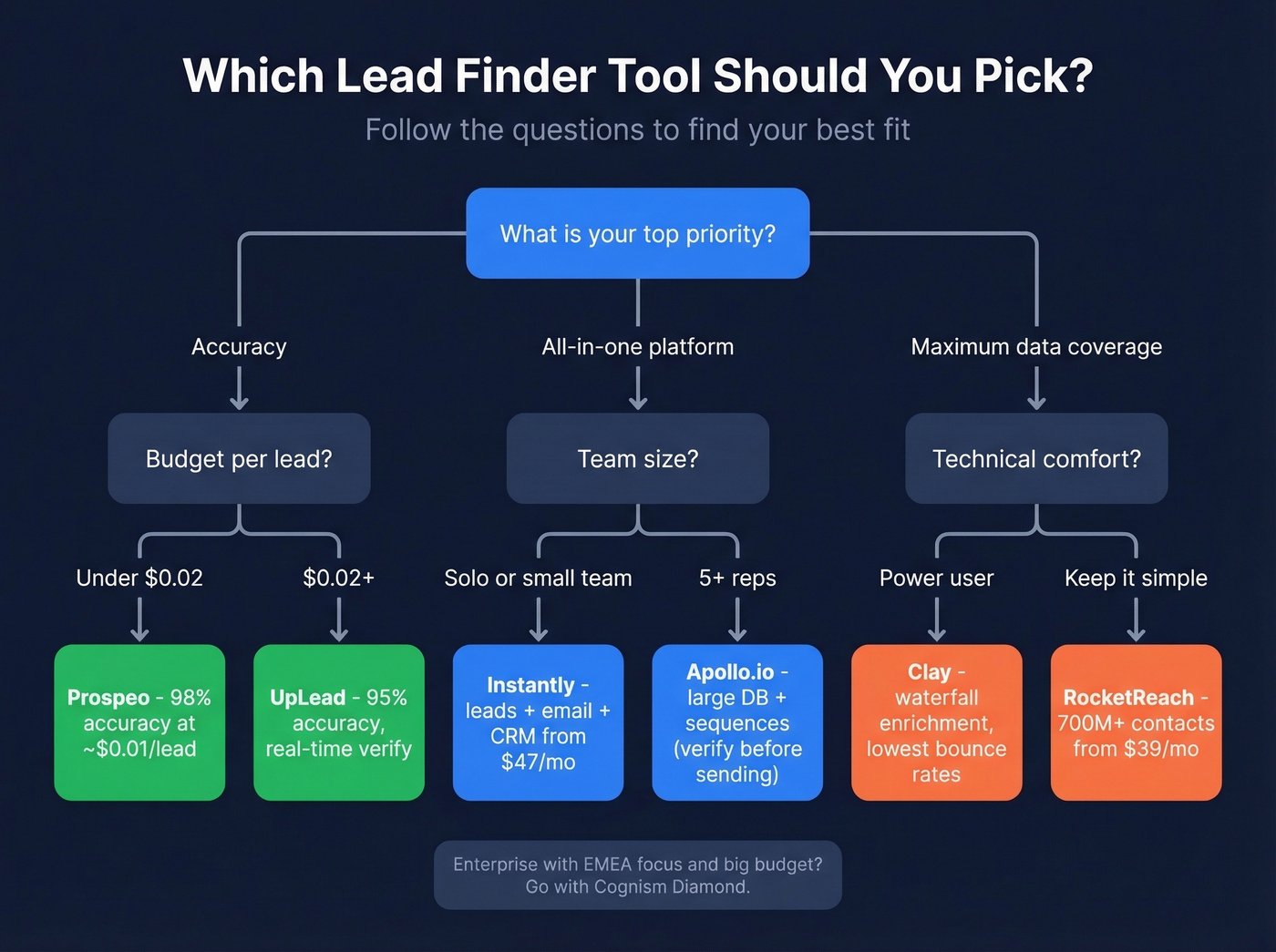
- Best for email accuracy and data freshness: Prospeo - 98% email accuracy, 7-day refresh cycle, ~$0.01/lead. Start free with 75 verified emails/month + 100 Chrome extension credits/month.
- Best all-in-one (leads + outreach): Instantly - lead finder, cold email, and CRM from $47/mo. One platform, one bill.
- Best budget email finder: Hunter - generous free tier (50 credits/mo), $49/mo starter plan, dead-simple interface.
Why Accuracy Beats Database Size
A 700M-contact database means nothing if a third of those contacts bounce. The r/coldemail community has been running field tests, and the numbers are ugly. Apollo lists recently bounced at 32-38%. Hunter and Snov.io came in at 28-35%. Even Lusha, which performed better, still hit 22-28%. The only approach that consistently dropped below 15% was waterfall enrichment through Clay, landing at 10-14%.

A Dropcontact benchmark testing 15 lead finding tools across 20,000 real contacts found that even top performers had wrong-domain rates up to 11.7%, with hard bounces among the best ranging from 0.9% to 3.6%.
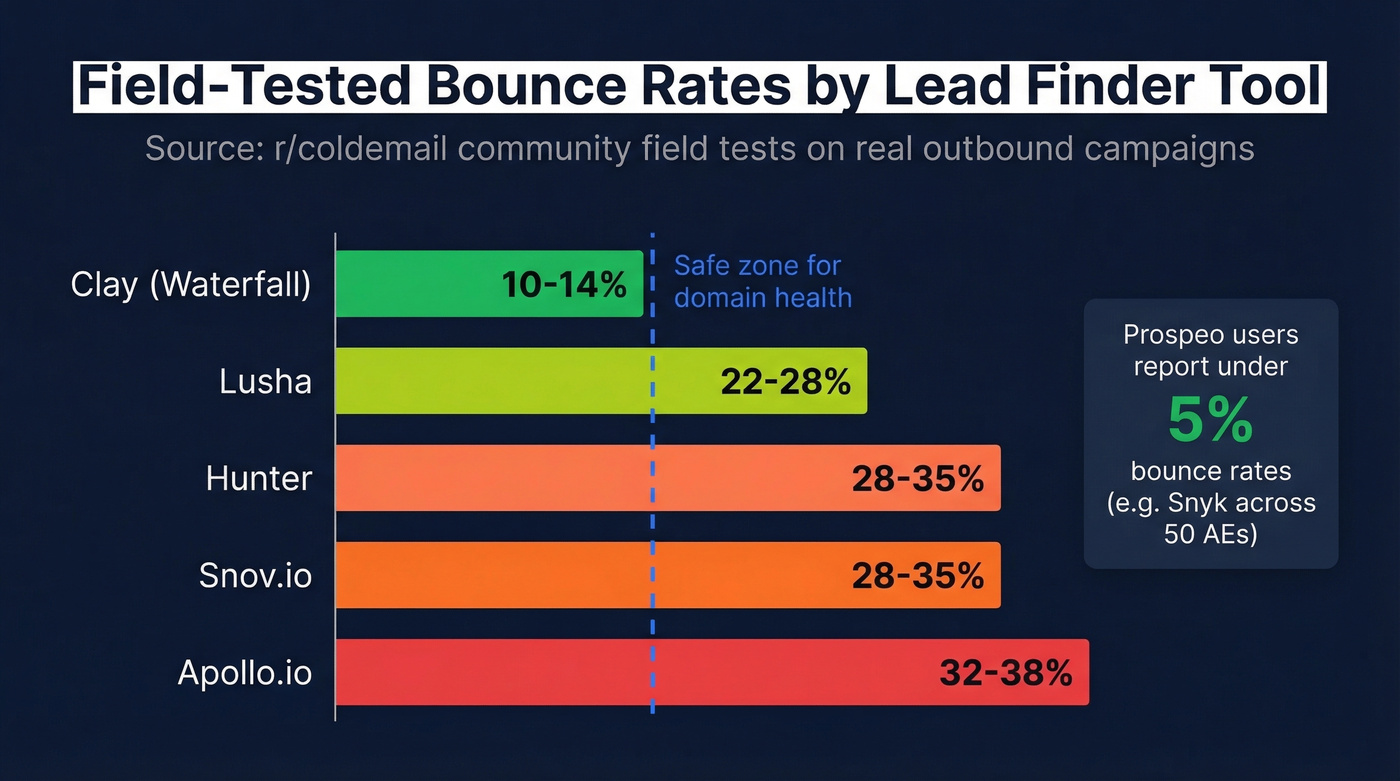
The cost of bad data isn't just wasted credits. It's domain reputation damage that takes weeks of warmup to recover from, sequences that stall, and reps who lose trust in the tools they're supposed to rely on. Meanwhile, 91% of marketers say lead generation is their top priority, yet 79% of marketing leads never convert. Picking the right lead finder tool is the shortest path to fixing that conversion gap.
Lead Finder Tool Comparison Table
Here's every tool side by side before the individual reviews.
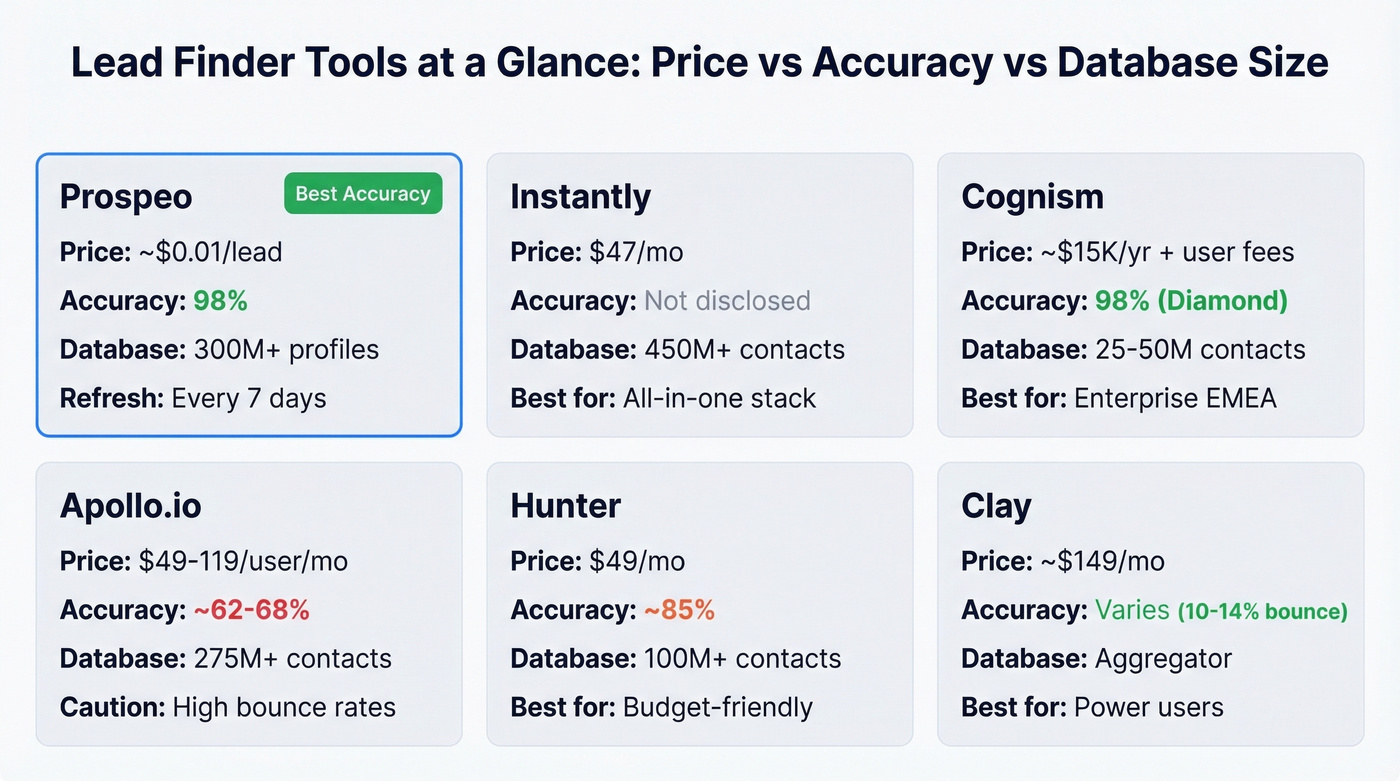
| Tool | Starting Price | Email Accuracy | Free Tier | Best For |
|---|---|---|---|---|
| Prospeo | ~$0.01/lead | 98% | 75 emails/mo | Accuracy & freshness |
| Instantly | $47/mo | Not disclosed | No | Leads + outreach |
| Cognism | ~$15K/yr + user fees | 98% (Diamond) | 25 leads trial | Enterprise mobiles |
| Apollo.io | ~$49-119/user/mo | ~62-68% | Yes | Large DB + sequences |
| Seamless.AI | ~$79/user/mo | ~85% | 50 credits | Real-time lookup |
| Hunter | $49/mo | ~85% | 50 credits/mo | Simple email finding |
| Clay | ~$149/mo | Varies | Yes | Waterfall enrichment |
| RocketReach | $39/mo | Not disclosed | 5 searches/mo | Budget large DB |
| Lusha | ~$49-79/user/mo | ~72-78% | Yes | Quick lookups |
| UpLead | ~$99/mo | ~95% | Yes | Real-time verify |
| Clearout | ~$0.01-0.02/credit | Not disclosed | 100 credits | Verify + prospect |
| Tool | Database Size | Data Refresh |
|---|---|---|
| Prospeo | 300M+ profiles | 7 days |
| Instantly | 450M+ contacts | Not public |
| Cognism | 25-50M contacts | Not public |
| Apollo.io | 275M+ contacts | Not public |
| Seamless.AI | 200M+ contacts | Real-time |
| Hunter | 100M+ contacts | Not public |
| Clay | Aggregator | Not public |
| RocketReach | 700M+ contacts | Not public |
| Lusha | 100M+ contacts | Not public |
| UpLead | 160M+ contacts | Real-time |
| Clearout | Not public | Not public |

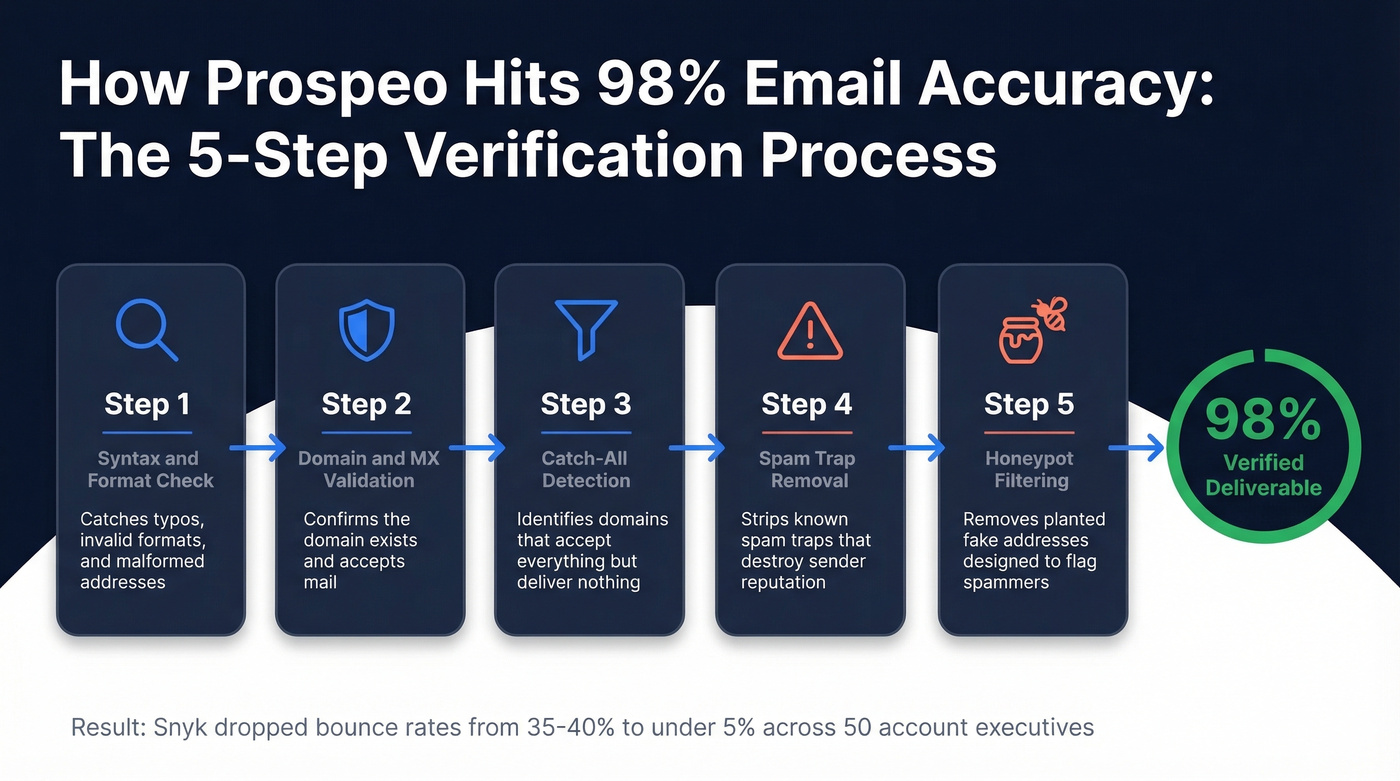
The field tests above show most lead finder tools bouncing 20-38% of emails. Prospeo's 5-step verification - with catch-all handling, spam-trap removal, and honeypot filtering - delivers 98% email accuracy on 300M+ profiles refreshed every 7 days. Snyk dropped bounce rates from 35-40% to under 5% across 50 AEs. Start free with 75 verified emails/month.
Stop paying for leads that bounce. Test 98% accuracy yourself.
Best Lead Finder Tools for Sales Teams
Prospeo
Use this if: You're tired of bounced emails killing your domain reputation and want the highest-accuracy data at the lowest cost per lead.

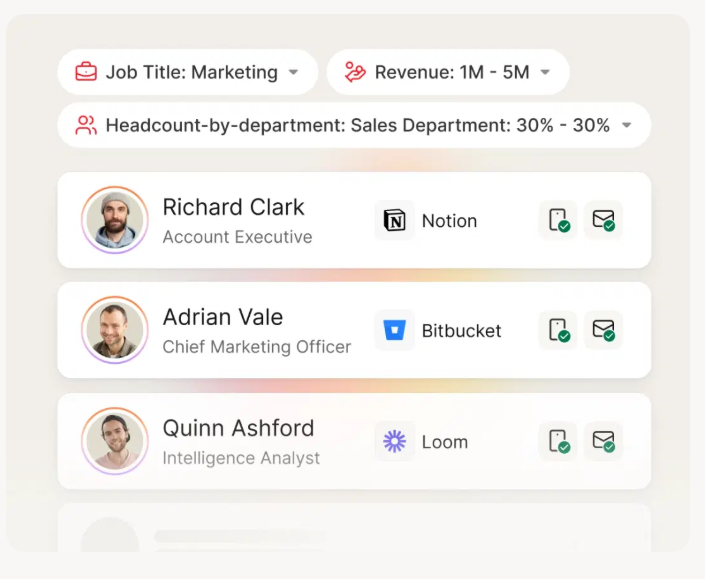
Prospeo's 5-step verification handles catch-all domains, strips spam traps, and filters honeypots - which is why email accuracy sits at 98%. The database covers 300M+ professional profiles, 143M+ verified emails, and 125M+ verified mobile numbers, all refreshed on a 7-day cycle. Most competitors sit on 4-6 week refresh windows, which means you're emailing people who changed jobs a month ago.
You get 30+ search filters including buyer intent powered by 15,000 Bombora topics, technographics, job changes, and headcount growth signals. The Chrome extension has over 40K users and works across company websites and professional profiles for one-click prospecting.
Native integrations push directly into Salesforce, HubSpot, Instantly, Lemlist, Clay, and Zapier. Real results from customers: Snyk cut bounce rates from 35-40% to under 5% across 50 AEs, and Meritt tripled pipeline to $300K/week. Pricing runs ~$0.01/lead with a free tier of 75 emails plus 100 Chrome extension credits monthly. No contracts, no sales calls.
Skip this if: You need everything in one platform - Prospeo is purpose-built for data accuracy and pairs with outreach tools like Instantly or Lemlist for the full workflow.
Instantly
Use this if: You want lead finding, cold email, and CRM in a single platform without stitching together three subscriptions.
Instantly's Lead Finder plan starts at $47/mo for 1,500-2,000 credits, pulling from a 450M+ contact database with waterfall enrichment across 5+ providers. The real value is the stack: add Outreach at $30-37/mo for unlimited email accounts and warmup, plus CRM at $47/mo, and you're running a full outbound operation for $131-241/mo depending on tiers. Hard to beat for a solo founder or small team that doesn't want to manage integrations.
Skip this if: Email accuracy is your top priority. Instantly doesn't disclose accuracy rates, and waterfall enrichment quality varies by source. We'd still verify outputs before sending.
Cognism
Use this if: You're an enterprise team selling into EMEA and need phone-verified mobile numbers with GDPR compliance baked in.
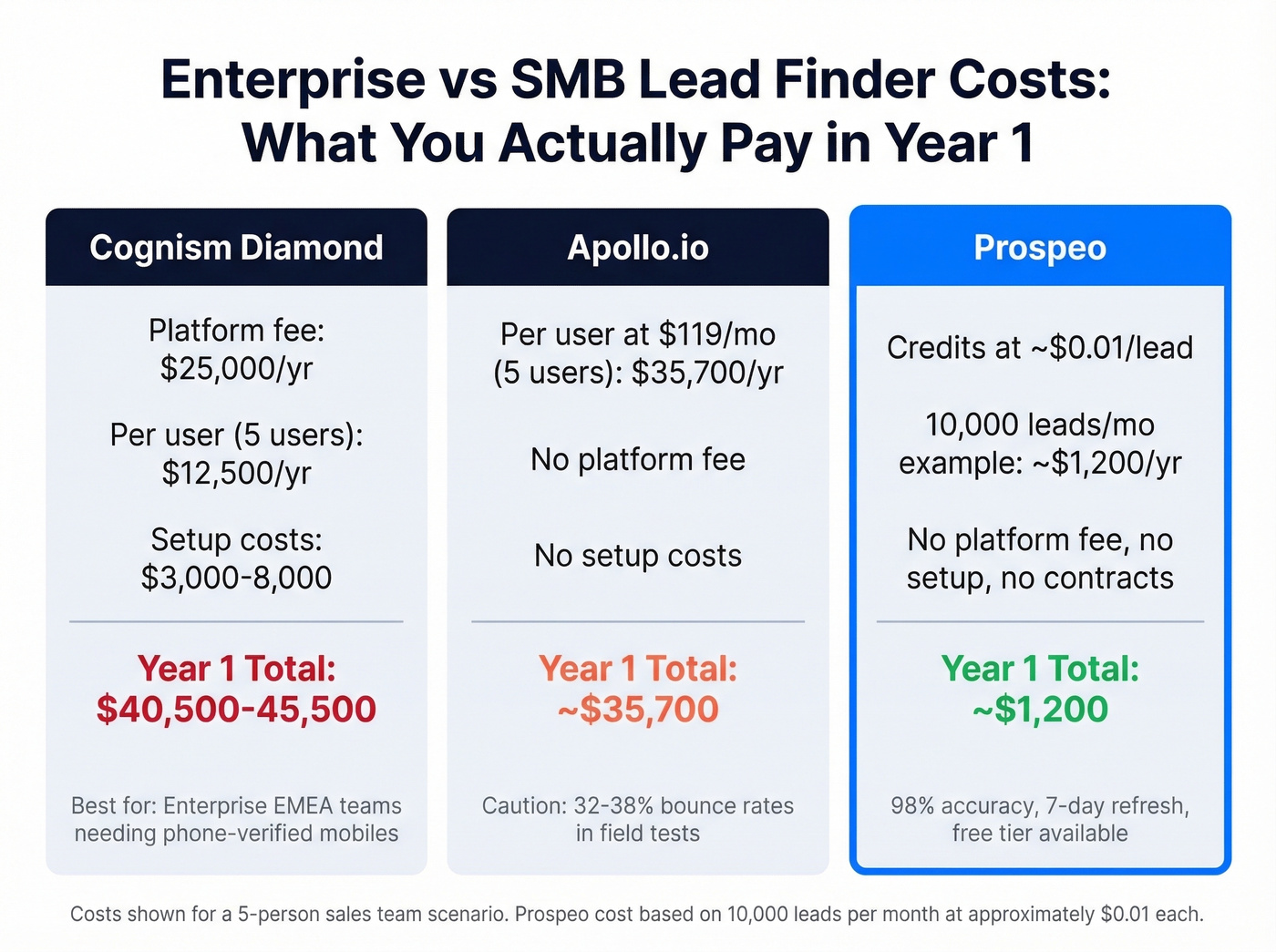
Cognism's Diamond tier includes phone-verified mobiles with 98% accuracy and Bombora intent data - a combination positioned to drive 3x higher connect rates on cold calls. The catch is price. Diamond runs $25,000/year platform fee plus $2,500/user/year, with $3,000-8,000 in setup costs. A 5-person team on Diamond is looking at $40,500-45,500 in year one including setup. Platinum is cheaper at $15,000/year plus $1,500/user/year but drops the phone verification.
Where Cognism wins over ZoomInfo: EMEA mobile coverage and compliance infrastructure. Where ZoomInfo still wins: US database depth.
Skip this if: You're a startup or SMB. This is enterprise pricing for enterprise teams.
Apollo.io
Apollo remains the default starting point for teams that need volume and a prospecting workflow in one place. The 275M+ contact database, built-in sequencing, generous free tier, and pricing from ~$49-119/user/mo undercut ZoomInfo significantly.
But accuracy has declined. Field tests on r/coldemail show 32-38% bounce rates on recent exports. The credit system means heavy users burn through allocations fast. Verify everything before it hits your sequencer. If your average deal size is modest and you're sending high volume, those bounce rates will eat your domain alive.
Seamless.AI
Real-time email validation at the point of search sounds great, and the ~85% accuracy is decent. The AI research assistant surfaces useful context on prospects, and 50 free credits let you test before committing.
Here's the frustrating part: Seamless.AI doesn't publish pricing. You'll talk to sales to learn that Pro runs $79/user/mo for 1,000 credits, with extra credits at $49 per 500. Enterprise hits $149/user/mo with a 5-user minimum, so $745/mo floor. One Reddit user blew through 50 free credits in two days. Phone accuracy sits around 60%.
Hunter
Hunter is the Honda Civic of lead finding tools: reliable, affordable, and nobody regrets buying one. The free tier gives 50 credits/mo, the $49/mo Starter plan is genuinely affordable, and the interface is clean enough that new SDRs use it on day one without training. It does email finding and basic verification without trying to be a full GTM platform. For anyone searching for a free lead finder to get started, Hunter's no-cost tier is one of the most practical choices available.
The tradeoff is scope. The database is smaller at 100M+ contacts, accuracy hovers around 85%, and enrichment beyond email is limited. Need phone numbers or intent data? You'll need a second tool.
Clay
Clay isn't a database - it's an orchestration layer that pulls from multiple data providers via waterfall enrichment. This approach is why practitioners on Reddit report 10-14% bounce rates with Clay, the lowest of any method tested. Plans start around $149/mo, and you'll pay additional credits for each data source in the waterfall. The learning curve is real, but for RevOps teams who want maximum data coverage, Clay is the power-user choice. (If you're building this workflow, see waterfall enrichment in practice.)
RocketReach
The largest claimed database at 700M+ contacts and 35M+ companies, with an entry price of just $39/mo for the Essentials plan. RocketReach is the tool you grab when you need broad coverage across industries and geographies and don't want to spend $15K+ on Cognism or ZoomInfo. Higher tiers scale into the $100-200/mo range. The free tier caps at 5 searches/month - barely enough to evaluate. You won't get intent data or workflow features, but for raw contact coverage per dollar, it's hard to beat.
Lusha
Field-tested bounce rates of 22-28% - better than Apollo and Hunter in head-to-head comparisons. Quick browser-based lookups make it fast for individual prospecting, and plans start around $49-79/user/mo. Credits deplete quickly, though, and the database of 100M+ contacts is mid-sized. Lusha works best as a supplementary tool for quick lookups rather than a primary list-building engine.
UpLead
UpLead runs ~$99-399/mo depending on credit volume and offers real-time email verification on a 160M+ contact database with a claimed 95% accuracy rate. A solid mid-market option if you want verification built into the search flow, though we haven't tested it deeply enough to recommend it over the top picks.
Clearout
Credit-based pricing starting around $0.01-0.02 per credit, with a 100-credit free tier. Clearout combines email verification with basic prospecting - a useful combo for teams that already have lists to clean. G2 rates it 4.6/5. Think of it as a verification-first tool with prospecting bolted on, not the other way around.
Every lead finder tool claims millions of contacts. Only one refreshes all 300M+ profiles every 7 days while competitors sit on 4-6 week cycles. Layer 30+ filters - buyer intent, technographics, job changes, headcount growth - and export at ~$0.01/lead. Meritt tripled pipeline to $300K/week. No contracts, no sales calls.
Get the freshest B2B data in the market for a penny per lead.
Single Source vs. Waterfall Enrichment
The Reddit field-test data tells a clear story: single-source tools bounce at 20-38%, while waterfall enrichment through Clay drops that to 10-14%. Waterfall works by querying multiple providers in sequence - if Provider A misses, Provider B fills the gap.
But waterfall adds complexity and cost. You're managing multiple data subscriptions, building Clay tables, and debugging enrichment logic. For most teams under 50 seats, a high-accuracy single source with weekly refresh is the simpler, cheaper path. Add waterfall layers only when coverage gaps actually appear in your campaigns.
How to Choose the Right Lead Finder Tool
Let's be honest: ZoomInfo is still the most feature-complete platform on the market. But most teams don't need all-in-one - they need accurate data that plugs into tools they already use. Paying $15K+/year for features you'll never touch is the most common mistake in this category.
Five things to evaluate before you commit:
- Accuracy over database size. A 700M database with 30% bounce is worse than a 300M database with 2% bounce. Always run a test batch before buying.
- Transparent pricing. If a vendor hides pricing behind "Contact Sales," expect a longer sales cycle and less flexibility. The best tools publish pricing openly.
- Data refresh frequency. Stale data is bad data. Ask every vendor how often records are re-verified. A 7-day refresh cycle catches job changes and email deactivations that a 6-week cycle misses entirely.
- Compliance and GDPR. If you're selling into the EU, your data provider's compliance posture is your compliance posture. Look for DPAs, opt-out enforcement, and EU data handling.
- Intent data. Buyer intent signals - tracking which companies are actively researching topics relevant to your product - are becoming table stakes. Tools that layer intent on top of contact info let you prioritize who to call first, not just who to call.
Lead Finder for Small Business Teams
Enterprise platforms like Cognism and ZoomInfo price out most small teams before the first demo call. If you're running a lean operation with under 10 reps and a limited budget, the best options prioritize cost per lead and ease of use over database size.
In our experience, the biggest trap for small teams is annual contracts with per-seat pricing that balloons as you grow. Look for credit-based models instead. Hunter's $49/mo Starter plan is solid for basic email finding. Instantly's combined lead finder and outreach stack at $131/mo total eliminates the need for multiple subscriptions. Filtering by geography and company size also helps small teams focus credits on the prospects most likely to convert rather than spraying across a massive database.
If you're building a broader stack, compare these tools against other outbound lead generation tools and your sales prospecting techniques so the data actually turns into meetings.
FAQ
What's the difference between a lead finder and an email verifier?
A lead finder discovers contact information from a database, while an email verifier checks whether existing addresses are deliverable. Some tools combine both - discovery plus multi-step verification - so you don't need separate subscriptions.
How many leads can I find for free?
Prospeo gives 75 verified emails plus 100 Chrome extension credits monthly - the most generous free tier for verified data. Hunter provides 50 credits/mo. Seamless.AI offers 50 credits total. RocketReach caps free usage at 5 searches/month.
Why do "verified" leads still bounce?
About 28% of B2B emails sit on catch-all domains, which basic SMTP verification can't resolve. Tools with deeper verification - catch-all handling, honeypot filtering, spam-trap removal - catch what standard SMTP checks miss, which is why accuracy ranges from 62% to 98% across providers.
Is paying for a lead finder worth it vs. manual research?
At scale, absolutely. Manual research costs ~$15-25/hour per SDR. A lead finder tool at $0.01-0.10/lead pays for itself after a few dozen contacts. The average cost per lead in most B2B industries runs $200-700, making even a premium tool a clear ROI win.
Can I use multiple lead finder tools together?
Yes - that's waterfall enrichment. Clay orchestrates multiple sources automatically. But if one tool delivers 98%+ accuracy with weekly refresh, stacking adds cost without proportional benefit. Start with one high-accuracy source and add layers only when coverage gaps appear.