

Lead Generation Chatbots: Capture, Qualify, and Convert More Leads in 2026
Your contact form converts at 3%. Maybe 4% on a good month. Meanwhile, the average cost per lead has doubled since 2017 - from roughly $200 to $400. You're paying twice as much to capture leads through a channel that loses 68% of form starters before they finish typing their job title.
A lead generation chatbot flips the model. Instead of a static form hoping someone fills it out, a conversational bot engages visitors in real time, qualifies them on the spot, and routes the good ones to sales before the visitor bounces. Conversion rates for chatbot flows land in the 10-20% range. The chatbot market has grown roughly 4.7x between 2020 and 2026, pushing past $9 billion. But capture is the easy part. Most teams skip the qualification logic, the scoring frameworks, and what happens to those leads after the chatbot collects them.
That last part - what happens after capture - is where we've seen the biggest gap between teams that get ROI from chatbots and teams that abandon the project in 90 days.
What You Need (Quick Version)
- Tidio - best for SMB and e-commerce. Free plan, Shopify-native, AI-powered responses via Lyro.
- Landbot - best no-code builder. Visual drag-and-drop flows, WhatsApp support, great for marketing teams.
- Botpress - best for developers. Open-source roots, code-level control, usage-based pricing.
Trial two of these. Not eight. Pick based on your technical comfort and primary channel, then ship a flow within a week.
What Is a Lead Generation Chatbot?
A lead generation chatbot is an automated conversation flow - embedded on your website, landing page, or messaging app - that engages visitors, asks qualifying questions, and captures contact information. Think of it as a form that talks back.
The difference isn't just UX polish. It's conversion math. About 50% of entrepreneurs say chat yields their highest on-site conversion rates. Forms still work - about 33% of businesses rely on them - but they suffer a 68% abandonment rate. Interactive content converts 70% of the time versus 36% for passive content, and chatbots are the most interactive capture method on your site.
| Channel | Conversion Rate | Response Time | Best For |
|---|---|---|---|
| Contact form | 2-5% | Hours to days | Simple inquiries |
| Live chat | 8-15% | Minutes (staffed) | High-touch sales |
| AI chatbot | 10-20% | Instant (24/7) | Qualification at scale |
The 62% of consumers who prefer a chatbot over waiting for a human agent aren't making a philosophical statement. They want an answer now.
How Chatbots Qualify and Route Leads
Every lead generation bot follows the same four-step loop.
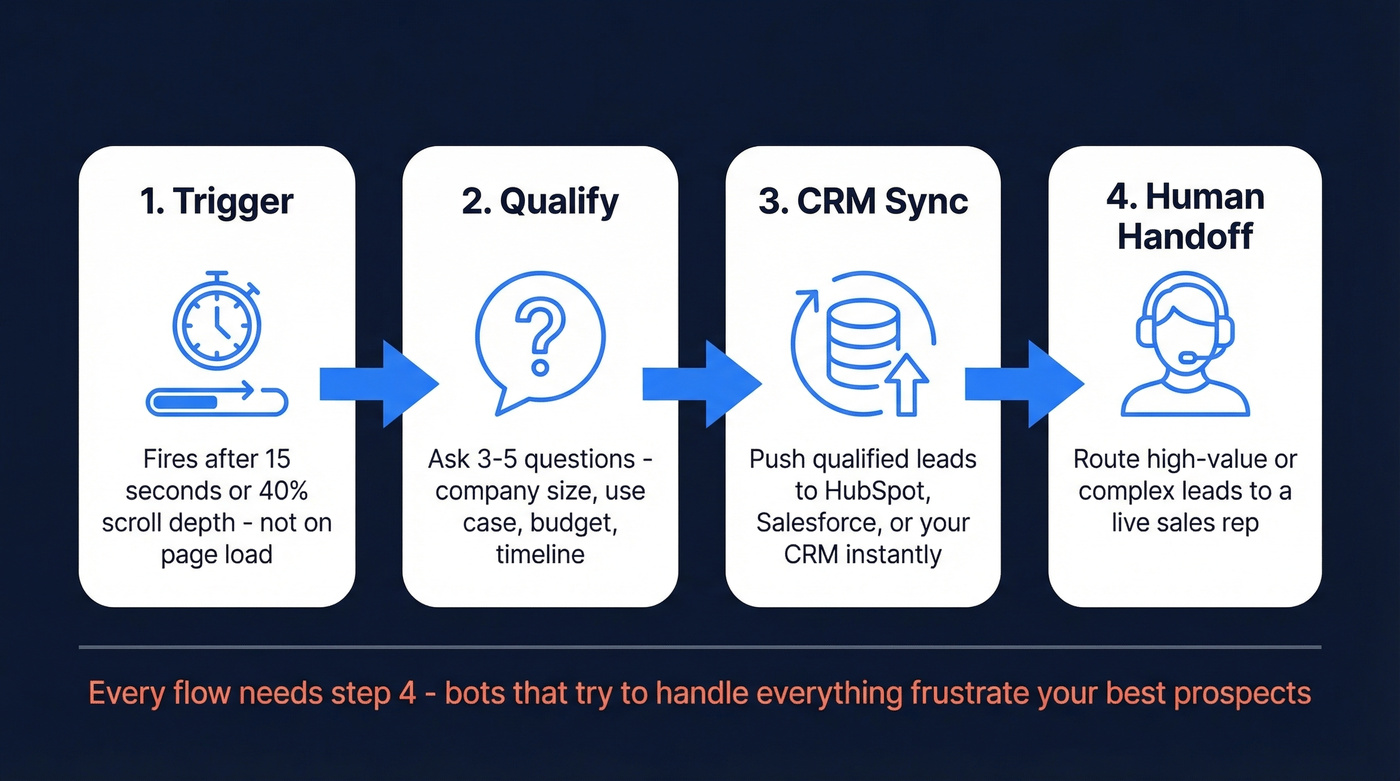
1. Trigger. The chatbot fires based on a rule: time on page, scroll depth, exit intent, or a specific URL visit. Good trigger logic prevents the bot from annoying someone who landed two seconds ago. We've found that a 15-second delay or 40% scroll depth works well for most B2B pages.
2. Conversational qualification. The bot asks 3-5 questions to identify fit - company size, use case, budget range, timeline. Each answer feeds scoring or branching logic that determines what happens next. With 56.2% of web traffic coming from mobile, the conversational format works far better than multi-field forms on small screens.
3. CRM sync. Qualified leads push directly into HubSpot, Salesforce, or whatever your team runs. (If you're evaluating options, see examples of a CRM.)
4. Human handoff. When the bot hits its limits - a complex question, a high-value prospect who wants to talk - it routes to a live rep. Every flow needs this escape valve. Bots that try to handle everything frustrate the exact people you most want to convert.
If you serve international markets, check for multilingual support. Tools like Chatling support 80+ languages, which matters for global lead capture.

Chatbot answers give you half the picture. Prospeo fills in the rest - company size, funding stage, tech stack, and 50+ data points per contact at 92% match rate. Your lead scoring model goes from guesswork to precision.
Turn chatbot conversations into fully enriched, sales-ready leads.
How to Qualify Leads Inside Your Chatbot
BANT for Quick Screening
BANT (Budget, Authority, Need, Timeline) is the fastest qualification framework for inbound leads. Here's how it adapts for a chatbot:
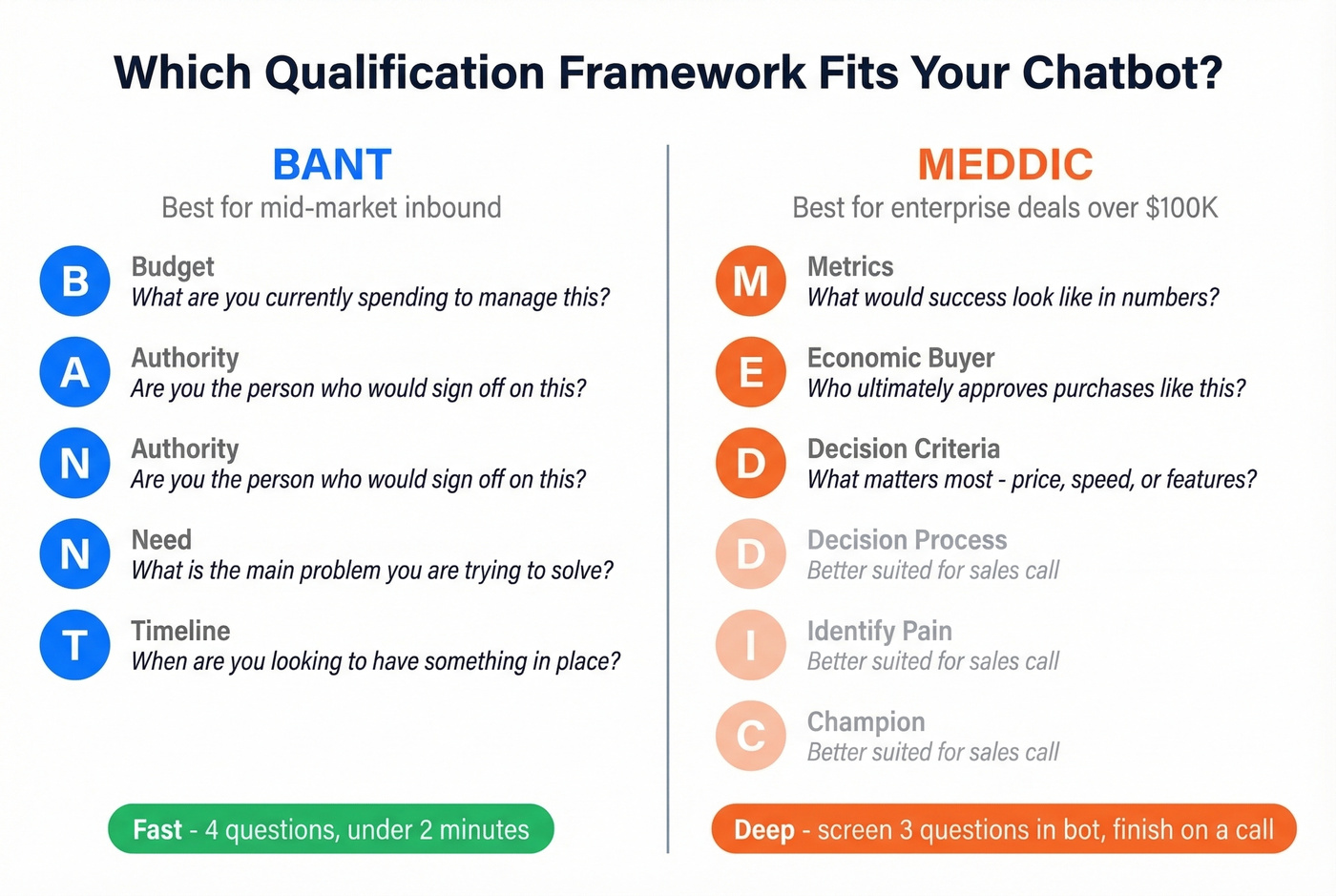
- Budget: Skip "What's your budget?" - too blunt. Try "What are you currently spending to manage this?" Conversational, not interrogative.
- Authority: "Are you the person who'd sign off on this, or should we loop someone else in?"
- Need: "What's the main problem you're trying to solve?" Open-ended enough to surface real pain.
- Timeline: "When are you looking to have something in place?" This one separates tire-kickers from active buyers.
BANT works best for mid-market inbound where you need to qualify volume fast. A variation worth knowing: CHAMP (Challenge, Authority, Money, Prioritization) leads with the prospect's challenge rather than budget - useful for consultative sales where opening with money feels premature.
Qualification logic also shifts by industry. For SaaS, ask about current tech stack and contract renewal dates. For e-commerce, ask about order volume and average order value. The framework stays the same; the questions change.
MEDDIC for Enterprise Deals
If you're selling six-figure contracts, BANT is too shallow. MEDDIC (Metrics, Economic Buyer, Decision Criteria, Decision Process, Identify Pain, Champion) gives you the depth enterprise deals demand. You won't run the full framework in a chatbot, but you can screen for high-signal questions:
- Metrics: "What would success look like in numbers?"
- Economic Buyer: "Who ultimately approves purchases like this?"
- Decision Criteria: "What matters most - price, speed of implementation, or feature depth?"
If you want to go deeper, use a dedicated MEDDIC sales qualification checklist.
Scoring and Routing Logic
Raw answers aren't enough. You need a scoring layer.
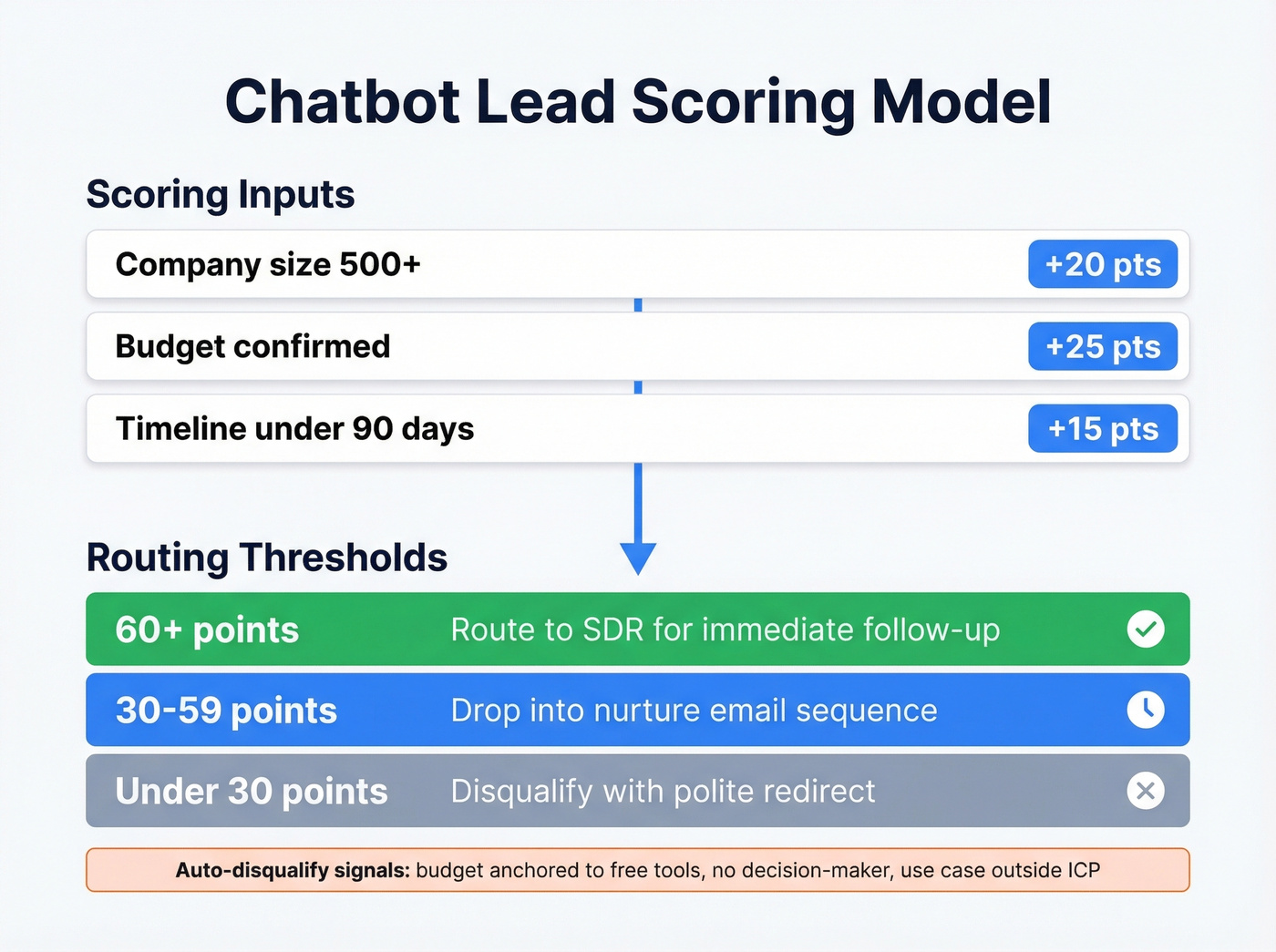
Assign points to each answer: company size 500+ gets 20 points, budget confirmed gets 25, timeline under 90 days gets 15. Set thresholds - 60+ points routes to an SDR for immediate follow-up, 30-59 drops into a nurture sequence, under 30 gets disqualified with a polite redirect. Watch for auto-disqualify signals: budget anchored to free tools, no identifiable decision-maker, or a use case outside your ICP.
Chatbot answers alone give you a partial picture. Layer in enrichment data like company size, funding stage, and tech stack, and your composite score becomes significantly more predictive. Prospeo's enrichment returns 50+ data points per contact, so your scoring model can factor in signals the prospect never mentioned. (More options: data enrichment services.)
Best Chatbots for Lead Generation in 2026
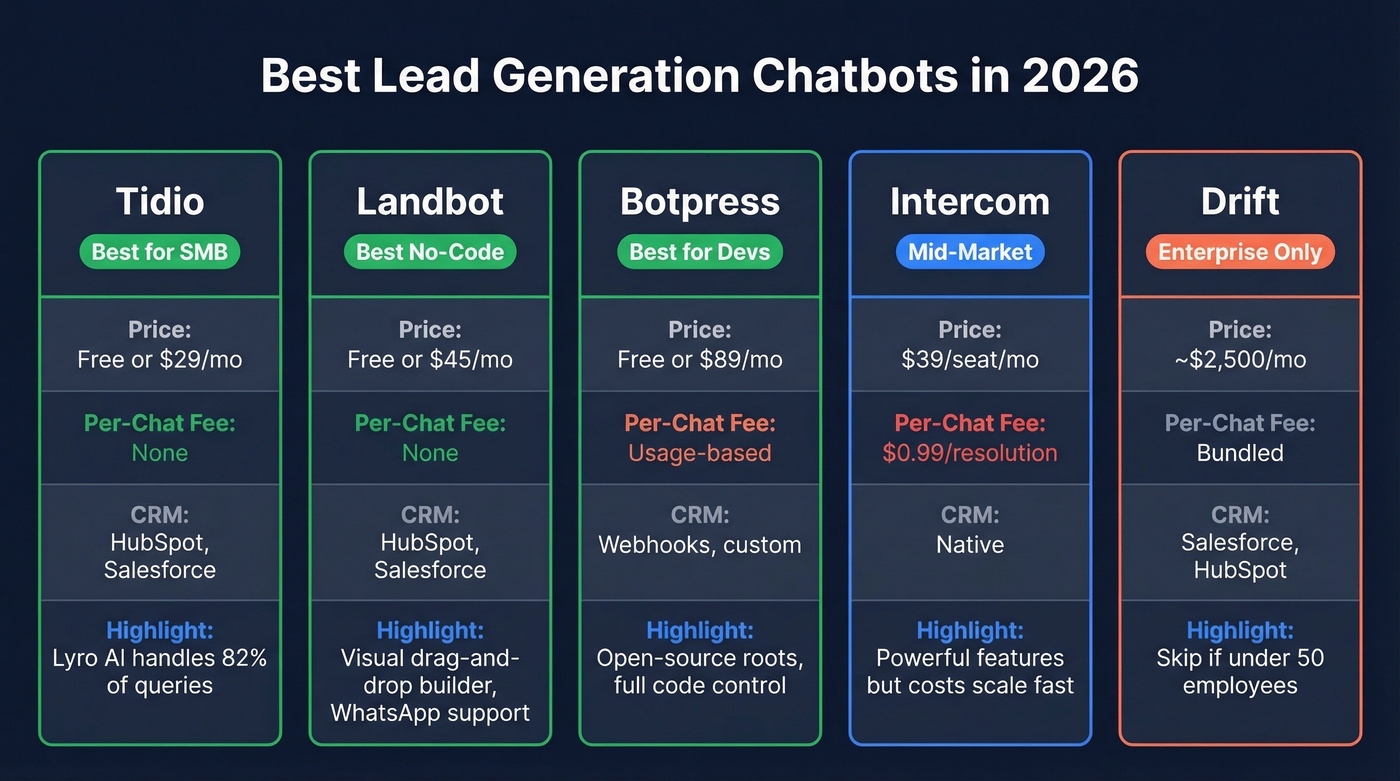
| Tool | Best For | Starting Price | Per-Conversation Fee | CRM Sync |
|---|---|---|---|---|
| Tidio | SMB & e-commerce | Free / $29/mo | None | HubSpot, Salesforce |
| Landbot | No-code teams | Free / $45/mo | None | HubSpot, Salesforce |
| Botpress | Developers | Free / $89/mo | Usage-based | Webhooks, custom |
| Intercom | Mid-market | $39/seat/mo | $0.99/resolution | Native |
| Drift | Enterprise | ~$2,500/mo | Bundled | Salesforce, HubSpot |
Tidio - Best for SMB & E-Commerce
Tidio is the obvious starting point for Shopify or WooCommerce stores. The free plan gets you basic chatbot flows, paid plans start at $29/mo, and Lyro - their AI layer - handles automated responses and lead capture without requiring you to script every branch.
The numbers back it up: Eye-oo, an Italian eyewear retailer, generated €177,000 in additional income with Tidio + Lyro, saw a 25% increase in overall sales, and dropped first-response time from 2-5 minutes to about 30 seconds. Lyro captured 1,305 leads and resolved 82% of 2,233 support inquiries. That's a real business running a real chatbot with real revenue impact - not a vendor's hypothetical case study.
Skip Tidio if you need deep customization or enterprise-grade analytics. The AI features require higher-tier plans.
Landbot - Best No-Code Builder

Landbot's visual flow designer is genuinely good. Drag blocks, connect them, and have a working qualification bot in an afternoon. Free plan gives you 100 chats/month; paid starts at $45/mo. WhatsApp support is a real differentiator if your audience lives there.
A Conversational Design case study showed 40%+ conversion rates on well-built Landbot flows. The platform handles lead scoring with conditional logic, Slack notifications for hot leads, and native HubSpot/Salesforce sync.
Use this if you're a marketing team that wants full control over conversation flow without writing code. Skip it if you need advanced analytics - Landbot's reporting gets thin below mid-tier plans.
Botpress - Best for Developers
Here's the thing: if your average deal size is under five figures, you probably don't need Intercom or Drift. Botpress gives technical teams everything they need at a fraction of the cost.
Botpress started as an open-source chatbot framework, and that DNA shows. You get code-level control over every aspect of the conversation, plus flexibility the no-code tools can't match. Free plan includes $5/mo in AI spend; paid plans start at $89/mo plus usage. The tradeoff is a steeper learning curve - if your team doesn't have a developer comfortable with conversation design, you'll spend more time building than selling.
Some platforms offer simulation modes that test your bot against historical conversations before launch, which cuts iteration time significantly. Botpress has this, and it's worth using before you go live.
Intercom - Powerful, but Watch the Math
Intercom's seat pricing runs $39-$139/seat/mo. Then Fin AI Agent charges $0.99 per resolution. For lead gen, you want more conversations - so 2,000 resolutions/month adds $1,980 on top of seat costs. Five seats on Advanced plus 2,000 resolutions = roughly $2,475/mo.
The feature set is strong, with 650,000+ websites using it. But per-conversation pricing is backwards for lead generation. You're being penalized for success.
Drift (SalesLoft) - Enterprise Only
If you're under 50 employees, don't look at Drift. After Salesloft acquired it in 2024, pricing became even more opaque. Estimates put the Premium tier at ~$2,500/mo with annual commitments, Advanced at $4,000-$6,000/mo. Year 1 TCO for a 10-person sales team runs $42,000-$53,000. G2 reviewers consistently flag renewal increases - some cite 40% bumps after the first year.
Others Worth Knowing
ChatBot starts at $65/mo - solid mid-range for teams that need more than Tidio's free tier but don't want Intercom's complexity. Qualified runs $3,000-$5,000+/mo for Salesforce-native enterprise teams. HubSpot Customer Agent charges ~$1 per conversation - at 2,000 interactions/month, that's $2,000. The consensus on r/hubspot is that it works fine if you're already deep in the HubSpot ecosystem, but it's not worth adopting HubSpot just for the chatbot.
If you're comparing other acquisition channels alongside chat, start with these lead generation trends before you commit budget.
Mistakes That Kill Lead-Gen Chatbots
Teams launch chatbots with high expectations and kill the project within 90 days. The failures follow predictable patterns.
No KPIs before build. If you haven't defined your baseline conversion rate, qualification rate, and handoff rate, you can't measure whether the chatbot is working. Set targets before you write a single conversation node. (If you need a tracking baseline, use lead generation metrics.)
Treating launch as "done." Chatbots aren't set-and-forget. Plan for weekly review cycles in the first month, then biweekly. Monitor drop-off points, refine question phrasing, update routing logic. In our experience, the first version of any chatbot flow is wrong - it's the third or fourth iteration that starts performing.
Under-resourcing the build. Budget for 1-2 developers plus 1-2 business-side people. Even with no-code tools, someone owns conversation design and someone else owns qualification logic. Enterprise builds take at least a month.
Overpromising NLU accuracy. Industry standard for natural language understanding sits around 75-78%. If leadership expects 95% accuracy on day one, the project is set up to fail.
No fallback or escalation. Every flow needs a human handoff trigger. Define the bot's scope so it doesn't hallucinate answers outside its domain. A bot that confidently gives wrong pricing does more damage than no bot at all.
Ignoring GDPR. If you're capturing data from EU visitors, your chatbot needs GDPR-compliant consent flows. Most platforms support this natively, but you need to configure it - unconsented data collection is a legal and reputational risk that no conversion rate justifies.
What Happens After Capture
Let's be honest about a frustrating reality most chatbot guides ignore.
It's Monday morning. Your chatbot captured 200 leads over the weekend. Then you start working them - 60 emails bounce, 40 phone numbers are disconnected, and a handful are spam traps that just dinged your sender reputation. You're left with maybe 100 usable contacts, and you've already burned deliverability on the bad ones.
Capture is only half the job. Before your SDRs start dialing, run the list through Prospeo's email verification. Its 5-step verification process - including catch-all handling, spam-trap removal, and honeypot filtering - delivers 98% email accuracy. It also enriches each contact with 50+ data points: job title, company size, tech stack, funding stage. Your reps get clean emails and context on who to call first. The free tier gives you 75 verifications per month; paid plans run about $0.01 per email.
If you're seeing bounces spike, fix the root cause with an email bounce rate audit and a tighter email deliverability guide.
A chatbot captures the email. But is it valid? Prospeo's 5-step verification delivers 98% email accuracy - so the leads your bot routes to sales actually connect. At $0.01 per email, bad data stops burning your pipeline.
Verify and enrich every chatbot lead before it hits your CRM.
FAQ
How much does a lead generation chatbot cost?
Free to $10,000+/month. Tidio and Landbot offer free tiers for small volumes. Most SMBs spend $29-$89/mo. Enterprise tools like Drift start around $2,500/mo. Watch per-conversation fees - Intercom's $0.99/resolution inflates costs fast at scale.
Can a chatbot replace my contact form?
Chatbots convert at 10-20% versus 2-5% for forms, so they should be your primary capture method. Keep a simple form as a fallback - some visitors still prefer them - but route the majority of traffic through a conversational flow.
What CRM integrations matter most?
Native HubSpot or Salesforce sync at minimum. Beyond that: Slack notifications for hot leads, webhook support for custom routing, and enrichment API connections. Prospeo integrates with both CRMs plus tools like Clay and Zapier, so chatbot-captured leads can be auto-verified and enriched before they hit your pipeline.
How do I measure chatbot ROI?
Track three numbers: chatbot conversion rate (visitors to captured leads), qualification rate (captured leads to sales-qualified), and cost per qualified lead. Compare against your form baseline. A healthy bot should cut cost-per-qualified-lead by 30-50% within 90 days.
Does B2B chatbot lead generation differ from B2C?
Significantly. B2B flows involve longer qualification sequences, decision-maker identification, and tighter scoring thresholds because deal sizes are larger and sales cycles run months, not minutes. B2C bots focus on speed: capture an email and push a discount code. B2B bots need to surface company size, budget authority, and timeline before routing to a rep, which is why frameworks like BANT and MEDDIC matter so much in that context.