

=== CURRENT ARTICLE (slug: lead-generation-for-manufacturing-companies) ===
Lead Generation for Manufacturing Companies (2026 Playbook)
Lead generation for manufacturing companies has always been a long game - but the rules shifted. A 6sense study of nearly 4,000 B2B buyers found that 95% of the time, the winning vendor is already on the buyer's Day One shortlist. That means you're not losing deals at the proposal stage. You're losing them before anyone picks up the phone.
What You Need (Quick Version)
Short on time? Here's the manufacturing lead gen priority stack for 2026:
- Fix your website conversion rate first. RFQ buttons on every product page, an above-fold value proposition, and mobile load times under 3 seconds. Manufacturing website conversion benchmarks range from 2.2% to 2.75% depending on the source - there's room to improve either way.
- Run Google Ads on high-intent manufacturing keywords. One industrial manufacturer generated $1M in additional revenue in year one by restructuring PPC around intent-based keyword groups.
- Build a verified prospect list and run cold email sequences. Manufacturing deals require roughly 62 touches across 6-18 months. You need accurate contact data that won't torch your domain reputation on the first send.
Why Generating Leads in Manufacturing Is Different
Manufacturing isn't SaaS. You can't run a free trial, collect a credit card, and call it a conversion.
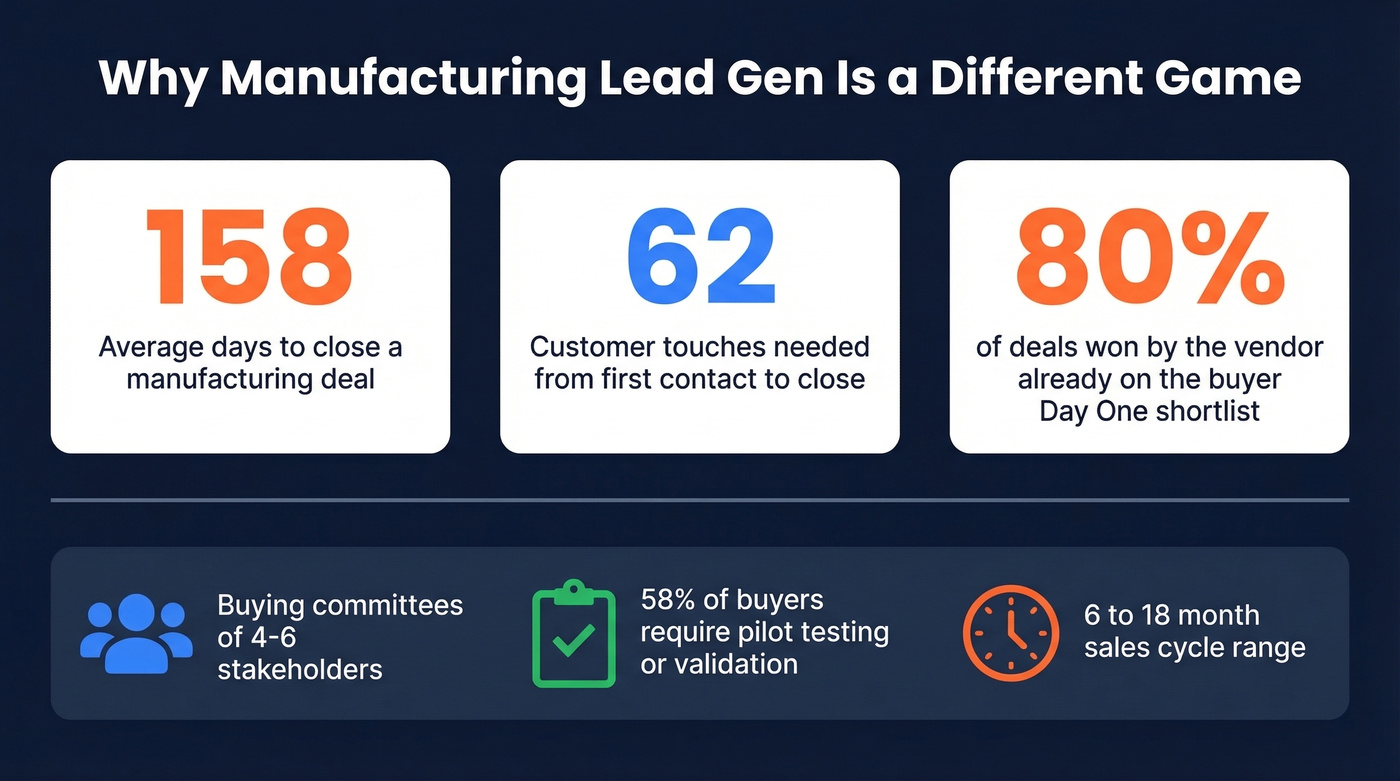
The average manufacturing sales cycle runs 158 days. That's over five months from first touch to closed deal, with a range of 6-18 months depending on deal complexity. During that window, your team needs to deliver roughly 62 customer touches - across email, phone, trade shows, content, and follow-ups. That number comes from Belkins' work with 200+ manufacturing companies, and it tracks with what we've seen in our own outbound campaigns for industrial clients.
Buying committees make this harder. You're not selling to one person. You're selling to a procurement manager, an engineer who validates specs, a plant manager who cares about uptime, and a CFO who cares about total cost of ownership. 58% of manufacturing buyers require extensive validation or pilot testing before signing - which is why those 62 touches aren't optional. They're structural.
Here's the kicker: 6sense's data shows the pre-contact favorite wins roughly 80% of the time. Buyers do more research independently before ever reaching out. If your content, your brand, and your data aren't working for you before that first conversation, you're already behind.
Manufacturing Lead Gen Benchmarks
Before you set targets, you need to know what "normal" looks like. These numbers will save you from overpaying agencies and underestimating timelines.
Cost Per Lead by Sub-Sector
| Sub-Sector | Avg CPL | Source |
|---|---|---|
| Aerospace | $103 | WebFX |
| Automotive | $294 | WebFX |
| Industrial | $333 | WebFX |
| Construction | $779 | WebFX |
| WebFX B2B Avg | $377 | WebFX |
| First Page Sage Blended Avg | $553 | First Page Sage |
| Organic Avg | $415 | First Page Sage |
| Paid Avg | $691 | First Page Sage |
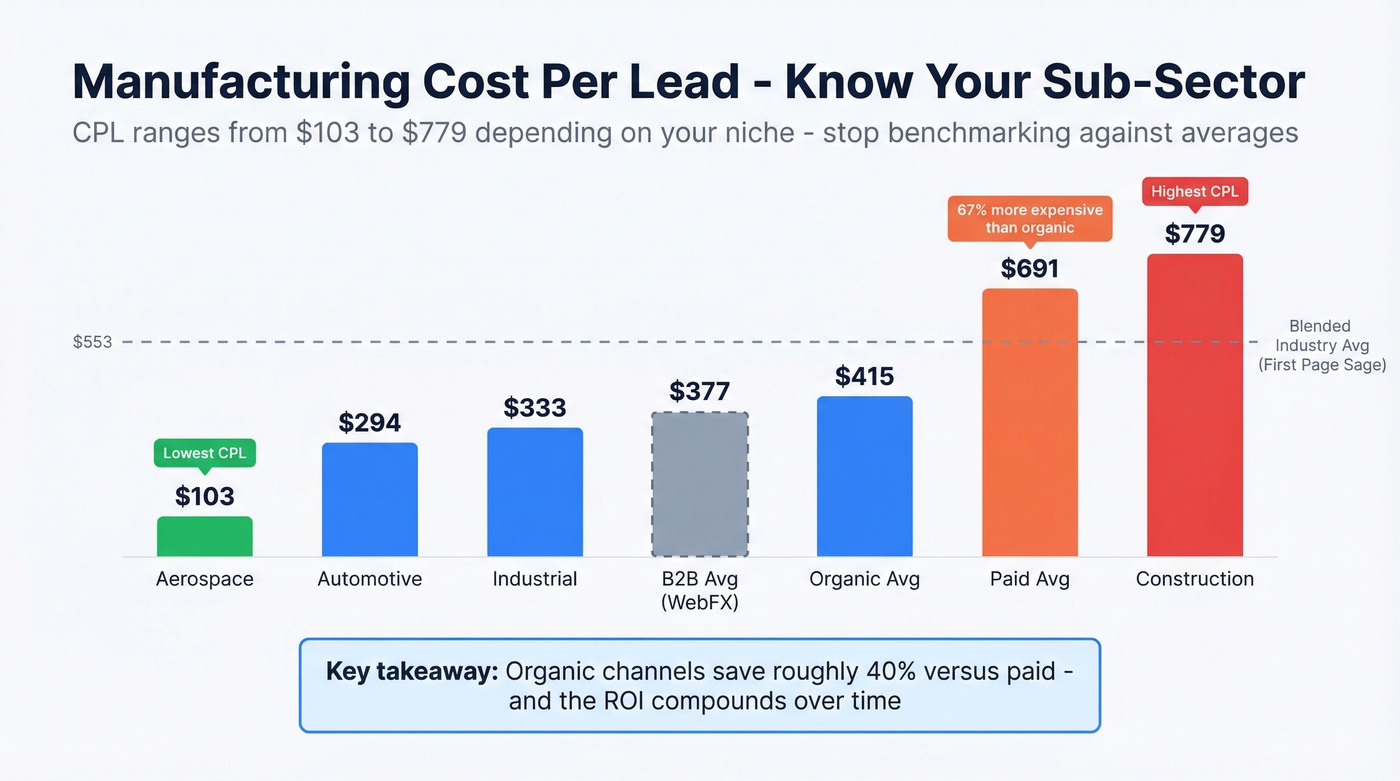
The spread is massive. Aerospace CPLs run a fraction of construction because the buyer pool and keyword competition are completely different. Don't benchmark against "manufacturing" as a monolith - know your sub-sector.
Channel Conversion Rates
| Channel | CVR |
|---|---|
| ABM | 3.8% |
| SEO | 2.6% |
| 2.4% | |
| Webinars | 2.3% |
| PPC/SEM | 1.5% |
| Trade Shows | 0.7% |
| Direct Mail | 0.3% |
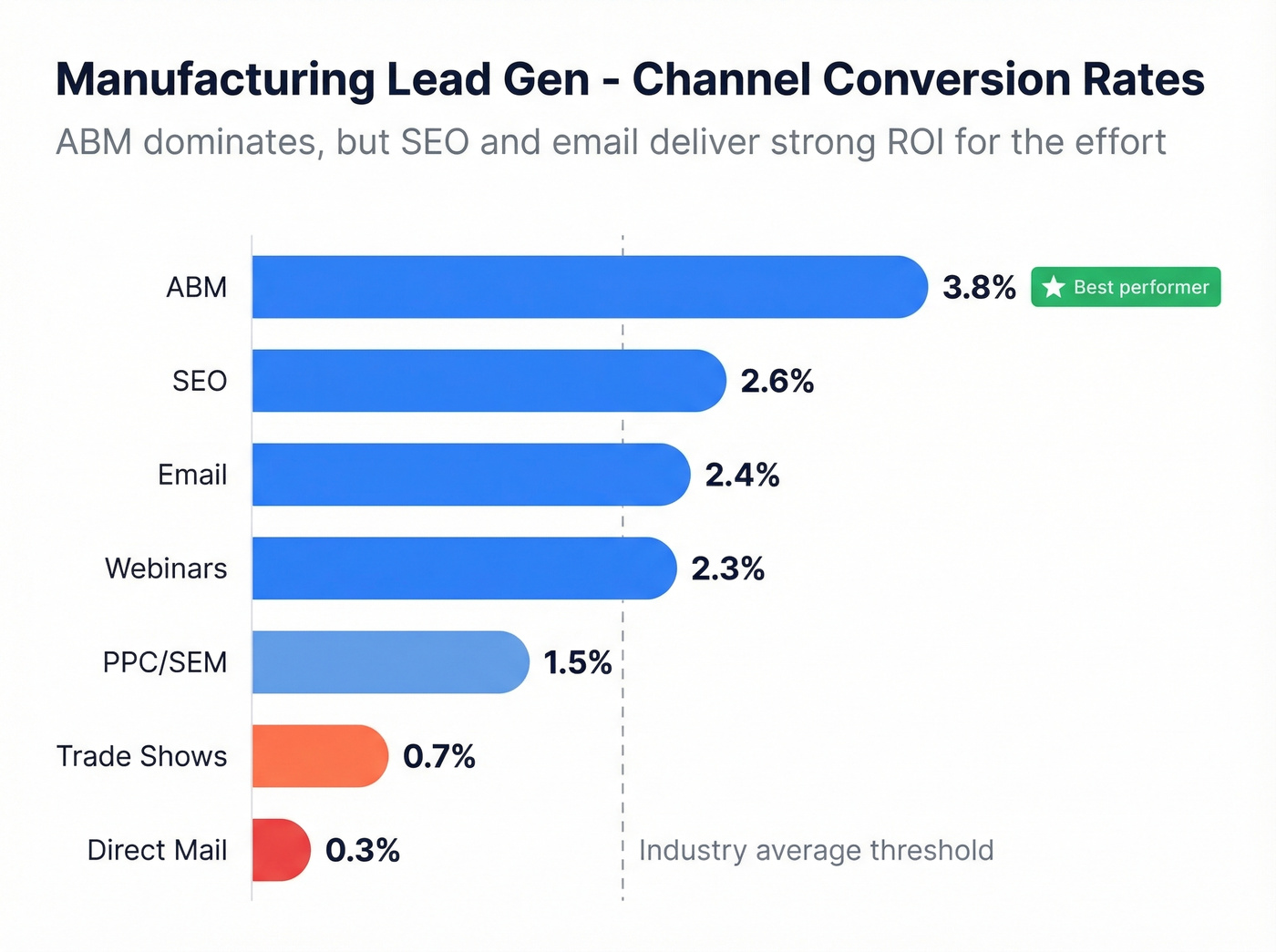
ABM leads the pack at 3.8%, which makes sense - you're targeting known accounts with tailored messaging. SEO and email cluster around 2.4-2.6%, solid for the effort involved. Trade shows? 0.7%. We'll come back to that.
Fix Your Website First
None of the strategies below matter if your website leaks leads. Most manufacturing websites do.
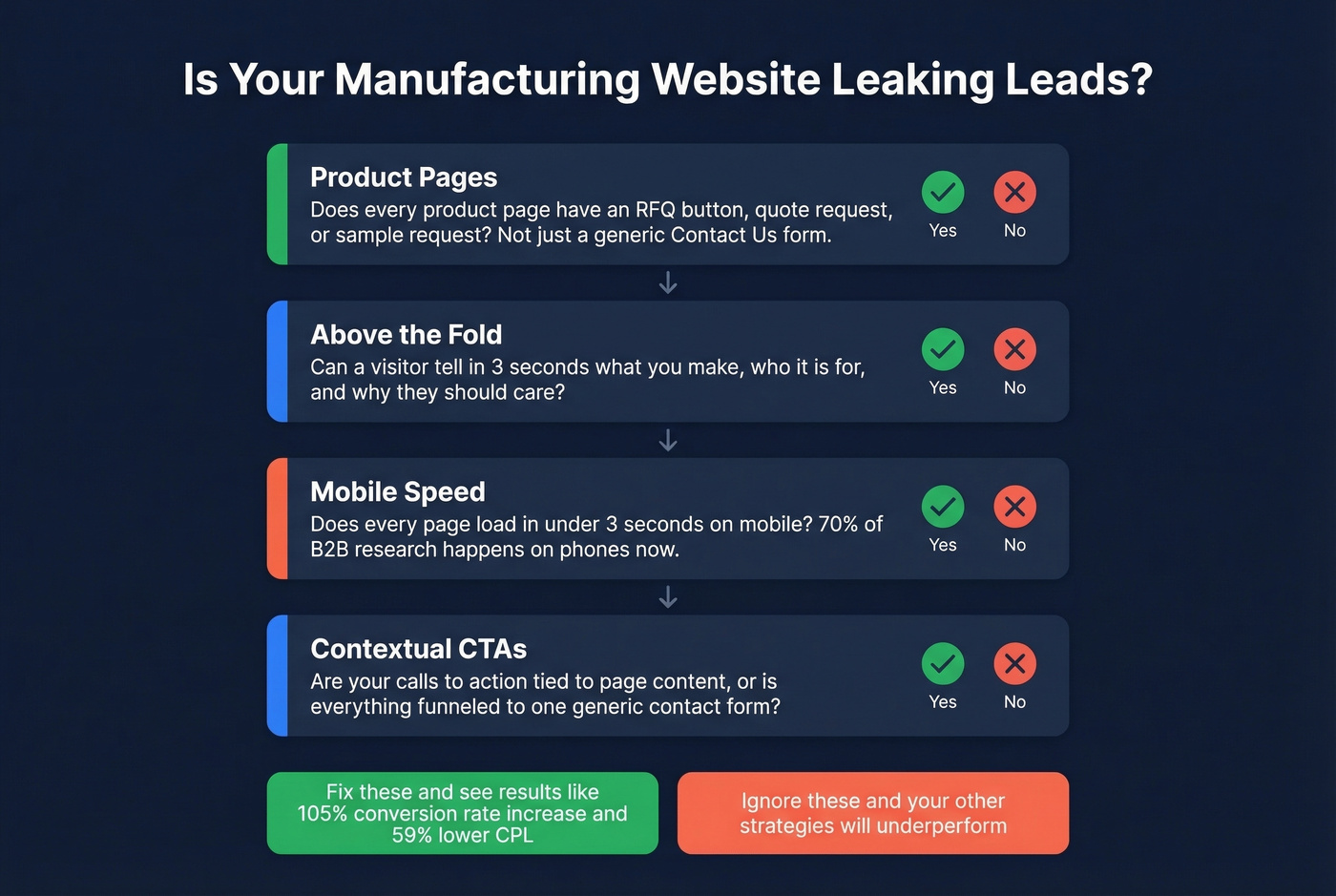
Many manufacturing sites have product pages loaded with spec sheet PDFs that take 8-10 seconds to load. No RFQ button. No sample request. No "get a quote" CTA - just a generic "Contact Us" buried in the nav. Nearly 70% of B2B research now happens on mobile devices, so if your site isn't fast on a phone, you're invisible to the engineer comparing suppliers on the plant floor.
Here's a quick diagnostic:
- Every product page needs a specific next step: RFQ, quote request, sample request, or spec download with an email gate.
- Above the fold should answer: what do you make, who's it for, and why should they care?
- Kill the generic "Contact Us" form as your primary conversion path. Replace it with contextual CTAs tied to the page content.
- Test mobile load time. If any page takes more than 3 seconds, you're losing visitors before they scroll.
The proof that this works: one industrial manufacturer saw a 105% increase in website conversion rate after redesigning around these principles. In a separate three-month engagement, another manufacturer saw a 59.4% reduction in cost-per-lead and a 66.8% boost in conversion rates - as reported by NPWS. That's not incremental improvement. That's a different business.

You can't afford 62 touches if half your emails bounce. Prospeo gives you 98% verified emails and 125M+ direct dials for manufacturing decision-makers - procurement, engineering, plant ops. Filter by technographics, headcount growth, and buyer intent across 15,000 topics to build the precision lists this article recommends.
Stop burning your domain on bad data. Start at $0.01 per verified email.
Seven Strategies That Work
1. Define Your ICP With Manufacturing Filters
Generic firmographic filters - industry, company size, revenue - aren't enough for manufacturing. You need to filter by production type, facility count, ERP/MES stack, and specific sub-sector. A CNC machining shop and a chemical process manufacturer have completely different buying triggers, even if they're both "manufacturing" companies with 200 employees.
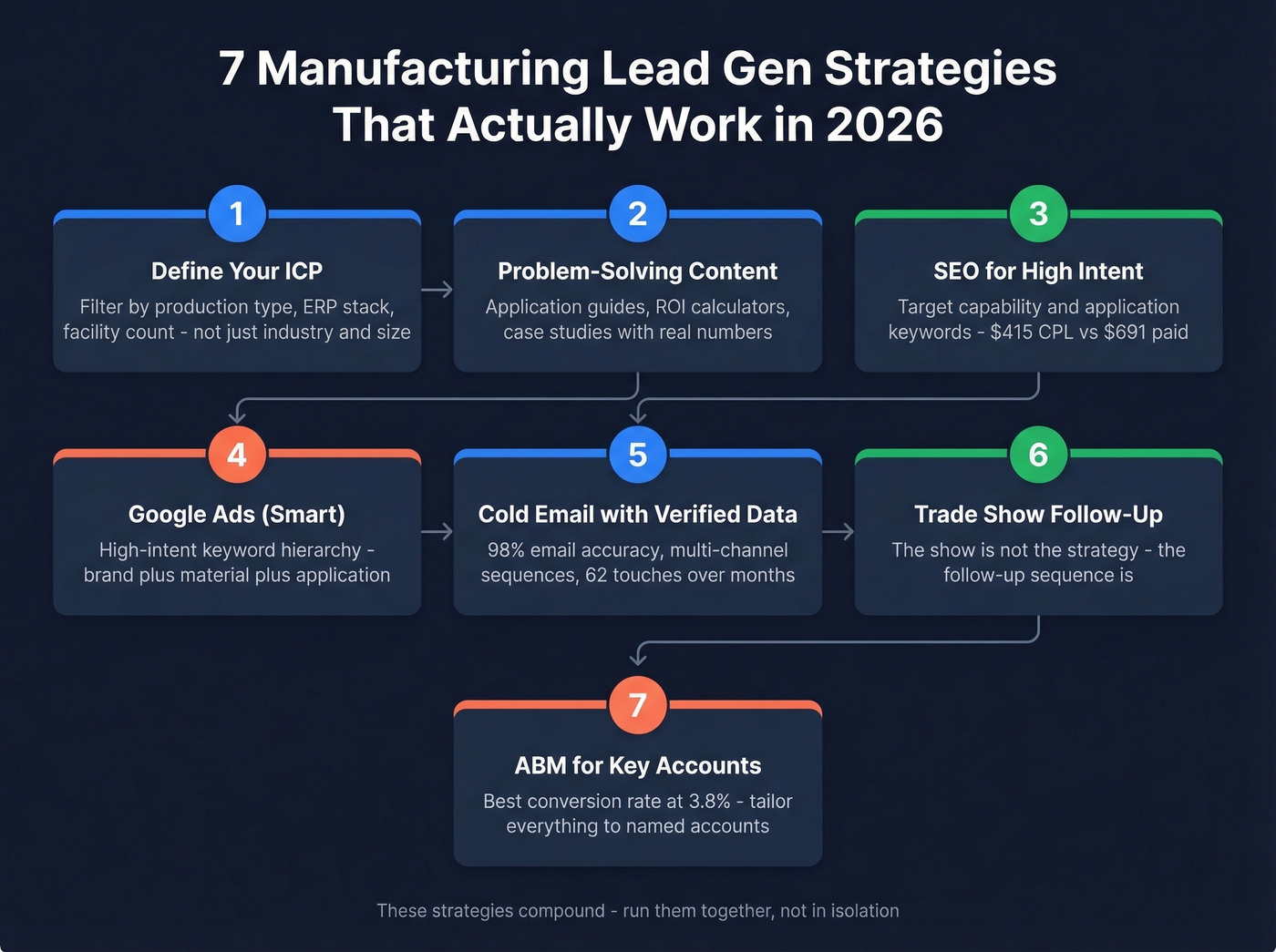
This matters because a NAM survey found that 67% of manufacturing buyers cite operational reliability as their primary concern. If you can't filter for the specific operational context where your product delivers reliability gains, your outreach will miss. The difference between a 500-contact spray-and-pray list and a 50-contact precision list is the difference between burning your domain and booking meetings.
2. Content That Solves Problems
Create this: Application guides showing how your product solves a specific problem. ROI calculators that help engineers justify the purchase internally. Case studies with real numbers - downtime reduced, throughput increased, scrap rate lowered.
Stop creating this: Product spec sheets disguised as blog posts. "About our company" content that nobody outside your building cares about.
64% of manufacturers struggle to prove marketing ROI, and 53% can't tie content to business goals. The fix isn't more content - it's better content aimed at the problems your buyers actually have. If you're publishing a blog post and can't name the specific buyer persona who'd forward it to their boss, don't publish it.
3. SEO for High-Intent Keywords
Don't target "manufacturing." Target "custom aluminum extrusion for aerospace" or "FDA-compliant packaging line automation." The more specific the keyword, the higher the intent and the lower the competition.
Organic channels deliver leads at $415 CPL versus $691 for paid - a 40% discount for the patient. Manufacturing websites that invest in SEO convert at 2.2-2.75% on average, which beats PPC's 1.5%. The tradeoff is time: SEO compounds over months, not days. But for a business with 158-day sales cycles, that timeline actually aligns well.
Focus on capability keywords, problem keywords, and application keywords. "How to reduce scrap rate in injection molding" will attract a buyer. "Best injection molding company" will attract a competitor.
4. Google Ads on High-Intent Terms
Industrial services Google Ads benchmarks: $2.56 CPC, 3.37% conversion rate, $79.28 CPA. Those are strong numbers compared to most B2B verticals. Broader manufacturing CPC can run higher - WebFX reports averages closer to $5.16 - so your mileage depends on sub-sector and keyword specificity.
The TopSpot case study is the best proof point here. An industrial manufacturer restructured their PPC around a keyword hierarchy - brand + material + application + requirement - and saw their close rate jump from 13.45% to 18.07%. The result: $1M in additional revenue in year one, with PPC leads converting to quotes climbing from 38% to 42%.
The lesson isn't "spend more on Google Ads." It's "spend smarter." Negative keywords matter. Landing pages need to match search intent exactly. And you need conversion tracking that goes beyond form fills - track quote requests, RFQs, and phone calls separately.
5. Cold Email With Verified Data
Here's the thing: 62 touches over 6-18 months means cold email isn't optional for manufacturing. It's the connective tissue between every other channel. But most manufacturing outbound fails for one reason - bad data.
We've seen this pattern repeatedly. A manufacturer hires an agency, gets promised 15 leads per month, and ends up with one decent lead in six months. The root cause is almost always the same: the contact list is garbage. Emails bounce, phone numbers are disconnected, and the domain reputation tanks before the campaign gets traction. The consensus on r/sales echoes this - threads about manufacturing outbound almost always circle back to data quality as the bottleneck.

Prospeo's 5-step verification process delivers 98% email accuracy, and its 7-day refresh cycle means you're not emailing people who changed jobs two months ago. With 125M+ verified mobile numbers, you can run a multi-channel sequence - email, then call, then email again - that's essential when you need dozens of touches to close. One customer, Meritt, saw their bounce rate drop from 35% to under 4% after switching, and their pipeline tripled from $100K to $300K per week.
For context, Mailchimp's B2B benchmarks show a 31.35% open rate and 2.78% click rate. Those numbers only hold if your emails actually land in the inbox. A 10% bounce rate doesn't just waste sends - it signals spam to every email provider watching your domain.
If your average contract value is under $25K, you probably don't need ZoomInfo-level data infrastructure. A verified list of 50 decision-makers with accurate emails and direct dials will outperform a database of 5,000 unverified contacts every time. Precision beats volume in manufacturing outbound.
6. LinkedIn Organic + Paid
LinkedIn Ads often cost more per click than Google Search in B2B manufacturing. But the targeting precision by job title, industry, company size, and seniority makes it valuable for ABM plays where you know exactly who you're after.
The bigger opportunity is organic. Engineers and plant managers trust content from other engineers, not from company pages. Get your technical team posting about real problems they've solved. A single post from your VP of Engineering about a production challenge will outperform a month of corporate content.
7. Generative Engine Optimization
Roughly 60% of searches now end without a click, and AI Overviews appear in 21% of all search results. If your content isn't structured for AI retrieval, you're invisible in the fastest-growing discovery channel.
GEO means optimizing so ChatGPT, Google AI Overviews, and Perplexity can cite your brand when a buyer asks "best CNC machining supplier for aerospace parts." Let's break down the implementation:
- Structured data - FAQ, HowTo, Article, and Organization schema on key pages.
- llms.txt - A machine-readable file telling AI crawlers what your company does and what content to reference.
- Direct-answer formatting - Lead sections with concise answers, then expand. AI tools pull the first clear answer they find.
- Entity authority - Consistent brand mentions, author bios on technical content, and a Google Knowledge Panel if you can get one.
- Measurement - Track AI-referred traffic in GA4. Monitor whether ChatGPT and Perplexity cite your content when asked about your category.
Don't sleep on this. It's how manufacturing brands will win visibility in 2026 and beyond.
Your Lead Gen Tech Stack
You don't need ten tools. You need three or four that work together without creating data chaos.
| Tool | Best For | Starting Price | Key Limitation |
|---|---|---|---|
| Prospeo | Verified emails + direct dials | Free tier; ~$0.01/email | Needs CRM for pipeline |
| Apollo.io | All-in-one prospecting | $49/mo | Below 80% accuracy on many segments |
| Hunter.io | Email-only lookups | $49/mo | No mobile numbers |
| ZoomInfo | Enterprise data + intent | $15,000+/yr | Overkill for most mfg teams |
| Lusha | Quick direct dials | $49/mo; 50 free credits | Smaller database |
| HubSpot | CRM + marketing automation | Free CRM; ~$800/mo Mktg Pro | Marketing Hub gets pricey fast |
For manufacturing teams running outbound, data quality is the bottleneck. Apollo works well as a secondary tool if you want built-in sequencing, but accuracy drops noticeably on niche manufacturing segments. ZoomInfo is powerful, but at $15K+ per year with annual contracts, it's hard to justify unless you're running a 50-person sales org. HubSpot's free CRM paired with lead scoring rules will handle nurture sequencing and keep your pipeline from going dark between those 62 touches.
Skip ZoomInfo if you're a team of five. You'll spend more time configuring it than using it.
Generic filters won't cut it for manufacturing ICP targeting. Prospeo's 30+ search filters - including tech stack, department headcount, funding, and job change signals - let you build the 50-contact precision lists that actually book meetings. Data refreshes every 7 days, not the 6-week industry average.
Ditch spray-and-pray. Target the exact buyers who need what you make.
Mistakes That Kill Your Pipeline
Treating the annual trade show as your marketing strategy. Trade shows convert at 0.7% - the lowest of any B2B channel. They're fine for brand awareness and relationship maintenance, but they shouldn't be your primary investment.
Hiring an agency without understanding the timeline. Manufacturing sales cycles run 6-18 months. Any agency promising 15 qualified leads per month from a standing start is either lying or doesn't understand your industry. Look for agencies that talk about pipeline value and sales cycle alignment, not lead volume.
Ignoring data quality in outbound. Bad contact data doesn't just waste sends - it destroys your domain reputation. Once Gmail and Outlook flag your domain as spam, every email you send suffers, including replies to inbound leads. Verify before you send. Every time. (If you need a baseline, start with email bounce rate benchmarks and remediation.)
Not scoring or nurturing leads. With 62 touches required to close, you can't rely on memory and spreadsheets. Set up basic lead scoring in your CRM - engagement with content, website visits, email opens - and build stage-specific nurture sequences. A procurement manager who downloaded your spec sheet three months ago still needs a reason to come back.
Creating content nobody asked for. 66% of manufacturers say their content isn't converting. The problem isn't volume - it's relevance. Stop publishing product announcements and start publishing content that helps your buyer solve a problem or justify a purchase internally.
Putting It All Together
The question every sales leader asks is how to find more buyers without ballooning headcount. The answer is layering inbound and outbound so each channel feeds the other.
SEO and content bring in warm leads who already know your capabilities. Cold email and outreach reach the buyers who haven't started searching yet. Manufacturing demand generation - the work you do to create awareness before a buyer has an active need - fills the top of that funnel so your outbound team isn't starting every conversation cold. When these layers work together, your cost per lead drops, your pipeline stays full between trade shows, and your sales team spends time on qualified conversations instead of chasing dead contacts.
That's what effective lead generation for manufacturing companies looks like in 2026. Not one silver-bullet channel, but a system where every touchpoint compounds toward the close.
FAQ
What's a good cost per lead for manufacturing?
The blended average ranges from $377 to $553 depending on the benchmark source. Organic channels deliver at $415, paid at $691. Sub-sector matters enormously - aerospace runs $103 while construction hits $779. Benchmark against your specific segment, not the industry average.
How long is the typical manufacturing sales cycle?
The average is 158 days, with a range of 6-18 months depending on deal size and buying committee complexity. Expect roughly 62 customer touches before close. Plan your outbound cadences and content accordingly - this isn't a one-email-and-done business.
Are trade shows still worth it for manufacturers?
Trade shows convert at 0.7%, the lowest of any B2B channel. They're useful for maintaining relationships and brand visibility, but shouldn't anchor your strategy. Allocate the bulk of your budget to SEO (2.6% CVR), email (2.4%), and PPC (1.5%), which all convert 2-5x higher.
How do I build a verified prospect list for manufacturing outreach?
Use a B2B data platform with manufacturing-specific filters like sub-sector, facility count, and job title. Verify contacts before sending to protect domain reputation - a single bad campaign can flag your domain for months. Tools like Prospeo offer 30+ search filters and a free tier to test before committing.
What's GEO and why should manufacturers care?
Generative engine optimization means structuring content so AI tools like ChatGPT and Google AI Overviews cite your brand. With 60% of searches ending without a click, traditional SEO alone won't maintain visibility. Add structured data, direct-answer formatting, and track AI-referred traffic in GA4.