

Lead Generation for Professional Services: The Data-Backed Playbook
Your managing partner just asked why the firm spent $15K on marketing last quarter and only closed one new client. You don't have a good answer - not because the tactics were wrong, but because nobody tracked the numbers that matter. The problem with lead generation for professional services isn't a shortage of ideas. It's a shortage of math.
Most firms jump straight to "we need more content" or "let's try LinkedIn ads" without knowing their cost per acquisition, their close rate, or how many conversations it takes to land a single engagement. That's not a strategy. That's hope with a budget line.
What You Actually Need
- Three channels, executed well. SEO + one outbound channel (cold email or LinkedIn) + one relationship channel (referrals or webinars). Don't spread thin across seven channels with no budget to do any of them right.
- Metrics before tactics. Know your CAC, close rate, and conversations-to-opportunity ratio before you choose a single channel. Benchmarks are below.
- Verified contact data before sending a single email. Bad data kills outbound faster than bad messaging ever will.
The ~$60-$200/month starter stack: HubSpot CRM (free tier) + Prospeo for verified contact data (free tier; paid from ~$0.01/email) + Instantly or Lemlist for sequence management (~$30-97/mo). That gets a 10-person firm running real outbound without enterprise software.
Why Professional Services Lead Gen Is Different
Selling consulting, legal, or accounting services isn't like selling SaaS. Most lead gen advice ignores this, and it shows in the results.
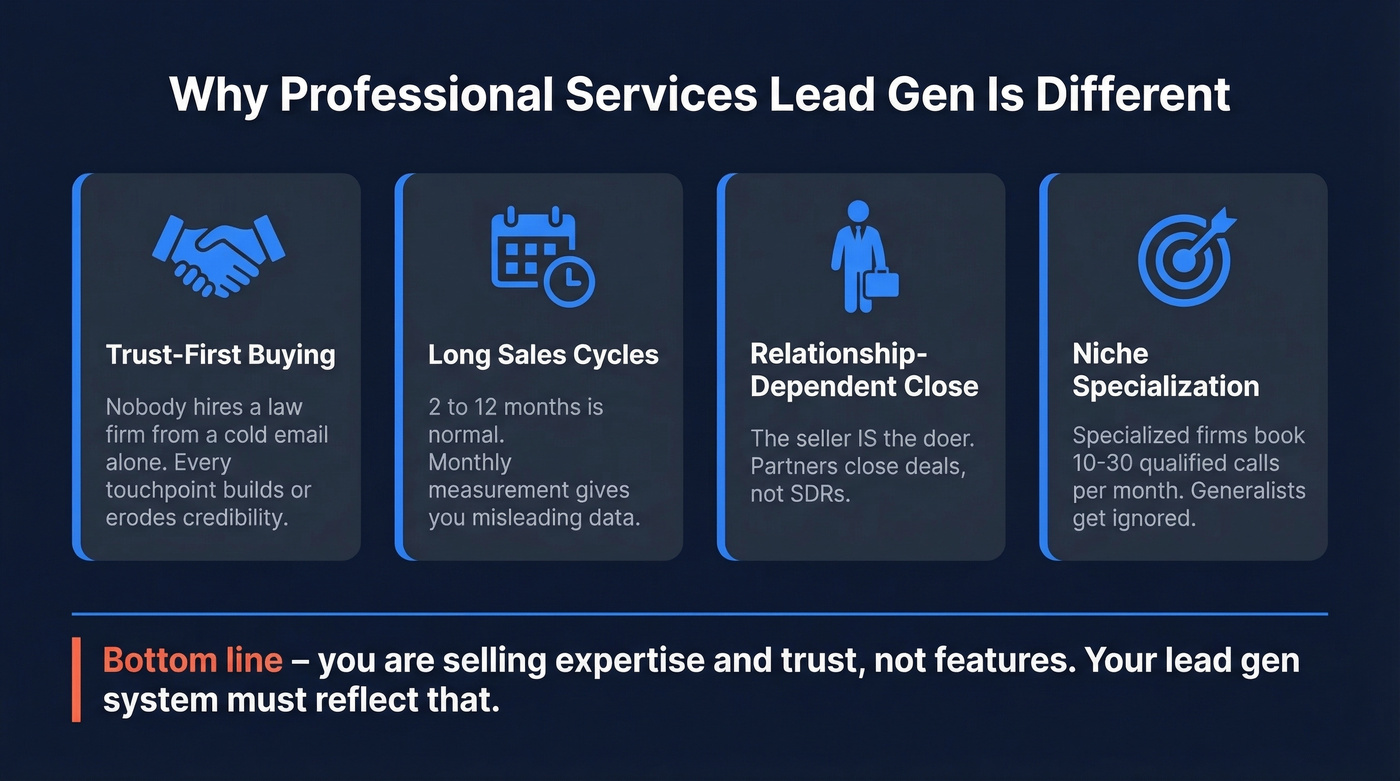
Professional services buyers make decisions based on trust, not feature comparisons. They're hiring expertise, not purchasing a product. That changes everything about how you generate and nurture leads.
Trust-first buying. Nobody hires a law firm from a cold email alone. Every touchpoint either builds or erodes credibility. Attracting corporate clients means leading with demonstrated expertise, not sales pitches.
Long sales cycles. Two to twelve months is normal. Enterprise advisory engagements stretch longer. Your lead gen system needs to account for this lag - if you're measuring monthly, you're measuring wrong.
Relationship-dependent close. The person who does the selling is usually the person who does the work. Partners and principals can't be replaced by SDRs.
Niche specialization as a multiplier. Data on accounting firms shows that specialized firms book 10-30 qualified calls per month with systematic outreach, while generic "we do everything" messaging gets ignored. Niching isn't optional - it's the single biggest lever. We've seen this pattern repeat across legal, consulting, and financial advisory firms. The generalists starve while the specialists pick their clients.
The Numbers Before the Tactics
Before you pick a channel, you need a framework. Start with how many clients you need per year, work backward to how many conversations produce an opportunity, and apply your close rate. Everything else is arithmetic.
Here are the benchmarks that matter:
| Metric | Benchmark | Source |
|---|---|---|
| Avg. conversion rate | 2.9% average conversion rate | Ruler Analytics |
| Form conversion rate | 1.7% | Ruler Analytics |
| Call conversion rate | 1.2% | Ruler Analytics |
| SEO conversion rate | 2.4% | First Page Sage |
| PPC conversion rate | 1.3% | First Page Sage |
| Legal SEO conversion | 4.4% | First Page Sage |
| Legal CAC (combined) | $749 | HubSpot |
| Financial Services CAC | $784 | HubSpot |
| Healthy LTV:CAC ratio | ~3:1+ | HubSpot |
| MQL-to-SQL target | 25-35% | Directive |
That 2.9% average conversion rate comes from Ruler Analytics' analysis of 100M+ data points, defining a conversion as a qualified lead including qualified form submissions and calls.
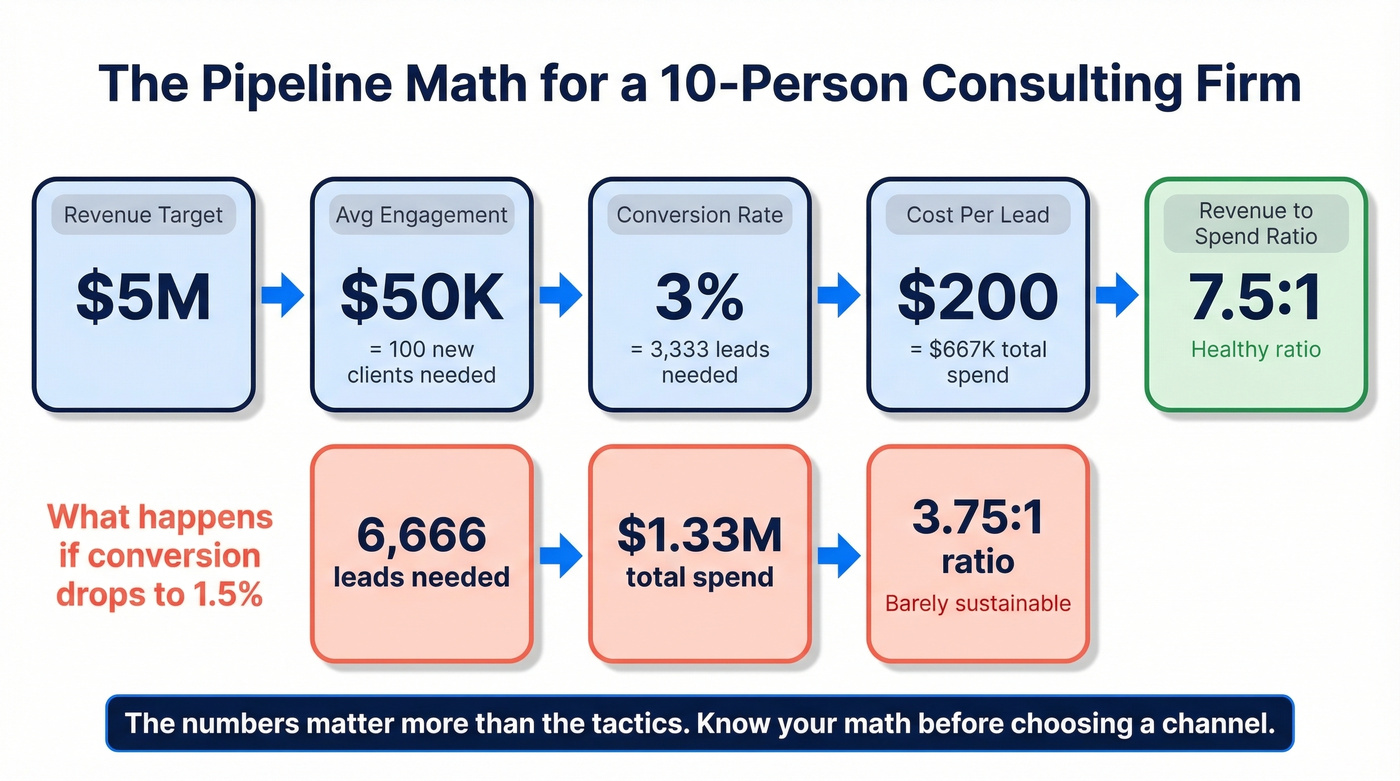
Let's run the math for a real firm. A 10-person consulting practice wants $5M in new revenue this year. Average engagement is $50K, so that's 100 new clients needed. At a 3% conversion rate and $200 CPL, you need roughly 3,333 leads costing about $667K in lead gen spend - a 7.5:1 revenue-to-spend ratio, which is healthy. But if your conversion rate drops to 1.5%, you need double the leads and double the budget. The numbers matter more than the tactics.
A healthy LTV:CAC ratio is ~3:1 or better. If you're spending $749 to acquire a legal client worth $2,000, that's barely sustainable. If that same client is worth $15K over the relationship, you're in great shape.
Highest-ROI Channels
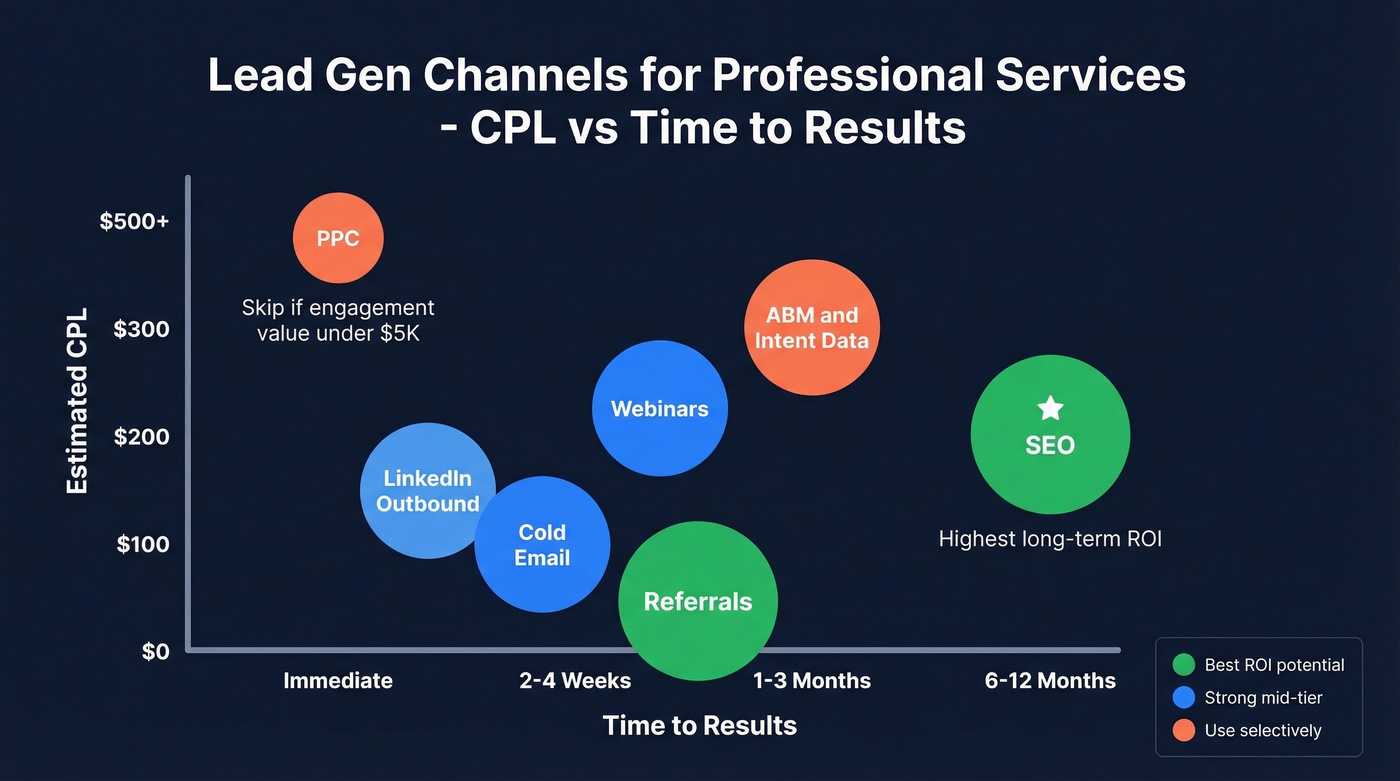
Seven channels worth your time, ranked by ROI potential for firms selling expertise.
SEO & Thought Leadership
SEO converts at nearly 2x the rate of PPC across all industries - 2.4% vs 1.3% - and the gap widens for legal services at 4.4% vs 2.2%. For professional services, organic search outperforms paid search consistently.
A common budget split is 75% SEO, 25% PPC. CPL often runs $50-$200 with high upfront investment but declining marginal cost over time. Generative Engine Optimization is emerging as a complementary tactic: making sure your content shows up in AI-generated answers, not just traditional search results. If you're not thinking about how LLMs surface your firm's expertise, you're already behind.
LinkedIn Outbound
SalesBread's data across their client base shows a 19.98% reply rate on LinkedIn, with 48.14% of those replies being meeting requests or qualified inquiries. Their CCQ method - Compliment, Commonality, Question - works because it feels human. CPL: $50-$150.
One critical caveat: Sales Navigator data is only about 33% accurate on contact details, so double-verify every prospect before launching a campaign. Reaching the right decision-maker is everything when targeting enterprise buyers.
Cold Email Outreach
The cheapest outbound channel at $30-$100 CPL, but only if your data is clean. A standard sequence runs 3-5 touches over two weeks. The prerequisite nobody talks about: verified email addresses. Without clean data, cold email isn't cheap - it's expensive domain damage. We'll break down why in the data quality section.
PPC (Google Ads)
Skip this if your average engagement value is under $5K. CPL runs $150-$500+, sometimes higher for competitive legal and financial keywords. Legal PPC converts at 2.2%, which is decent but still half the SEO rate. PPC captures existing demand - it doesn't create it. Use it for high-intent searches like "hire [service] firm [city]" and nothing else.
Webinars & Events
CPL: $100-$300 per registrant. Webinars work exceptionally well for complex advisory services because they let you demonstrate expertise before asking for a meeting. The conversion path is longer - registrant to attendee to follow-up to meeting - but the quality is high. In our experience, firms that run monthly webinars on narrow topics outperform those doing quarterly "thought leadership" events by a wide margin.
Referral Systems
Here's the thing: referrals have the highest close rate of any channel, and the lowest CPL at $0-$50. But referrals aren't a strategy. You can't forecast referral volume, you can't scale it predictably, and you can't build a business plan around "hoping clients mention us." Systematize referrals with a formal ask process and partner network, but never make them your only channel.
ABM & Intent Data
71% of B2B companies now run ABM programs. For professional services targeting enterprise accounts, intent data helps you reach firms actively researching your service category. Target a 10-20% MQA rate from target accounts and 5-10 meetings per 100 surging accounts in the first 30 days.
| Channel | Est. CPL | Key Metric | Best For | Time to Results |
|---|---|---|---|---|
| SEO | $50-$200 | 2.4% conv. rate | Long-term pipeline | 6-12 months |
| $50-$150 | ~20% reply rate | Direct outreach | 2-4 weeks | |
| Cold email | $30-$100 | 15-25% open rate | Scale + speed | 2-4 weeks |
| PPC | $150-$500+ | 1.3% conv. rate | High-intent capture | Immediate |
| Webinars | $100-$300 | 30-40% attend rate | Expertise demo | 4-8 weeks |
| Referrals | $0-$50 | Highest close rate | Warm pipeline | Ongoing |
| ABM/Intent | $200-$500 | 10-20% MQA rate | Enterprise accounts | 1-3 months |

The article says it clearly: bad data kills outbound faster than bad messaging. Prospeo's 5-step email verification delivers 98% accuracy - meaning your firm's cold email sequences actually reach decision-makers instead of burning your domain. At ~$0.01 per verified email, a 10-person practice can run real outbound for under $60/month.
Stop paying enterprise prices for data that bounces. Start with 75 free emails.
The Data Quality Problem
Look, we've watched this scenario play out dozens of times. A firm sends 2,000 cold emails, 600 bounce, and suddenly their domain reputation is wrecked. Not just for that campaign - for every email the firm sends going forward, including client communications. Bounce rates above 5% trigger spam filters and reduce deliverability across the board.
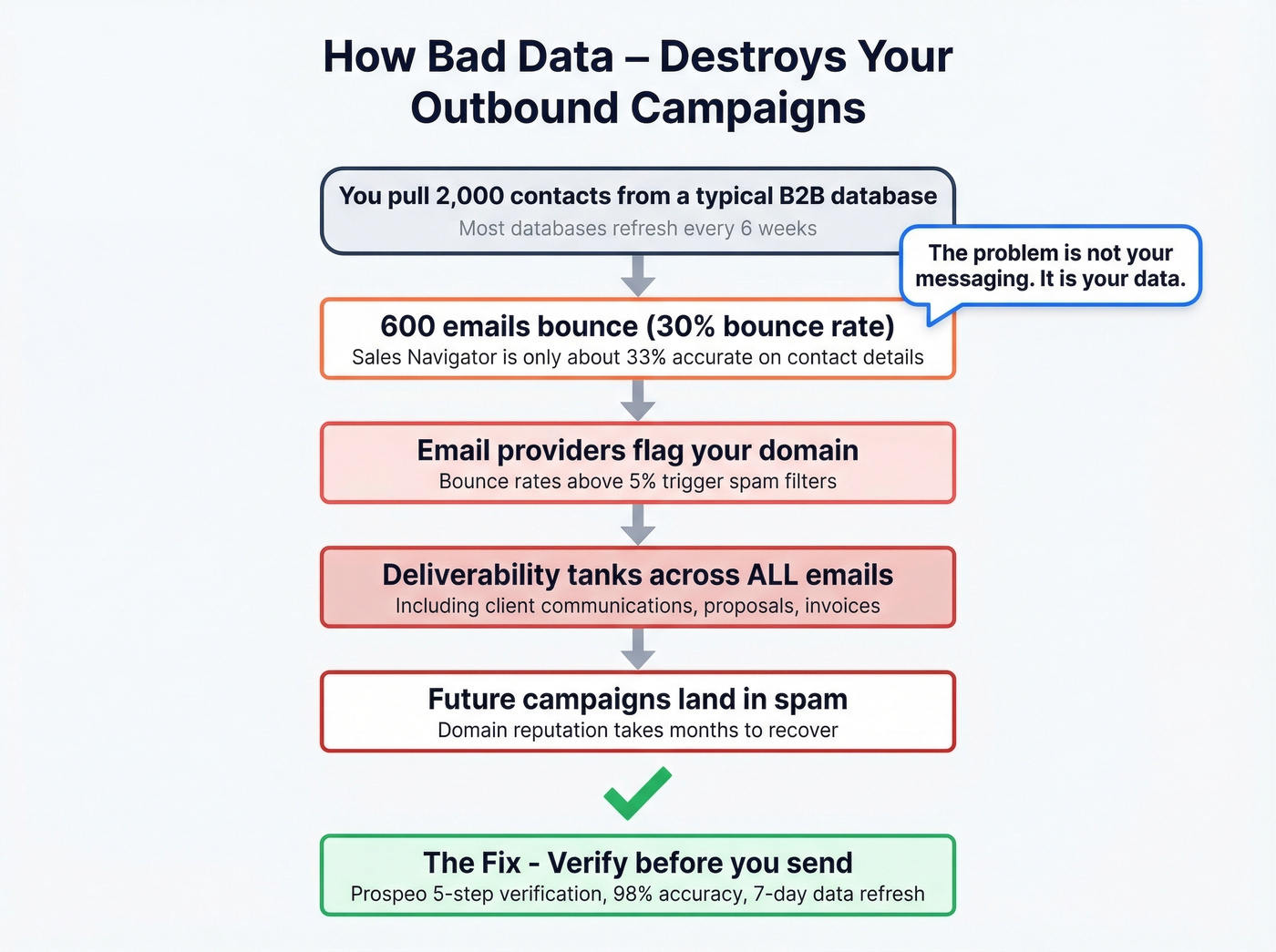
Your outbound campaigns aren't failing because of bad messaging. They're failing because of bad data.
Sales Navigator is only about 33% accurate on contact details. Most B2B databases refresh on roughly a 6-week cycle, which means a significant chunk of your list is stale before you hit send. People change jobs, companies restructure, email formats shift.
This is where verified data earns its place in the stack. Prospeo's 300M+ professional profiles with 143M+ verified emails, 98% email accuracy, and 125M+ verified mobile numbers - refreshed on a 7-day cycle versus the 6-week industry average - solve the data quality problem at the source. The platform runs a proprietary 5-step verification process that handles catch-all domains, removes spam traps, and filters honeypots.
Snyk's team saw their bounce rate drop from 35-40% to under 5% after switching, and across 50 AEs their sourced pipeline jumped 180%, generating 200+ new opportunities per month. Before you send a single outreach email, verify your list.
Tool Stack That Actually Works
You don't need enterprise software to book meetings. A 10-person firm can run effective outbound for under $200/month.
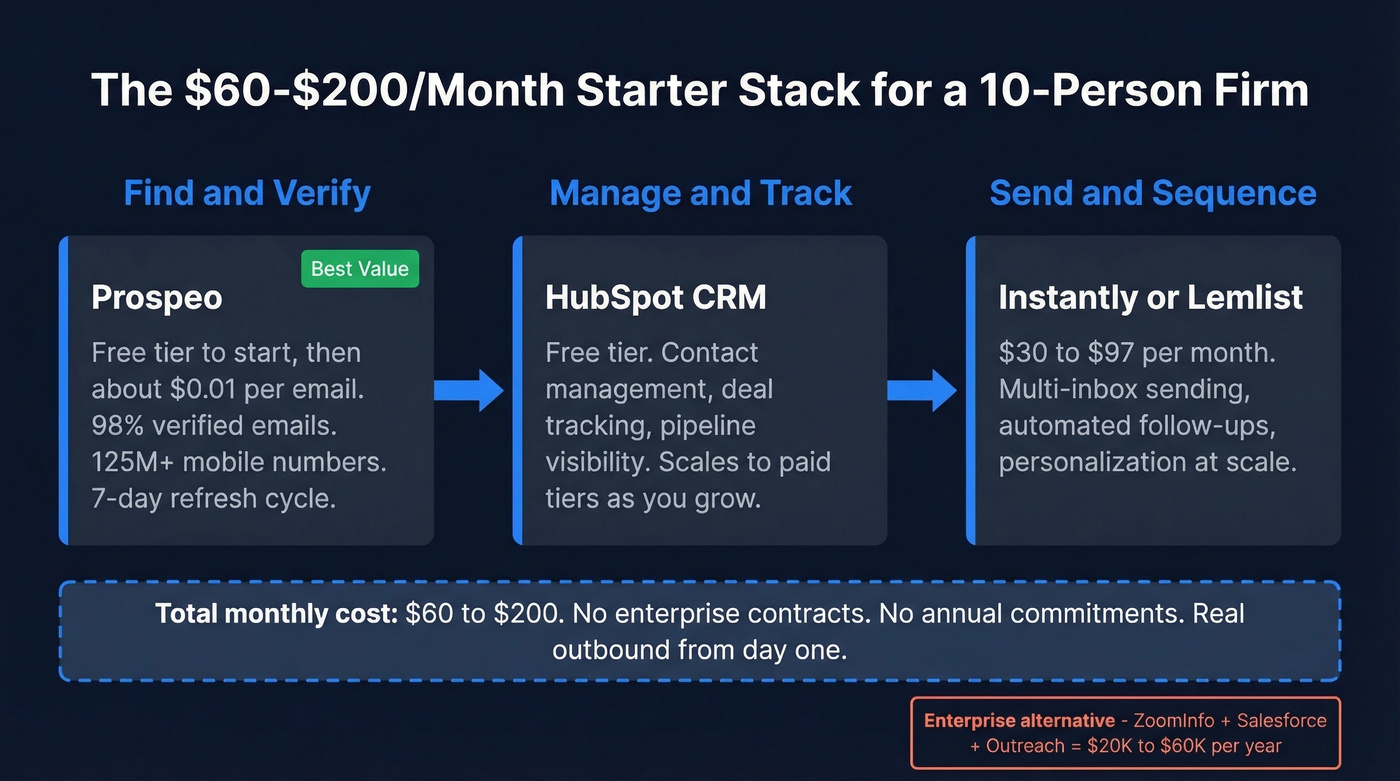
| Category | Tool | Starting Price | Key Strength |
|---|---|---|---|
| Data & Verification | Prospeo | Free; ~$0.01/email | 98% accuracy, 7-day refresh, 125M+ verified mobiles |
| Data & Verification | Apollo | Free; $49/user/mo | Large database + sequencing |
| Data & Verification | ZoomInfo | ~$15K-$40K/yr | Enterprise firmographics |
| CRM | HubSpot | Free; Starter from $15/user/mo | Best free tier, scales up |
| CRM | Salesforce | $25/user/mo | Deep customization |
| Sequencing | Instantly | ~$30-$97/mo | Multi-inbox sending at scale |
| Sequencing | Lemlist | ~$30-$97/mo | Personalization + multichannel |
| Enrichment | Clay | From $134/mo | Waterfall enrichment + AI |
If your average contract value is under $15K, you almost certainly don't need ZoomInfo-level data infrastructure. A $200/month stack will outperform a $40K/year platform that your team barely uses. We've seen more firms waste money on enterprise tools they underutilize than firms that outgrew a lean stack.
LinkedIn Sales Navigator is only 33% accurate on contact details. Prospeo's Chrome Extension - used by 40,000+ professionals - verifies emails and finds direct dials right from LinkedIn profiles, company sites, and your CRM. Pair it with Instantly or Lemlist and you have the exact starter stack this playbook recommends.
Double-verify every prospect before you hit send. 125M+ verified mobiles included.
Mistakes That Kill Your Pipeline
Six patterns we've seen repeatedly in professional services firms that stall pipeline growth.
Targeting everyone. Fuzzy personas and outdated data mean your outreach lands in the wrong inboxes. Define your ICP by industry, company size, title, and buying trigger. Niche beats broad every time.
Misaligned marketing-to-sales handoffs. No shared definition of "qualified," no follow-up SLA, leads rotting in a queue. We've audited dozens of professional services pipelines, and the handoff problem shows up in nearly every one. Agree on MQL/SQL criteria with your partners and enforce 24-hour follow-up.
Single-channel dependency. All eggs in referrals, or all in paid ads. When that channel dips, your pipeline disappears. Run 2-3 channels minimum and measure each independently.
Slow lead activation. Manual routing means your competitors engage the prospect first. Automate lead routing in your CRM and set alerts for high-intent signals.
No real nurture. Generic drip sequences or early sales disengagement after the first "not now." Build stage-specific content - case studies for evaluation, ROI calculators for decision stage, and industry-specific proof points for the skeptics who need to see results before they'll take a call.
Ignoring attribution. If you can't tell which channel drives revenue, you're allocating budget based on gut feel. Implement multi-touch attribution, which we'll cover next.
Scaling and Measuring ROI
If you can't tell me your CAC and close rate, you're not doing lead gen - you're guessing.
Professional services sales cycles run months, sometimes over a year. Last-click attribution breaks down completely in this context. A prospect finds you through a blog post, attends a webinar three months later, gets a cold email from a partner, and finally books a call after a referral. Which channel gets credit?
The answer is multi-touch attribution. Linear models split credit evenly across touchpoints. Time-decay models weight recent touches more heavily. Position-based models give 40% credit to first touch and last touch, splitting the remaining 20% across the middle. Data-driven attribution uses your actual conversion data to assign weights algorithmically - it's the most accurate but requires enough volume to be statistically meaningful.
For firms spending $50K+ per month on marketing, Media Mix Modeling correlates historical spend with outcomes while accounting for seasonality and market conditions. For everyone else, the priority is simpler: connect your CRM to your marketing tools so you can trace a closed deal back through every touchpoint. First-party data and CRM integration aren't optional anymore. They're the foundation of knowing what works - and the prerequisite for scaling lead generation for professional services beyond a single channel without wasting budget.
FAQ
Should I hire a lead gen agency or build in-house?
Outsource if you have fewer than two people doing business development and need pipeline within 90 days. Expect $3K-$8K/month. Ask for channel-specific conversion data before signing - any agency that can't share their average reply rate and meeting-booked rate isn't worth the spend.
How long before outbound produces results?
Outbound channels produce meetings in 2-4 weeks with clean data and a solid ICP. SEO takes 6-12 months but compounds. PPC delivers immediate traffic at higher cost. Plan for a 90-day ramp regardless of channel mix.
What conversion rate should I expect?
The average B2B conversion rate is 2.9% based on Ruler Analytics' 100M+ data points. Legal services SEO converts at 4.4%. If you're below 1.5%, audit your landing pages and targeting before increasing spend - more traffic to a broken funnel just wastes money faster.
How do I avoid damaging my domain with cold email?
Verify every email address before sending. Keep bounce rates under 5% and warm up new sending domains for 2-3 weeks before scaling volume. The consensus on r/coldemail is that domain warmup is non-negotiable, and most deliverability disasters trace back to skipping verification, not bad copy.
What's a reasonable budget for a small firm?
$2K-$5K/month covers tools, content production, and one outbound channel for a 5-15 person practice. Expect $200-$800 CAC depending on your service type and market. Start with the $200/month starter stack - CRM, verified data, and a sequencer - then scale based on what the numbers tell you.