

Lead Generation Marketplaces: What They Are, What They Cost, and When to Skip Them
You just paid $2,000 for 50 "exclusive" leads from a marketplace. Two weeks later, your SDRs have burned through the list - a 2% connect rate, zero meetings booked, and three competitors calling the same contacts. Sound familiar? 61% of marketers say lead quality is their biggest challenge, and marketplace leads are often the reason why.
The term itself is a mess. Agencies, data tools, and actual marketplaces all get lumped together. Most listicles rank ZoomInfo and Apollo as places to "buy leads" - but those aren't marketplaces. They're databases. That distinction matters because it determines what you're paying for, who controls the data, and whether those leads are worth anything by the time they hit your CRM.
The Short Version
A lead generation marketplace is a platform where lead generators sell contacts to lead buyers. Not a tool you use to build lists, and not an agency running campaigns on your behalf. It's a middleman.
Cost: Anywhere from $15 to $500+ per lead depending on industry, exclusivity, and vertical. The cross-industry average CPL sits around $198.44.
When to skip it: If you're in B2B, building your own verified prospect list with a data platform is almost always cheaper and produces higher-quality contacts. We're talking roughly $0.01 per email versus $200+ per marketplace lead - and you control every filter.
How Lead Marketplaces Actually Work
A lead marketplace connects two sides: companies or individuals who generate leads and businesses who need them. The supplier captures contact information through web forms, content downloads, paid ads, or other channels, then lists those leads on the platform. Buyers browse by category, industry, or geography, purchase leads individually or in batches, and load them into their sales process.
One common confusion: when Martal talks about "marketplace lead generation," they mean generating leads for marketplace businesses - a completely different concept. The platform we're discussing here is where leads themselves change hands. Think of it like a wholesale market for contacts. The marketplace takes a cut, sets quality standards in theory, and handles the transaction. In practice, quality varies wildly because the marketplace's incentive is volume, not your close rate.
Marketplace vs. Agency vs. Data Tool
These three categories get conflated constantly. The differences matter for your budget and your results.
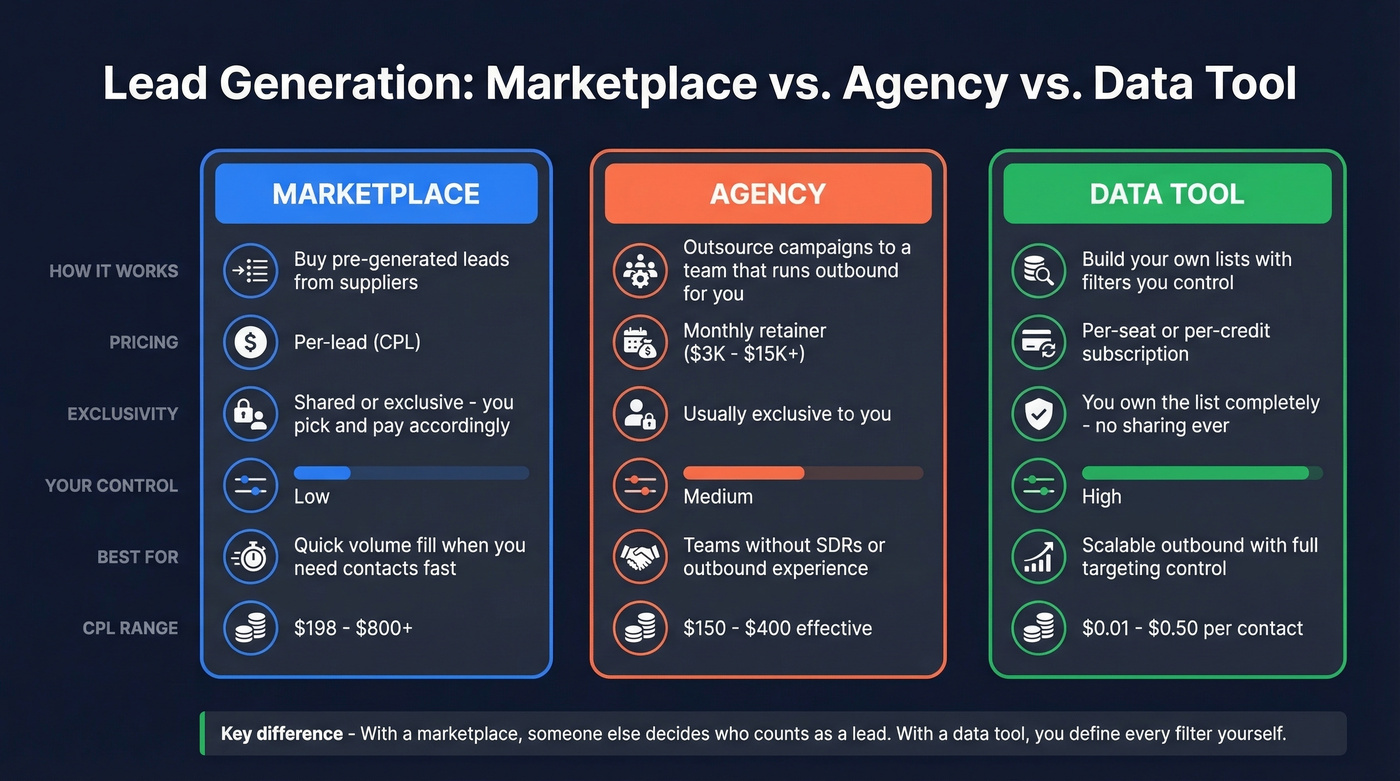
| Marketplace | Agency | Data Tool | |
|---|---|---|---|
| How it works | Buy pre-generated leads | Outsource lead gen campaigns | Build your own lists |
| Pricing model | Per-lead (CPL) | Monthly retainer | Per-seat or per-credit |
| Lead exclusivity | Shared or exclusive | Usually exclusive | You own the list |
| Your control | Low | Medium | High |
| Best for | Quick volume fill | Teams without SDRs | Scalable outbound |
| Examples | TechConnectr, HomeAdvisor | Belkins, Martal | Prospeo, Apollo, ZoomInfo |
The key difference: with a marketplace, someone else decided who qualifies as a "lead" before you ever see the contact. With a data tool, you define the criteria yourself - starting with your ideal customer profile.
Shared vs. Exclusive Leads
This is where marketplace economics get ugly.
Shared leads go to multiple buyers. HomeAdvisor and Angi built their entire model on this approach - you pay whether the lead is qualified or not, and by the time you call, competitors may already be working the same contact. You'll also see people using r/LeadGenMarketplace to buy and sell lead lists and promote lead gen services. That's essentially a DIY marketplace with minimal quality control.
Exclusive leads cost more but go to a single buyer. For high-value B2B deals, exclusivity is non-negotiable. For high-volume, low-touch verticals like home services or insurance, shared leads can work if your speed-to-contact is fast enough.
Here's the thing: even "exclusive" leads from a marketplace aren't truly yours. The supplier generated that contact through their own funnel, and nothing stops them from selling similar contacts to your competitors next month under a slightly different campaign. The only leads you truly own are the ones you build yourself.
What Marketplace Leads Cost
Most marketplaces don't publish pricing, which makes comparison shopping nearly impossible. But based on industry benchmarks and what buyers actually report paying, CPL swings wildly by vertical - and regulated categories get expensive fast.
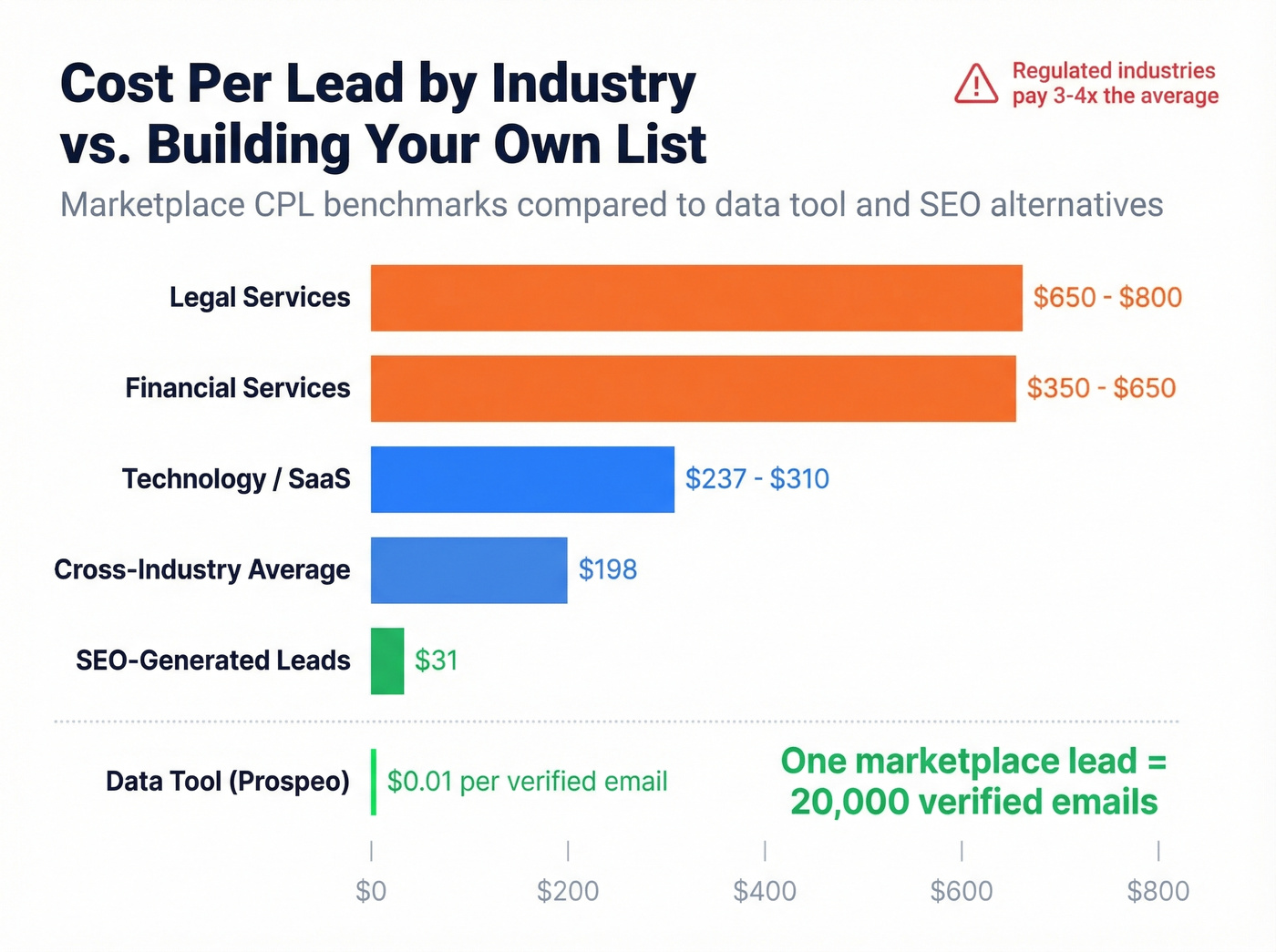
The average CPL across all industries is $198.44. Vertical-specific benchmarks paint a clearer picture:
- Technology/SaaS: $237-$310
- Financial services: $350-$650
- Legal services: $650-$800
For context, the average CPL from SEO-generated leads is about $31. That's a 6x+ difference, and the SEO leads are typically warmer because they came to you. If you're in B2B tech, expect $237-$310+ per lead at minimum, with exclusive leads running higher once you factor in targeting and volume commitments.

Marketplace leads cost $198+ each and you don't control the filters, the freshness, or the exclusivity. Prospeo gives you 300M+ profiles with 30+ search filters - buyer intent, technographics, headcount growth - so you define exactly who qualifies. At $0.01 per verified email with 98% accuracy, one marketplace lead buys you 20,000 contacts you actually own.
Stop renting leads from middlemen. Build the list yourself.
How to Evaluate a Lead Marketplace
Vetting Checklist
If you're going to buy marketplace leads, demand these five things before you spend a dollar:
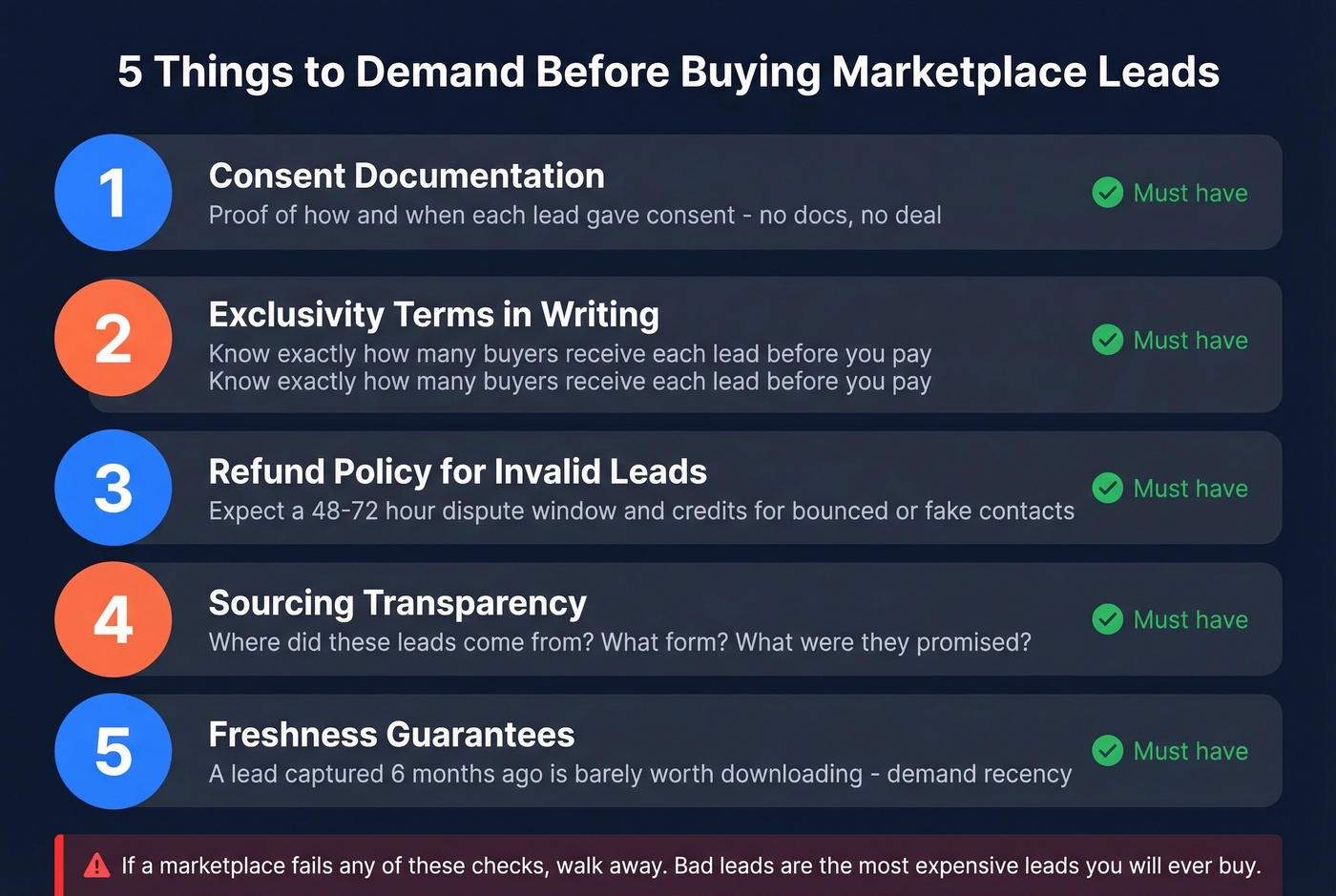
- Consent documentation. Every lead should come with proof of how and when consent was captured. No documentation, no deal.
- Exclusivity options. Know exactly how many buyers receive each lead. Get it in writing.
- Refund policy for invalid leads. Expect a dispute window (typically 48-72 hours) and credits for bounced emails, wrong numbers, or contacts who never opted in.
- Sourcing transparency. Where did these leads come from? What form did they fill out? What were they promised?
- Freshness guarantees. A lead captured six months ago is barely worth the bandwidth to download it.
TechConnectr is one of the few marketplaces that takes vetting seriously. Their process runs suppliers through application, screening/discovery, a compliance approach review, and a verified listing before leads change hands, with an optional pilot phase. One published testimonial reports CPL dropped 40% after switching to their vetted supplier network - which tracks, because bad leads are the most expensive leads you'll ever buy.
Compliance Non-Negotiables
TCPA violations carry fines of $500 to $1,500 per violation. One bad batch of 1,000 leads could mean $500K-$1.5M in liability. That's not theoretical - it's the math.
The TCPA recognizes three consent tiers, and you need to know which applies to your outreach. Prior Express Written Consent (PEWC) is required for autodialed or prerecorded marketing calls or texts - that means a signed written agreement with clear disclosure, consent that isn't bundled with other terms, and recordkeeping that includes the date, signature, and phone number. Prior Express Consent (PEC) covers informational or transactional autodialed messages and can be given verbally, a lower bar but still requiring documentation. Prior Express Informed Permission (PEIP) applies to manual-dialed calls without an autodialer or prerecorded voice.
If the marketplace can't produce PEWC documentation on request for any leads you plan to contact with automated systems, walk away immediately.
GDPR and CCPA add another layer. Privacy regulations have effectively doubled the cost of verified leads while shrinking available contact lists. That compliance overhead is baked into every marketplace CPL - and it's one reason building your own compliant pipeline is increasingly attractive.
Audit Quality Before You Dial
Before loading any purchased leads into your CRM, run them through a verification tool. We've seen teams dump 5,000 marketplace leads into their outbound sequences without verification, only to watch their domain reputation crater within a week from bounces and spam traps. A 10-minute verification step saves weeks of wasted outreach on dead contacts and protects your sender reputation from damage that takes months to repair - especially if you’re not tracking email bounce rate and using proper spam trap removal.
When to Skip the Marketplace
Let's be honest: lead marketplaces solve a problem that shouldn't exist anymore. The problem of not knowing how to find your own prospects. In 2026, with the data tools available, that's a solved problem for most B2B teams. If your average deal size is under $15K, you almost certainly don't need marketplace-grade leads - you need a better prospecting workflow (and better sales prospecting techniques).
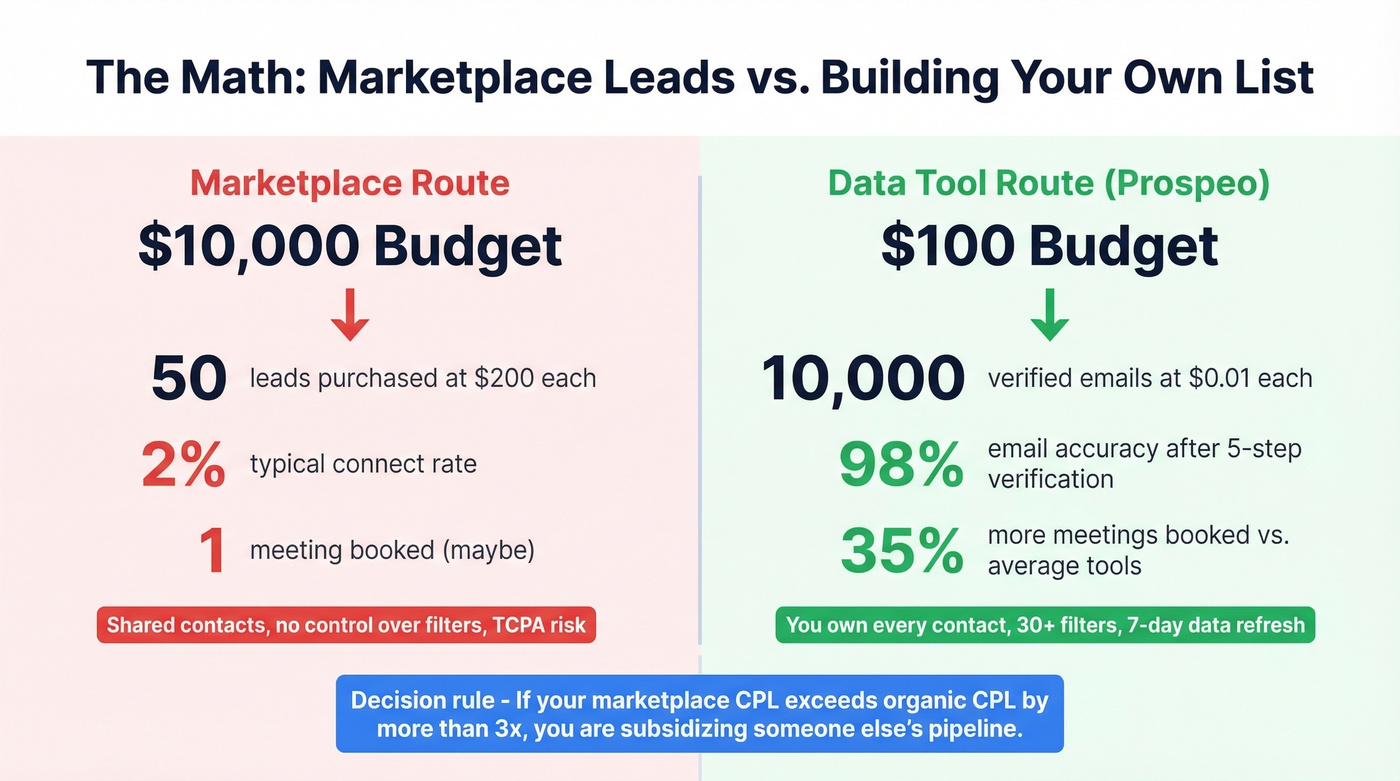
Here's the math. A marketplace charges $200+ per B2B tech lead. Prospeo charges about $0.01 per email across 300M+ professional profiles with 98% verified accuracy. For the cost of a single marketplace lead, you can verify 20,000 emails that match your exact ICP - with 30+ search filters covering buyer intent, technographics, job changes, and headcount growth. Every email runs through a 5-step verification process on a 7-day refresh cycle, and you're not sharing those contacts with anyone.
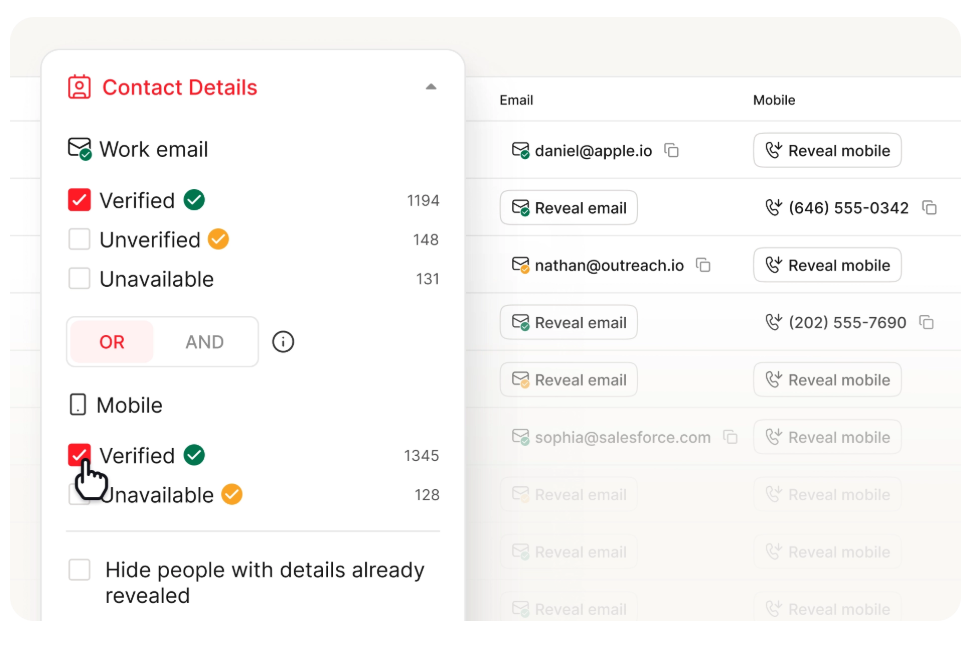
We've watched teams burn through $10K in marketplace leads before realizing they could build better lists for $100. The decision rule is simple: if your marketplace CPL exceeds your organic CPL by more than 3x, you're subsidizing someone else's pipeline.
Marketplaces still make sense in a few narrow scenarios: you're in a high-volume consumer vertical like home services or insurance, you need leads in a geography where you have zero brand presence, or you're testing a new market before investing in outbound infrastructure. Outside those cases, you're overpaying.
The real cost of marketplace leads isn't the CPL - it's the 2% connect rates, the shared contacts, and the TCPA risk from undocumented consent. Prospeo's 7-day data refresh cycle and 5-step verification (including catch-all handling and spam-trap removal) mean your outbound hits real inboxes. Teams using Prospeo book 35% more meetings than Apollo users and keep bounce rates under 4%.
Own your pipeline data. Pay 99% less than marketplace CPL.
Marketplace Examples by Category
Not all lead marketplaces are created equal. Here's what's out there, organized by vertical.
TechConnectr is the closest thing to a quality-controlled B2B lead marketplace. They vet suppliers through a multi-step process before leads change hands, and their compliance review is more rigorous than most competitors. Pricing depends on volume, targeting, and lead terms - expect to negotiate.
HomeAdvisor/Angi dominates home services with pay-per-lead and flat-fee options. High volume, low exclusivity. Shared-lead dynamics are a core part of how these platforms work, so speed-to-contact is everything.
Allstate Lead Marketplace serves Allstate agents within Allstate's ecosystem. Pricing varies by line of business and geography.
LeadsMarket runs a pay-per-lead affiliate model in consumer finance, connecting lenders with borrowers. The platform works with approximately 100 direct lenders.
Legiit is a service marketplace where sellers offer lead generation services and some offer lead lists directly. It lists 100+ lead gen services with pricing that varies by seller and package. Quality control is minimal - buyer beware.
Creatio offers lead gen apps within its CRM marketplace. One "Lead Generation" app runs $10/user/month billed annually and is also available within Creatio Marketing at no additional fee on top of the product license. Not a lead marketplace per se, but an example of how lead generation is increasingly embedded in platform ecosystems.
Calculating ROI
CPL is what you pay the marketplace. CAC is what it actually costs to close that lead - including your SDR's time, your tech stack, and every follow-up touchpoint. The number that matters is CAC, not CPL (see: cost to acquire customer).
Industry CAC benchmarks put the real cost in perspective: B2B SaaS averages $239, financial services hits $784, legal services runs $749, and real estate climbs to $791. Now do the math on marketplace leads specifically. If your marketplace CPL is $200 and your close rate on those leads is 2%, your effective CAC from marketplace leads is $10,000. For most B2B companies, that's catastrophic.
In our experience, marketplace leads consistently underperform self-built lists on connect rate, especially when lead freshness is poor. That gap widens when your self-built list is pulled from frequently refreshed data and verified before outreach - then worked with consistent sales follow-up.
The health benchmark is a LTV:CAC ratio of 3:1. Work backward from your average deal size. If your LTV is $30,000, your CAC ceiling is $10,000. If marketplace leads push you above that threshold, you're losing money on every customer you acquire through that channel - even the ones who close.
FAQ
What's the difference between a lead marketplace and a lead gen tool?
A lead marketplace sells pre-generated contacts at a per-lead price. A lead gen tool gives you a database and filters to build your own lists. Marketplaces sell leads someone else found. Tools let you find them yourself, with full control over targeting criteria, data freshness, and quality.
Are shared leads worth buying?
Rarely for B2B. Shared leads go to multiple buyers simultaneously, so you're competing purely on speed-to-contact. They can work in high-volume verticals like home services or insurance where the first callback wins. For B2B sales cycles, exclusive leads or self-built lists deliver significantly better conversion rates.
How do I verify marketplace leads are TCPA compliant?
Demand proof of Prior Express Written Consent for every contact - including date, signature, phone number, and clear disclosure that consent wasn't bundled with other agreements. If the marketplace can't produce consent records on request, walk away. TCPA violations carry fines of $500-$1,500 per violation.
What's a realistic cost per lead from a marketplace?
The cross-industry average CPL is about $198, but B2B tech runs $237-$310 and regulated verticals like legal can exceed $800. Compare marketplace CPL to your organic CPL - if it's more than 3x higher, a self-serve data platform at ~$0.01 per verified email is almost certainly a better investment.
How are lead aggregator companies different from lead marketplaces?
Lead aggregator companies collect contacts from multiple sources and resell them in bulk with minimal filtering or exclusivity controls. A lead generation marketplace typically offers more structured transactions between vetted suppliers and buyers, though the line blurs in practice. Either way, verify every contact through email validation before outreach.