

Lead Nurturing Email Examples With Templates You Can Steal
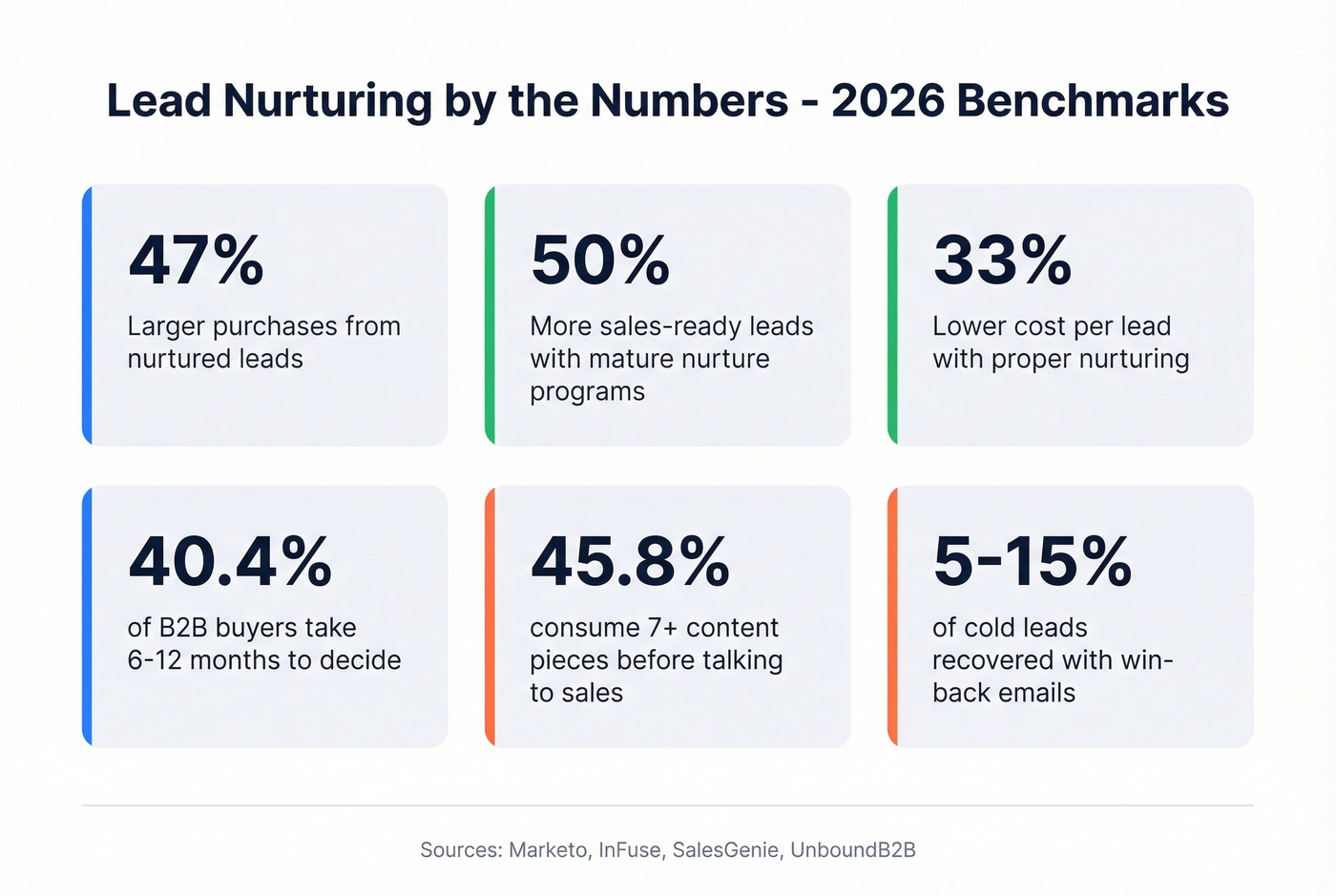
40.4% of B2B buyers take six to twelve months to reach a purchase decision. Another 15.4% take over a year. During that window, 45.8% consume more than seven content pieces before they'll talk to sales - and if you're not sending lead nurturing emails that match where each buyer actually is, you're handing pipeline to whoever does.
The ROI is hard to argue with. Nurtured leads make 47% larger purchases, and companies with mature nurture programs generate 50% more sales-ready leads at 33% lower cost, per Marketo's widely cited research. Yet most nurture sequences we've audited fall into two camps: a three-email drip that ends with "Ready for a demo?" or a 21-email monster nobody finishes. Both fail because they lack progression logic, behavioral branching, and any respect for the buyer journey.
Here's the thing most articles on this topic skip: you don't need more emails. You need fewer emails, sequenced better. This guide gives you the templates, cadence, and benchmarks to build a nurture sequence that converts - not one that annoys.
What's Inside
- 13 copy-paste templates for B2B and B2C, with subject lines and body copy → jump to templates
- A 4-email B2B starter sequence → jump to starter sequence
- Cadence framework so you don't over-send or under-send → jump to cadence
- 2026 benchmarks so you know what "good" looks like → jump to benchmarks
- Branching workflow logic so your sequence adapts to behavior → jump to workflows
Starting from scratch in B2B? Skip straight to the 4-email starter sequence. Already running a sequence? Start with the mistakes section - you're probably making at least two of them.
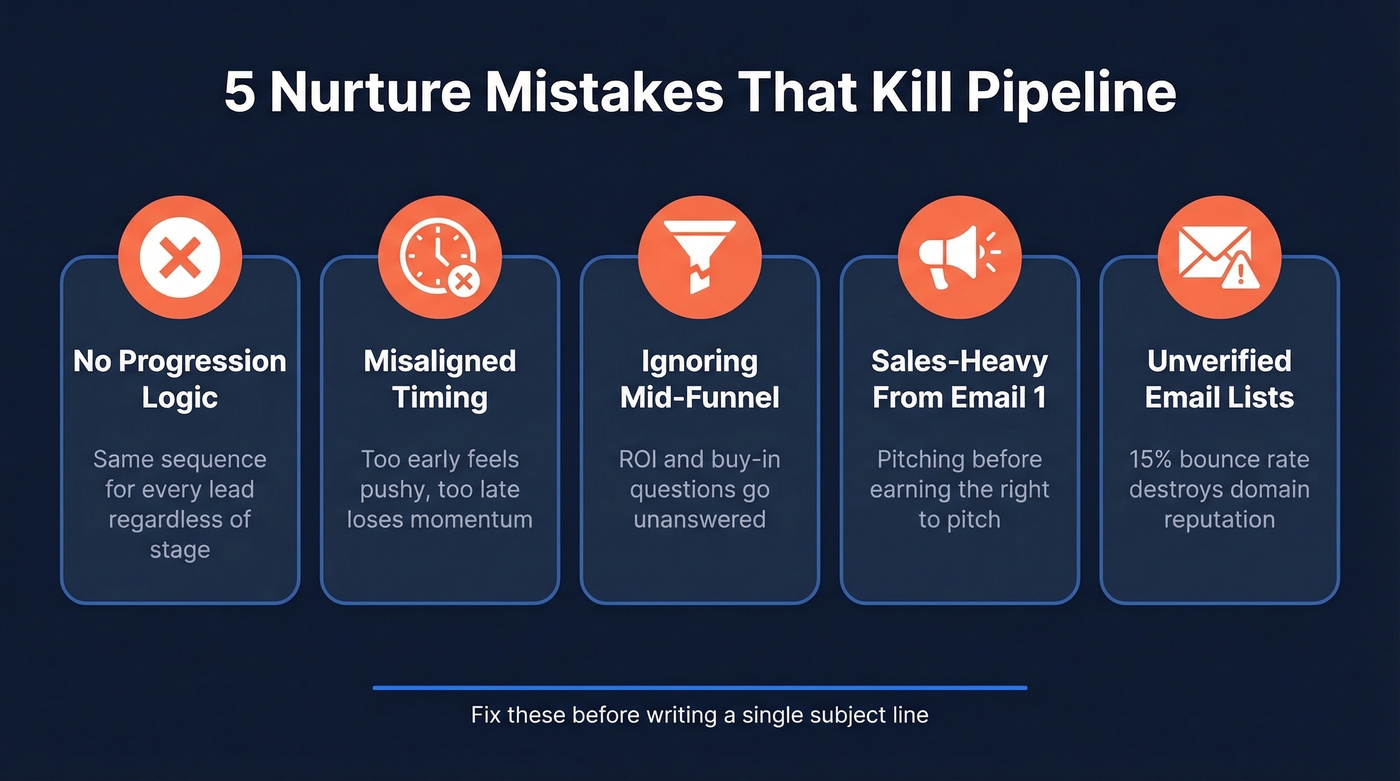
Five Nurture Mistakes That Kill Pipeline
1. No Progression Logic
Same sequence for everyone. The VP who downloaded your pricing guide gets the same "What is [category]?" email as the intern who signed up for your newsletter. Without stage-based segmentation, your best leads feel talked down to and your early-stage leads feel pressured. Both unsubscribe.
2. Misaligned Timing
Too early and you're pushy - sending a case study 30 minutes after someone reads a blog post feels aggressive. Too late and you've lost momentum. UnboundB2B's research recommends following up with high-value resources within 48 hours of an asset download. After that, engagement drops fast.
3. Ignoring Mid-Funnel Questions
Most nurture sequences nail the top of funnel and the bottom. The middle - where buyers ask about ROI, implementation complexity, and how to build internal buy-in - gets ignored. That's exactly where deals stall, and it's the gap your competitors aren't filling either.
4. Overly Sales-Focused From Email #1
Lead nurture becomes lead nagging when every email is a variation of "Enroll now!" Your first 2-3 touches should deliver value with zero ask. Earn the right to pitch before you pitch.
5. Sending to Unverified Lists
This one's invisible until it's catastrophic. A 15% bounce rate trains Gmail and Outlook to treat your domain as untrustworthy, and every subsequent nurture email - even the perfectly written ones - lands in spam. For context, ActiveCampaign's platform-wide deliverability rate sits at 94.2%. If your list hygiene is poor, you won't come close.
Verify your list before writing a single subject line. Prospeo's 5-step verification catches invalid addresses, spam traps, and honeypots at 98% accuracy, with a free tier that gives you 75 email verifications per month.

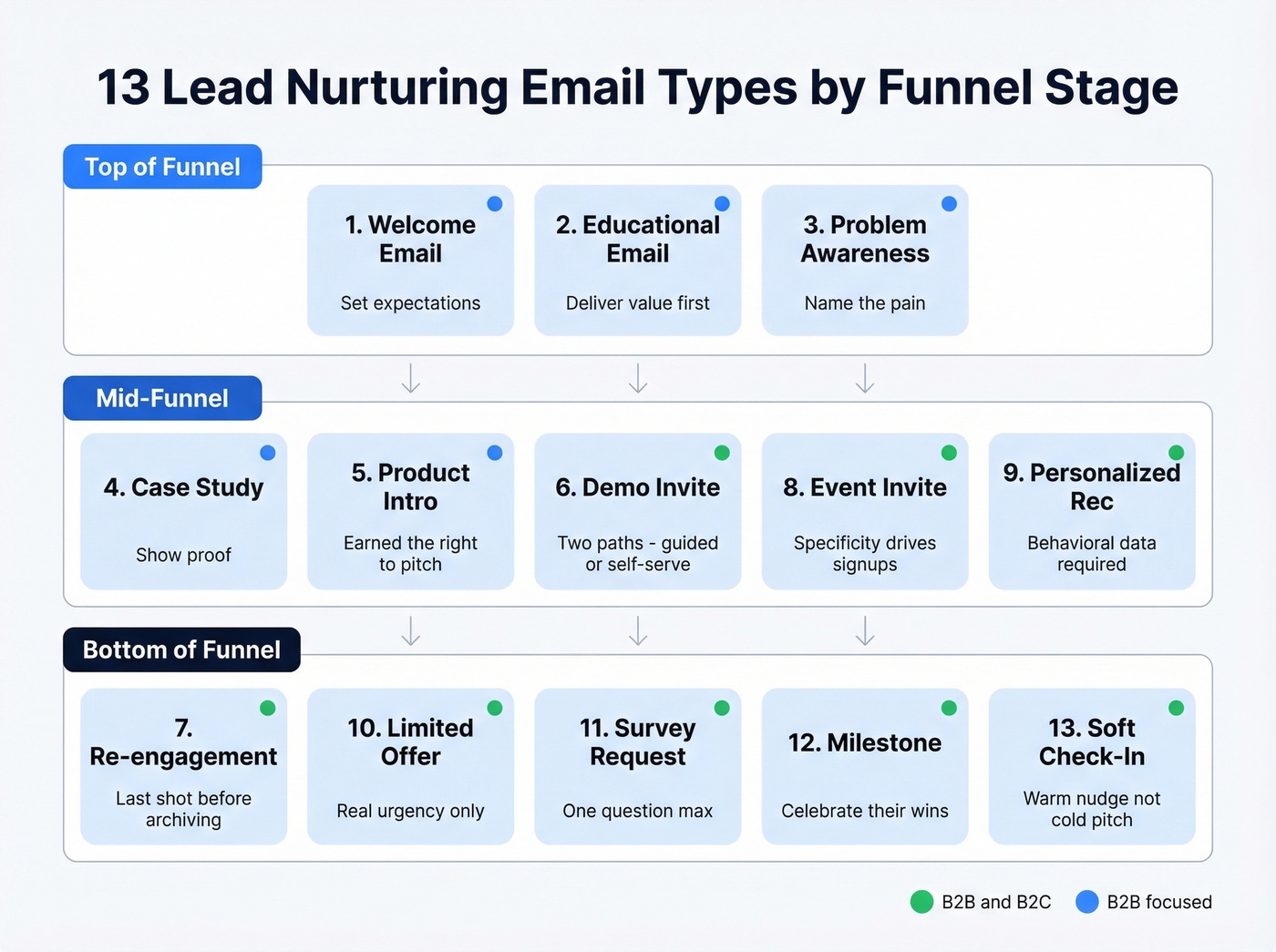
13 Nurturing Email Examples (With Templates)
Quick note: the first five templates are explicitly B2B-framed. Templates 6-12 work across B2B and B2C. We've flagged B2C-specific notes where the approach differs.
1. Welcome Email
Subject line: Welcome aboard, {{First Name}}
Hey {{First Name}},
Thanks for joining us. You signed up because [specific reason], and we want to make sure you get value fast.
Here's the one resource our customers find most useful in their first week: [Link to best asset].
We'll send a few more emails over the next couple weeks - all focused on helping you [outcome]. No spam, no fluff.
Sets expectations, delivers immediate value, and establishes a human tone. Common mistake: stuffing your welcome email with five links and three CTAs. Pick one resource. One.
B2C variant: Replace the resource link with a product recommendation or a discount code.
2. Educational / Value-First Email
Use this on days 3-5 after welcome. The lead hasn't asked for anything yet - give before you take.
Subject line: The framework our team uses for {{topic}}
{{First Name}},
Most teams approach {{pain point}} by [common but ineffective approach]. We've found a simpler framework that actually improves close rates.
[2-3 sentence explanation of the framework]
Here's the full breakdown: [Link to guide]. Worth 5 minutes if you're dealing with this right now.
Positions you as a practitioner, not a vendor. The "most teams do X, we do Y" framing creates curiosity without being salesy.
3. Problem-Awareness Email
Send this when the lead has engaged with top-of-funnel content but hasn't shown purchase intent.
Subject line: Is {{specific problem}} costing you deals?
{{First Name}},
We talk to a lot of {{role}} teams, and the same issue keeps coming up: {{specific problem}}.
The usual fix - {{common workaround}} - works until it doesn't. Here's what we've seen change outcomes: [Link to resource].
Curious if this resonates with what you're seeing.
Names the problem without pitching a solution. Invites a reply - the highest-value action in any nurture sequence.
4. Case Study / Social Proof Email
After the lead has consumed 2+ pieces of content, they need proof, not more education.
Subject line: How {{Customer}} solved {{problem}}
{{First Name}},
{{Customer Name}} was dealing with the same challenge you're researching - {{1-sentence problem}}.
In {{timeframe}}, they {{specific result with numbers}}. Full story: [Link to case study].
Third-party proof is more persuasive than anything you can say about yourself. Pitfall: using a case study from a completely different industry or company size. Relevance matters more than impressiveness.
5. Product Introduction Email
You've delivered value in 2-3 previous emails. Now you've earned the right to talk about what you sell.
Subject line: A faster way to handle {{workflow}}
{{First Name}},
You've been reading about {{topic}} - so you already know the manual approach doesn't scale.
We built {{Product}} specifically to solve this: {{one-sentence value prop}}.
Here's a 2-minute overview: [Link]. No pressure - just wanted to make sure you knew this existed.
The "no pressure" framing is critical. You're introducing, not selling.
6. Demo / Free Trial Invitation
Send when: The lead has clicked on product-related content or visited your pricing page.
Subject line: See it in action (15 min)
{{First Name}},
Looks like you've been exploring how {{Product}} works. I can walk you through it in 15 minutes, tailored to your use case: [Calendar link].
Prefer to explore on your own? Here's a free trial: [Trial link].
Offers two paths - guided or self-serve. Watch out for: sending this too early. If the lead has only read one blog post, a demo invite feels aggressive. Wait for pricing page visits or product content clicks.
7. Re-Engagement / Win-Back Email
30-60 days of inactivity. This is your last shot before archiving.
Subject line: Should we stop emailing you?
{{First Name}},
We haven't heard from you in a while. If you're still interested in {{topic}}, here's the most useful thing we've published recently: [Link].
If not, no hard feelings - click here to unsubscribe: [Link].
The "should we stop?" subject line is a proven pattern for re-engagement. Giving an easy out paradoxically increases engagement - this format often recovers 5-15% of cold leads.
8. Event or Webinar Invite
Subject line: {{Topic}} workshop - {{Date}}
{{First Name}},
We're hosting a live session on {{topic}} - specifically focused on {{angle relevant to their segment}}.
{{Speaker Name}}, {{Title}}, will cover {{2-3 bullet points}}. {{Date}} at {{Time}}: [Registration link].
Specificity in the angle and speaker credentials drives registrations. Vague "join our webinar" invites get ignored.
9. Personalized Recommendation Email
This one requires behavioral data - pages visited, content downloaded, features explored. Without it, skip this template entirely.
Subject line: Picked this for you, {{First Name}}
{{First Name}},
Based on what you've been exploring, I think you'd find this useful: [Link to specific resource].
It's relevant because {{1-sentence connection to their behavior}}.
Behavioral personalization feels like service, not marketing. It proves you're paying attention.
10. Limited-Time Offer Email
Use sparingly - for leads who've shown high intent but haven't converted. Works better in B2C, but can work in B2B for self-serve products.
Subject line: 20% off ends Friday
{{First Name}},
We're running a limited promotion on {{Product/Plan}} - 20% off through {{Date}}.
You've been exploring {{topic}}, and this is the lowest price we'll offer this quarter: [Link]. Code: {{CODE}}.
Pitfall: faking scarcity. If the offer is always available, your leads learn to ignore every deadline you set. Only use this when the urgency is real.
11. Survey / Feedback Request
Subject line: Quick question (30 seconds)
{{First Name}},
We're trying to make {{Product}} better for people like you. Would you mind answering one question?
[Link to 1-question survey]
Takes 30 seconds. Your answer directly shapes what we build next.
"One question" is the key. Multi-page surveys get abandoned.
12. Milestone Email
Subject line: One year in - here's your impact
{{First Name}},
It's been {{timeframe}} since you started using {{Product}}. In that time, you've {{specific metric - e.g., "sent 4,200 verified emails"}}.
Here's a quick look at your highlights: [Link to summary].
Milestone emails have some of the highest engagement rates in any nurture program because they make the email about the reader's accomplishments, not yours. They reinforce the value of staying.
13. Soft Check-In / Sales Opener
The final template - and the one most sales teams get wrong. This isn't a cold pitch. It's a warm nudge for leads who've consumed multiple pieces of content and shown buying signals.
Subject line: Quick thought on {{their company}}
{{First Name}},
I noticed you've been digging into {{topic}} - specifically around {{specific angle based on behavior}}.
I work with teams in {{industry}} and had a quick thought on how {{Company}} might approach this differently. Worth a 10-minute call? [Calendar link].
If the timing's off, happy to share some resources instead.
The "quick thought" framing positions you as a peer, not a salesperson. Offering resources as a fallback keeps the relationship warm even if they're not ready to talk.
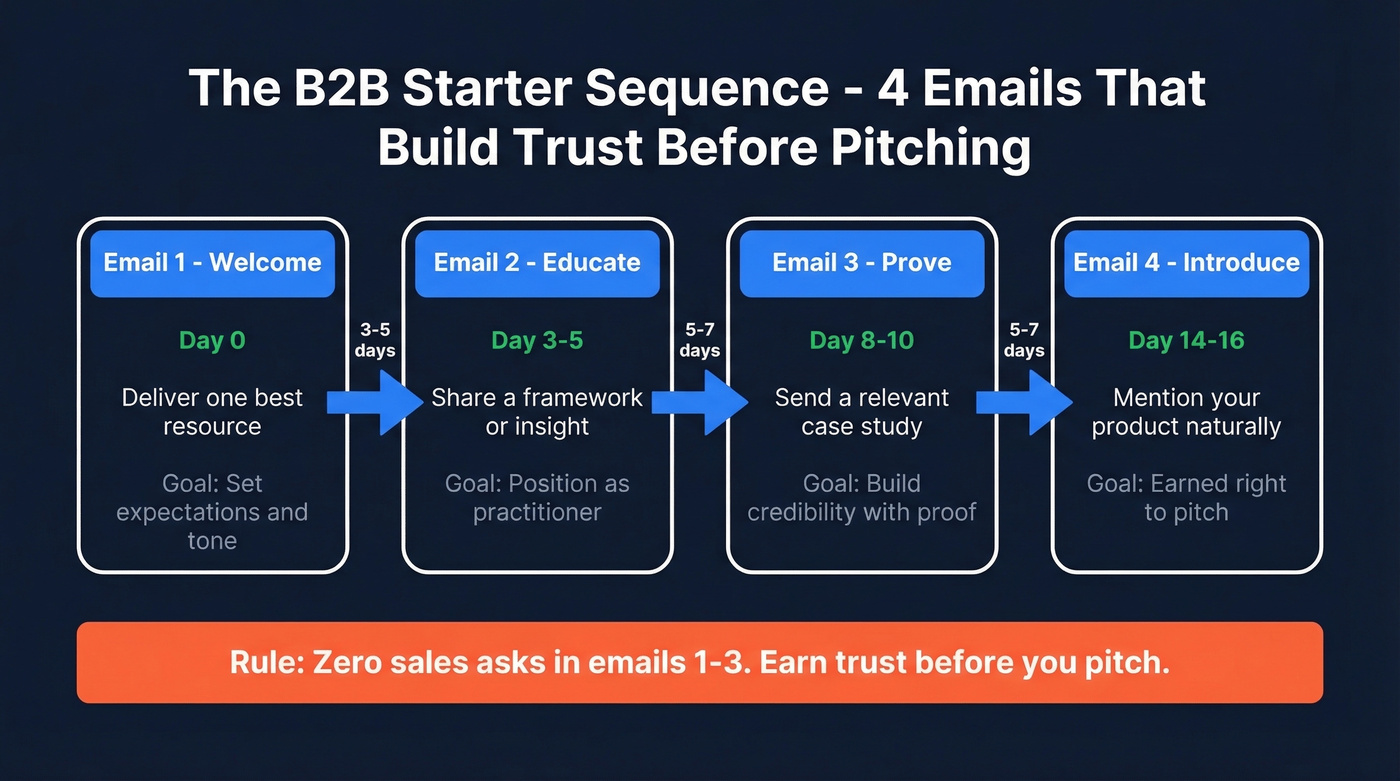
The B2B Starter Sequence
You don't need all 13 templates to start. You need four, sequenced correctly with a progressive storyline. Here's the framework, adapted from UnboundB2B's progressive model.
Step 0: Verify your list. A clean list is non-negotiable. We've seen teams spend weeks crafting the perfect nurture sequence only to watch it crater because 20% of their addresses bounced on send one.
Day 1 - Welcome + Value Delivery
Subject: Welcome aboard, {{First Name}}
Thanks for downloading {{asset}}. Here's the one resource our customers reference most when tackling {{problem}}: [Link]. Over the next two weeks, I'll send you a few more things that should help. No fluff.
Day 4 - Educational Framework
Subject: The 3-step fix for {{pain point}}
Most {{role}} teams try to solve {{problem}} with {{common approach}}. Here's a simpler framework we've seen work across 50+ teams: [Link to guide]. Worth 5 minutes if this is on your radar.
Day 8 - Case Study (Proof)
Subject: How {{Customer}} cut {{metric}} by {{number}}
{{Customer}} was in the same spot - {{1-sentence problem}}. In {{timeframe}}, they {{result}}. Full story: [Link]. This is the email to forward to your team if you're building a business case.
Day 12 - Soft Pitch
Subject: Quick thought on {{their company}}
You've been exploring {{topic}} for a couple weeks now. I work with teams in {{industry}} and had an idea for how {{Company}} might approach this. Worth a 15-minute call? [Calendar link]. If the timing's off, here's a resource instead: [Link].
This four-email sequence covers awareness, education, proof, and conversion - the minimum viable nurture. Once it's running, layer in branching based on clicks and engagement.

A 15% bounce rate kills your nurture sequence before a single lead reads your perfectly crafted copy. Prospeo's 5-step verification catches invalid addresses, spam traps, and honeypots at 98% accuracy - so every email in your sequence actually reaches the inbox. Free tier: 75 verifications/month.
Clean your list first. Write your nurture sequence second.
Cadence Framework
Getting the timing right matters as much as getting the copy right. Here's the framework we recommend, based on Pedowitz Group's cadence playbook.
Baseline: One email per week. This is the default for most nurture sequences and the safest starting point. Most B2B cadence guides land here too.
Intent Burst: When a lead takes a high-intent action - visits your pricing page, downloads a comparison guide, watches a demo video - accelerate to 2-3 emails per week for 10-14 days. This is your window. Don't waste it with the same weekly pace.
Cooldown: When engagement drops (no opens or clicks for 2+ weeks), pull back to biweekly or monthly. Continuing at weekly pace for disengaged leads just trains them to ignore you.
Enforce hard caps: maximum one nurture touch per day, even during intent bursts, and no more than 3-4 total marketing emails per week across all workflows. When a meeting is booked or the lead becomes an SQL, pause nurture for 14 days. Cross-talk between nurture and sales is one of the fastest ways to lose a deal.
Persona-based adjustment: Executives generally prefer biweekly cadence. Evaluators and researchers tolerate more frequent touches. If you're not segmenting by seniority, you're probably annoying your most important leads.
A/B test intervals - try 3-day vs. 5-day vs. 7-day delays between emails and optimize toward the shortest interval that doesn't increase unsubscribes.
Subject Lines That Get Opened
Let's be honest about open rates: Apple Mail Privacy Protection pre-loads tracking pixels, inflating open rate data across the board. Open rates are directionally useful but no longer reliable as a primary metric. That said, subject lines still drive the initial decision to engage or delete.
Keep subject lines under 50 characters. Mobile clients truncate anywhere from 25-50 characters depending on the device. Personalization - even just a first name or company name - boosts opens by 26%+. It's the easiest win in email marketing.
Swipe file - steal these:
- Quick question about {{Company}}
- {{First Name}}, this reminded me of you
- The framework behind {{result}}
- 3 minutes on {{specific topic}}?
- How {{Customer}} fixed {{problem}}
- Should we stop emailing you?
- One thing most {{role}} teams miss
- Your {{milestone}} recap
- Idea for {{Company}}'s {{initiative}}
The best subject lines feel like they came from a colleague, not a marketing automation platform. If it sounds like it belongs in a promotional tab, rewrite it.
If you want more options, pull ideas from these subject lines and adapt them to your funnel stage.
Build Branching Nurture Workflows
Linear drip campaigns - send email 1, wait 3 days, send email 2, repeat - are the 2018 approach. In 2026, most serious email platforms support behavioral branching, and the numbers explain why everyone's switching. Automated workflows generate 30x more revenue per recipient than batch campaigns, and 31% of email orders come from targeted automation despite being just 1.8% of total sends. Companies using automation also see a 12.2% reduction in overall marketing spend.
Look, if your deal size is above $5k and you're still running a linear drip, you're leaving six figures on the table annually. Branching isn't a nice-to-have. It's table stakes.
The framework is simple: Trigger → Condition → Action.
Trigger: Lead downloads your pricing guide. Wait: 2 days. Condition: Did they click a link in the follow-up email?
- Yes: Tag as "high intent," send case study email, notify sales.
- No: Send a reminder with a different angle (an ROI calculator, for example). Wait 3 more days. Still no click? Move to monthly nurture.
This single branch point separates your hottest leads from your lukewarm ones and treats them differently. In our experience, even one well-placed branch outperforms a linear drip by a wide margin because later emails in linear sequences almost always see declining engagement - branching is how you fight that decay.
If you need a clean way to operationalize this, start with a simple lead scoring model tied to clicks and page visits.
Start with one branch point per sequence. Once you've got data, add more. But don't over-engineer it on day one.
Measure Nurture Email Performance in 2026
Open rates used to be the default metric. Apple Mail Privacy Protection changed that. Salesforce recommends shifting focus to CTR and click-to-open rate as primary engagement metrics, and we agree - clicks are the signal that actually correlates with downstream conversion.
Here's where the benchmarks land:
| Metric | ActiveCampaign (2025 data) | Cross-Platform Avg | Software/SaaS |
|---|---|---|---|
| Open Rate | 39.26% | 23.44% | 36.20% |
| Click Rate | 6.21% | 2.62% | 6.67% |
| Conversion Rate | - | 2.9-3.3% (Retail) | Varies by offer |
Data from ActiveCampaign's benchmark report (campaigns sent Jan-Dec 2025) and Insider One's cross-platform averages. Salesforce's guidance: promotional emails typically see 1-3% CTR, transactional emails surpass 5%. Nurture emails should land in between - if you're below 2%, you've got a content or targeting problem.
Three metrics that actually matter for nurture:
- Click-through rate - the most reliable engagement signal post-Apple MPP
- Conversion rate - leads who take the desired action (demo booked, trial started, reply sent)
- Unsubscribe rate - your earliest warning signal for cadence and relevance issues
Track these per email position in your sequence. If email #4 consistently underperforms, the problem is that specific email - not your entire strategy.
If you want to get more precise, use a consistent click rate formula and track it by segment.
B2B vs. B2C: Where Nurture Differs
| Dimension | B2B | B2C |
|---|---|---|
| Typical sequence length | 4-8 emails, then long-cycle nurture | 3-5 emails over days |
| Primary conversion action | Demo/meeting booked | Purchase or signup |
| Personalization lever | Company, role, industry | Browsing behavior, purchase history |
| Urgency tactics | Rarely effective | Discounts and scarcity work well |
B2B nurture is about building consensus across a buying committee. B2C nurture is about reducing friction for a single decision-maker. Design accordingly.
If you're building the rest of the funnel around this, map your nurture emails to a clear B2B sales funnel so each touch has a job.
The best nurture sequence in the world fails if you're emailing the wrong people. Prospeo gives you 300M+ verified professional profiles with 30+ filters - buyer intent, job changes, technographics - so your nurture emails reach decision-makers who are actually in-market. Data refreshed every 7 days, not 6 weeks.
Stop nurturing dead leads. Start with verified contacts at $0.01 each.
FAQ
How many emails should a nurture sequence have?
Start with 4-8 emails covering awareness through conversion, then shift to monthly or biweekly long-cycle touches with intent-triggered bursts when a lead re-engages. The right length depends on your sales cycle - B2B sequences with 6+ month deal cycles need more emails than B2C flows targeting impulse purchases.
What's a good click-through rate for nurture emails?
Expect 2-5% CTR as a healthy range. Software and SaaS companies on ActiveCampaign average 6.67%, well above the cross-platform average of 2.62%. If you're consistently below 2%, audit content relevance and list segmentation before blaming subject lines.
How do I keep nurture emails from landing in spam?
Verify every address before sending - a bounce rate above 5% damages sender reputation fast. Beyond verification, authenticate your domain (SPF, DKIM, DMARC) and avoid image-heavy layouts. The consensus on r/emailmarketing is that list hygiene does more for deliverability than any copywriting trick.
What's the difference between a drip campaign and a nurture sequence?
Drip campaigns are time-based and linear - every lead gets the same emails on the same schedule regardless of behavior. Nurture sequences use behavioral triggers and branching, sending different emails based on what the lead clicks, downloads, or ignores. Branching workflows generate 30x more revenue per recipient.
Where can I find more nurture email templates?
The 13 lead nurturing email examples above cover the most common scenarios, but the best templates come from studying your own high-performing sends. Export your top-clicked emails, identify the patterns - subject line style, CTA placement, content type - and build future sequences around what already works for your audience.