


Lead Onion Pricing, Reviews, and Honest Pros & Cons (2026)
You just got pitched on intent data. The promise: know which accounts are "in-market" before your competitors do. The reality: 91% of B2B marketers use intent data, but only 24% report exceptional ROI. That gap should make anyone pause before signing a contract.
Lead Onion sits at $500 to $3,000/mo versus ~$25k+/year for Bombora or ~$35k+/year for 6sense. The price gap is real, but so is the risk that intent signals don't move your pipeline needle at all.
30-second verdict: Lead Onion is one of the cheapest intent aggregators you'll find. But one agency's 6-month test found zero performance lift over basic firmographic targeting. Worth a trial if you're committed to intent-based outbound. If your real problem is bad contact data, skip the intent premium entirely.
What Is Lead Onion?
Lead Onion, built by the Zymplify team, pulls together buyer-intent signals from 24+ sources into a single platform. It uses partners including Bombora for topic intent, IP Flow for website/company web visits, and Delivr.ai powering person-based intent for US-based contacts.
The core pitch: identify in-market buyers using a four-stage buying intent model (Initial, Interested, Active, In-Depth), surface their contact data, and run cadences against them without leaving the tool. Think of it as an intent data layer with a lightweight sales engagement engine bolted on.
Lead Onion Pricing Breakdown
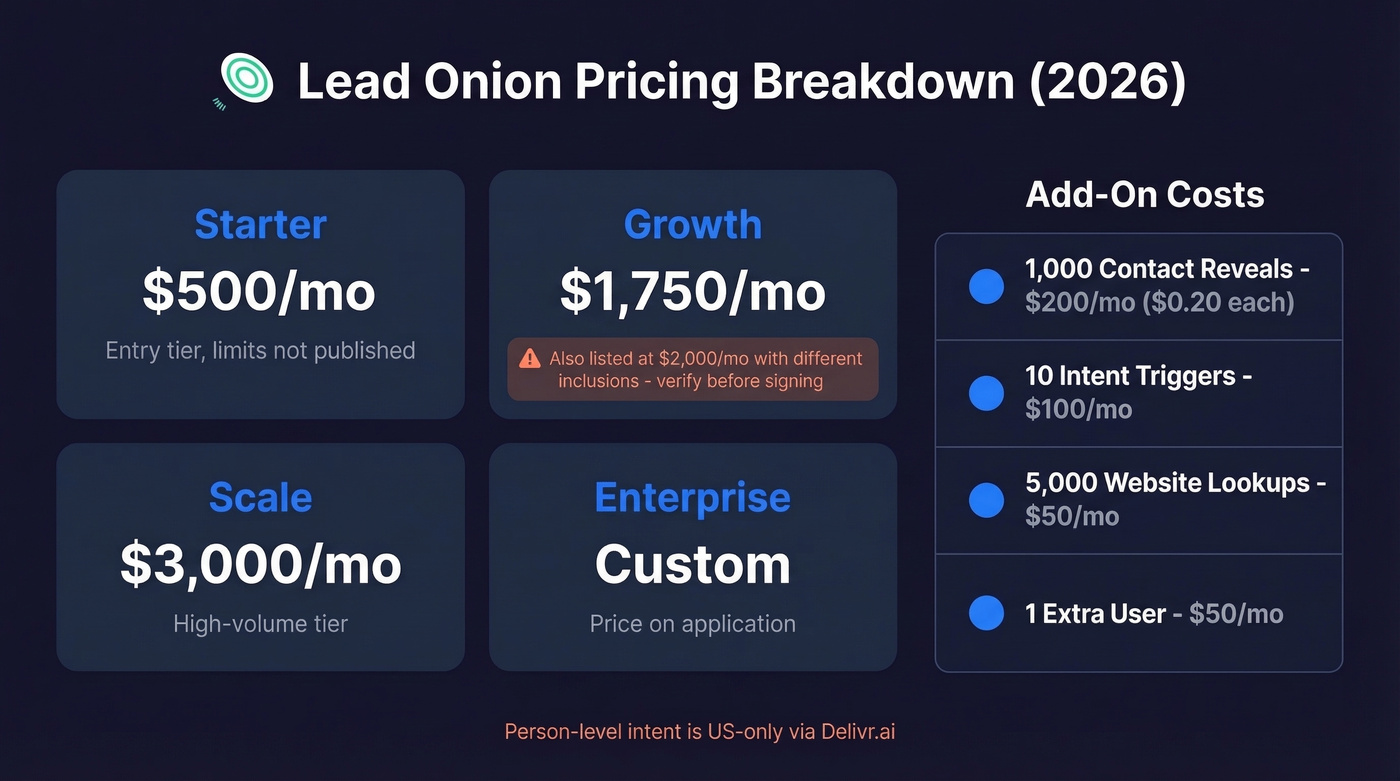
Here's what Lead Onion's pricing page shows right now:
Plan Tiers
| Plan | Monthly Cost | Key Details |
|---|---|---|
| Starter | $500 | Entry tier - specific reveal/trigger limits not published |
| Growth | $1,750 | Mid-tier - specific limits not published |
| Scale | $3,000 | High-volume tier - specific limits not published |
| Enterprise | POA | Custom everything |
Lead Onion's pricing page also includes a separate "Lead Onion Growth" callout priced at $2,000/mo, listing 3,000 Contact Reveals, 100 Intent Triggers, and 10 users.
Some directories list Lead Onion at $245.78/user/month, but their own site doesn't present the product as a simple per-user price. We noticed the same page shows both Growth at $1,750/mo and a "Lead Onion Growth" package at $2,000/mo with different inclusions. Clarify which package you're actually being quoted before signing.
Add-On Costs
Extra capacity comes in blocks:
- 1,000 contact reveals: $200/mo ($0.20/contact)
- 10 intent triggers: $100/mo
- 5,000 website lookups: $50/mo
- 1 extra user: $50/mo
At $0.20 per reveal on the add-on rate, you're paying a premium for intent-enriched contacts. That cost adds up fast if the intent signals don't convert.
One critical limitation: person-level intent is US-only, powered by Delivr.ai. If you're targeting EMEA or APAC, you're limited to account-level and topic-level signals - which strips out the most actionable layer.
How Lead Onion Compares on Price
| Platform | Annual Cost Range | What You Get |
|---|---|---|
| Lead Onion | $6k-$36k | Intent + contacts + cadences |
| Prospeo | Free tier; ~$0.01/email | Verified contacts + Bombora intent across 15,000 topics |
| Apollo.io | $49/user/mo ($588+/yr) | Database + basic intent |
| Bombora | $25k-$80k | Intent data only, no contacts |
| 6sense | $35k-$150k+ | Intent + ABM orchestration |
| Demandbase | $40k-$120k | Intent + ABM + advertising |
| ZoomInfo Intent | $7.2k-$36k | Intent add-on to database |
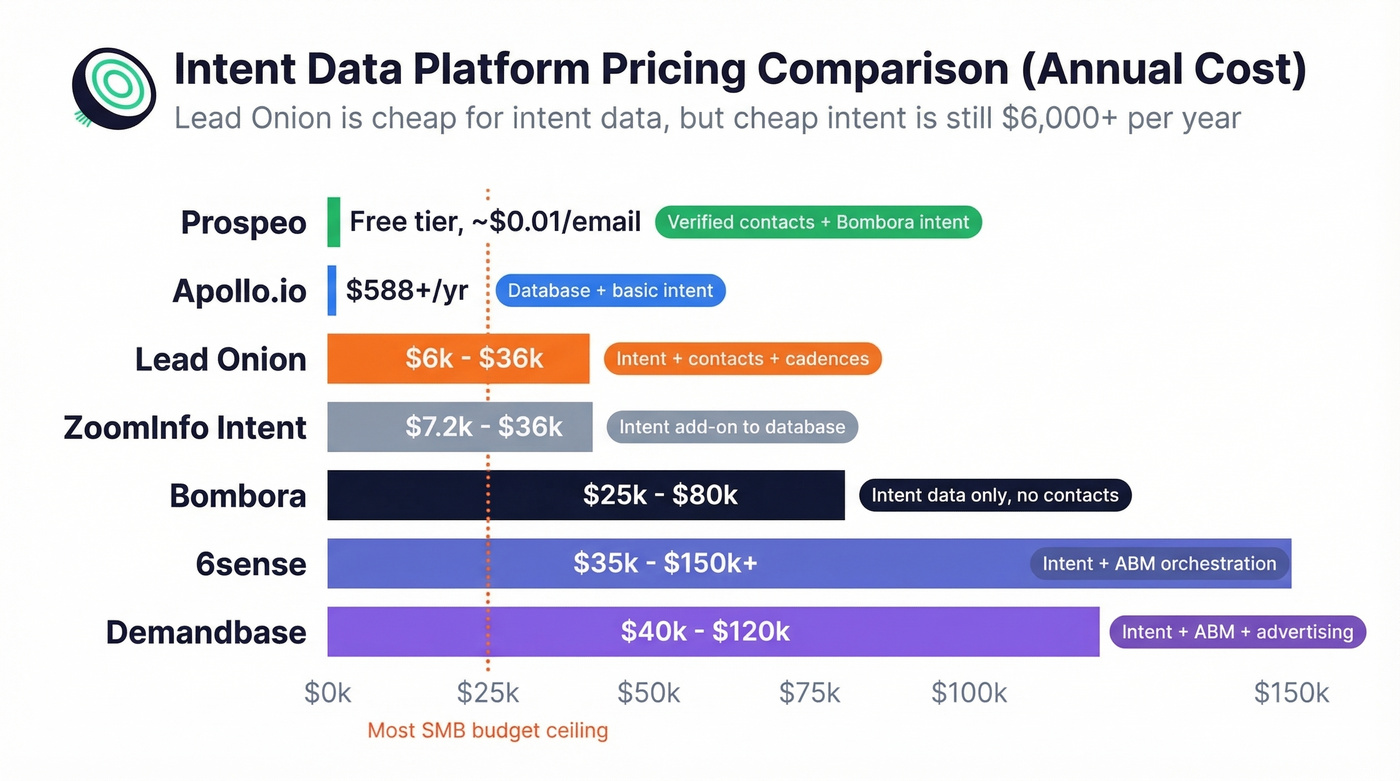
Lead Onion is cheap for intent data. But "cheap for intent data" is still $6,000+/year at the Starter tier. For teams whose bottleneck is contact accuracy rather than buyer signals, that's money spent on the wrong problem.

Lead Onion charges $0.20 per contact reveal. Prospeo delivers verified emails at $0.01 each - with 98% accuracy and a 7-day data refresh cycle. Plus, you get Bombora intent data across 15,000 topics without the US-only limitation on contact quality.
Fix your contact data first. Intent signals can't save a 35% bounce rate.
User Reviews: What People Actually Say
Lead Onion carries a 4.2/5 on G2 across 31 reviews - 54% five-star, 35% four-star, 6% three-star, 3% one-star. The review base skews European (19 of 31 reviewers) and small-to-mid-market, which makes sense given the price point and Zymplify's UK roots.
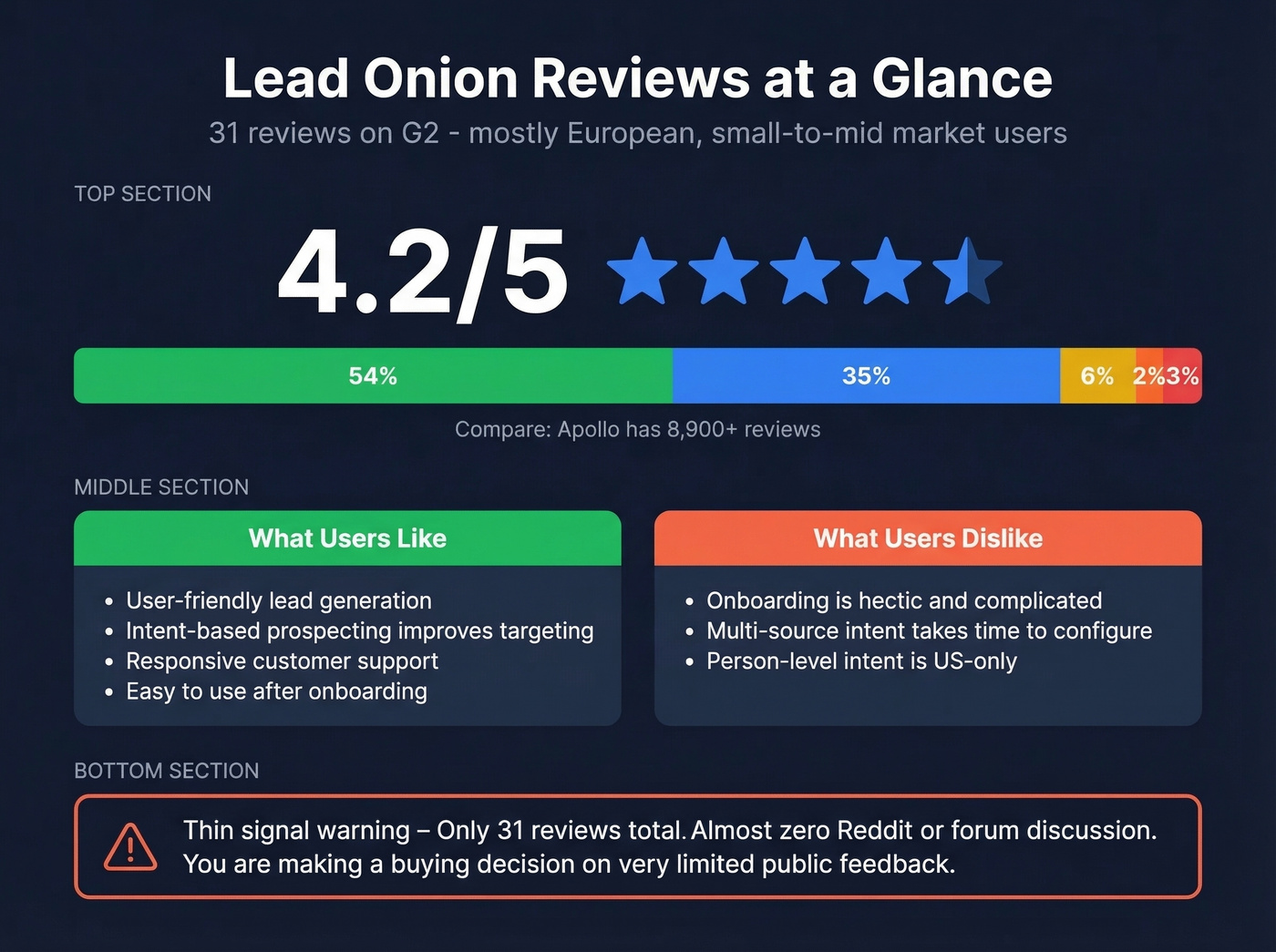
What users like: User-friendly lead generation and intent-based prospecting come up most often, followed by responsive customer support and ease of use once you're past onboarding. Several reviewers credit intent data with improving their targeting precision.
What users don't like: Multiple reviewers describe onboarding as "hectic and complicated," and the multi-source intent model takes real time to configure properly. The biggest gap: person-level intent is US-only, which is a painful limitation for the European user base that dominates their reviews.
Here's the thing: we found almost zero public discussion of Lead Onion on Reddit or sales forums. With only 31 G2 reviews versus ~8,900 for Apollo, there simply isn't enough market presence for unfiltered community sentiment to exist. That's not a red flag on its own, but it means you're relying on a thin signal when making a buying decision.
Does the Intent Data Actually Work?
This is the question that matters most, and the honest answer isn't encouraging.
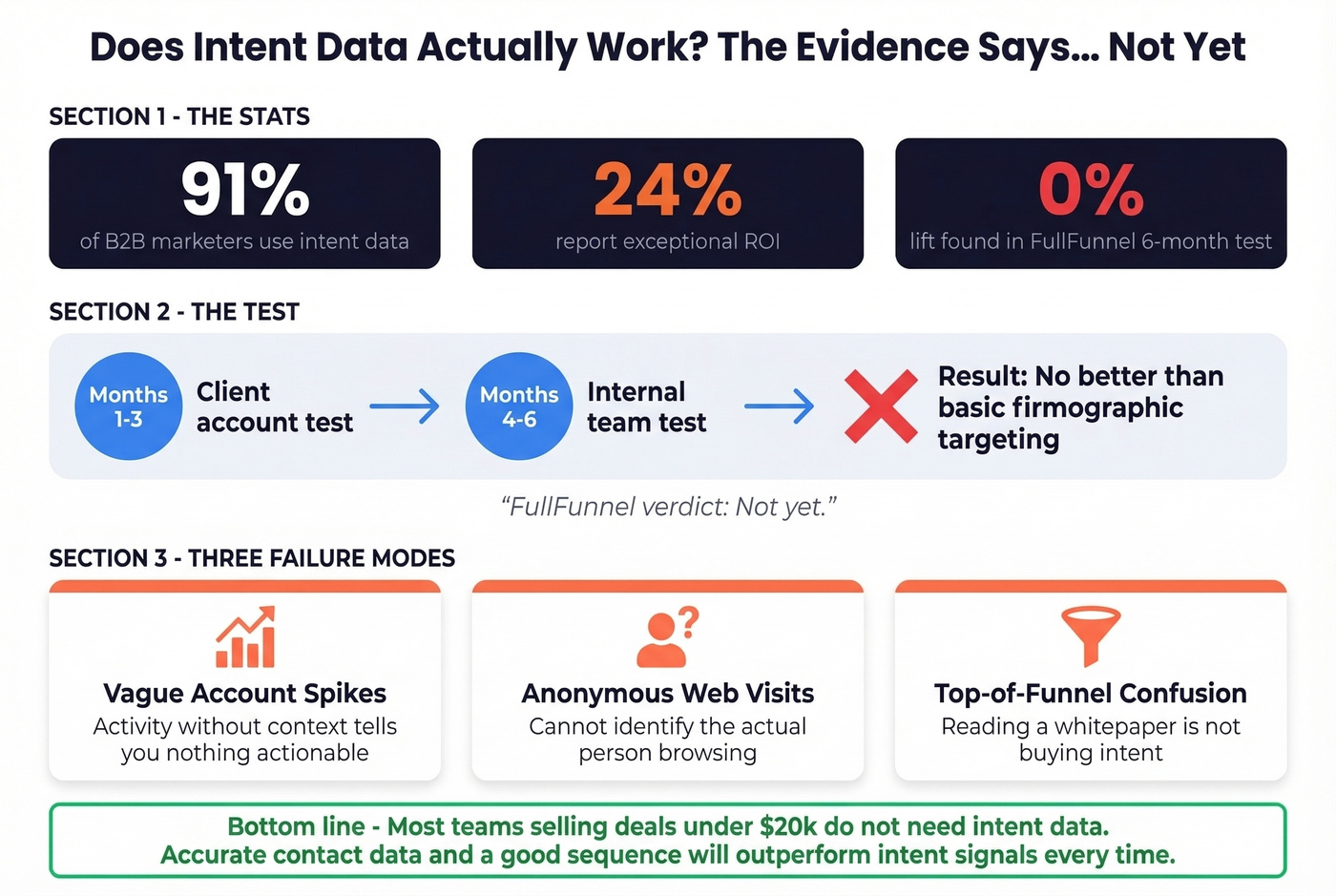
FullFunnel ran a 6-month test - three months on a client account, three months internally. Their verdict: "Not yet." Lead Onion didn't yield better results than regular outbound using firmographic targeting alone. That's one agency's experience, and implementation matters. But it aligns with the broader market reality: intent data is a $4.5B market growing at 16.6% CAGR, yet most buyers aren't getting their money's worth.
Lead Onion's own framework for "junk intent signals" calls out three common failure modes: vague account spikes without context, anonymous website visits without identifying the person, and top-of-funnel topic intent being mistaken for buying intent. Their recommended fix is demanding more precision - layering 20+ sources, predictive scoring, and person-level proof. The FullFunnel result suggests that even with a multi-signal approach, intent doesn't automatically translate into pipeline.
Let's be honest: most teams selling deals under $20k don't need intent data at all. The conversion lift from knowing someone read a whitepaper about your category is marginal compared to the lift from simply having accurate contact data and a good sequence. Intent data is a force multiplier, but you need something worth multiplying first.
Demand a free trial. Measure pipeline impact against a control group. Don't commit $6k+ on faith.
Who Should (and Shouldn't) Buy
Use Lead Onion if you're committed to intent-based ABM under $25k/yr, your target market is primarily US-based, you already have clean contact data in your CRM, and you have 3+ reps who'll actually use the intent signals daily.
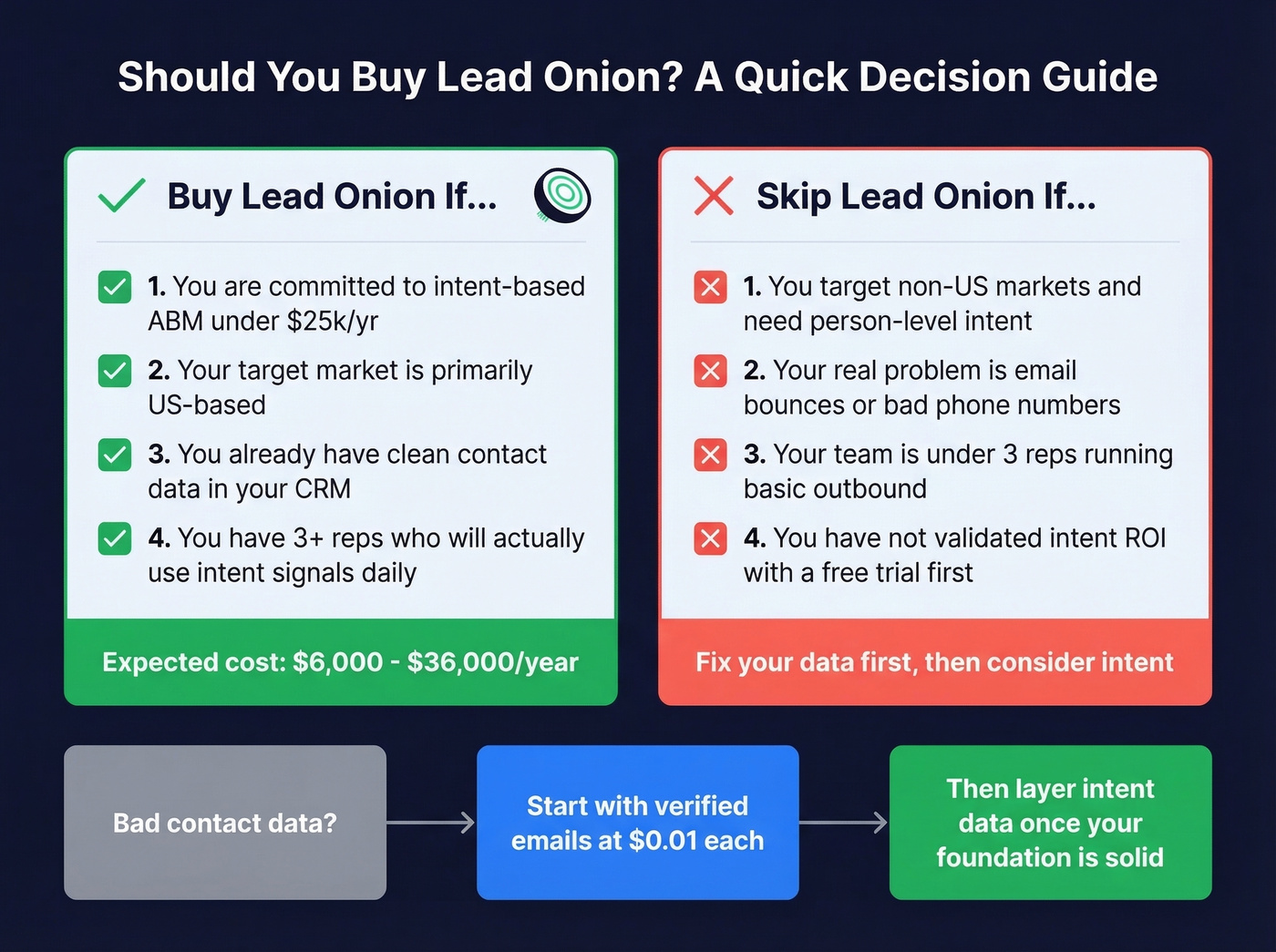
Skip Lead Onion if you're targeting non-US markets and need person-level intent, your primary problem is email bounce rates or bad phone numbers, or your team is under 3 reps. The ROI math simply doesn't work at $500+/mo for a small team running basic outbound.

Alternatives Worth Considering
Apollo.io is the other obvious comparison - 210M+ contacts, a free tier, and paid plans from $49/user/mo. It's stronger as a combined prospecting and sequencing tool with basic intent signals baked in, though its email accuracy runs lower than what you'd get from a verification-first platform.
If you're evaluating databases, it also helps to compare broader sales prospecting databases and data enrichment services before you commit.
For teams that want the full enterprise ABM stack and have the budget, 6sense and Demandbase remain the category leaders - but you're looking at $35k+ minimum annually, and the implementation timeline alone can eat a quarter.
If your main issue is deliverability, start with email bounce rates and an email deliverability guide before paying for more signals.
FullFunnel's 6-month test found zero lift from intent data over basic firmographic targeting. The teams that actually book more meetings aren't chasing intent signals - they're reaching real buyers with accurate emails and direct dials. Prospeo users book 26% more meetings than ZoomInfo and 35% more than Apollo.
Stop paying for intent. Start paying for accuracy at $0.01 per email.
FAQ
Does Lead Onion offer a free trial?
Lead Onion doesn't publicly list a free trial on its pricing page. Contact their sales team and push for one - FullFunnel's 6-month test showed zero lift over firmographic targeting, so a paid leap of faith is risky at $500+/mo minimum.
What integrations does Lead Onion support?
HubSpot, Salesforce, Dynamics, Slack, and Zapier. The Zapier connection opens access to hundreds of additional tools, though native CRM integrations are limited to those three.
Is Lead Onion worth it for non-US teams?
Account-level and topic intent work globally, but person-level intent is limited to US-based contacts via Delivr.ai. European or APAC-focused teams lose the most granular signal layer. If individual contact accuracy matters more than intent scoring, a global database with verified mobiles across all regions is a stronger fit.
What's the cheapest way to get intent data in 2026?
Lead Onion's Starter plan at $500/mo ($6k/year) is among the cheapest standalone intent tools. Prospeo includes Bombora intent data across 15,000 topics alongside its verified contact database starting from a free tier - making it the lowest-cost entry point if you need both intent signals and accurate contact data.