

The Best Lead Prioritization Software for B2B Teams in 2026
Your SDR gets a "hot" inbound lead. They call - number's disconnected. They email - it bounces. They check the CRM - the company rebranded six months ago and nobody updated the record. That lead was never hot. It was stale data wearing a high score like a costume.
Here's the thing: only 44% of organizations use lead scoring at all, and the ones that do often score against garbage data. Companies that get prioritization right see 138% ROI versus 78% without it. The gap isn't the scoring model. It's everything underneath it.
Our Picks (TL;DR)
- Best for data accuracy: Prospeo - 98% email accuracy, 7-day refresh, starts free
- Best CRM-native scoring: HubSpot - rules + predictive scoring inside the CRM you already use
- Best all-in-one under $100/mo: Apollo - scoring + outbound + data in one platform
- Best for custom workflows: Clay - build any prioritization logic you can imagine
What Lead Prioritization Actually Does
Lead prioritization isn't a score. It's a system - ICP definition, data quality, scoring rules, routing logic, and follow-up automation all working together. A lead score of 85 means nothing if the email bounces and the phone number belongs to someone who left the company in January.
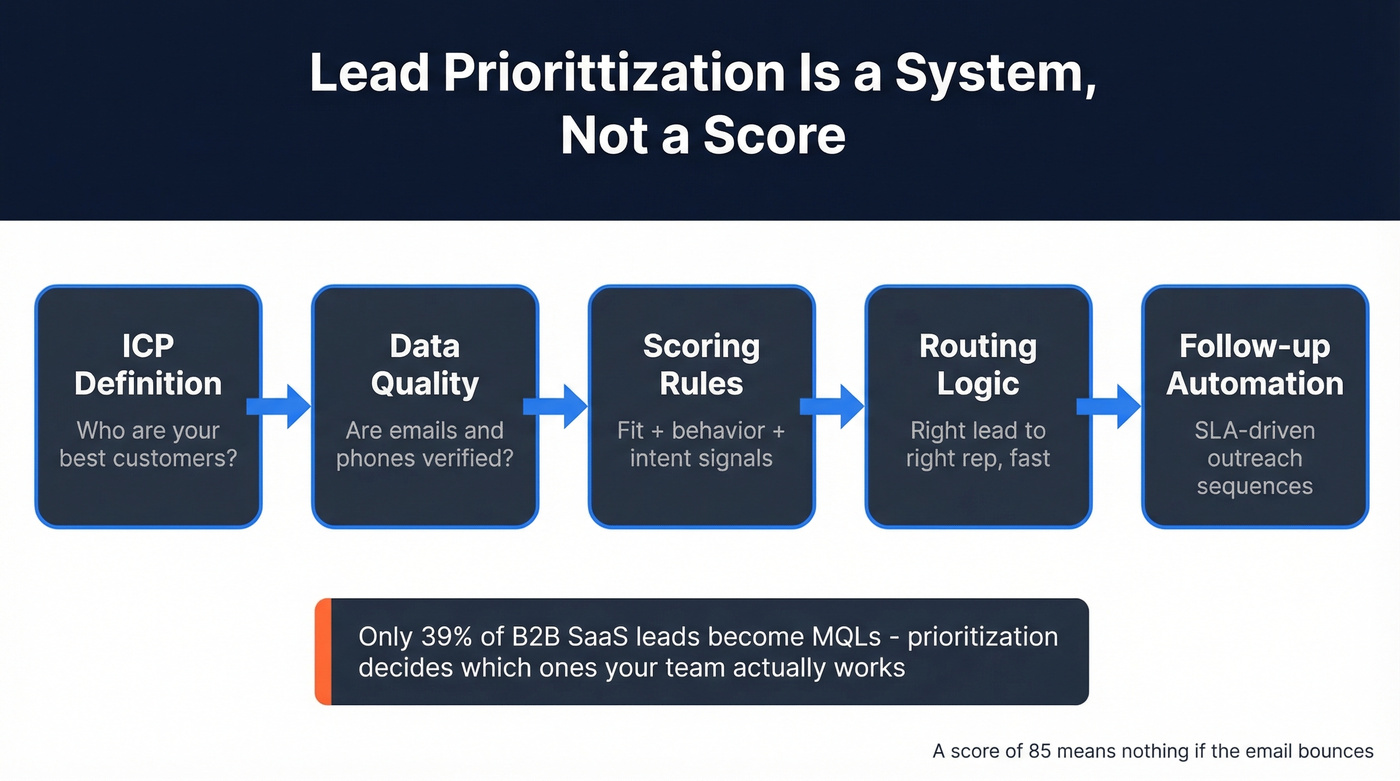
Only 39% of leads become MQLs in B2B SaaS, so prioritization determines which ones your team actually works. The strongest models reverse-engineer scoring from your highest-LTV closed deals, not just engagement signals. Scoring tells you who matters. Prioritization tells you what to do about it and how fast.

Lead prioritization breaks when 35% of your emails bounce and phone numbers are disconnected. Prospeo's 7-day data refresh and 98% email accuracy ensure your scoring model runs on verified contacts - not six-week-old records wearing high scores like a costume.
Stop scoring leads your team can't actually reach.
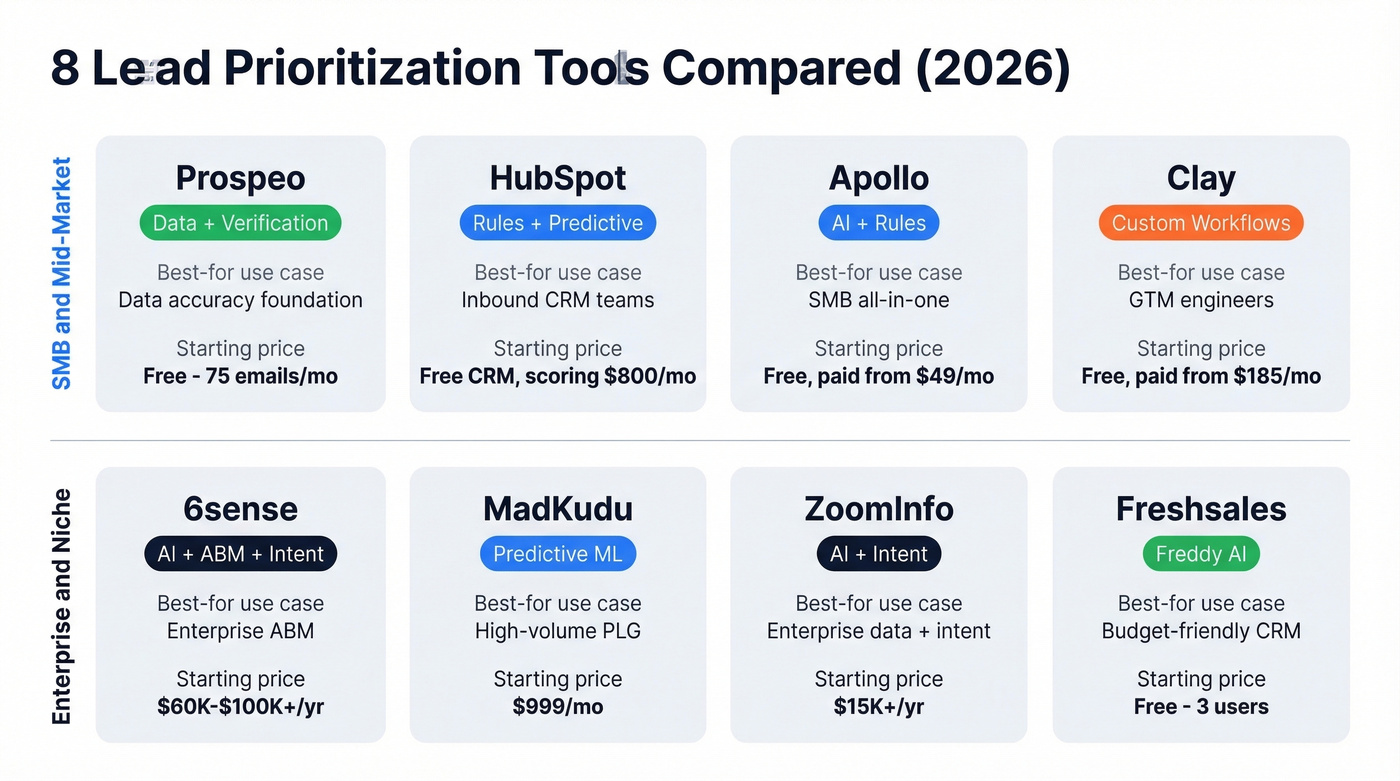
Quick Comparison
| Tool | Scoring Method | Best For | Starting Price |
|---|---|---|---|
| Prospeo | Data enrichment + verification | Data accuracy foundation | Free (75 emails/mo) |
| HubSpot | Rules + predictive | Inbound CRM teams | Free CRM; scoring from $800/mo |
| Apollo | AI + rules-based | SMB all-in-one | Free; paid from $49/mo |
| Clay | Custom workflow logic | GTM engineers | Free; paid from $185/mo |
| 6sense | AI + ABM + intent | Enterprise ABM | Free (50 credits/mo) |
| MadKudu | Predictive ML | High-volume PLG | $999/mo |
| ZoomInfo | AI + intent data | Enterprise data + intent | ~$15K+/yr |
| Freshsales | Freddy AI scoring | Budget-friendly CRM | Free (3 users) |
Best Lead Prioritization Tools Reviewed
Prospeo - Data Accuracy Foundation
Your scoring model is a house of cards if the underlying data is wrong. Prospeo solves that layer. Its database covers 300M+ professional profiles with 98% email accuracy and 125M+ verified mobile numbers hitting a 30% pickup rate. Data refreshes every 7 days - the industry average sits around six weeks.
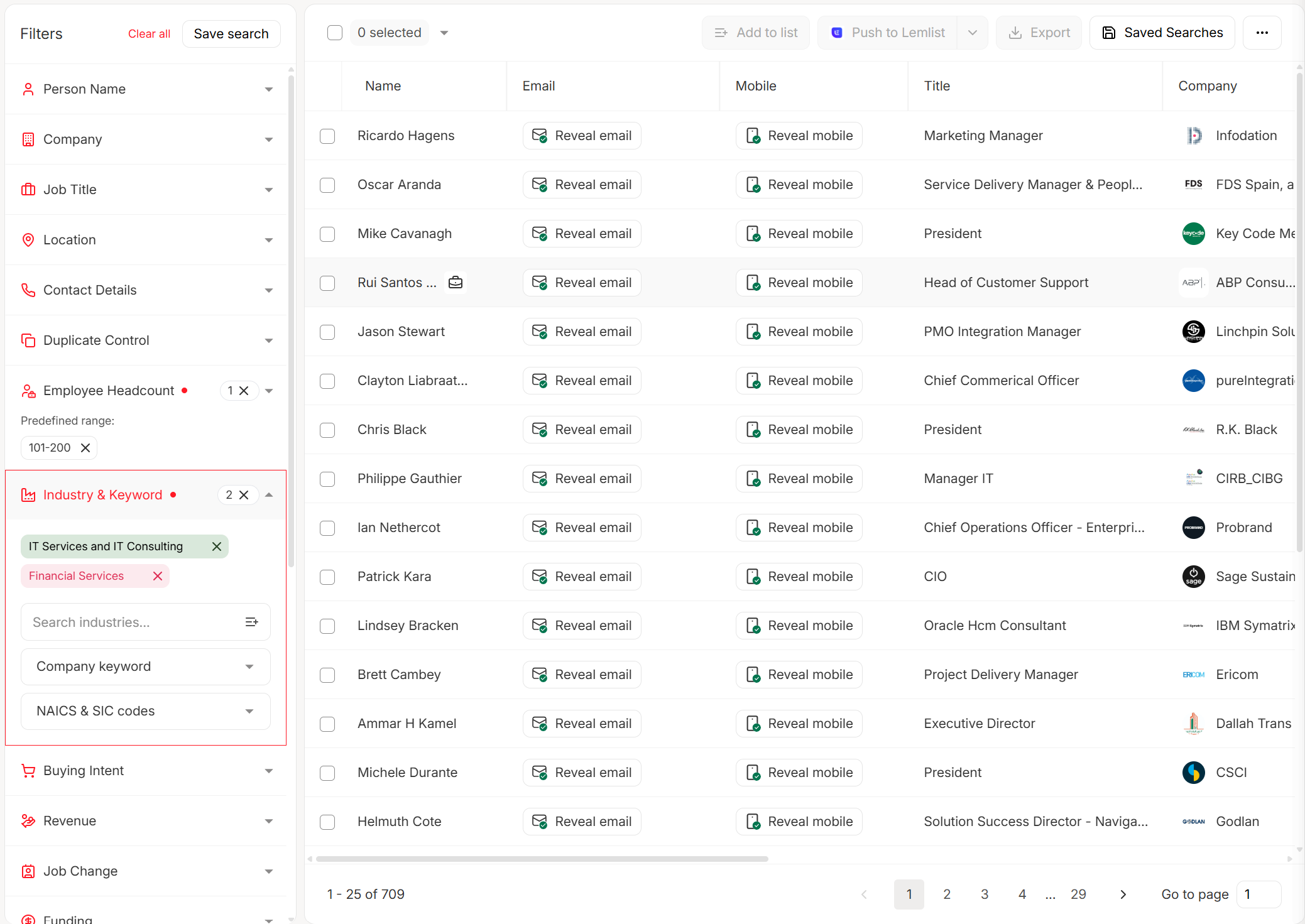
Push your CRM contacts through the enrichment engine and 83% come back with verified contact data across 50+ data points. Layer in intent data tracking 15,000 Bombora topics, and you're scoring against signals that are actually current. Snyk's team saw their bounce rate drop from 35-40% to under 5% after switching, with AE-sourced pipeline up 180%.
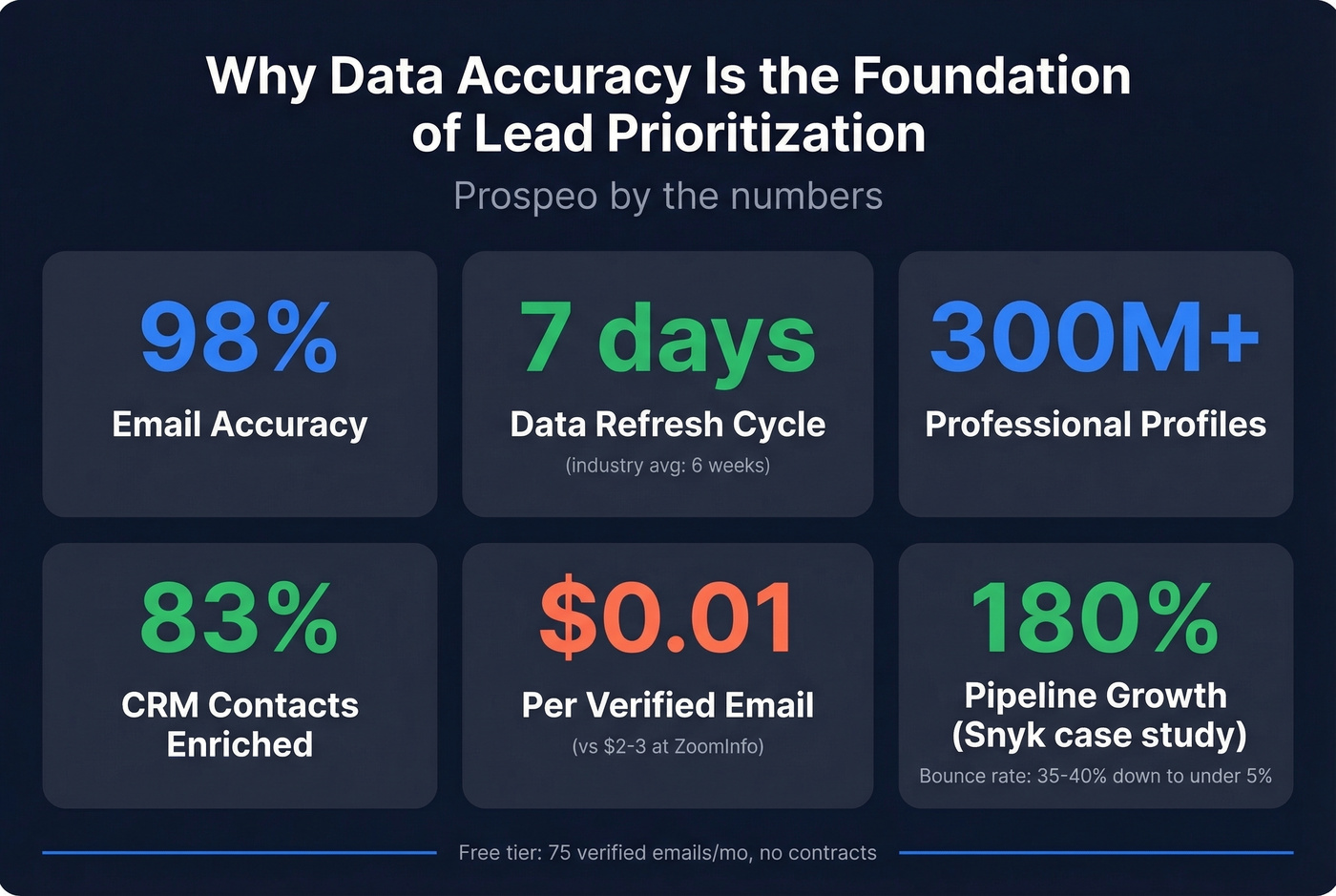
Pricing runs about $0.01 per email. Compare that to $2-$3 per credit at ZoomInfo's entry tiers. The free tier gives you 75 verified emails per month - no contracts, no sales calls required.
Use this if: You need a data quality layer before (or alongside) any scoring tool. Skip this if: You want a standalone scoring engine with built-in routing rules.
HubSpot - CRM-Native Scoring
HubSpot is the default for inbound-heavy teams, and its scoring lives right inside the CRM. It supports both manual rules-based scoring and AI-powered predictive models. Professional starts at $800/mo and includes lead scoring; Enterprise starts at $1,600+/mo. Expect a $1,500 onboarding fee on Sales Hub plans.
The strength is zero integration friction. If your team already lives in HubSpot, scoring just works - no data piping, no middleware. The tradeoff: predictive scoring is locked behind a tier that costs more than some teams' entire tool budget.
Use this if: You're an inbound-first team already paying for HubSpot Marketing Hub. Skip this if: You're outbound-heavy or can't justify $800+/mo for scoring alone.
Apollo - All-in-One Under $100/mo
Apollo bundles scoring, outbound sequencing, and a contact database into one platform. Basic runs $49/user/mo, Professional $79/user/mo, Organization $119-$149/user/mo depending on billing, with a free tier available. AI-generated scoring prioritizes leads based on fit and engagement signals without requiring you to build rules from scratch.
It's the obvious starting point for SMB teams tired of toggling between five tabs. You trade customization depth for speed - and in our testing, most teams under 10 reps don't miss the granularity. For teams that want prospecting and scoring in a single workflow, Apollo covers more of the funnel than any comparably priced option.
Use this if: You want scoring + outbound + data in one seat under $100/mo. Skip this if: You need granular custom scoring logic or enterprise-grade data accuracy.
Clay - Custom Workflow Builder
Clay is a power tool for GTM engineers who want prioritization logic that doesn't exist off the shelf. It recently moved to a dual-currency model - Data Credits for enrichment and Actions for orchestration. Free plan available, Launch at $185/mo, Growth at $495/mo. The pricing change sparked heated debate on r/gtmengineering; existing customers were grandfathered into legacy tiers, but new users face higher entry points.
The learning curve is steep. But if you want to score leads based on technographic signals combined with headcount growth and recent job postings - all weighted by custom formulas - nothing else comes close. Clay's flexibility lets you build scoring models that mirror exactly how your best reps already qualify deals in their heads.
Use this if: You have a GTM engineer (or think like one) and want total flexibility. Skip this if: You need something working by Friday with no configuration.
Enterprise and Budget Picks
6sense is the enterprise ABM play. Free tier with 50 credits/month; the full platform runs $60K-$100K+/year and can exceed $200K with a typical 2-year commitment. Credits don't roll over. Only makes sense with a dedicated ABM program and the budget to match. Skip it if you're under 200 employees.
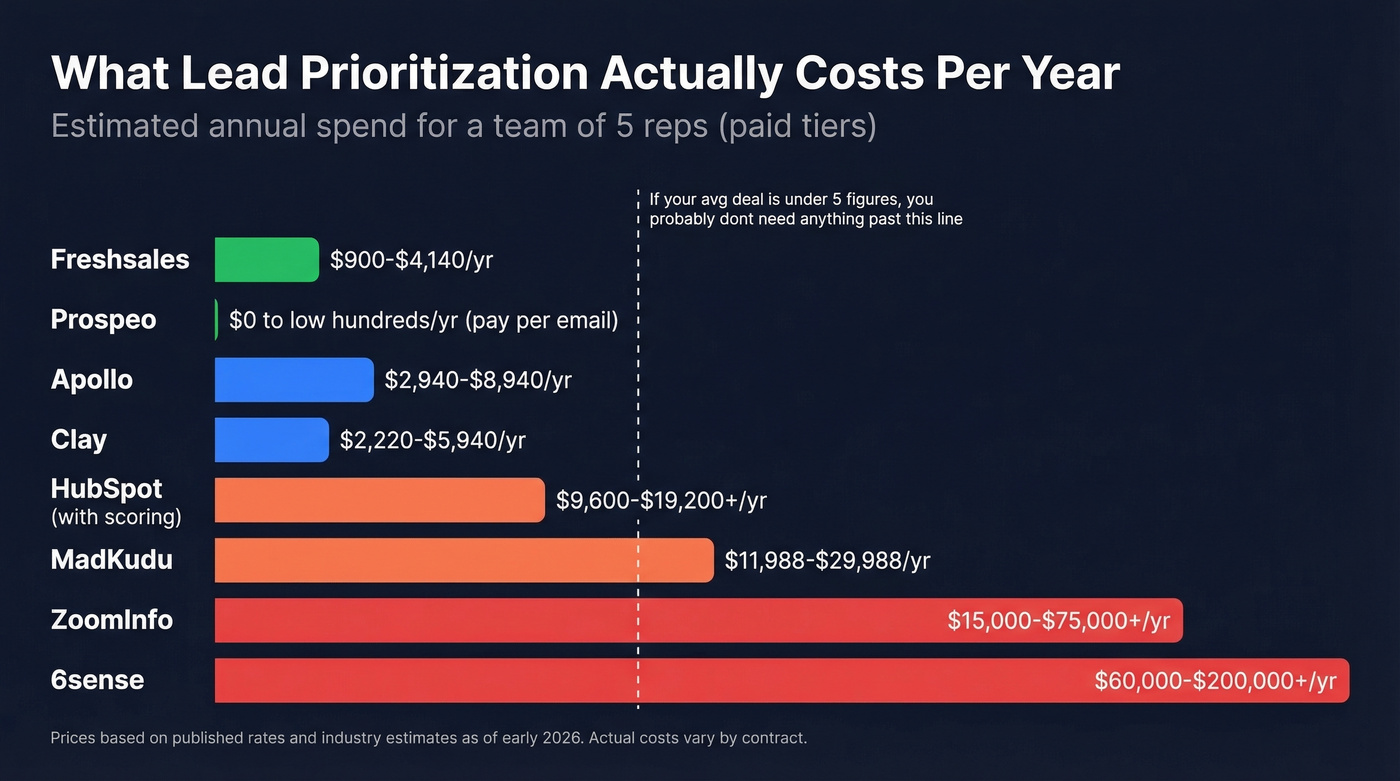
MadKudu focuses exclusively on predictive lead scoring for PLG companies drowning in leads. Growth plan at $999/mo, Pro at $2,499/mo. G2 rates it 4.5/5 with users praising ICP qualification but wanting better UI and more customization. We've found that rules-based scoring breaks down past roughly 500 leads/month, which is exactly where MadKudu earns its keep.
ZoomInfo Professional starts at $15K+/year, but most teams pay $30K-$75K+ after add-ons. 250M+ contacts and intent data built in. The credit economics add up fast - at roughly $3/credit on the Professional tier, a 5,000-credit allotment burns through quicker than you'd expect. Budgeting another $3K for NeverBounce email verification on top of that is frustrating.
Freshsales is the most affordable CRM with built-in AI scoring. Free for up to 3 users, paid plans from $15-$69/user/mo. Freddy AI scoring comes with paid tiers. Ideal for small teams that need a CRM and basic prioritization without bolting on separate tools.
Let's be honest: if your average deal size is under five figures, you almost certainly don't need ZoomInfo-level data or 6sense-level intent. Start with a solid data foundation and your CRM's native scoring. Upgrade when lead volume forces the issue, not when a vendor's sales rep tells you to.
How to Build a Scoring Model
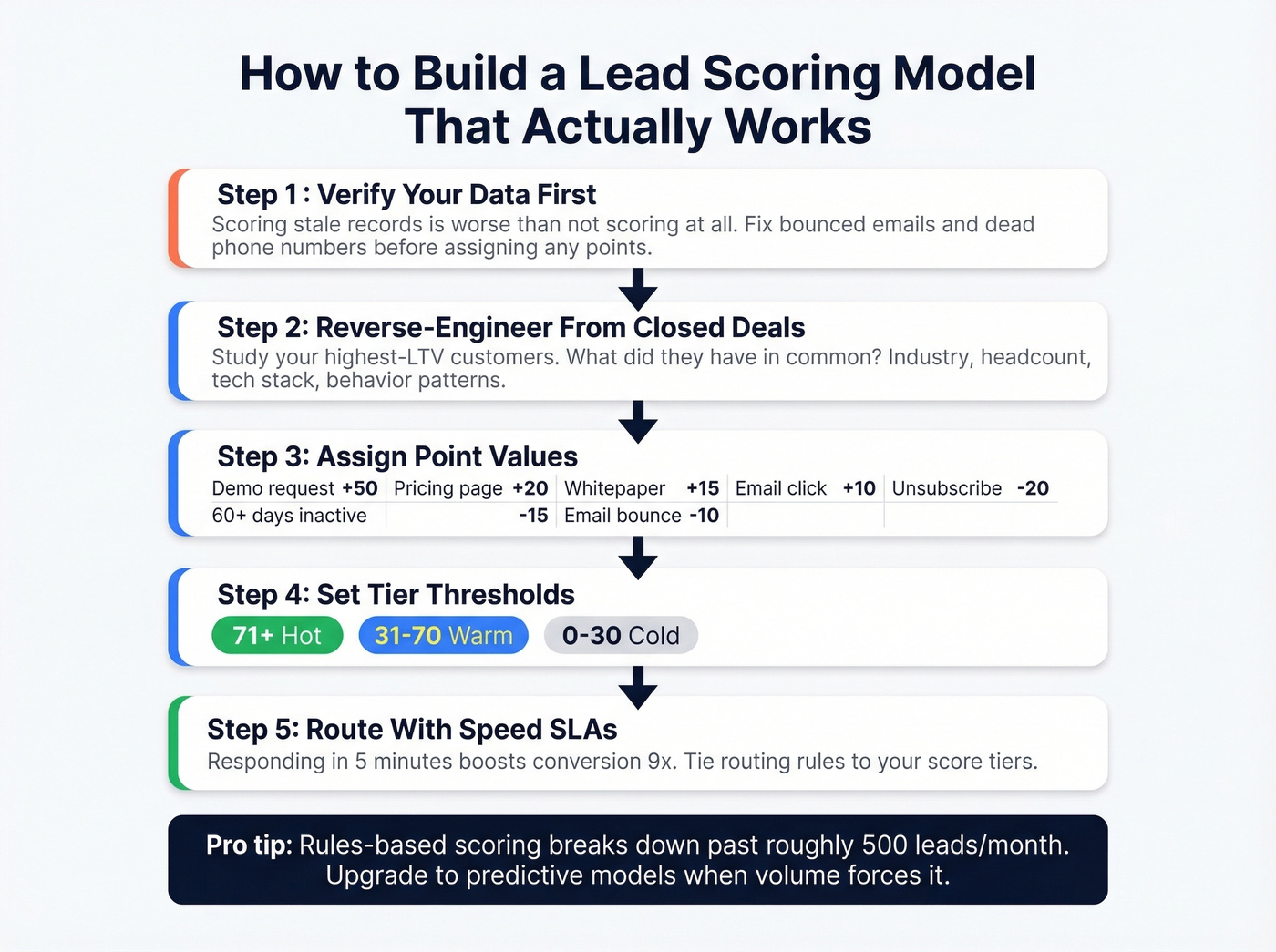
Before you assign a single point value, verify your data. Scoring stale records is worse than not scoring at all - no tool can compensate for a database full of dead contacts. We've seen teams spend weeks tuning scoring weights only to discover that 30% of their CRM records had invalid emails. Fix the foundation first. (If you need benchmarks and setup, start with our lead scoring guide.)
Positive signals:
| Action | Points |
|---|---|
| Demo request | +50 |
| Pricing page visit | +20 |
| Whitepaper download | +15 |
| Email link click | +10 |
| Email open | +5 |
Negative signals:
| Action | Points |
|---|---|
| Unsubscribe | -20 |
| 60+ days inactive | -15 |
| Email bounce | -10 |
Set your thresholds at 0-30 (cold), 31-70 (warm), and 71+ (hot). Then tie routing SLAs to those tiers - responding within 5 minutes boosts conversion up to 9x. That's not a typo. Five minutes versus thirty can be the difference between a closed deal and a competitor's demo.
If you're building this for an outbound motion, pair scoring with repeatable sales prospecting techniques and a clean lead status taxonomy so reps don't "re-qualify" the same accounts every week.
Snyk dropped their bounce rate from 35-40% to under 5% and grew AE-sourced pipeline 180% - because their reps finally called real numbers and emailed verified addresses. Prospeo enriches 83% of CRM contacts with 50+ data points at $0.01 per email. No contracts, no sales calls.
Build your prioritization model on data that's actually current.
FAQ
What's the difference between lead scoring and lead prioritization?
Lead scoring assigns point values based on behavior and demographic fit. Lead prioritization software covers the full system: scoring plus data quality, routing rules, and follow-up automation. Scoring is one input; prioritization is the workflow that turns scores into action - ensuring the right rep contacts the right lead at the right time.
How much does lead prioritization software cost?
Free tiers exist at HubSpot, Apollo, Freshsales, and Prospeo (75 verified emails/mo). Mid-market tools run $50-$500/mo per user. Enterprise platforms like 6sense and ZoomInfo start at $15K-$60K/year and can exceed $200K with full ABM and intent modules. Start free and upgrade when you outgrow the limits.
Can my CRM handle lead scoring without a dedicated tool?
Most CRMs - HubSpot, Salesforce, Freshsales - include basic rules-based scoring out of the box. Dedicated tools like MadKudu or 6sense add predictive AI and intent signals on top. Start with your CRM's native scoring and upgrade only when lead volume outgrows rules-based models or when you need intent data your CRM can't provide natively.
What's a good free option for data-driven lead prioritization?
Prospeo's free tier includes 75 verified emails per month with 98% accuracy and intent data access - enough for small teams to validate data quality before scoring. Apollo's free plan adds basic AI scoring and sequencing. HubSpot's free CRM includes manual scoring properties. Combine any of these to build a zero-cost prioritization stack.