

Lead Qualification Criteria That Actually Predict Conversion
Half your "qualified" pipeline hasn't had a single activity in 45 days. You know it. Your VP knows it. But nobody wants to scrub those deals because the board deck looks better with a fat number at the top.
That's not a pipeline - it's a fiction. And the root cause is almost always the same: lead qualification criteria that measure activity instead of intent.
Contacting a lead within five minutes makes you 100x more likely to connect and 21x more likely to qualify than waiting half an hour. Speed matters. But speed without criteria is just faster chaos.
The Short Version
Pick one framework your whole team will use - BANT for SMB velocity, MEDDIC for enterprise. Score leads on fit multiplied by intent, not vibes. And none of it works if your contact data is garbage. Verify before you score, or every number downstream is fiction.
What Is Lead Qualification?
Lead qualification is the process of deciding whether a prospect deserves your team's time. Not whether they downloaded a whitepaper. Not whether they opened an email twice. Whether they have the problem you solve, the budget to pay for it, and the urgency to act.
It's different from lead scoring. Qualifying criteria act as a gate - yes or no, does this lead belong in the pipeline? Scoring is a ranking among qualified leads. Qualification gates the pipeline; scoring prioritizes within it.
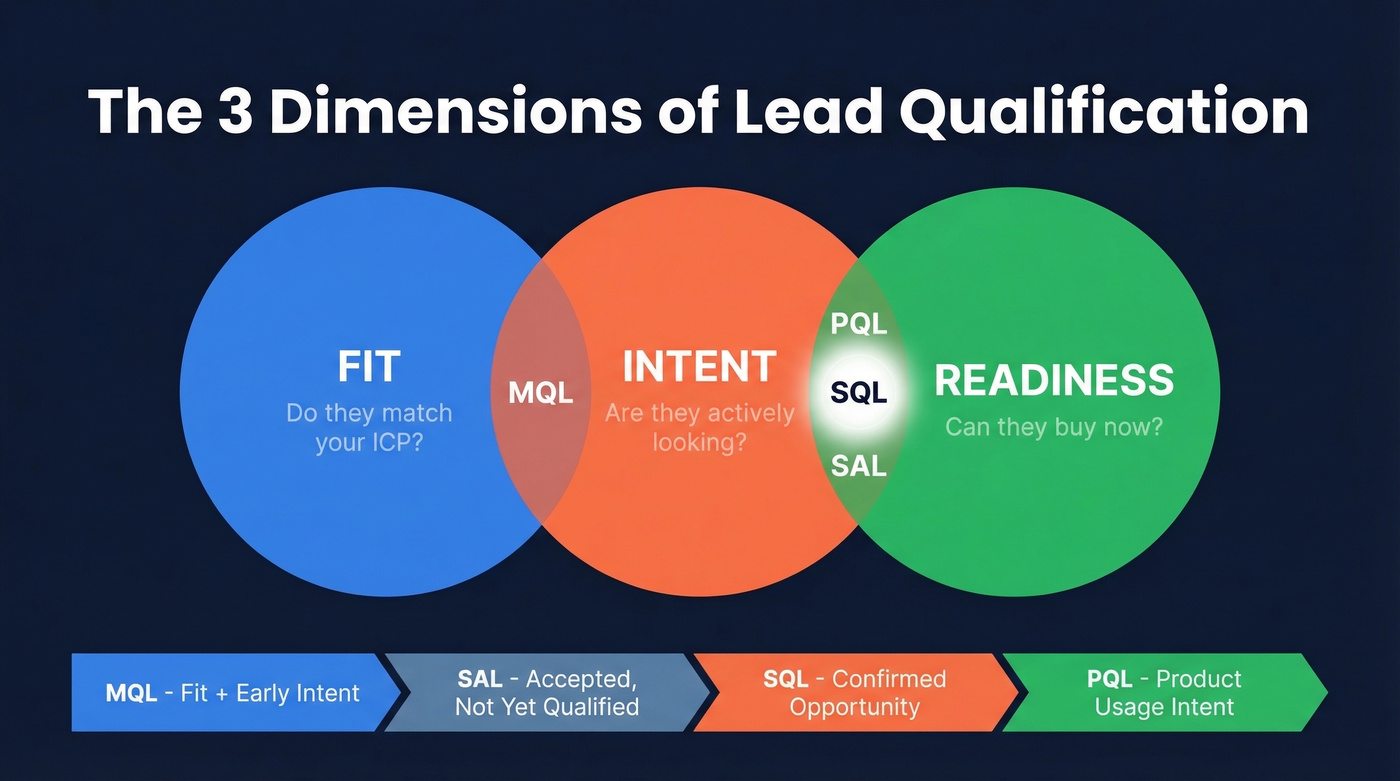
Three dimensions drive every qualification decision: fit (do they match your ICP?), intent (are they actively looking?), and readiness (can they buy now?). MQLs show fit and early intent. SQLs have been vetted by a rep and confirmed as real opportunities. PQLs demonstrated intent through product usage, and SALs sit in the handoff zone between marketing and sales - accepted but not yet fully qualified.
What Strong Qualification Criteria Produce
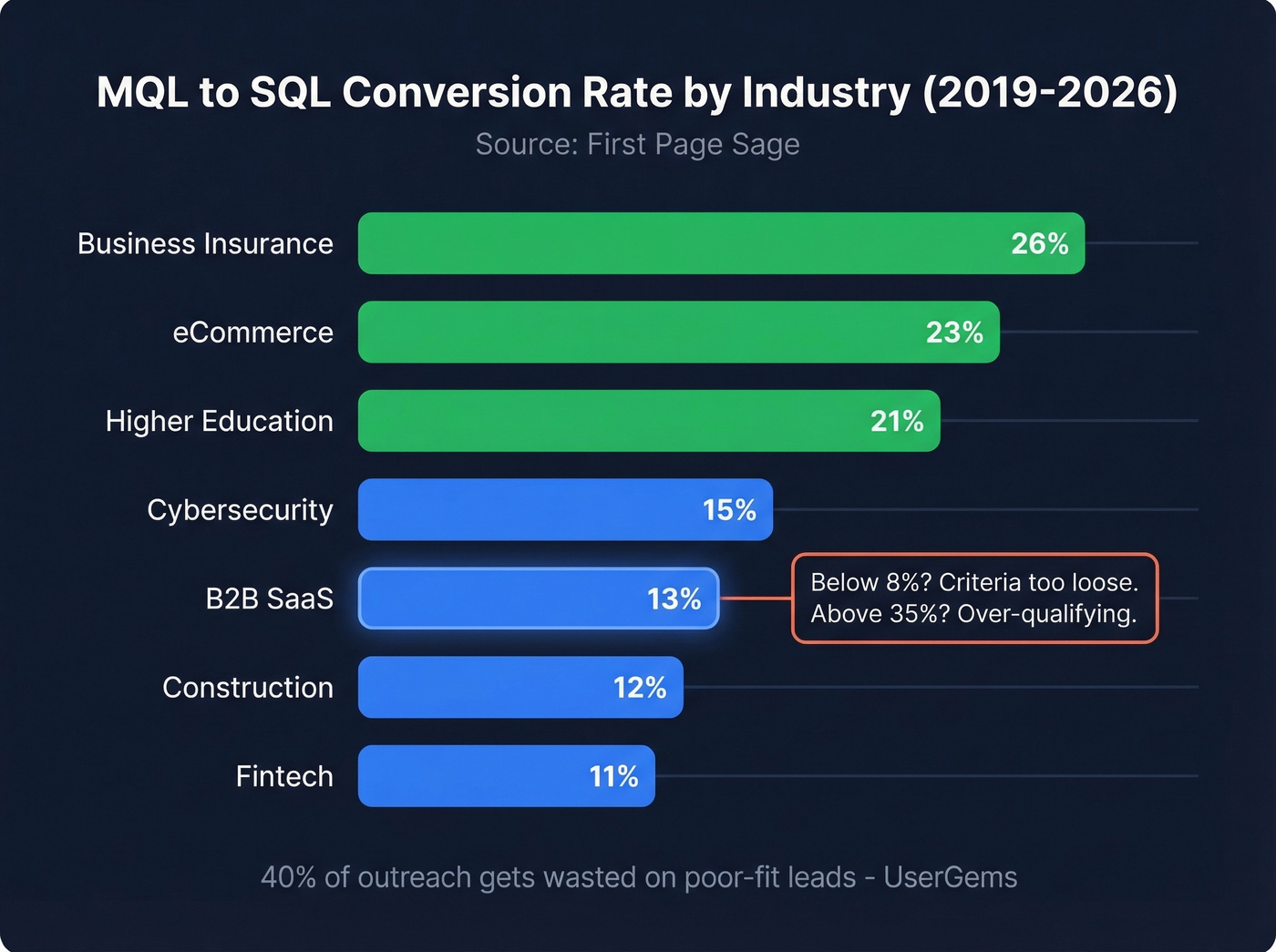
Most teams track MQL volume but never benchmark MQL-to-SQL conversion against their industry. The data tells a different story than most teams expect. First Page Sage's analysis of client data from 2019-2026 breaks it down:
| Industry | MQL-to-SQL Rate |
|---|---|
| Business Insurance | 26% |
| eCommerce | 23% |
| Higher Education | 21% |
| Cybersecurity | 15% |
| B2B SaaS | 13% |
| Construction | 12% |
| Fintech | 11% |
If you're a B2B SaaS company converting MQLs to SQLs at 8%, your qualifying criteria are too loose. At 35%, you're probably over-qualifying and starving your pipeline. UserGems found that 40% of outreach gets wasted on poor-fit leads - that's time your reps never get back.
Teams with strong sales-marketing alignment see 24% faster revenue growth. Following up within the first hour yields 53% conversion versus 17% after 24 hours. Your qualification criteria only work if the handoff is fast and the definitions are shared.
Why Most Qualification Criteria Fail
68% of B2B organizations struggle with lead conversion due to poor qualification. That's not a marginal problem - it's the majority.
Here's the thing: in our experience, the teams that struggle most aren't the ones with the wrong framework. They're the ones with no framework at all. Each rep qualifies differently, pipeline reviews become storytelling sessions instead of data analysis, and nobody can explain why forecast accuracy is stuck at 60%.
Leadership-level failures tend to cluster around three patterns. No documented ICP, so reps pursue wildly different prospects while marketing generates leads that don't convert. No enforced framework, so qualification is subjective. And rewarding quantity over quality - when the dashboard celebrates "leads generated," you incentivize premature stage progression and bloated forecasts.
Rep-level failures swing in both directions. Over-qualifying means asking 47 discovery questions before booking a demo, which slows deals to a crawl until prospects ghost. Under-qualifying means pushing everything to Stage 2 because the activity metric demands it. Pipeline looks great until the quarter ends and nothing closes.
One team we spoke with documented switching to MEDDIC and saw forecast accuracy jump from 62% to 89%. The framework itself mattered less than the fact that everyone used the same one.
The 7 Criteria That Matter
Not every qualification model needs seven criteria. But these are the data points that actually predict whether a deal closes.
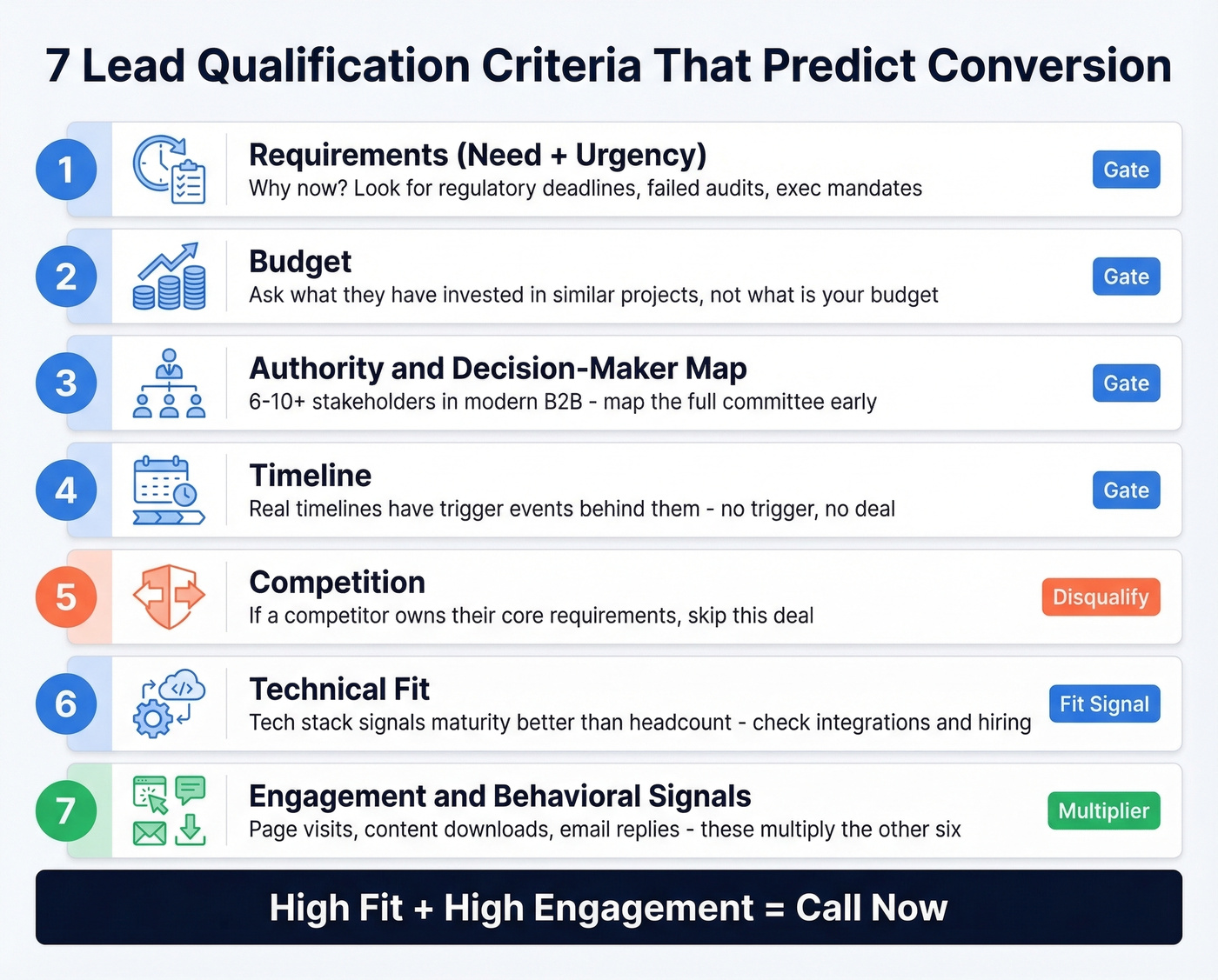
1. Requirements (Need + Urgency). Don't just ask "do you have this problem?" Dig into why now. A regulatory deadline, a failed audit, a new executive mandate - these are buying triggers. "We're exploring options" isn't one.
2. Budget. Asking "what's your budget?" directly rarely works. Better: "We typically tailor proposals to your budget range - what would suit this type of initiative?" Indirect benchmarking questions like "What have you invested in similar projects?" work even better.
3. Authority and Decision-Maker Mapping. Modern B2B buying groups include 6-10+ stakeholders. If you're only talking to one person, you're hoping, not qualifying. Map the committee early.
4. Timeline. "Next quarter" is different from "when we get around to it." A real timeline has a trigger event behind it. No trigger, no urgency, no deal.
5. Competition. Skip this deal if a competitor has strengths on the prospect's core requirements that you can't match - your time is better spent elsewhere. One advanced tactic for large-deal qualification: monitor competitor reps' new connections on professional networks. If their product and tech teams start connecting with your prospect's staff, that signals an active evaluation and tells you exactly where they are in the cycle.
6. Technical Fit. Headcount is a noisy proxy. Tech stack is often a cleaner signal of operational maturity and budget allocation. A company running modern systems for CRM, collaboration, and data tends to have the processes and internal ownership to actually implement what you sell. Prospeo's technographic filters - powered by Wappalyzer and live job posting signals - let you operationalize this criterion before the first call. If they're hiring a RevOps lead and running your integration partners, that's a fit signal worth more than any firmographic checkbox.
7. Engagement and Behavioral Signals. Page visits, content downloads, webinar attendance, email replies - these don't qualify on their own, but they multiply the value of the other six criteria. High fit plus high engagement means call now.

Your qualification criteria are only as good as the data behind them. Prospeo gives you 30+ filters - buyer intent, technographics, job changes, headcount growth - so you can operationalize every criterion on this list before the first call. 98% email accuracy means your scores reflect reality, not stale records.
Stop scoring leads built on bad data. Verify first, qualify second.
Pick a Framework and Enforce It
Let's be honest: the framework debate is one of the most overanalyzed topics in sales. BANT, CHAMP, MEDDIC, GPCTBA/C&I - they all work. The question is which one matches your motion.
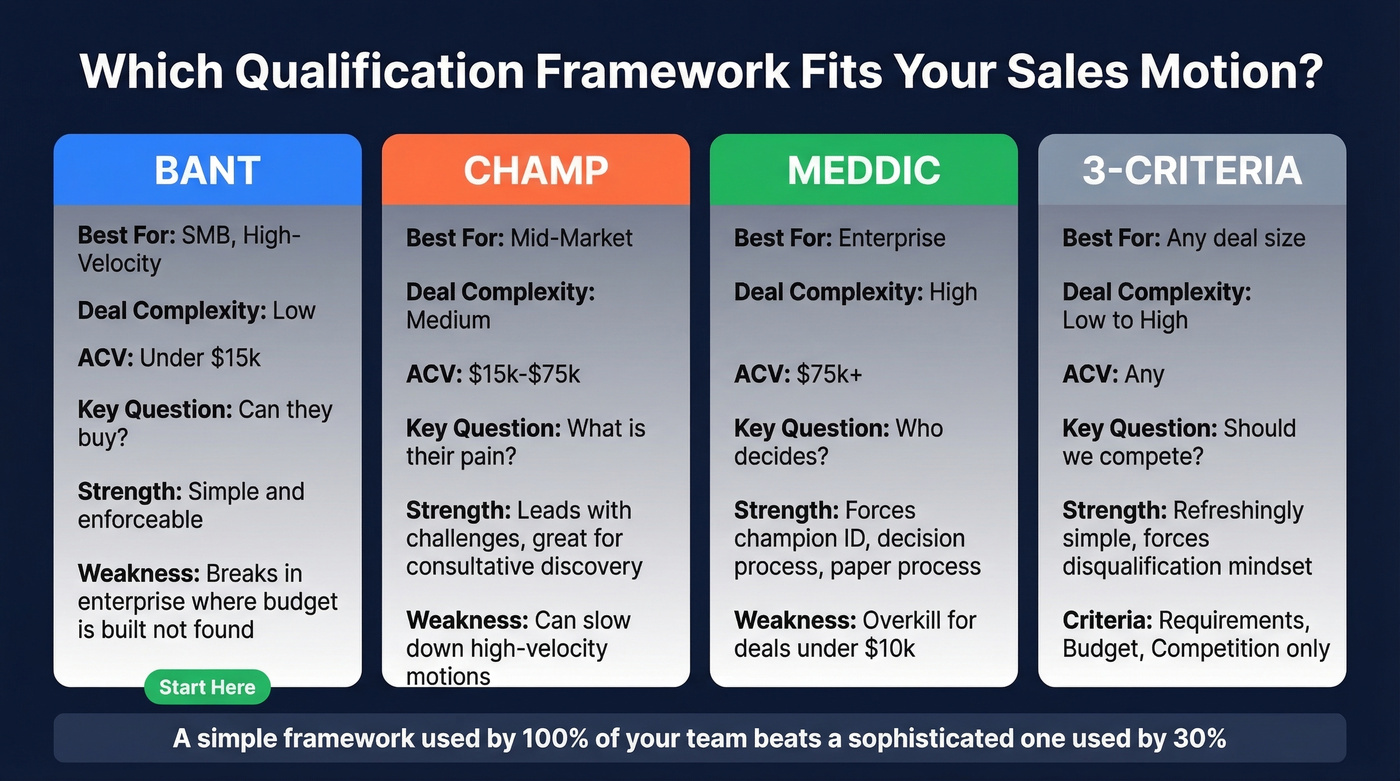
| Framework | Best For | Deal Complexity | ACV Range | Key Question |
|---|---|---|---|---|
| BANT | SMB, high-velocity | Low | Under $15k | Can they buy? |
| CHAMP | Mid-market | Medium | $15k-$75k | What's their pain? |
| MEDDIC | Enterprise | High | $75k+ | Who decides? |
| GPCTBA/C&I | Strategic/exec | High | $100k+ | What outcome? |
| 3-Criteria | Any (field-tested) | Low-High | Any deal size | Should we compete? |
BANT is the default for a reason - it's simple, enforceable, and works for transactional motions. But it breaks in enterprise deals where budget doesn't exist until you build the business case. Asking "what's your budget?" to a VP evaluating a $200k platform is the wrong first question.
MEDDIC shines in complex sales because it forces you to identify the champion (not just a fan - someone who'll sell internally), the decision process, and the paper process. CHAMP flips the order and leads with challenges, which works better for consultative discovery calls.
The practitioner "3-criteria" alternative - Requirements, Budget, Competition - deserves attention. A 20-year sales veteran on r/sales built his entire career on just these three, treating relationship as a nice-to-have rather than a qualification criterion. It's refreshingly simple and forces a disqualification mindset.
If your average deal closes under $10k, you probably don't need MEDDIC. You need BANT, a fast handoff, and reps who aren't afraid to disqualify. We've seen teams agonize over BANT vs. MEDDIC for months while their pipeline rots. A simple framework used by 100% of your team beats a sophisticated one used by 30%.
Pick one. Train on it. Enforce it in every pipeline review.
Build Your Scoring Model
Once you've chosen a framework for qualification gates, you need a scoring model to prioritize within the qualified pool.
| Signal | Points | Category |
|---|---|---|
| Demo/trial request | +100 | Intent |
| Pricing page visit | +50 | Intent |
| Webinar attendance | +30 | Intent |
| ICP industry match | +40 | Fit |
| Target company size | +30 | Fit |
| Director+ title | +25 | Fit |
| Tech stack match | +20 | Fit |
| No activity 30 days | -30 | Decay |
| Personal email domain | -50 | Negative |
| Competitor employee | -100 | Negative |
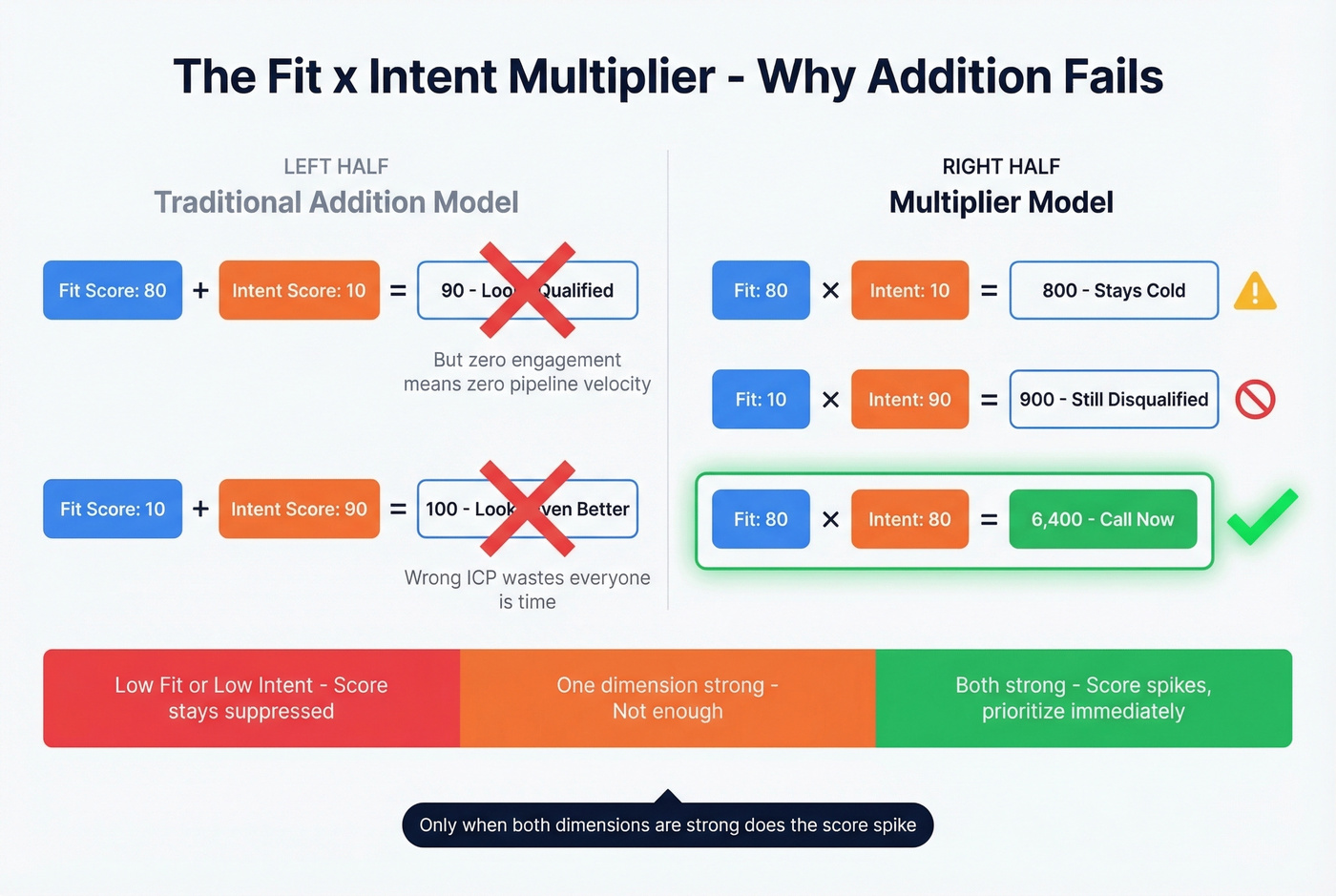
The real power comes from the fit x intent multiplier pattern. Instead of adding fit and intent scores together, multiply them. A perfect-fit account with zero engagement stays cold. A highly engaged lead at a company that doesn't match your ICP stays disqualified. Only when both dimensions are strong does the score spike. Clearbit's model routes by employee count tiers - SMB under 100, mid-market 100-499, enterprise 500+ - then applies the intent multiplier on top.
For teams that prefer simplicity over point models, a 0-5 rubric per criterion (need, interest, budget, timing, authority) standardizes handoffs without building a full scoring infrastructure.
One critical rule: if someone submits a "talk to sales" form, send them to sales regardless of score. A human check beats a formula every time.
Set your MQL threshold based on sales capacity. If your team can handle 50 leads per week, calibrate so roughly 50 pass. Then iterate - one team tightened title and seniority filters while lowering the activity threshold and saw MQL-to-meeting rates climb 13%.
Your scoring model is only as good as your data. If a third of your emails bounce, every score is fiction. Prospeo's 98% email accuracy and 7-day data refresh cycle keep your model grounded in reality - you're scoring against current, verified contacts instead of stale records that left the company six months ago.
The Qualification Process
A five-step RevOps blueprint that turns qualification from a vibe check into infrastructure:
1. Align on ICP and thresholds. Get sales and marketing in a room. Define the firmographic, technographic, and behavioral criteria that make a lead worth pursuing. Write it down. These shared definitions prevent the finger-pointing that kills pipeline velocity.
2. Capture and enrich. Every inbound lead gets enriched with firmographic and technographic data before a human touches it - company size, industry, seniority, funding stage, tech stack, all populated automatically.
3. Apply your framework consistently. Every discovery call follows the same qualification structure. No freelancing. No skipping budget because the prospect seemed enthusiastic.
4. Route immediately. A form submission at 2 AM should trigger routing and follow-up before the prospect's coffee is cold. Speed-to-lead is a qualification multiplier.
5. Analyze and iterate. Review closed-won and closed-lost data quarterly. If sales rejects more than 30% of MQLs, your criteria have drifted.
Always multithread. Connecting with a single contact is a single point of failure in a world where buying committees run 6-10+ people deep.
AI in Lead Qualification
AI doesn't replace qualification judgment - it accelerates it. The real value is identifying the 20-30% of leads with genuine buying intent and surfacing them before they go cold. Real-time scoring means a form submission at 2 AM triggers routing instantly, not when someone checks the queue at 9 AM.
More than 8 in 10 marketers now use AI in some part of their workflow. Marketing budgets have dropped to 7.7% of revenue, down from 9.1% in 2023 - and the pressure hasn't eased. Doing more with less isn't optional.
But AI still can't tell you whether a champion is real or just a friendly contact. Use it for speed and pattern detection. Keep humans on the judgment calls. AI is especially useful for applying account-level qualification at scale - flagging companies that match your ICP before reps ever pick up the phone.
B2B vs. B2C Qualification
| Dimension | B2B | B2C |
|---|---|---|
| Fit signals | Firmographics, tech stack | Persona, behavior |
| Cycle length | 3-6 months typical | Days to weeks |
| Decision makers | 6-10+ stakeholders | 1-2 people |
| Framework | BANT/MEDDIC/CHAMP | Behavioral scoring |
| Key qualifier | Budget + authority | Intent + urgency |
B2C qualification is behavior-driven - repeat visits, cart actions, and purchase history tell you most of what you need. B2B qualification is committee-driven and framework-dependent. The criteria overlap, but the operationalization is completely different. If you're running a product-led motion with a self-serve tier, you'll lean closer to B2C behavioral scoring even in a B2B context.
FAQ
What's the difference between lead qualification criteria and lead scoring?
Qualification is the yes/no gate - does this lead match your ICP and meet minimum thresholds for budget, authority, and need? Scoring ranks qualified leads by priority using points. You need both. Qualification comes first, scoring comes second.
Which framework works best for small teams?
BANT. It's the simplest to implement for teams under 10 reps closing deals below $15k ACV, the easiest to enforce in pipeline reviews, and requires zero custom tooling. Consistency beats sophistication every time.
How often should I update my qualification criteria?
Review quarterly using closed-won and closed-lost data. If sales rejects more than 30% of MQLs, your criteria have drifted. One SaaS team cut rejection rates from 40% to 18% after a single quarterly recalibration.
What tools help automate lead qualification?
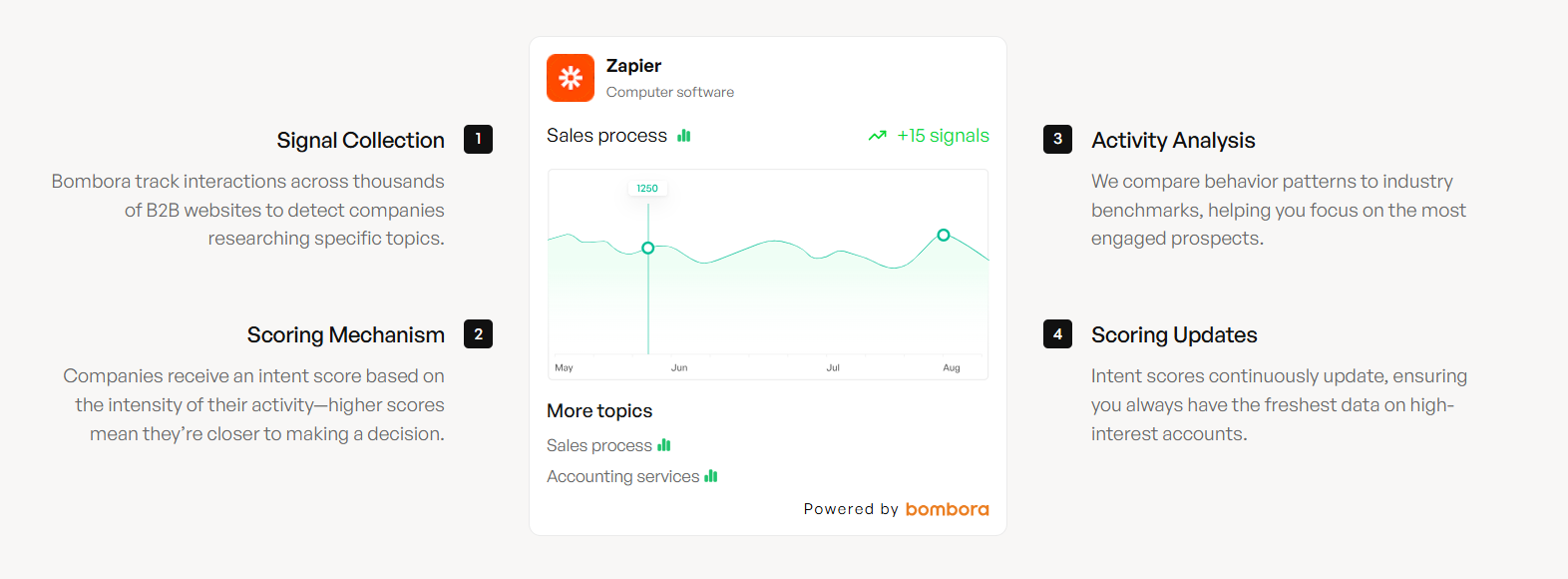
CRM platforms like Salesforce and HubSpot handle scoring rules and routing. For the data layer - verified emails, technographics, and intent signals - Prospeo provides 98% accurate contact data with a 7-day refresh cycle, plus Bombora-powered intent tracking across 15,000 topics so your scoring model runs on current information.
You just read that 40% of outreach gets wasted on poor-fit leads. Prospeo's technographic filters, Bombora intent data across 15,000 topics, and 7-day data refresh cycle let you map technical fit, authority, and buying signals before a rep ever picks up the phone. At $0.01 per email, disqualifying bad leads costs almost nothing.
Qualify leads with real intent signals, not downloaded whitepapers.