Lead411 vs Mailshunt: Platform vs Point Tool - Which Do You Need?
Lead411 vs Mailshunt isn't a comparison you'll find covered head-to-head anywhere. That's because these tools aren't really direct competitors - they're different categories that happen to touch the same problem: finding someone's work email.
Lead411 is a full sales intelligence platform with buyer intent data, direct dials, and CRM enrichment. Mailshunt is a lightweight email finder/verifier with very limited independent coverage. What actually separates them comes down to what buyers care about most: bounce rates under 5%, pricing that doesn't punish you per seat, and integrations that don't break your workflow.
30-Second Verdict
- Pick Lead411 if you need a complete sales intelligence stack - intent signals, direct dials, and CRM enrichment - and you're comfortable paying $150+/month for the tiers that actually matter.
- Pick Mailshunt if you only need a simple email finder/verifier and want to keep costs under $50/month. Just know you're betting on a tool with almost zero independent reviews.
Quick Comparison
| Dimension | Lead411 | Mailshunt |
|---|---|---|
| Category | Sales intelligence | Email finder/verifier |
| Database | 450M B2B contacts | Undisclosed; likely on-demand |
| Email verification | Re-verified every 3 months | Included (method undocumented) |
| Direct dials | Yes | No |
| Intent data | Yes (Bombora; $1,000/seat/year enterprise add-on) | No |
| CRM integrations | Salesforce, HubSpot, more | Unknown |
| Pricing | $49/mo (Spark), $150/mo+ (Ignite), Custom (Blaze) | Est. $30-$100/mo |
| Free tier | 7-day trial with 50 exports | Unknown |
| Review footprint | Strong (G2, Capterra, TrustRadius) | Minimal |
| Founded | - | 2019 |
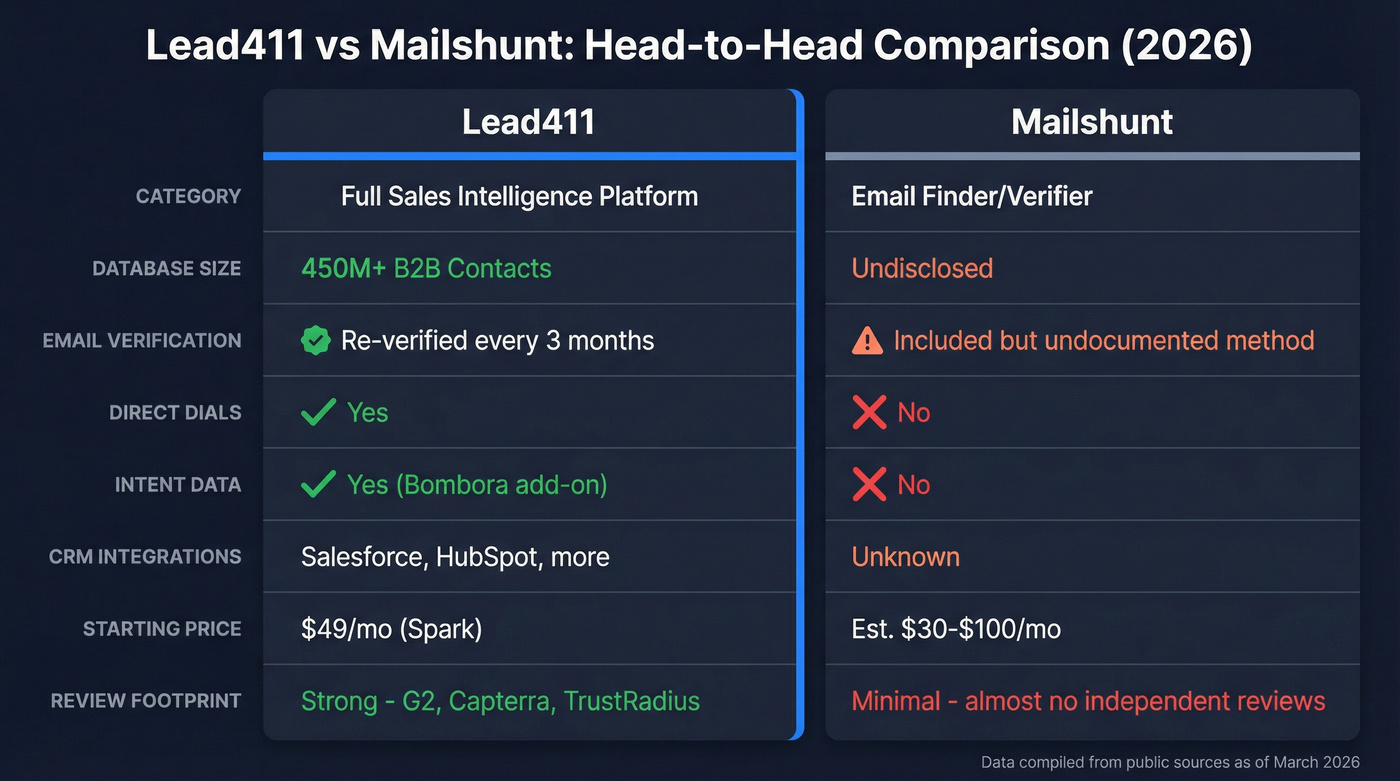
The table tells the story pretty clearly. Lead411 competes in the same arena as ZoomInfo and Apollo. Mailshunt competes with Hunter, GetProspect, Wiza, and Dropcontact. The overlap is narrow.
What Sets Them Apart
Lead411 - Full Sales Intelligence
Use this if you're running outbound at scale and need more than just emails.
Lead411 includes verified emails, mobile direct dials, company profiles, and sales alerts covering hiring, funding, and executive changes. It re-verifies its data every 3 months, which matters because email data decays fast as people change jobs - we've seen bounce rates spike 15-20% on lists older than 90 days when using providers with slower refresh cycles.

The Spark plan at $49/month includes 1,000 exports, with additional exports at $0.50 each. Ignite starts at $150/month and adds API access. Bombora buyer intent data is available as an enterprise add-on at $1,000/seat/year, which pushes total cost up fast for mid-size teams.
You also get CRM integrations with Salesforce and HubSpot, plus a Chrome extension for prospecting.
Skip this if international coverage is a top priority. Reviews consistently cite gaps in EMEA and APAC data, and the 3-month re-verification cycle means you'll hit stale records more often than you'd like.
Here's the thing about Lead411's tier structure: the plan most teams actually want is usually the one that includes API access and buyer intent, so budget for Ignite or Blaze from the start. The Spark tier works for individual reps doing manual prospecting, but it won't scale.
Mailshunt - Bare-Bones Email Finder
Mailshunt (spelled "MailsHunt" on Tracxn) is a cloud-based platform for finding and verifying email addresses, founded in 2019 and listed as unfunded.
What's missing is the part buyers usually rely on to feel safe: independent coverage. Mailshunt doesn't publish pricing publicly, it has virtually no footprint on major review sites, and there are no third-party accuracy benchmarks for it. That's a red flag for anyone sending at volume.
For context, tested email finders typically return 65-72% verified match rates on a 1,000-profile sample. Benchmarks like these are why teams often use multiple providers instead of betting on one - especially when they're building lists via email search tools or email append vendors. Based on category pricing norms - Hunter at $49/month, Snov.io at $39/month - expect Mailshunt to land somewhere in the $30-$100/month range.
The consensus on Reddit threads about email-finder selection is simple: under 5% bounce rate is the baseline, and "verified" labels don't always prevent bounces. People regularly call out cases where bounce rates hit 20%+ even when tools mark emails as verified. If you can't find independent reviews or benchmarks for a tool, you're taking that risk blind.

Bouncing between a bare-bones email finder and a $1,000/seat intent data add-on? Prospeo gives you 98% email accuracy, 125M+ verified mobiles, and 15,000 Bombora intent topics - with data refreshed every 7 days, not every 3 months. Starting at ~$0.01/email.
Stop gambling your domain reputation on unverified data.
Lead411 vs Mailshunt for Cold Outreach
If you're choosing between these two specifically for outbound, the decision isn't about "which is better." It's about what you're trying to protect:
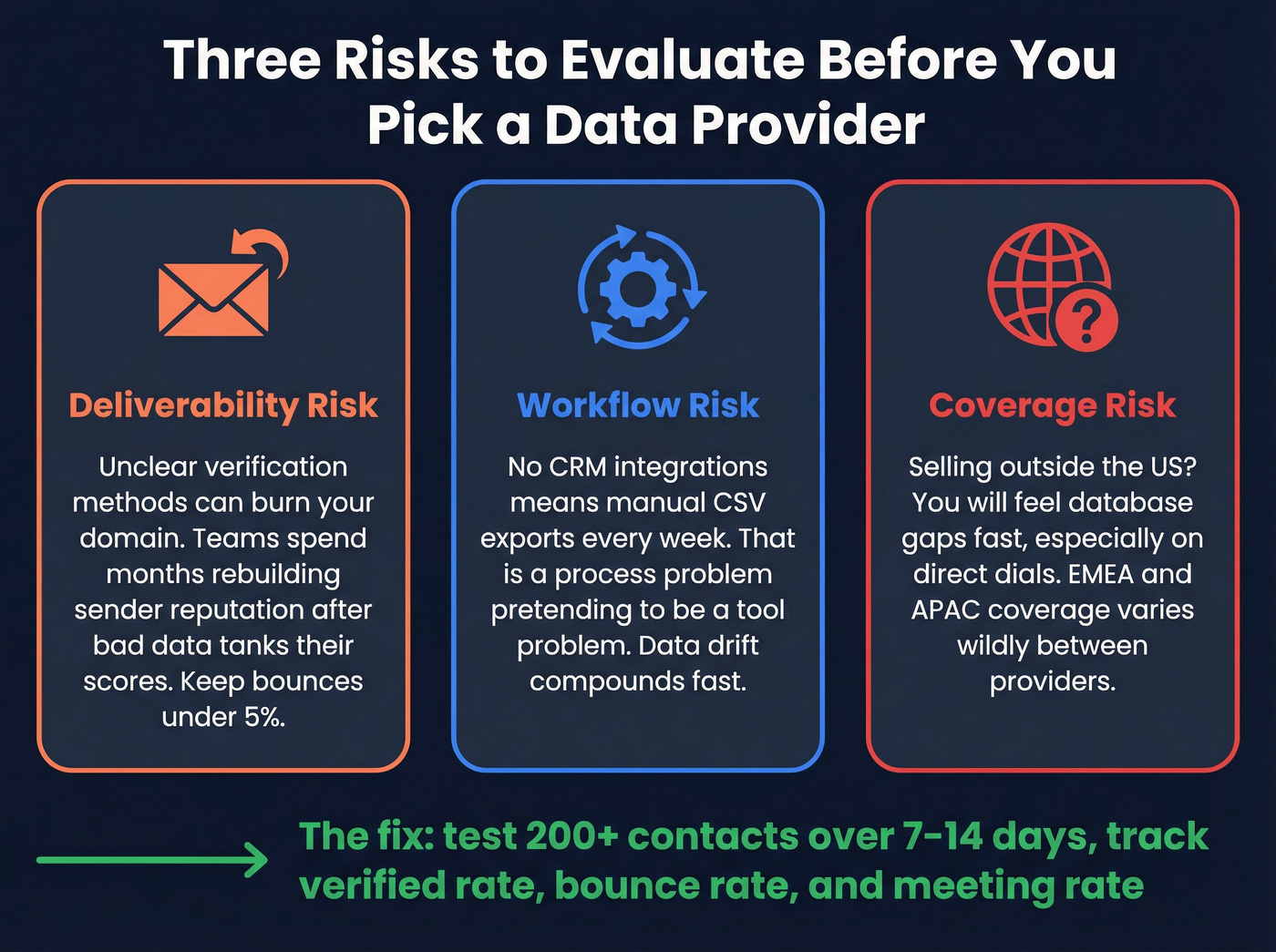
Deliverability risk. A finder with unclear verification methodology can cost you more than it saves - burned domains, spam-folder placement, wasted sends. We've worked with teams who spent months rebuilding domain reputation after a bad data provider tanked their sender scores. (If you're troubleshooting this, start with email deliverability and sender reputation.)
Workflow risk. A platform without the integrations you need creates manual work and data drift. If you're exporting CSVs and re-uploading to your CRM every week, that's a process problem masquerading as a tool problem - especially if you haven't standardized your data enrichment flow.
Coverage risk. If you sell outside the US, you'll feel database gaps fast - especially on direct dials.
Lead411 is built for teams that want a broader prospecting and enrichment workflow. Mailshunt is built for "I just need an email, right now."
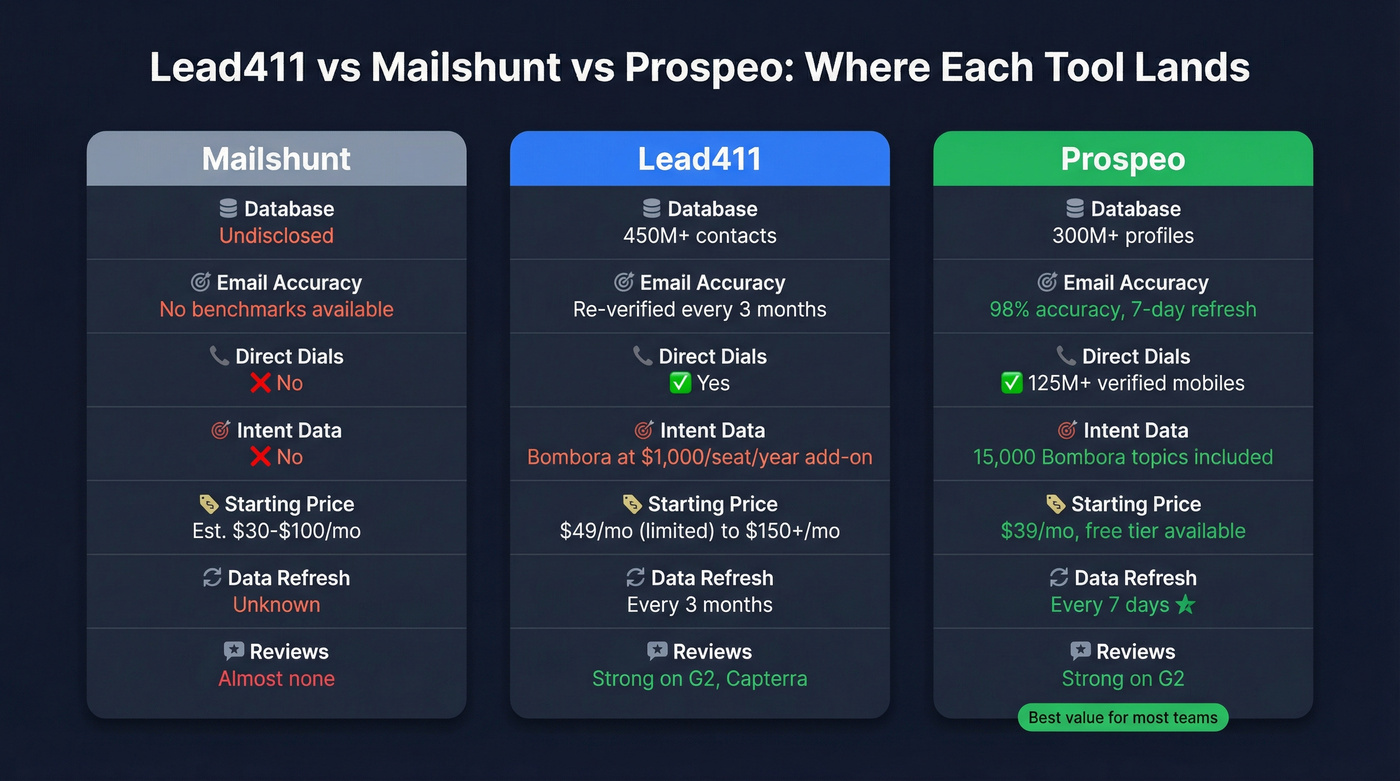
A Stronger Third Option
Prospeo bridges the gap between Mailshunt's simplicity and Lead411's depth. You get 300M+ professional profiles with 98% email accuracy, 143M+ verified emails, 125M+ verified mobile numbers, and intent data covering 15,000 topics via Bombora - all self-serve, no contracts.
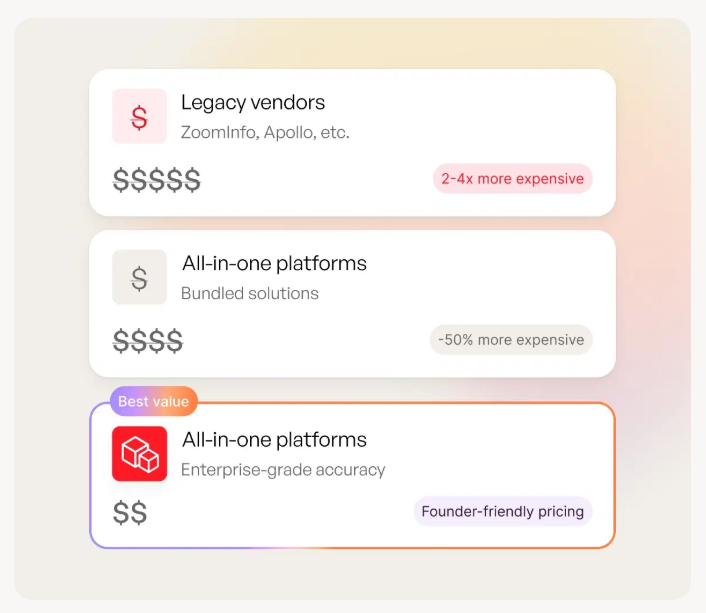
Data refreshes every 7 days, which is meaningfully faster than a 3-month re-verification cycle. The free tier gives you 75 verified emails and 100 Chrome extension credits per month, and paid plans start at roughly $39/month. You don't need to choose between "cheap email finder" and "expensive sales intelligence platform." (If you're comparing more tools in this category, see our breakdown of sales prospecting databases.)
Teams using Prospeo book 26% more meetings than ZoomInfo users and 35% more than Apollo - at 90% lower cost. 300M+ profiles, 30+ search filters, and a 7-day refresh cycle mean your outbound hits real inboxes, not spam folders.
75 free verified emails. No contract. No sales call. No risk.
The Verdict
Three scenarios, three answers.
If you need a full platform with intent data, CRM enrichment, and direct dials, Lead411's higher tiers are solid. Just know that international coverage has gaps and the Bombora add-on pushes total cost well past what most mid-market teams budget for.
If you only need email finding on a tight budget, Mailshunt is technically an option. But the lack of reviews, pricing transparency, and third-party accuracy data makes it a gamble. In our experience, the risk of domain damage from unverified data far outweighs the savings from a cheaper tool.
If you want verified emails, direct dials, and intent signals without enterprise-style pricing, Prospeo is the clearest path: start free, then scale credits as your outbound volume grows.
FAQ
Lead411 vs Mailshunt: Which is better for cold email?
Lead411 is better for cold email when you need more than addresses - direct dials, CRM enrichment, and intent signals all help you target the right people at the right time. Mailshunt works only for basic find-and-verify on a small budget. If you're sending at scale, prioritize tools that keep bounce rates under 5% and support enrichment workflows.
Does Mailshunt verify emails?
Mailshunt includes email verification, but its methodology isn't publicly documented and there are no third-party accuracy benchmarks available. Strong verification typically includes MX/DNS checks, SMTP handshakes, and catch-all detection - so you'll want to validate results on a 100-200 lead pilot before scaling sends.
Is there a tool that covers both use cases?
Prospeo covers both by combining email finding at 98% accuracy across 300M+ profiles with 125M+ verified mobile numbers and intent data across 15,000 topics. Records refresh every 7 days, and the free tier includes 75 verified emails plus 100 Chrome extension credits per month.
What's the safest way to choose between them?
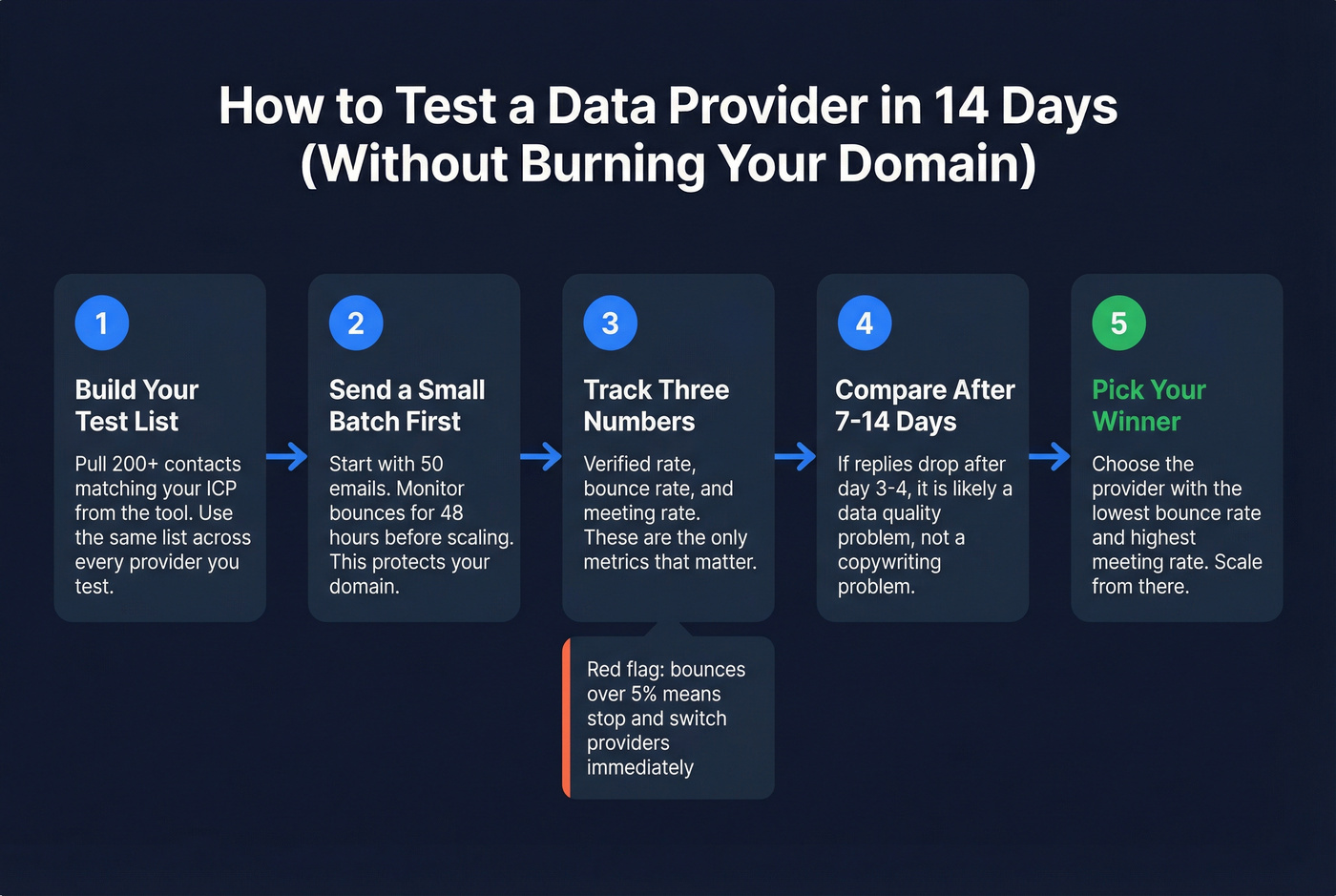
Run a 7-14 day test with the same ICP list - at least 200 contacts - and track three numbers: verified rate, bounce rate, and meeting rate. If bounces exceed 5% or replies drop after day 3-4, treat it as a data-quality problem, not a copy problem, and switch providers before you burn your domain.