


LeadGibbon Pros and Cons: Honest Review (2026)
You just ran your first cold email sequence off a LeadGibbon list and 18% bounced. Now you're wondering whether the tool's the problem or you just picked the wrong contacts. This breakdown of LeadGibbon pros and cons covers what verified users actually say - and what to do about it.
30-Second Verdict
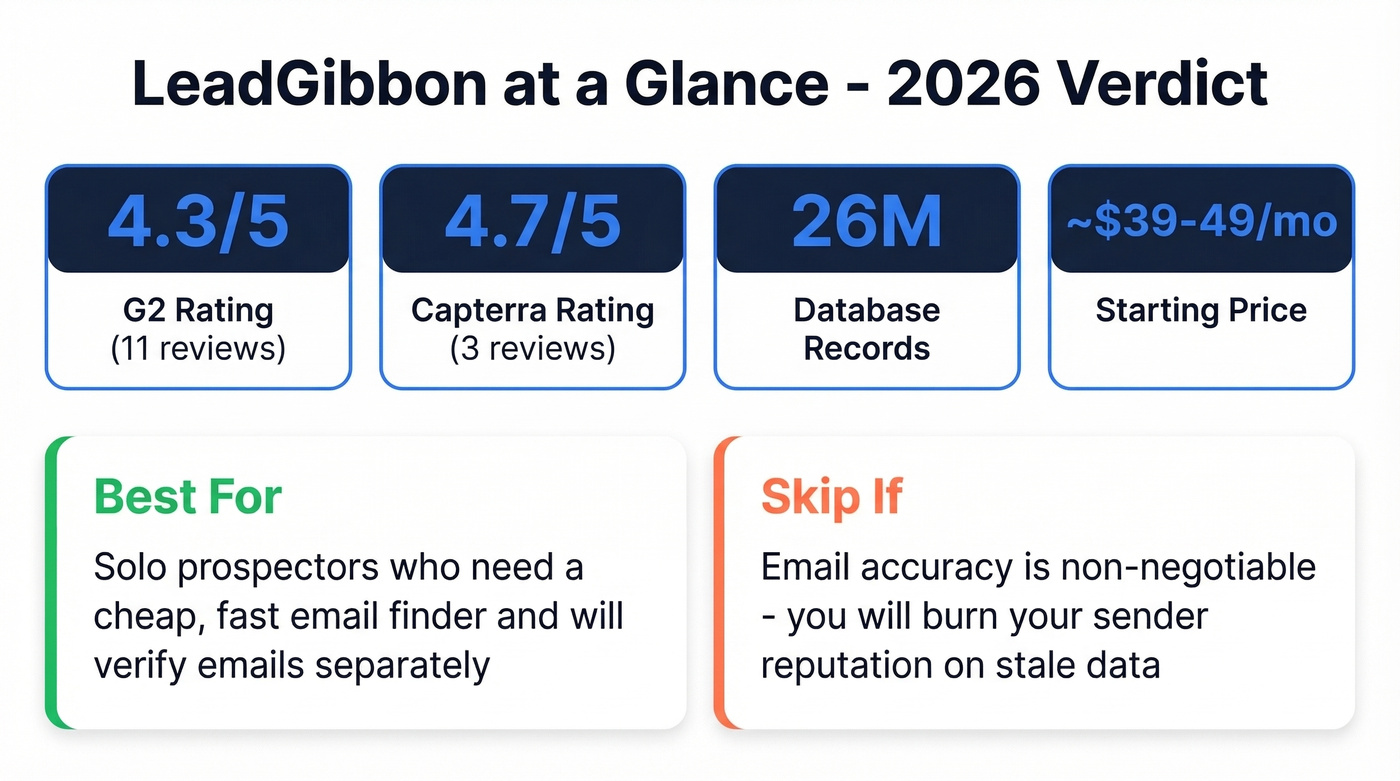
LeadGibbon scores 4.3/5 on G2 (11 reviews) and 4.7/5 on Capterra (3 reviews). Users love the simplicity but consistently flag stale emails and a shallow database. Use it if you're a solo prospector who needs a cheap, fast email finder and you'll verify elsewhere. Skip it if email accuracy is non-negotiable - you'll burn your sender reputation.
What LeadGibbon Does
LeadGibbon is a Chrome extension that finds work emails by pinging company mail servers using a contact's name and domain. It labels results as "Valid" (under 1% bounce chance) or "Risky" (best guess). The workflow is Google Sheets-first with CSV and Drive export, so you don't need a CRM to get value.
Their site lists 26 million records in the database, though third-party roundups usually describe it as 20M+.
Key Advantages
Dead-simple UX. On Capterra, LeadGibbon's ease-of-use sub-score is a perfect 5.0/5. The Chrome extension workflow is genuinely frictionless - install, click, get emails into a spreadsheet. No onboarding calls, no CRM setup.
You only pay for validated emails. "Risky" results don't cost credits. That's a fair model at this price point, and it means you're not burning money on guesses.
Google Sheets native. Export to CSV or sync to Google Drive and you're running. For solo operators and small teams who live in spreadsheets, this is a real plus.
Responsive support. Multiple G2 reviewers mention timely customer support, which matters more than you'd think when your extension glitches mid-workflow.
Budget-friendly entry point. At roughly $39-$49/mo for 1,000 credits, you're not overpaying for what you get.

Tired of "Risky" emails tanking your sender reputation? Prospeo's 5-step verification delivers 98% email accuracy across 300M+ profiles - refreshed every 7 days, not whenever they get around to it. Teams switching from smaller email finders see bounce rates drop below 4%.
Stop verifying emails twice. Get them right the first time.
Notable Drawbacks
Here's the thing: LeadGibbon's weaknesses are real and well-documented.
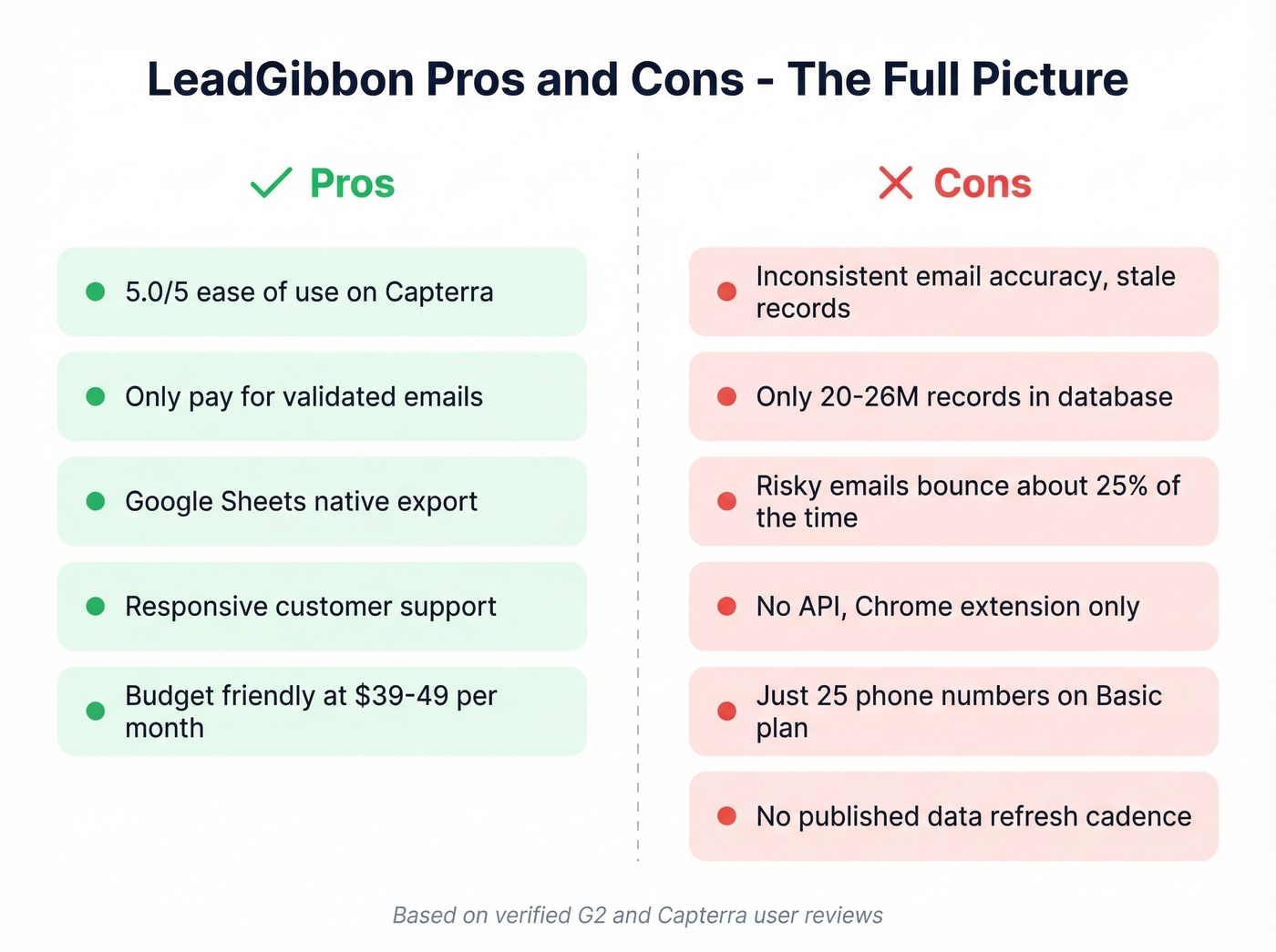
Inconsistent accuracy. A G2 reviewer from January 2023 says it "doesn't work all that well" and returns old emails or guesses based on company format. Another from August 2023 calls the database "insufficient." We've seen similar patterns when testing smaller email-finder tools - the verification layer just isn't deep enough to catch stale records before they hit your outbox.
Shallow database. With ~20-26M records, the tool is a fraction of competitors like Apollo (275M contacts). A Snov.io extraction test returned only 5 out of 10 emails - mid-pack at best. If your ICP is niche, expect a lot of empty searches.
"Risky" emails bounce roughly 25% of the time. LeadGibbon's own tests show Risky results are correct about 75% of the time. If a big chunk of your results come back Risky, your effective deliverability drops fast, and your domain reputation takes the hit (see email bounce rate).
No API, and the extension occasionally glitches. Everything runs through the Chrome extension plus CSV/Sheets export. If you need programmatic enrichment or want to pipe data into Clay or Make, you're stuck. (If you're evaluating providers, compare against data enrichment services.)
Limited phone numbers. The Basic plan includes just 25 phone numbers. Even the Business tier caps at 125. If direct dials matter, this isn't the tool.
Data freshness is unclear. B2B contact data decays roughly 30% per year, and LeadGibbon doesn't publish a refresh cadence - which lines up with the stale email complaints from G2 reviewers. If deliverability is a priority, use an email deliverability guide to protect your domain.
LeadGibbon has minimal Reddit presence. Most user discussion lives on G2 and Capterra, which limits the breadth of sentiment available.
Pricing Reality
LeadGibbon's listed pricing varies by source. Here's the best composite view:
| Plan | Price (approx.) | Emails | Phone Numbers |
|---|---|---|---|
| Free Trial | $0 | 5 leads | 0 |
| Basic | ~$39-$49/mo | 1,000 | 25 |
| Pro | ~$99/mo | 10,000 | 50 |
| Business | ~$299/mo | 30,000 | 125 |
Check their pricing page directly before committing; directory listings are inconsistent.
If Accuracy Is the Dealbreaker
Let's be honest: LeadGibbon is fine for casual prospecting, but if your average deal size exceeds a few thousand dollars, the cost of a bounced email - damaged sender reputation, lost pipeline - dwarfs the savings on a cheaper tool. Invest in accuracy upfront. (If you're building a repeatable outbound motion, start with sales prospecting techniques.)
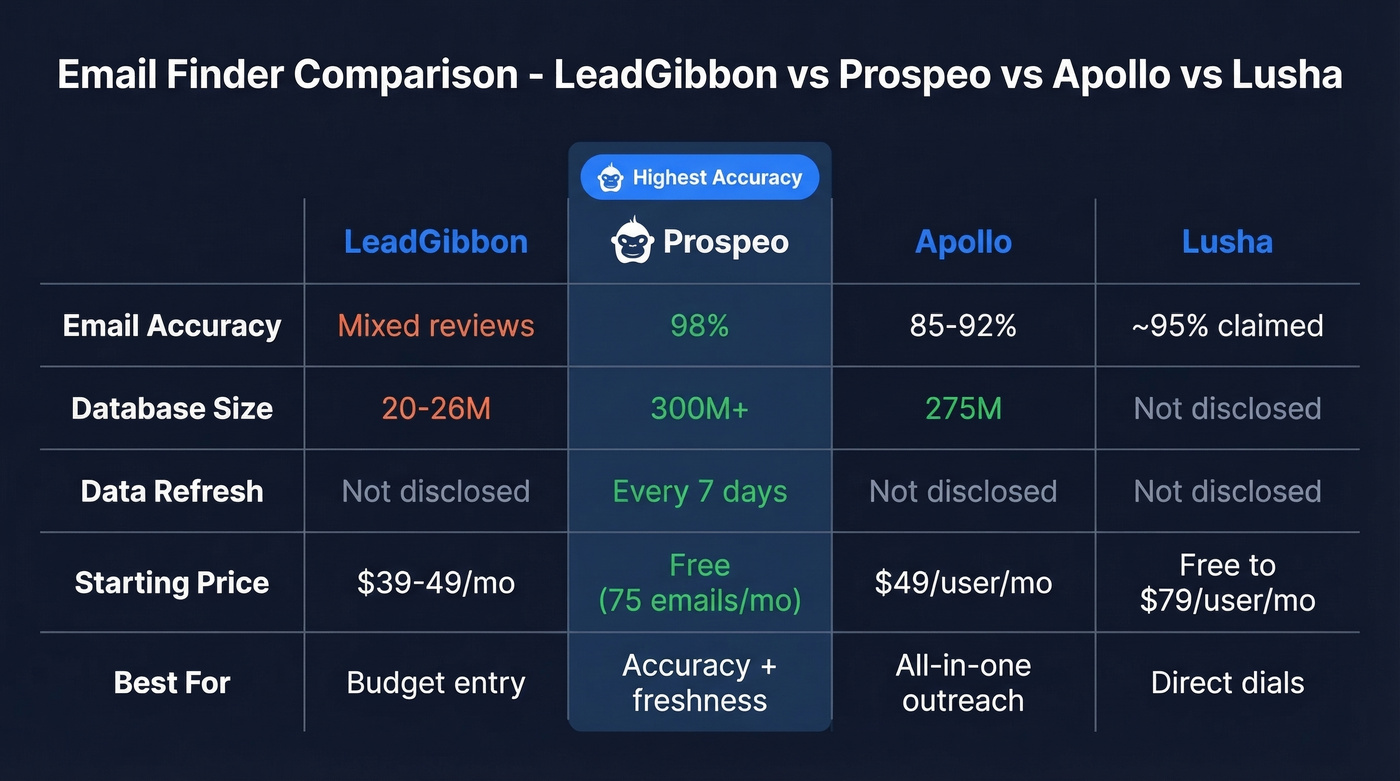
Prospeo indexes 300M+ professional profiles with 98% email accuracy and a 7-day data refresh cycle. We've tested it against LeadGibbon lists and consistently seen bounce rates drop below 4%. It also includes 125M+ verified mobile numbers, 30+ search filters covering buyer intent, technographics, and job changes, plus native integrations with Salesforce, HubSpot, Clay, and Zapier. The free tier gives you 75 emails/month to validate before spending a dollar.

Lusha claims 95% email and 90% phone accuracy. Plans run free to ~$79/user/mo. Strong pick if phone numbers are your priority.
Apollo offers 275M contacts with built-in outreach automation. Plans start at $49/user/mo. Email accuracy runs 85-92% - solid, not best-in-class. If you're comparing stacks, see our roundup of SDR tools.
| Tool | Email Accuracy | Database Size | Refresh Cycle | Starting Price | Best For |
|---|---|---|---|---|---|
| Prospeo | 98% | 300M+ profiles | 7 days | Free (75 emails/mo) | Accuracy + data freshness |
| Apollo | ~85-92% | 275M contacts | Not disclosed | $49/user/mo | All-in-one outreach |
| Lusha | ~95% (claimed) | Not disclosed | Not disclosed | Free-$79/user/mo | Direct dials |
| LeadGibbon | Mixed reviews | ~20-26M records | Not disclosed | ~$39-$49/mo | Budget entry |
30-Minute Trial Checklist
Don't trust any tool's marketing page. Run this instead:
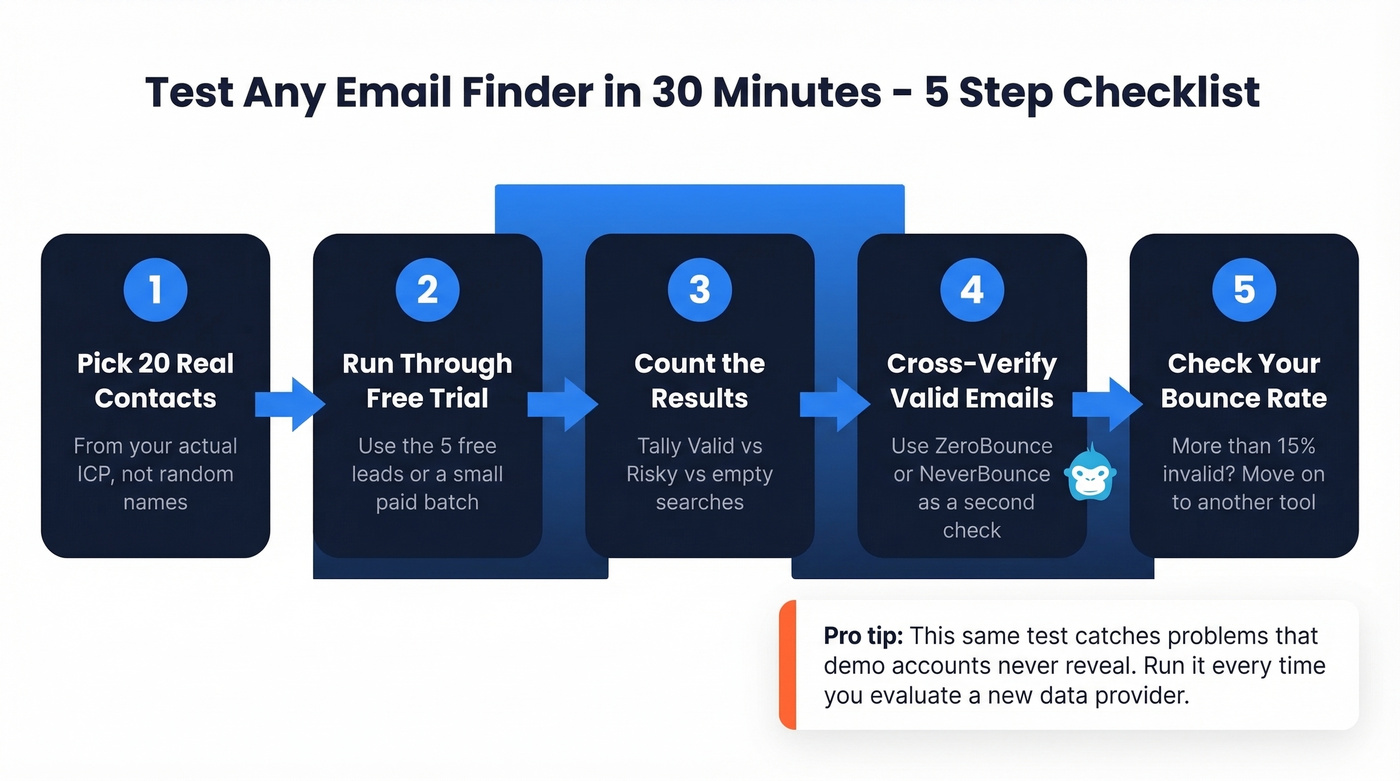
- Pick 20 contacts from your actual ICP - real prospects, not random names (use an ideal customer profile template if needed).
- Run them through LeadGibbon's free trial (5 leads) or a small paid batch.
- Count how many return "Valid" vs "Risky" vs nothing.
- Send the "Valid" emails through a standalone verifier like ZeroBounce or NeverBounce.
- If more than 15% come back invalid, the tool doesn't fit your ICP. Move on.
In our experience, this takes 30 minutes and saves months of bad data compounding in your sequences. We run this same test every time we evaluate a new data provider internally, and it's caught problems that demo accounts never would.
LeadGibbon caps you at 25 phone numbers and 26M records with no API. Prospeo gives you 125M+ verified mobiles, 30+ search filters, native Clay and Zapier integrations, and a 92% API match rate - starting at $0.01 per email with no contracts.
Outgrow the Chrome-extension-only workflow. Scale with real data.
FAQ
Does LeadGibbon have an API?
No. LeadGibbon works through its Chrome extension and Google Sheets/CSV export only. Teams needing API-first enrichment should look at tools like Prospeo (92% API match rate) or Apollo.
What does "Risky" mean in LeadGibbon results?
It means LeadGibbon can't fully verify the email against the mail server. Roughly 1 in 4 Risky emails will bounce. You aren't charged credits for Risky results, but sending them still damages your domain reputation.
Is LeadGibbon accurate enough for cold outreach?
Not reliably for high-volume campaigns. Verified users report stale and format-guessed contacts. Pair it with a standalone verifier, or use a platform with higher native accuracy - Prospeo's 5-step verification delivers 98% accuracy out of the box.
How does LeadGibbon compare to larger databases?
LeadGibbon's ~26M records cover a fraction of the market. Apollo has 275M contacts, and Lusha doesn't disclose its count. For niche ICPs, a larger database means fewer empty searches and less time wasted on manual research.