

LeadIQ vs QuickEnrich (2026): Which Enrichment Tool Wins?
You ran out of LeadIQ credits mid-month - again - and now you're staring at QuickEnrich's pricing page wondering how they charge $0.004 per email. This LeadIQ vs QuickEnrich breakdown covers what you actually get, where the tradeoffs hide, and whether either one deserves your budget.
30-Second Verdict
- Pick LeadIQ if your SDRs live in a browser extension and need one-click CRM push.
- Pick QuickEnrich if you're running bulk enrichment via API or Clay and want the lowest unit cost.
What Each Tool Actually Is
LeadIQ is a prospecting workflow tool built around a Chrome extension. SDRs capture contacts from professional profiles with one click and push them into Salesforce or HubSpot. Its Universal Credits system pools emails (1 credit), phones (10 credits), and account enrichment (3 credits) into a single balance. Champion Tracking monitors job changes. The core value proposition is speed-to-CRM for reps who prospect in-browser all day.
QuickEnrich is an API-first B2B email finder with 130M+ contacts and a 97% accuracy claim. It runs double verification - multiple tools plus catchall and SMTP checks - and excludes risky addresses automatically. It also claims to find true email domains rather than defaulting to company website domains, which matters for accuracy at scale. Mobile numbers come with roughly 25% of enriched contacts. Lean, cheap, built for programmatic enrichment.
Pricing: What It Actually Costs
These two aren't playing the same pricing game.
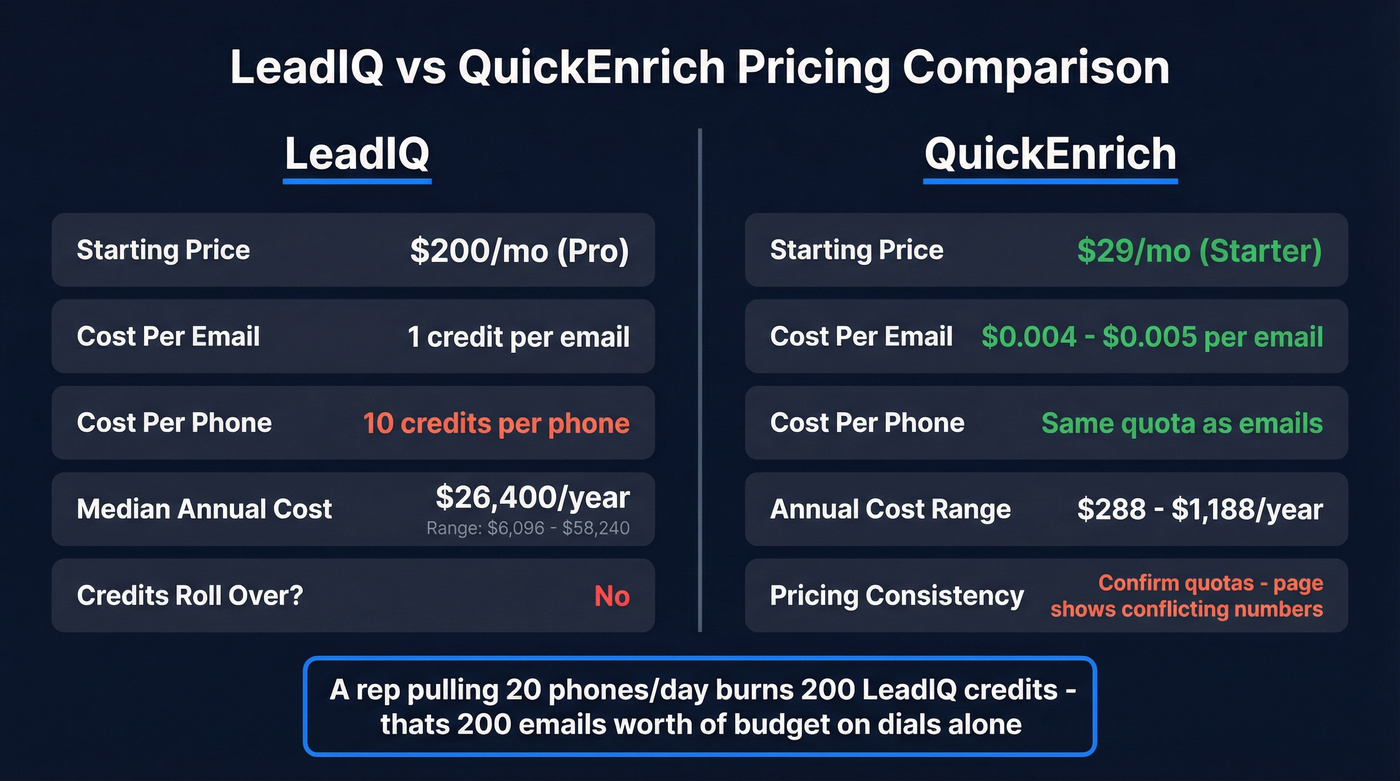
LeadIQ charges 1 credit per email and 10 per phone number. The free plan gives 50 credits - that's 50 emails or 5 phone numbers. Pro starts at $200/mo. Per-user estimates land around $36-$79/month depending on tier. An analysis of 93 real purchases found the median annual cost at $26,400, ranging from $6,096 to $58,240. Teams that negotiate save about 21%. Credits don't roll over month to month, which stings.
QuickEnrich runs Starter at $29/mo and Growth at $99/mo. Annual billing drops those to $24/mo and $83/mo. One warning: their pricing page shows inconsistent quota numbers (6,000 vs 3,000 on the same card), so confirm your exact allocation before committing.
| Metric | LeadIQ | QuickEnrich |
|---|---|---|
| Cost per email | Credit-based (1 credit/email) | ~$0.004-$0.005 per found email/phone |
| Cost per phone | 10 credits/phone | Same "found emails or phone" quota |
| Monthly starting price | $200 (Pro) | $29 (Starter) |
Here's the thing: if your average deal size sits below $15k and your reps pull more than 10 phone numbers a day, LeadIQ's credit math will eat you alive. A rep pulling 20 phones daily burns 200 credits - that's 200 emails' worth of budget on dials alone. QuickEnrich puts phones into the same found-email/phone quota, which is dramatically cheaper on paper.
Data Quality & Verification
QuickEnrich double-verifies through multiple tools with catchall and SMTP checks, excludes risky emails automatically, and shows a verification date so you know data freshness. The 97% accuracy claim is vendor-stated - we haven't found an independent benchmark to confirm it. Mobile coverage at 25% is thin for teams that need direct dials.
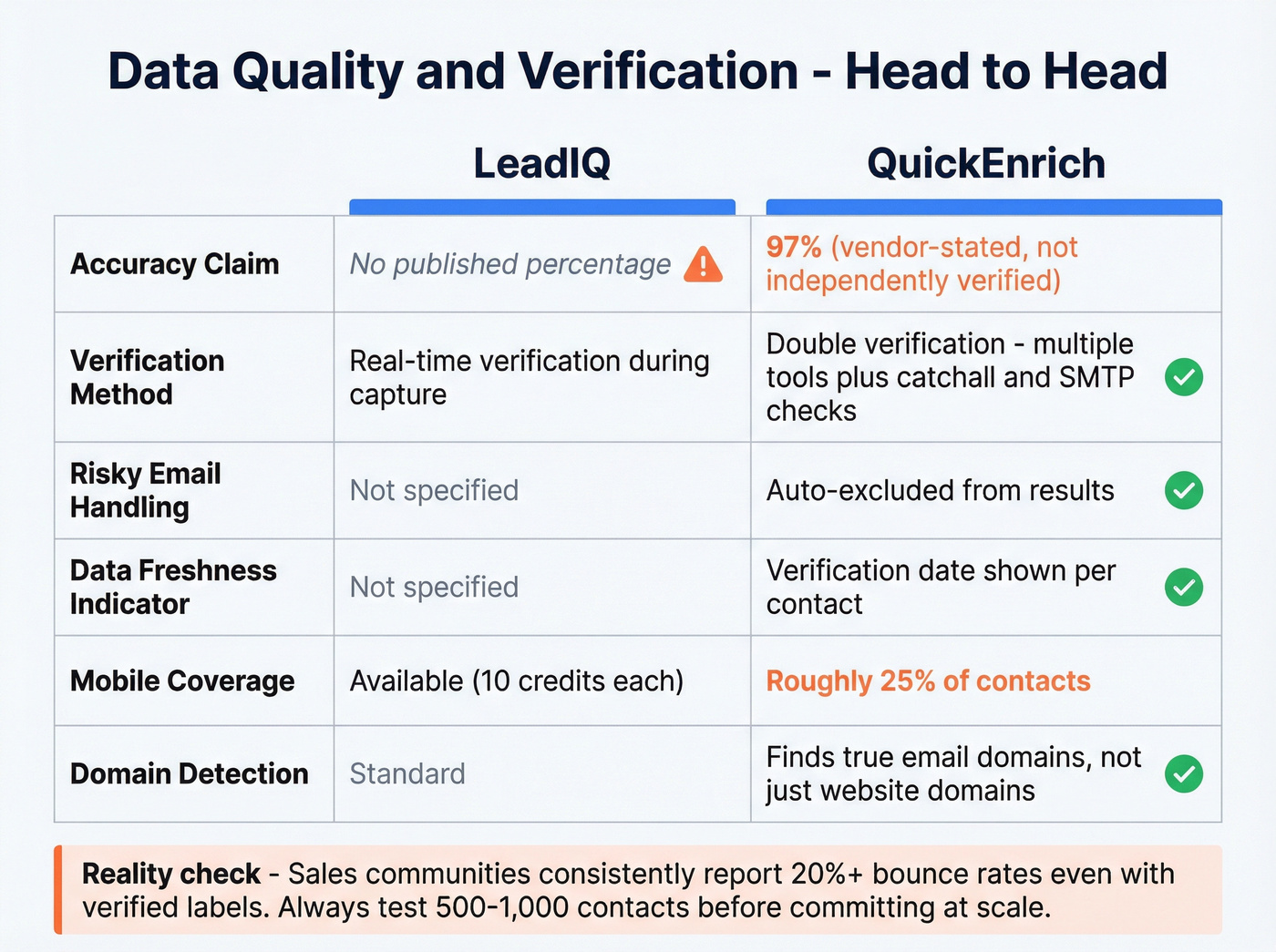
LeadIQ positions itself around real-time data verification during the capture workflow. No published accuracy percentage, though, which makes apples-to-apples comparison impossible.
Let's be honest: sales communities on Reddit consistently report 20%+ bounce rates even when tools label emails as "verified." We've seen this ourselves across multiple platforms. Run a test batch of 500-1,000 contacts before committing to either tool at scale - it's the only way to know what your actual deliverability will look like. (If you want benchmarks and fixes, start with our guide on bounce rates.)


Bounce rates above 20% destroy your domain reputation and waste credits you already paid for. Prospeo's 5-step verification with catch-all handling and spam-trap removal delivers 98% email accuracy - verified independently, not just vendor-claimed.
Test 75 emails free and see your actual bounce rate drop.
Workflow & Integrations
LeadIQ is a prospecting tool that happens to have data. QuickEnrich is a data tool that happens to have an API. They're solving different problems. (If you're building a modern outbound stack, see our roundup of SDR tools.)
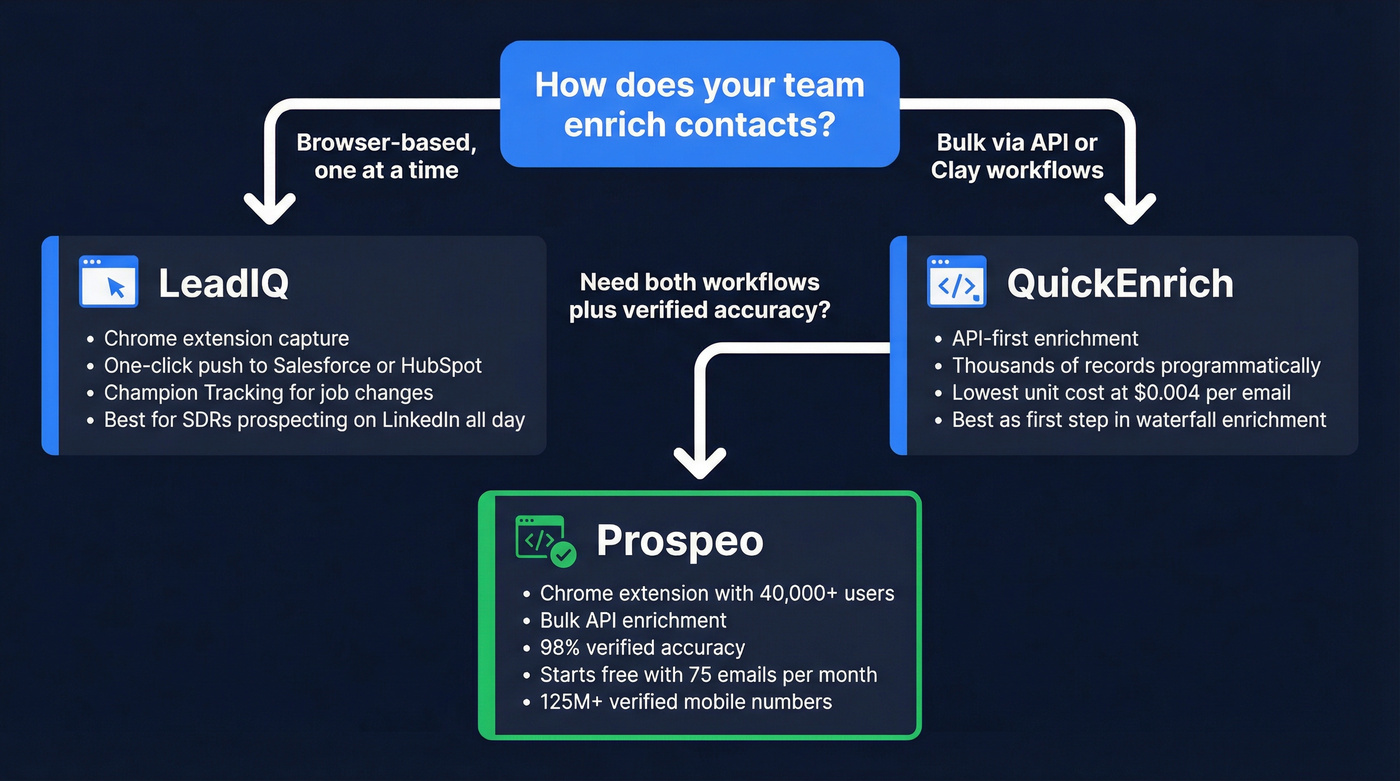
For reps who prospect in-browser and need one-click capture to Salesforce or HubSpot with job change alerts baked in, LeadIQ fits. For teams running bulk enrichment through API calls or Clay workflows and enriching thousands of records programmatically, QuickEnrich fits. QuickEnrich also pushes a "use us first" message for waterfall stacks, and the unit economics support trying it early in your enrichment sequence. (If you're doing this at scale, our Clay list building guide breaks down the real workflow and costs.)
Trust Signals
This matters more than most buyers realize.
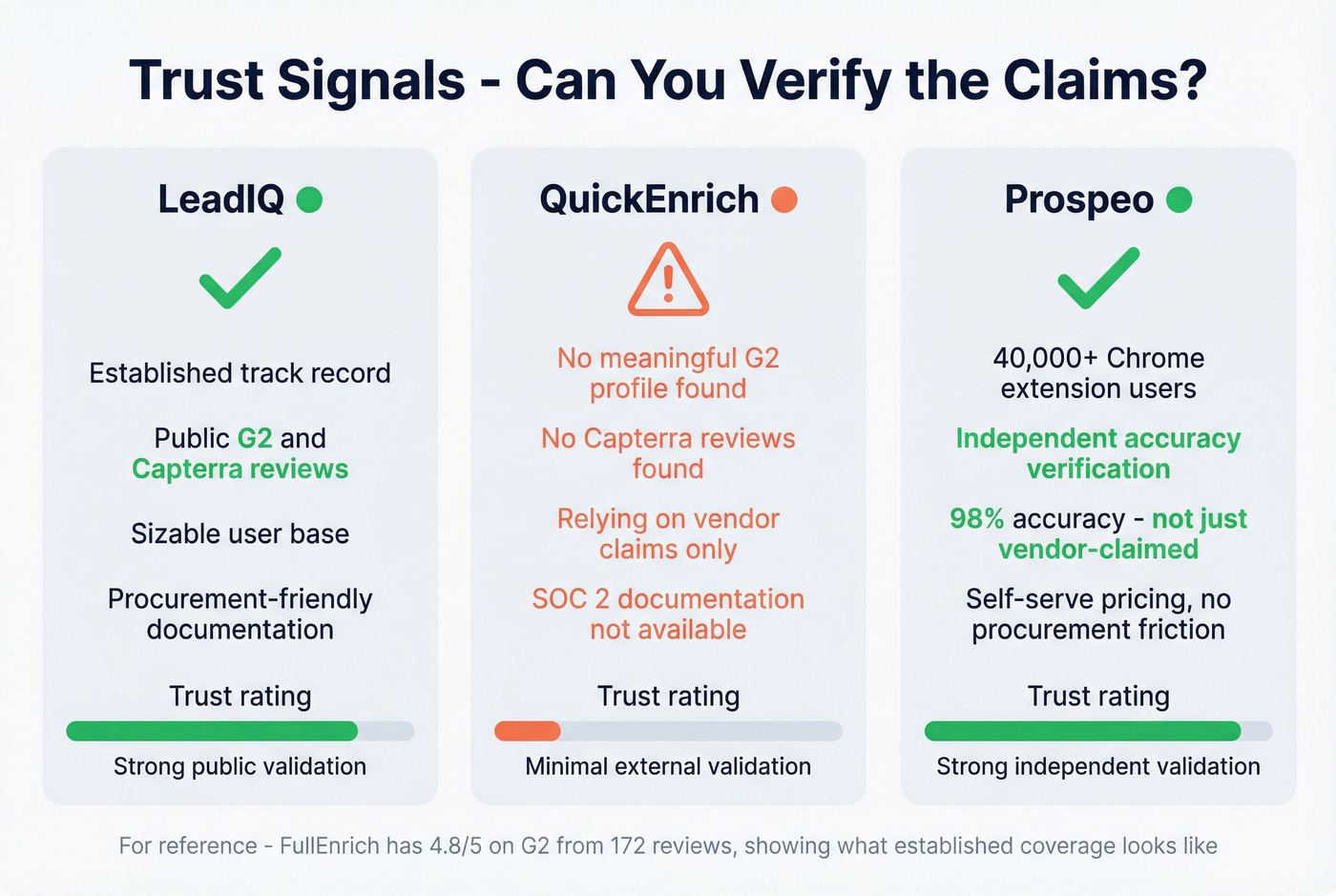
In our research, QuickEnrich has virtually no third-party review coverage - we didn't find a meaningful G2 or Capterra profile with real user reviews. That doesn't mean the tool is bad, but you're relying heavily on vendor claims with no external validation. For context, FullEnrich has a G2 rating of 4.8/5 from 172 reviews - that's what established coverage looks like. LeadIQ has a much longer track record with public reviews and a sizable user base.
Skip QuickEnrich if your procurement team requires third-party validation or SOC 2 documentation before approving a vendor. You won't find what they need.
A Third Option Worth Testing
Prospeo also ships with 30+ search filters including buyer intent data powered by Bombora across 15,000 topics, technographics, and job change signals - turning it from a simple enrichment tool into a full prospecting database. The Chrome extension (40,000+ users) works on professional profiles, company websites, and CRMs, so browser-based reps get LeadIQ-style convenience without the credit anxiety. Pricing starts free with 75 emails/month and scales at ~$0.01/email with no contracts. (If you're comparing vendors broadly, start with our list of data enrichment services and the deeper dive on lead enrichment.)
LeadIQ's 10-credit phone lookups drain budgets fast. QuickEnrich's 25% mobile coverage leaves gaps. Prospeo gives you 125M+ verified mobile numbers with a 30% pickup rate - plus the browser extension and bulk API enrichment in one platform.
Stop choosing between workflow convenience and unit economics.
Final Verdict
Pick LeadIQ if your SDRs need instant browser-to-CRM capture and your budget absorbs 10-credit phone lookups. Expect $6,096-$58,240/year (median $26,400).
Pick QuickEnrich if you're enriching in bulk via API or Clay and you're comfortable adopting a tool with limited public reviews. Budget $29-$99/mo.
Pick Prospeo if you want 98% verified accuracy, weekly-fresh data, and self-serve pricing you can predict without a spreadsheet. (If deliverability is a priority, pair enrichment with an email deliverability guide and a process for spam trap removal.)
The right LeadIQ vs QuickEnrich choice hinges on workflow - browser-first prospecting vs. programmatic enrichment. But if you need both use cases covered with stronger data quality and actual third-party validation, Prospeo bridges that gap.
FAQ
What's the main difference between LeadIQ and QuickEnrich?
LeadIQ is a browser-based prospecting tool with native CRM integrations; QuickEnrich is an API-first bulk enrichment tool. LeadIQ costs roughly 100x-1,000x more per found email but offers a richer workflow with Champion Tracking. QuickEnrich is cheaper but has minimal public reviews.
Why does LeadIQ feel expensive for phone numbers?
Phone lookups cost 10 credits - the same as 10 email lookups. A rep pulling 20 phones daily burns 200 credits, which is the single biggest driver of LeadIQ's effective cost-per-contact. Teams spending over $20k/year on LeadIQ often find 60%+ of credits going to phone lookups alone.
Does QuickEnrich include mobile numbers?
Yes, but roughly 25% of enriched contacts return with a mobile. That's workable for email-first workflows but thin for dial-heavy teams. Prospeo returns 125M+ verified mobiles with a 30% pickup rate - a stronger option if direct dials drive your pipeline.