

ListKit vs MailCleanup: Different Tools, Different Jobs
ListKit vs MailCleanup isn't a typical head-to-head - it's more like comparing a car dealership to a car wash. One helps you get the car. The other helps you stop ruining the one you already own.
30-Second Verdict
ListKit is a B2B lead database. You search, filter, and export prospect lists by job title, industry, company size, and more. It triple-verifies emails before export, so verification is baked into the sourcing workflow.
MailCleanup is a standalone email list cleaner. You use it when you already have a list - from events, scraped sources, partners, or an old CRM dump - and you need to strip out risky addresses before hitting send.
Use ListKit when you need fresh lead data with built-in verification for ongoing outbound.
Use MailCleanup when you've got existing lists from multiple sources and need cheap, fast cleaning.
The Real Difference
Here's the thing: these tools don't compete with each other. They solve different problems at different stages of the pipeline.
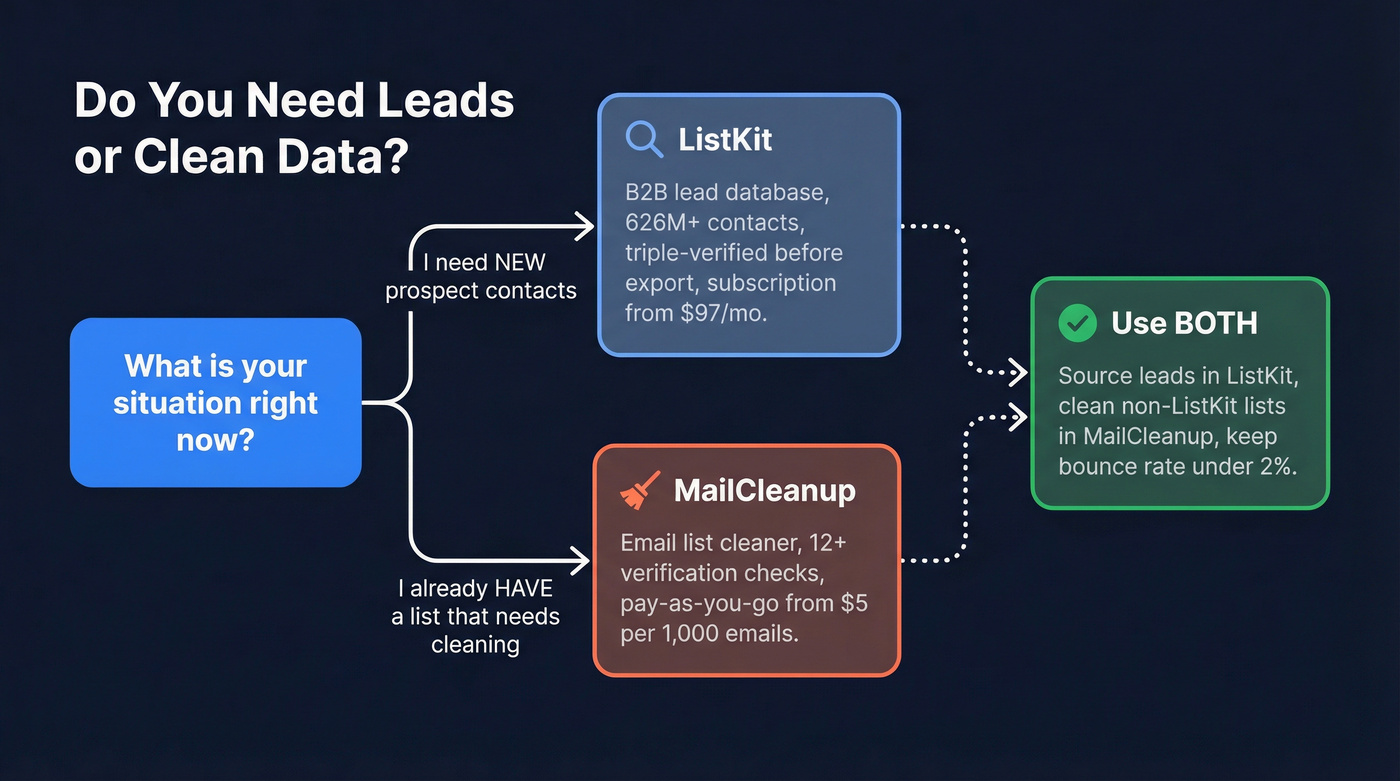
Scenario 1: You bought a lead list from a broker six months ago, loaded it into your sequencer, and your bounce rate hit 8%. That's 4x the 2% ceiling that most deliverability guidance recommends, and it's how domains get burned. You don't need more leads - you need to clean the ones you have. That's MailCleanup's job: upload the CSV, pay $30 for 25,000 verifications, download a safer file.
Scenario 2: You need 10,000 verified VP-level emails in SaaS this week. You don't have a list yet. That's a lead database problem. ListKit verifies before export, so if you source exclusively through it, many teams skip a separate cleaning tool entirely.
Side-by-Side Comparison
| ListKit | MailCleanup | |
|---|---|---|
| Category | B2B lead database | Email list cleaner |
| What it does | Sources + verifies leads | Cleans existing lists |
| Pricing model | Subscription (credit-based) | Pay-as-you-go packs |
| Starting price | $0/mo (100 credits) / $97/mo paid | $5 for 1,000 emails |
| Cost for 25K emails | ~$253/mo (Scale plan) | $30 (one-time) |
| Verification | Triple-verified pre-export | 12+ checks (SMTP, MX, etc.) |
| G2 rating | G2 rating | 5.0/5 (4 reviews) |
| Best for | Teams needing fresh lead data + verification | One-off list cleaning on a budget |
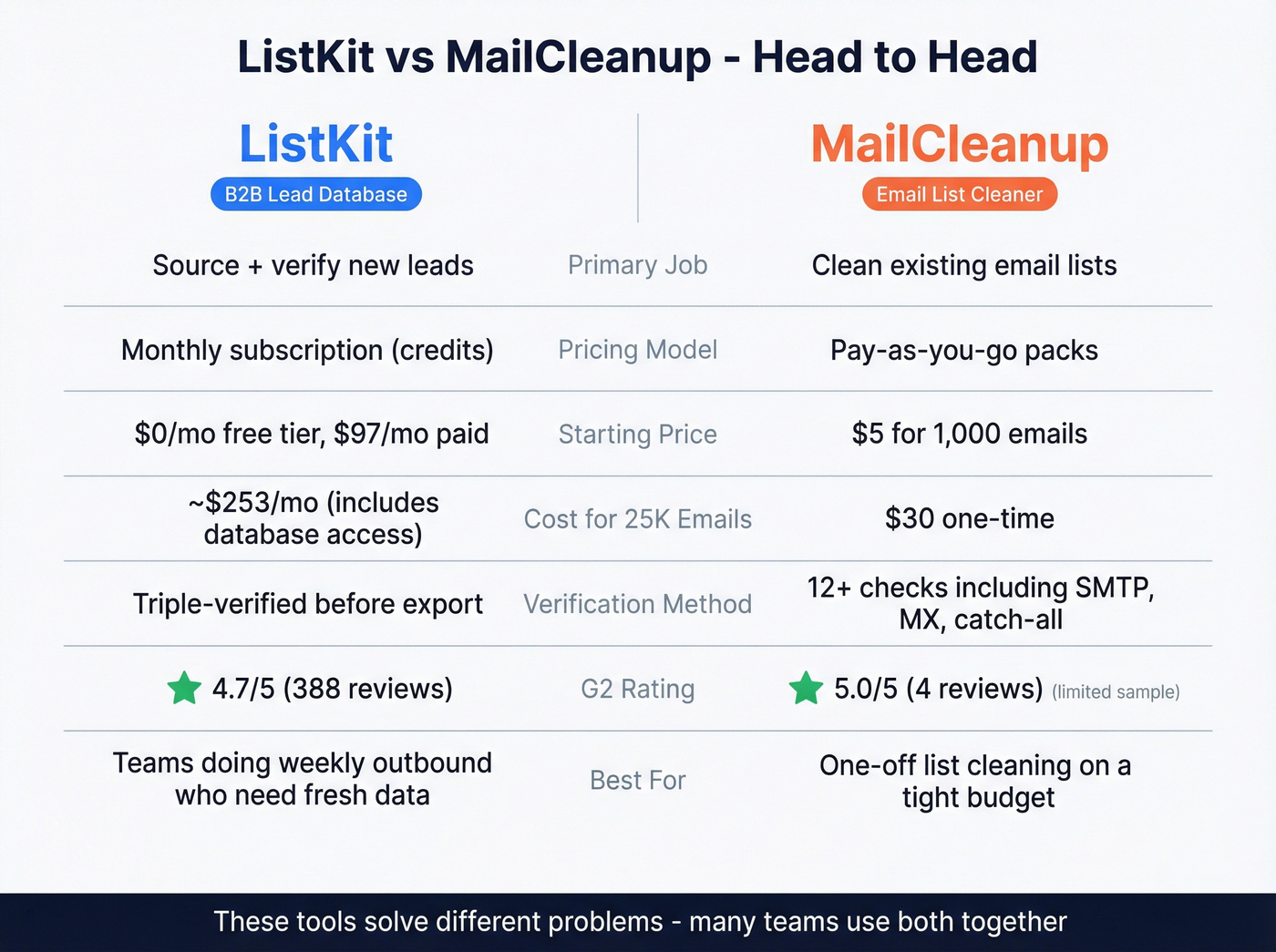
The pricing gap only looks weird if you pretend both tools do the same job. MailCleanup's $30 is a pure cleaning fee. ListKit's ~$253/mo includes the database, filtering, and exports - verification is bundled into the sourcing subscription.


Why juggle ListKit for sourcing and MailCleanup for verification? Prospeo combines 300M+ profiles, 143M+ verified emails, and built-in 5-step verification - all refreshed every 7 days. At ~$0.01/email with 98% accuracy, you replace two tools with one.
One platform. Sourcing and verification. 75 free emails to prove it.
ListKit Overview
ListKit's 626M+ contact database with triple-verification is the main draw. You search, filter, and export - verification happens before the data leaves the platform. The plain-English search is a genuine quality-of-life upgrade when you don't want to babysit Boolean logic all afternoon.
We've found ListKit works best for teams doing consistent outbound every week, because it removes the "where do we get leads?" question and keeps the workflow simple. Pricing typically lands around $83-$508/mo on annual billing, with $97/mo as a common paid starting point depending on plan and billing cycle.
One caution worth flagging: we've seen "triple-verified" lists still produce enough bounces to matter at scale. The consensus on r/coldemail is that no single verification layer is bulletproof. Run a small test batch first, and check recent G2 reviews - not just the averages.
If you're building lists as part of a broader outbound motion, it also helps to tighten your sales prospecting techniques so you're not just exporting bigger lists.
MailCleanup Overview
MailCleanup does one thing: it takes a list you already have and makes it safer to send. It runs 12+ checks including SMTP verification, catch-all detection, disposable email filtering, MX validation, and bounce-risk signals. Upload a CSV, wait a bit, download the cleaned file. No onboarding ceremony, no subscription commitment.
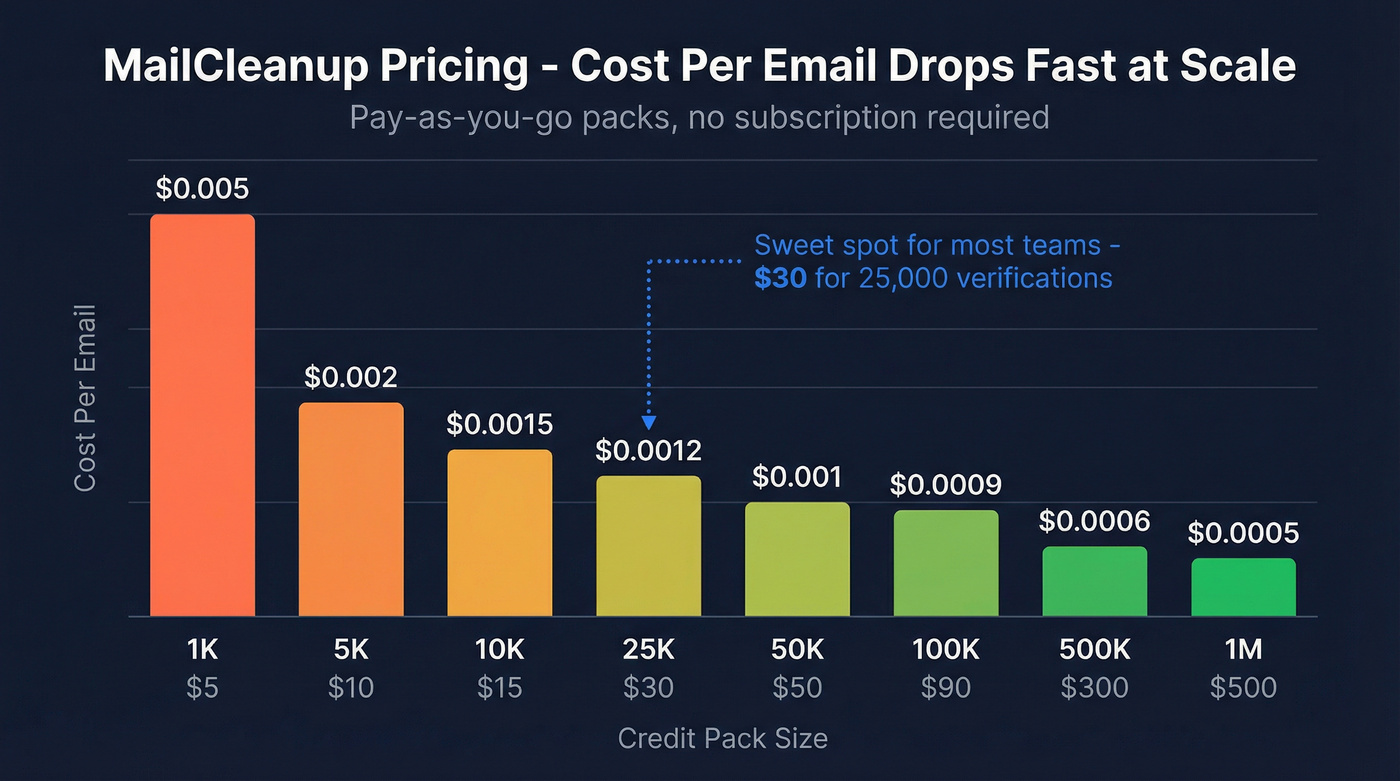
The pricing is genuinely hard to beat for one-off cleanup. A Software Advice reviewer explicitly said they switched from ZeroBounce because it was "way too costly" by comparison.
| Credits | Price | Per Email |
|---|---|---|
| 1,000 | $5 | $0.005 |
| 5,000 | $10 | $0.002 |
| 10,000 | $15 | $0.0015 |
| 25,000 | $30 | $0.0012 |
| 50,000 | $50 | $0.001 |
| 100,000 | $90 | $0.0009 |
| 500,000 | $300 | $0.0006 |
| 1,000,000 | $500 | $0.0005 |
G2 reviewers mention limited credit flexibility and sparse product documentation in places, so buy the tier that matches your list size upfront to avoid awkward leftovers.
Don't fall for "99% accuracy" marketing from any verifier. Hunter's benchmark across 15 verification tools put the best performers around 67-70% in real-world testing. That's why we always recommend a small test batch before you scale.
If you want a deeper breakdown of what verification can and can't catch, see our guide on email bounce rate and how it impacts deliverability.
When to Use Each Tool
Building lists from scratch every week? Pick ListKit. It's sourcing plus pre-export verification in one motion.
Already sitting on CSVs from events, partners, or old exports? Pick MailCleanup. It's the cheapest way to reduce bounces fast.
Mixing sources? Use both. Source in ListKit, then run the non-ListKit chunk through MailCleanup. Deliverability guidance: keep total bounces under 2%, and aim for hard bounces under 1% if you want your sending infrastructure to last.
If you're scaling outbound, it’s worth pairing this with an email deliverability guide and tracking safe email velocity so you don’t fix bounces but break reputation.
Let's be honest about one more thing: if your deal sizes are modest and you're emailing a few hundred prospects a week, you don't need an "all-in-one" sales data universe. You need clean data and a repeatable workflow. Most teams overbuy here.
A simple way to keep the workflow repeatable is to standardize your lead generation workflow and document what happens before a list ever hits your sequencer.
A Third Option Worth Considering
If you're tired of stitching together a database tool and a separate verifier, Prospeo puts sourcing and verification in the same place. It includes 300M+ professional profiles, 143M+ verified emails, and 125M+ verified mobile numbers, with 98% email accuracy on a 7-day refresh cycle. Self-serve, transparent pricing, no contracts.

Pricing works out to roughly $0.01 per email, plus a free tier with 75 emails/month so you can test it before spending anything.
If you're comparing databases more broadly, our roundup of sales prospecting databases can help you sanity-check pricing and data coverage.
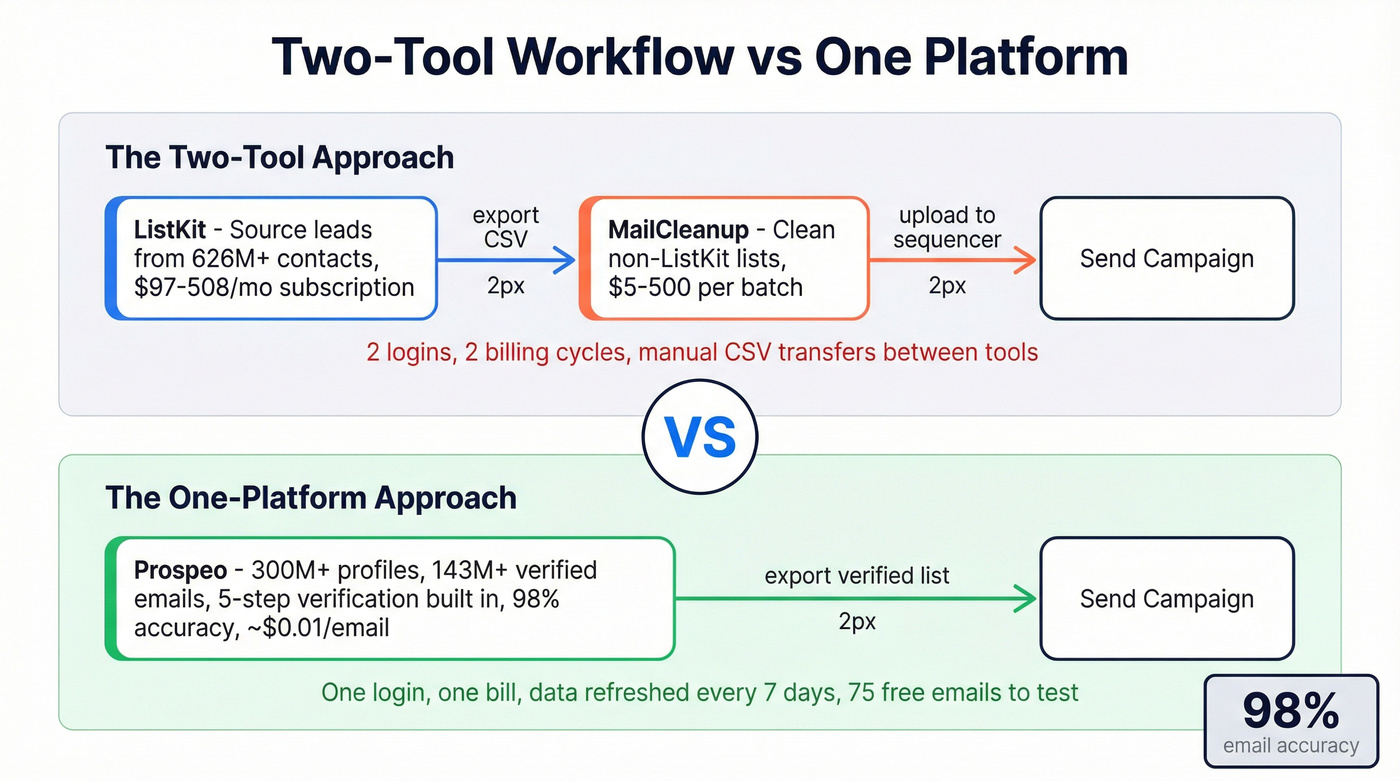
ListKit triple-verifies but bounces still slip through. MailCleanup catches them after the fact. Prospeo's proprietary 5-step verification - with catch-all handling, spam-trap removal, and honeypot filtering - hits 98% accuracy before export. No second tool needed.
Skip the two-tool workflow. Start with data that's already clean.
FAQ
Should I use ListKit, MailCleanup, or both?
Use ListKit when you need to source new leads. Use MailCleanup when you need to clean lists you already have. If you pull leads from multiple places - a database, scraped sites, event signups - it's completely normal to use both in the same workflow.
Is MailCleanup accurate enough for cold email?
It covers the core checks (SMTP, MX, catch-all, disposable, spamtrap signals) and costs as little as $0.0005/email at volume. No verifier is perfect in real-world conditions, though, so send a 200-500 email test batch and watch bounces before scaling.
Is there a tool that handles both lead sourcing and verification?
Prospeo combines a 300M+ leads database with built-in 5-step email verification, delivering 98% accuracy on a 7-day data refresh cycle. It also includes a free tier (75 emails/month), so you can validate results before committing to a paid plan.