


Lusha vs NeverBounce: Prospecting Tool or Email Verifier?
Comparing Lusha and NeverBounce is like comparing a fishing rod to a fish scaler. One finds contacts. The other cleans the list you already have. They don't compete - they solve different problems in the same workflow.
The confusion happens because Lusha now markets itself as a replacement for dedicated verification tools, and NeverBounce sits adjacent to prospecting in every "best tools" list. Let's cut through it.
30-second verdict: If you need contact data, Lusha works for small-volume lookups but credits get expensive fast. If you need to clean an existing list, NeverBounce handles bulk verification well. If you need to find and verify contacts without stitching two tools together, skip both - Prospeo does it in one workflow at ~$0.01/email with 98% accuracy.
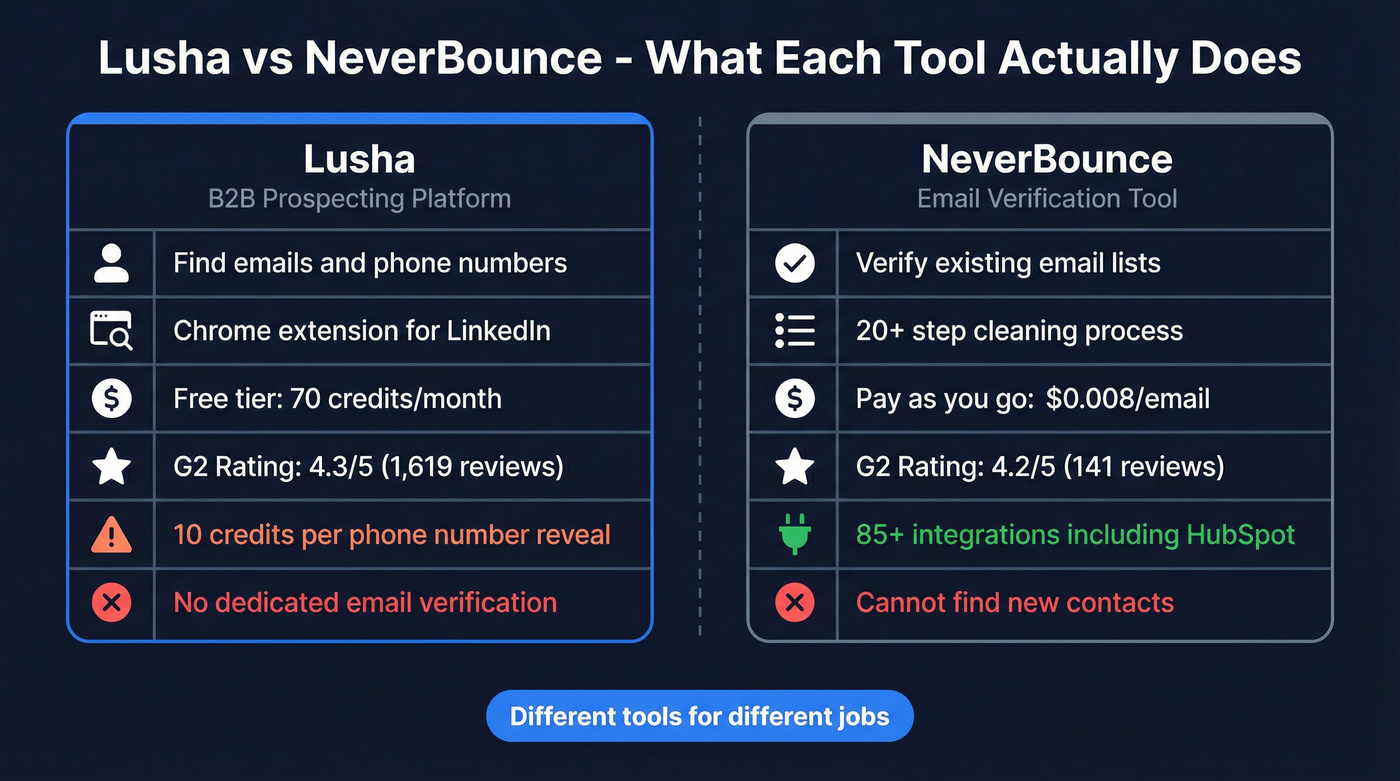
Feature Comparison at a Glance
| Lusha | NeverBounce | |
|---|---|---|
| Category | B2B prospecting | Email verification |
| Primary use | Find contact data | Clean email lists |
| Starting price | Free (up to 70 credits/mo) | $0.008/email PAYG |
| G2 rating | 4.3/5 (1,619 reviews) | 4.2/5 (141 reviews) |
| Best for | Quick contact reveals | Bulk list cleaning |
| Free tier | Up to 70 credits/month | None (PAYG or subscription) |
| Pick this if... | You need emails and phone numbers fast | You have a list and need to scrub it before sending |
What Lusha Does
Lusha is a B2B prospecting platform, not a verification tool - no matter what their marketing suggests. You install the Chrome extension, browse professional profiles or company websites, and reveal emails and phone numbers on the spot. Their recommended workflow is upload a raw list, enrich and validate it, then push clean contacts into Outreach or Salesloft. It's fast, intuitive, and the free tier lets you test without commitment.

Here's where the economics get tricky. Revealing a verified email costs 1 credit. Revealing a phone number costs 10. That free tier evaporates after 7 phone lookups - seven. Paid plans start around $29/month, but heavy prospectors burn through credits in days. The credit-per-phone-number model makes Lusha one of the most expensive options for teams that need direct dials at any real volume, and its Capterra Value for Money score of 3.7/5 reflects that tension: users like the product but feel the pinch on pricing.
Use Lusha if you need quick contact lookups for small-volume outbound and already have a separate verification step. Skip it if you're running campaigns at scale or need dedicated email validation.
What NeverBounce Does
NeverBounce is a pure-play email verification tool. Upload a CSV, and it runs every address through a 20+ step cleaning process - mail server validation, domain health checks, risk detection, spam-trap identification. A 10K-email list typically processes in 2-10 minutes.
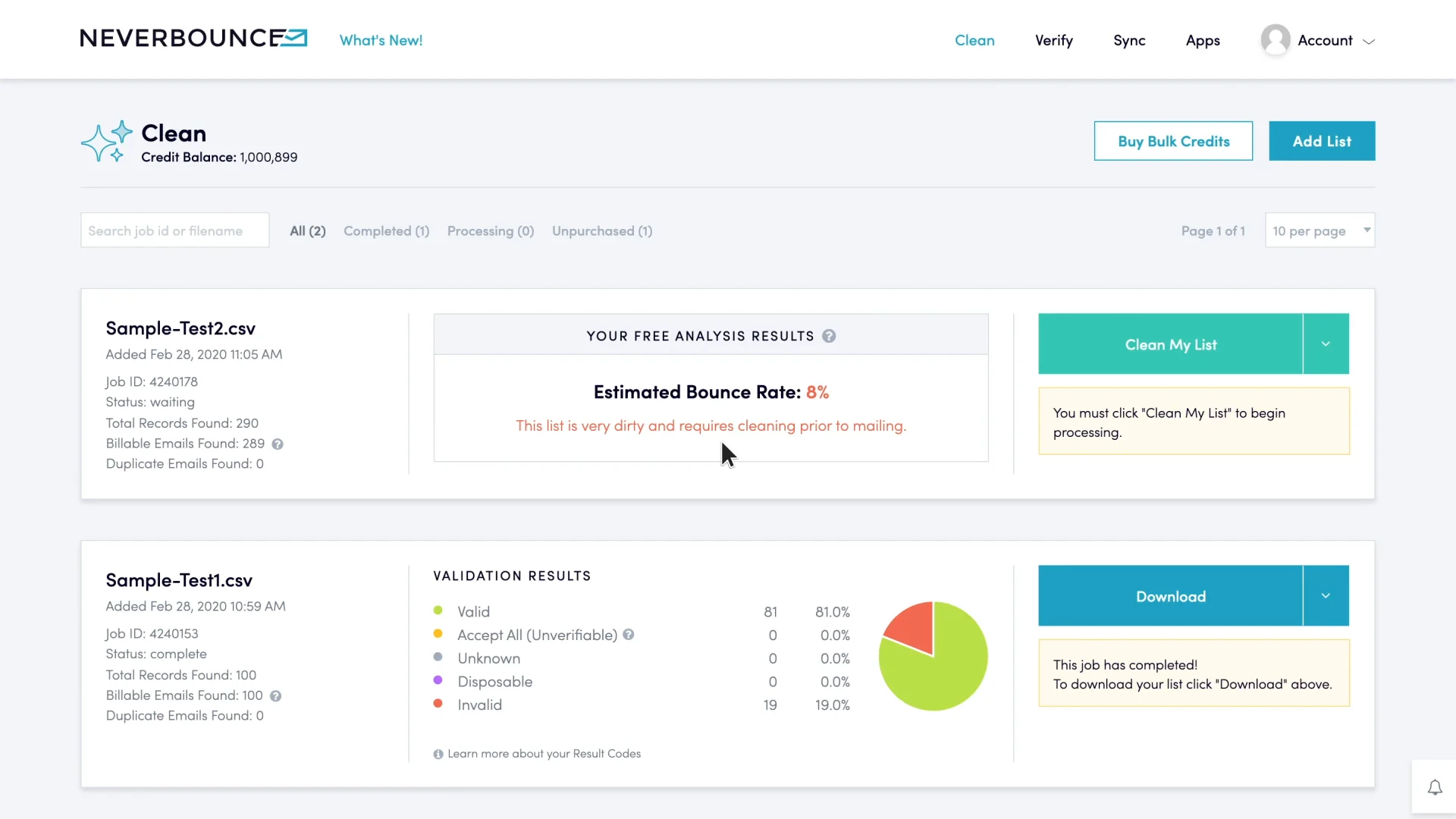
Results come back categorized as valid, invalid, catch-all, unknown, or disposable. The platform plugs into 85+ integrations including HubSpot, Mailchimp, Zapier, and n8n, and there's a JavaScript widget for real-time form verification on your website. It doesn't find contacts. It just tells you whether the ones you already have are any good.

NeverBounce verifies emails at 93-95% real-world accuracy. Lusha finds contacts but charges 10 credits per phone number. Prospeo does both - 300M+ profiles, 98% email accuracy, 125M+ verified mobiles - in a single workflow at ~$0.01/email.
Ditch the two-tool tax and cut your bounce rate below 2%.
Pricing Compared
This is where the comparison gets interesting, because these tools price fundamentally different things.
| NeverBounce | Lusha | |
|---|---|---|
| Entry price | $0.008/email (PAYG) | Free (up to 70 credits/mo) |
| Paid plan | $49/month (up to 10,000 emails) | ~$29/month (limited credits) |
| Phone numbers | N/A | 10 credits per reveal |
| Credit expiry | 12 months | Monthly; unused credits roll over up to 2x plan limit |
Let's model a real scenario. You need to verify 10,000 emails per month. NeverBounce costs $49/month on the Growth plan. Finding and revealing those same 10,000 contacts through Lusha? At ~$29/month for a limited credit allotment, you'd need to upgrade to a significantly higher tier - expect $200+/month - and you still don't get dedicated verification.
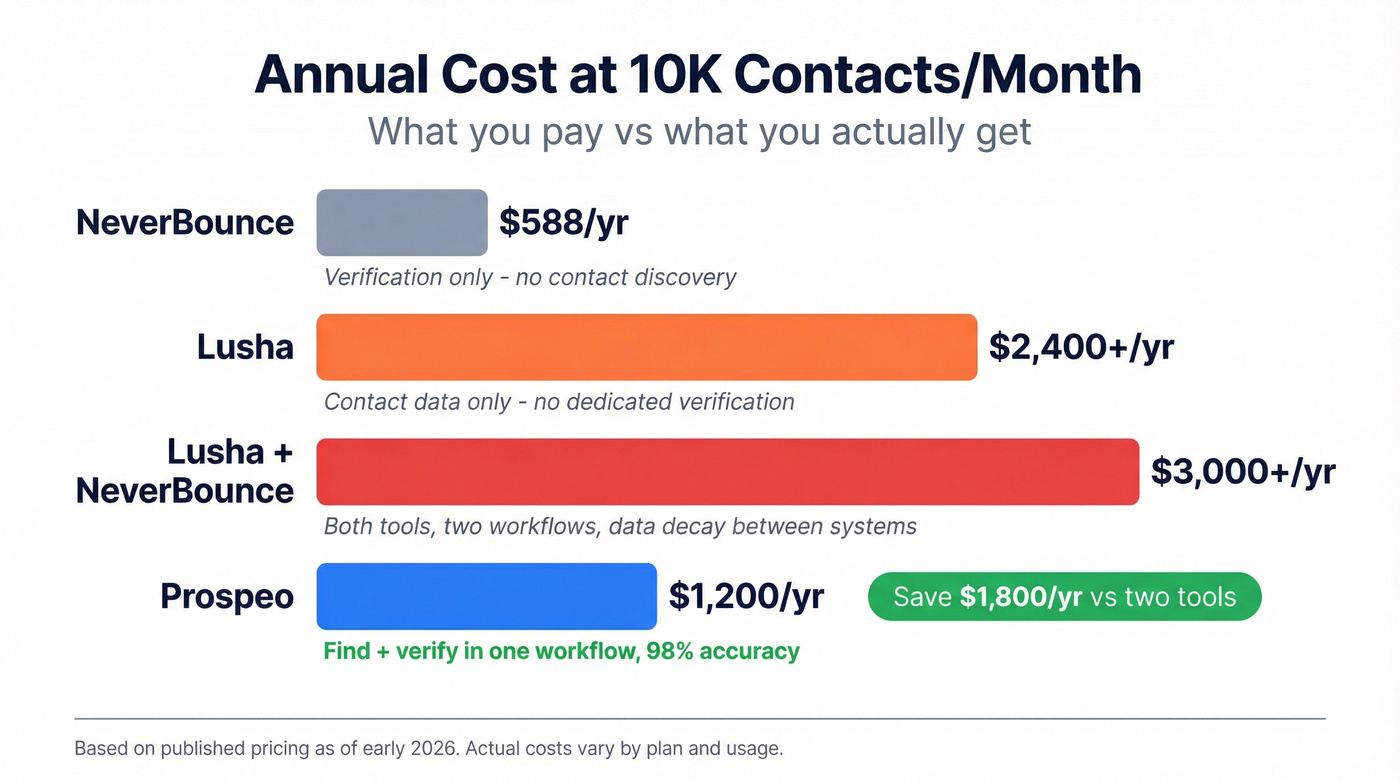
Annual cost at 10K contacts/month:
| Tool | Annual cost | What you get |
|---|---|---|
| NeverBounce | ~$588/yr | Verification only |
| Lusha | ~$2,400+/yr | Contact data only |
| Lusha + NeverBounce | ~$3,000+/yr | Both, two workflows |
| Prospeo | ~$1,200/yr | Find + verify, one workflow |
That's the math. Two tools and two subscriptions cost roughly 2.5x what a single platform costs for the same output.
What Users Actually Say
We spent time combing through G2, Capterra, and Reddit threads to get past the marketing claims. Here's the pattern.
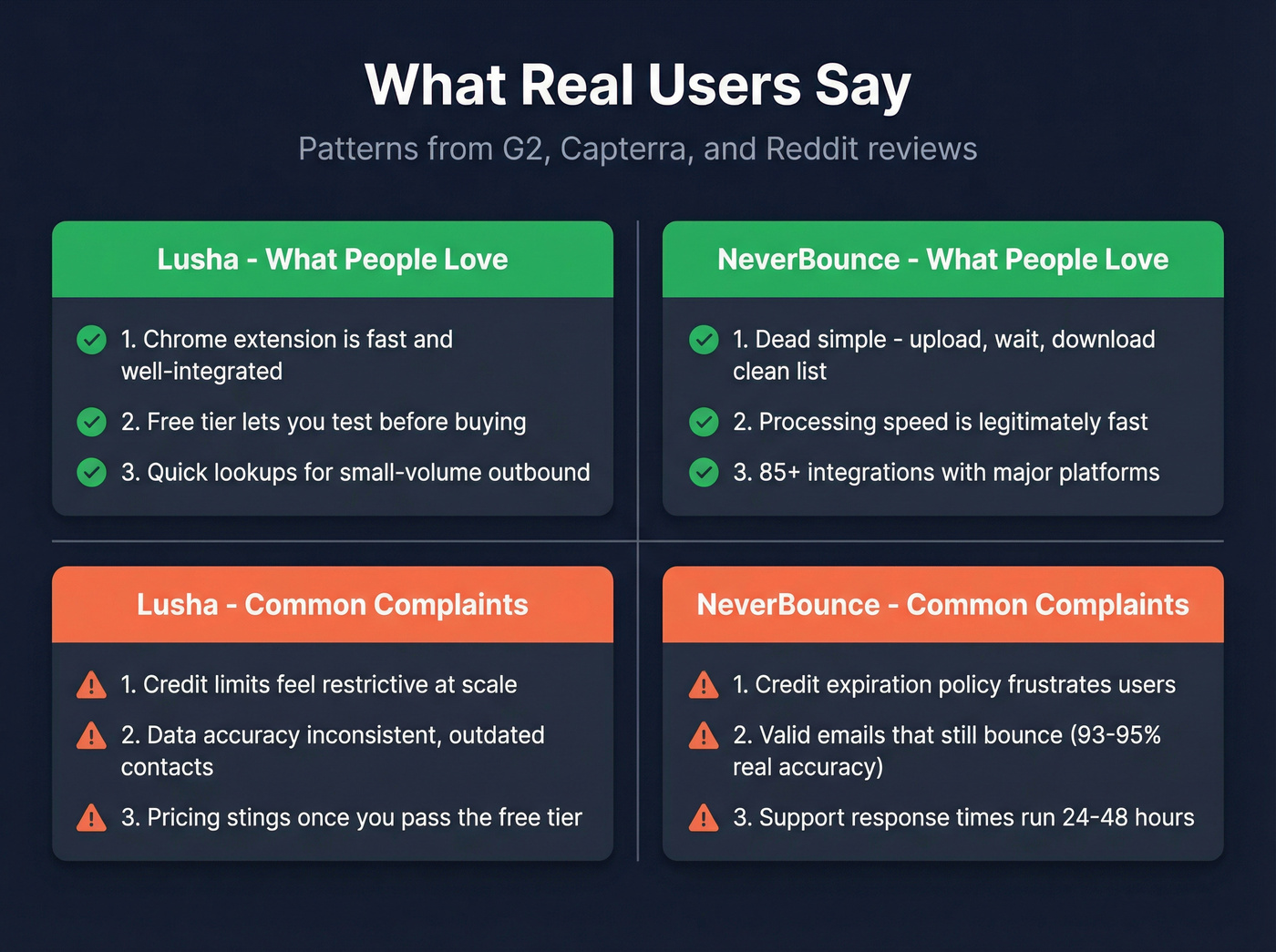
Lusha - what people love:
- Chrome extension is genuinely fast and well-integrated with CRM workflows
- Free tier lets you test before committing
Lusha - what people complain about:
- Credit limits feel restrictive for anything beyond light prospecting
- Data accuracy is inconsistent - outdated contacts are a recurring theme in G2 reviews
- The pricing stings once you scale past the free tier
NeverBounce - what people love:
- Dead simple to use - upload, wait a few minutes, download a clean list
- Processing speed is legitimately fast
NeverBounce - what people complain about:
- Credit expiration policy frustrated long-time users, and it's called out directly in multiple G2 reviews
- "Valid" emails that still bounce - in one independent test of 1,003 emails, 3 out of 795 "valid" addresses bounced, putting real-world accuracy closer to 93-95%
- Support response times run 24-48 hours
Here's the thing: neither tool's user base is unhappy with the core product. The frustration is almost always about pricing or about hitting the ceiling of what a single-purpose tool can do.
Which Tool Should You Choose?
You have a list and need to clean it. NeverBounce is the straightforward pick. If its credit expiration policy bothers you, ZeroBounce (starting ~$0.008/email, with AI-based email scoring) and MillionVerifier (~$0.003/email for bulk lists, the cheapest per-email option we've seen) are both worth testing.
If you’re optimizing for deliverability end-to-end, it also helps to understand bounce rates and how they impact sender reputation.
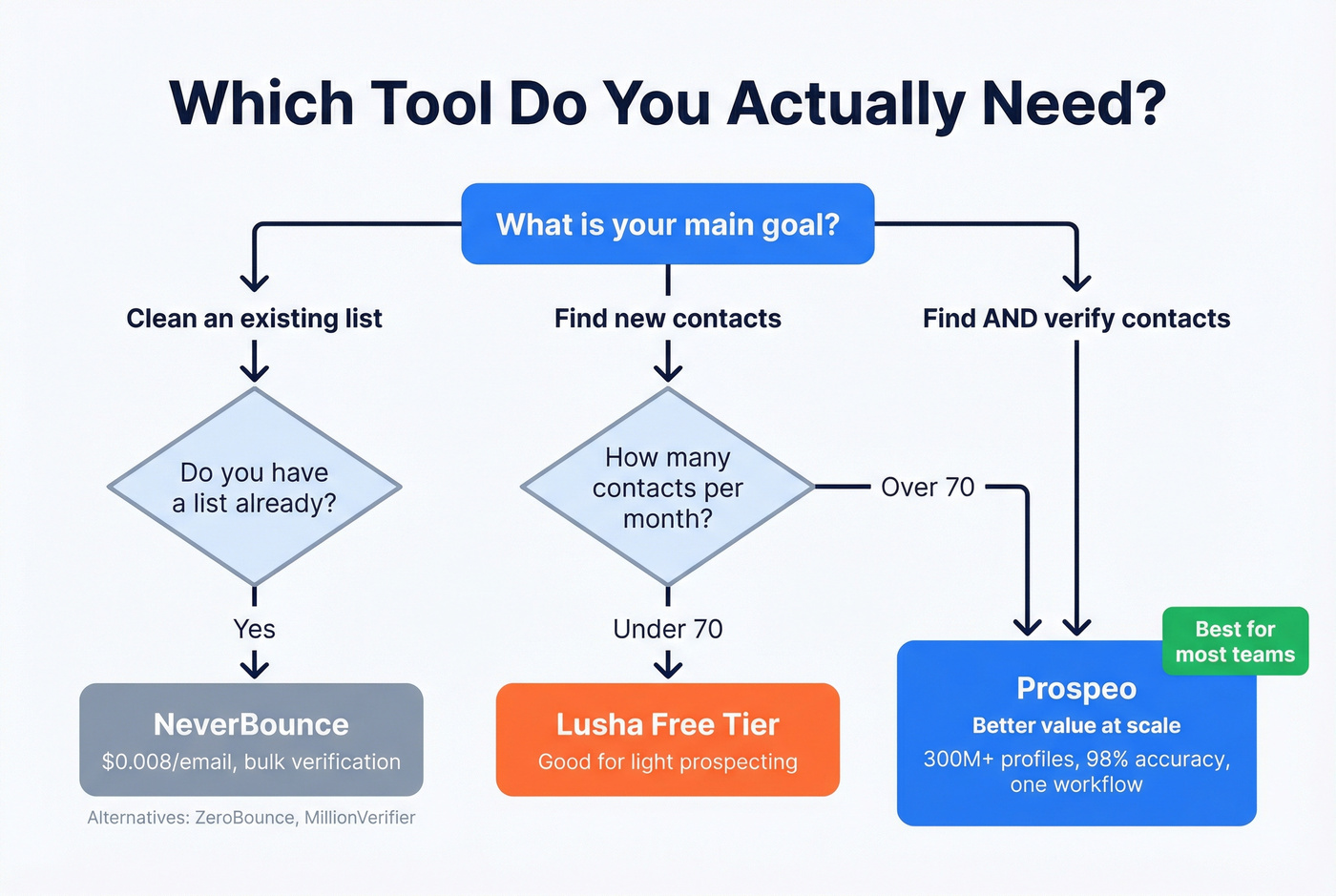
You need contact data for prospecting. Lusha works for small-volume lookups where the Chrome extension workflow fits your process. Just know that credits disappear fast once you start pulling phone numbers. If you’re building a repeatable outbound motion, these sales prospecting techniques can help you get more from the same data.
You need to find and verify contacts. Neither tool solves this alone. You'd need Lusha plus NeverBounce, which means two subscriptions, two workflows, and data decaying while it moves between systems.
For teams that want everything in one place, we've found that consolidating discovery and verification into a single platform eliminates the data decay problem entirely. Industry benchmarks say to keep bounce rates below 2%, with top teams targeting under 1% - that's hard to hit when your prospecting tool and verification tool don't talk to each other. If you’re sending at scale, managing email velocity matters just as much as list quality.
What If You Need Both?
Look, running two separate tools for finding and verifying contacts is a workflow from 2019. Prospeo combines a 300M+ contact database with built-in 5-step email verification - 98% accuracy on a 7-day data refresh cycle, where the industry average is 6 weeks. No contracts, no annual commitments, and a free tier with 75 emails and 100 Chrome extension credits per month.
If you’re comparing broader stacks, it’s worth looking at data enrichment services and how they fit alongside verification.
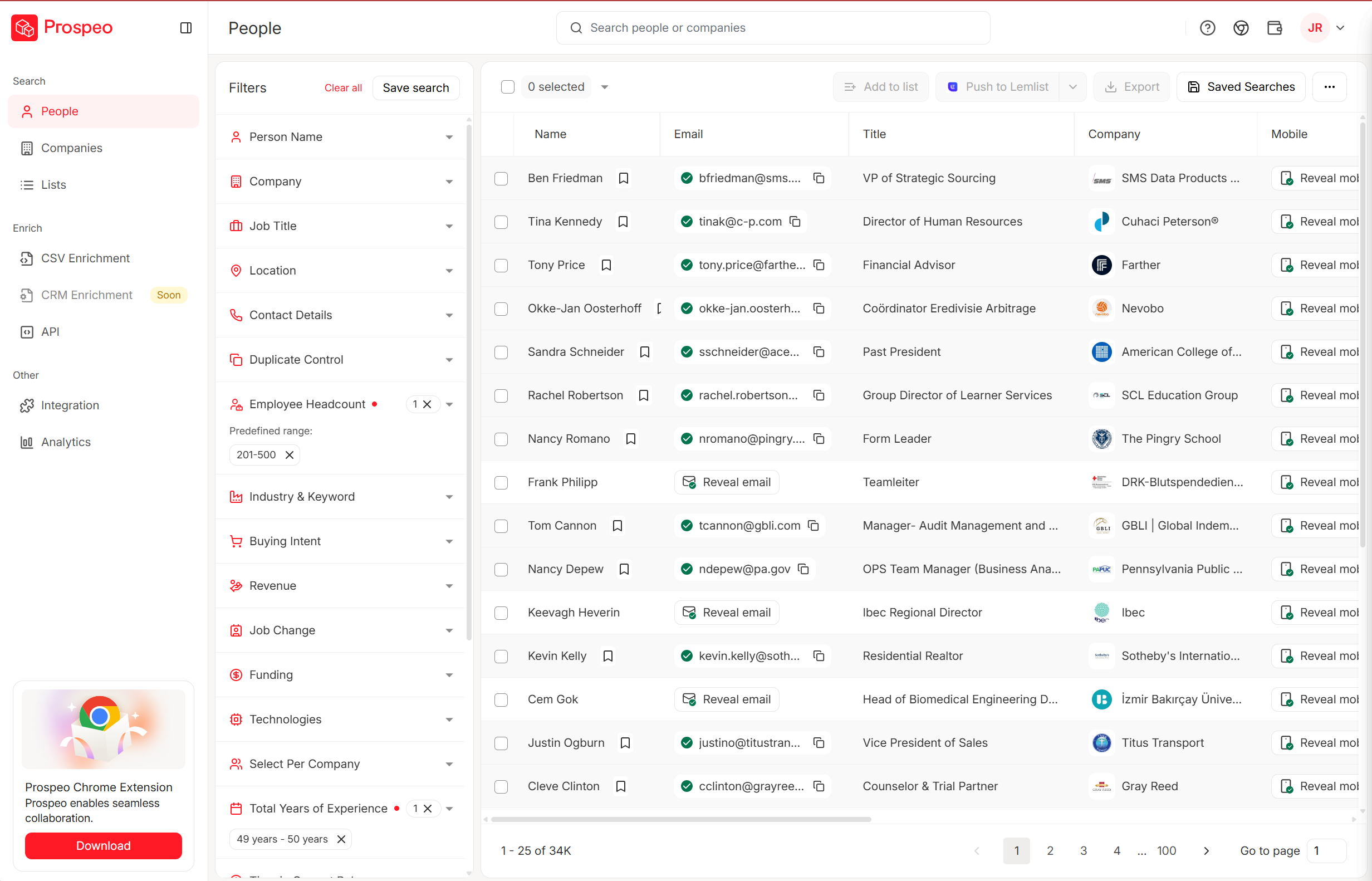
One customer, Meritt, cut bounce rates from 35% to under 4% and tripled their pipeline after switching from a multi-tool stack. We've seen that pattern repeat across dozens of teams - consolidating discovery and verification into one platform eliminates the data decay that happens when contacts sit in export limbo between tools. To keep the rest of your outbound tight, pair clean data with strong email copywriting and better prospecting email subject lines.
The article math doesn't lie: Lusha + NeverBounce costs ~$3,000+/yr for 10K contacts/month. Prospeo delivers the same output - contact discovery, 5-step verification, CRM push - for ~$1,200/yr with data refreshed every 7 days, not 6 weeks.
Save $1,800/yr and get better data. Start with 75 free emails.
FAQ
Is Lusha an email verification tool?
No. Lusha is a B2B prospecting platform that reveals contact data via a Chrome extension and API. Its validation is a byproduct of enrichment - not a purpose-built multi-step verification process. If deliverability is your main concern, you need a dedicated verifier or a platform that bakes verification into contact discovery from the start.
How accurate is NeverBounce really?
NeverBounce advertises 98%+ accuracy, but independent testing puts real-world performance closer to 93-95%. In a 1,003-email test, 3 out of 795 "valid" emails still bounced - a 0.38% bounce rate on "verified" addresses. That's solid for bulk list cleaning, but don't expect perfection on catch-all domains or older addresses.
Can one tool replace both Lusha and NeverBounce?
Yes. Platforms that combine a contact database with built-in email verification eliminate the need for separate prospecting and cleaning tools. Prospeo, for example, pairs 300M+ profiles with 5-step verification at 98% accuracy - at roughly 60% less than running Lusha and NeverBounce together.