


Mail Rocket Review 2026: Pricing, Pros, Cons, and Whether It's Worth It
There are at least three products with "Rocket" and "Mail" in the name, and search results love to mix them up. Rocketmailer, MailerRocket, RocketReach - all different tools. This review covers Mail Rocket specifically: the Gmail and Google Sheets mail merge add-on at mailrocket.io that lets you send personalized bulk emails from your inbox. It's cheap and simple. Whether it's reliable enough to trust with your sender reputation is the real question.
30-Second Verdict
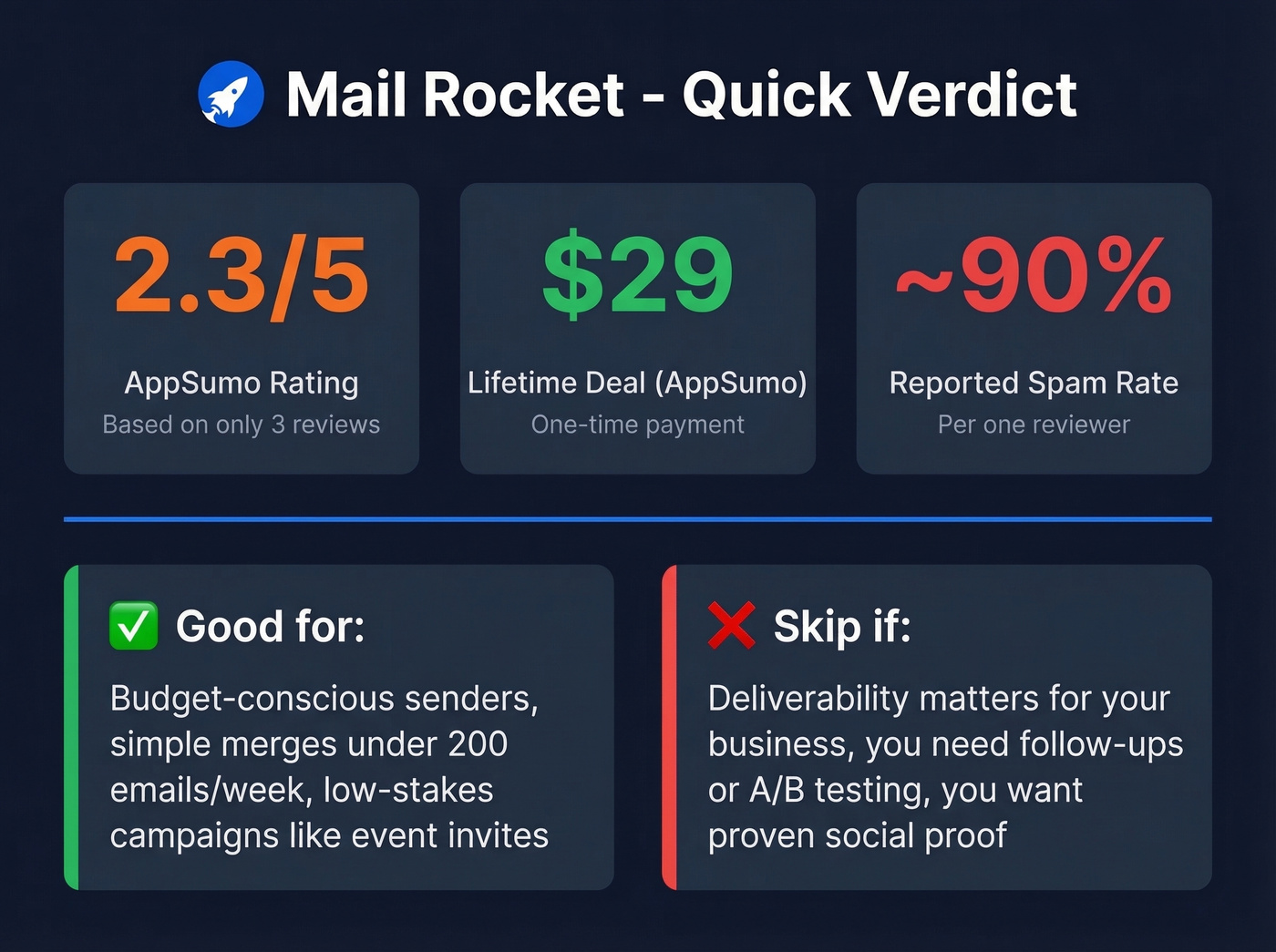
Budget pick: Mail Rocket's $29 AppSumo lifetime deal (when available) is one of the cheapest lifetime options for a Gmail mail merge add-on.
Reliable pick: GMass at $29.95/mo - battle-tested, with serious deliverability and automation features.
Best free tier: Mailmeteor, with 50 emails/day and a 4.9/5 rating from 11,741+ reviews.
Here's the catch with Mail Rocket: AppSumo shows an overall rating of roughly 2.3/5 based on just 3 reviews, and at least one reviewer reported their emails went straight to spam. You're betting on an unproven tool. At $29, the bet is small - but your sender reputation isn't.
Mail Rocket Pricing Breakdown
Mail Rocket's pricing is straightforward and aggressively low.
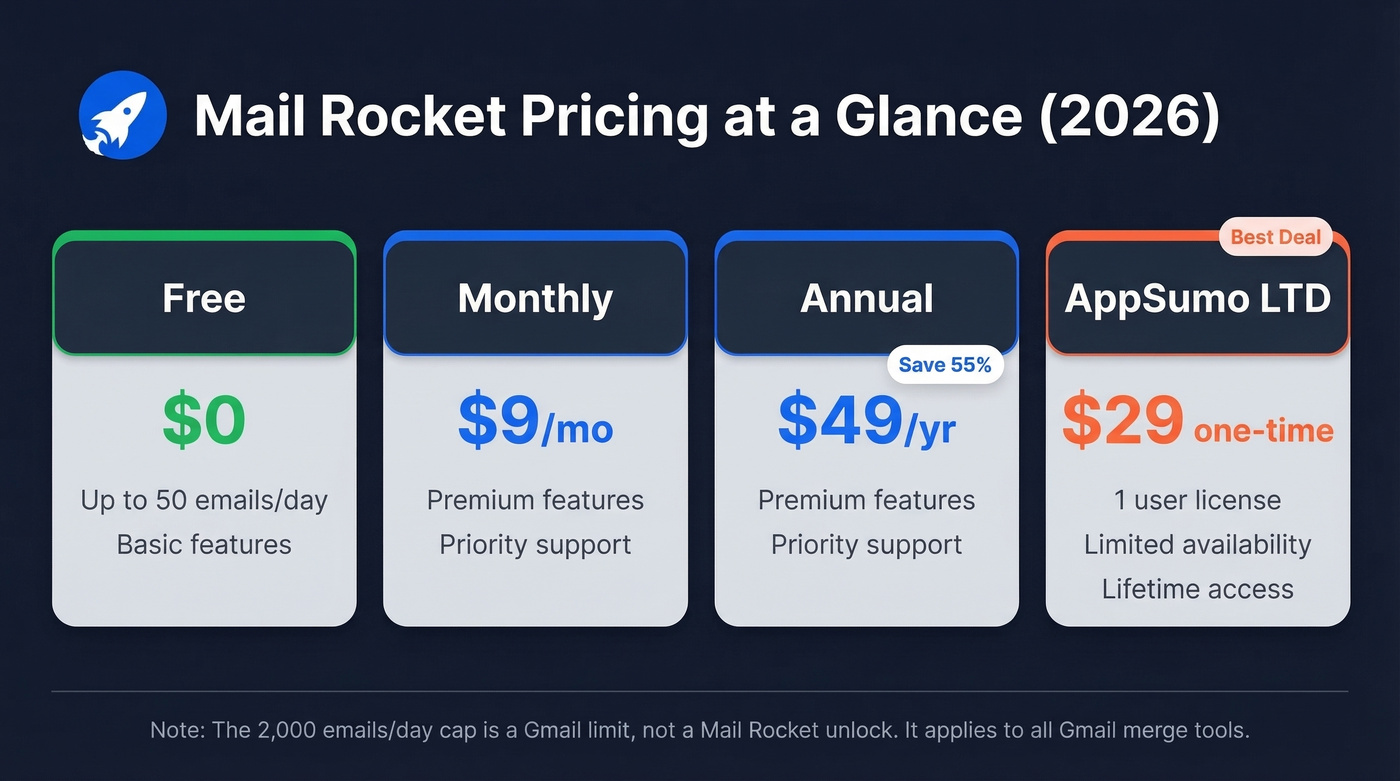
| Plan | Price | Details |
|---|---|---|
| Monthly | $9/mo | Premium features + priority support |
| Annual | $49/yr | Premium features + priority support |
| Lifetime (limited-time offer) | $199 one-time | Premium features + priority support |
| AppSumo LTD (1 user) | $29 one-time | When available |
| AppSumo LTD (5 users) | $58 one-time | When available |
| AppSumo LTD (10 users) | $87 one-time | When available |
| Free plan | $0 | Up to 50 emails/day |
One thing worth clarifying: Mail Rocket advertises "up to 2,000 emails/day" on paid plans. That's not a Mail Rocket unlock - it's the Gmail sending limit. Every Gmail mail merge tool hits the same ceiling: 500 recipients/day on free Gmail accounts and 2,000/day on Google Workspace accounts. Those limits apply to all emails sent from your account that day, not just mail merge campaigns. (If you want to go deeper on safe volume, see email velocity.)
Pros and Cons
Pros:
- One of the cheapest paid options in the Gmail mail merge category, especially if you grab the $29 lifetime deal
- Gmail-native simplicity: works with Gmail + Google Sheets, nothing else to configure
- Real-time tracking for sent, opens, clicks, and unsubscribes on premium plans
- Batch sending with configurable delays between emails
- Scheduling, templates, and attachments (including personalized attachments)
Cons:
- Roughly 2.3/5 rating on AppSumo based on only 3 reviews
- Deliverability concerns in reviews: one AppSumo reviewer said about 90% of recipients reported messages landing in spam
- No follow-up sequences, no A/B testing, no advanced automation
- Very limited public review footprint compared with established alternatives
- The lifetime deal model raises real questions about long-term product viability

Mail Rocket sends from Gmail, but it can't tell you who to email. Prospeo gives you 300M+ verified professional contacts with 98% email accuracy - so your merge lists actually reach real inboxes. Start with 75 free emails per month.
Stop merging bad data. Start with verified contacts.
How Mail Rocket Compares
| Tool | Monthly | Annual | Free Tier | Daily Cap |
|---|---|---|---|---|
| Mail Rocket | $9/mo | $49/yr | 50/day | 500 / 2,000 |
| GMass (Standard) | $29.95/mo | $249/yr | Limited trial | 500 / 2,000 |
| Mailmeteor | $4.99-$24.99/mo | Varies | 50/day | 50-1,500 |
| YAMM | Not public | Not public | 20/day | 400 / 1,500 |
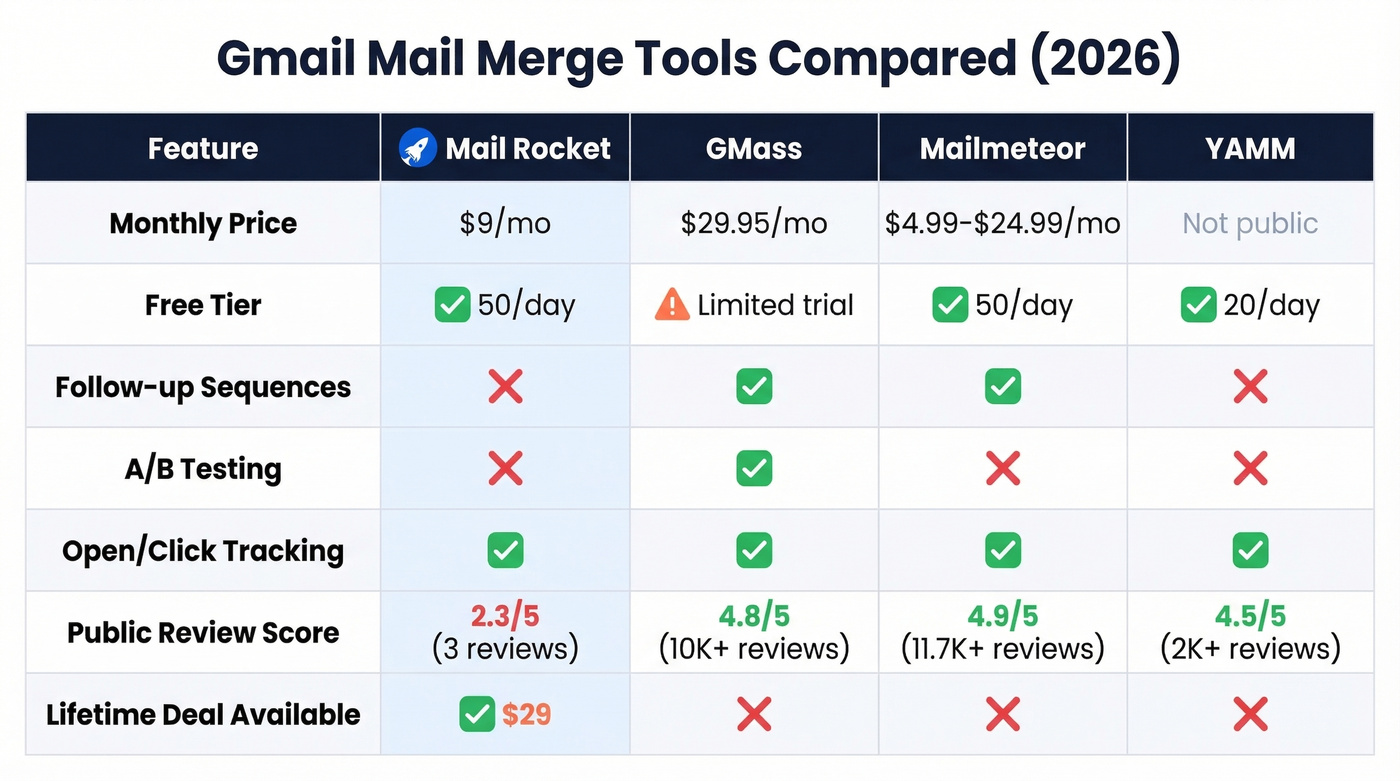
Mail Rocket does the core job - send a merge from Gmail using a Google Sheet - but it's a lighter product than GMass or Mailmeteor when it comes to deliverability tooling and automation.
GMass increased prices effective January 1, 2026, with Standard jumping from $25 to $29.95/mo and annual going from $225 to $249/yr. GMass users have collectively sent 9+ billion emails, and the tool offers follow-up sequences, A/B testing, SMTP support, and deeper deliverability features than basic mail merge add-ons. That track record matters when your domain reputation is on the line. (If you're troubleshooting GMass specifically, see GMass email deliverability.)
Mailmeteor sits in the middle. The free tier matches Mail Rocket's 50 emails/day, Premium at $12.99/mo adds reply detection and follow-up sequences, and that 4.9/5 rating across 11,741+ reviews is strong social proof. We've seen it recommended consistently in Reddit threads on r/gmail and r/smallbusiness as the safest free option.
One option most people overlook: Gmail itself added a basic built-in mail merge in 2023. It's free, requires no add-on, and handles simple merges from Google Sheets - though it lacks the tracking and scheduling you get from dedicated tools.
All these tools share the same Gmail sending ceiling. The difference isn't capacity. It's deliverability tooling, follow-up sequences, and whether the tool has a track record of landing in primary inboxes.
Let's be honest: if your list is under 100 contacts, you probably don't need any mail merge add-on. Gmail's native merge or even BCC handles it fine. Mail Rocket's value only kicks in at scale - and at scale, its lighter deliverability and automation feature set becomes the biggest risk.
Who Should Use Mail Rocket?
Use it if: You send fewer than 200 emails per week from Gmail, you want the absolute cheapest option, and the $29 AppSumo lifetime deal is still available. At that price, it's a low-risk experiment for classroom announcements, event invitations, or simple newsletter sends where inbox placement isn't make-or-break.
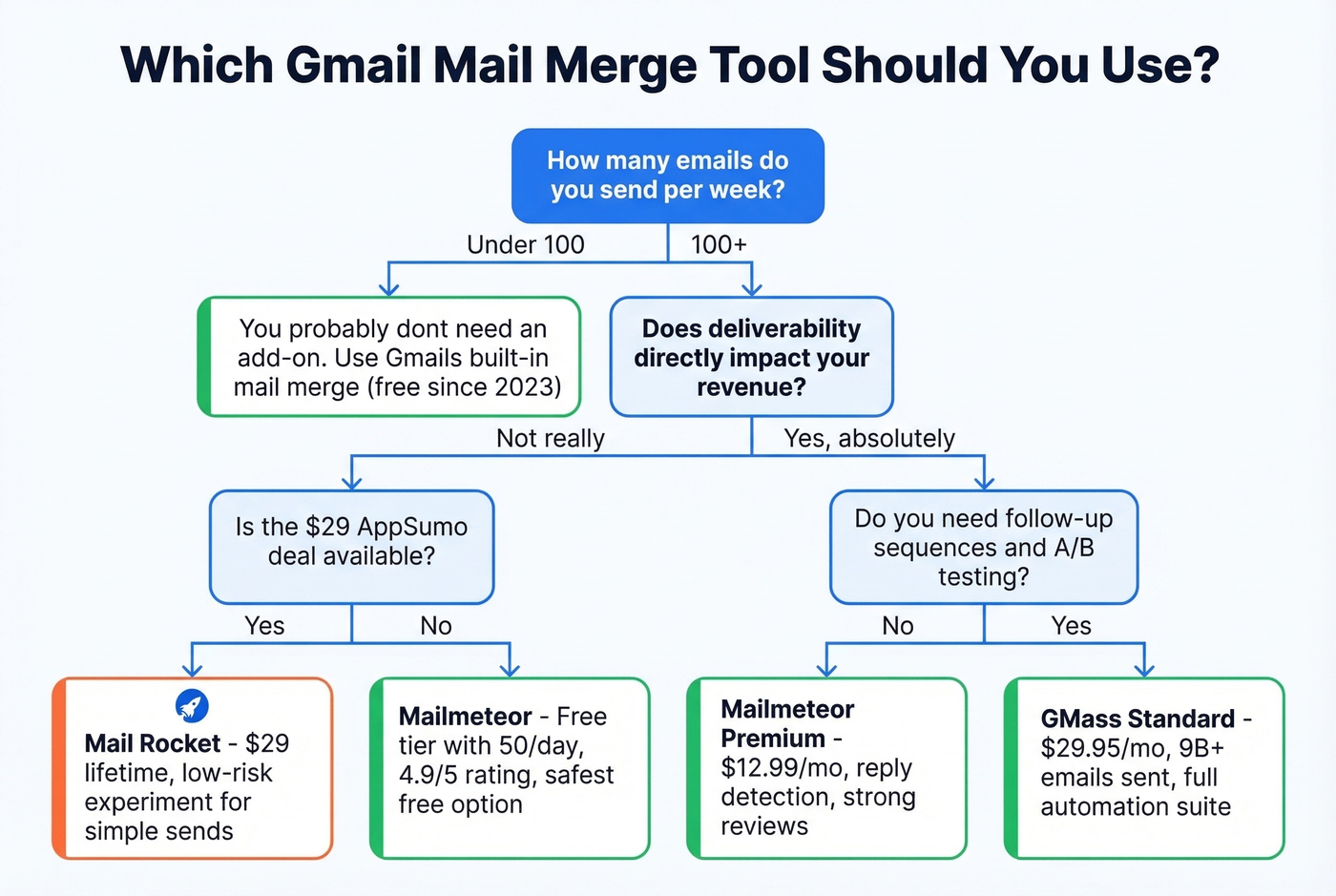
Skip it if: Deliverability matters for your business, you need follow-up sequences or A/B testing, or you want a tool with substantial public validation. Also, be careful with reviews - Rocketmailer and MailerRocket are different products with their own separate review pages on Capterra and G2. Rocketmailer holds a 4.6/5 on Capterra across 17 reviews. Don't confuse that with Mail Rocket's 2.3/5 on AppSumo.
When You Outgrow Gmail Mail Merge
Mail Rocket handles sending, but it doesn't help you find who to email. That's a different problem entirely, and in our experience it's the one that actually bottlenecks growth for most outbound teams. If you're building lists from scratch, start with how to generate an email list and then layer in data enrichment services to keep records current.
Worried about deliverability? A $29 mail merge tool won't fix a list full of invalid addresses. Prospeo's 5-step verification catches spam traps, honeypots, and catch-all domains before you hit send - keeping bounce rates under 4%.
Protect your sender reputation before you press send.
FAQ
How much does Mail Rocket cost?
Mail Rocket offers a free plan (up to 50 emails/day), a $9/mo monthly plan, a $49/yr annual plan, and a $199 lifetime plan. AppSumo has listed lifetime deals at $29 (1 user), $58 (5 users), and $87 (10 users) - though these rotate and can expire without notice.
Is Mail Rocket safe to use with Gmail?
Yes - it works as a Gmail/Google Sheets mail merge add-on within Google's ecosystem. All Gmail merge tools are constrained by Google's daily sending limits: 500/day on free accounts and 2,000/day on Google Workspace. Those limits apply to all emails sent from your account that day, not just merge campaigns.
Why do Mail Rocket reviews mention different products?
"Mail Rocket," "Rocketmailer," and "MailerRocket" are three separate products that search engines often conflate. Rocketmailer holds a 4.6/5 on Capterra across 17 reviews and 4.5/5 on G2. Mail Rocket (the Gmail add-on) has only 3 public reviews on AppSumo. Always verify which product a review actually covers before trusting the rating.
What if I need verified emails before sending?
Mail merge tools assume you already have a contact list. For finding verified B2B emails, Prospeo offers 98% accuracy across 300M+ profiles with a free tier of 75 emails per month - handling the "who to email" problem so your merge tool can focus on delivery.