

How to Manage a Sales Funnel Without Overcomplicating It
Sales cycles have lengthened 32% since 2021, and reps spend roughly two hours a day actually selling. Most teams respond by adding more stages, more tools, more process. That's backwards.
Managing a sales funnel well means fewer moving parts, not more - clean data, clear exit criteria, and fixing your biggest drop-off first. Here's the short version: five funnel stages with observable exit criteria, clean contact data before you optimize anything else (bad emails mean fake pipeline numbers), and benchmark your stage-to-stage conversion rates against the tables below so you know exactly where to focus.
What Is Sales Funnel Management?
A funnel is the buyer-centric conversion journey: are the right people moving forward? A pipeline is the seller-centric deal workflow: what should reps do today?
Conflating the two is how only 54% of forecasted deals actually close. Reps track activity while nobody watches where buyers drop off. The simplest definition: sales funnel management is the ongoing process of measuring, diagnosing, and improving how prospects move from first touch to closed deal. It's not a dashboard you check quarterly - it's an operating discipline.
Five Stages That Work
A practitioner thread on r/SaaS makes a point we agree with: most funnels are overcomplicated. You can collapse nearly any B2B motion into five stages.
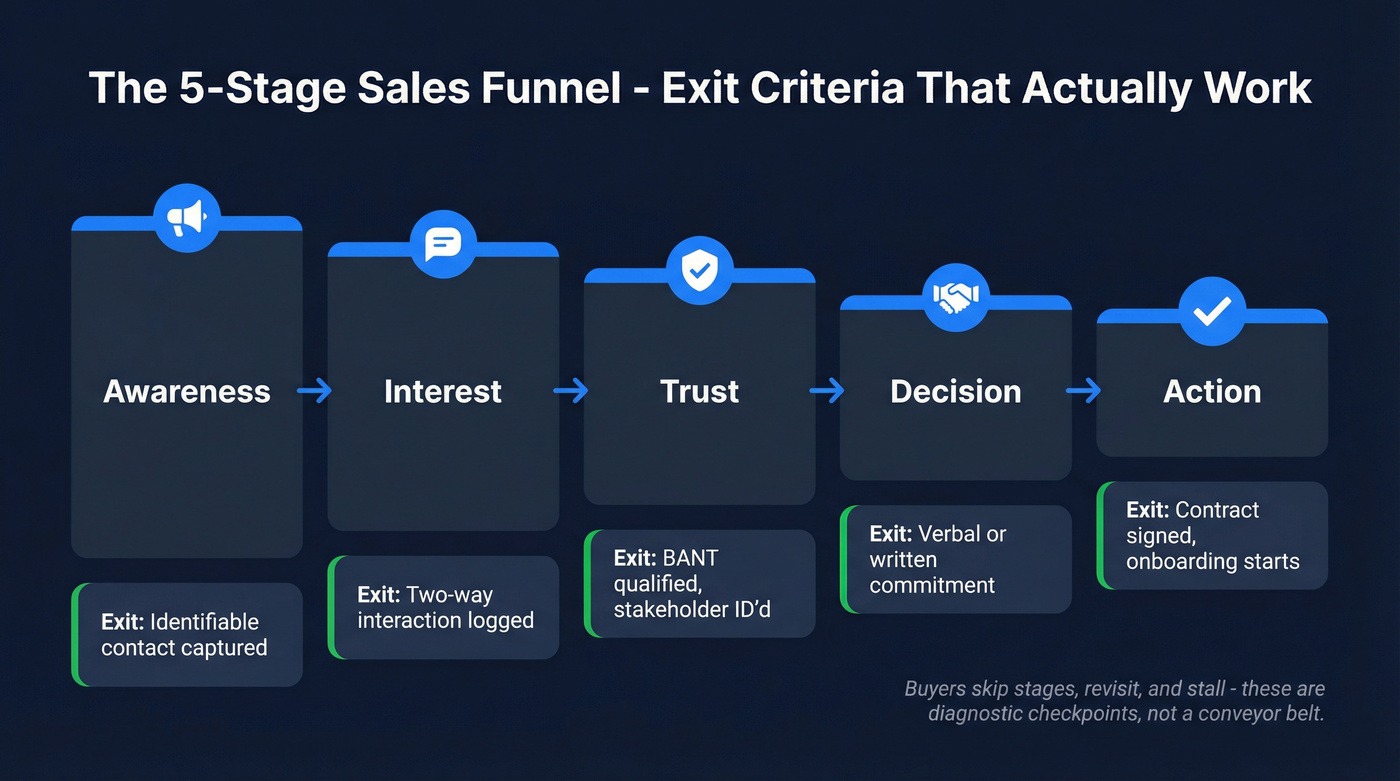
- Awareness - Prospect engages with content or an ad. Exit: identifiable contact captured.
- Interest - Prospect responds to outreach or consumes mid-funnel content. Exit: two-way interaction.
- Trust - Prospect evaluates your solution against alternatives. Exit: qualified via BANT; stakeholder identified.
- Decision - Prospect negotiates terms, reviews proposal. Exit: verbal or written commitment.
- Action - Contract signed, onboarding begins.
Buyers don't march through these sequentially. They skip stages, revisit earlier ones, and stall for weeks. Think of the stages as diagnostic checkpoints, not a conveyor belt.
As one r/SaaS poster put it: "Decision rarely fails at the decision stage. It usually fails earlier." If your close rate is low, look upstream at Trust and Interest. For subscription businesses, add a sixth stage (Retention) since 72% of revenue comes from existing customers.
Benchmarks You Can Actually Use
Saying "our funnel converts at 5%" tells you nothing without stage-level context.
General stage-level ranges:
| Stage Transition | Typical Range |
|---|---|
| Visitor → Lead | 1-5% |
| Lead → MQL | 25-35% |
| MQL → SQL | 13-26% |
| SQL → Opportunity | 50-62% |
| Opp → Closed Won | 15-30% |
Data from VWO's funnel conversion analysis.
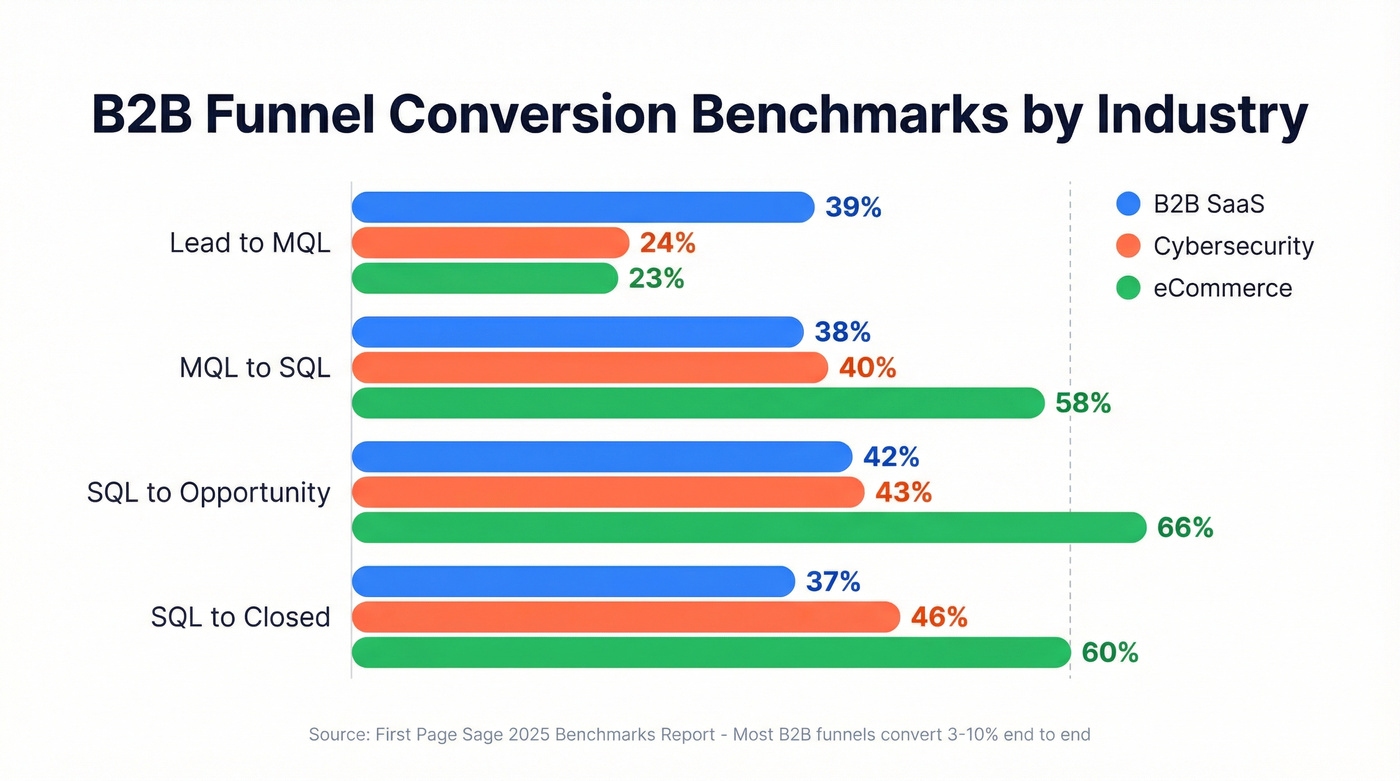
Industry-specific conversion rates (post-lead stages):
| Industry | Lead→MQL | MQL→SQL | SQL→Opp | SQL→Closed |
|---|---|---|---|---|
| B2B SaaS | 39% | 38% | 42% | 37% |
| Cybersecurity | 24% | 40% | 43% | 46% |
| eCommerce | 23% | 58% | 66% | 60% |
Data from First Page Sage's benchmarks report.
Most funnels convert 3-10% end-to-end. The average B2B win rate sits around 21%. If you're significantly below these numbers at any stage, that's your priority - not another nurture sequence.

Every benchmark in this article becomes meaningless if your contact data is bad. Snyk's funnel showed 35-40% bounce rates - their pipeline numbers were a mirage. After switching to Prospeo's 98% verified emails, bounces dropped under 5% and they added 200+ opportunities per month. Fix the data layer first, and your stage-to-stage conversions start telling the truth.
Stop optimizing a funnel built on dead emails.
The Operational Playbook
Define Stages With Exit Criteria
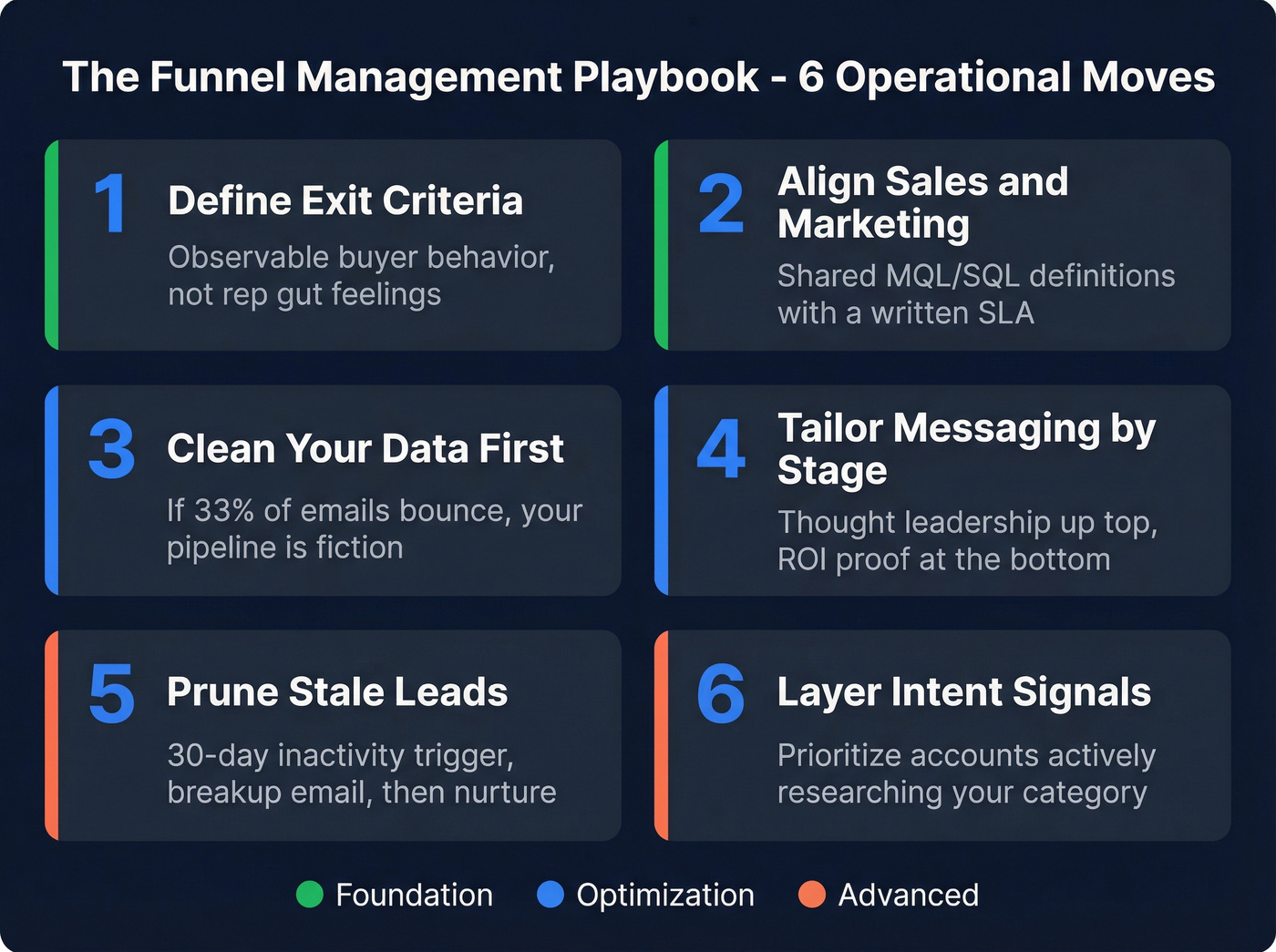
Every stage needs an observable buyer behavior as its trigger - not a rep's gut feeling. "They seemed interested" isn't a stage transition. "They booked a technical demo with their IT lead" is. When reps log stages accurately, your forecasting actually means something, and documenting these criteria is the foundation of any solid funnel management plan.
Align Sales and Marketing on Definitions
Sales and marketing need shared MQL/SQL definitions. Without them, marketing celebrates lead volume while sales complains about quality - and both are right from their own perspective. Set an SLA covering both sides: marketing commits to quality thresholds, sales commits to response time and follow-up cadence. Write it down. Revisit it monthly.
Clean Your Data First
Here's the uncomfortable truth we've seen play out dozens of times: if a third of your emails bounce, your top-of-funnel metrics are fiction. Snyk hit bounce rates of 35-40% that were silently destroying their outbound pipeline. After switching to Prospeo's verified contact data, bounces dropped under 5% and they generated 200+ new opportunities per month. Verify emails before they enter your CRM, and your funnel numbers start reflecting reality from day one.

Tailor Messaging by Stage
Top-of-funnel prospects need thought leadership and industry insights - credibility without an ask. Mid-funnel buyers want case studies and product comparisons that help them build an internal business case. Bottom-of-funnel decision-makers need ROI calculators, testimonials, and proof that implementation won't be a nightmare. Sending a case study to someone who doesn't know you exist is a waste of everyone's time.
If you want a tighter framework for what to say when, map your messaging to sales tactics by stage and keep your outreach consistent across channels.
Prune Stale Leads Ruthlessly
Deals that haven't moved in 30 days need a breakup email or a hard look. Set a 30-day inactivity trigger in your CRM. If a prospect doesn't respond to a direct "should we close this out?" message, move them to a nurture track. Some will re-enter the funnel later when timing or budget changes. Most won't. That's fine - a smaller, honest pipeline beats a bloated one that makes your forecast meaningless.
This is also where a simple pipeline hygiene routine pays off fast.
Choosing the Right Tools
Let's be honest: for most teams under 50 reps, the tool stack is simple. Capture leads, gate a demo, store contacts in a CRM, run outreach. Here's what works at each layer.
| Tool | Best For | Starting Price |
|---|---|---|
| Prospeo | Email/data accuracy (98% verified) | Free (75 emails/mo); ~$0.01/email |
| Zoho CRM | SMB teams on a budget | $14/user/mo (billed annually) |
| Pipedrive | Visual pipeline management | ~$15-$30/user/mo (plan-dependent) |
| HubSpot | Free CRM + marketing | Free; Sales Hub from ~$15/seat/mo |
| Salesforce | Enterprise scale | From $25/user/mo (billed annually) |
The CRM matters far less than whether your team actually uses it. In our experience, the biggest funnel leak is almost always data quality, not CRM features. A basic CRM with verified emails outperforms an expensive setup full of dead contacts every single time.
If you're evaluating platforms, start with a shortlist of sales pipeline software and prioritize adoption over features.
Quick Wins That Move Conversion
A/B test your CTAs. Going, a travel deals company, improved premium trial starts by 104% month-over-month by testing "Sign up for free" against "Trial for free." One word. That's it.
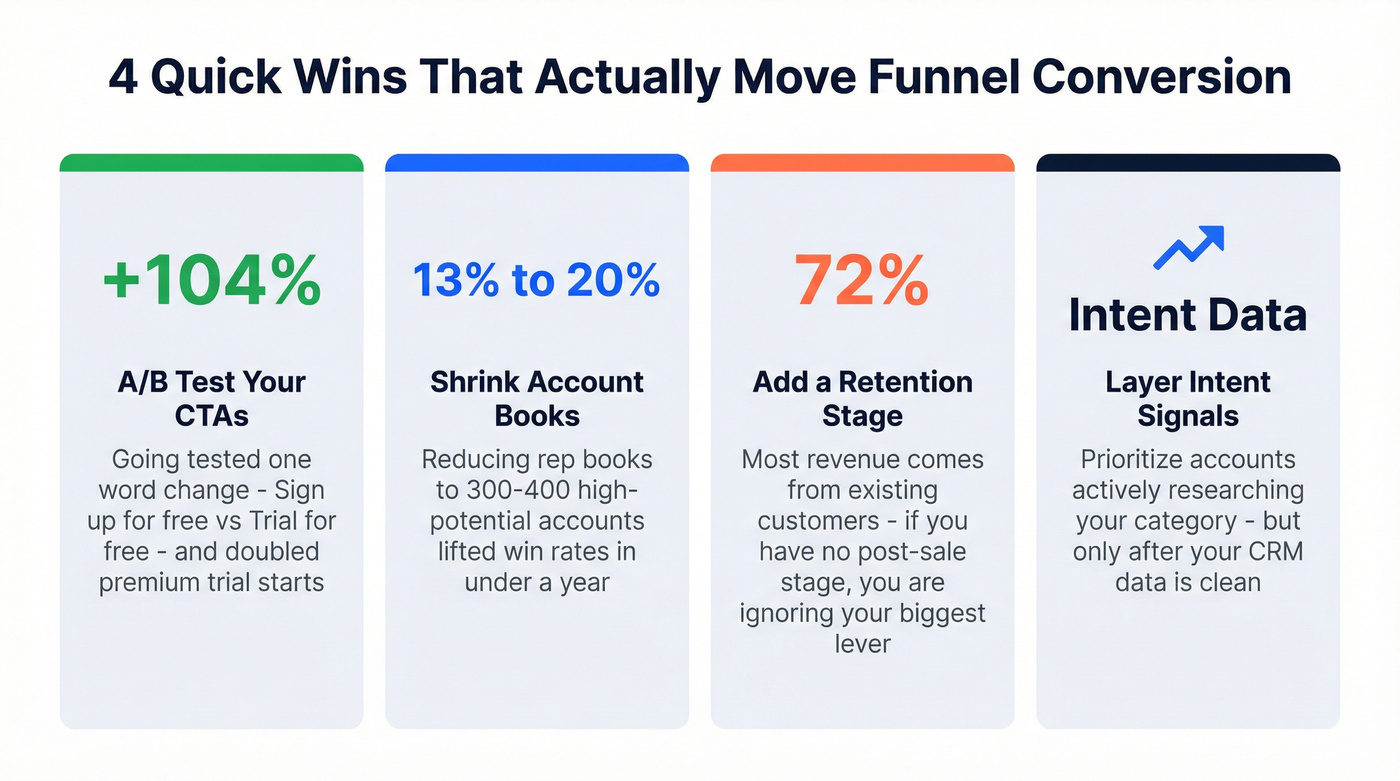
Shrink rep account books. One company reduced books to 300-400 high-potential accounts and watched win rates climb from 13% to over 20% in under a year. More accounts doesn't mean more revenue - it usually means more neglected accounts.
If you're trying to systematize this, borrow a few ABM tactics to keep focus on the accounts most likely to convert.
Add a retention stage. If 72% of revenue comes from existing customers and you don't have a post-sale funnel stage, you're ignoring your biggest growth lever. (If you need examples of what that stage looks like in practice, see sales funnel examples.)
Layer intent signals. Use buyer intent data to prioritize accounts actively researching your category. It moves the right prospects into your funnel faster than volume-based prospecting ever will. Skip this if your team is still struggling with basic CRM hygiene - intent data on top of dirty records just creates expensive noise.
Intent works best when paired with a clear pipeline prioritization model so reps know what to do first.
You just saw that SQL→Closed rates in B2B SaaS average 37%. The fastest way to beat that number isn't another nurture sequence - it's reaching real decision-makers with verified direct contacts. Prospeo gives you 300M+ profiles with 30+ filters including buyer intent, job changes, and headcount growth, refreshed every 7 days. At $0.01 per email, cleaning your funnel costs less than one bad forecast.
Build a pipeline full of real buyers, not dead contacts.
FAQ
What's a good overall funnel conversion rate?
Most B2B funnels convert 3-10% end-to-end. B2B SaaS SQL-to-Closed rates average 37%; eCommerce hits 60%. Benchmark against your vertical using the tables above, not a generic number.
How many funnel stages should I have?
Five is enough for most teams. Add a sixth (Retention) for subscription models. More than six usually means you're overcomplicating things - simpler funnels iterate faster and produce cleaner data.
How do I fix a leaky top-of-funnel?
Start with data quality. If your bounce rate sits above 5%, your outreach isn't reaching anyone. Verify emails before they enter your CRM, then audit targeting - you might be reaching the right volume but the wrong people entirely.
What tools do I need for managing a sales funnel?
At minimum: a CRM for deal tracking, an email verification tool to keep data clean, and a reporting dashboard to monitor stage-level conversion rates. Small teams can start with Zoho or Pipedrive plus a verification layer and add complexity only when the data tells them to.