

ABM Tactics That Actually Work in 2026 (With Data)
You launched the pilot six months ago. Marketing built the target account list, ran display ads, sent personalized emails. Sales ignored half of it. Now the CMO wants a pipeline number, the CRO wants to know why reps aren't working the accounts, and the whole program is quietly dying in a shared spreadsheet nobody opens. The ABM tactics were sound. The execution wasn't.
You're not alone. Only 26% of ABM programs are considered truly successful by the teams running them - even though 77% report increased pipeline. Another 55% say ABM influences just 0-20% of company revenue, and 26% aren't even sure of its financial impact. Activity without revenue confidence. That's the gap.
What You Need (Quick Version)
The teams that land in the 26% share three things. First, a unified data foundation - they don't let sales pick accounts by gut feel. Second, they pick 3-4 account-based marketing tactics and execute them with discipline for 90 days, not 90 different plays for 9 days each. Third, sales and marketing co-own the program. Not "marketing runs it and hopes sales follows up."
One practitioner on r/b2bmarketing rebuilt a stalled pilot using exactly this framework and hit 56% account engagement with a 63% meeting-to-opportunity conversion rate in 90 days. Those aren't vanity metrics. That's pipeline.
The silent prerequisite underneath all of it? Contact data quality. If your emails bounce and your phone numbers are dead, every downstream tactic fails before it starts.
Why Most ABM Programs Fail
Before the tactics, let's diagnose the failure modes. If any of these sound familiar, fix them first.
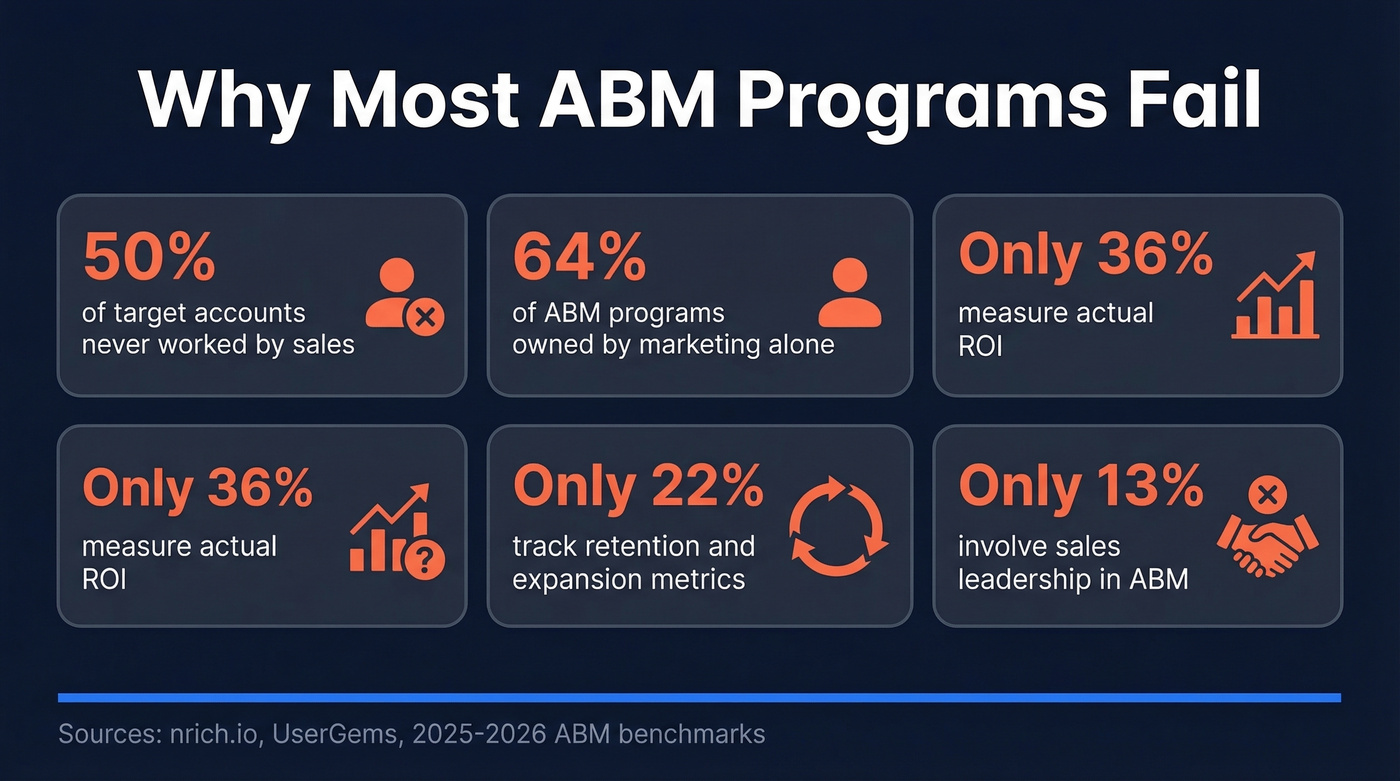
Sales never works the list. Trinity Nguyen at UserGems shared a painful example: after launching ABM, sales only worked half the target accounts. That's 50% of the ABM budget wasted - and the resulting mistrust nearly killed the program entirely.
Nobody measures what matters. Teams track pipeline (81%) and revenue (69%), but only 36% measure actual ROI. Just 22% track retention and expansion - the metrics that prove long-term value.
Marketing owns it alone. 64% of ABM programs sit with marketing leadership. Only 13% involve sales leadership. When marketing runs ABM as a campaign and sales treats it as "more leads," you get activity without alignment.
They fall into the three traps. Running display ads to a CSV and calling it ABM. Using one playbook for every account regardless of tier or intent. Treating ABM as "more air cover for SDRs" instead of a fundamentally different go-to-market motion. If any of these describe your program, you're doing demand gen with an ABM label.
Giving up too early. ABM isn't a two-week experiment. Teams that abandon paid channels or outbound sequences after a few weeks never reach the engagement threshold where the program compounds.
ABM Is a System, Not a Campaign
Here's the thing: the traditional SDR model is breaking. Pavilion's B2B sales benchmarks paint a brutal picture - win rates down 18%, deal values down 21%, sales cycles up 16%, and 69% of reps missed quota. The "touch lots of accounts and hope" approach yields roughly 0.03% account-to-pipeline conversion in complex B2B SaaS. One opportunity per 3,000 accounts touched.
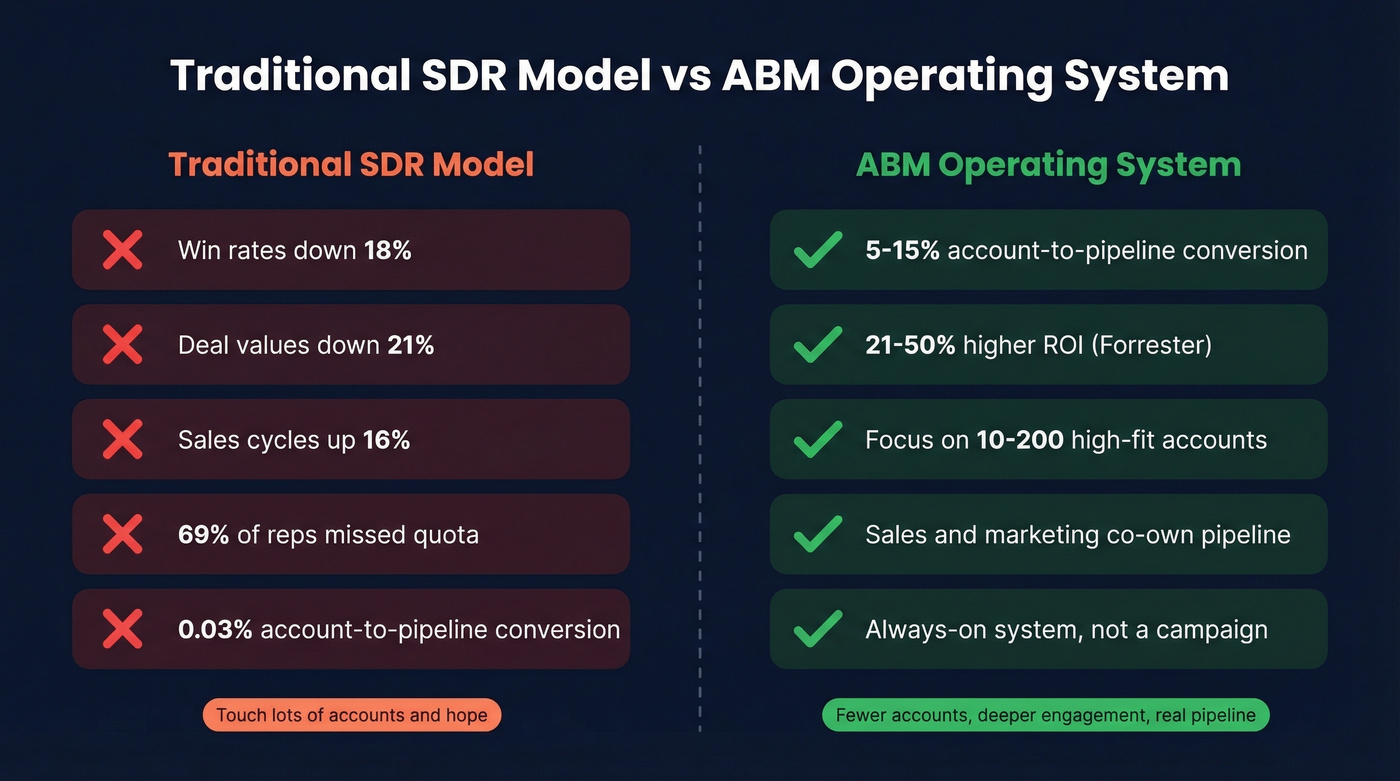
ABM flips the math. Properly executed programs convert at 5-15% account-to-pipeline. Forrester data shows 21-50% higher ROI versus non-ABM approaches. The difference isn't magic - it's focus, coordination, and treating ABM as an operating model rather than a quarterly campaign.
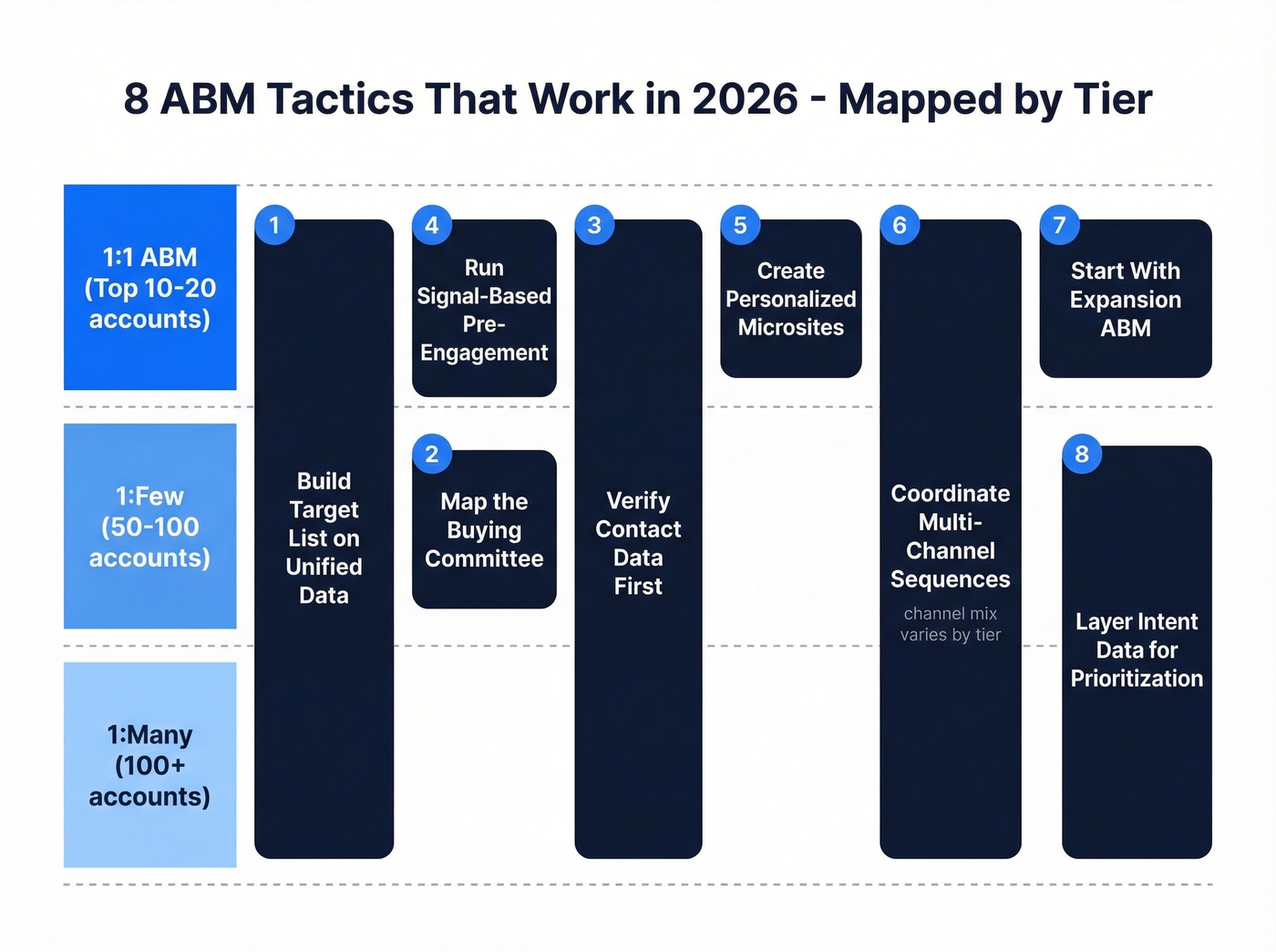
The three tiers matter here. 1:1 ABM dedicates custom plays to your top 10-20 accounts - fully bespoke content, executive engagement, personalized microsites. 1:few clusters 50-100 accounts by shared attributes like industry or pain point and runs semi-custom plays. 1:many scales lighter-touch tactics across hundreds of accounts using intent signals and automation. The tactics below work across tiers, but we'll flag where each fits best.
The 26% who succeed don't run "ABM campaigns." They build ABM systems - always-on motions where data, targeting, personalization, and follow-up run continuously and get measured continuously. That mindset shift matters more than any individual tactic.
Account-Based Marketing Tactics That Work in 2026
These eight tactics aren't theoretical. They're drawn from practitioner playbooks, benchmark data, and patterns we've seen work across dozens of implementations. You don't need all eight. Pick the 3-4 that match your maturity level and execute them well.
Build Your Target List on Unified Data
The practitioner who rebuilt their stalled pilot is instructive here. The original attempt failed because sales "flagged random priority accounts" with no data backing. The rebuild unified Salesforce, 6sense, HG Insights, and historical sales notes into a single target list. That's the difference between a wish list and a strategy.
Your target list should combine CRM data - accounts that have bought before or shown engagement - with intent signals from accounts actively researching your category, and technographic data from accounts running the stack your product integrates with. Sales gut-feel lists are how you waste 50% of your budget. Best for: all tiers.
If you want to scale this without adding ops overhead, automate target account lists so your tiers and filters stay consistent.
Map the Buying Committee
Enterprise deals involve 3-8 stakeholders per account - economic buyer, champion, influencers, and blockers. 42% of marketers say identifying the right buyers is their biggest challenge. Don't just find the VP. Map the committee. Who signs? Who champions internally? Who can kill the deal quietly?
Most teams under-invest here. They find one contact per account and call it "targeted." Real account-based marketing means multi-threading into the buying committee with role-specific messaging. In our experience, teams that map at least three contacts per account before launching outreach see 2-3x the engagement of single-threaded approaches. Best for: 1:1 and 1:few.
This is also where account-based selling best practices make the handoff from marketing to sales actually work.
Verify Contact Data First
ABM lives or dies at the data layer. If 35% of your emails bounce, every downstream tactic fails. Your personalized microsites don't matter if the invite never lands. Your multi-channel sequences don't matter if the phone numbers are disconnected.
Snyk's 50-person AE team faced this exact problem - bounce rates of 35-40%. After switching to Prospeo, bounces dropped under 5% and AE-sourced pipeline jumped 180%. Bad contacts kill every downstream play, and fixing data quality is the highest-ROI investment in your ABM stack. Best for: all tiers.
If you’re troubleshooting deliverability, start with email bounce rate benchmarks and root causes, then work through an email deliverability guide to fix the source issues.
Run Signal-Based Pre-Engagement
Don't pitch cold. Spend 7-10 days engaging target accounts on social before any outreach. Like their posts. Comment with a genuine point of view. Share their content with your network. Build familiarity so when the BDR email arrives, the prospect recognizes the name.
This feels slow. It's the difference between a cold email that gets deleted and a warm email that gets a reply. The team that hit 56% engagement used this exact pre-engagement motion before sending personalized microsite links. Best for: 1:1 and 1:few.
To operationalize this, build a simple system for identifying buying signals and routing them to reps.
Create Personalized Microsites
That same 90-day rebuild used Mutiny to create personalized landing pages by account funnel stage - different CTAs, social proof, and resources by industry. BDRs sent emails with the message: "We made this just for you." The result? 56% of target accounts showed engagement signals.
Personalized microsites work because they signal effort. A generic landing page says "you're one of thousands." A page with the prospect's logo, industry-specific case studies, and stage-appropriate CTAs says "we understand your problem." Best for: 1:1.
Coordinate Multi-Channel Sequences
ABM isn't email. It's ads plus email plus BDR outreach plus direct mail, orchestrated by account stage. Run 3-6 email touches with role-based messaging. Layer display ads for air cover. Have BDRs follow up on engagement signals. Send personalized video walkthroughs - a 60-second screen-share showing how your product solves the prospect's specific problem outperforms templated emails by a wide margin. For high-value 1:1 accounts, a handwritten note or relevant book can break through digital noise when every other channel is saturated.
If you need a tighter process for this, use sequence management to keep timing, messaging, and ownership aligned across channels.
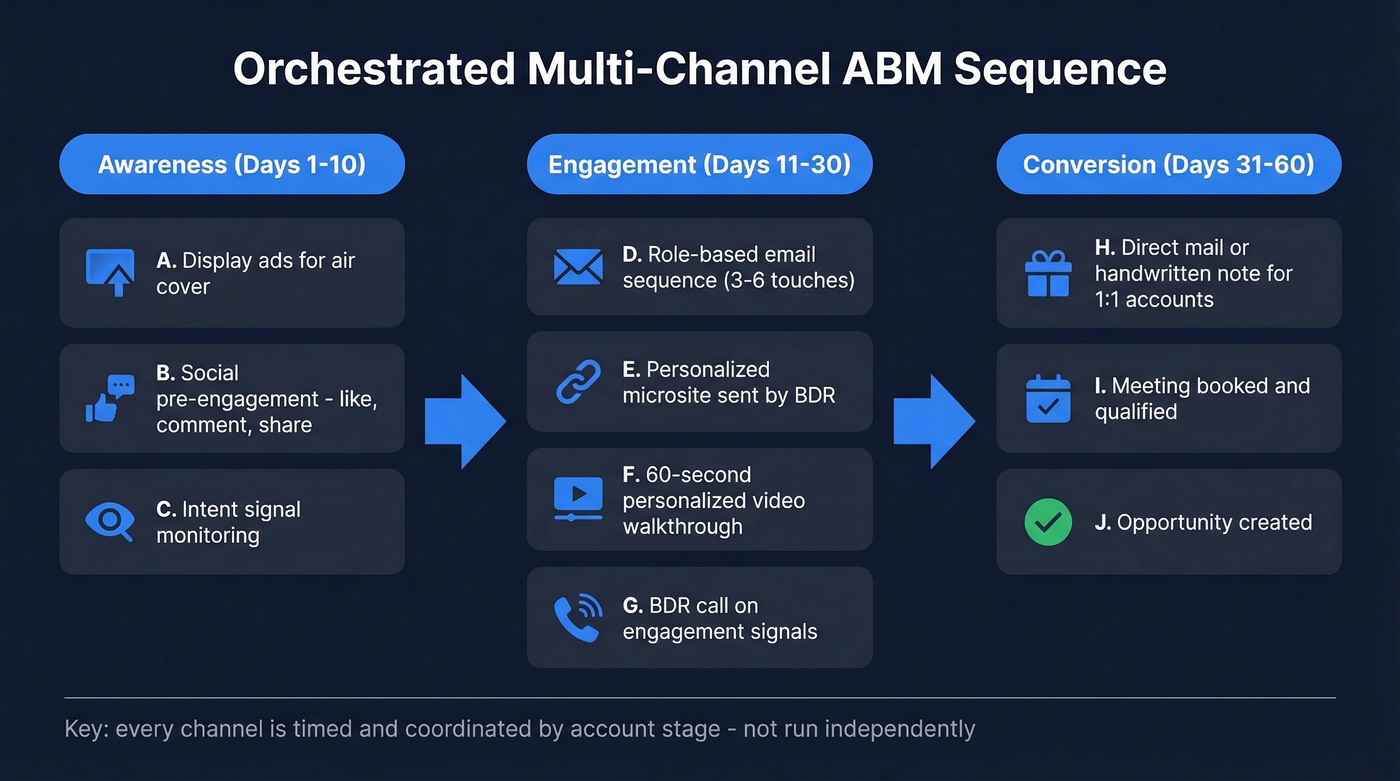
The key word is "orchestrated." If marketing runs ads, BDRs send emails, and nobody coordinates timing or messaging, you're just running three separate campaigns at the same accounts. That's not ABM. It's noise. Best for: all tiers, with channel mix varying by tier.
Start With Expansion ABM
Skip this if you're already running a mature new-logo program. But if you're launching ABM for the first time? Start with existing customers. They already trust you, they already use your product, and expanding them costs a fraction of new logo acquisition. Pick 10-20 expansion accounts and run a focused motion against them.
The math is compelling: a 5% increase in retention drives 25-95% profit increases according to Bain. Yet only 22% of ABM teams even track retention and expansion metrics. That's free money sitting there. Use expansion ABM to prove the model, build internal credibility, and fund the new-logo program with the revenue it generates.
To keep this measurable, track renewal rate and run a simple churn analysis on accounts that don’t expand.
Layer Intent Data for Prioritization
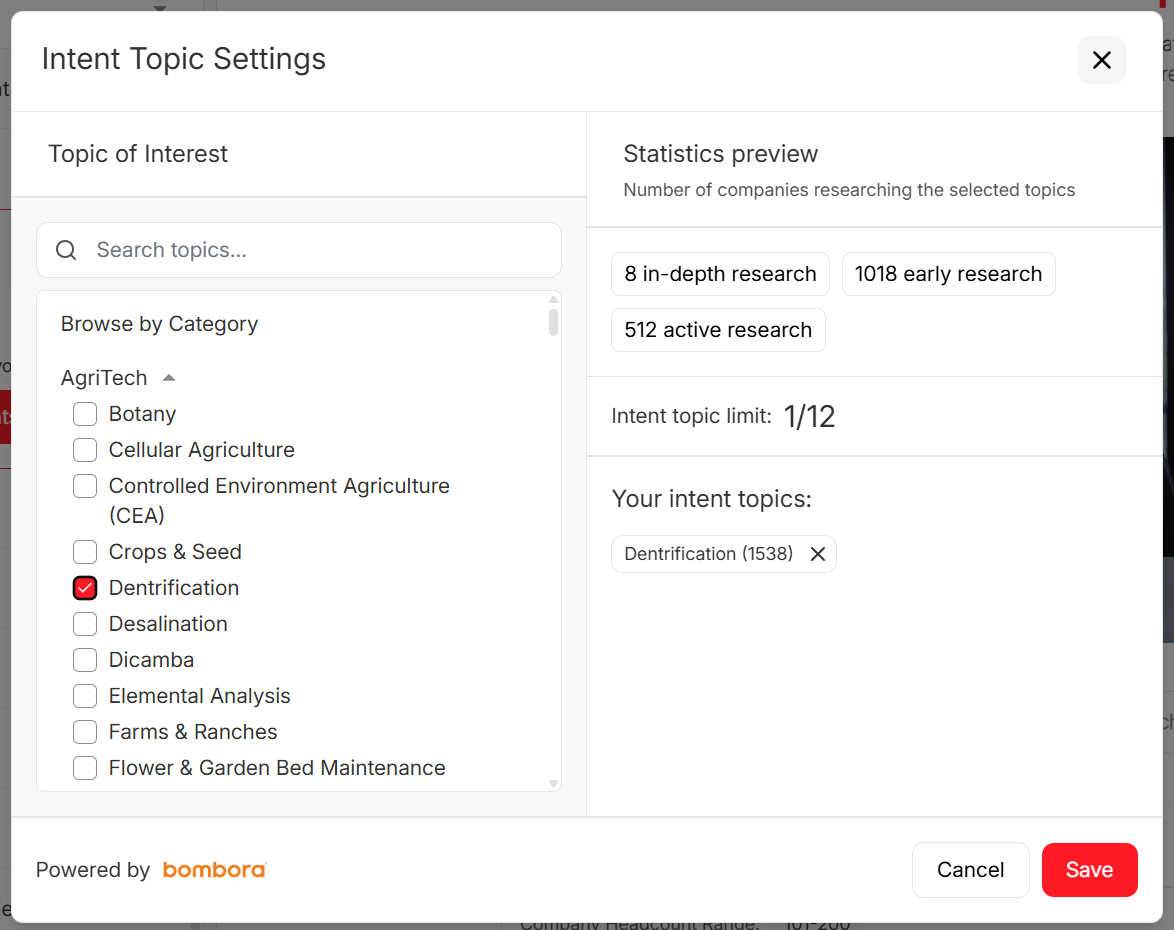
Not all target accounts are ready to buy right now. Intent data - first-party signals like website visits and content downloads, second-party signals from review site activity, and third-party research signals tracking topic-level interest - tells you which accounts are actively in-market.
When marketing targets the same people sales is pursuing, teams convert 65% more prospects into pipeline. Intent data ensures that alignment isn't just organizational - it's temporal. You're reaching the right accounts at the right moment. We've found that layering intent with technographic and job-change filters surfaces accounts showing both buying interest and organizational readiness, which is where the real conversion lift lives. Best for: 1:few and 1:many, where prioritization matters most.

ABM lives or dies at the data layer. Prospeo's 300M+ profiles with 30+ filters - including buyer intent, technographics, and headcount growth - let you build target account lists on unified data, not gut feel. Map entire buying committees with verified emails (98% accuracy) and direct dials (125M+ mobiles). All refreshed every 7 days.
Stop wasting ABM budget on bounced emails and dead phone numbers.
90-Day ABM Sprint
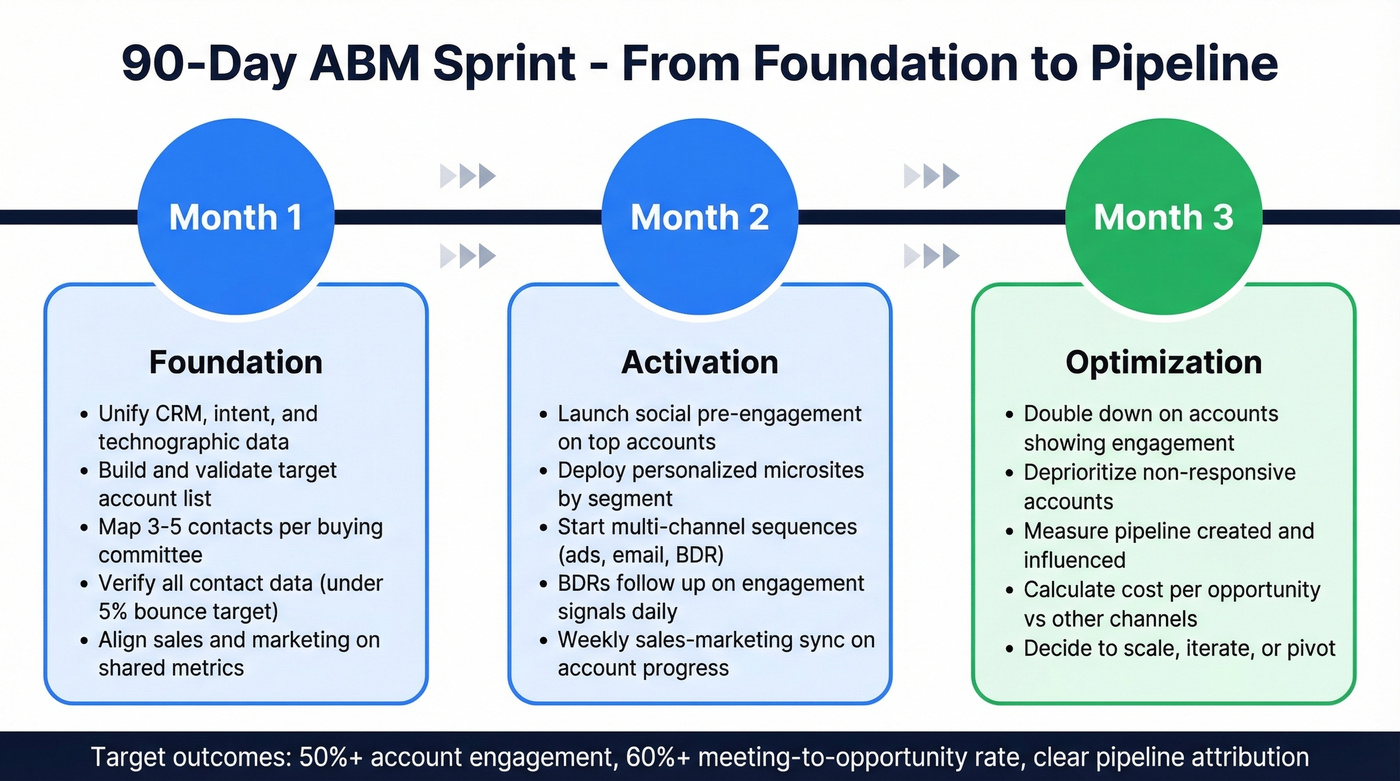
You don't need a year-long roadmap. Here's what a focused sprint looks like:
| Month | Focus | Key Activities |
|---|---|---|
| Month 1 | Foundation | Unify data, build target list, map buying committees, verify contacts, align sales + marketing on shared metrics |
| Month 2 | Activation | Launch pre-engagement, deploy personalized microsites, start multi-channel sequences, run display ads for air cover |
| Month 3 | Optimization | Measure engagement by account, double down on responding accounts, cut non-performers, report pipeline influence to leadership |
If you want a rep-friendly version of this cadence, adapt it into a 30-60-90 day plan for sales reps.
AI-Powered ABM in 2026
81.5% of B2B marketers now call ABM a strategic priority, and AI is a big reason the economics are shifting. The immediate ROI is productivity - we've seen teams cut account research time by 60% using AI for profiling and message generation. Reps spending less time researching and more time selling is a real, measurable outcome.
Where AI delivers the most value right now: dynamic ICP discovery that surfaces lookalike accounts you'd never find manually, real-time prioritization that re-ranks target accounts as intent signals shift, and auto-generated persona-specific messaging that gives BDRs a strong first draft instead of a blank screen. These aren't futuristic. They're operational today.
The bigger structural shift is composable stacks replacing monolithic platforms. Teams are pushing data coverage from roughly 40% to 85% while cutting costs by 60-70% by stitching together best-of-breed tools via API. Contact-level ABM - targeting specific people within accounts rather than just account-level ad impressions - is where 72% of practitioners say the real differentiation lives. AI makes this operationally feasible at scale for the first time.
How to Measure ABM ROI
Only 36% of ABM teams measure ROI. The rest track activity metrics and hope leadership doesn't ask hard questions. Here's a framework adapted from Directive's approach.
Step 1: Quantify total investment. Fixed costs like tools and headcount allocated, plus variable costs like ad spend, content production, and direct mail. Don't forget sales time - if reps spend 25% of their week on ABM accounts, that's roughly $37K/year at $150K OTE. That number belongs in your ROI denominator.
Step 2: Attribute pipeline influence. Pick an attribution model and commit. Single-touch is simple but misleading for ABM. Multi-touch is more accurate but requires integrated tooling. Weighted/hybrid balances clarity with precision - factor in engagement depth, buying stage progress, and account tier.
Step 3: Calculate returns. Pipeline generated, opportunities created, revenue closed, expansion revenue influenced. Compare against your total investment. The common blockers are disconnected tools, offline touchpoint invisibility, and model paralysis - teams debating attribution models instead of picking one and iterating.
To pressure-test your reporting, use a simple pipeline health scorecard so leadership sees leading indicators, not just lagging revenue.
Tools for Resource-Constrained Teams
You don't need a $50K platform to run ABM. You need the right tools for your maturity level.
| Tool | Category | Starting Price | Best For |
|---|---|---|---|
| Prospeo | Data quality & enrichment | Free tier; ~$0.01/email | Verified contacts + intent data for ABM lists |
| 6sense | Intent & orchestration | Free plan (50 credits/mo); ~$25K-$75K/yr | Enterprise intent signals |
| Demandbase | Full-stack ABM | ~$30K-$100K+/yr | Multi-channel orchestration |
| HubSpot ABM | CRM-native ABM | ~$800-$3,600+/mo | Mid-market HubSpot teams |
| RollWorks | ABM advertising | ~$1K-$3K+/mo | Account-based display ads |
| Mutiny | Web personalization | ~$1K-$5K+/mo | Personalized landing pages |
| Terminus | ABM ads + orchestration | ~$20K-$80K+/yr | Multi-channel ad campaigns |
For most teams starting out, the minimum viable stack is your CRM, a data quality layer, and one orchestration tool. The composable approach can push coverage from ~40% to 85% while cutting costs by 60-70% when you stitch best-of-breed tools together via API.
If you’re evaluating vendors for the data layer, start with data enrichment services and then compare options in best B2B company data providers.
Snyk's 50 AEs cut bounce rates from 35% to under 5% and grew AE-sourced pipeline 180% with Prospeo. When your ABM program depends on multi-threading into buying committees across dozens of target accounts, bad data doesn't just hurt - it kills the entire motion. At $0.01 per verified email, fixing your data layer costs less than one wasted display ad impression.
Join 15,000+ companies running ABM on data they actually trust.
FAQ
What's the difference between ABM and demand gen?
Demand gen casts a wide net to generate volume. ABM targets specific accounts with coordinated, personalized motions across the buying committee. Traditional outbound converts at roughly 0.03% account-to-pipeline; well-executed ABM programs convert at 5-15%. They're complementary strategies, not competitors.
How long before ABM shows results?
Expect 60-90 days for early engagement signals and 2-3 quarters for meaningful pipeline impact. The team that hit 56% engagement and 63% meeting-to-opportunity conversion did it in 90 days - but they had unified data and sales alignment from day one.
Can small teams run ABM without enterprise platforms?
Yes. A composable stack - your CRM plus a data quality tool for verified contacts and intent signals, plus one orchestration tool - can push data coverage to 85% at a fraction of enterprise platform costs. Free tiers and credit-based pricing make it viable for teams running focused programs against 20-50 target accounts.