

Sales Funnel Strategy: The Practitioner Playbook With Real Numbers
Your SDR team sent 2,000 cold emails last month. 400 bounced. Another 300 went to people who changed jobs. Your "top of funnel" was actually 65% of what you thought - and every conversion rate downstream was calculated on a lie.
Most sales funnel strategy content gives you an AIDA diagram and calls it a day. We're skipping that. What follows is the math, the benchmarks, and the operational plumbing that actually moves pipeline.
The Short Version
- Do the funnel math first. With 50% stage-to-stage progression, you need 160 pitches to close 10 deals. At 33%, you need 810. That gap is your entire strategy.
- Set stage-by-stage exit criteria and enforce them in your CRM. If reps can drag deals forward without meeting defined thresholds, your pipeline is fiction.
- Audit your data before optimizing anything else. Bad contact data silently destroys every conversion rate downstream.
Why Most Funnels Leak
The average B2B funnel loses 79% of leads between first contact and closed deal. That's not a funnel - it's a sieve.
The root causes are almost always the same two things. First, teams don't agree on what "qualified" means. Marketing counts an MQL as anyone who downloaded a whitepaper. Sales counts an SQL as someone who picked up the phone. The handoff is a mess, and 47% of enterprise GTM teams admit they struggle to deliver a strong lead experience, while another 41% can't engage leads in a timely or personalized way.
Second - and this is the one nobody talks about - bad contact data poisons the math before anyone runs a single sequence. If a third of your emails bounce, your stage-to-stage conversion rates are fiction. You can't A/B test your way out of a data quality problem. Every "optimization" you run on a dirty database is optimizing noise. (If you need a baseline, start with email bounce rate benchmarks and fixes.)

The Skinny Funnel - Math Most Guides Skip
A practitioner on r/GrowthHacking laid out the math that most vendor guides conveniently omit.
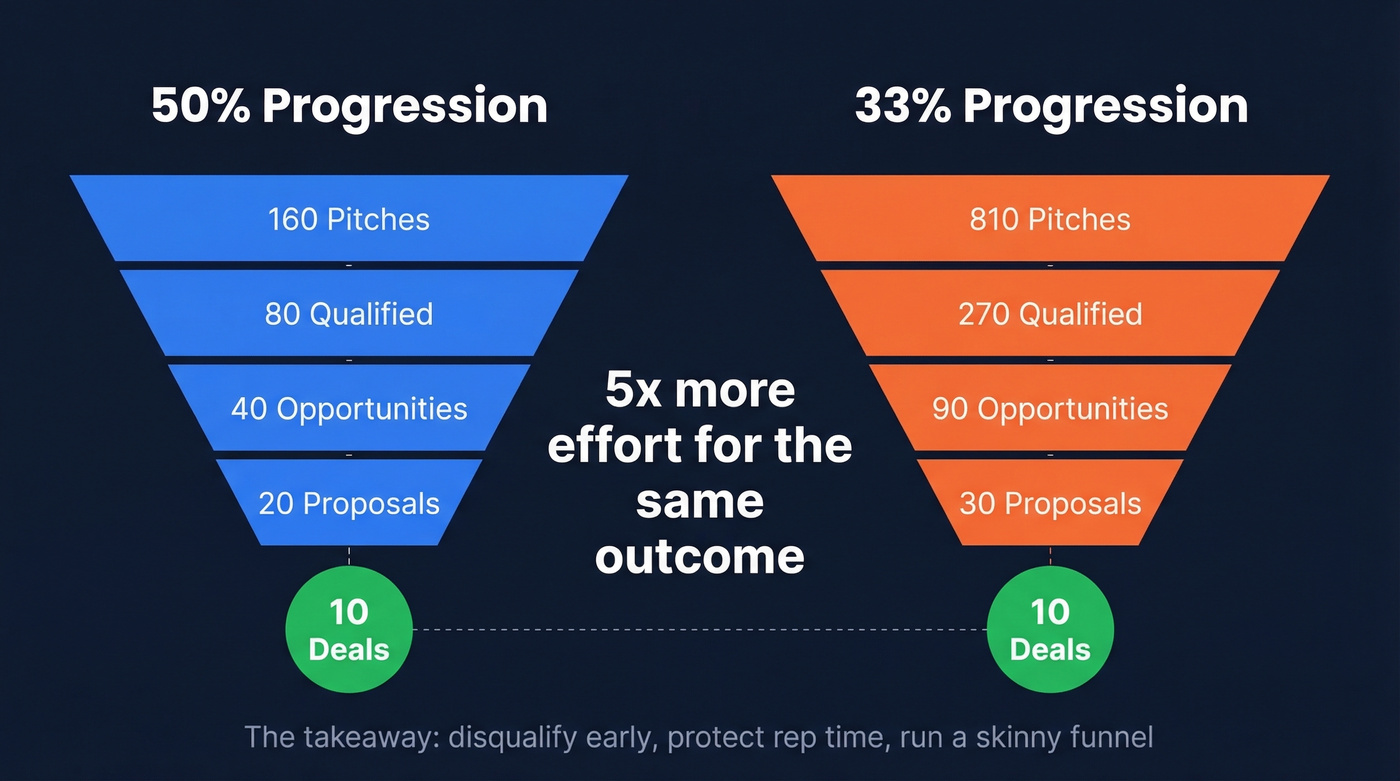
With 50% stage-to-stage progression across four steps, closing 10 deals requires 160 pitches (10 x 2^4). With 33% progression, you need 810 pitches (10 x 3^4). That's a 5x difference in effort for the same outcome.
The strategic takeaway isn't "fill the top of funnel harder." It's the opposite: disqualify leads as early as possible. Every unqualified lead that survives to the next stage burns your scarcest resource - sales time. Some teams call this a "nail funnel" - wide at the very top, then immediately narrow. A skinny funnel with aggressive early disqualification beats a wide funnel with volume-based hope every single time. The Reddit consensus backs this up: practitioners who've been doing this for decades consistently say that protecting rep time by killing bad deals early, then reinvesting that time into higher-probability pipelines, is the entire game.
Modern Funnel Models Compared
The original funnel dates to 1898 - Elias St. Elmo Lewis's AIDA model). It assumed a linear path. Buyers don't work that way anymore.
| Model | Core Idea | Best For |
|---|---|---|
| AIDA | Linear stages | Simple sales |
| McKinsey Loop | Decision journey | Complex B2C |
| HubSpot Flywheel | Momentum-based | PLG / inbound |
| Bow-Tie Funnel | Post-sale expansion | B2B SaaS |
A real buyer journey looks like a pinball machine, not a slide. Ballistic Arts mapped a typical B2B path: social post, Google search, blog reads over months, retargeting ad, guide download, colleague input, competitor evaluation, then a return when the pain gets urgent enough. Seven or eight touches across multiple channels before a single sales conversation happens.
For most B2B teams, the bow-tie funnel is the right model because it accounts for expansion revenue. The funnel isn't dead - the assumption that it's linear is dead.
Stage-by-Stage Funnel Tactics
This is where strategy becomes operations. Every stage needs a clear definition, a measurable exit criterion, and an SLA. Without these, your CRM pipeline is a wish list. (If you want a KPI list, use a dedicated funnel metrics framework.)
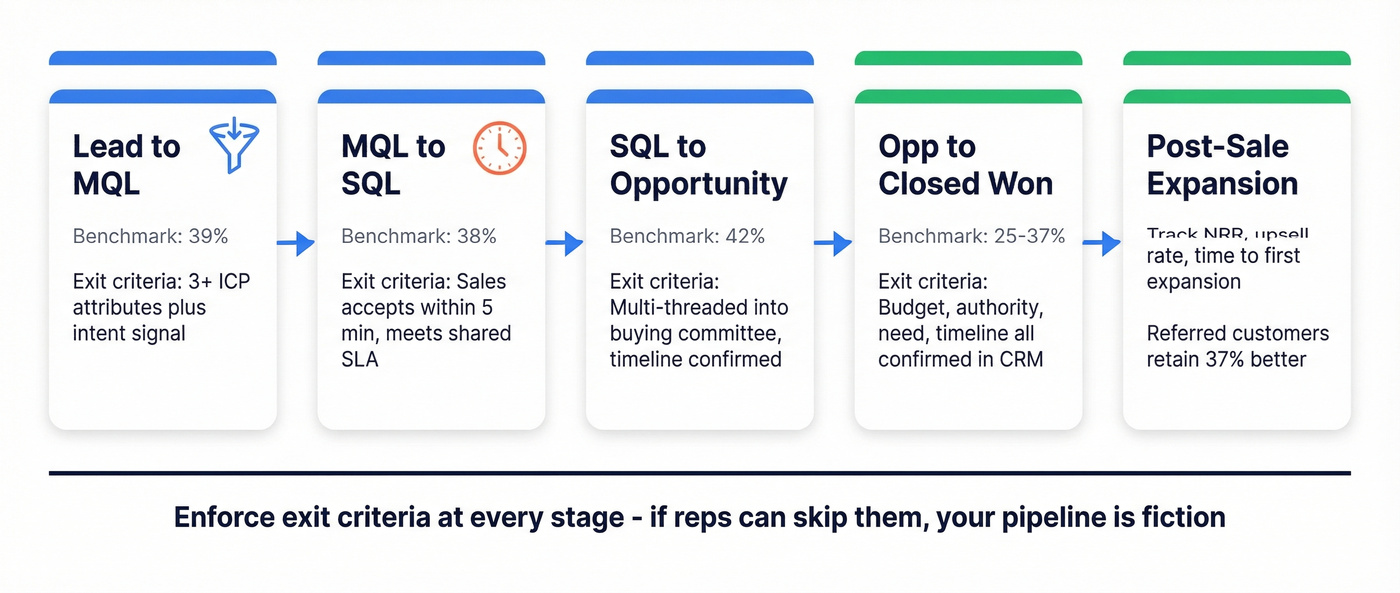
Lead to MQL
A lead becomes marketing-qualified when they match your ICP criteria and demonstrate engagement beyond passive interest - firmographic fit plus behavioral signals like visiting your pricing page, attending a webinar, or downloading a comparison guide. (Use an ideal customer profile template so both teams score fit the same way.)
The exit criterion: does this person match at least three ICP attributes and show intent? If not, they stay in nurture. First Page Sage benchmarks show B2B SaaS teams convert leads to MQLs at about 39%. If you're below 25%, your lead sources or ICP definition needs work. This is the stage where data quality has the most outsized impact - garbage contacts at the top inflate every metric below.
MQL to SQL
Here's where most funnels break. Marketing says they delivered 500 MQLs last quarter. Sales says 80 were worth calling. The gap is almost always a definition problem.
Set a shared SLA: sales must follow up within a defined window, and marketing must deliver leads that meet agreed criteria. Responding within 5 minutes makes you 21x more likely to qualify a lead. Most teams respond in 30-60 minutes. That gap is where most of your qualified leads die. Speed-to-lead is one of the most underrated tactics, and it costs nothing to implement. (If you need a system for the follow-up motion, keep sales follow-up templates handy.)
SQL to Opportunity
Once a lead is sales-qualified, the levers shift to deal execution: multi-threading into the buying committee, aligning on a decision timeline, and running a tight evaluation process. B2B SaaS benchmarks show SQL-to-Opportunity conversion around 42%.
For teams selling into accounts with five or more stakeholders, multi-threading isn't optional. It's survival. Deals with a single champion die when that champion goes on vacation, changes roles, or loses internal political capital. (If your qualification is inconsistent, implement a formal lead scoring model.)
Opportunity to Closed Won
Enforce stage exit criteria in your CRM. Reps shouldn't advance a deal without confirming budget, authority, need, and timeline. If your win rate is below 25%, audit time-in-stage to find where deals stall. We've seen teams discover that 60% of their "stuck" deals were actually dead - nobody had the discipline to close them out. (This is usually one of the core sales pipeline challenges.)
Post-Sale Expansion
The bow-tie stage. Expansion revenue is cheaper to generate than new-logo revenue. Referred customers show 37% higher retention and are 4x more likely to refer others. Track net revenue retention, upsell conversion rates, and time-to-first-expansion. If your CS team isn't measured on pipeline contribution, you're leaving money on the table. (To tighten the model, track pipeline health alongside NRR.)

You just read it: bad contact data silently destroys every conversion rate downstream. Prospeo's 5-step verification delivers 98% email accuracy on 300M+ profiles - refreshed every 7 days, not 6 weeks. When a third of your emails stop bouncing, your funnel math changes overnight.
Stop optimizing noise. Start with data that's actually real.
90-Day Funnel Roadmap
Most guides tell you what a funnel should look like. Here's what to do Monday morning. (If you're building this into rep onboarding, adapt it into a 30-60-90 day plan for sales reps.)
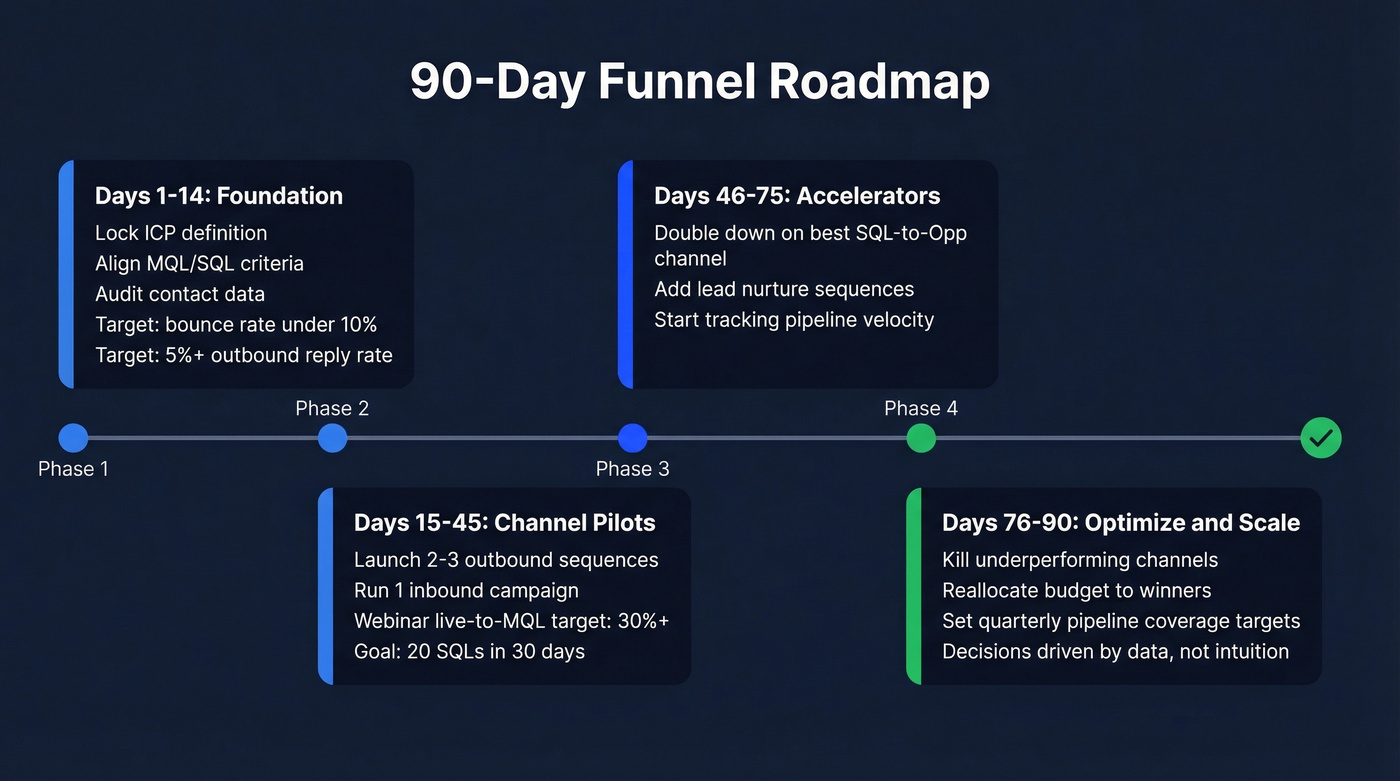
Days 1-14: Foundation. Lock your ICP definition, align marketing and sales on MQL/SQL criteria, and audit your contact data. If your bounce rate is above 10%, stop everything else and fix it. Target: outbound reply rate of 5% or higher.
Days 15-45: Channel pilots. Launch 2-3 outbound sequences and one inbound campaign. Measure webinar live-to-MQL conversion (target 30%+). Goal: 20 SQLs in the first 30 days.
Days 46-75: Pipeline accelerators. Double down on the channel producing the best SQL-to-Opportunity rate. Add lead nurturing sequences for leads that aren't ready. Start tracking pipeline velocity.
Days 76-90: Optimize and scale. Kill underperforming channels. Reallocate budget to what's working. Set quarterly pipeline coverage targets by segment. By this point your approach should be driven by data, not intuition.
5-Minute Funnel Health Audit
Run through these seven questions quarterly. If you can't answer any of them with a specific number, that's your first problem to fix.
- What percentage of your emails bounced last month?
- What's your average speed-to-lead in minutes - not what you think, what your CRM says?
- Do marketing and sales agree on MQL criteria? Can both teams recite the same definition?
- What's your MQL-to-SQL acceptance rate? Below 30% means the handoff is broken.
- How many deals have been in the same pipeline stage for more than 2x your average cycle length?
- What's your pipeline velocity number, and is it growing quarter over quarter?
- What percentage of revenue comes from expansion vs. new logos?
The Funnel Tech Stack
You don't need 12 tools. You need four layers, each doing one job well.
| Layer | Tool | Typical Cost |
|---|---|---|
| Data | Prospeo | Free tier; ~$0.01/email |
| CRM | HubSpot / Salesforce | Free-$330+/user/mo |
| Engagement | Outreach / Salesloft | ~$100-$200+/user/mo |
| Intent | Bombora / 6sense | ~$25K-$55K+/yr |

Your sales funnel strategy is only as good as your contact data. Snyk's team of 50 AEs saw AE-sourced pipeline increase 180% after fixing their data layer - bounce rates dropped from 35-40% to under 5%, and the team generated 200+ new opportunities per month. At roughly $0.01 per lead with no annual contract, Prospeo is worth testing as your data foundation. Compare that to ZoomInfo starting at $14,995/year. (If you're evaluating vendors, start with data enrichment services and work backward from accuracy.)
Let's be honest: the most expensive tool in your stack isn't the one with the highest price tag. It's the one feeding bad data into everything downstream.
Funnel Benchmarks by Industry
Numbers without context are useless. Here's how conversion rates actually break down, drawn from First Page Sage's benchmark dataset.
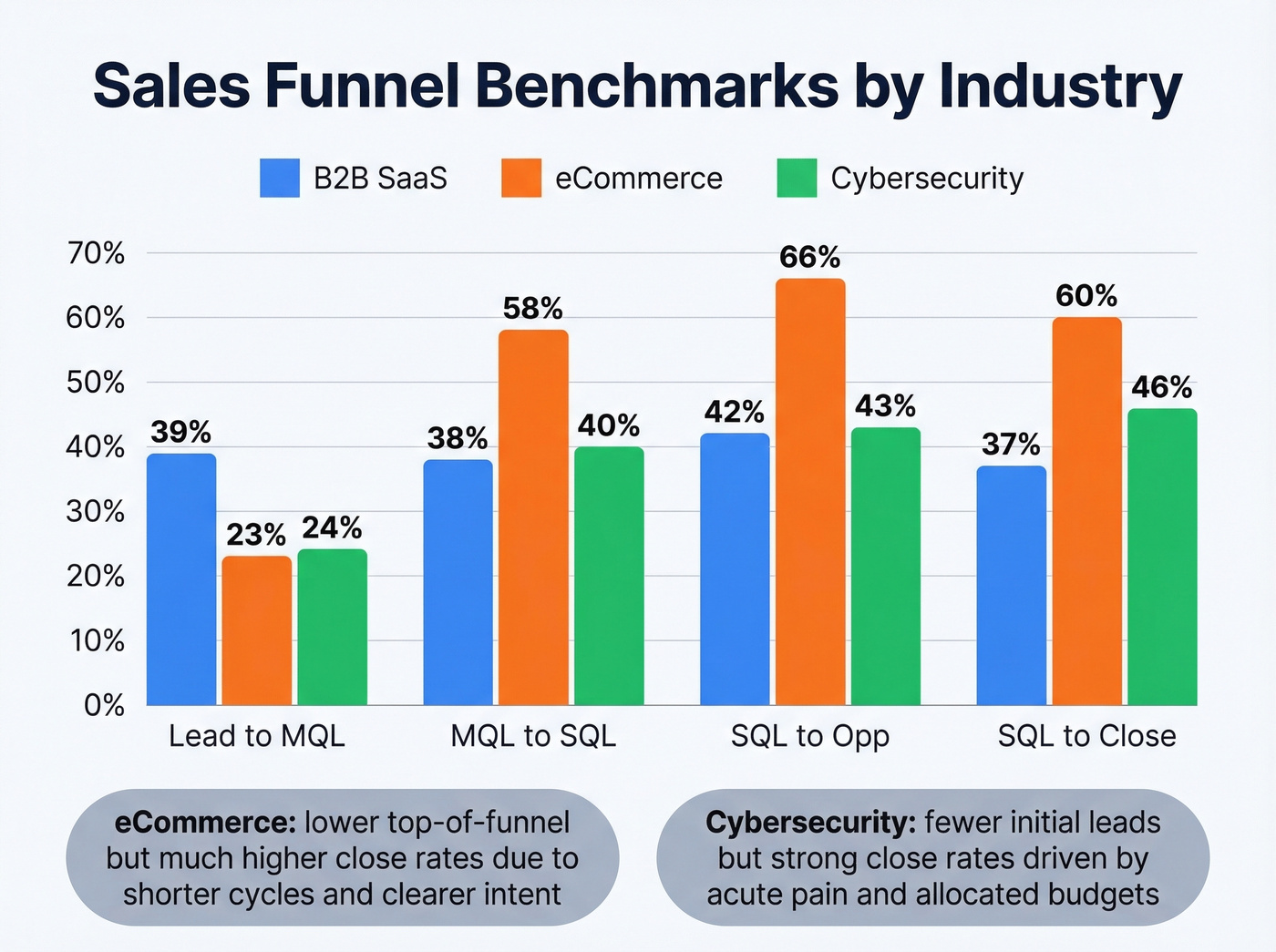
| Industry | Lead to MQL | MQL to SQL | SQL to Opp | SQL to Close |
|---|---|---|---|---|
| B2B SaaS | 39% | 38% | 42% | 37% |
| eCommerce | 23% | 58% | 66% | 60% |
| Cybersecurity | 24% | 40% | 43% | 46% |
eCommerce has a lower lead-to-MQL rate but much higher close rates - shorter sales cycles and clearer buyer intent. Cybersecurity converts fewer leads initially but closes at a higher rate than SaaS, driven by acute pain and allocated budgets.
SMB vs. Enterprise win rates tell a different story. SMB deals close at roughly 39% from opportunity stage; enterprise deals close at about 31%, per Digital Bloom's analysis. If your enterprise win rate is below 25%, audit time-in-stage to find where deals stall.
For time-to-convert, SaaS Hero's 2026 benchmarks show visitor-to-lead happening within 1-3 days, MQL-to-SQL taking 8-15 days, SMB deals closing in 30-45 days, and enterprise deals averaging around 120 days. Channel matters too: SEO drives a 2.1% visitor-to-lead rate versus 0.7% for PPC, and SEO leads convert MQL-to-SQL at 51% versus 26% for paid.
Here's my hot take: if your average deal size is under $10K, you probably don't need a 120-day enterprise sales process. Shorten the cycle, reduce the number of stakeholders involved, and close faster. The funnel math rewards speed at lower ACVs.
Pipeline Velocity - The One Metric
If you only track one number, make it pipeline velocity.
Pipeline Velocity = (Opportunities x Avg Deal Size x Win Rate) / Sales Cycle Length
Let's run it with SaaS medians: 50 opportunities x $26,265 average deal size x 25% win rate / 84-day sales cycle = $3,906/day in pipeline velocity.
That number tells you more than any single conversion rate. If it's growing quarter over quarter, your funnel strategy is working. If it's flat or declining - regardless of how many leads you're generating - something's broken. The formula also reveals your highest-leverage fix: shortening cycle length by 10 days might matter more than adding 20 opportunities. (To go deeper, use sales operations metrics to diagnose which lever is actually moving.)
Optimization That Actually Moves Numbers
"Going" A/B tested CTA copy - swapping "Sign up for free" for "Trial for free" - and saw a 104% month-over-month increase in premium trial starts. One word. "Later" took a different approach, building gated content that generated 100,000+ leads and a 60% average conversion rate. Unbounce's benchmark puts the median landing page conversion rate at 6.6% across industries. If you're below that, CRO is your fastest win.
On the AI front, 83% of sales teams using AI saw revenue growth versus 66% without. The use cases map to funnel stages: signal-based prospecting at the top, conversational AI for speed-to-lead in the middle, predictive lead scoring at qualification, and AI email personalization for nurturing. Reps spend 2-3 hours per day on CRM entry alone - AI that automates even half of that gives you back selling time, which directly improves customer acquisition cost. (If you're building the outbound motion, start with AI cold email outreach workflows.)
The biggest mistake we see? Teams optimizing the middle of the funnel when the top is full of garbage data. Fix the input quality first. Then optimize conversion. The order matters.
Multi-threading into buying committees requires verified direct contact data for every stakeholder. Prospeo gives you 143M+ verified emails and 125M+ verified mobile numbers with a 30% pickup rate - so your reps reach the full committee, not just a single champion who might vanish.
Reach every decision-maker, not just the one who downloaded your PDF.
FAQ
What's the difference between a sales funnel and a sales pipeline?
A funnel measures conversion rates between stages; a pipeline measures the dollar value of deals in progress. You need both - the funnel diagnoses efficiency, the pipeline forecasts revenue.
What's a good B2B funnel conversion rate?
B2B SaaS benchmarks show 39% Lead-to-MQL, 38% MQL-to-SQL, 42% SQL-to-Opportunity, and 2-5% overall lead-to-customer. If your MQL-to-SQL rate is below 20%, start there - it's usually a marketing-to-sales handoff problem, not a lead quality issue.
How long should a B2B sales cycle take?
The median B2B SaaS cycle is 84 days. SMB deals close in 30-45 days; enterprise averages around 120 days. If yours is significantly longer than peers in your segment, audit time-in-stage to find where deals stall and whether dead deals are inflating the average.
Is the sales funnel dead?
The linear funnel is outdated, but the funnel as a measurement framework is essential. Use a bow-tie or flywheel model that includes post-sale expansion, and treat it as a diagnostic tool rather than a rigid path buyers follow step by step.